

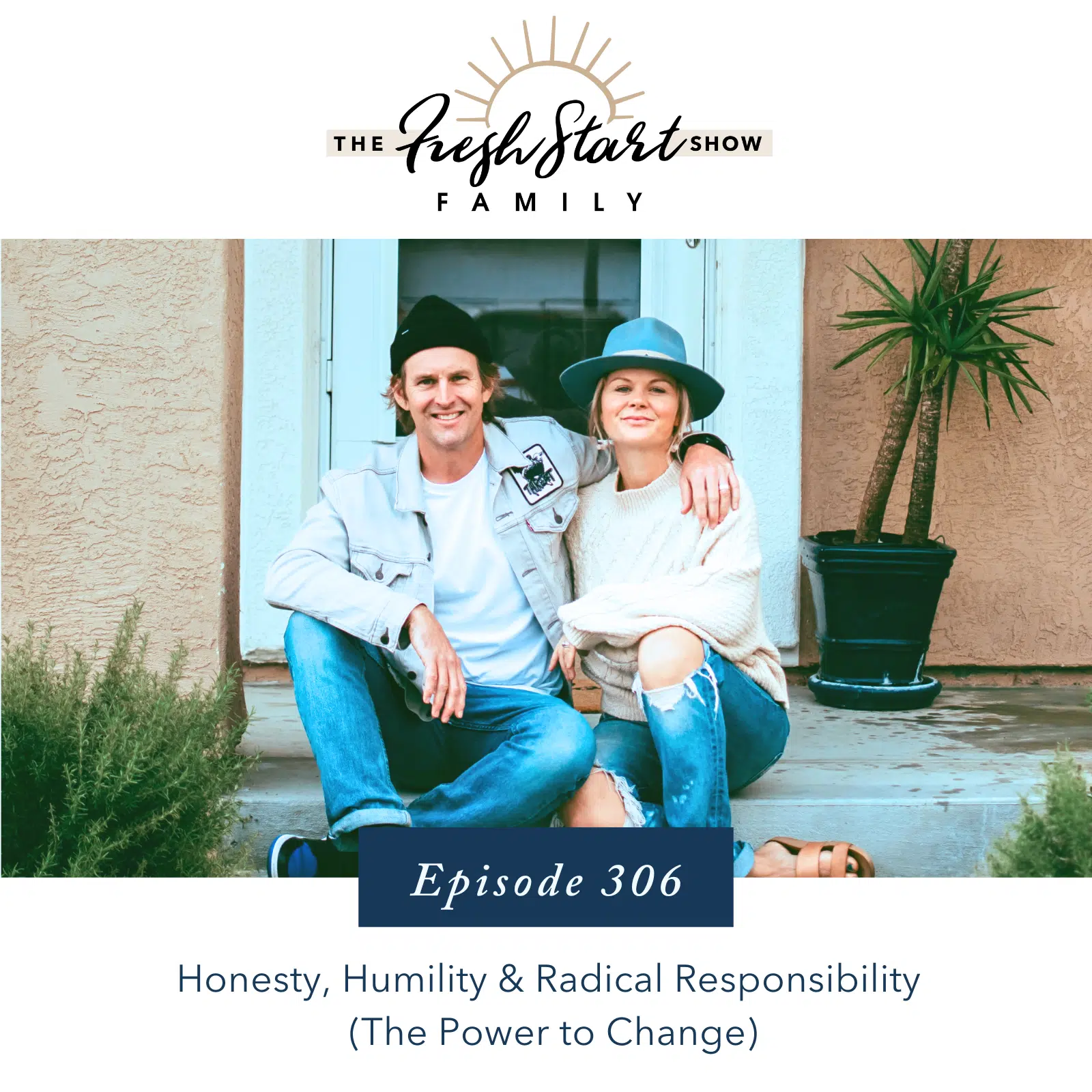
In this episode of The Fresh Start Family Show, Wendy and Terry explore how honesty, humility, and radical responsibility give parents the power to create real change at home.
They share why breaking generational patterns starts with looking at our own reactions, not blaming kids, and how compassionate discipline builds trust, safety, and lasting connection. Through honest stories and practical insight, they show how becoming a calm, accountable leader helps your child feel safe coming to you when it matters most.
A grounding listen for parents who want less reactivity and more peace, connection, and confidence.
Episode Highlights:
- Honesty about our own behavior is the doorway to real, lasting change in our families.
- Humility doesn’t weaken parental leadership, it strengthens trust, safety, and connection.
- Radical responsibility means looking at our part of the “dance” instead of blaming our kids.
- The nervous system prefers what’s familiar, even when it’s unhealthy, which is why change feels uncomfortable at first.
- Compassionate discipline creates more cooperation than punishment ever could.
- When parents regulate first, kids learn that mistakes are safe moments for growth, not shame.
- Breaking generational cycles requires courage, consistency, and a willingness to learn new tools.
- Kids are more likely to come to us when we respond with support instead of fear or control.
- Being the “first call” for our kids starts with how we handle their mistakes today.
- Cultural change begins in the home when parents model accountability, repair, and grace.
Resources Mentioned:
The Empowered Parenting Reset Workshop is happening Jan 28 – Don’t miss it!
Wendy Snyder
Hey there, families, and welcome back to a new episode of The Fresh Start Family Show. We’re so happy you’re here. This episode is part of our three-part series, Reset, Rewire, Reimagine, as we start the new year off strong.
Terry is here with me today. Welcome back to the show, babe.
Terry
Hello, hello. Happy to be here.
Wendy
If you’re watching on YouTube, you’ll notice Terry finally got his haircut. It had been a minute. I was starting to feel like I was married to a different man.
Terry
I was testing the limits. Seeing how far I could go.
Wendy
You passed. Barely.
Alright, today we’re diving into a really important topic: honesty, humility, and radical responsibility, and how being honest about where you are actually gives you the power to change.
Last week, I recorded solo and talked about visioning strong for your family as we move into 2026. We talked about how uncomfortable that process can be, especially because so many of our listeners are first-time generational cycle breakers.
What you want for your family often wasn’t modeled for you. You’re disrupting patterns that may have been in place for generations. And that’s brave, but it’s also uncomfortable.
We talked about how the nervous system prefers what it knows. It operates on predictability and probability. So even when something isn’t healthy, it can still feel familiar and “safe.”
But what we’re inviting families to do this year is to live from possibility, not from the past.
Wendy
So many parents in our community want homes filled with peace, connection, kids who have self-control and intrinsic motivation, families who can work through conflict instead of avoiding it or exploding, and environments where mistakes don’t lead to shame.
But for many people, that vision feels hard to imagine because they never experienced it themselves.
And that’s where today’s conversation comes in.
One of the most powerful steps in creating change is being willing to honestly look at your contribution to the dance.
That doesn’t mean blame. It doesn’t mean shame. It means awareness.
Most of us were raised with some form of autocratic parenting. For some it was mild, for others it was extreme. But the message was often the same: mistakes lead to disappointment, punishment, or shame.
So of course honesty feels risky. Admitting fault used to come with a price.
But I’ve learned that when I can see my part of the dance, I actually gain power. Because if I’m part of it, I can change it.
Terry, when you look back at our journey over the last 15 years, what comes up for you around humility and honesty?
Terry
I think the first thing is that humility is required just to even consider what you’re laying out here.
You have to be in a headspace where you can reflect without being defensive, without being overly hard on yourself, and without refusing to admit fault.
It’s about being able to ask: How am I showing up?
What am I bringing into this situation?
And that includes both the healthy things and the things that might need to change.
I think the goal is creating a new default.
You have your current default, patterns you may not want to carry forward, and then you have a future default you’re working toward. It’s not that different from changing habits in any other part of life.
When Wendy talks about the “dance,” that really helped me early on. If bedtime is always a mess, or homework always turns into conflict, there’s a dance happening. And you’re part of it.
When one dance partner changes, the other one almost has no choice but to respond differently.
Unable to listen, or prefer to read along? Here’s the transcript!
Wendy
Yes. That’s exactly it.
We’re constantly co-regulating, or honestly sometimes co-dysregulating, with the people we love. And when we believe that admitting responsibility makes us bad, it blocks us from ever creating change.
There’s a readiness required. You can hear new strategies all day long, but until you’re willing to say, I’m open to learning a different way, nothing shifts.
We talk a lot about responding versus reacting, nervous system regulation, and slowing down. Modern culture tells us everything is urgent, everything is an emergency, and it’s just not true.
I want to share a quick story from our community that really illustrates this.
We had a couple write in recently, first-time painful generational cycle breakers. They grew up with authoritarian parenting combined with high-control religion. A lot of shame, punishment, and fear.
One day, their child accidentally dropped a box of Christmas bulbs and glass shattered everywhere. In the past, one or both of them would have exploded.
But this time, they both instinctively said, “Are you okay? It’s okay. It was an accident.”
They were so calm and grounded that they didn’t even have the kids help clean it up because they didn’t want anyone getting hurt.
Their kids were confused. They weren’t used to that response.
But afterward, the parents wrote in and said, We did it. We have proof. We can do this.
That one small moment showed them that the cycle really could be broken.
Terry
And that’s how it grows.
Those small moments turn into bigger ones. Your kid makes a bigger mistake, and instead of hiding or lying, they come to you.
That’s what we want. To be the first call, not the last.
Wendy
Exactly.
I wrote about this in the book, the day Stella accidentally hit another car in the school parking lot. She called us immediately. No hiding. No fear.
We didn’t rescue her. We came alongside her. She handled it responsibly, and the situation resolved with grace.
That experience didn’t teach her that mistakes don’t matter. It taught her that honesty and responsibility are safe.
Terry
I think that’s the question for parents listening. Do you want to be the first call?
Because if your default reaction is blowing up, shaming, or punishing, you move yourself further down that list.
You unintentionally send the message that when things go wrong, you’re not safe.
Wendy
And what’s wild is that when we started taking responsibility with our kids, saying things like, We’re learning too. We’re changing how we parent, they respected us more, not less.
Culturally, we’re told that admitting fault makes you lose authority. But it actually builds trust.
We expect coaches, leaders, and professionals to have mentors and support. Yet somehow, with the most important job in the world, raising human souls, we think we should just “figure it out.”
It makes no sense.
I have so much respect for parents who slow down, invest in education, get support, and intentionally create a different future.
Terry
And it doesn’t stop at the home. This work breaks cultural norms.
If people were taught from childhood that humility, repair, and responsibility were safe, our world would look very different.
It all starts in the family.
Wendy
That feels like a powerful place to land.
We’re going to keep exploring this at the Empowered Parenting Reset on January 28th. Two times to choose from, 9 a.m. or 1 p.m. Pacific.
You can save your spot now at
freshstartfamilyonline.com/reset
This year, our word is simple. One hour of teaching, thirty minutes of Q&A. That’s it.
Showing up for this is a way of saying: My family matters. I’m willing to slow down. I’m willing to learn.
Thanks for being here today, families. We love you, and we’ll see you next week when we talk about my favorite replacement for threats.
It’s going to be so good.