

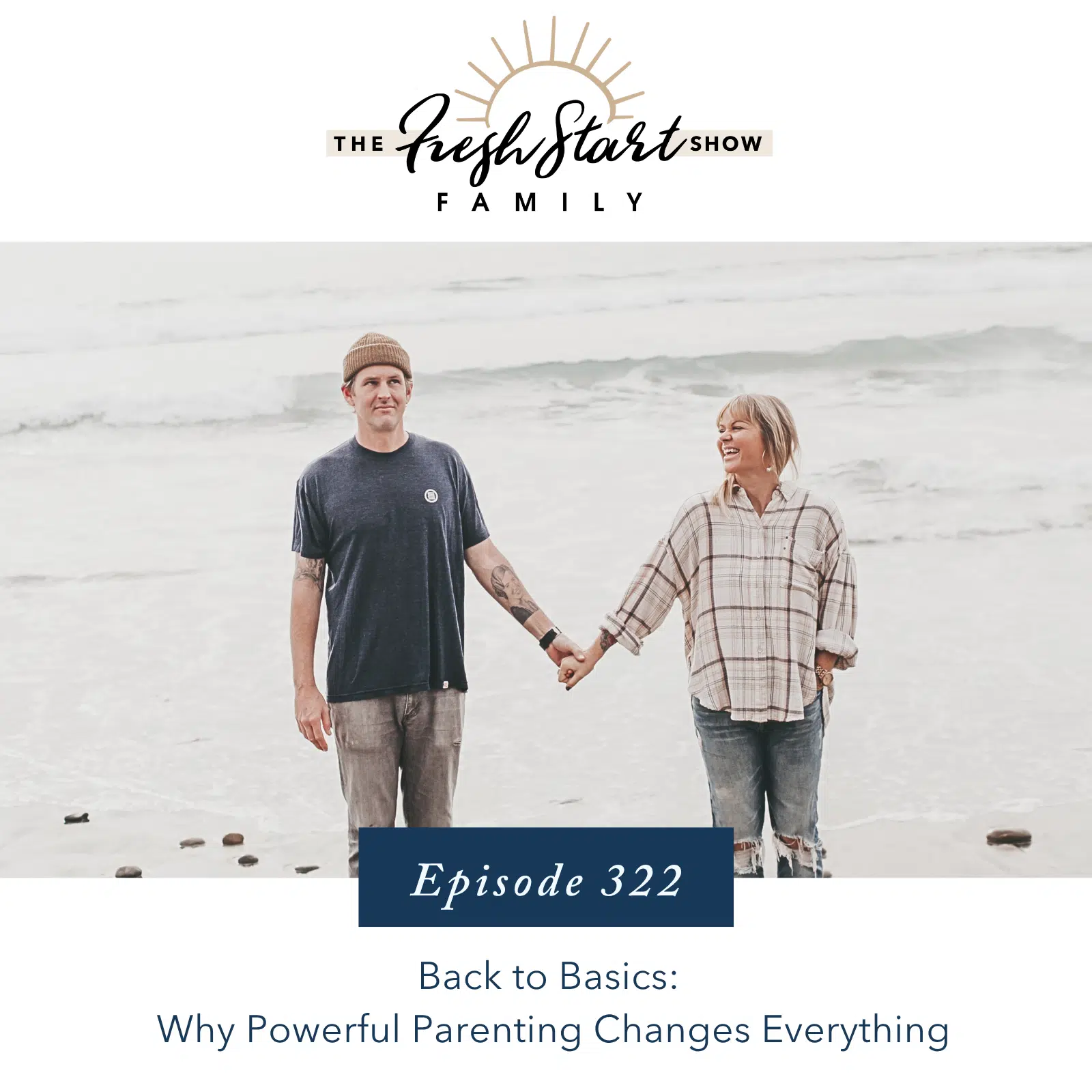
In this grounding episode, Wendy sits down with her husband Terry for a conversation about the why behind Powerful Parenting.
Together, they reset the table and walk through the four core pillars of the Fresh Start Family approach: paradigm shifting, healthy communication, understanding root causes, and compassionate discipline. They also share what they’ve seen after 15 years of using these tools in real life with their own kids.
If you’ve ever wondered whether this work is really worth it, or what kind of long-term results it creates, this episode will remind you that peaceful, connected family life is possible.
Episode Highlights:
- Parenting is shaped by a belief system, whether chosen or inherited
- Misbehavior is communication, not proof that something is wrong with your child
- Kids learn more from what we model than what we say
- Different behaviors have different root causes, and need different responses
- Discipline can teach powerfully without fear, shame, or punishment
- Long-term results include honesty, self-control, emotional literacy, and stronger relationships
- It’s never too early or too late to create a fresh start for your family
Unable to listen, or prefer to read along? Here’s the transcript!
Wendy Snyder:
Hello families, and welcome to a new episode of the Fresh Start Family Show. I’m your host, Wendy Snyder, powerful parenting educator and family life coach. Today I have Terry with me. Welcome to the show, Terry.
Terry:
I’m her wingman.
Wendy Snyder:
Yes, you are my wingman, my best friend, my better half. Babe, we’re going on 25 years, by the way. In just a few months, 25 years of marriage, 30 years together. Look at that. You’re my everything.
But you are so much fun to have on the show. Today we’re going to talk about why powerful parenting. Why? Why would a family look at this body of work or this type of parenting system, hopefully as young as possible?
We always say it’s never too late in this work, whether you have teenagers or you could even be someone who has adult kids and decide one day that you want to change the way you influence them, the relationship you have with them, how you work through struggles and challenges and all the things. But we always pray that people find this work as early as possible.
So why would a family want to choose to learn these tools, as we say, expand your heart, learn new tools, strengthen your family, and really adopt a powerful parenting system? That’s what we’re going to be talking about today.
Terry:
I love it.
Wendy Snyder:
Maybe you can start us off, Terry, with kind of what your idea was for this episode as far as resetting the table since, I don’t know, we get into a lot of deep discussions. And as the Fresh Start Your Family book comes out, we’ve been diving into certain chapters of the Fresh Start Your Family book, which, by the way, is available for pre-order, freshstartfamilyonline.com/pre-order. So many fun bonuses. We just dropped a new one last week. So many great bonuses when you pre-order.
But with the book dropping, we’ve been diving into these little chapters and having these discussions. Sometimes we go really deep with them. But today you had this idea to kind of go top level. So speak to that, please.
Terry:
Well, we’re being introduced to so many new people, especially through the book coming out, Fresh Start Your Family, as Wendy said. So I just think it’s good to imagine that you guys are just walking in the door for the first time. What’s this all about?
I think every day that goes by, every year that goes by, there is an opportunity for a family to say, what’s our guiding light here for our family unit? What are we going to believe in? What are we going to not believe in? How are we going to focus on our relationships? What are our long-term goals?
Every day there’s an opportunity to do that. Sometimes, like Wendy said, we get really good at focusing on all these things because we’re so much further down the road now. As Wendy said, we’ve been together 30 years, 25 years of marriage coming up. We’ve got our wonderful 18-year-old daughter, Stella, our 15-year-old son, Taryn.
But I think it’s worth kind of taking it back to clean slate and saying, why did we choose this? And not just, this wasn’t just a family choice and then we decided to have a podcast. This was a lot of time in the classroom. Wendy, you took positive parenting classes over and over again at our daughter’s preschool when she was around three years old and our son was just born. Then I dove into the work so that we would be speaking the same language. I got my mom in there.
So I think it’d just be worth sharing, if you guys are in that season of life where you’re looking around at how are we going to do this thing called life with kids and family, why did we choose this? Why might you want to pick up this book? Why would you want to pre-order this book? Why would you want to read this book? Why would you want to do life this way?
Like Wendy said, it doesn’t have to mirror our exact story where it was a three-year-old and a newborn. Family life looks like a lot of different things. You could be a step-parent that’s just walking into being a parent for the first time. I think this is all just about learning the language of relationships and, with the hope also that what you do in your home is what you’re going to radiate out into the world. And we all know the world needs some light out there.
So that’s why we’re here. Let’s just talk about why we’re here and why might you want to pre-order this book.
Wendy Snyder:
Yeah, we are. To me, it really comes down to two things for people that I think help us choose a system, so to speak.
The word system is a word that I’m using more and more as my body of work evolves and as I become older. I think that getting old does come with wrinkles, but I love the wisdom that drops into you as you get older every year. I’m starting to just see the world through the lens of systems.
So when someone is early in their parenting journey and they’re trying to decide, what am I going to choose? What do I believe in when it comes to sleep training or how am I going to get my kid to listen? We remember those days where someone would just be like, you should read this book, you should try this. It was all based on belief systems. And now that I get older, I’m like, holy smokes, it’s all the same.
It’s all basically belief systems around are you going to choose to have a power-over system or a power-with system? So yeah, I just use the word system so much now, but it comes down to two things, values and also results.
As I’ve built this organization now over the last eight years, when you are an entrepreneur and you love what you do, of course you want to find new families. As I said when I founded this organization and when I decided to go online with my work, I wanted to preach this message from the mountaintop. I wanted as many people as possible to understand they were truly at choice with how they choose to raise their human souls.
So in order to do that, of course, you’ve got to learn all these new ways to reach people and what’s going to help people say yes to stepping into a classroom or picking up a book or requesting it at their library and actually doing the work. All these years, people have always shared with me, the experts in the marketing world or whatever, just give them what they want, which is fast results. Everyone wants this system that’s like, tell me what to do now so my kid will put on their shoes, sit still at the dinner table, do their homework without arguing, be kind, keep their hands to themselves, wear their helmet when I tell them to.
I think it is getting more and more dominant in this world, the whole desire for these fast results. So we will speak to results today for sure, because I do think we sit in a very unique position now. We have the 18-year-old who we’ve put every single one of these strategies to the test for 15 years now. I still don’t understand where time has gone, but 15 years we have lived and breathed these strategies into life. So it is so fun to talk about the results side of things.
And we often have people come into our work where it is very fast. Just by changing their paradigm and the energetic state in which they see their children and start to communicate, and we’re going to go through some of the core pillars here in a minute, we do see families get such fast results before they even learn how to switch up their discipline model or replace threats with sequencing or whatever it may be. Just the simple act of changing your paradigm does wonders. And then we do see so many families get very fast results.
But really, this work and choosing this system is an investment into your legacy and your entire future with your children. So just keep that in mind. We’re going to come back to results.
When it comes to values, I think that is what is the biggest choice in the beginning. Yes, you’re going to be tempted by all these different people out there who are like, hey, try this, try this, this will get your cooperation that you want. But just remember that values, and being in line and authentic to who you are and what you believe in, is what leads to true thriving for human souls. And relationships lead to true thriving.
One of my favorite studies, and I think I cite it in the book, I don’t remember, I think I do. Writing a book is crazy. You write so much and then you do your teaching every week with your members and you’re like, I don’t know what I wrote anymore.
But there was the longest study that was pretty much ever done, to my understanding, through Harvard University. They studied a large group of individuals, and the goal was to really see if they could find some accurate data on what led to the healthiest and longest lives. Longevity and health and human thriving.
In the end, when they wrapped this 50-year study, and they studied all different types of people, people who had been to war, people who had experienced massive loss, whether it be children or spouses, oppression, wealth, married, unmarried, all different religions, all the different types of people you could imagine, the ender bender of the study was that it was actually the value or the health of their relationships that led to the longest lives and longevity and health.
I thought that was so interesting because there are a million things you can do to try to be healthy and live a long life. But that study proved that it was actually how strong your relationships are. And to me, that means your ability to work through conflict without overpowering or dominating someone, because we know that never works. The ability to make amends, take responsibility for your part of the dance, lead with true integrity.
When you’re in a partnership, whether it be with kids or your spouse, take turns leading and truly find unconditional love in the people around you. Create safety and belonging where people truly feel like they belong and they are safe. Create ecosystems in your relationships where everyone can contribute and everyone can feel valuable and all these things.
So I say that because it comes down to that first initial thing of what kind of values are you going to base your life on? I would think that most people want to have strong relationships. Then it comes down to, okay, what system is going to create the strongest relationships in your life and also help you get the results that you want? Because let’s be real, we all want cooperation. We don’t want to go through life every day with our children, whether they’re three or 13, feeling like everything is a battle, feeling like you’re having to do everything and somebody else isn’t.
So let’s go backwards now and kind of lay the groundwork of what are the pillars that this body of work, when I say powerful parenting, is based on.
The book, Fresh Start Your Family: Powerful Parenting to Restore Peace in Your Home, asks what creates a powerful parenting system. There are four pillars.
The first one is the idea of paradigm shifting and seeing children as human souls who are communicating and understanding the psychology underneath all human behavior. Understanding that we all have core needs, the need to belong, the need to feel powerful, the need to feel valuable, the need to feel unconditionally loved. When those needs are not met, we will go get them met somehow because it is such a basic human need to get those needs met.
So that’s where you see some people in life getting those needs met, for example the need to feel powerful, in very unhealthy ways. Other humans that you might come into contact with have learned how to get those needs met in very healthy ways that lift themselves up and lift others up.
One of the base teachings that we do in that first pillar of understanding when you’re creating this type of system in your family legacy is the belief system that a misbehaving child equals a communicating child, which equals an empowered parent who can work through challenges with grace and dignity and connection and firm kindness.
And that is very different than the old-school inherited belief system, which is a misbehaving child equals a bad child equals a bad parent. So that’s where “get control of your kid,” and “if you have a kid that’s hitting kids or talking back, then that means you’re failing.”
That’s kind of a little bit of that first pillar that we stand strong on in the world of powerful parenting, shifting your paradigm so you’re no longer wearing old scratched-up sunglasses where you can barely see through them and everything is tainted and seems difficult and hard. Life is so difficult to see through scratched old lenses. Instead, you put on a pair of fresh polarized sunglasses where when you look at the ocean, you can see all the different layers of the sand and the turquoise and the blue and the reef and the fish. You start to understand what’s actually happening that drives human behavior.
What would you add to that as far as that first pillar of understanding when you step into this work that it starts with a paradigm shift?
Terry:
I would add that anybody who’s listening to this should rewind and listen to that again and again until you kind of get the idea, because this is so foundational. That’s why you call it a pillar.
Speaking from personal experience, until you can open your eyes wide enough to see that this young human being who is behaving in a certain way is just communicating with you, and it’s not like they’re out to get you or manipulating you or there’s some battle with them or you have to somehow overpower them or snuff this out, until you can set that aside and actually see this just as communication, and not only with whatever age child that you have, but all human beings, there are grown adults walking around all day long every day doing the same thing.
When it’s happening with your child, especially if it’s a toddler or a teenager, any of those key moments that might challenge you more than not, it’s just communication. There are things that are lying beneath the surface, and you just have to ask yourself, do I care enough and am I patient enough to understand what’s lying beneath all of this?
Wendy Snyder:
Am I ready to evolve and grow myself?
Terry:
I would assume it’s a yes, yes, yes, and yes. But if you find yourself in a firm fixed position where things aren’t going your way and you’re just trying to white-knuckle it, I’ve got news for you. I don’t think things are going to get better for you. I don’t think you’re going to grow. I don’t think the behavior of your child is going to get much better.
If you do have a tactic that makes it better right there in that instant, I don’t know that it’s a long-term sustainable thing. And that’s what we found with this paradigm shift, or looking at things differently from the very beginning, it allows you to look at not just the short term, but the long-term goal.
You’ve had kids, assuming you want to have a lifelong tight relationship with them. You want to be respected, not just because you said something, but because they just inherently respect you because they know you and they love you and they’ve seen you for your true self and you’ve seen them for their true selves.
When you realize that, I think that’s when the paradigm shift actually becomes, you’re like, I’m on board. So yeah, I would say if this is abstract at all, rewind, listen to what Wendy said again. And of course we’ve got other resources, including a book for you to read in depth on this. Be ready for that and be excited about it, for this paradigm shift, because it changes everything. It’s like seeing things in a whole new way.
Wendy Snyder:
Yeah. And it’s because the conditioning is so thick, right? Learning to assume integrity in children is so new for us. We just go into parenting like we know best, we know better, we need to make sure we shape these human beings. It is so wild, especially now that we sit on this mountaintop, so to speak, that our children have literally shaped us. I would not be the person I am today if they wouldn’t have given me all these opportunities to humble myself, to learn about psychology or human behavior or understand their needs, how to communicate in a healthier way, which we’re going to talk about next. They are just as much our teachers in life as we are theirs.
It’s this beautiful coexistence, like a symbiotic relationship. And that is very different than the model that many of us inherited. So this initial pillar that we just talked about, just know that I know it feels very out of the box when you’re just like, dude, bro, I just want you to teach me, Wendy, what do you say when my kid will not get in the car each morning and we’re literally 20 minutes late to preschool every day, or they won’t stop shaking the baby. I get it. We all want those just tell me what to do answers. But the first pillar is the paradigm shift.
Okay, Terry, let’s go into our pillar number two, which is healthy communication and modeling.
When it comes to communicating and teaching, pillar two inside the book and within this body of work is all about understanding that you have so much power in how you ask for what you want, how you communicate with people in your life. Obviously we talk so much about kids here, but it’s the same. The way you show up in one way is the way you show up in all ways.
If you have a belief that trying to force someone into submission works in parenting, you’re going to do the same thing in your work or with your neighbors. It’s all the same. So we learn how to ask for what we want and just communicate differently.
One of the biggest examples that’s very easy and tactical to give, and we’ve recorded a podcast on this one before, is moving away from thinking that threats are an effective way to get what you want.
With kids, the example is, “If you don’t listen, you’re going to get your iPad taken away.” That’s the number one thing that we see parents doing these days in the world of technology. So just remember that. If you’re using the words if/then, that’s your little flag to go up. It’s so culturally conditioned now that people just think, duh, that’s what you do. What else would you do? And it’s like, just so you know, you are creating a power-over system. Your kids will rebel against it. They will revolt against it eventually.
I see it with neighbors too. We just had a situation where outside of our back window, their truck alarm kept going off, and they’re new to the neighborhood. They just moved in as a roommate with our other neighbor who’s been there forever. But Terry, the way you handled it was so beautiful. You went over, you left a really kind note with your name and number, but you were very firm with, hey, here are three ideas for how to make this stop happening, because we cannot be woken up in the night four times. This keeps happening. We are dying.
But you were so firm and kind. You asked for exactly what you wanted, and you were like, call me, we’ll work through this. But this is something that needs to be handled now. What we have seen in our 20 years, and it’s so funny, specifically with that house, but in general, is where someone will threaten instead. “If you don’t change this, I will report you to HOA. If you don’t get this taken care of, then I’m going to call animal control.” I’ve been in this house for 20 years. I cannot even tell you how many situations I’ve seen happen with this.
“If you don’t move your old truck out of the thing, I’m going to…” Or they’ll use an angry tone to communicate. We’ve seen that so many times. I just laugh because I’m like, clearly this person wants to get what they want so bad. We all want to get what we want, but they’re communicating in a way that is never going to get them what they want.
So the example of the neighbor was so cool. They responded that afternoon and they were like, my gosh, we’re going to take care of it right away. Joey has disassembled the alarm and blah blah. Thank you so much. Thank you for your patience. And you were like, no problem. Thank you for taking care of it right away, because that was awful.
But it’s the same with kids. We take away the power-over systems in our communication.
Then the biggest thing of pillar two is we work on our modeling. So that is where we really start to look at the hypocritical stance that we live in.
If you go back to the basics of parenting, like where I stood as a parent of a three-year-old where I was like, why won’t you just calmly step to the side when your little brother ticks you off and handle your emotion with calm and be nice to him, while I was literally yelling, raising my voice, using probably way too aggressive hands to put my three-year-old down on the naughty spot because that’s what the nanny show told me to do at that time. If they’re three years old, they get three minutes on the naughty spot. But I would always add a little bit of aggression, like, you are going to listen to me. It was just this power-over. Then I would get so mad because Stella wasn’t able to control herself when her little brother would drool on her doll or something, and she would get so mad and she would shake him or pinch him or bite him, the famous story I tell in the book of when she drew blood from Taryn’s back when he was 11 months old.
But we start to have the discussion around hypocrisy and modeling as one of the most powerful ways to communicate what you actually want because 99 percent of what kids learn is caught, not taught.
What would you add to that pillar of communication and modeling?
Terry:
I mean, the modeling part is really something that you get better at over time, but it also makes even more sense over time because you start to see these little mirrors of yours.
You gave the example of grabbing a wrist too tight and then how can you expect this child, who then feels that from you, not to do the same thing to her little brother? But that example will happen over and over and over again in all different types of behaviors and examples. It takes on a whole new shape when they’re teenagers too.
Blame is another way. We blame somebody else for our yelling. We blame them for our tone. Then you have a kid who blames life, teachers, their sibling, and you’re like, stop blaming. Most people have blinders on there. They’re not taught. There’s a lot of humility in this work, but the humility is empowering.
It’s an opportunity for you to grow as a human being. So I think that goes back to pillar one of paradigm shifting. Are you ready to learn and grow yourself too? And it’s a beautiful thing. It really beats the alternative.
To be willing to admit that you’re willing to learn and grow and your example of the kids being our greatest teachers, it actually takes a lot of the pressure off too. Because if you’re expected to be a parent that knows everything and you’re just instructing and teaching down all the time and you just have to know everything, that’s exhausting. But what if you could just say, I am going to be in relationship with my kids. I’m going to learn from them. They’re going to learn from me. And then I’m not going to expect that I can yell and not have them yell, or I can be too forceful and expect them not to be too forceful. It takes the playing field and kind of says, I’m going to walk the walk.
That’s what I’m looking for. Are you ready to walk the walk? I think most people would be because I don’t think people want to be hypocritical or better than or come across that way. So if you could just say to yourself, I’m willing to walk the walk, I think that was an important part of this whole shift.
Wendy Snyder:
And it takes you out of a victim mindset, which is so important. When you’re trying to make a system work that literally goes against human behavior and takes so many calories to maintain, meaning so much energy, I always tell people, with the autocratic authoritarian system of power-over, you have to keep upping the ante over time and it just is so exhausting.
So stepping into that place where you’re like, oh, I see what’s actually happening and I have this contribution and when I change my contribution, whoa, the kid changes, you step out of this whoa-is-me, what is happening to me, this doesn’t make sense, this kid is crazy or this kid just won’t listen. You step out of that and you’re like, oh, I have so much power in my life. I am actually not a victim 99 percent of the time.
I will say we talk a lot about the reactive stuff, but even anxiety and depression tendencies are similar. We see it all the time with children in this work where it’s not always outwardly that the parent is modeling this. A lot of times it is inner battles that, when a parent doesn’t find the healing and then looks at their child and their child has anxiety or depression tendencies, they don’t understand the correlation. But the correlation is literally everywhere with the modeling, and it goes both ways. If you’re doing something that’s yikes, you’re going to probably see your kid do it in one way or another. Also, if you’re doing something that’s glorious, like stepping into healing, whether it be reactive tendencies or depression or anxiety tendencies, your child, it’s like magic. It’s like osmosis. So it’s good news, but it also takes humility.
Pillar three of the book, of our body of work of powerful parenting, is around understanding root causes of misbehavior. This is where we really go and take it one step further to really look deeper into the psychology of, okay, when a child has this certain type of misbehavior, for example, “Put on your shoes.” “No, I don’t need shoes.” “Yes, you do. You need shoes.” “No, everybody else scooters without shoes.” “No, I don’t care what everyone else does. You need to put on your shoes. Remember just last week you got stung by a bee.” “No, I’m not doing it.”
Then voices escalate. That’s an example of a power struggle. We have specific step-by-step guidance to help parents handle that one category of misbehavior because it is a unique category of misbehavior.
Again, there are similarities of human tendencies that are psychology-based that help you understand the differences. So for that one example, that’s just one of four categories of misbehavior we teach. For that one example, we say a child who is engaging in power struggle behavior has the mistaken belief that in order to feel powerful, I must overpower others, often because that’s what’s been modeled to me.
So they engage in a power struggle because it is feeding their need to feel powerful in one way or another. We start to educate a parent on how can you help your child feel powerful in a different way. Then that comes along with helping a parent understand how to feel powerful handling conflict in a different way.
Because once you get well versed with handling conflict, for example peaceful conflict resolution is one strategy that we teach within this pillar of the body of work to get what you want without overpowering another human, it feels so freaking powerful. It is like the best feeling in the whole wide world.
I imagine Nelson Mandela in prison for 30 years in South Africa for awful, no-good reasons, and he came out and his famous line that he said was, “If I didn’t forgive them, then I would have been the one who was still captive.” He went into a long season of reconciliation efforts with the government of South Africa, and in the end there was making amends, there was repair, there was forgiveness, there was firm kind asking for the people to come together to kind of demand a new way. I can only imagine how powerful that felt for him when he looked at his accomplishments and thought, I brought these people together and I didn’t do it in this traditional way of the world by overpowering people.
I know that’s kind of a random tangent there, but power is just one of the four categories of misbehavior that we teach there.
The others are attention, revenge, inadequacy. Once a parent understands the human tendencies of a child when they’re, air quotes, misbehaving, they will understand their neighbors, they will understand their spouse, their colleagues, their parents. Everything just starts to make so much more sense when you understand what is happening for a human inside of themselves, what needs are they trying to get met when they display that behavior, and what can you do on the other side to solve the problem, influence their behavior, but do it in a way that is effective and filled with connection versus trying to change them through guilt, shame, domination, power-over, violence, threats. That’s just the way of the world that we’re like, no thanks.
Terry:
I think that’s a lot of learning you just put in there.
Wendy Snyder:
I am a lot, aren’t I?
Terry:
No, but I just go back to, if this is going back to the beginning, I think it was fun to learn what type of kids you’re working with. And you’ll learn some of this through the book.
You just mentioned the different types of misbehavior, it kind of relates to what type of kid you have. It’s just part of their wiring. When you have a child, you wonder at first, what are they going to look like? Are they going to have a full head of hair? What is their voice going to sound like? Are they going to talk early or late? When are they going to walk? Are they going to be tall? Are they going to be strong? Are they going to be one of those little babies who’s kind of mushy? Eventually then they start communicating and this personality comes out.
While I’ll be the first to say that misbehavior or power struggles, you’re not going to say that’s your favorite part of the day, but if you’re willing to just say that’s life and that’s what it is, and then you’re willing to look even deeper and be like, hey, this is just a window into how I get to learn more about my child. This is a window into their soul and how they’re wired. I’m like, man, looking at our two kids, and I know we use Stella as a big example because she led the way, but I got to know who she is through how she communicated, through what she wanted. Through all of these things.
Then once you look at those as not an inconvenience or a struggle and you start to look at it as wow, what is she going to do with that? We as parents need to have the patience and learn new tools and do all these things so that we can just get along as human beings, but really it’s these wirings that are going to be the things that make her amazing and make her exceptional, or have her present some idea later in life and she’s going to be so convincing that it could be something that changes her world or somebody else’s life or changes the world.
So it’s really about their unique gifting. Then we get the chance as parents to practice with them on when and how to use that and how it makes other people feel sometimes and how to use it as a superpower and not as a stumbling block.
Then we get to learn about ourselves too, being like, wow, I didn’t realize I’m just a grown-up kid who’s seeking this type of attention, or I actually just need to feel powerful in this, or inadequacy. You just learn more about yourself and you get this window into your child.
Wendy Snyder:
That’s important. We’re alluding to this, but all kids will do all of the categories of misbehavior we teach. But most kids fall into one quite often.
For sure, Taryn is more of an attention kid. Stella, for sure, is the power kid. In their life, their misbehavior when it happens goes towards those more. But because we created the fluency and were able to become educated in all the different ways a human can misbehave, every single time all of them happened, we were able to solve them with tools and with empowerment and get to the result much faster.
And so yes, when you realize, my one kid, I’m working with them with power struggle misbehaviors 75 percent of the time, you’re like, oh, I’ve got a power kid on my hands. Or if you’re working with a kid that you’re like, man, they really are the class clown quite often or making the fart noises in the back of the truck or constantly whistling like Taryn does at 15, you’re like, gosh, they just really have a deep desire to feel loved. And when you’re working with them, they feel that love.
But I do want to add one more thing before we go into this fourth pillar. A lot of people, you’ll hear this, and it’s always kind of bugged me a little bit, so I want to make sure I speak to it. People will say, well, kids need different approaches.
I just want to make sure. Yes, what we’re saying here is different behaviors and different uniquely gifted children need different approaches. But I am a firm believer that all children need the same approach, which is democratic, firm and kind parenting, connection-based, relationship-first parenting. There’s just no child in the world where one needs to be parented with authoritarianism and this kid over here, no. They all need connection-based, firm and kind parenting. That’s it.
And then yes, some kids are going to be the power kids. Some kids are going to be the inadequacy kids. Taryn dipped into inadequacy quite a bit when he was younger. Stella never really did. There was maybe twice in her life, when she was learning to read and maybe learning to ride a bike, where we were like, dang.
So I just want to say that. I often relate this to learning a language. If the language is relationships, and it’s like what you just described, democratic, firm and kind relationships, that’s the language. Within that, you’re going to probably use certain words and certain things for certain situations with a certain child. Then it’s just like, okay, what is this specific child needing, trying to communicate in this thing? Okay, I’ve learned a tactic now within this language that would really work with that specific child. That’s where the variation starts to come in.
It is so trippy to think about our own journey. I can’t even tell you one story where Stella dipped into attention misbehavior, and I can’t even think of one story where Taryn dipped into revenge.
Terry:
Isn’t that interesting?
Wendy Snyder:
It’s so fascinating. Everybody will do all of them, but certain personalities will have a tendency to go in certain directions. The more educated you are about how that is not a flaw, it is just kind of the tendency of that personality, and we all as human beings are going to have positive attributes to our unique gifting and then other things that we’ve got to develop the ability to manage that unique gift in a way that brings connection and goodness to the world.
Okay, I am getting hungry, so we’ve got to wrap up, babe.
Our last pillar of powerful parenting is compassionate discipline.
This is the ability to teach important life lessons with grace and dignity and empowerment, to come beside a human being and say, you made a mistake, which means you’re human. It doesn’t mean you’re failing. It doesn’t mean you’re bad. It means you’re human. And in the parenting world, a lot of mistakes happen because a kid learned how to do that behavior from their parent. Again, back to modeling, we’re going to bring everything back to modeling so much. Not always, but 99 percent of the time.
And we’re going to teach you, we’re going to use A, B, C, D, and E tools, which we call the compassionate discipline toolkit, to teach you how to make a different decision tomorrow without feeling bad about yourself. And that is very different than the way most of the world does things, whether you look at the parenting model or the judicial system or solving world conflicts between countries. It’s so beautiful and it is so effective.
Compassionate discipline, there is so much firmness, there is so much kindness, there is forgiveness, there is patience involved, and there’s nervous system regulation involved. It is just so beautiful.
So yes, step-by-step, how to literally fully dissent from a punishment system and step into the ability to hold your kids accountable, teach them that mistakes are simply opportunities to learn, failure is just unfinished success, and that is how life works. We quite literally as human souls are designed to learn through failing.
That’s why when you have a baby and they learn to walk at 11 months old or a year, we just had the cutest baby on our steps, by the way, that couple at the beginning of the neighborhood with the Cockers, oh my gosh, he is so cute. His name is Leo. I’m dying. He’s got chubby arms, and he was on the front porch yesterday. I was talking to them and he is in that stage where they go back on their heels and then they go forward. It’s like they’re little drunk people. But when they fall down, can you imagine if we said to them, that’s it, you now have to sit in time out. What are you thinking? You don’t fall down. In this world, we walk.
No. To a baby, we say, he was sitting there talking to me and trying to come up and see our husky in the door, and he fell down on his big diaper booty. One of the first words humans learn, can you guess, Terry? It’s the cutest word. It’s two syllables.
Terry:
Uh-oh?
Wendy Snyder:
Uh-oh. That was one of Leo’s words that he knew yesterday. He fell on his booty and he said, “Uh-oh.” And I was like, are you okay? Do you need a hand? And he just pushed himself back up and he started to walk toward the door to see the blue-eyed majestic wolf-looking husky.
It’s okay. What did you learn from that? Okay, if you lean too far back on your heels on a hill, gravity will take over. You will fall down. But culture gets a hold of us and then our kids, by the time they’re three or four, it’s like, it’s done. We’re done with the compassion and grace. Now you’ve got to feel bad about the falling down.
It’s just so sad. And it’s such good news that you don’t have to make your children feel worse in order to make them behave better. That’s one of the most joyous belief systems that we teach families to dissent from believing. Then you just get to see every opportunity as an opportunity to teach.
And yes, it is exhausting. Raising human souls is exhausting. You’re going to spend your entire life teaching, but it is so much more joyful to be in the teacher role than the correctional officer and punisher role.
Amen.
Okay, so the last thing that we promised we’d talk about real quick is the results. That’s kind of the four pillars that we walk you through in the Fresh Start Your Family book, Powerful Parenting to Restore Peace in Your Home. That’s what every single strategy that we teach here at Fresh Start Family, we build on. We have now 150 lessons in our learning library for our members. We teach so much strategy here, whether when it comes to setting limits, the how-to of compassionate discipline, the nervous system rewiring, responding versus reacting, exactly what to say, the scripts for communication. But all of it rests on these four pillars.
The coolest thing is the long-term sustainable results are where the pot of gold is.
I often describe this work as it’s like a rainbow and at the end is this pot of gold, but rainbows are big. It might take you a little bit of time to redo the way you do things, especially if you came from a family lineage where your mom yelled and your grandma yelled, or your dad was the punisher and your grandpa was the punisher or the shamer. It’s going to take you a hot minute. But it’s so fun to see the long-term results.
So we can just kind of riff here for a minute. But I think when I think of all the moments we’ve used compassionate discipline with our kids, the life skill that gets created is so beautiful. Thinking about Stella when we were teaching her body safety, and I tell the story in the book of a day when she crossed the road in a place that we weren’t okay with, we rolled out compassionate discipline, and then it stuck. The mistake she had made turned into compassionate discipline. We watched her year after year be the black sheep in a group of friends, and she wasn’t perfect. She made mistakes. I can think of one right now. But the grand majority of the time, she was able to say, no, I’m going to put safety first, take care of myself and keep my body safe and out of harm’s way over just fitting in and meeting that need to belong in my teenage years. The actual lesson sticks, and then you see it play out in real time with your children.
I can also think of the time Taryn made a mistake where he pushed a buddy, really hurt his arm. We did boatloads of compassionate discipline. He was four at the time. He literally never touched another child again in his life with aggressive hands. So the life skills get learned.
I will also say that truth and safety are nurtured and developed in the most beautiful way. I think of all the things our kids have told us the truth about, admitted fault, admitted mistake. Again, not perfection. Even with a family of our level of fluency, there have been moments where some of them are silly, where you later find out, you felt like you needed to hide that or you didn’t tell us the truth there. Some are not. There’s no perfection in any home. But it sure feels like 90 to 95 percent of the time, it creates children who feel safe telling you the truth.
Like the day Stella came home and said, “Mama, I need to tell you the truth. I watched a rated R movie at age 10 or 11. It really scared me. I needed to tell you the truth. I lied to my friend’s parents. I am terrified. I understand now why you have such firm boundaries around rated R movies.” But they tell you the truth. They admit fault without going to shame or blame.
Anything else that comes to mind right now that you want to add? I’m going to add one more in a minute.
Terry:
You end up talking with your kids versus talking at them.
That’s one of the results. Your kid doesn’t hear the Charlie Brown, wah wah wah wah wah. They actually hear what you have said. So then the end result is they actually have a grander look at life. The teaching sticks.
Because even the mistakes that we think about with any of our kids, it was pretty rare. Once, maybe twice. These weren’t things that were just repetitive, repetitive, repetitive. It wasn’t like, okay, you’ve been hiding this for years. It’s like, yeah, no.
The freaking house chores is the one thing. The dirty bathroom is the one thing that I’m like, we have talked about this.
Wendy Snyder:
Yeah, but that’s debatable if it’s a mistake.
Terry:
You’re right. It’s a lifestyle choice and a life skill that we are kind of like, yeah, that’s probably it. It’s last on our list.
Wendy Snyder:
A few more to add, and then you can pop in if you can think of more. The emotional literacy.
The ability for the children to be like, I feel scared right now. The reason why I’m pushing back so much. I’m thinking of Stella when we were like, hey, you should consider Florida schools, Florida schools, Florida schools. She finally got to a place where she was like, I don’t like to be pressured, and I feel scared about being that far from home. It feels like it’s too far. But I’ve seen Stella for sure over and over again, and Taryn too, the ability to say, I feel scared or I feel hurt or I feel mad or whatever it may be. Their emotional literacy really is strong, which is so beautiful.
I will also say the ability to make amends, repair relationships, and work through conflict with integrity. So we see them be able to do that out in the world with their friends who definitely don’t have this work.
Terry:
And that’s huge. Let me just say, if you don’t have a teenager yet, that’s huge as a teenager because you will have the kid that’s not the drama one. They’re able to sidestep and go around a lot of these things.
Wendy Snyder:
Forgive their friends easily.
Terry:
Easily create boundaries, but also forgive and not hold grudges.
Wendy Snyder:
Right. And then work through things and be able to talk to us about it. I can’t even count how many times, especially Stella, has come and described to us at length what’s going on with her and her friends. Not like she’s living her life and we’re living a separate life.
I can even think of when they’re little, this starts. So we’re sharing these long-term results now at 15 and 18, but I can remember when Taryn would have his best buddy over from the block, who didn’t have the higher level of conflict resolution skills or this body of work very present in their home. Every time they would have a conflict over Legos, this buddy would be like, that’s it, I’m done, I’m leaving. He would go to a threat and I’m out. That was the way.
And I would have the honor of coaching them back then and being like, hold on, hold on, come back. You guys can work this out. Taryn, let’s do a win-win. I want peace. Come on, buddies, it’s Legos. You can do this. Most of the time I would be able to get him to stay. But it starts young.
The ability to have a child who then at age 15, 16, 17, 18 into adulthood is able to handle conflict in a way that doesn’t give up, blame, or aggressively try to get what they want through emotional manipulation, fear, threats, it starts young.
And then also just the ability to speak up and stand for your values because you’ve been raised in a home where your voice is honored and seen. I can think of a time just in the last year where Taryn, our more chill child, stood up in a group of very loud adults with a little support from me and said, “Actually, what the research shows is this.” He was very confident in the heated moment to be able to use his voice, which is much more rare for a child who has been raised in a more power-over system because you learn to second-guess your voice. You learn to go with the flow. You’ll do anything to keep the peace because conflict is so painful. That’s so painful.
Then of course you see that out in the world when people think conflict or disagreeing with someone makes you a bad person. No, it actually is a beautiful part of human life. It is very important that we have the ability to disagree with someone and do it with integrity.
I’m trying to think of the young years of the results. So I’m thinking of Stella, when we didn’t do a power-over system of forcing homework, she learned to read and do well with reading and school on her own. What I’m trying to say is the intrinsic motivation and the ability to self-manage. Okay, there it is. That’s a huge one. I cannot even tell you. When it comes to long-term results, no joke, we literally, I see you every once in a blue moon check the back end of the school system. We have, for the most part, never, ever managed our children’s homework or schoolwork. There has been no pressure. If they have a class ever, which has been very, very rare, where they might get a C or a D, what we teach you in this work is we’ve used the tools and strategies and the powerful parenting system to come beside them, lift them up, empower them, help them make the changes to get what they want. And it has resulted in very self-sustained children who don’t need anyone to make them do better.
They make the decisions and they do the work because they want to, not because they’re doing it to please us or because they feel like they have to. And they’re not pressured. A lot of people get into, my kid doesn’t care. And it’s like, well, if you’ve been pressuring them, that’s one of the reasons why they don’t care. It’s a bit of a power move when you’re like, I don’t care about what you care about, therefore I’m going to put my feet in the mud even more.
The list of long-term results is so wild. Just to bring it all together, self-control, intrinsic motivation, humility, safety, honesty, telling the truth, the ability to admit fault without believing something’s wrong with you.
Healthy conflict resolution.
Terry:
Emotional literacy.
Wendy Snyder:
Those are amazing.
And then also, I put this last because it is the least freaking important, but let’s just go ahead and put high achievement in there because it is insane what a kid who is empowered and built up can freaking do with their life. We’ve seen Stella execute that. When you take away the pressure and the power-over and just see a kid that has talent with whatever that is, whether that’s coding, a computer, athletics, being an artist, or a kid that likes to talk a lot, when you learn to see the goodness in your child and focus more on filling them up than making them conform or do what you want or teaching them to obey, it’s beautiful.
And that’s what we’ve seen Stella do with her Division I beach volleyball commitment and now playing for a top 10 team in the nation, which less than one percent of high school athletes reach that goal. So achievement is on the list too, even though it’s the least important.
I love it.
All right, babe. Thank you for listening. Pick up the book, Fresh Start Your Family. Pre-order now. Wendy had the URL earlier. You can also…
Terry:
Freshstartfamilyonline.com/pre-order.
Wendy Snyder:
But anywhere books are sold. Amazon, Barnes and Noble, Bookshop.org if you want to support your local bookshop. If you’re like, do not want to order from those big guys, Bookshop.org pulls from local places.
And all the pre-order bonuses are insane. When you pre-order, you also get invited to the launch team. So if you want to share with your friends and family, we have a special group for that. We have special workshops. We have special support, contests, prizes. It is going to be so fun. And you won’t get charged until the book ships. So pre-ordering is just saying, I’m in, and it helps authors. So thank you so much for your support.
And then once this book is live after May 19th, because someone could be listening to this afterwards, just go find us wherever books are sold. Amazon, hopefully Target. We’re trying our hardest to get these pre-orders up so we can get in Target. We can’t wait for you to dig into these four main pillars and understand why you would want to choose a powerful parenting system over the hand-me-down system you might have inherited.
Thanks for being with me today, Terry.
Terry:
Thank you.
Wendy Snyder:
Thanks for listening, guys. See you in the next episode. Bye.