
What if the frustration so many parents feel about politics could actually become influence?
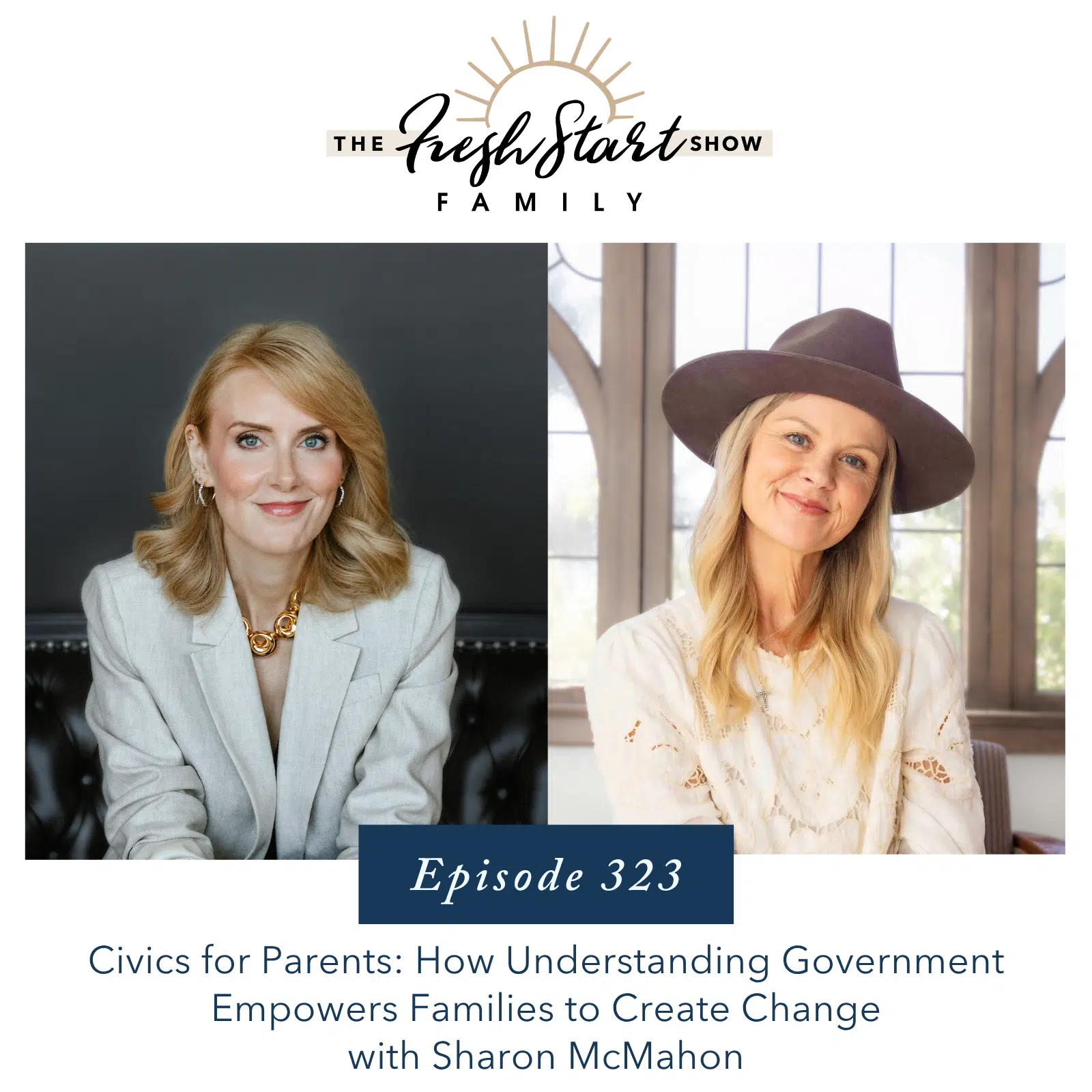
In this deeply meaningful conversation, Wendy sits down with Sharon McMahon, author of The Small and the Mighty and founder of Sharon Says So, to talk about why civics matters for parents, how history gives us hope, and what it looks like to stay grounded when the world feels heavy.
Together, they explore how learning government and history can help families move from fear and confusion into courage, clarity, and purposeful action. Sharon shares the heart behind The Small and the Mighty, the power of ordinary people who refused to give up, and why unity does not have to mean agreement.
This episode is a beautiful reminder that our kids are always watching, that character matters, and that influence begins with how we show up at the table, in our communities, and in the hard conversations.
Episode Highlights:
- History can turn fear and frustration into perspective, hope, and influence
- Unity does not mean agreement, it means solidarity of purpose
- Real change often comes through ordinary people who refuse to give up
- Doing the right thing is rarely the easiest thing, but it is still worth doing
- Our children are watching how we respond to conflict, disagreement, and uncertainty
- Character and integrity often influence people more than argument ever will
- You do not have to hold power to make a meaningful difference in the world
- Change stays possible when we refuse to give up on people
- Parents can help shape a more thoughtful, courageous generation by staying engaged themselves
Resources Mentioned:
Follow Sharon on Instagram
Grab a copy of Sharon’s book The Small and the Mighty: Twelve Unsung Americans Who Changed the Course of History, from the Founding to the Civil Rights Movement
Sharon’s website to take action
Pre-order Sharon’s new children’s book We are Mighty: 12 Ordinary Americans Who Did the Next Needed Thing
Sharon’s podcast The Preamble
Unable to listen, or prefer to read along? Here’s the transcript!
Wendy Snyder:
Hello families, and welcome back to a new episode. I’m your host, Wendy Snyder, powerful parenting educator and family life coach.
And today, I am here with Sharon McMahon. We are going to be talking about civics for parents, how knowing government can turn frustration into influence.
Welcome to the show, Sharon.
⸻
Sharon McMahon:
Hello. It’s so nice to see you. Thanks for inviting me.
⸻
Wendy Snyder:
Yeah, thanks for being here. I’m trying to be a cool cat right now, I really am. But the excitement is just bubbling out of me.
Sharon, we’re going to talk about your book today, The Small and the Mighty, as part of our discussion. Oh my goodness. And we’re also going to talk about some news you just dropped around another book, which is really exciting.
But I do want to start by saying, I am not kidding… this is my favorite book I have ever read in my entire life.
⸻
Sharon McMahon:
What? That’s such a high compliment, Wendy. Oh my gosh, thank you.
⸻
Wendy Snyder:
Literally, my family thought I was crazy. I would stop and say, “Oh my gosh, listen to this.”
⸻
Sharon McMahon:
That just warms my heart so much. Thank you.
⸻
Wendy Snyder:
This book came into my life during a season when I was really scared. I found it last June, and things felt like they were changing so fast. I was confused.
I had friends who have been in my life for 25 years sitting at my kitchen table crying, afraid we were going to lose everything because of what was happening. It was such an alarming time.
And then I picked up your book.
I had known your work for a while, and we’ve had Carlos Whitaker on the show. I’ve always loved the community you’re part of. But it wasn’t until I read this book that I thought, I think we’re going to be okay.
It’s interesting because the stories are often heartbreaking, but also incredibly inspiring. It gave me hope. It reminded me that things are cyclical, that we work together, that we get through hard seasons.
So I just have to ask… how did you do this? How did you weave these stories together like this?
Because you’ll be reading a chapter, and then suddenly it’s like, “By the way, Rosa Parks was sitting in Septima Clark’s classroom.” And I literally stopped and said, “Wait… what?!”
How did you do that?
⸻
Sharon McMahon:
I know, right?
It didn’t take 20 years, but in some ways it did. It took a lifetime of studying history to understand how it all fits together.
We often learn history in a straight line. This happened, then this happened, then this happened. But in reality, so many things are happening at once.
Understanding how those moments connect and shape each other, that takes time.
The actual research and writing took about three years. I spent a lot of time in archives, trying to uncover stories, many of which people haven’t heard before.
And for me, learning about people who weren’t famous but still changed history is incredibly powerful.
Because most of us aren’t going to be George Washington or Abraham Lincoln. It’s easy to feel like our lives don’t matter in the big picture.
But that’s just not true.
⸻
Wendy Snyder:
Yes.
It’s so funny, as I was preparing for this interview, part of me just wanted to sit in your arms and cry and say, “Hold me, Mother Sharon.”
⸻
Sharon McMahon:
That’s okay. I get it.
When I was recording the audiobook, there were so many times I had to stop because I was crying… reading my own book.
I already knew what was coming, of course. But I felt so connected to these people. Like they had become part of my community.
There’s this idea that reading allows you to “commune with the dead.” Not in a creepy way, but in a way where you learn from people who are no longer here.
And that felt very real to me.
⸻
Wendy Snyder:
Yes.
The emotion I feel reading your book is joy and inspiration, but also this sense of urgency.
It feels like a time when people are scared and trying to find their courage to speak up, to advocate, to get involved. And at the same time, there’s this message of, “Stop. Everything’s fine. Be quiet.”
But when you spend time with the people in your book, they didn’t stop. They kept going. They stood for human dignity. They advocated for others.
And they did it with determination, perseverance, and respect.
It feels like such a powerful picture of what it means to be an engaged citizen.
⸻
Sharon McMahon:
Mm-hmm.
⸻
Wendy Snyder:
And at the same time, it’s confusing. Because you want to speak up, but you also want to stay respectful. You don’t want to cross a line.
So I’d love to hear from you… how have you navigated that?
Because I see you as someone who shows up so authentically. You don’t feel masked. You feel grounded and clear.
How have you been able to do that, especially when people expect you to stay in that “safe middle space”?
⸻
Sharon McMahon:
It’s not easy.
And I think it’s important to say that doing the right thing often feels hard. Sometimes it even feels bad.
But that doesn’t mean it’s wrong.
If doing the right thing always felt easy, everyone would do it.
So I don’t want to pretend that it’s comfortable. It’s not.
But throughout history, the people we admire didn’t wait for comfort. They didn’t wait for perfect circumstances. They just did the next right thing.
⸻
Wendy Snyder:
That’s so true.
And I think what’s been wild for me is realizing how divided things feel right now. It can feel like we’ve never been this divided.
But when you look at history, that’s not actually true.
⸻
Sharon McMahon:
Exactly.
⸻
Wendy Snyder:
When you tell the story of Abraham Lincoln, it’s like… oh. We’ve been here before.
The division, the intensity, the stakes… it’s not new.
And yet, people still showed up. They still stood for what they believed was right.
⸻
Sharon McMahon:
Yes. And the people we admire weren’t focused on making everyone comfortable.
They were focused on what was true and what was right.
⸻
Wendy Snyder:
Yes.
And that brings me to Septima Clark.
Her story just stopped me in my tracks.
She refused to stop teaching. No matter what happened, she kept going.
And then we find out that Rosa Parks was one of her students.
It’s unbelievable.
⸻
Sharon McMahon:
It really is.
And one of the most powerful things she said later in life was that she could work with her enemies, because people can change.
That doesn’t mean you give people unlimited access to you. It doesn’t mean you allow harm.
It means you believe that transformation is possible.
And often, people change not because they were argued into it, but because of who they encountered.
⸻
Wendy Snyder:
Yes. That’s everything.
That’s exactly what we teach in parenting. Kids don’t change because we lecture them. They change because of who we are.
⸻
Sharon McMahon:
Exactly.
⸻
Wendy Snyder:
Okay, last question before we wrap.
Tell us about your new book.
⸻
Sharon McMahon:
Yes! I have a children’s book coming out called We Are Mighty. It highlights 12 ordinary Americans who did the next needed thing.
Septima is one of them.
It’s really about showing kids that they don’t have to be famous or powerful to make a difference. They just need to take the next step.
⸻
Wendy Snyder:
I love that so much.
Thank you for the work you’re doing. It matters so deeply.
Where can everyone find you?
⸻
Sharon McMahon:
You can find me at SharonMcMahon.com or on social media at Sharon Says So.
⸻
Wendy Snyder:
Amazing. Thank you so much for being here.
And thank you, families, for listening. We’ll see you next time. Bye!