

What we teach kids about history shapes how they see the world, and themselves.
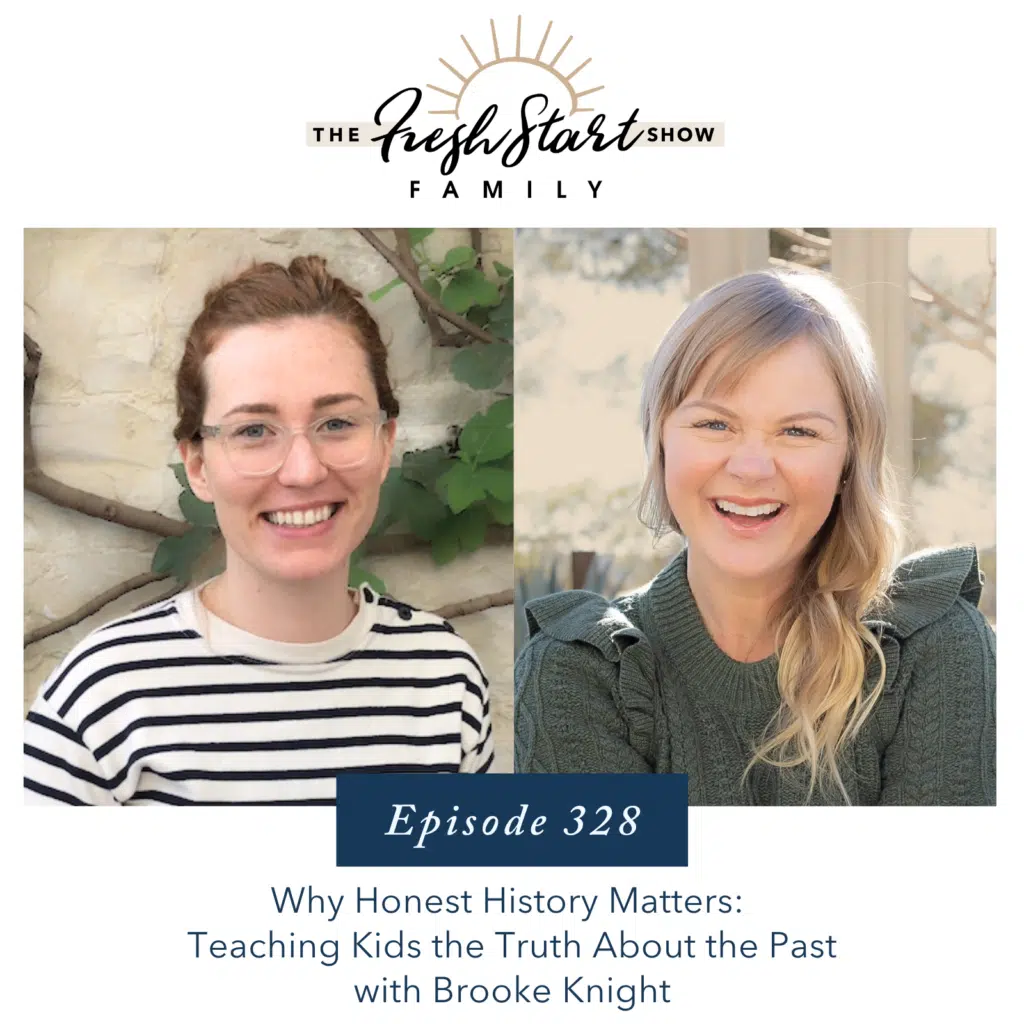
In this meaningful and eye-opening conversation, Wendy sits down with Brooke Knight, co-founder of Honest History, to talk about why truthful history matters and how we can teach kids about the past in a way that builds empathy, curiosity, and confidence.
Brooke shares the heart behind Honest History, a beautifully designed educational platform that helps kids explore real stories from the past through engaging storytelling, diverse perspectives, and honest conversations. Together, she and Wendy unpack how history doesn’t have to be boring, overwhelming, or watered down. It can be inspiring, empowering, and deeply human.
This episode will help you feel more confident talking with your kids about hard topics, current events, and the complexities of the world, without fear, shame, or confusion.
If you’ve ever wondered how to raise thoughtful, compassionate kids who understand the world and want to make it better, this conversation is for you.
Special thanks to our sponsor!
Click here to check out the award winning Pep & Perk’s new album It’s Cool To Be A Kid — music designed to support and celebrate everyday family life, promoting positivity, because after all, it is cool to be a kid.
Episode Highlights:
- Kids don’t need history to be simplified, they need it to be truthful and age-appropriate
- Honest conversations build trust and strengthen your relationship with your child
- Teaching history through stories makes it engaging, memorable, and meaningful
- Kids can handle complexity when it’s presented with care and connection
- Diverse perspectives help children develop empathy and critical thinking
- History isn’t just facts, it’s real people, real choices, and real impact
- Difficult topics don’t harm kids, they help them build resilience and understanding
- Focusing on human stories highlights courage, kindness, and change
- You don’t have to know everything, learning alongside your child is powerful
- The goal isn’t perfection, it’s raising kids who think deeply and care deeply
Resources Mentioned:
Check out Honest History’s website
Listen with your kiddos to Honest History’s kid-friendly podcasts Unlock This! (ages 3+) and Anytime Now (ages 8+)

Unable to listen, or prefer to read along? Here’s the transcript!
Wendy
Well hey there, families, and welcome back to a new episode of The Fresh Start Family Show. I’m your host, Wendy Snyder, positive parenting educator and family life coach.
Today I am here with Brooke Knight from Honest History, and we’re going to be talking about why truthful history matters, and how to teach kids the truth about the past.
Welcome to the show, Brooke.
Brooke
Hi, thank you so much for having me, Wendy. I’m excited to be here.
Wendy
Yes, I feel like this has been a long time coming. I have admired your work for so many years. I feel like you might be someone I gently stalked over the years. I don’t know if you remember this, but I feel like I messaged you for years, like, “Brooke, come on the show!”
So I’m really thrilled to have you here today. I really respect the work you do over at Honest History, and I’m excited to learn more about your heart behind this organization and why you do this work.
Would you start us off by telling us a little bit about your story? Maybe where you live, how many kids you have, and what made you passionate about building Honest History?
Brooke
Definitely. I’m Brooke. I am a wife, a mother, and a co-founder, not always necessarily in that order, but usually some combination of those three things.
I have two amazing little boys who are really the age of our primary audience. They are seven and five. And then we have a little girl on the way in a few weeks, which we’re very excited about.
Honest History came about because I had the idea to start the company around 2016. I wanted to work in education, not necessarily in the classroom, but I’ve always been passionate about educating kids and teaching them about history, which has always been a huge passion of mine.
I thought, “I want to write for a children’s history magazine.” So I looked to see what was available, and I was extremely disappointed with the very limited options at the time.
I went to my husband and said, “I have this really crazy idea. What if we start a children’s educational company, call it Honest History, and teach kids about history in an exciting way? It could be illustrated, inspire creativity, and encourage kids to go out and make a positive impact on history.”
The way I remember it, so many years and so many kids later, is that a few weeks passed and my husband said, “All right, I registered the business. We have a domain name. We’re doing this.”
We took off running from there. We launched the company the same month, I think within a week of having our oldest son, which was crazy and very stressful. I don’t recommend becoming a first-time parent and launching a business in the same month. It was so hard, but truly so rewarding.
I’ve gotten to see my son grow up with Honest History as such a big part of his life, and it’s exciting to see how the business has inspired my own kids now that they’re finally old enough to really engage with it.
It’s been a wonderful journey, and I feel so lucky to have my dream job centered around my kids and to have them be part of it too.
Wendy
Amazing. And the magazine is quarterly, right?
Brooke
Yes, it is quarterly. Right now we have 29 issues out. We have several different subscription models. You can get each new issue quarterly, order back issues, order bundles. There are lots of ways to get your hands on the magazine.
We also have two podcasts. They’re available anywhere you listen to podcasts. They’re free and ad-free.
And then we have a kids’ book series called History Is… There are three books in that series, and they’re really fun.
Wendy
Amazing. Tell us the difference between the two podcasts, Anytime Now and Unlock This. I’m sure our listeners will want to tune in.
Brooke
Unlock This is for slightly younger kids. My five-year-old loves it and has been listening to it since he was about three and a half.
It’s about two kids who sneak into a museum vault with the help of Percy the Mouse. They see a real artifact that parents can look up with their kids. Then they travel back in time with Percy and experience the artifact and see how that bit of history unfolds.
Anytime Now is for kids maybe six and older. It’s more narrative storytelling. We focus on a particular person or big event in history and give a fuller story of the person or event.
Both are exciting, and they’re short, about 20-minute episodes. They’re perfect for the ride to school or a quick trip around Target.
Wendy
Yes, that’s perfect because everyone is always trying to figure out how to keep kids entertained in the car without screens.
Who does your illustrations, Brooke? Is it always the same illustrator? The magazine is beautiful. Not only is the storytelling and history great, but the pictures are gorgeous.
Brooke
We use a lot of different illustrators. With each issue, we try to find different illustrators, especially if we’re talking about people from a particular culture outside the Western purview.
Whenever possible, we try to get illustrators from that culture to do the illustrations so they can represent themselves and how they see themselves.
That made our issue on Indigenous people in the Americas really special. I think about 90% of those illustrations were done by Indigenous Americans. It really shows how passionate they are about telling their stories and representing themselves, and showing the world how they see themselves.
That really goes into our mission and what we’re about.
Wendy
I love that. Tell us more about your mission. What is the heart behind Honest History?
Brooke
What we really want to do is inspire kids to go out and make a difference today.
Every single person who ever made history was once a kid. They all had dreams and aspirations.
Our mission is to teach kids about the past through truthful stories and beautiful illustrations that spark their creativity and imagination, then encourage them to go out and be the change they want to see in the world.
There are so many incredible examples throughout history of people who made decisions based out of kindness, curiosity, and who they were, and those choices had incredible ripple effects.
We want to encourage kids that they can be history makers today, in big and small ways. By learning about the past, we can help create a better future.
Wendy
Yes. I love it. It reminds me of the spirit behind Sharon McMahon’s book The Small and the Mighty. Have you read that or do you know Sharon McMahon’s work?
Brooke
I haven’t, no.
Wendy
You would love it. Sharon is a government teacher turned phenomenon. Her book tells stories of Americans who helped make this country what it is, but they’re not the people you usually read about in history books. They’re ordinary people who did incredible things.
It has the same spirit as your work.
Brooke
That sounds amazing. I’ll definitely check it out.
A lot of times in a traditional classroom, we’re taught that the victors are always the winners, but that’s not always the case. Sometimes history is made by the very average person.
History isn’t always clean-cut. It can be messy and beautiful and average, but still phenomenal and worth learning about.
Wendy
Absolutely.
When I look at your work, I think of what we teach here in powerful parenting. Our families are implementing firm and kind democratic parenting strategies that are often very different from how they were raised.
A lot of our families come in with knee-jerk behavior. Yelling is a common example. Nobody goes into parenting thinking, “I’m going to be a yeller,” and then suddenly you have a three-year-old and you’re like, “Who am I?”
We teach a lot about undoing reactive patterning by looking at patterns. And that’s kind of like what we’re talking about here with history. History repeats itself, and knowing what happened gives us insight for the future.
If bedtime is a pattern every night, and we study that pattern, we can make changes for the future. It gives us power to know history.
So let’s talk about why truthful history matters. Why does truthfulness build trust and curiosity? When we tell kids the truth about history, we’re not overwhelming them. We’re teaching them they can handle complexity.
Brooke
That’s such a great question. When we’re talking to kids, it’s important that we’re never dumbing things down. I hate that phrase when we’re talking about kids, and it has become very common when talking with experts. Sometimes they’ll ask, “Do I need to dumb this down?” And I’m like, “Absolutely not.”
Kids can handle a lot more than we give them credit for.
What we try to do at Honest History is create jumping-off points, because every child is different. My second-born is a sensitive soul. We have to be very cautious about what media he’s exposed to, whereas my older one can take a lot more.
So we want our products to help parents find a jumping-off point where they can have slightly more difficult conversations with their kids and explain truthful events in history in an age-appropriate way, in a comfortable home setting.
It builds trust when parents can sit down and explain uncomfortable topics. Kids can handle bite-sized pieces.
For example, my older son came up to me about a year ago and asked, “Mom, what’s a Nazi?”
And I thought, “Okay, here we go.”
I told him, “They were people who hated other people who didn’t look like them or think like them, and they were not nice people.”
That was it. He said, “Okay, great.”
Months later, he followed up with another question, and we went a little deeper.
Being honest and not shying away from difficult topics shows kids that you trust them with hard things. It may feel uncomfortable to us because we might think, “A six-year-old doesn’t have the full context to understand what a Nazi is or why Nazis came about.”
But small, honest conversations help build trust. They show kids there is no taboo topic that is completely off-limits. It also helps us understand their curiosity. Why are they interested? Where are they learning about this?
It helps create open dialogue. There are bad people in history, unfortunately. There are good and bad people making history today too. Helping kids understand that nuance in an age-appropriate way is important.
Ultimately, it strengthens the parent-child relationship and builds trust on a deep level.
Wendy
I agree. Kids can handle complexity when we guide them. They are brilliant, and they love to feel empowered.
I noticed in one of your pieces about France and the guillotine that the illustration was respectful and not scary. It shared the facts without making it terrifying.
That’s so different from when my kids were little and we had the Lego Bible. I thought it would be so cool, and then I opened it and there were Lego people in pools of blood. I was like, “Terry, we have to get rid of this book.”
So yes, we want age-appropriate truth. Here are the facts, here’s what happened, and here’s the good news: we can learn from this and not repeat it.
Brooke
Absolutely.
Wendy
The next point is that kids don’t need perfection, they need perspective. Stories with real people, hard choices, and diverse viewpoints help kids see the world in full color.
Talk to us about that, especially diverse viewpoints. That’s so important when it comes to history.
Brooke
We’ve always believed that the more you know about history, the more informed you can be, and it helps shape your worldview.
When we started the company, I was frustrated as an adult seeing the same pictures over and over again. How many times have we all seen the same portrait of George Washington? Probably hundreds of times.
There are so many other incredible people who helped shape America and other countries. Those stories are often not told, even though they are important.
We want kids to understand that history is complex. The winners of a war aren’t always the good guys. We wish they were, but that’s not always the case.
What about the people who lost the war? What about their culture, their land, their environment? How did their world change?
When we help kids ask, “What if that happened to me? What if I were in that situation? What would happen to my family?” they start to develop empathy.
History can be complicated and hard, but there are so many stories. And a lot of times, history can be uplifting and positive too. It’s not always sad, scary, gruesome, or boring.
There are examples of people from every race, every color, and every part of the world who made history and made a difference. It’s important for kids to see people who don’t always look like them, think like them, or come from their culture, and to understand that those people had rich, beautiful lives and still made history.
A broader understanding of history helps kids understand that the world is vast, with differing opinions and ideas. A lot of those ideas are valid and important, and we should learn about them.
Wendy
So good. I’m looking at one of your recent issues about the history of the computer and who the original founder of the computer was. These days, kids think of Apple and modern technology, but to read about the real human being behind the origins is so cool.
The next point is that teaching history is about connection, not correction. When we focus on empathy and understanding, kids naturally become critical thinkers and compassionate humans.
This is juicy, because sometimes there’s a desire to candy-coat or erase parts of history because it feels like telling the truth is being critical of the past. But that’s not accurate. Of course we can have compassion for people’s choices from the past, and we can tell the truth.
Talk to us about that.
Brooke
Teaching kids empathy and demonstrating empathy are both important. We can teach kids about empathy all day, but actually showing it matters more.
History gives us so many beautiful examples of people going above and beyond for their neighbors and for people who were different from them.
One of my favorite stories is Ralph Lazo. I don’t think I’m pronouncing his last name perfectly, so apologies if not. He was a young Hispanic boy, about 17 years old, and he voluntarily got on the bus to go with all his Japanese friends to the internment camp.
He was, I believe, the only person who was not married or related to someone of Japanese descent who voluntarily went to the camps and stayed there for months. He told his dad he was going to summer camp, then got on the bus and went.
What an incredible story to teach kids about standing up for friends and neighbors. It shows how one person can make an impact and help people pay attention.
He is just one of thousands of examples in history of people who modeled empathy, courage, and what it means to stand up for other people.
And it wasn’t comfortable. He did not live a comfortable life in Manzanar, but he did what was right.
Showing kids real examples of people they probably haven’t heard of gives them role models and helps shape their worldview.
Wendy
Yes. Putting real people at the center of the story makes history come alive.
The next point is that the past comes alive through storytelling. Facts matter, but stories make them memorable. They let kids feel the heartbeat behind history.
You just gave the perfect example, but talk to us more about why storytelling matters.
Brooke
Storytelling is the most important thing a teacher, educator, or homeschooling parent can do. Textbooks are boring. I have yet to find a textbook where I thought, “This did a good job.”
A lot of state standards require dates, names, and events in bullet point fashion, but that is not how history took place.
Even last week is history. Think of all the things that happened. If you narrow it down to a few dates and events, it becomes boring, but there are so many interesting stories in any individual state, city, or home.
One important thing is finding stories that connect to a child’s interests. For example, one of our books is called History Is Delicious. It talks about food history.
If a child is interested in food but not history, you could teach them about the history of Vietnamese food. That includes French occupation, how the French influenced food, and how we got the bánh mì sandwich on a French baguette.
That one topic opens the door to so many other parts of history.
We do this with each issue by focusing on one topic and exploring different areas that might interest kids. Some kids naturally love history, which is fantastic, but many kids don’t. So we have to show them there’s math history, medical history, engineering history, architecture history, fashion history, food history, and more.
Understanding historical context matters, and we can do that through engaging stories.
When stories get kids curious, they start asking questions. As educators and parents, we can educate ourselves first or be willing to hold our kids’ hands and learn with them. Take them to the library. Ask the librarian, “My child is interested in this topic. What books do you recommend?”
Librarians love helping kids, especially when kids have niche interests.
Wendy
They really do.
Brooke
By telling stories and educating ourselves, we help kids become curious about history. We can cater to their interests and teach them in a way that expands their brains without them even realizing it.
They’ll get drilled on dates and names in school. But at home, in a safe and fun environment, stories can be at the heart of education. That’s when history becomes alive and breathing.
Wendy
Yes. I didn’t realize you had books too. These are beautiful. History Is Worn, a story of fashion, is such a great example. So many kids would love that.
Our last point is this: our job isn’t to protect kids from truth, it’s to guide them through it. Truthfulness doesn’t steal hope. It teaches resilience.
Talk to us about that as we wrap.
Brooke
There’s so much to say. War is always the first thing that comes to mind. Every country has experienced war, unfortunately. It’s an integral part of history and how borders were created.
For example, I think of the USSR and all the countries that were created after its fall.
Or Ukraine. I’m of Ukrainian descent, and I love Ukraine. I lived there very briefly. Teaching kids about the history of Ukraine can be devastating. The Ukrainian people have endured so much.
Their history goes back centuries, but Ukraine as a country is fairly new. Teaching kids about Ukraine and showing them their history can feel sad, especially with current events. But it also gives hope.
There are so many examples of people who fought, resisted, and brought about positive change. Look at Ukrainians today fighting for their freedom.
Not being afraid to teach kids about current events, and then linking those events back to history, helps them understand why history matters.
There were people in the past who did great things out of terrible situations. There are people today, including kids today, who will grow up and do amazing things.
I think that encourages kids not to feel hopeless about what’s happening in the world. We know so many Gen Z kids and young adults feel hopeless. History can remind them that good things can come from difficult times.
Not toxic positivity, but real hope. We have to remember that good can prevail. It may not look like the perfect solution we want, but people are strong. We are resilient. We have the ability to overcome hard things.
Teaching that early, using both historical and current examples, gives kids hope.
Wendy
Yes, because of people. People keep showing up, resisting, and standing up for their neighbors.
I also think this is a great way to allow children to feel sad. We teach a lot of emotional literacy here at Fresh Start Family, and it’s important for kids to be allowed to feel sadness.
With the internet now, there’s no more completely sheltering children. They’re going to hear about shootings and bombings and wars.
My son had twin girls from Ukraine come into his class. One of them had both of her legs blown off in a bombing at a train station as they were trying to flee Ukraine. She came to our town in San Diego through a nonprofit that provided prosthetics.
It was such a beautiful year for my son to learn about the truth of war, the ramifications of war, and why we teach peaceful conflict resolution.
We got to see her come in in a wheelchair, and by the end of the year, she was walking. It was still painful, but it was incredible.
It was emotional to see her resilience every day.
I think it’s important that we don’t try to mask or shelter our children from truth, because truth can help them become people who do things differently.
Brooke, what a blessing to spend time with you today. I love what you, your husband, and your co-founder are putting out into the world. Thank you so much for being here.
Can you tell listeners and viewers where they can find your work and subscribe?
Brooke
Absolutely. You can find us at honesthistory.co.
There you can order any of our products. We have blog posts that go out weekly with resources for parents, including books, research, prompts, and activities for kids.
You can also find our podcasts, Unlock This and Anytime Now, on Apple and Spotify.
And follow us on social media at Honest History. We’re always posting events from history, prompts, and quizzes from our issues. It’s fun, and it’s always safe for kids to look at with their parents.
Wendy
Amazing. I also meant to ask, do schools and classrooms subscribe too? Could listeners ask their teachers or school systems to get this?
Brooke
Absolutely. Parents can ask teachers, libraries, or schools to order subscriptions or bundles.
Parents can order too. We also have a big Black Friday sale coming up, which is our biggest sale of the year.
We offer digital magazines as well, so if you’re not in the U.S. or you’re traveling, you can read on an iPad. And we do ship worldwide.
Wendy
So many great options. Amazing, Brooke. Thank you again for being here. We’re so grateful for all that you do.
Brooke
Thank you, Wendy. Thank you for having me.