

How do we raise kids who care deeply, speak up with courage, and take meaningful action in the world?
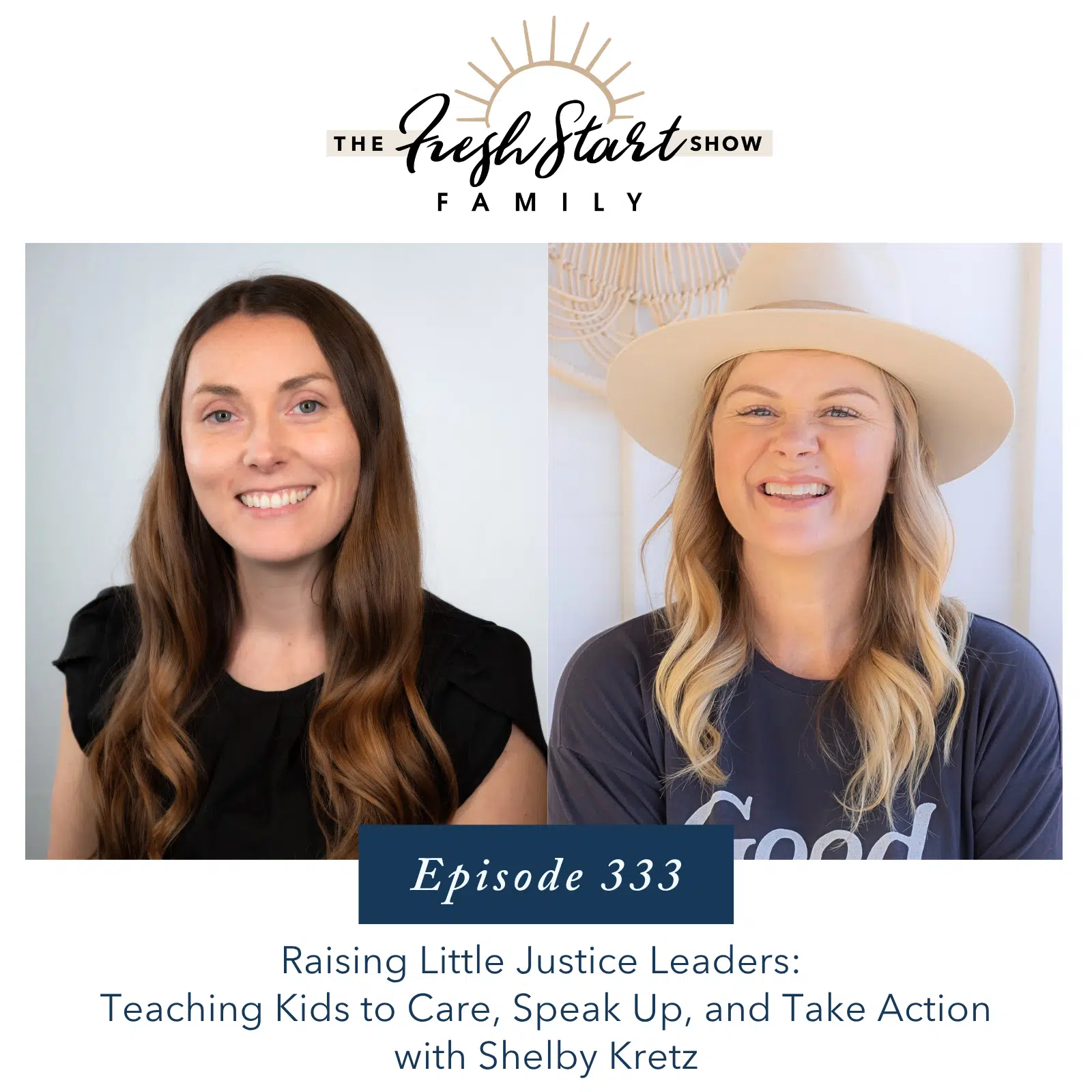
In this important and timely conversation, Wendy sits down with Dr. Shelby Kretz, founder of Little Justice Leaders, to explore how parents can nurture empathy, awareness, and advocacy in their children, without fear, shame, or overwhelm.
Shelby breaks down what it really means to raise a “justice leader,” starting with everyday moments at home. From navigating tricky conversations about language and bias to helping kids understand history in an honest, age-appropriate way, this episode is packed with practical guidance and hope.
Together, they talk about how to approach hard topics with curiosity instead of judgment, why kids are more capable than we think, and how small, consistent conversations can shape a more compassionate next generation.
If you’ve ever wondered how to talk to your kids about fairness, inclusion, or standing up for others, this episode will leave you feeling grounded, empowered, and ready to lead.

Episode Highlights:
- Bias is a natural part of how our brains work, awareness helps us expand our perspective, not shame ourselves.
- Kids are capable of understanding complex topics when we meet them with age-appropriate honesty.
- Raising justice leaders starts with everyday moments, language, and connection at home.
- Asking questions is more powerful than lecturing when guiding kids through tough topics.
- Modeling humility (“I used to think that too”) builds trust and keeps kids open.
- Conversations about history should include both harm and the people who worked to create change.
- Empathy grows when kids are invited to think about how their words and actions impact others.
- Justice work isn’t about perfection, it’s about staying curious, connected, and willing to grow.
Resources Mentioned:
Little Justice Leaders website
Little Justice Leaders on Instagram
Unable to listen, or prefer to read along? Here’s the transcript!
Wendy
Hello, families, and welcome back to a new episode of The Fresh Start Family Show. I’m your host, Wendy Snyder, powerful parenting educator and family life coach, and I am thrilled to be here today with Dr. Shelby Kretz from Little Justice Leaders. Welcome to the show, Shelby.
Shelby Kretz
Thank you so much, Wendy. I’m so excited to be here.
Wendy
Me too. I’ve been looking forward to this interview for quite some time now.
Today, we’re going to be talking about how we, as parents, can raise little justice leaders. How can we teach kids to care, speak up, and take action?
The last few years have been a whirlwind here in America. Dr. Shelby, talk to us about how you’re doing as someone who specializes in social justice work, especially with children, parents, and families. And then tell us a little bit about your story and why you became passionate about helping kids and families in this way.
Shelby Kretz
Yeah, absolutely, Wendy.
It’s definitely been a wild ride the past few years, especially this past year. So many things are happening so quickly, and kids have more access than ever to information. Whether that’s online or from friends at school who have access to the internet, social media, or YouTube shorts, it’s a really difficult time for parents to navigate.
Emotionally, for many of us, it can be a very challenging time. And then on top of that, of course, we’re trying to support our kiddos. So I’m doing okay. I think, like many people, I’m hanging on while also recognizing that a lot of folks are being impacted in different ways. It’s a very heavy and difficult time.
I came to this work during a similar time period. I started thinking about this around the 2016 election when we started to see a rise in more hateful language in political rhetoric and in the media that young people were starting to see more and more as they had more access to technology and social media.
That has only grown since then. I was working in schools and working a lot with parents, and I had the chance to have conversations about it. I realized parents didn’t always know how to address what their kids were seeing in the media.
A couple of years later, in 2018, I started Little Justice Leaders, and it’s been seven years since then.
Wendy
Oh my gosh, amazing. And you have a PhD in education from UCLA, right? So you were already thinking, “I’m going to be an educator of some sort,” and then this topic grabbed your heart. You were like, all right, let’s go.
Do you have kids yourself, Shelby?
Shelby Kretz
I don’t have kids yet myself, but I have lots of nieces and nephews, so I’m constantly around kids. Maybe someday I’ll have my own.
Wendy
I love it. I always loved kids and helping parents and families too, but I did it in different ways. I started as a diving coach, then I was a nanny, and now I’m a parenting educator. I’ve always been a child advocate and helped children, parents, and families in different ways.
Now, we help kids by helping their parents. So it’ll be cool to see how that evolves for you.
Let’s start with this idea of teaching kids to care, speak up, and take action as a way to raise little justice leaders. What do you see as a kiddo who is a justice leader?
We have families here with kids from age two all the way up to my little girl, who just turned 18. I have an adult child now, which is wild. And I’ve watched what it’s been like to raise a kid to be an advocate, or at least to do the best I can.
I’m no expert on this, but I try to show my children that it’s important to speak up, especially around marginalized communities and people who may be very different from us. I want them to advocate because they have a voice.
They’ve watched me do that and go through some pretty painful seasons, like leaving a church that was doing things way out of alignment with our family values and then finding a new church that truly is in line with our values. Our new church is centered on justice, joy, and inclusion.
But it still feels dicey and tricky, especially in this modern landscape where being a social justice person or someone who cares about advocating for marginalized people is mocked by so many people. It’s heartbreaking.
Studying with Sharon McMahon has really helped me this last year, especially her book The Small and the Mighty. It helped me remember that it really is important to do whatever you can, raise the children you’re raising, and advocate for your neighbors the best you can.
So tee it up for us, Shelby. What is a little justice leader?
Shelby Kretz
Yes, absolutely. And Wendy, you hit on so many important points that I think we can dive into in this conversation.
Parents are going through constant emotional turmoil right now. Sometimes they feel attacked from both ends. You also said, “I’m not an expert,” and I’m so glad you said that because that’s how we all feel.
None of us are experts on this topic. There is always more to learn. I’ve been doing this full-time for seven years, and I still would not call myself an expert on social justice because there’s always so much more.
That can leave us feeling, as educators or caregivers, like we’re not doing enough or not doing it right. And then we have folks on the other side who may be outright attacking us for our beliefs or how we want to raise our kids.
When I think about what a little justice leader is, I think about a kid who is able and willing to speak up for themselves, whatever that looks like, and willing to speak up for someone else, whatever that looks like.
A justice leader is a kid who has learned to appreciate and value other humans, even if they’re different, even if they’re similar, whatever they bring to the table. It’s a kid who genuinely brings a sense of kindness to their interactions.
Anyone who works with kids knows no kid and no human is like this all the time. We all have good moments and bad moments, and our kids will have good moments and bad moments. That doesn’t mean they’re not little justice leaders.
A justice leader is a kid who’s trying, just like an adult who’s trying, to be open-minded, curious, kind, value diversity, value people’s stories, learn about other people, and be open to other opinions. Those are really the traits we want to cultivate.
And frankly, they’re very similar to traits that most parents want to cultivate, regardless of their social or political viewpoints.
Wendy
Yeah, I love that.
The idea that kids aren’t too young for justice is so important. In my work, we help a lot of families who have strong-willed kids because strong-willed kids are expert “no” people. You’re like, “Put on your shoes,” and they’re like, “No.” “Get in the car.” “No.”
I have one beautiful strong-willed child and one more mild child. My strong-willed one is 18, and my little one is 15 now. He’s still a teenager, so he might say no three times. But the strong-willed one will say no nine times and then still try to negotiate the yes.
They are their own incredibly gifted and talented breed of human.
A lot of our families fall to their knees, so to speak, when they have the honor of raising one of these kids. But what we always say is that these kids are often wired to have big justice buttons.
So when they’re playing Monopoly and they think their sibling is cheating, they lose their mind because they sense inequality. If we can help parents see that from a young age, it’s like, okay, this kid has a natural gift.
This isn’t a problem. This is how you work with that beautiful personality or gene you’ve been blessed with. You are our future leader.
So I love that idea.
Talk to us about how teaching anti-bias doesn’t have to be heavy. It can be creative, compassionate, and consistent.
But first, define bias for us. Before I did diversity, equity, and inclusion work, I didn’t really understand these terms. And so much of the world attacks them, which is wild to me because that work is so beautiful and connecting. It will stretch you as a human, for sure.
How do you define bias?
Shelby Kretz
Great question. It’s so important to start at the beginning and make sure we’re all on the same page.
For me, bias is the natural way our brain sorts and makes sense of things. It’s human. It’s natural to have bias. Our brains wouldn’t function without it because we have to use mental shortcuts. We have to make sense of things and categorize them.
Often that leads to stereotypes, generalizations, and sometimes negative views of different folks. Sometimes our bias is unconscious, and it’s just because it’s in the air. It’s in the media, in our culture, in how we were raised, and in how we think.
Untangling it can get tricky, but recognizing that it’s normal and that we all have it is important. Bias is really the lens through which we view the world.
You can think of it like a pair of glasses. You wear a pair of glasses with your unique view of the world based on where you’re from, who you are, and how you were raised. That shapes your bias.
The more we realize what those biases are, the more we can widen that lens, deepen and expand our understanding, and see different ideas, perspectives, and ways of being.
Wendy
I love the way you set that up. It’s not a good or bad thing. Every human has bias. Especially if you have white skin and you’re straight, you just have it. That’s just the way it is.
It’s heartbreaking to see so many people, especially in leadership, make it seem like people are being attacked when we talk about bias. It’s like, no, when you have the courage to look at it, it can actually become fascinating.
When I was doing that work, we would get homework assignments where we’d witness ourselves. What happens if I’m in a situation around someone who is a minority? Was there an assumption? Was there a fear that popped up?
It became more of an adventure in humility and awareness than, “You’re doing it wrong and you’re a bad white straight person.”
It was more like, I’m someone who cares about becoming more aware so I can take the blinders off.
When you go through life with blinders on, it’s hard to understand someone with black skin who is sharing a pain point. If you haven’t done the work, you might think, “What are you talking about? That’s crazy.” But when you slow down, you create more room for compassion, empathy, and connection with neighbors who may be different from you.
Would you agree?
Shelby Kretz
Absolutely. And when we can own, “Hey, I have bias. That’s normal,” then we don’t have to shame ourselves or feel guilty and bad about it.
But we can actively work to understand what our bias is so we can show up as better, more connected humans and show up better for other people and communities.
I know so many people who, in other areas of life, are learners. They want to learn new things and are open-minded. But when it comes to bias, many of us close down.
Reframing it as another way to learn about the world can be helpful. The more we deconstruct our bias, the more we understand different perspectives and ways of viewing things.
We’re not always going to agree or completely shift the way we think. Sometimes we will, sometimes we won’t. But just knowing what else is out there, what other ways of thinking exist, and what ways of thinking might be limiting us or hurting people, is important.
Most of us don’t want to hurt people. Untangling bias can be a learning experience and an opportunity to be better. It doesn’t have to be this shameful secret thing, even though it can feel scary and uncomfortable.
Wendy
Yeah, I love that.
I was thinking about this because I knew I was interviewing you this week. I noticed something in my body. I think this comes from studying this work for years.
You do something for so long, and then one day you realize, huh, I’m not sure if that’s in line with my values anymore. Maybe there’s some bias there. Maybe there’s harm being done.
When the helicopter comes around above our house, I’ve still used the term “ghetto bird.” And about six months ago, I said to my husband, “Huh, I wonder if I should find a new term because my intuition is telling me something is off there.”
And then Gabby Velez did a beautiful post on that this last week. Are they a partner with you, or do you just post their stuff a lot?
Shelby Kretz
They’re on our team. Gabby is a Little Justice Leaders team member. And they’re amazing.
Wendy
They are amazing. They were talking about the historical context of the word “ghetto,” and how Jewish people were forced to live in underfunded areas before being sent to concentration camps during the Holocaust.
And then black people in America were forced into under-resourced communities too. So to use that term as a demeaning term, it’s like, oh my gosh, that is educational.
It’s inclusive when you say, “Your ideas are welcome. My ideas are welcome. Let’s talk about this. Let me educate you and then ask what you think.”
Do you want to continue using this word now that you know it could cause harm?
I found that piece really applicable to my own journey of becoming more aware of things I say and do that could cause harm.
Shelby Kretz
Absolutely. There are so many things for all of us that we still don’t know yet.
I might learn something next week that I’ve been doing all this time that’s harmful. Then it becomes a process of unlearning it and practicing something different.
Gabby also has a video like that for when kids say, “That’s gay.” That’s another one you can check out on our Instagram because that’s also a really common one kids say.
And I think your point is important. We don’t come in and say, “Hey, we don’t say that anymore, and that’s it. If I hear you say it, you’re in trouble.”
That’s not how we approach the work. For one thing, as caregivers and educators, we know that’s probably not going to be very effective. How many times have you asked your kids not to say or do something and then they proceed to say or do that thing?
But when we bring education, kids do have a natural sense of empathy and fairness. They mostly want to be kind, at least in their best moments.
So when we present the history and then genuinely ask their opinion, “Now that you know where this word comes from or where this phrase comes from, do you still want to use it?” we have to accept that they might say yes.
Then it might take a few more conversations.
Obviously, certain slurs are never going to be permitted. But for some things, we can allow it to be a learning experience where they come to conclusions through their own understanding.
Language evolves over time. Words that have historically been harmful have sometimes been reclaimed by communities. So I think there can be a conversation about what words we use and why.
The key is inviting our kids into this conversation rather than coming to them with the correct answers. And that’s true with any justice topic.
We don’t come with all the answers. We don’t come as experts. We come with information about history, society, and how these things work.
Our kids come with information about their experiences and what they’ve seen, learned, and know to be true. Then it becomes a dialogue, just like it would with other adults.
Sometimes when we come to kids, we come with the idea that we have the answers and they’re going to learn. I think with social justice, and really with a lot of things, we need to flip that and say, “We’re both coming to this conversation. We both have something to contribute, and we’re both going to learn.”
Wendy
So good, Shelby.
That connects so much to a conversation I was having with my son this last week. I want to circle back and have a deeper conversation with him.
A very high person in leadership used the word “retarded” to demean someone else. The amount of mothers I saw who have children with Down syndrome who were weeping was so heartbreaking.
I said something to my son, but I wish I had said it differently. I used a tone of mockery and disgust to basically say, “We don’t do that,” around someone who was insulting someone else.
I realized I used disgust to call out someone else’s harm. As someone who teaches about tone and influence, I know disgust is rooted in judgment. That tone usually drives people away and creates division.
So I want to circle back and connect with my son. I want to say, “Do you happen to know anybody who has Down syndrome? They are often the brightest lights in the room. And when people use that word as a derogatory term, it does harm.”
That was unchecked back in the day. And right now, that’s what’s so heartbreaking. We see so much behavior in America that people stay silent about, and it’s painful.
How do you keep your community centered on not dipping into that tone of disgust or superiority? How do we stand tall in our values and have empathy and compassion without dipping into judgment?
Shelby Kretz
Yes, absolutely.
There’s no perfect formula. We’re all going to get this right and get it wrong sometimes, and that’s okay.
It’s natural to be really bothered by something harmful, especially when it’s harming people we love. We’re human, and we have emotional reactions.
I love that you’re saying, “Let me circle back to this conversation,” because that is the process of justice parenting or justice educating. It is a constant conversation.
Sometimes it’s, “I really messed that conversation up, and I need to revisit it.” Or, “There are things I said that I didn’t mean, or things I didn’t say that I should have said.”
When we’re approaching the person who said the thing, let’s say it was your child who said something offensive, hopefully we have a better ability to check ourselves in those conversations.
But sometimes starting with, “You know what? I used to say that too,” is really powerful. Whether it was in the 70s, 80s, or 90s, you can say, “I used to say that, and since then I’ve learned why I don’t use that language. Maybe you’ve never heard that before, so I wanted to share this with you.”
Coming from a real sense of humility and recognizing, “Just six months ago, I was saying something I recently learned was harmful,” or, “Ten years ago, I was saying something super harmful, and now I cringe thinking about it,” helps.
Try to picture yourself as that person. Remember the harm you might have caused with language you used 10 years ago, 20 years ago, five years ago, or last week.
That allows us to have a little more empathy. I learned, and now I do better. Let me give this person a chance to learn and do better.
When we go to our kids, we can come with less judgment and less disgust in our tone. And if you’re at a loss for words, start with a question.
“Did you hear that person use this term?”
“Do you know what this word means?”
“Have you heard that before?”
“We don’t use that word. Do you know why?”
Sometimes they’re miles ahead of you. Sometimes they’ll say, “Mom, what are you talking about? I’ve known this for 10 years. Are you just learning?”
Sometimes they’re far ahead of us.
Other times they might say, “No, I didn’t know.” Maybe they have a friend with Down syndrome but didn’t realize the R-word had a connection to Down syndrome.
Or maybe they say, “That’s gay,” and have a good friend, sibling, or family member who is gay, but they never thought about how that might be hurtful.
So either you open their mind with these questions, or you realize they’re already ahead of you. Questioning is usually more effective than coming in with, “We don’t say this, and here’s why.”
Kids don’t want to be lectured. Nobody really wants to be lectured.
If we invite them into a conversation and genuinely ask for their thoughts, it becomes a connection point. It’s not telling them what to think. It’s inviting them to share what they think.
Wendy
It’s so good, Shelby.
Especially with kids in the second decade of life. They hate it when their friends feel judged. Even if it’s not directly them, they can feel that.
The other day, we were watching one of the latest South Park episodes, and it was about Sora. The AI stuff is scary. It has reached a whole new level. It’s also very helpful, so we’re trying to hold the balance.
Afterward, we started playing around with Sora and making funny videos. My son showed me a Sora video someone had made of one of his surf team friends. It looked so real. The boy was holding a gay pride flag and dancing around saying, “Happy Pride Day,” and the caption was something like, “That’s so gay.”
My heart stopped. I wish I’d had this conversation before that because I think I would’ve been more likely to say, “Tell me more. Is that still a slur or a way boys make fun of each other?”
I know it is. One of my best friend’s kids literally got beat up because people called him small and gay. That was just two years ago.
To address it from a place of, “Tell me more. Do you know why our family values are not going to join in on that?” feels much better.
I always teach families that there are different levels. The first level is you stop laughing. You stop giggling at harmful jokes. The second level is you walk away or don’t participate. The third level is you use your voice and say, “Actually, I’m not cool with that.”
These are different levels of growth.
I could tell with my little guy last week that he’s still in the stage where it’s hard as a high schooler not to laugh. He’s in a family that advocates for oppressed groups. We advocate for the queer community. We go to a fully inclusive Christian church. And he still had trouble not laughing at it.
That’s just a real-life example that we all have plenty of opportunities to practice. I love the idea of saying, “I used to laugh at that too.” That would have been connecting in that moment because 15 years ago, I was way different than I am today.
Shelby Kretz
Yes. There’s something really connecting about that. It can break down the barriers of feeling judged.
Adults and young people can lash out when they feel judged. So saying, “I used to say things like that too,” or, “I used to think that was funny, and then I learned this,” can open up the conversation.
You can also ask, “How do you think that might impact people?” Or, “How do you think that might impact your friends who are gay?” if they have friends who are gay.
Or you can connect it to people in their school or community. We know the statistics around depression, anxiety, and suicide for LGBTQ+ kids. Those are real harms.
As social justice educators and parents, we also have to realize that sometimes kids go through a little rebellion. If they have been raised with these values, this can be their way of trying to make sense of it. They’re figuring out their own values and seeing if it aligns.
Especially with the ages your kids are, this could be an age where they’re starting to figure out, “What are my beliefs versus what I’ve learned and taken in?”
Sometimes that looks like saying and doing things that shock us as social justice educators. But we can cut ourselves a little slack, knowing there’s going to be a period of experimentation as they figure out what their beliefs are.
Continuing to ask questions and trusting that they’ve been raised with values of empathy, care, and genuine appreciation for diversity is important.
I often like to think, when I look at a 15-year-old, 10-year-old, or even 20-year-old, they are so much farther along in this journey than I was at that age.
That’s true for so many of us as adults. We might look at our 15-year-old and think, “How are they still laughing at that?” But if we think about ourselves at that age, many of us were less knowledgeable, less aware, and more harmful.
It doesn’t mean we lower our standards, but it puts it in perspective. They are still kids.
That can help because it’s easy to blame ourselves and wonder, “Have I done something wrong? Have I not spoken about this enough? Have we not instilled these values enough as a family or classroom?”
That’s not a place we want to get stuck because this work is hard enough without all that self-judgment.
Wendy
Yeah, so good. There’s so much I can go back and look at differently.
Our last point is that justice work begins in our home. We’ve talked about modeling empathy and addressing harm, but I also wanted you to riff on telling the truth about history.
We’ve seen a big movement in our nation, especially over the last year, to change what people are presented as far as history goes. That has been heartbreaking.
What do you teach children, or educators who teach kids, about how the truth of history is beautiful, freeing, and empowering, not bad or meant to make certain people look bad?
Shelby Kretz
Good question.
I think sometimes we sugarcoat or whitewash history for a lot of reasons. It’s how it’s written in textbooks a lot of the time. It’s what we learned. It takes work to uncover what the truth is.
These days, it’s easier than ever to understand, but it can feel scary and hard to talk to kids. We want to make things pretty. We don’t want to introduce them to violence, shameful experiences from our history, or painful realities.
That’s partly where the fear comes from. “I don’t want to talk to my six-year-old about genocide. I don’t want to talk to my eight-year-old about horrible things our ancestors did.”
But that is such an underestimation of kids and what they can handle. Kids have so much more capacity than we give them credit for to understand, make sense of, and emotionally regulate through difficult topics.
There’s also a lot we can do to make it less scary and less hard.
There have always been people fighting for justice. Don’t forget to add that in.
When we hear white parents say, “I don’t want my kid to look back on our history and think all white people were bad,” then teach about the white people who weren’t bad. There have always been activists. There have always been changemakers. There have always been people speaking up.
Let your child look back and think, “I hope I would have been that person. I hope I would have been the person speaking up, harboring people in my home, or taking big or small actions to make the world better.”
Let them see themselves in that history.
We don’t have to lie or change the narrative and pretend it wasn’t what it was. We present it in age-appropriate ways at different points of development.
But when we give them the truth, we allow them to grapple with much more complex ideas. That helps them develop critical thinking skills, problem-solving skills, and the ability to piece things together. These are skills we want them to have.
It also teaches valuable lessons from history, which is the point of studying history. And it doesn’t have to paint one group of people as all bad because we can say, “Look at these people who were doing good, who were trying, who were resisting in some way. You can see yourself in that.”
It’s important for kids to know what happened because that helps us prevent and change what’s happening now. We need to understand how things happened in history, why they happened, and how identity ties into that because it does.
Wendy
It’s so true.
In my own faith journey over the last few years, I had a lot of discomfort when I’d talk about Christianity. It felt like the whole thing was tainted because of all the awful stuff.
Then I realized there are so many amazing, healthy circles of Christianity doing beautiful work that are inclusive and Christ-centered instead of centered around submission, indoctrination, violence, aggression, and harm, especially with children.
It’s been fun to teach my children that there’s a difference. There are certain parts of Christianity that advocate for one thing, and others that are doing harm.
I remember watching one of the Yellowstone shows, I think it was 1883, and they highlighted how Christians or Catholics came in and tried to beat and rape Native Americans into submission. So many were murdered and killed.
That is a key part of American history, but so many of us didn’t learn about it. I found it fascinating to teach my children about it. It’s important for them to understand that this is part of our history, and that’s why it’s important for us to advocate and use our voices.
I like that idea of helping our children understand that within groups, whether Christian, white, men, or any group that has historically held power, there have always been oppressors and there have always been people in sacred rebellion and resistance.
Last night, in that call with Sharon McMahon and Dr. Jamar Tisby, I asked, “How do we remain helpful in a time like this in America when it feels so heavy?” His answer was really about grounding down into the communities of sacred resistance and rebellion that have always been there.
There will always be oppression and harm, and we ground down into the helpers. As Mr. Rogers said, look for the helpers.
If we can teach our kids that…
Shelby Kretz
That’s such an important point for kids because history can feel scary and heavy.
From an emotional development perspective, we want to allow them to grab onto hope. Let them see themselves in the resistance and in the people who were doing good.
The idea that our kids will automatically see themselves in the oppressor doesn’t give them enough credit. Young people don’t necessarily see the world that way. Sometimes they don’t think, “I’m white, so I’m reflected in these people.” Sometimes they think, “I’m good, so I’m reflected in the people who were good.”
It doesn’t always have to be people who share your exact identity.
That being said, age appropriateness matters. We’re not going to tell detailed stories of violence to a three-year-old. But as they get older, we can tell them more and more.
With a three-year-old, we might say, “Some communities hurt other people.” When we celebrate Thanksgiving, for example, we might say, “In the past, people hurt people on this day, so many people don’t celebrate this day, and that’s why.”
You bring it down to a three-year-old, and then you bring it up as they grow.
That’s so much easier than lying over and over again and then, when they’re 15, 18, or 20, having them find out that everything they learned about a piece of history was incorrect, embellished, or whitewashed.
It’s much easier to tell them from the time they’re little, “This history is complicated. This history was harmful.”
That gives our kids so many more skills in critical thinking, problem-solving, understanding the world, making sense of complex things, and navigating their emotions.
Sometimes they will feel guilt. Sometimes they will feel sad. And that’s okay. We can let them have those feelings too.
Wendy
Yeah, I just interviewed one of the co-founders of Honest History magazine. They do a great job with little ones, using age-appropriate language and beautiful illustrations. I can’t advocate for their work enough.
As kids get older, you can have more complex conversations.
We just went to Disney World for my daughter’s 18th birthday and did four parks in one day. Fifteen miles. It was wild.
Star Wars Land is always a great place to remind my kids that there will always be oppressors and there will always be resistance. If you’ve ever been on the Star Wars ride, it is so good and so intense. They do an amazing job.
The sacred resistance represented in the Star Wars series gives kids an opportunity to remember, “I can be part of that.”
There is belonging in being part of the sacred rebellion against oppression, and in being someone who remains open, nonjudgmental, and willing to go the extra mile to understand someone different from you.
That’s what’s aching our world and nation right now. People are being told that it’s stupid to try to imagine what life is like for someone else. People are being made scared of their neighbors.
But it’s actually really cool to try to understand what it’s like to walk in another person’s shoes. You can do the work to learn what they go through, what life was like for them as children, what they face every day in the world, and commit to not doing more harm.
As someone who teaches that the core basic needs of human beings are the need to feel powerful, the need to belong, the need to feel valuable, and the need to feel and give love, there is a core need met when you find belonging.
I love teaching kids that they can look for the helpers. They have always been there. There will always be oppressors, but we can find identity in the sacred resistance.
Tell everyone where they can find you and learn more about your work. How can they get involved? How can they advocate for what you do in their school system? What do you have available for parents?
Shelby Kretz
Absolutely.
You can find us at littlejusticeleaders.com. You can also find us on most social media platforms, but our main platform is Instagram, @littlejusticeleaders.
We have different options for families and educators to get involved. We put out tons of free content, so that’s a really good place to start if you’re just dipping your toes in. Check out our Instagram, YouTube, website, and email list. We give lots of free resources that way.
The second thing would be joining our membership. We have a membership for families and educators. If you want to go deeper and really dive into the work, that’s a good place to start.
We also have a school-based program. If you want your child’s school to integrate justice on a school-wide level, or if you work in a school or have connections to schools, we can work with schools to think about what a justice-based school culture looks like.
We’d love for people to get involved and engage in the work in any way they can. You can find us pretty much everywhere by searching Little Justice Leaders.
Wendy
Amazing. And if someone wants their school system to learn more, like if they want to send this to their principal or child’s teacher, it looks like they can apply and then there’s some kind of consideration process, right?
Shelby Kretz
Exactly. They can find it on our website and apply, which takes just two or three minutes if a principal or school system is interested. Then we’ll reach out with more information and discuss whether it’s a good fit.
Wendy
Amazing. Shelby, thank you for being here today. We really value and appreciate the work you’re doing and your dedication to raising little justice leaders.
Shelby Kretz
Thank you so much, Wendy. I really appreciate the conversation.