

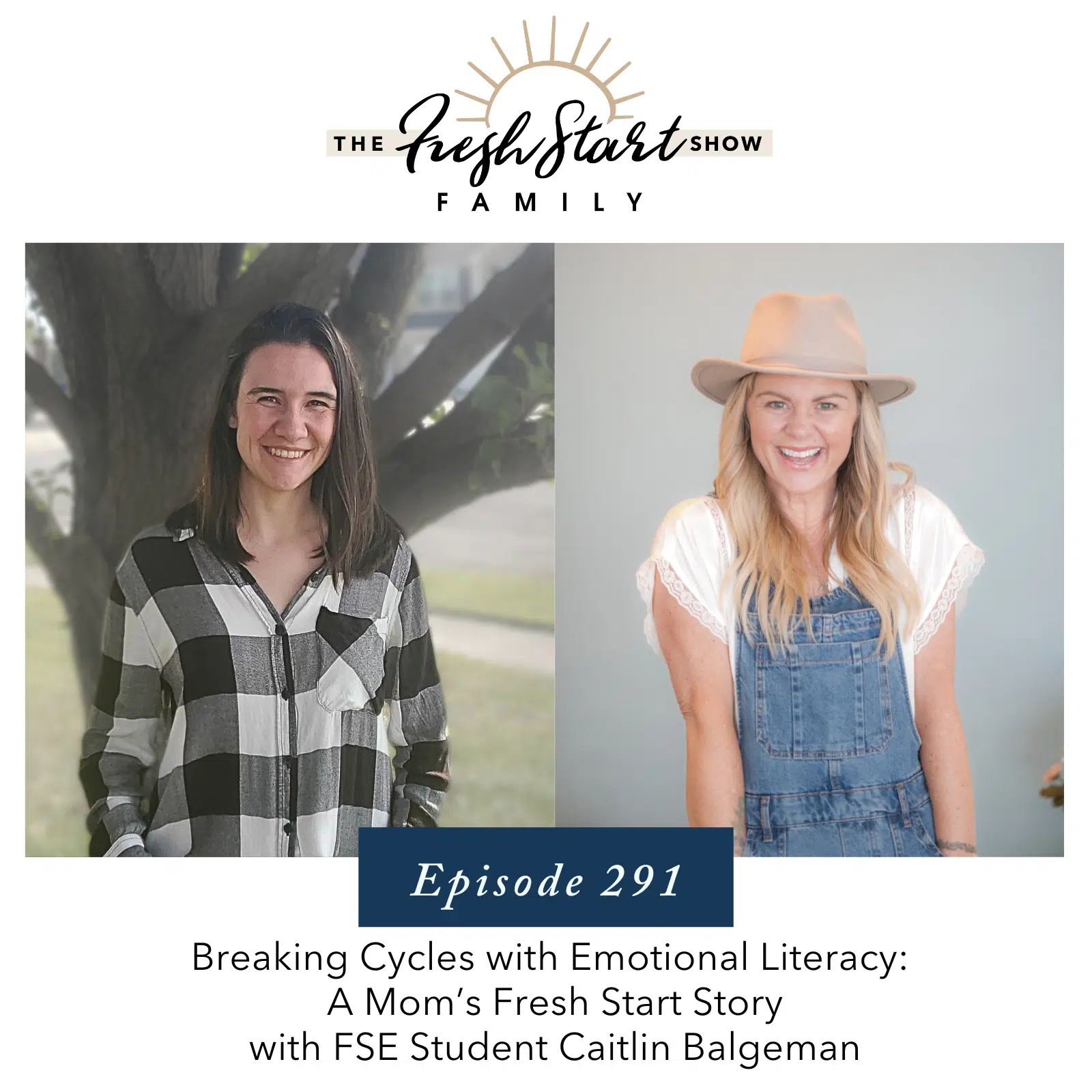
In this Student Spotlight, Wendy Snyder interviews Caitlin—a mom of two from Indianapolis—about her real-life journey with the Fresh Start Experience. Caitlin shares how shifting from reactive habits to peaceful parenting has strengthened connection at home, built emotional literacy in her kids, and helped her break generational cycles with empathy and consistency.
She also celebrates inviting her parents (the boys’ grandparents) into the learning—proof that growth can ripple through an entire family. With practical wins rooted in nervous system regulation, Caitlin shows how modeling calm, naming feelings, and holding firm, kind boundaries can transform everyday moments like transitions, spills, and sibling tension into chances to learn and bond. If you’re curious what positive parenting looks like beyond theory—and how community support keeps you consistent—this encouraging story will give you hope and a roadmap for real change.
Feeling stressed or short-tempered after summer? You’re not alone.

Join this FREE 4-Day live event to reset your mindset, bring peace to your home & step into a more unfrazzled, confident way of parenting. Start the school year with a fresh start . Register now – we start Sept 8th!
Episode Highlights:
- Modeling emotional literacy works.
- Grandparents can grow too.
- Catching yourself mid-moment is powerful.
- Firm boundaries don’t mean permissive parenting.
- Nervous system awareness changes everything.
- Humility models growth.
- Seeds of learning take time.
Resources Mentioned:
Follow Wendy on Instagram
Catch this full episode on YouTube!
Unable to listen or prefer to read along? Here’s the transcript!
Wendy (00:00)
Hello families and welcome back to a new episode. I am so honored and thrilled and excited to be here with our student of the Fresh Start Experience, Ms. Welcome to the show, Caitlin.
Caitlin (00:10)
Hi, it’s good to be here.
Wendy (00:13)
So good to have you. Start off by telling us a little bit about you. Where do you live? How many kids do you have? And how long have you been a student with us at the Fresh Chart Experience?
Caitlin (00:22)
Yeah, so my name is Caitlin. My husband and I live in Indianapolis with our two amazing boys. We have Rowan who’s almost seven and Finn who’s four and a half. And we are an outdoor and indoor family. We like going kayaking and hiking. And we also like playing board games together and reading and playing video games and all those good things.
Wendy (00:45)
love it, kayak and hiking, that’s my kind of family. So in Indianapolis there’s, I imagine, lakes or is it rivers that you go to to kayak?
Caitlin (00:48)
Yeah, yeah.
Yeah,
there’s two rivers that kind of cut through the city and there’s some reservoirs too. And so we like, this is like prime kayaking time in the summer. Like most weekends we’re like out there, we each take a kiddo and we have friends that we go with and it’s just a really good time.
Wendy (01:09)
What a beautiful way to spend quality time with the kids. I love it. And Caitlin, how long have you been with us at the Fresh Start Experience? When did you join?
Caitlin (01:17)
Yeah, so I looked back through my emails. I first heard about Fresh Start from a webinar that Fresh Start partnered with Sheila Rae Gregoire from Bear Marriage podcast. And that was almost exactly three years ago in 20 or no, 2023, doing my math, right? Two years ago. And so it was just like a one-off.
Wendy (01:31)
Cool.
Yeah. Yep.
Caitlin (01:45)
And so I went to that and I was like, well, that was interesting. And like, I want this for my family, but I don’t see yet how like that can be a reality. And so I just kind of, it was just like kind of simmering in the back of my mind. And then in January of 2024 was the like New Year Kickstart program that Fresh Start does. Yeah, challenge, yep. And so I was like, great.
Wendy (02:00)
Yeah.
Challenge, yep.
Caitlin (02:15)
dive into that. And that was really eye opening in a good way and challenging in a good way. And even just like it’s it’s short. It’s it’s a week, you know, it’s like tiny little lessons and just like committing to that and implementing those things. Like I remember, you know, just like having conversations with my kiddos that I wouldn’t have had like if I hadn’t done that.
that challenge. And so I joined the Fresh Start community after that challenge. And so it’s been since January of 2024. And here we are. Yeah, year and a half. Yeah.
Wendy (02:54)
Yeah, so about a year and a half now.
So
year and a half-ish, because I can’t believe it’s almost September. When this airs, it’ll be September. And wow. So yeah. And you are an example, of someone who’s really shown up, right? You’ve really seemed to stay engaged. You obviously finished the foundations course. That’s where we start off everyone in the program. And so it’s just been so fun to see your progress. The team and I have just really admired how you have stayed consistent with it. And I think you’re an example of a student who is really
Caitlin (03:00)
I ⁓
Wendy (03:26)
been able to see the fruits of your labor. And one of my favorite things about your family and the way you’ve led your family into this season of growing and healing, I’m sure on some capacity or many capacities, is that you’ve brought your mom with you.
And she has agreed to step into this program and do some of the education. And it sounds like she takes care of one of your little guys once a week or something. And so that’s just like the extension of my dream, right? So when families join the Fresh Art Experience, we always say that your immediate mom and dad are able to have access to the program too, as far as the education materials go. And just to see a student fully taking advantage of that and using it just like.
melts my heart. So thank you for leading your family in this way. And Caitlin, you mentioned you found me through Sheila. We love Sheila’s work so much. So it sounds like were you kind of raised in more a bit of the evangelical or a little bit of the high control stuff that you decided to kind of unravel a little bit and do your own thing, like do it your way, so to speak, or let go maybe of some things and move into other things as you became an adult. Is that more of your history?
Caitlin (04:10)
Yeah.
I think not to maybe the extent that other people have. ⁓ I was raised Lutheran and still like happily Lutheran. but there’s like definitely an aspect of, just like, I think more like my growing up was the things that I’m like unpacking from that are not as much religious.
Wendy (04:37)
Mm-hmm.
Caitlin (04:57)
and are more like learning how to express emotions, because that was not something that I feel like I really learned growing up. And so that’s been, yeah, that’s been really good in terms of like continuing on my journey of like learning to express emotions and like verbally processing them aloud to model to my kids, like having emotions and then visibly employing those strategies to self-regulate. There was something
Wendy (05:06)
Yeah, most of us didn’t. Yeah.
Caitlin (05:26)
that happened recently, we were like leaving, like a back to school night and the boys were like getting at each other, cause it was like almost bedtime, you know? And so we’re like leaving and my almost seven year old, we’re like walking back to the car and he just yells, I just feel so sad and hurt and like, like, right. Which is like, you know, he’s, he’s having a rough time and he’s moving through it, you know, but like for me, that was a success.
Wendy (05:26)
Yeah.
Caitlin (05:51)
because it’s like I still struggled to be able to say like, I’m feeling sad and hurt right now, you know? And so for like him, almost seven, like having that vocabulary and self-awareness and understanding was just like, okay, like this is working, you know? Like this, we’re moving through this. So that was really sweet to see. And I should have posted it as a success and I just haven’t done it on the circle yet, but.
Wendy (05:56)
Yeah.
Yes.
That
is so amazing. Yes, that tells me so much about the way you are changing with your modeling of the emotional literacy. That’s amazing. So yeah, so like that’s so cool to hear. And being raised in a face circle, was there any like…
punishment style stuff like reactivity, because I imagined to follow Sheila, there must have been something, right? Like, so was that common in that face circle? Because I feel like we see some Lutheran circles in our area that have evolved into more, like there’s a preschool here that everyone now over the last 20 years, that one, and then the United Methodist Preschool that my kids been to, people are so happy there. And they really are now teaching
They have healthy, compassionate discipline teachers come in. I’m trying to think of the name of that sweet little Lutheran church that I pass every single day and I cannot remember right now, but was there a little aspect of that growing up, of the punishment that you then have to now unpack as an adult as far as their reactivity, maybe just a tinge of instant obedience? I think that circle doesn’t have it as much as others, but it’s still there, right? Yeah.
Caitlin (07:14)
Mm-hmm.
Yes, yeah, I think like for my family, particularly,
like that’s not, I don’t think that’s the same for everybody and everybody’s family is different, but there definitely was like a, like you obey and like a shame aspect to it of like why you don’t do things, you know? And so that’s been good to,
Wendy (07:30)
Okay.
Yeah.
Caitlin (07:45)
unpack and re-imagine, you know, like this time around, you ⁓ And my parents live really close to my kids’ school. And so they’re like the before and after care for our kiddos, which is amazing. And it’s just been really cool to see my parents, like when I’ve shared various things with them, like I’m really fortunate.
Wendy (07:50)
Yes, okay. Yeah.
Caitlin (08:09)
that they are so receptive and willing to learn new things. That’s something I respect about them so much is how they’re able to change. And there was something recently where my four-year-old was having a meltdown, leaving. The transitions are so hard sometimes, like pick up and drop off is kind of chaotic at times, but we were just leaving and…
I just got to see my mom really empathize with my four and a half year old about like, yeah, of course, you’re feeling sad about this and all that. And so that was just really cool to see that changing because I don’t remember that from my childhood. And I have a good relationship with my parents. I love them very much. And there’s some things that I didn’t learn as a kid that I’m learning now. ⁓
Wendy (08:51)
Yeah.
Yeah. And that they didn’t
learn as parents then. Now they’re learning as now. Yeah.
Caitlin (09:00)
Right, that they didn’t learn and they’re still learning. Yeah,
and are such a good example of like still being able to learn. Like I hope I’m still able to learn like that, you know, when I’m their age, you know. But yeah.
Wendy (09:11)
Yes, and I
love that, Katelyn, because I think we do a great job of together as a community developing the joy of learning and just staying in that joy of the adventure, right? It feels so good to fall in love with the process of learning and growing and not see it as a danger, right? But just more of like, interesting. I am reacting really strong or whatever. saw a reel this morning.
We used to have a black lab that loved to swim. And it was this funny one where someone had filmed him. He was going to the pool and he ran up to the door. This other lab on the internet, you know, but someone sent it to us because it made us think a tank. He runs up to the door and he’s barking at the door and then he runs in this pool. He grabs his toy, jumps in the pool and he’s swimming around the pool and he’s so happy. And I’m like, this is what I hope my students develop as far as the lifelong.
joy of learning and growing. And I think that’s kind of what I think of when I see, when I hear about a mom, a grandma that’s like, okay, cool, throw me in. I’m down, Caitlin, like what do you got for me? And then you see her actually applying it. And that story you just mentioned is one I hadn’t heard, but you had shared another one where your little boy had like accidentally tipped his, I think it was his chair over and some, was it some goldfish or whatever went all over the place. And I think you said,
Caitlin (10:15)
Yay.
Wendy (10:32)
your mom kind of first was like responded with a little bit of a shamy tone, like, and then you saw her redirect herself. So maybe share that story with us. Cause that, mean, when my heart melts, when I think of the opportunities that grandparents have and like we have a, so Terry’s mom took the same thing. She took care of our kids. Like the first, at least the first five years, she was like there once or twice a week.
you know, before after school, she was just like the ride or die grandma. And it’s so beautiful to see them be able to develop this multi-generational relationship. And so it’s great for parents, it’s great for grandparents, but maybe just share that story of what happened and how you saw her redirect herself in the moment.
Caitlin (11:13)
Yeah, so you have a better memory than I do on this because I was like, oh yeah, when was that? But yeah, like something had spilled and like my mom’s knee jerk was like, oh no, you know, like, oh, you know, like you made a mess or whatever. And just like me knowing, like seeing that and like being familiar with that as a response. And then she
Wendy (11:18)
I have notes.
Caitlin (11:41)
like changed gears and like I could see really clearly her changing gears and like switching into like a positive framing of like, we have to clean it up. Like, let’s get a paper towel and you know, and take care of it. And just like hearing the tone shift and like hearing her change focus was really cool to see and like inspiring that like I can do that too. Like even if I react initially to something like that’s not the end of the scene, you know.
That’s just the beginning of the scene and I don’t have to end it that way, you
Wendy (12:08)
Yeah.
such a good way to put it. And yeah, you went on to say that then what we teach students and what you guys practice understanding is we’re not, you we are changing to be in moral alignment with who we are and who we were designed to be, right? Kind, empathetic, loving, self-control, self-compassion, cool.
but like also because it works. So you said instantly Rowan happily started cleaning up with her. My dad and I joined in and even his two year old brother joined in on the fun when he saw everyone else cleaning up. It was a beautiful, beautiful moment of connection when it could have ended up with shame. And I’m so inspired by my mom changing gears and I made sure to tell her how much I appreciate her. But like, it’s just a great example of like, you want your kids to cooperate. You want them to learn to clean up their messes, take responsibility for their mistake, learn from them.
like, hey, next time, like, it makes sense why my parents tell me not to lean back in the chair. I don’t even know if that’s what he was doing, but you want them to learn from their mistakes, right? We know that shame, like, shuts down the learning center, but compassion and firm kindness, like, it really opens it up and it makes them see the mistake and then take responsibility to make amends or clean up the mess. So I love that so much.
What a beautiful moment to be able to witness. Funny, when I think that’s so much a part of this work is when we get good at just catching ourselves. I think that’s like, that’s kind of more of an advanced level, but because in the beginning, know, Caitlin, tell me if you’ve experienced this, like you, you often catch yourself after, right? So you might like, if you’re a parent, you might be like, you reemum, yell at them, whatever, grabber is too tight. Everyone’s got different responses. Sometimes people.
lean towards permissiveness, but a lot of our crew leans towards reactivity with like more aggression or puffing up. And then later that night is when the learning comes and you get to look back and be like, that’s so interesting. This makes sense. This is how I’m gonna do it differently tomorrow. But then the second stage is like when you start to be able to catch yourself in that middle zone. And that’s a really cool zone to be in because then you can actually stop and redirect yourself and.
This is funny, this happened with a full mastery student this morning. I was leaving a voice memo. I have a drive to my office and I was just leaving her a voice memo about something and someone ran a red light in front of me and it scared me really bad and I was like, I get so angry. I get so angry at red light runners and I was like, oh, I’m like, dude, someone just ran a red light and then I’m like.
Caitlin (14:28)
Yeah.
Wendy (14:40)
And then I said, they make me so angry. before the whole thing came out, I stopped myself. And I was like, ugh, I feel so angry when red light, people run red lights. And that’s something we teach in the community, right? Like you just take radical responsibility for your own emotions, and then you process your emotions, and then you act, right? We know anger is where justice is born. It shines a light on what needs to change. But she was laughing. She was like, I heard you.
Caitlin (14:50)
huh. Yeah.
Wendy (15:06)
correct yourself and like, or redirect yourself in real time. And that happens a lot, but that’s beautiful.
Caitlin (15:06)
Right, yeah. Yeah. I have a
story that happened like kind of recently that I think is an example of, you know, like doing something different than you’ve done before, like catching yourself in the middle and not after. So like something that has been really helpful for me on my journey, like I said before, is like, like expressing emotions and like being more comfortable with that.
Wendy (15:17)
nice.
Caitlin (15:34)
And kind of connected to that is like learning to empathize without trying to fix. Like I’m definitely somebody, and this is a good practice for me with both with my husband and my kids, you know, like if somebody tells me something, like I want to jump in and fix it. And that’s like not the answer, like most of the time, you know? And so recently my almost seven year old got new shoes for the new school year because his old ones were worn out.
And my four year old was very sad because he did not get new shoes because he had already gotten new ones back in March when he’s worn out. And instead of bringing in that tone of like sort of scolding or like reasons like, well, you know, you already got new shoes like here, you know, right? Yeah, yeah, yeah. All of that. Like I didn’t do that this time and I just sat there and held him and empathize like
Wendy (16:15)
You should be thankful. ⁓
Caitlin (16:24)
it totally makes sense you’re sad. Like it makes sense you’re disappointed you didn’t get new shoes when your brother did. Like that makes sense. And it was definitely a growing moment for me because I get really uncomfortable when people express emotions sometimes. And it was, it was like not a short process. Like I think with uncomfortable emotions, we want it to be like as fast as possible and just get through it, you know? And that’s not what this was, you know? And so,
Wendy (16:38)
Yeah.
Caitlin (16:52)
I was able to just be there for him and not dive into fixing mode like I would have in previous months, years, you know, and that like diving into fixing mode like that wouldn’t have been a connecting experience, but choosing empathy in that moment was a connecting experience. And I’m proud that I was able to do that in that situation when I wouldn’t have in the past.
Wendy (17:17)
Yeah, and once he kind of what we would call the first experience got over the rainbow, right? Like was able to get himself back down. I know sometimes in those moments, the little ones, they’re like crying so deeply that they’re like can’t breathe or Stella used to get like rashes on her face because she would be so mad. But like in those in that moment, let’s say when he was able to come back down just by you holding space for him, that’s a concept we really teach deeply at Freedom to Be. But.
he was able to come down off of that emotional roller coaster, right? Like we always say, emotions are like clouds. They come and go if you allow them instead of like, don’t be sad. I’ll get you new ones at Christmas, like that fixing that you’re talking about. when he came off of it and he got down off your lap or whatever, did you see him just kind of go back a little bit to life or was he still like pushing, pushing, pushing about the shoes? Do you remember?
Caitlin (17:55)
Yeah, yeah.
Yeah, it hasn’t it hasn’t really come up since then, you know, he’s like he he he wrote it and like we wrote it together and I think eventually, you know, like it takes a lot of repetition, like a lot more than, you know, maybe I would want, you know, but yeah, just like even even having to like repeat and like it’s like it’s OK to repeat, you know. ⁓
Wendy (18:13)
Bingo.
Yep.
Yeah.
Yeah, yeah.
Caitlin (18:38)
And, you know, I think eventually, like it was, it was so, I don’t have a memory of it really, because it was just like so chill and calm. And it was just, we were able to go do something else, like get a snack or something. And he hasn’t been like, brother still has cool new shoes, but he hasn’t been like feeling, he doesn’t have like the residual like sadness about it. Like he was able to just like feel all the sadness and move through it. And.
Wendy (18:45)
that’s so cool.
Yeah.
pushing and yeah, yeah.
Caitlin (19:05)
He’s been good, you know?
Wendy (19:05)
Yeah.
Because the misbehavior
would be like complaining, whining, pushing back, begging, right? In traditional, like if we were defining misbehavior. And to hear, again, the effectiveness of the strategy, right? So it’s like, it’s not only connecting, and it’s also like a healing moment for you, where you’re like, wow, I spent a lot of my life feeling responsible for somebody else’s emotions and feeling like I needed to fix them, or I needed to make things better, or I was failing in some capacity. then now, so you get the healing experience, you get
Caitlin (19:09)
Right, yeah.
Wendy (19:35)
growth experience and he gets to learn I really am capable of moving emotions and also that there’s firm boundaries like my mom says no right like I think we know that so many people mistake this work for permissive parenting and there are just endless attacks especially unfortunately
in the more like high control religious circles that just try to slaughter this work. And it’s like so clear that they don’t understand that we actually spend time building the muscle to be able to say no in a firm way with compassion and connection and follow through.
And that’s what that’s what that is, right? Because a lot of people would just be like, OK, fine, I’ll get you new shoes. But like, you better be grateful and you better not get them dirty because this is ridiculous. I shouldn’t even. But it’s fine. You know, so they kind of lean towards permissiveness with an attitude or you better stop crying. You know, if you don’t stop complaining about this, you will never get shoes again in your life. Right. Like that’s the other side. And those are both examples of sticking to the boundary, kind of, but not. And so to see someone follow through with just like the answers, no.
Caitlin (20:29)
Yeah, yeah.
Wendy (20:38)
and you’re okay. It’s okay to be upset in this house. It’s okay to like have an imperfect moment where you might be loud at the park on like a bench and cry for 10 minutes and like people around us are gonna be okay. We’re gonna be okay. So I love that.
Caitlin (20:52)
Yeah, that like emotions aren’t
manipulative by nature if that ⁓ makes sense like I Like had this sense growing up that like if you’re like, know, like having a hard time like crying for ten minutes like that’s you doing a power play to like make people do something or whatever and You know, it’s really
Wendy (20:58)
⁓ yeah.
Caitlin (21:19)
it’s really nice to be able to like see my kids from like a genuine, like truthful perspective of like, no, like sometimes you are that sad for 10 minutes, you know, and you don’t have to like cut that short and like, you don’t have to like get in people’s faces about it, but sometimes you need to cry for 10 minutes, you know? and that’s okay. And that doesn’t make you a bad person or a manipulative person or anything like that, that that’s just.
Wendy (21:31)
Yeah.
Yeah.
Caitlin (21:45)
Like you’re working through it and you’ll move through it and there’s not something wrong with emotions, there’s not something wrong with you. ⁓ So all those good things.
Wendy (21:54)
Yeah, which is
such a beautiful way to break a generational cycle, right? Painful generational cycles come in all ways, but we know, especially more in some religious circles, that emotions and the heart is seen as bad, untrustworthy, wicked. Empathy is seen as like…
dangerous ground, right? Like even to this day, there’s still like very famous books and pushes that like empathy is like this bad thing. And to be able to stand firm and say, No, this is actually the way one of the ways I express my faith and a true moral value to me that emotions are God given and beautiful and help us help our nervous system actually function the way it’s supposed to empathy is a superpower. Like all the things we practice is, is really beautiful to watch you do that, Caitlin.
And as we wrap today, I mean, I could talk to you for so long, because I mean, I just have so many of your success stories we didn’t get to today, because there are many. But one of them you had shared with us over the last year or so was around.
your nervous system and really diving into the nervous system mini course that we have within the first year at experience and starting to really understand what’s happening from a body perspective. How has that supported you and helped you? know you were really great to come in and celebrate that you had finished, you had set out to do the mini course, you had finished the mini course and that…
you’re able to start applying some of those concepts to create that bigger space between the stimulus misbehavior and your response. How has that helped you as a mom specifically, the nervous system stuff?
Caitlin (23:27)
Yeah,
so I think the successes I’ve probably shared with the community are more like, know, like I implemented this like in a situation where I was feeling dysregulated and I could tell and you know, like instead of like jumping into like reactivity or like fixing something, I was like, ooh, I’m gonna use this this time and see what happens, which has been good.
But I think on like the more internal side, something that like I’m still learning is like catching myself, like my own awareness of like how regulated or dysregulated I am. think I know I do this and I think it’s easy for like other people that I know to do this too of like to be quote fine.
for as long as you can, to say you’re fine and you don’t need anything else and you can just keep going and going and going for as long as you can. And then it gets to the point where it’s actually really hard to use those tools and regulate, because your dysregulation is so high. But something that’s been helpful for me is really noticing in my body when I’m at the midpoint of not fully dysregulated, of just halfway dysregulated, like,
Wendy (24:15)
Mm.
Caitlin (24:42)
I’m dysregulated. I don’t have to wait until things have really hit the fan to take a step back and be like, okay, I’m gonna take care of myself. I love using a heating pack. That’s really comforting to me. ⁓ just bedtime shenanigans happen. I think often the time when parents are like, whoa, dysregulation, right? And so…
Wendy (24:55)
Ooh, okay.
Caitlin (25:08)
Like I have my heating pack like in my bedroom and we’re like getting ever getting the kids ready for bed or in and out of the bedroom and Like being able to say like you know, like I’ve had that like a kind of a hard day at work I’m kind of a little drained like I should just use the heating pack now and like take care of myself now before I’m at the point of like Flipping my lid with my kids So that’s been like more of like the internal side of it of like being able to take care of myself before like
I need like a whole like band-aid like cast on my like ⁓ mental broken bone or whatever it’s like no I can do a band-aid now before it gets like to that extreme so.
Wendy (25:41)
Yes.
Yeah.
Yeah, staying in that, what my favorite nervous system teachers call that range of resonance, right? Where it’s like sometimes you’re super chill, you’re like, my gosh, and then other times you’re approaching that top line. And what you’re describing is such a great example of leaning into.
building awareness around your body, right? So it’s like embodiment, that’s none of us learned that as a kid. And then as you get older and through this work and the Freshwater Experience, I think it’s been fun to expand the ability to just listen, right? So like the feeling you get in your stomach or the tightening, like I get so much communication through like my neck and my shoulders that, you know, I had like a.
a big interview yesterday for the podcast and I didn’t sleep well and I had woken up with like a little headache and I’m like, that is so interesting. I really clinch in my neck, you know, or your heart starts to beat fast. Like that’s a big one that I feel when I’m starting to approach tornado volcano world. And so that’s cool to learn that you’ve really started to build that and, and be able to come in there midway. Last one I want to just touch on because it’s so, so sweet.
as we close this beautiful interview, Caitlin, we’re just so grateful that you took time to be with us today and bless everyone listening with understanding what it looks like to go on this journey when you join the Fresh Heart Experience and really commit to just being consistent, learning, growing, healing, making mistakes, getting it wrong, asking questions, coming back, celebrating your successes and like having it all based on just building the family legacy of your dreams.
But one of the things you had shared was you’ve developed the ability to tell your little guys, like, hey, I’m working on something. And really, this is a way to influence them to do the same, right? We talk so much about modeling in the community and our teachings and our coachings. But you had said to them, hey, I’m working on changing and growing. And one day, your little boy had said to you in the car, like, mama, his exact words were,
You shout at me all the time and you had said to yourself like, wait, I think I’m doing actually really good. And you wanted to say, what? No way. Like I’ve been learning. haven’t, I don’t yell at you. But instead you just said, oh, tell me more. Like you got curious, right? Which is one of the tools we teach. You got curious and you said, tell me more. I have been working on like learning the pause, the stop sign instead of yelling. And then you had said to him,
Caitlin (27:50)
Hey
Mm-hmm.
Wendy (28:14)
Okay, so when I yell, do you want to just be able to tell me like, hey, mama, look, you’re yelling, let’s take a pause. And he was like, okay, and he ended up practicing with you. And then at the very end, you said, then with no prompting from me, he said, mama, if I start yelling, you can tell me, hey, let’s take a pause. So just put this in your own words, Caitlin, of what this has meant to you to be able to influence your child.
to behave in a way, what we would call that is like humility, and that is taking direction well, being able to take coaching, to listen to his mom because he wants to, not because he has to. What does that look like for you to realize that that is what you are teaching your son?
Caitlin (28:57)
I love that story and that is actually from like the New Year Kickstart Challenge. Like that’s how early that was and that’s what really like prompted me to be like, like this is really like this is effective. know, like I had been in it for two and a half days or whatever. So like I hadn’t implemented a lot yet, you know. So yeah, just in terms of like effectiveness, like not everything.
Wendy (29:02)
cool.
Caitlin (29:21)
is gonna like happen right away, but like that was something that for me happened quickly. And I was like, because I was in like the thick of the challenge, I was able to be like, whoa, okay, I should pay attention here and not just like jump to like, no way, you know? But yeah, it’s been really cool to see the ways that my kids are growing.
at the same time that I’m growing and the ways that they pick up on things I think quicker than we think they will because we have certain, like those certain triggers that just keep coming around and there’s like lot of invisible progress that’s happening that we don’t always see. So I’ll share one more story. Recently, my almost seven year old started first grade. Super exciting.
And my husband was asking him like, would you learn at school today? And this was like the second day of first grade. And he immediately was like, it’s okay to make mistakes. We don’t have to be perfect. it was so fun. Like my husband and I had to laugh because it’s like, you know, we’ve been working on this for a long time. You know, it’s like two days into first grade and that happens. like I was telling my husband like that, like he wouldn’t be able to do that.
Wendy (30:11)
Yes.
Bring this teacher a ribbon.
Yes.
Caitlin (30:37)
two days into first grade if it wasn’t for all of the foundation stuff that we’ve been doing. ⁓ And so, like I said, we hadn’t seen him, we hadn’t seen that click for him in our home, but it clicked, things were happening behind the scenes, the seed was growing underground and it finally sprouted. And so I’m grateful that we got to see that and that.
Wendy (30:43)
Heck yeah.
Caitlin (31:01)
even if it was at first grade and not in our house, you know, that that happens. So yeah, yeah.
Wendy (31:04)
It’s such a great example, yeah.
Kids often learn from other people. They’re learning from us, that invisible thing. And then one teacher or one coach, one music teacher says it they’re like, guess what they taught me? And you’re like, they taught you that? Really, they taught you that? But that is, probably a great example of how the reticular activating system works, which is so perfect, right? So I’m imagining maybe you are blessed to be in a school system where this first grade teacher
Caitlin (31:11)
Yeah, we’re priming them to be able to
Right? Yeah, yeah, yeah.
Wendy (31:33)
either she’s really young, that’s the beauty about really young teachers, they come out of school fresh with like updated information, or it is an older teacher that has been open to learning and growing, but somebody… ⁓
Caitlin (31:43)
Yeah, the school that
they’re at is like a local Lutheran school and the teachers are all like really into like social emotional learning and like zones of regulation. So it’s like really beautifully like weaving together with what we’re doing at home. So yeah.
Wendy (31:56)
Dang. I remembered the name
of the school, Bethlehem Lutheran. So shout out to Bethlehem Lutheran in our town, little preschool church, like again.
seems to me that they are doing things in a really healthy way when it comes to faith and teachings because they are doing the same exact thing. They are bringing in teachers that teach this and it’s just really great, right? Again, someone who sees such a large amount of the unhealthy stuff in faith circles. So I love to hear that his school is teaching this, but him…
When someone says that, like the way the reticular activating system works, and it’s like so fun, I’m like knee deep in this right now because we’re doing, I’m doing a million private sessions for our full mastery students who…
you know, train to like become certified coaches of the Fresh Start family approach if they want to. Some choose to just go on and volunteer or be fully mastered in their own home and family. But what happens is like we when we believe things, we start to see them in the world. And that can be like not helpful stuff or it can be helpful stuff, right? Like the unhelpful stuff a lot of the message kids get when they’re little is like mistakes do make you bad. Be ashamed. Hide them.
and do not admit fault. And danger, danger, danger, blame somebody else because you are going to get hurt. And it’s just so evident that your little guy is like, no.
I believe mistakes are opportunities to learn. as soon as a teacher does that or says something like the tiniest little bit, as she’s welcome to first grade in this classroom, we believe and he’s like, bingo. That’s what I believe. So he sees it, it locks in and it becomes his way of life. Right. And so then that moves into as he gets older, he takes responsibility for his mistakes because he doesn’t see them as shameful. He’s just like, hey, I got really mad at a kid and I pushed him on the playground today. Like, are you mad at me? I’m sorry. know, it’s just like very,
it becomes this natural flow that’s so beautiful, which is very different than we see with a lot of kids. So that story makes me want to cry. And especially because I just think of young men. And it’s just so refreshing to see a family who is really leaning into raising young men with emotional literacy, with humility. There’s a lot of the opposite of that in the world right now.
Caitlin (34:07)
sure yeah me too me too
Wendy (34:07)
I’m just really thankful, Caitlin. So thank you for being here. Thank you for sharing.
Yes. Thank you for sharing some of your story with us. It really is an honor to have you in the community, to coach you on a consistent basis. And just thank you for like truly giving a damn about your family legacy and about how you show up in your motherhood. Thank you for leading your family and having the courage to step into this type of learning and consistency. Last question, and then we’re going to wrap. What would you say to someone who was like, I’m doing one of those challenges right now.
about to do, head into our unfrazzled free four-day event. We’re teaching a lot of nervous system stuff and just it’s so beautiful. It’s such a great way to head into the school year, but someone’s like, this sounds really cool. Like I might want to jump into this community. Our doors open pretty soon or they may have opened by the time we we launch this episode. What would you say to someone to encourage them to to jump in on the adventure?
Caitlin (34:59)
Yeah, I would say Now is the time like don’t wait for something else to be ready or for you to like have more time in your schedule or for your kids to be a certain age or for things to be just right like there’s always gonna be something more that could be more perfect and Like now is the time
So just like jump in now with all of mess that you have going on. Now is it. So that’s what I would say.
Wendy (35:33)
Thank you, Caitlin. Thank you
so much, and I’ll see you in the community soon.
Caitlin (35:38)
Yep, thank you, Wendy, and thanks to all your team.
Wendy (35:41)
Thanks.