

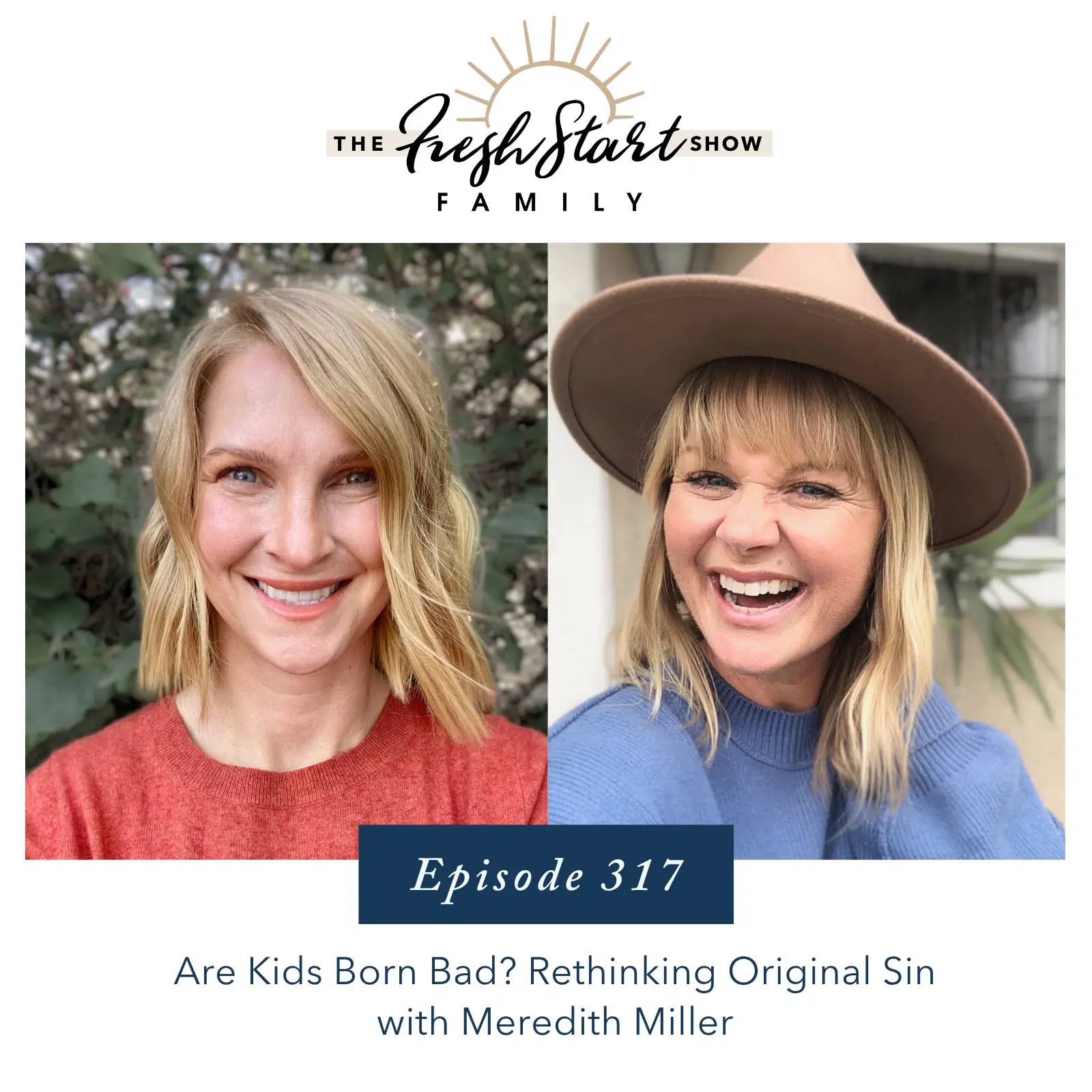
What if the story you were told about sin… isn’t the whole story?
In this deeply freeing conversation, Wendy sits down with author and faith leader Meredith Miller to explore one of the most tender, loaded questions many parents carry…
Are kids born bad?
Together, they unpack how traditional teachings around original sin and total depravity have shaped generations of parenting… and how we can choose a different path rooted in truth, compassion, and connection.
This episode is an invitation to breathe again. To release fear. To trust what your heart has always known about your child… and yourself.
If you’ve ever wrestled with faith, parenting, shame, or the desire to raise kids who feel safe in their goodness… this conversation will meet you right where you are.
Episode Highlights:
- The story of humanity begins with goodness, not brokenness
- The story of humanity begins with goodness, not brokenness
- Children are image bearers, not problems to fix
- There is more than one faithful way to understand sin
- Fear-based theology often disconnects us from truth and trust
- You can take scripture seriously without interpreting it through shame
- Sin is real, but it is not your child’s identity
- Jesus came to restore connection, not control behavior
- Parenting is mentorship, not domination
- Kids don’t need fear to grow in faith, they need safety and relationship
- Healing your own shame changes how you show up for your child
- You are allowed to question what you were taught
- You can raise kids who feel deeply loved by God without fear
Resources Mentioned:
Find Meredith on Instagram
Meredith’s Substack
Meredith’s “Are Kids Tiny Sinners?” substack article
Meredith’s “finish the sentence” IG reel with her kids
Meredith’s book Woven: Nurturing a Faith Your Kid Doesn’t Have to Heal From
Meredith’s book Wonder: 52 Conversations to Help Kids Fall in Love with Scripture
Meredith’s 1st episode on The FSF Show
The Book of Belonging by Kelsey McGinnis and Rachel Elenanor
The Little Soul and the Sun by Neale Donald Walsch
Unable to listen, or prefer to read along? Here’s the transcript!
Wendy:
Hello families, and welcome back to a new episode of the Fresh Start Family Show. I’m your host, Wendy Snyder, powerful parenting educator and family life coach. I’m so happy you’re here.
Today we are so excited to have Meredith Miller back on the show to talk with us about the question, are kids born bad? We’re going to talk about how we can rethink original sin to raise faith-filled kids without shame.
Welcome to the show, Meredith.
Meredith:
Thank you for having me. I always enjoy talking with you so much. I’m looking forward to this.
Wendy:
I am too. I am so grateful for your work, Meredith. I have your first book here in my hands right now, in case our viewers are watching on YouTube, Woven: Nurturing a Faith Your Kid Doesn’t Have to Heal From. You don’t know how much I recommend this book, Meredith. Your name comes out of my mouth so much.
We have families of all kinds in our community. I love really having a very inclusive, diversified community with families of all faiths and no faiths. We also have a pretty large section of families who are coming from more of those high-control religious environments where there was just so much they don’t want to repeat with their own children. They’re often first-time painful generational cycle breakers. We’re teaching them how to compassionately discipline versus punish, which is, of course, so different than the “godly discipline” so many of them were raised with.
So you coming in and really supporting them through this book, with the scriptural side of how to raise children in this new, beautiful, healthy Christian way, is just so meaningful.
This book is so awesome. And now you have a new book. Tell us about the new book that’s coming out.
Meredith:
I do. It’s called Wonder and it’ll be out in March of 2026. It is a collection of 52 Bible stories that I picked because they’re the ones kids should be hearing, which means I left out some ones you’re going to find in a common kids’ Bible.
They’ve been paraphrased in kid-accessible language, but it isn’t a kids’ Bible. It’s a grown-up’s guide to exploring the Bible with kids. So in addition to these paraphrases that you as an adult could just read with enthusiasm with a kid, there are footnotes like you’d find in a study Bible, and they’ve been curated around the stuff that kids wonder about, think is weird, or that doesn’t make sense to them. It’s also for kids who’ve heard stories a lot and are like, “Well, I’ve done this before,” and you can say, “Ooh, I’ve got a new fun fact for you.”
It’s your best friend for feeling like you don’t have to be an expert to have great conversations with your kid about the Bible. That’s what’s happening, and I’m so excited about it. It was just a really fun way to bring together the nerdy part of my brain that loves to study scripture and the part of my experience that has told a lot of different children a lot of Bible stories in the last 25 years.
Wendy:
That’s so cool. The cover is absolutely beautiful, and I just cannot wait to help you promote that book.
The way you describe it reminds me a little bit of when I had the honor of interviewing Mari Clark and Rachel Eleanor about their book A Kids Book of Belonging. I told them it feels more like an adult book because so many of us who have been in an evolving faith journey or letting go of unhealthy Christianity, it was the first time I had picked up scripture in a while and it felt safe and comforting.
I had just been in a season where I was unmotivated to pick up my traditional Bible, not because it really had anything to do with God. It had just been such an intense last few years as I left the evangelical space, and there was just so much sadness there. Now, of course, I’m in a different place. I call it ancient modern Christianity. The church building I sit in right now is a hundred years old. Our congregation is 150 years old. The type of Christianity I have found now is this healthy Christianity that I feel like my soul was always yearning for. I found it.
But it took so much stumbling and wandering in the wilderness and thinking that there was only one way. It took me 15 or 20 years to realize what was actually happening.
So will you start us off, Meredith? Today we’re going to talk about this concept of tiny sinners and original sin and how that’s taught to so many people, total depravity. So many people in our community were raised with that and are now realizing they do not have to pass that on to their children. There are different ways to read scripture and understand that.
Would you set us up with this? When I’ve seen you teach or heard you write about this concept of “tiny sinners,” I see you start with the idea that a lot of people in Christian faith circles, especially raising children in Christian faith circles, feel like there is only one way. There is one way, it is the truth, and that’s it.
I’ve heard you speak and teach around how this is actually not true. Often the people who are saying there is one way and only one way are the loudest. They do often have the biggest social media presence, and they are intense and often aggressive. But that’s not actually the truth in Christianity. Would you tee this conversation up with that, just to create safety? Because so many of our parents feel like it is so scary to even have conversations that are different than what was ingrained into them in the first two decades of their life.
Meredith:
Yeah, I would love to, because it is really important. When we’re thinking about how we want to introduce our kids to God, we are doing a theological examination. That is a challenging process. It’s intellectually rigorous, and that may or may not sound fun to us, depending on how we’re wired and how study and rethinking feel to us.
Beyond that, there is a particular camp within Protestant Christianity that is really intentionally well-organized to be very loud. There are certain segments of this group that will write openly about why they’re doing well, because numerically it’s a highly represented group and, overtly, in articles you’ll see it described that they are skilled at social media. This was an intentional choice in terms of promoting the way they understand faith and scripture, to be really media-savvy.
That creates an amplification of their ideas. Over the last 15 or 20 years, what you’ve seen is this particular view from a particular subset of Reformed folks positioning themselves as if they are the center of Christianity. Whatever it is they think in the theological particulars, which today we’ll talk about sin, but there’s kind of a list of things they think are the right way to read the Bible and do faith.
More than just thinking they’re right, they have intentionally positioned themselves as if they’re the middle. It creates an artificial sense for anybody who’s not familiar with what’s going on that if you disagree, that has somehow put you outside the boundaries of acceptable faith or orthodoxy, or what’s “real Christian.”
But they aren’t the middle. They aren’t the arbiters. They aren’t the gatekeepers. They are one stream in a robust stream of Protestant Christians, with whom I personally happen to disagree about quite a lot.
We have done better and worse over the long haul of Protestantism with disagreeing and still believing we belong. We are not right now in a season where Protestant Christians disagree with one another very well and still hold on to the fact that, yeah, we’re still Christian together. We’re in a really “you think what I think or you aren’t a real Christian” kind of place.
That does create a real challenge anytime you move into something they would say is central, and then you start to say, “I’m not so sure I agree. I’m not so sure I see it that way.” This question around what sin means in the Bible, what it means to talk to our kids about sin, how we define it for them, and how that definition grows as they age, all of these things become very hard when you have a locked-in, very loud perspective.
Also, this has been a question and a conversation since the early centuries of Christians trying to figure out what this means and how it works. It’s not a new question to be like, “This feels complicated. I’d love to give it some more time.” You’re just joining everybody who’s thought that way for hundreds of years. It’s all good.
Wendy:
I love the way you teach, Meredith. It’s so down-to-earth and funny. It’s really nothing new. I just had the honor of interviewing Sharon McMahon this morning, and I still cannot believe it. I’m just pinching myself.
But in her work too, historically, this isn’t new. People have been exploring these concepts, questioning, evolving, and working through all of this for hundreds and hundreds of years.
What’s so interesting is that once you add in so many of these tenets from the Christian circles that are like “my way or the highway,” those are often also the circles that combine fear and force, the hitting and harming of children, the teachings of instant obedience. Quite literally, there is danger conditioned into a human body from very early on that if you question authority, if you go outside the box, if you stray from what the people in power are teaching, which are your parents and the authority figures around you, then you are going to get hurt in one way or another.
So I just have so much compassion for the parents and community members we serve that really struggle with this. I had the honor of graduating 10 people a few weeks ago from our high-level certification program, our full mastery program, where they are now certified to teach or coach parenting with the Fresh Start Family approach. I go very, very deep with them.
A few of them had been raised in this very high-control environment. They were actually from a different country, but it was all very similar. To watch and support them through the suffering that this had created in their nervous system, even around the questioning of going outside the box, was intense.
One in particular was very deep in the Calvinistic total depravity circle. She walked in with such low confidence. It was like she was terrified of trusting herself, thought it was impossible, and had no confidence.
Meredith:
Potentially also wrong. If you come from a certain version of this, trusting yourself is choosing your sinful nature over God. Trusting yourself is wrong because, to pull a verse out of context, “the heart is deceitful above all else.” So you are actually supposed to second-guess yourself and reject yourself. That is somehow considered more spiritual than learning to connect with the Spirit of God that lives within you and the image of God you are stamped with.
All of these pieces are really of a kind.
Wendy:
Exactly. She walked in with such lowness, hopelessness, and disempowerment as a mom of five and left just feeling so free. I think to this day, it’s one of the most beautiful testimonials I’ve ever gotten after a seven-month program. She learned that she is inherently good and worthy, that she can trust herself, and she upped her emotional literacy by a thousand percent.
Now she understands what’s happening in her body when she feels scared and angry, and that it is safe to trust herself. It’s really interesting.
So one more fancy theological jargon question before we move on to the subject matter. One of my favorite things I learned from you, Meredith, in one of your studies, was the four different ways to read through scripture. Let’s quiz me and see if I got it right. I did not check my notes.
Inerrant, infallible, literal, and contextual. Did I get them all?
Meredith:
Yes, and then I sometimes talk about authoritative too.
Wendy:
Oh yes, there was a fifth. Okay, so tell us the difference between these ways to read the Bible because, again, those big loud circles are going to make you think there is one way and that’s the only way.
Meredith:
One right way, yes. And that starts from inerrancy. Inerrancy is the idea that the Bible is literally without error. There would be some dialogue about whether we mean English translations or whether we mean in the original manuscripts, which, just to be clear, do not exist, but were they to be found, they would be perfect. That includes no typos. Not an error.
That often goes along with people who believe the best way to read scripture is literally, but not always. Literalists would say that if on day one the world was created like this, then that is a true 24-hour cycle in creation. If the account of Noah says that the world was flooded, it means truly the globe was covered in water. It is not regional because the text does not say regional. Literalists would look at most of the stories of scripture and say, “That means that’s how it happened.”
Again, you don’t have to put inerrancy and literalism together, but it’s pretty common.
Infallibility was meant to be an alternative to inerrancy when it first came into vogue in the 1970s. Seminarians and professors were working this out, and infallible became the idea that the Bible will not fail us in what it teaches. It is true in what it leads us to, but what it teaches is still a conversation we have. How we interpret what the Bible is saying to us still takes some practice and is still a dialogue.
Nowadays, I think that distinction has collapsed somewhat. People will say inerrant and infallible and kind of grab the same word, so you might not find that distinction in the same way it originally cropped up.
Authoritative would be the idea that whatever scripture says, I recognize it as an authority in my life. I will defer to what the Bible says. However, what it says is still open as part of an interpretive conversation. Not that I get to decide what the Bible means, but that I listen to collective scholarship, wise counsel, people who know languages better than me, and so on. I get to wrestle with scripture, and I believe that what scripture says I am going to try to let be an authority in my life. So it’s a posture I take as a reader of the story of scripture.
Contextual is about the skill of understanding that the stories of the Bible come from a particular time, place, community, and culture that are wildly different than our own. Contextual is about recognizing that potentially we were not on the minds of the writers one bit. They were telling the story of God in the style that would be understandable to the community they were writing to, the one front and center in their actual lives at that moment.
So we get curious, and we grow skills in what that might have meant for them in their world in order to help us do good work on what the text is teaching and what the authoritative thread is that we carry forward.
Again, the people who want to say, “But the Bible says,” love to grab these five words and leverage them over people with whom they disagree. They love to quickly say, “Well then, you just must not think the Bible’s inerrant.” And it’s like, well, lots of Christians haven’t thought the Bible was inerrant for a very long time. It’s a relatively new statement to go that bold, and it was not universally accepted by Protestants even when it first came out.
So having a sense of these categories hopefully just gives somebody some freedom to be like, “I can take scripture incredibly seriously without necessarily having to have the same lens of inerrancy or literalism that others might have.”
And I’ll just say, if someone is like, “Wait, I need to camp out on this whole how-the-Bible-works thing,” Zach Lambert’s Better Ways to Read the Bible is a wonderful book. It’s about these lenses, and it gives you a lot of examples of how those lenses interpret what we read. We all have lenses through which we read scripture. We all do it. We pretend we don’t, but we do.
So if that piece for anybody listening is like, “I need to stay here and understand what it means to take the Bible seriously in different ways,” Zach Lambert’s Better Ways to Read the Bible could be a great next step.
Wendy:
I’m so happy you mentioned that. I’m still trying to get him on the show, so maybe you can put in a good word for me, Meredith. I’m going to send you an email.
Meredith:
Yeah, I’ll text him after this. Zach, come hang out with Wendy.
Wendy:
Come on, Zach. I’ve referred his book to so many people already, and I haven’t even read it yet, because I trust that his work is going to really dig into these things.
I love this because once you start to empower yourself with an educated understanding that there are different ways, it makes sense why in certain circles, or in this particular student I’m talking about, she’s realizing, “I’m still knee-deep in a circle where this is the way.”
It’s been beautiful to hear her story because over time she started listening to her body. In our work, we do so much embodiment work. We start to listen to what I would call divine intuition. You’re getting those hits from the top and you’re getting them from within. All of a sudden she’d be reading a Bible story to her child and she’d be like, “I don’t…” and she’d skip the page. Then she’d come and we’d chat about it. It’s so beautiful because she was creating safety in her body to say, “Something feels off here. As I’m reading this to my three-year-old child, I’m realizing I don’t want her to think this is the way. This does not actually feel Christ-centered to me.”
Now that she’s an adult and she’s invested in healing work, she realizes she has a choice. A lot of people just don’t think they do. So for me, leaning into the contextual lens has been so interesting because it makes it fun again. You can look at a funky weird verse and dig into what was going on in that time, society, culture, laws, and legal structures.
Meredith:
It’s like a scavenger hunt. That’s why Deuteronomy is my favorite book of the Bible. It has been for a long time. Part of it is that it’s such an amazing story of a community trying to figure out how to reshape their life in non-Egyptian ways. It’s this embodied rejection of empire that we could learn something from. It becomes so fun.
Wendy:
It does. And I think a lot of people are ready for that breath of fresh air. Once I found your work, I was like, “Oh, this is so fun again.”
So now that everyone knows the fancy theological jargon of original sin and total depravity and the five different ways to read the Bible, let’s jump into our subject matter.
We’ve already been talking about it, of course, but when it comes to rethinking original sin to raise faith-filled kids without shame, riff for us around how our kids are not tiny sinners we need to fix, but image bearers learning how to be human.
Meredith:
This is all a question of whether the Bible starts in Genesis 1 or starts in Genesis 3. We have so accepted a false narrative that the story begins in Genesis 3 with people who were told by God not to do something and they do it anyway and ruin everything and God is big mad. The whole story starts with tragedy.
You’ll see this, for example, in children’s Sunday school curriculum or children’s Bibles that tell Genesis 1 to 3 as if it is a single story. They’ll hear about the creation of God’s good world and immediately be thrust into the plot of things unraveling in Genesis 3, all in one. That becomes a child’s impression of how the story starts.
The story starts in Genesis 1 with a God who is so great they can just speak a world into existence that is ordered instead of chaotic, that has a container for everything and then fills it up. And then at the pinnacle of all of this, God says, “Let’s make humanity in our own image.” So male and female, God made them, and God said it was very good.
That is a whole entire story. The beginning is nothingness and chaos. The middle is the creation of a good abundant world. The end is people who are made in God’s image and receiving God’s original blessing.
So there’s our new fancy theological jargon. Original blessing says that the story starts in Genesis 1 and that people are, most of all, image bearers, and that nothing can take that away from them. Not because of how great people are, but because if God has said it so, then it’s so because of who God is and what God can do in humanity to stamp that as the most foundational truth.
If I could wave a magic wand over a listener, it would be to let them shake off any narrative that says the story starts in Genesis 3. If that’s what you’ve been told, you just get to let that go. It starts in Genesis 1.
Image bearing is an identity. It’s not something that can be lost. One of the best sermons I ever heard given to high school students about this was by Brian Field, a pastor at a camp. He had two posters in frames on easels. He started talking about the way sin affects us, how we get tangled up and go selfish and hurt ourselves and each other. Every time he described one of those things, he added a layer of paint to one of the pictures in different colors and textures, smearing it around to the point that the second image was absolutely disgusting and unrecognizable.
And yet beneath all that was the whole and intact original image in all its beauty. What he was giving those students was a visual representation that no matter what, beneath it all, untarnished, is the image of God that has been stamped in you.
That’s the theological claim of original blessing. The name tag a kid wears at all times is “image bearer.” It is never “sinner.” Even though, and we can get into this more, yes, of course everyone is going to sin. “For all have sinned and fall short of the glory of God.” Yes, that is true. This doesn’t counter that. It’s just about being clear about where we start and what stays true even in the midst of sin.
Wendy:
I love that so much. It’s amazing as I look at child development and how much has come out through the years from doctors, psychologists, and child development experts. There’s just so much exchange of information and education now that we know about what normal behavior is that in the past was confused and labeled as sinful.
Meredith:
Yes. I know you’ve had Kelsey McGinnis and Marissa Burt on as guests. I could not encourage people enough to look at The Myth of Good Christian Parenting as an example of this idea that a baby who won’t go to sleep is defying your God-given authority, or that a toddler who doesn’t come to you quickly is disobeying you. This stuff is just utter baloney.
What I appreciate about their work is how they trace its origin, because I think that empowers us to become suspicious. When you can see where it began and then, of course, see its fruit, that really empowers a person to go, “This is not the timeless truth of God. This is a creation of just a small group of people who ended up being very popular and very powerful, taking normal child development and labeling it sin, and taking normal challenges and saying, ‘No, this is a heart issue.’”
I remember once my kids pastor, who was my boss when I was an assistant kids director, was preparing to tell kids Jesus’ story and invite them to say yes to Jesus as a friend. One thing she said to the group of volunteers was, “We’re going to talk about sin because Jesus defeats sin and invites us into life that is better than that. But also, how much sin do these kids actually have?”
I was so grateful. She was like, “If our room is full of kids who are five to ten years old, how much do these kids actually have? Because they’re kids.” That means they’re growing. They are growing into what it means to be people.
That’s one of the messages of God becoming a person in Jesus and therefore being a child, not just a grownup. God understands the full process of being human. That’s a question that has to be grappled with. Does God actually understand what is happening in the heart and mind of a four-year-old who is absolutely melting down, potentially even violently and physically?
The incarnation, God in a body, is a testament to the fact that God genuinely knows what it means to be four and not necessarily be able to follow a direction.
Unless you want to claim, which I suppose some might because there’s nothing in the Bible that explicitly says otherwise, that Jesus never had a meltdown or tantrum. But we do have one story. It’s called Jesus ignored that his parents were leaving and peaced out for days. So we’ve got something. He was a kid when he did that, and when they found him, he did not apologize.
So what are these theological threads that invite us to think differently? One of them is this: Does God in God’s wisdom know what it is to be human? And does God respond to the challenges of being three and seven and thirteen with the standard of obedience and perfection? Or does God genuinely have compassion for how hard it is to learn to be a human in this world, especially a young human? Because we are not a culture that collectively values and raises up children all that well.
God stands with children in that.
Wendy:
Absolutely. There’s a book called The Little Soul and the Sun that I love. In it, God and this little soul make this pact. The soul basically says, “I want to be patient,” and God says, “Well, in order to learn patience, someone is going to have to really test you.” So this little soul’s best friend says, “I’ll go down with you and be the one that’s a pain in the ass so you can learn patience.”
I love that story because it reminds me of this. Are kids from a young age, especially little tiny kids, being bad? Or are we being given the opportunity to develop beautiful Christ-like attributes of patience, compassion, humility, and self-control? You literally cannot develop those things if you don’t get opportunities to practice.
I feel like the common teaching, especially in the high-control, unhealthy Christian world, robs parents of the opportunity to develop those things because they’ve been fed this myth that they need to break the will of this child or they are failing and not operating in a godly way. Then when you were raised with the rhetoric that now God is disappointed in you, and there’s even a question of eternity, it is so intense. Really, these are missed opportunities over and over again to develop those fruits of the Spirit that happen when you’re actually living a Christ-centered life.
And the second thing I’d add is that as I get older and watch power-over structures work, whether that’s in religion or the world or a nation, they all demonize a certain section of people and then justify how they have to have power over them to make them better.
As someone who just feels like they were born with a justice button the size of Texas, I can’t sleep at night if anybody is oppressed. To me, children are the biggest oppressed group in the world because it has been justified for so long that we have to hurt, harm, humiliate, and scare them into submission because otherwise they’ll just go their own way.
No. Actually, children guide us. They’re the ones who guide us, and we miss the opportunity because we’ve been fed this lie that they are tiny sinners who need us to shape them.
So our second point here is that there’s more than one Christian story about human nature, and not all of them begin with brokenness. I feel like we kind of covered that. Anything else you want to add there?
Meredith:
That really is so much about understanding scripture well. The story doesn’t start with sin. Jesus did not come to offer a sin reduction plan. And the story does not end with sin’s defeat.
The story starts in the presence of God, and Jesus is the presence of God, and the story ends in the presence of God. Whatever we do to take sin seriously and understand this theme through scripture, and it is there and it is important, sin is always subsumed by the presence and power of God.
There is an odd backhanded disempowering of God when we become extremists about the power of sin. I find that really fascinating from some of these camps. Their functional theology becomes such that sin is always so strong that it’s like almost not even God can break through and win.
You referenced the fruit of the Spirit, this idea that the Spirit of God is truly indwelling people who follow Jesus and empowering them toward lives that look more and more like Jesus and reflect more and more of the character of God. That’s a process that grows in a child over a lifetime.
And yet this alternative camp would say that a parent is supposed to manage that process or an authority figure is supposed to manage that process, and there is a very tight timeline on that. Toddlerhood or preschool years are where it’s supposed to be defeated out of them by age four.
Again, you’d say it like that and some folks who subscribe to that would say, “No, we don’t mean that. You’re misrepresenting us.” But when you listen to the stuff they put out, the functional theology is that a parent is responsible for the discipleship process of a child. That process is fundamentally about obedient behavior to the parent. It often centers on behaviors that bother the parent, and somehow God is supposed to sanction all of that.
That is very different than saying, “You start in the presence of God, and Jesus comes as the presence of God, and the story ends in the presence of God, and I am teaching you, kiddo, how you can be part of that story.”
Wendy:
That’s so powerful. Riff for just a second more on what you mean by Jesus did not come with a sin reduction mission.
Meredith:
Jesus came to end the power of sin and death, absolutely. He did so that people could accept his invitation when he says, “The kingdom of God is at hand.” Right here, right now, on this earth, there is a reign of God, an alternative reality, that is available for people to live into. What blocks them is this force.
When Paul writes about sin, he often almost personifies it. It’s like this thing that is always against humanity. But notably, God is on our side against that force.
When Jesus comes saying the reign of God is here, then the work he does with sin is to defeat any power it would have to keep us from fully living in that kingdom. We need Jesus to do that. Jesus is the only one who can do that. It is not possible without his life, death, and resurrection.
But it is not Jesus saying, “Come to me all who are weary and burdened and I will give you the steps that will help you become more good and less bad. Take my yoke upon you and learn from me because I can make sure that you mess up less often.” If that’s the message, that doesn’t sound like “I am gentle and humble of heart.” It doesn’t sound like rest for our souls.
Jesus has this alternative way to live. Insofar as sin keeps us from actually being with Jesus to do it, he’s going to take care of that for us. That is the power of the resurrection.
The images for what Jesus does with sin are not just me liking them better. They are also biblical images for sin. I have this graphic I put together for a class once, and I was looking at it before we recorded. It is one biblical scholar’s list of the ways the Bible talks about sin and the ways the Bible talks about what Jesus does to deal with it.
There are over ten different images and descriptions of sin that run through the whole story of scripture, including things we might never think of, like pollution. There was a lot of concern about fluids and where they lived and how they belonged. This would be true for things like menstrual fluids and seminal fluids. It’s a very different ancient understanding of “we’ve got to deal with this.”
No one is saying those things are wrong, but it’s part of the list. Sin is a power, which I mentioned before. Sin is our lower nature. We have these competing parts of us, the part that is always drawn to good and the part that is kind of selfish and not. There’s a variation of that throughout scripture.
Then you get this list of the ways Jesus deals with it. Jesus carries humanity’s wrongdoing, holding the weight of it and carrying it away from us. He makes reconciliation possible. He cleanses and purifies because of that pollution theme. He rescues. He makes it so we can be one with God again, which is really what atonement is about. At-one-ment. The process by which we are able to be more aware that we are one with God because of Jesus.
The list goes on, but I find this both beautiful and very compelling when we start to talk about why we don’t have to live with only a Jesus who gives us a sin reduction plan, because Jesus is doing so much more.
Wendy:
Sometimes when it comes to studying the life and work of Jesus in scripture, it almost seems so fun to expand your brain to understand things that are so outside of our common understanding. It makes religion fun when you allow yourself to be willing to see it from such a different perspective than what’s always been taught.
And so many of us are like, “Gosh, that feels so much more in alignment with what we believe deeply and intuitively.” To be able to trust that inner knowing of like, that makes more sense about the character of Jesus and what he came for.
So cool. I could hear you riff on this stuff for hours.
Okay, our last point. We can raise kids in faith without fear, connecting them to the God who made them good. Leave us with this final point as we wrap our discussion on rethinking original sin to raise faith-filled kids without shame. I know fear just injects people with shame, and in my world when people heal from shame, their whole life changes. So how can we raise kids in faith without fear that leads to shame?
Meredith:
Part of it is you just get to say, “I ain’t doing that.” You get to say, “No, we’re not doing it that way.” And then sometimes that leaves people asking, “So what are we doing?”
You are introducing your good kid to the God who made them so. You’re saying, “Yeah, kiddo, you’re good. Let me introduce you to the God who made you that way. Not just you, but every person you meet. And not just the people, but this whole world.”
Then at some point your kid is going to ask, “So why, if all of us are made in God’s image, are those kids hurting systemically because they’re not being cared for like they deserve?” And you get to say, “We have a word for that. We call that sin. Sin is anything that isn’t what God would want. God wants every person, because we are loved and bear God’s image, to know they are loved, to flourish, and to be in community. So when we see something get in the way of that, we call that sin.”
What’s so cool is that because we know and love God, we get to join with God in helping those things get fixed. What’s even more cool is that someday it all gets fixed. This is God’s promise to us. Because Jesus is alive, we know there’s a day coming that is all happy, no sad, all gladness, no bad.
Until that day is how everything works, we get to be part of that with God. That’s what the church is about. That’s what God’s people, near and far, the ones with buildings and the ones without buildings, are about. They are about living in this way that matches who God is together.
So this is the story we tell our kids. You’re a good kid. God made you good. And then we go from there.
It doesn’t overlook sin. It isn’t soft on sin. Quite the contrary. When I look out and see the stuff that makes me go, “This is evil,” I think, if we’re going to talk about taking sin seriously, I want to actually be talking about serious sins. I want to be talking about the stuff that is actually wrong and evil and dishonoring the image of God in each other and abusing the land God has given us as a place of nourishment and abundance.
If we’re going to take sin seriously, then let’s talk about serious sin. When we start with our kids by saying, “You’re good, God made you good, Jesus came to make sure you could live into that more and more by the power of God’s Spirit,” then let’s get to work on the stuff that’s actually sin. Let’s link arms with God’s people, empowered by God’s Spirit, and join forces against that stuff for real instead of just spiraling in shame that says, “I’m so bad. I’m not good enough.”
That shame spiral blocks our ability to participate with God in whatever thing, small or big, is ours to do for the sake of others knowing their goodness as image bearers.
Wendy:
I love it. And bringing it back to the simple misbehaviors that happen on a consistent basis, I used to teach this thing called the firm, kind authority cookie. It was back years ago when I was teaching more in the evangelical spaces. I would say the first part was the firm boundary. This was more for when something needed to be more firm.
Now we teach a different method when we’re making agreements ahead of time and we’ve got patterns and need to use agreements, empathy, restating the agreement, and choices. That’s more chill. But when it’s intense, we teach firm boundary, then connection and mentorship, then firm boundary again. So we call it a cookie.
I used to teach the firm boundary as something like, “I will not let you hit your sister.” It was very much like, “You are being sinful. I will not allow that. I need to stop it.”
Now it’s more, “Hey, we have a value in our home that is we solve problems peacefully with our words. That is true power. You’re not alone. You’re not an alien. Everyone makes mistakes. And I will teach you how to keep your hands to yourself when you have a disagreement with your sister, because in this home we have a firm value of peaceful conflict resolution.”
It’s so different than the way I used to teach when I was deep in the evangelical spaces and drinking the water without realizing how it was affecting me. It’s so different than, “I will not let you act like that.” The tone used to be very much, “You are being sinful. I won’t allow that.”
Now it’s more like, “Hey, I’m going to come beside you because you’re just not quite in alignment right now.”
We also teach in our revenge misbehavior redirection that we bring it back to the child. We’ll say, “Hey, earlier when you said ‘I hate you’ or ‘you suck’ or ‘this is the worst family,’ I think you were just mad.” Because, God, you are made in God’s image. You are good. You are loving. You are kind. You are patient. You are respectful. Earlier, I think you were just mad. You were just hurt that life feels unfair and your brother gets to stay up later than you. So next time, here’s how we’re going to do it.”
I want you to practice feeling hurt and then doing it differently. But it all comes back to the fact that you’re made perfectly good. Everything about you is good, and sometimes you just mess up. Let’s get you back in alignment with who you are.
I always think of it like an artichoke. We’re born with these beautiful, tender hearts inside, the artichoke heart that everyone loves. That’s the yummy part. Then over time these hard leaves with pokies on them form. You can’t just take an artichoke and bite into it. You have to steam it and melt away those hard layers.
I feel like that’s what happens as life goes on, because children are watching everything we do. Even the parents who challenge this and say, “Yeah, but the kid that’s three and already throwing a tantrum or hitting, how can you say that’s not original sin?” I’m like, honestly? The apple doesn’t fall far from the tree.
By three, they have already learned by witnessing the world how to do power over, how to get what they want through force, aggression, and intimidation. I always think to myself what it would be like to raise a kid on a total farm, if you were fully mastered in the work that I teach and basically were Jesus and never messed up. If you had a kid away from capitalistic society, in nature, with animals, I don’t think a kid would just naturally go there in the same way. I feel like it’s full humanity conditioning, and then we blame it on the kid.
Meredith:
That full humanity conditioning is what we mean by sin. It’s a little bit like how we’re all going to catch a cold at some point. Sin is inevitable. But that doesn’t mean it’s inherent or inherited.
Yes, it’s inevitable because the systems, the power-over systems that are as big as global atrocities and as small as “I’m annoyed that my sibling seems to be getting something different,” those systems form us. And yes, our kids are going to be formed by them too, as are we.
So there’s this reality that we are guiding and our kids are growing. That recognition of how the world works lets us ask, “How do we create a home that is safe, a home that is a place where we can learn?” That’s how we take sin seriously, by creating a home where grace is real for the long haul, where it is actually true that there is no mistake that leaves you too far gone, and there is always someone here to help you.
That is actually how you embody a story that says yes, sin is serious. That is why it matters so much that our family cares for each other as we learn how to be through this. If we don’t, of course you’re just going to be hurt and hardened by the way the world goes after you, kiddo. So I’m here to help. I’m here to help you navigate.
Wendy:
Yeah, I’m on your team. It’s the best. You’re not crazy. You’re not in trouble. I’m on your team. You’re just a normal kid growing up. I’m going to teach you, and I’m going to go first.
I know we have to wrap because we’re at time, Meredith, but would you finish us off with that reel you did? I don’t know if you remember the questions, but you did this trend where you were asking your kids to finish certain sentences. I loved that trend so much because you got to see the people who are really painful generational cycle breakers and who are choosing not to raise their kids with original sin, total depravity, instant obedience, “godly discipline,” all the things.
You’re such an example of someone who really did it the healthy way. Healthy Christianity, raising your boys in a faith they don’t have to heal from, speaking original blessing and goodness to them from the day they were born.
Would you tell us those questions again?
Meredith:
Yeah, I do remember. I asked them to finish the sentence of some toxic theological phrases. I said, “These are things that Christians say, and I’m curious what you think is the end of the sentence.” I knew they would not have particularly heard them, so they had this guest tone to them.
The first one was “Everyone is born…” and my older son sat quietly for a second and then said, “in God’s own image.” That was his guess. Like, “Isn’t that the phrase Christians say?” My younger son paused for a second and went, “holy?” because he knew these were kind of churchy.
I asked them, “God is always…” and they said, “with us.”
Then I said, “Jesus came to…” and they said, “be with us.” I don’t remember what my other son said, but that was one of them.
Then I did “Love the…” and that was the only one they knew. They went, “hate the sin,” really quickly. I kind of panicked. Then they said, “It’s from Calvin and Hobbes.” I just thought, imagine a world where kids think “love the sinner, hate the sin” is just a joke from a comic strip. That’s what they think that phrase is from. They don’t think it has any other life or any other power than Calvin and Hobbes.
It was so encouraging to hear them. They’re now 10 and 12. I think they were 10 and 12 when we had that little conversation.
To be honest, because this is the kind of community you have, when my older son was zero to one and a half, he was a terrible sleeper. Not that that’s a trait, but he just did not sleep well. We were deeply sleep deprived and incredibly stressed. I never subscribed to the paradigm that my parenting role was to be a disciplinarian, but I was broken at a nervous system sort of level. I was overstimulated, overwhelmed, too isolated relationally, and we had some other family stressors come up.
There was a very brief window where we had an extreme family crisis come up and my older son did something that frustrated me and I spanked him. I had never before. He flipped out, and it unlocked in me a short season of all my rage coming out through my body. I couldn’t fix it. It took maybe a year to circle back and get healed enough and retooled enough.
It wasn’t a high-frequency pattern in our house, and our kids probably don’t remember, but I remember. I remember how visceral it was in my body that my brain and my nervous system couldn’t find any other way forward.
I remember the incredible shame. I can feel my face get hot telling you even the summarized version now, as someone who thought I’d never do that. I think we all have those moments as parents where it’s like, “I always thought I’d never do that. I always thought I wouldn’t cross that line.” Then we say something so unkind to our kids, or we say it in such a scary way, or our voice gets so frightening, or we use our bodies in ways we never thought we would.
That place to say original blessing is for us too. The image of God is not broken in us too. The healing that comes for us as the parents, to say we are not defined at a character identity level by even that stuff that we would full-on say, “I would take that back in a heartbeat,” is so important.
But it was long. It was long to reclaim that. It was long to work through it. It was not just intellectual, it was embodied. It was a holistic thing.
So I’m just so with any of your listeners who are in that stuckness and shame. I’m grateful for where we are now. I’m grateful for my kids saying all kids are born in God’s own image and for that to be what they think. But it was a journey to get there.
When they were in their early childhood years, we had to take some stuff on in order to turn that corner because life took us away from what we always aspired to be as a family. That’s what grace is.
Wendy:
That is so meaningful. It’s really important for my community to hear that. There’s no perfect path. I’m sure some people would think, “Oh, Meredith has just been perfect from day one,” but hearing that is just so meaningful.
It is such a visceral nervous system response, and that’s become such a fascinating part of the body of work that we teach now. It’s really cool to think about these kids, even if the first two or three years, or for some of our students the first six or ten years, there was some of that fear-based stuff. Most of us are reversing this shame-filled, intimidation-based, fear-based upbringing in our third or fourth decades of life.
These kids have the honor of getting it reversed very young, and because they have those neuroplastic brains, it gives me hope in a world where I’m often hopeless that the next generation of human souls we are raising are going to grow up with so much less shame than many of us who were raised in authoritarian ways. That’s a bright spot.
So no matter where you started, the fact that you’re willing and eager to learn a different way is just so amazing, and that’s what we’re celebrating today.
Meredith, thank you for being here. We went a little long, so thank you for staying with me. Please let listeners know where they can pre-order your new book, get your new book, and where they can find you and engage with your beautiful work.
Meredith:
Wonder is available for pre-order wherever books are sold. It has a retelling of Genesis 3 that might be exactly what your heart needs to reimagine how you tell that story to kids in ways that will not fill them with shame. It also has a paraphrase of Revelation if anyone was raised on Left Behind and terrified, because that’s not what that’s about either.
I write on Substack at meredithannmiller.substack.com. I have a free monthly newsletter that takes on topics related to kids, faith formation, and family faith cultures. And then I am on Instagram at @meredithannmiller. Those are the best places to find me. I’d be so glad to connect there.
Wendy:
Amazing. Okay, we’re going to link that reel in the show notes. We’re going to link your article called “Tiny Sinners,” which is a really quick synopsis of what we talked about today. It’s a six-minute read. And of course we’ll link all the other things.
Thank you again for being here, Meredith. We love you, and we are so grateful for the work you do in the world.
Meredith:
Thank you for having me. Love you too.