

What if your reactivity isn’t a failure… but a pattern your nervous system learned to keep you safe?
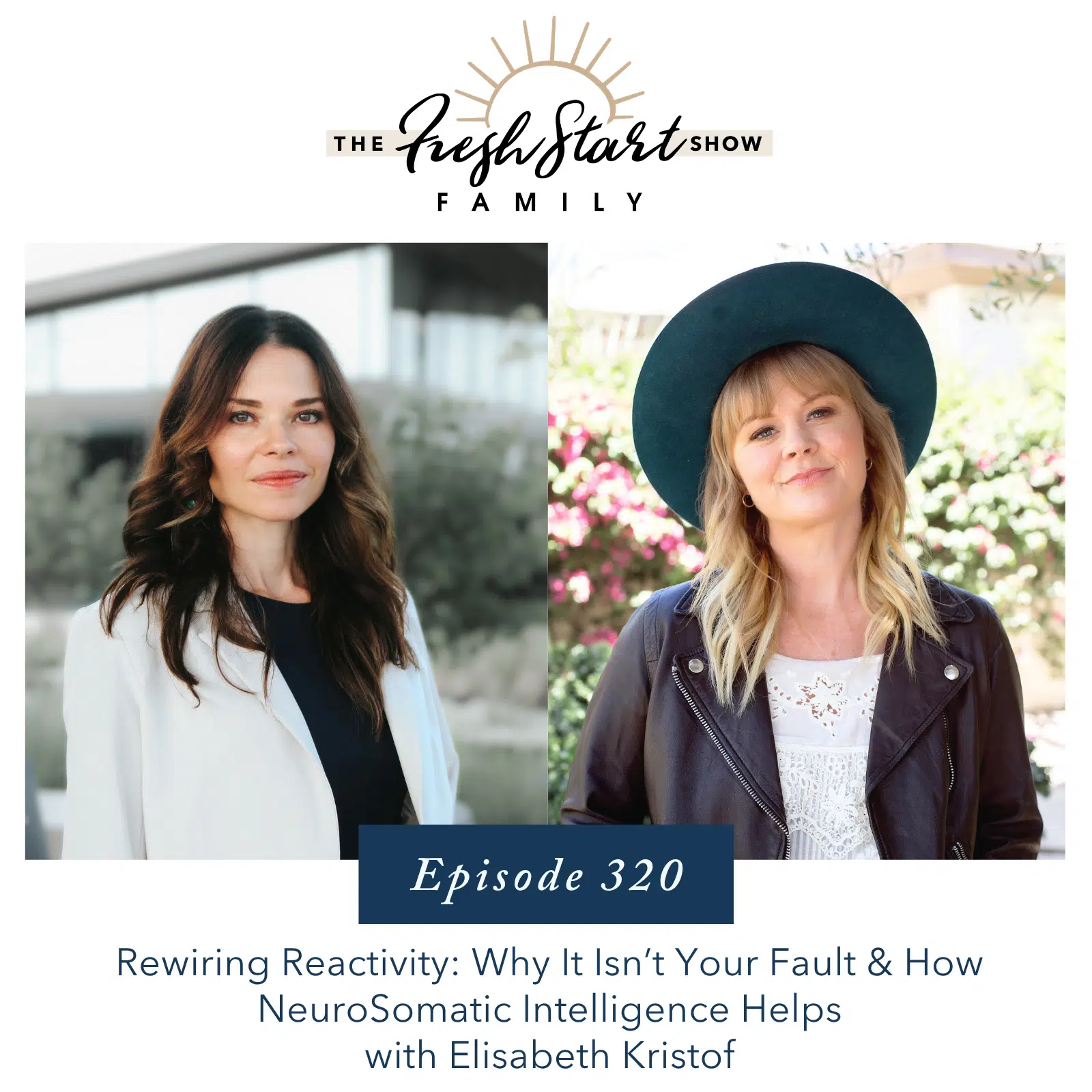
In this powerful conversation, Wendy sits down with applied neurology and somatic practitioner,Elisabeth Kristof, to unpack why so many parents keep reacting in ways they don’t want to, and why it’s not their fault.
They explore how trauma lives in the body as patterns, not just past events, and how your nervous system is constantly shaping your reactions before your logical brain has a chance to step in. From yelling and shutting down to overreacting or giving in, these responses often come from deeply wired survival loops.
You’ll also learn how emotional suppression keeps those patterns alive, and how simple, daily nervous system practices can begin to shift them.
This episode is a hopeful reminder that you’re not broken, you’re wired, and with the right tools, you can create real, lasting change.
Episode Highlights:
- Reactivity isn’t a character flaw, it’s a learned nervous system pattern
- Trauma is not the event, it’s the pattern your body created to protect you
- Your brain is always taking in data, interpreting it, and reacting, often before you’re aware
- Yelling, shutting down, or overreacting are outputs, not the root problem
- Emotional suppression keeps reactive patterns stuck in place
- Emotional literacy is a skill most of us were never taught, but can learn
- You can’t think your way out of reactivity, your body has to be part of the process
- Small, daily nervous system practices create real, lasting change over time
- The pause becomes possible when your system has more capacity, not just more willpower
- Neuroplasticity means you are not stuck, your patterns can change
Resources Mentioned:
Find Elisabeth on Instagram
Brain-based Wellness FREE 2 week trial
Neurosomatic Intelligence website
Unable to listen, or prefer to read along? Here’s the transcript!
Hello families, and welcome back to a new episode. I’m your host, Wendy Snyder, powerful parenting educator and family life coach. I’m so thrilled to be here today with Elisabeth Kristof. We’re going to talk about how to rewire reactivity, why it isn’t your fault, and how neurosomatic intelligence can help.
Welcome to the show, Elisabeth.
Elisabeth Kristof:
Thank you so much for having me. I love the work that you do, and it’s such an honor to be here.
Wendy:
Thank you. I’ve been in awe of your work and what you’ve created for a long time, so it really is an honor to have you here. Thank you for spending time with us.
We met in person back in Miami last year at one of Kate Northrup’s live events, where I started learning more about the nervous system, especially around financial healing and health.
And what I’ve seen is that nervous system healing doesn’t stay in one area. It starts to ripple into every part of your life. It’s been so powerful to integrate that into our work here at Fresh Start Family. It’s changing the game for so many of our parents.
As we talk about rewiring reactivity today, I want to keep a few types of students in mind. Because everyone who steps into this work is doing some kind of rewiring.
But I tend to see three main patterns.
The first is what I call the “standard fear and force” upbringing. This was the autocratic model. My way or the highway. Do what you’re told or else. Don’t question authority. That was just the norm in the 70s, 80s, and 90s. Parents were doing the best they could, but there was a lot of punishment, shame, and disconnection.
Then there’s a second layer, where that same model was combined with religious conditioning that promoted a punishment mindset. Where hurting or harming children was framed as “godly discipline.” That created even deeper wiring, where kids learned to associate pain with love, obedience, and even their relationship with God.
And then the third group I see is families that had warmth and connection, but also high achievement pressure. You were praised when you performed well, but when you made mistakes, there was disapproval, silence, or withdrawal.
Across all three, what I notice is this same pattern. When stress hits, the reaction is big. It feels dangerous to do something different, like lead with empathy or firm and kind discipline. So even when parents don’t want to react that way, their bodies take over.
So I wanted to set that stage before we dive in.
Elisabeth, can you share a bit about your work, your podcast, your institute, and how you got so passionate about this?
Elisabeth:
I’d love to. And yes, these are big, layered topics, so I’m excited to explore them.
I live in the world of trauma, nervous system health, and repatterning. When we understand our nervous system, we start to see that it really is our operating system. All of our behaviors and reactions come from our internal state.
We are neuroplastic beings, which means we’re always changing. When we understand how to work with our system, we gain agency in that change.
I co-host a podcast called Trauma Rewired, where we explore complex trauma, how it lives in the body, and how to work with the nervous system to heal.
I’m also the founder of Neurosomatic Intelligence, which trains practitioners to integrate nervous system work into their coaching or therapy.
And my path into this work was personal. I started in applied neurology, working with movement, performance, and chronic pain. But in 2019, my life really shifted. I lost my business, experienced financial strain, and became a full-time caretaker for my partner who was diagnosed with cancer.
At the same time, I started having severe nervous system symptoms. Binge eating, chronic pain, dissociation, fatigue. Even with all my knowledge, I was struggling.
That led me deeper into somatics and trauma work. I began to understand my own history and see how much of this lived in the body. And that’s when I realized this work could go far beyond performance. It could help people heal at a much deeper level.
Wendy:
So beautiful. I love when experts have both the knowledge and the lived experience.
Let’s lay some groundwork before we go deeper.
Can you define trauma from your perspective, and also explain what somatics means?
Elisabeth:
Yes.
From a neurosomatic perspective, trauma isn’t the event itself. It’s the pattern your nervous system creates in response to that experience.
That pattern becomes the way your brain interprets the world and how your body responds. It shows up as reactions like racing heart, tension, shutdown, or overwhelm. And those internal states then drive behavior.
So trauma is really a learned pattern of protection.
And somatics is about coming back into the body. It’s building a relationship with your internal sensations, learning to feel them, process them, and move through them. Because many of us grew up disconnected from our bodies, this becomes a process of reconnection.
Wendy:
Yes. That resonates so much.
For years, my work was very mindset-focused. Pause, choose your response, think differently. And that’s powerful.
But when I started integrating somatics, it was like a whole new world. I remember being in a class where someone said, “Check in with your body. Is this a yes or a no?” And I was like… what are you talking about?
Now, I feel that all the time. My body speaks first.
And it’s been life-changing.
Elisabeth:
Yes, and that takes time. That connection doesn’t happen overnight. But once it builds, it becomes the opposite of self-abandonment. It becomes a return to self.
Wendy:
And for so many parents, especially those with religious conditioning, they were taught the opposite. Don’t trust your emotions. Don’t trust yourself.
So reclaiming that inner wisdom is huge.
Let’s talk about reactivity.
In our community, the outputs are things like yelling, grabbing too hard, shutting down, or becoming permissive. And most parents will say, “I didn’t plan to be this way.”
So how do we actually change that?
Elisabeth:
It comes back to understanding the nervous system.
We’re always taking in sensory input. Our brain interprets that input based on past patterns, and then it creates an output. That output is our behavior, our emotions, our reactions.
So instead of trying to change the behavior directly, we work with the inputs.
We use sensory tools to shift the nervous system state. That might take 30 seconds to a couple minutes. And when the state changes, the interpretation changes, and then the response changes.
There are two main ways we use these tools.
First, daily practice. Think of it like nervous system hygiene. Just a few minutes a day to help your system take in clearer information and reduce stress load.
Second, in the moment. When you notice cues like tension or overwhelm, you pause, use a tool, shift your state, and then respond.
Over time, that creates new patterns.
Wendy:
I love that. It’s like building muscle memory.
Just like my daughter trains in volleyball, when the moment comes, her body knows what to do.
Same with this work. The more you practice, the more automatic it becomes.
Elisabeth:
Exactly.
Wendy:
Before we wrap, I want to speak to the parents who feel like change is impossible.
The ones who say, “I can’t stop yelling,” or “It just takes over my body.”
What would you say to them?
Elisabeth:
First, compassion.
These patterns are protective. They were created to keep you safe. So it’s not about being broken. It’s about understanding your system.
And second, hope.
Neuroscience shows us that we are always changing. The brain is constantly adapting. So even deeply ingrained patterns can shift.
But it takes repetition and support.
Daily practice is key. Because in high-stress moments, it’s hard to access new tools if you haven’t built that capacity beforehand.
Over time, the same triggers won’t create the same reactions. The pause becomes possible. The space becomes available.
And that’s where change happens.
Wendy:
That is so powerful.
Neuroscience really is the science of hope. We are not fixed.
Elisabeth, thank you so much for being here and for sharing your wisdom in such a clear and grounded way. Your work is incredibly important.
Tell everyone where they can find you.
Elisabeth:
Thank you so much. The best place to start is Brain-Based Membership at rewiretrial.com, where you can get a free two-week trial.
And for practitioners, you can learn more about certification at neurosomatic.com.
Wendy:
Amazing. A free two-week trial, what a gift.
Families, go take advantage of that. Elisabeth, thank you again. We’re so grateful.
Elisabeth:
Thank you. I appreciate you so much.