
What if the key to breaking generational cycles isn’t just learning new tools… but healing your nervous system at the root?
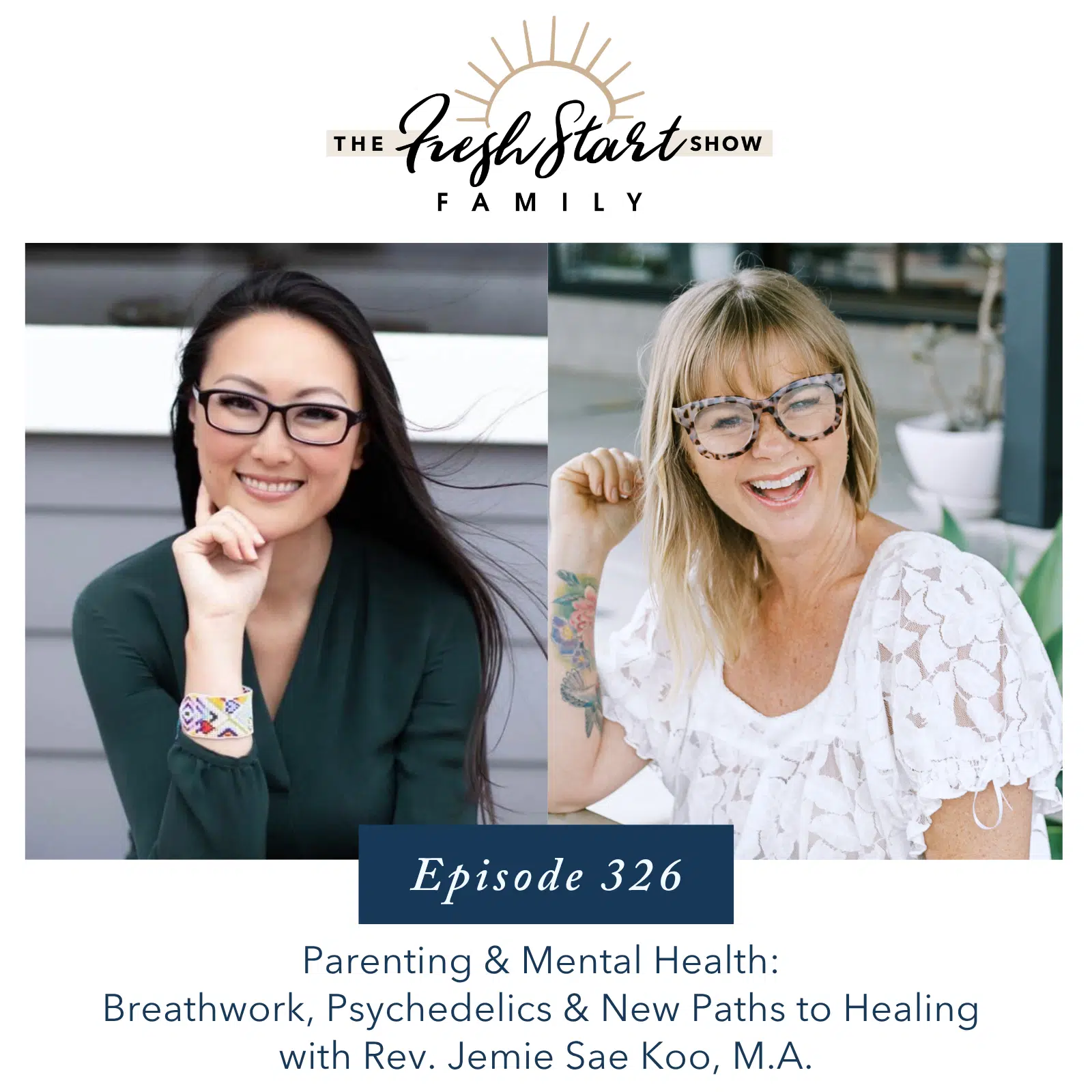
In this powerful and deeply personal conversation, Wendy sits down with Rev. Jemie Sae Koo, founder of Psychable, to explore new pathways to healing, including breathwork, nervous system regulation, and the emerging world of plant medicine.
Jemie shares her own story of growing up in trauma, battling decades of depression, and ultimately finding life-changing healing through psychedelic-assisted therapy. Together, she and Wendy unpack why so many parents struggle to follow through on the parenting strategies they want to use, and how unresolved trauma keeps them stuck in reactive patterns.
This episode opens an honest, thoughtful conversation about alternative healing modalities and how they can support parents in creating lasting change, not just for themselves, but for generations to come.
If you’ve ever felt like you “know better” but still can’t do better in the moment, this conversation will meet you with compassion and possibility.
Episode Highlights:
- Many parenting struggles are rooted in unresolved nervous system trauma, not lack of knowledge
- Healing is relational, we need safe connection with ourselves and others to truly transform
- Plant medicine can support healing, but integration through daily practices is where change lasts
- Microdosing may help create space between trigger and response, allowing for more intentional parenting
- Breathwork and simple body-based tools can begin shifting patterns immediately
- Shame dissolves when parents realize they are not alone in their struggles
- Small, consistent steps toward healing can break generational cycles
- When we choose to heal, we don’t just change our lives, we change the legacy for our children
Resources Mentioned:
Unable to listen, or prefer to read along? Here’s the transcript!
Absolutely, here’s the cleaned-up version without timestamps:
Wendy Snyder:
Hello families and welcome back to a new episode of The Fresh Start Family Show. I am thrilled to be here today with Jemie Sae Koo, who is going to be chatting with us about parenting and mental health, breathwork, psychedelics, and new paths to healing. Welcome to the show, Jemie.
Rev. Jemie Sae Koo:
Thank you so much for having me. It’s such an honor to be here.
Wendy Snyder:
I have been looking forward to this conversation for so long. You and I met in person back in February in Miami when I was attending one of Kate Northrup’s nervous system regulation and healing workshops. I had the honor of seeing you speak on stage and listening to you on a few shows, and instantly I was like, wow, I need to get Jemie on the show to talk about different modalities of healing, specifically with plant medicine.
This feels like a very untapped avenue for my community. Our parents here at Fresh Start Family are learning firm and kind, connection-based parenting. Many of them are recovering from what we would call an autocratic or authoritarian upbringing.
Even if it was “chill” autocratic parenting, there are still marks left on the nervous system. We have some families who were raised in high-control religion, where religious indoctrination, fear, and so many messages left deep marks. Then we have the middle ground, what I would call normal fear and force. That was my upbringing. I wasn’t raised with religious indoctrination, but you got spanked, you were threatened if you didn’t comply, and if you didn’t get the grades you were supposed to get, there were high levels of shame and disappointment.
The phrase “what’s wrong with you?” was big in my home. That’s what I eventually realized I needed to heal from, this shame element that had taken very deep roots in me.
Then we have other parents who are simply like, wow, this is the way I want to raise my kids. They come into it without those deeper layers of trauma. But what I’m realizing is that when it comes to implementing what we teach, like compassionate discipline, many parents really struggle because the knee-jerk reaction is so intense. That neural pathway is so paved. It feels like a bear is chasing you when your child misbehaves.
So when we say, “Step to the side, take a deep breath, source some nature, go to the bathroom,” it can feel so dangerous. Parents end up repeating painful generational cycles. It takes some of them years to unwind that knee-jerk reaction.
When I saw your work, I thought, dang, I wonder if this is the type of support that would really help our clients experience faster healing.
So with that setup, will you tell us your story? Your story of healing is so inspirational, and I want our community to get to know you and your work.
Rev. Jemie Sae Koo:
Thank you for all of that. I came into this work through my own healing journey. Point blank, plant medicine saved my life.
So much of what you shared about your audience deeply resonates with me. I grew up in a very challenging home. My father was very abusive. He was an alcoholic. At just nine years old, I watched him being taken away by the police because he threw me out of the house for disobeying him and going to church.
My mom quickly became a single mom raising three children. I was the eldest. She was working multiple jobs just to keep us afloat. Being a mother now, having only one child, I can’t even begin to imagine how much she was taking on, coming to this country, not really knowing how to speak English, struggling through that, and then taking on multiple jobs.
At that time, I had no idea what was happening in my nervous system. I was a child. What I knew was that my mom leaned heavily into her faith, and my entire childhood was basically growing up in the church. It was this experience of learning how to navigate trauma while also being this obedient, faith-abiding member of the church.
I was so involved in church. If I wasn’t in school, I was in church. I took on aspects of being a youth pastor, helped with music direction, and was even a greeter at church.
Seeing my mom lean heavily into the church obviously had a lot of influence on my upbringing. The other part of it was that we never fully learned how to navigate the trauma and PTSD that came from that abusive environment.
Like many people, I was put on antidepressants and SSRIs at a very young age. I struggled with depression for at least three decades, pretty much all my life. The challenge was that the antidepressants and SSRIs never actually helped me feel better. If anything, they numbed me out, blunted my emotions, and made it hard to connect with myself, with others, and with the world around me.
Fast forward, when you go through those types of experiences at a formative age, a lot of character develops within you. I became an executive at a management consulting firm in the corporate world, one of the youngest executives in corporate environments, and launched several successful startups.
Outwardly, I was really successful. But inside, I was always unraveling and navigating this feeling of not knowing where I really belonged in the world.
Almost a decade ago, I found myself in a place where I hit rock bottom. I’ve hit rock bottom several times in my life, but this was the bottom of rock bottom. All of my hair started falling out. I was waking up in the middle of the night in puddles of sweat. I developed brain fog where I couldn’t even formulate a sentence anymore.
I had resolved that depression was going to be my norm, but then I fell into the deepest depression. I completely isolated myself from the world. My own family didn’t even know what I was going through, including my mother. I went from being very outward-facing and extroverted to just sitting in isolation.
During one of the darkest periods of my life, out of the blue, I had two people call me in the same week. They didn’t know each other, but in separate conversations, both mentioned that psychedelics and plant medicine had been very transformative for them.
I grew up in the church, walking the straight and narrow. I had never done drugs. I was the poster girl for “just say no.” So when they mentioned psychedelics, I instantly felt judgment. I lumped it all together and thought, “These are drugs.” It sounded so fringe.
But at that point, I was running out of hope. I had tried all types of antidepressants, every fad diet, every supplement under the sun. You name it, I tried it. I spent tens of thousands of dollars seeing doctors who said I checked out normal. I was quickly running out of hope.
So I sat down and dove into the research. I wanted to educate myself so I could make the most informed decision. As I researched plant medicine and psychedelics, I saw that the information was often either very “woo” or very medicalized, with not much in between.
I remember sitting with a lot of fear. It was fear of the unknown and fear of death. I had a come-to-Jesus moment with myself where a part of me said, “What is there to lose at this point?” On one side was death. On the other side was freedom.
Wendy Snyder:
At that point, Jemie, when you talk about low, that included suicidal thoughts too, right?
Rev. Jemie Sae Koo:
Yes. It was to the point where I was running out of hope very quickly. I had lost all sense of purpose in life. Even though I was raised with a strong faith, I was asking, “What’s the point anymore? I don’t even know why I’m waking up.”
When I came to that realization about freedom, two days later I jumped on a flight to Costa Rica. I sat with ayahuasca for four nights. It not only lifted me out of my depression for the first time in my life, it literally saved my life. It gave me a renewed sense of purpose, that everything I do is to be in service to humanity for the highest source.
That became my life purpose. That’s how I came to this path.
Wendy Snyder:
And that was almost a decade ago, and the depression has stayed away?
Rev. Jemie Sae Koo:
Yes. I have not had depression ever since.
Wendy Snyder:
That is so powerful. Tell listeners what you spend your days doing now. How did you get from that experience to leaving your successful, financially lucrative career and stepping into this life of service?
Rev. Jemie Sae Koo:
I left corporate America because this was such a profound, transformative experience. I thought, more people need to know about this as an option. These are things provided to us through nature. These are God-given through nature. Why are we criminalizing them? Why are they being buried?
That’s a different conversation, but there are a lot of agendas at play, including billion-dollar pharmaceutical industries.
After that experience, it led me down a path of deep devotion to this work. I got my master’s in psychology, focused on psychedelic-assisted therapy. I also trained and apprenticed with Indigenous communities to understand the ancient wisdom and traditional lineages so I could bridge those worlds together.
Out of that came Psychable, one of the most comprehensive platforms providing not only a directory of practitioners who support individuals seeking the healing properties of psychedelics and plant medicine, but also education. We want people to be informed and able to make the safest decision for themselves.
We also support the full life cycle, from preparation to the treatment or ceremony, and then post-integration. That is so critical, and it’s an area we’ve really nailed down.
I also have my private practice, where I’ve supported thousands of clients and students, particularly with depression, anxiety, PTSD, trauma, and addiction, bringing in a more holistic, integrative approach and addressing issues from the root cause level.
Lastly, I’m passionate about empowering people to understand that your body already has its own innate intelligence and wisdom. We just have to tap back in, connect, listen, and honor what that innate intelligence is speaking to us.
Wendy Snyder:
So good. Psychable helps people find practitioners and learn more about these healing paths. And it sounds like there are different routes. Some people do a full weekend experience, like your ayahuasca journey, and then there’s also microdosing. Some people do one, some people do the other, and some do both. Will you explain the difference?
Rev. Jemie Sae Koo:
Yes. That distinction is important because it comes down to intensity, preparation, integration, and intention.
Full experiences, whether it’s a high dose psilocybin ceremony, traditional ayahuasca, iboga, or a retreat, are deeply immersive and often life-altering. People sometimes compare them to the birth of a child. They can be that profound and transformative.
These experiences can catalyze a lot of emotional release that has been under the surface. They can bring forth repressed memories and provide powerful spiritual experiences. There are reports of atheists turning into believers because they connect with God for the first time. It can be incredible.
For many people, it can feel like a nervous system and life reset. Like 10 years of therapy condensed into a few hours or days. You may cry, purge, laugh, have visions, or feel an overwhelming connection to something greater than yourself and to others.
These experiences can shift the trajectory of a person’s life, but they are not always light or gentle. A lot of people may not be ready for them. They can be physically and emotionally intense. What comes up doesn’t always resolve itself in the ceremony or treatment, which is why integration is critical.
Integration goes beyond talk therapy. It asks, how do we bring in lifestyle tools that support the individual in daily life? The real work isn’t only what happens with the medicine. It’s how we carry those insights back into our day-to-day life. Without support, that transition can be destabilizing and disorienting.
Microdosing can be a beautiful companion or alternative. Microdosing is subtle, safe, and gentle. It’s taking a sub-perceptual amount of the medicine or sacrament. You’re not hallucinating or tripping. It’s like a gentle opening of a window.
So many people, especially parents, caregivers, and people trying to get out of patterns that don’t serve them, are waking up to the fact that their nervous system is running on survival mode. That’s not their fault.
Many of us were raised in environments where fear, control, and corporal punishment were the norm. Whether it was authoritarian parenting, religious shame, punishment, or disconnection, those patterns wire into the nervous system. Even when you know better as a parent, your body may still default to yelling, grabbing, or punishing.
That’s not a lack of willpower. It’s unresolved trauma expressing itself through reflex.
That’s where microdosing can become such a powerful tool. Microdosing with psilocybin doesn’t take you on a trip. From a neuroscience perspective, it enhances neuroplasticity, which is your brain’s ability to rewire itself and create new neural pathways.
It also increases levels of BDNF, brain-derived neurotrophic factor, which is like Miracle-Gro for the neurons in the brain. It helps quiet the monkey mind, the default mode cycle of thoughts, the mental chatter, self-criticism, shame, guilt, and rumination.
It also helps regulate the gut-brain axis, which is foundational for mood, immune system, and emotional regulation.
In real life, that means if you’re a parent who goes from zero to 100, you have an opportunity to pause. That one-second pause creates space for awareness, presence, and a different choice. It helps you respond rather than react. And that’s not just mental, it’s a nervous system-level change.
So many of us were raised in environments that trained our nervous system to survive. The nervous system is the body’s command center for safety. When we grow up with chronic stress, trauma, or PTSD, we can get stuck in fight, flight, freeze, or fawn.
Microdosing can help create that moment of pause and reset. It can support the nervous system in shifting from survival to safety.
Wendy Snyder:
So many things are coming up for me. Amazing.
The first time I started learning about this was a few years ago. Terry and I were on vacation in Mexico and watched Fantastic Fungi, the documentary on mushrooms. We were laughing because we were like, this is so interesting, and also this is not the mushroom experience we had when we were younger. We had fun and laughed, but it was not this magical spiritual experience.
Now, to understand what people are doing with mushrooms and plant medicine, like in the show Nine Perfect Strangers with Nicole Kidman, it’s fascinating. She runs one of these centers where people go through this guided experience and end up healing in significant ways. I’ve heard those stories and have always thought, I want to go do one of these weekends.
But the microdosing piece is fascinating too. I had dinner with a friend on her birthday, and she shared that the previous spring she had ended up in the hospital with suicidal thoughts. She had been struggling with depression for a long time. A friend introduced her to microdosing, and she told me, “Wendy, it literally healed me. It’s been six months and I’ve never felt better in my life.”
It was incredible to hear how fast and profound the healing was for her.
And then I think of one of my students, who came from a very high-control religious background. Dobson was a big teacher in her upbringing, and it was heartbreaking what he taught and what parents did with those teachings. To this day, every time she sees wooden spoons on the counter, she flinches because her core memory is being hit with one. Her parents still joke about the time she was hit 32 times as a three-year-old to break her will.
She is one of our more extreme stories, and she is relentless in her pursuit of healing. She may do well for six months, taking the pause and stepping to the side, and then sometimes reverts back to hitting or harming her kids. She says it feels like she can’t control her hands. She hears me in her head, but she still can’t always break through that pattern.
For students like that, I wonder what your work could do. It feels so powerful.
Let’s dive into the three points we wanted to cover. First, healing is relational. True healing happens in connection with our bodies, ancestry, land, and each other, not in isolation.
Rev. Jemie Sae Koo:
Healing is never an individual journey. Community is so important. We heal in community. We were never meant to be on our own island.
Trauma often happens in relationships, so healing can also happen in relationship. With ourselves, it’s about learning to listen to our bodies. Like I said earlier, our bodies have their own innate wisdom and intelligence.
Whatever you call the creator, source, divine, that which is there as the divine is also within you. You are divine and powerful. So often, the systems around us, or what I call the noise, distract and disconnect us to the point where we forget how divine and powerful we truly are.
Many things disconnect us from our bodies because it’s too overwhelming, too painful, or emotions aren’t welcome. So we need to establish a foundational sense of safety so we can be in the fullest expression of who we are and what we came here to do.
A lot of this is learning to listen to the body.
With our ancestry, it means honoring our past, honoring the wounds, and honoring the stories we came from. These can be vehicles that brought us to this moment and invite us into our next level of awareness, evolution, and consciousness.
There’s also so much already provided around us through land and nature. Reconnecting with nature, going outside and facing the sun in the morning before grabbing your phone, supports your mitochondria. It’s like drinking a cup of coffee from nature.
With each other, when we give each other a sense of safety, we can provide more compassion and empathy. Neuroscience supports this through co-regulation, which microdosing can also support. It can help us co-regulate with each other and attune to one another.
When we’re in a safe, supportive community, our vagus nerve activates, stress hormones lower, and the body calms.
I think of a mother we worked with who came from a broken family and felt ashamed about yelling and reacting to her kids. She was secretly drinking alcohol to numb herself. When she started microdosing and being in community with other parents sharing similar struggles, the shame lifted because she realized, “Oh, it’s not just me.”
That sense of belonging and acceptance supported her healing. She didn’t feel alone anymore. Community became medicine in itself.
That is the power of being discerning about who we surround ourselves with and stepping into a circle that provides safety, so we can show up.
Wendy Snyder:
So good. We see the same thing happen in our communities. Individual therapy is fantastic and there is so much goodness there, but we’ve had many clients say, “I have healed more in this one year in this group program than I have in years of therapy.”
We go deep at Fresh Start Family. We teach concepts, strategies, tools, and tactics, but we’re also going for root causes and triggers. We lovingly excavate why we’re reactive or why we’re not modeling what we want.
The shame does melt away when you realize, I’m not alone. That inner critic voice that tells you your kids are the craziest or you’re the worst starts to quiet.
I also love what you said about connection to self and connection to God through inner knowing. Over the past few years, I’ve been diving into the wisdom of the God within, the inner knowing, the spirit within. I’ve been reading Megan Watterson’s work about Mary Magdalene’s ministry, and it feels like we’re designed to connect with the greater source through our bodies.
But so many people raised in high-control religious circles were taught that they can’t trust their emotions. Their heart is wicked. Their body will lead them astray. So many come into our work confused because the conditioning is, shut it down.
I’ve seen people talk about the repression of anger and how the suppression of any emotion leads to suffering. Yet that’s the story of so many of our students. I love the idea of doing this type of healing work in community.
Next, the medicine is within. Plant medicines can support transformation, but real integration comes from presence, breath, daily choices, and self-inquiry.
Rev. Jemie Sae Koo:
The first things that come to mind are safety, intention, and spiritual alignment.
Plant medicines are powerful catalysts when held with those three things, but they are not a magic pill. The real shift comes through integration. Integration is the daily practices we commit to after entering relationship with the sacraments.
That can look like journaling, breathwork, somatics, mindfulness, or simply walking barefoot on the grass to ground your nervous system.
From the neuroscience side, when we work with plant medicines, there is what’s called a plasticity window. That’s a period where the brain is more flexible. It can last for days or even weeks after an experience with microdosing or plant medicine. That’s where new habits and healthier patterns can take root.
One parent we worked with paired microdosing with morning meditation and breathwork. Within weeks, she noticed she was able to stay more present with her child, especially when her child was in a complete meltdown. Instead of spiraling into her own childhood trauma response, she could recenter herself and hold space for her child to move through the moment.
That’s the powerful combination of medicine and daily tools. The medicine opens the doorway, and integration creates lasting, sustainable change.
Microdosing, plant medicine, and psychedelics alone are not the whole answer. That’s why we created The Microdosing Method, a five-week guided program where we walk people through a step-by-step process, followed by a 12-month container to help people implement what they learn in their day-to-day life.
We bring in well-respected experts and practitioners to walk alongside participants. In the five weeks, we cover intention setting, mindset shifts, gut health and biology, nutrition, sleep, circadian rhythm, mood, resilience, nervous system regulation, somatic awareness, and how to feel safe processing emotions in the body.
I often say emotions are energy in motion. If we can see them that way, there’s no judgment. It’s just energy moving through us.
We also get into emotional healing, inner child work, and clearing the roots of where reactivity comes from. Lastly, we focus on integration and how to anchor this new way of being into daily life so we can be the best version of ourselves and live the best life possible.
Wendy Snyder:
I knew it. Your program sounds like the perfect complement to our work.
We can teach parents all the strategies in the world. We can teach compassionate discipline, self-calming, natural consequences, logical consequences, and how they’re different from punishment. But if someone doesn’t have the ability to regulate their nervous system and still has deep stuck trauma points, it’s very hard to integrate. Not impossible, but much harder.
I can imagine a student doing your program and ours together, and it being so beautiful. It sounds like the plant medicine and integration would open the pathways to apply the strategies and concepts so much more easily.
Our last point is that this moment matters. We are at a collective crossroads. We can either repeat old patterns or root into conscious, compassionate ways of being.
I interpret that as finding the courage to step into healing when many of us are not. We’re living in a weird time in America. I’m processing so many emotions, fear especially. It feels like there is a lot moving in a different direction.
How do you find the courage to anchor down, step into healing, set healthy intentions, commit to these practices, and live a life of compassion and empathy? What does that courage look like?
Rev. Jemie Sae Koo:
Such a beautiful and potent question.
It takes immense courage. It also takes readiness and willingness to choose healing, to choose yourself, and to choose love.
That often means going against the grain. That’s why it takes courage and bravery. Every time we break away from family patterns, cultural conditioning, or even the communities we grew up in, it can feel lonely and isolating.
But for every parent out there, this is a time where we can fortify ourselves and bring in the tools that nature has provided us. These tools are God-given. We can reclaim our birthright, the birthright of sovereignty, freedom, and agency.
This is where we get to choose love over hate. We choose connection over control. We choose coming back to ourselves.
That begins with one small step. How can you pause? How can you take one deep breath?
Even if you’re not ready for microdosing or plant medicine, one of the most powerful tools given to us is our breath. Can we take one deep breath from the bottom of our tummy right now? Can we savor that breath? Can we sit with what is coming up?
That one small intention of bringing in breath helps us understand that small steps compound over time. When small steps compound, we change our legacy. We step out of generational trauma and say, “This stops with me.”
Neuroscience confirms this. Studies in epigenetics show us that trauma is passed down generation to generation. It’s not just through behavior. It’s through changes in gene expression.
The reverse is also true. When we heal, we shift what gets passed down to future generations.
Indigenous wisdom reminds us that when we step forward with courage and bravery and say, “It stops with me,” we are healing seven generations before us and seven generations after us.
One father in our program told me it was the first time his son didn’t see him raise his voice. That might sound small, but that is everything. That child is rewiring for safety, trust, connection, and love.
That’s generational healing. It takes courage to step out of old patterns, and it is one of the most powerful legacies we can leave behind. When we heal ourselves, we heal everyone around us, including the generations to come.
Wendy Snyder:
Wow. Mentioning the Indigenous wisdom really lands. As I get older and approach 50, I find myself wanting to learn more and more about Indigenous wisdom. Especially in a world where I teach anti-authoritarian leadership systems and we’re watching authoritarianism grow in the nation we live in, it feels like a scary time.
I want to go backward and tap into the wisdom of the Indigenous people of this land.
Before we end, will you speak to that? I think some people might wonder, isn’t this illegal? I know you’ve partnered with Indigenous communities and use plant medicine as a sacred sacrament with reverence. Will you speak to that so people understand how this work is connected to ancient wisdom and respect?
Rev. Jemie Sae Koo:
Absolutely. We would not be here with medicine without our Indigenous brothers and sisters, communities, and tribes. It’s never lost on me to bring them forward and give them that platform.
In our program, we’re bringing in the chief of the Huni Kuin tribe. We’re bringing in Colombian Taitas. We’re also bringing in amazing Indigenous women leaders in their communities, so we are balancing the feminine and masculine aspects.
More importantly, we’re also collaborating with nondenominational churches and plant medicine practices that are federally protected under the Religious Freedom Restoration Act of 1994. This gives people another layer of safety and protection to fully engage in what we call sacred work.
This structure allows us to support participants in deeper healing across every dimension: mind, body, soul, and spirit.
Wendy Snyder:
Jemie, I am so blessed by this discussion today. Thank you for your work. It feels like a real honor.
I’m excited to get into your program. I’ve had this thing that sounds small, but it’s pretty big for me, where sometimes I can’t take a deep breath. I’ve dealt with it for decades. It comes up in different spikes. I’ve worked with energy healers who seem to heal it quickly, and then it comes back. I’ve also dealt with headaches since I was about 20.
I know my body is speaking to me. My body is saying, Wendy, we still have some healing to do. I’ve done so many healing things, but I’m like, this is the next adventure I’m going to go on.
I’m looking forward to getting into your program and experimenting with this so I can let my community know what it was like, what it felt like, and what I experienced.
Thank you from the bottom of my heart for doing the work you do. Thank you for having the courage to leave the shiny, financially abundant job and step into this life of service. We really appreciate you, Jemie.
Please finish us off by telling everyone where they can find you and learn about your programs.
Rev. Jemie Sae Koo:
You’re welcome to visit us at psychable.com. That’s P-S-Y-C-H-A-B-L-E.com. There you’ll find a directory of practitioners, a ton of educational materials and resources, program offerings, and you can sign up for the waitlist for The Microdosing Method.
You can also find us on all social media channels. And if you want to personally reach out and learn more about what I’m interested in and passionate about, you can find me on Instagram at @JemieSaeKoo. That’s J-E-M-I-E-S-A-E-K-O-O.
Wendy Snyder:
All right, Jemie, thanks again. Listeners, we’ll see you in the next episode.