
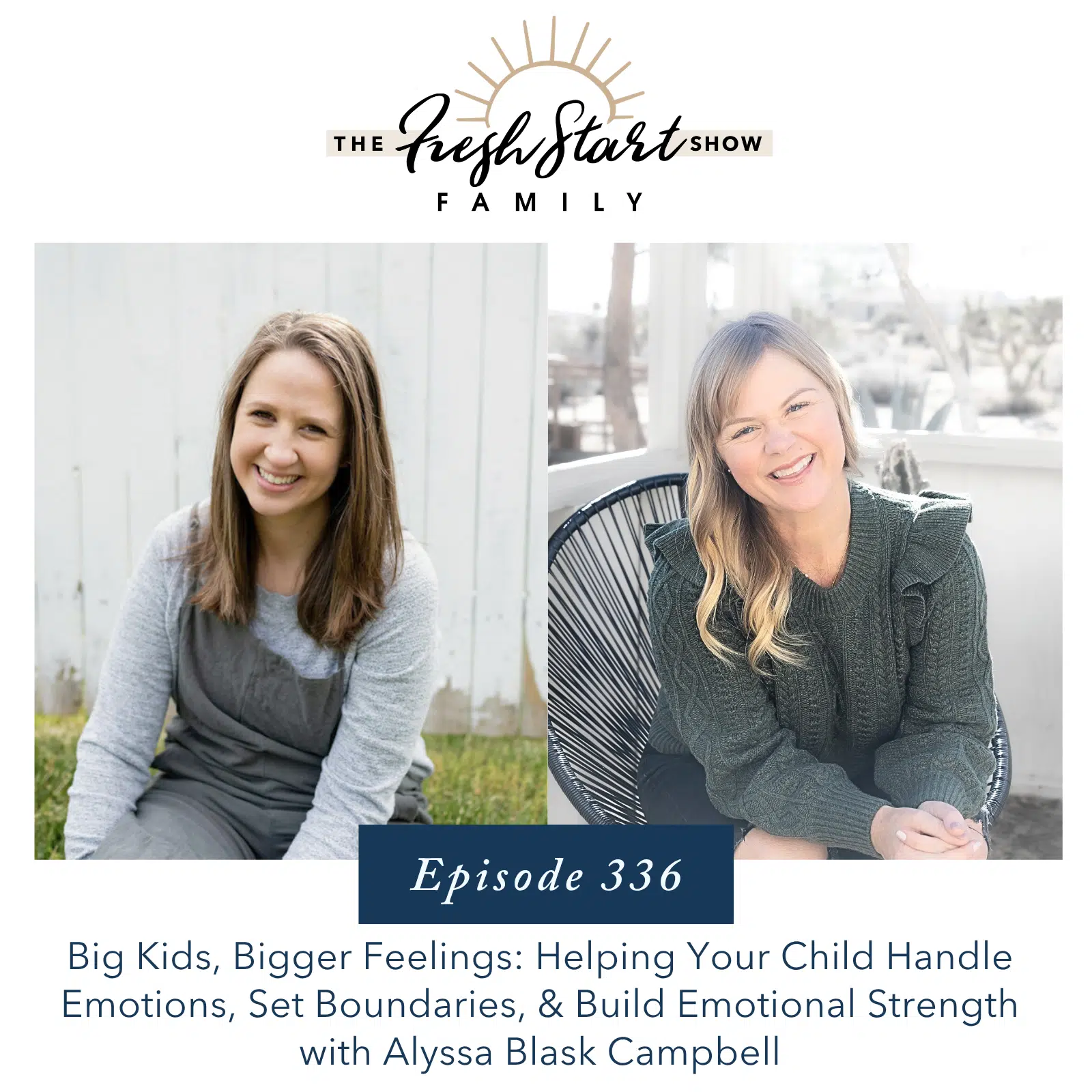
In this episode, Wendy welcomes back Alyssa Blask Campbell, bestselling author of Tiny Humans, Big Emotions and Big Kids, Bigger Feelings, for a powerful conversation about helping older kids build emotional strength, navigate boundaries, and move through big feelings with support.
Alyssa shares why middle childhood is often overlooked, even though elementary-age kids are still developing major emotional regulation skills. Together, Wendy and Alyssa talk about why parents don’t need to fix every hard feeling, how co-regulation still matters as kids grow, and why strong boundaries help children feel safe when they’re offered with calm, clarity, and respect.
Episode Highlights:
- Big kids still need co-regulation, especially as friendships, school pressures, sports, and independence become more complex
- Parents don’t need to fix every hard feeling. They can walk alongside their child as they learn how to process it
- Emotional strength grows when kids are allowed to experience disappointment, sadness, conflict, and mistakes with safe support nearby
- Boundaries are not punishments. They are loving limits that help kids feel secure and understand what to expect
- Requests and boundaries are different, and children feel safer when adults follow through calmly and clearly
- Kids need room to practice messy life skills, including conflict, disappointment, problem-solving, and risk assessment
- When parents step in too quickly to rescue or solve, kids miss opportunities to build confidence and resilience
- Emotional literacy helps kids understand themselves and others with more compassion
- Middle childhood deserves more support, because these years are full of important emotional and relational development
- The goal isn’t perfect parenting. It’s becoming a safe, steady presence kids can return to as they grow
Resources Mentioned:
Find Seed and Sew on Instagram
Alyssa’s website
Alyssa’s first episode on The FSF Show
Alyssa’s books: Tiny Humans, Big Emotions and Big Kids, Bigger Feelings
Unable to listen, or prefer to read along? Here’s the transcript!
The Fresh Start Family Show with Alyssa Blask Campbell
Wendy Snyder:
Well hey there families, welcome back to a new episode of The Fresh Start Family Show. We’re so happy that you are here.
Today I have a returning guest, someone who we admire so much, Alyssa Blask Campbell. Do you still say your full name like that? Or are you just Alyssa Campbell now?
Alyssa Blask Campbell:
I do. Alyssa Blask Campbell. But I’ll answer to almost anything. I’m number four of five kids, and at this point we just answer to really anything.
Wendy Snyder:
Nice.
Listeners, today we are talking about Big Kids, Bigger Feelings: How to Help Your Child Handle Emotions, Set Boundaries, and Build Emotional Strength.
Alyssa, we’re here to celebrate your second book. You were on our show before, probably a few years ago now, Episode 196, Understanding and Building Emotional Regulation. We talked about your first book, Tiny Humans. What’s the full title again?
Alyssa Blask Campbell:
Tiny Humans, Big Emotions.
Wendy Snyder:
Tiny Humans, Big Emotions. Such a pivotal book for parents. We recommend your book so many times in our coaching through the years when we personally coach our students, especially if they are learning to teach their young children emotional regulation.
And our first episode together, we still recommend students go listen to because, my gosh, Alyssa, you’re brilliant.
Now you have this second book where you’re continuing the conversation into the older kids. So tell us a little bit about what’s happened since the last time we talked, why you’re excited about getting this newer book into the world, and also give us an update on how old your kids are now.
Alyssa Blask Campbell:
Yeah, for sure.
Well, thank you for having me back. I’m always jazzed when I get to hang out with you, Wendy.
I have a daughter who’s two and a half and very comfortable with expression. I’m zero percent worried about her self-advocacy skills in this world. She’s got some fire to her in a delightful way.
She’s one of those kids where people might see her as a “big feeler,” but actually she’s just more outwardly expressive.
Then I have a five-year-old son who’s autistic and very different than my daughter. He tends to go into more of a shutdown, but he’s my big feeler. He feels things really deeply, but he’s not as outwardly expressive. He’ll hold it in longer and then eventually there’s a big expression.
They’re very different humans, and parenting them is a blast. There’s no one-size-fits-all in this journey.
It’s doubled down on this work for me in helping folks understand the unique child in front of them.
Then Big Kids came about because we started doing work in elementary schools. My master’s is in early childhood and my research was in emotional intelligence in kids.
We kept hearing from principals that they wanted this work for kindergarten, first grade, second grade teachers too. So we started working with elementary schools and developing a program after collecting a lot of data around what they really needed.
At the same time, Tiny Humans had published and our families started saying, “This makes so much sense… but why is my nine-year-old suddenly acting like a teenager?”
We realized there’s this huge gap in resources for middle childhood.
There’s a ton of support for toddler years and early childhood. Then there’s a lot for teenagers and puberty. But middle childhood kind of gets skipped over with this myth that it’s supposed to be easy.
It turns out, there’s still a lot of development happening.
So we started hearing demand from families while we were doing this school work, and Big Kids, Bigger Feelings was born.
Wendy Snyder:
Oh, so good.
I love it because when I watch you teach about bigger kids and bigger feelings, you really get it. And what’s fascinating is you don’t even have teenagers yet.
That’s part of my own journey that I love so much now that my daughter is eighteen and graduating high school the same week my book comes out. My son is fifteen now.
What’s so cool is after fifteen years of doing this work, testing the strategies, living it, you finally get to this place where you realize… it works.
And I feel like you explain emotional literacy and nervous system work in such a relatable way.
You’re so brilliant, but also so human.
I remember in our first episode you were talking about creating external environments that support regulation, like dimming the lights or creating connection cues during tantrums.
You just have this beautiful way of helping people understand how nervous systems work and how all humans are different.
Alyssa Blask Campbell:
Thank you.
I’m just a big nerd for data.
What’s interesting is I started doing this work and my research before I had kids. So now, instead of only having my own two children as examples, I’ve had the privilege of learning from thousands of kids.
I’ve seen how this works in different socioeconomic situations, different parts of the country, different nervous systems, different family dynamics.
And I think that broader perspective has really helped shape how I teach this.
Wendy Snyder:
Yeah, absolutely.
What differences have you seen over the years between children raised with emotional safety and this type of respectful parenting versus more traditional authoritarian parenting?
Alyssa Blask Campbell:
There’s a lot to it.
And I also want to acknowledge that in America there are so many cultural and systemic realities that impact how families can navigate this work.
I remember a mom during one of our research studies saying, “This sounds good in theory, but my son can’t be screaming in public because he won’t be safe.”
That reality matters.
So part of our work is helping families cultivate emotional safety at home while also acknowledging the world their children move through.
One little guy I worked with had experienced unimaginable trauma. He had been removed from his mom’s care, placed with a dad he’d never met, moved to a new state, and started kindergarten.
He was ripping things off walls, pulling fire alarms, throwing things.
And through this work, alongside teachers and school systems embracing these tools, we got to watch incredible transformation happen.
We’ve seen things like sixty percent reductions in behavior support calls.
Why?
Because kids are operating from regulated brains.
They feel safe. They feel connected. They feel emotionally supported enough to try, fail, make mistakes, and learn.
And then recently I got a text from a mom I started working with thirteen years ago. Her daughter is fifteen now.
She came home and said, “Stuff is happening in my friend group and I don’t want you to fix it. I just need to talk through it.”
Then she explained that her friend was “still learning how to connect.”
That language — “What are they still learning?” — is something we use all the time.
Instead of seeing behavior as personal attacks, kids begin understanding that everyone is learning skills.
That’s the dream.
Wendy Snyder:
Yes. It’s so beautiful.
I’ve watched that happen in my own home too.
And one thing I love so much about your work is the combination of school support and family support. That’s really the dream.
Because in America, so many school systems are still rooted in authoritarian approaches.
One of my greatest goals in life is to eventually help end legal corporal punishment in schools in the United States.
And what you’re doing by helping schools embrace emotional literacy and regulation work is so important.
Okay, let’s talk about one of the big themes from your book.
We’re not here to fix our kids’ feelings. We’re here to process emotions with them.
Talk to us about that.
Alyssa Blask Campbell:
Yeah.
Honestly, it’s my least favorite truth because I wish there was a way to keep my kids from ever feeling sadness or disappointment or rejection.
But I think we’ve seen a pendulum swing.
A lot of us grew up not feeling emotionally seen, so now some parents swing all the way into trying to remove every hard feeling from their child’s life.
Calling the coach.
Calling another parent.
Trying to make sure their child never feels excluded or embarrassed.
But our goal isn’t to remove hard feelings.
Our goal is to walk alongside our children and help them build tools for processing emotions.
Because feelings move through us when we allow them to.
Wendy Snyder:
Yes.
I think so much of that comes from parents learning that emotions themselves are safe.
Scared feelings often lead to bravery.
Anger can point us toward justice.
Sadness shows how deeply we care.
There’s so much beauty in emotion once we stop trying to eliminate it.
And Lenore Skenazy talks so much about how overprotecting kids can actually contribute to anxiety because they never get opportunities to navigate life themselves.
Alyssa Blask Campbell:
Exactly.
Kids need opportunities to navigate risk assessment.
I’m so grateful I grew up in a time where I could just ride my bike to a friend’s house and come home when the streetlights came on.
Now kids are constantly tracked.
They lose opportunities to build autonomy and decision-making.
And yes, it’s messy.
But we can’t avoid the mess and still get the lessons.
That’s true emotionally too.
Wendy Snyder:
That’s so true.
Okay, last big point before we wrap.
Boundaries are not punishments. They’re protective and respectful.
Speak to that.
Alyssa Blask Campbell:
Boundaries are how kids know they are safe.
In our house, boundaries are built around health, safety, and growth.
Bedtime, for example, is about health.
Kids’ brains aren’t mature enough yet to make those decisions consistently for themselves.
And the biggest mistake we see is the difference between boundaries and requests.
A request sounds like:
“Hey buddy, can you turn off the TV?”
Then the adult gets more and more irritated because they never intended to follow through.
A boundary sounds more like:
“When the microwave timer goes off, dinner will be ready. You can turn off the TV yourself before I come in, or I’ll turn it off when I walk in.”
Then you calmly follow through.
That predictability creates safety.
I watched a teacher do this beautifully in a classroom recently.
Two students couldn’t focus while sitting together during independent work time. She reminded them of the expectation and let them know that if they couldn’t focus, they’d need separate work spaces.
When they still struggled, she calmly followed through.
The child was disappointed, but not unsafe.
That’s the difference.
Wendy Snyder:
Yes.
Strong-willed kids especially respect strong boundaries when they are respectful and consistent.
One of my favorite stories from our community was a dad who told his son:
“You can stay in the bath longer, but then we won’t have time for books.”
His son chose the bath.
Later at bedtime he was crying because he was sad they missed books.
Instead of saying “I told you so,” the dad simply held space and said:
“Yeah, that makes sense. Tomorrow you can make a different choice.”
And that’s such a beautiful example of emotional literacy and respectful boundaries.
Alyssa Blask Campbell:
Exactly.
And it’s important that boundaries aren’t delivered as threats.
There’s a difference between:
“If you don’t get out now, then no books!”
Versus:
“You can choose extra bath time or extra book time.”
That regulated energy matters.
Wendy Snyder:
So good.
Alyssa, tell everyone where they can find your books and all the incredible work you do.
Alyssa Blask Campbell:
Tiny Humans, Big Emotions and Big Kids, Bigger Feelings are both available wherever books are sold.
I also narrated both audiobooks.
And SeedandSow.org is kind of the mothership for all of our work.
We have free nervous system quizzes there for adults and kids.
We work with schools, families, and educators.
And on social media you can find us at Seed.and.Sow.
Wendy Snyder:
I love it.
And listeners, if you want to go back and hear our first conversation together, you can listen to Episode 196: Understanding and Building Emotional Regulation.
Alyssa, thank you so much for being here with us today. We are so grateful for the work you do in the world.
Alyssa Blask Campbell:
Thanks for having me.