


🎉 It’s YouTube Contest Time! Click HERE to enter to win over $550 in prizes! 🎉
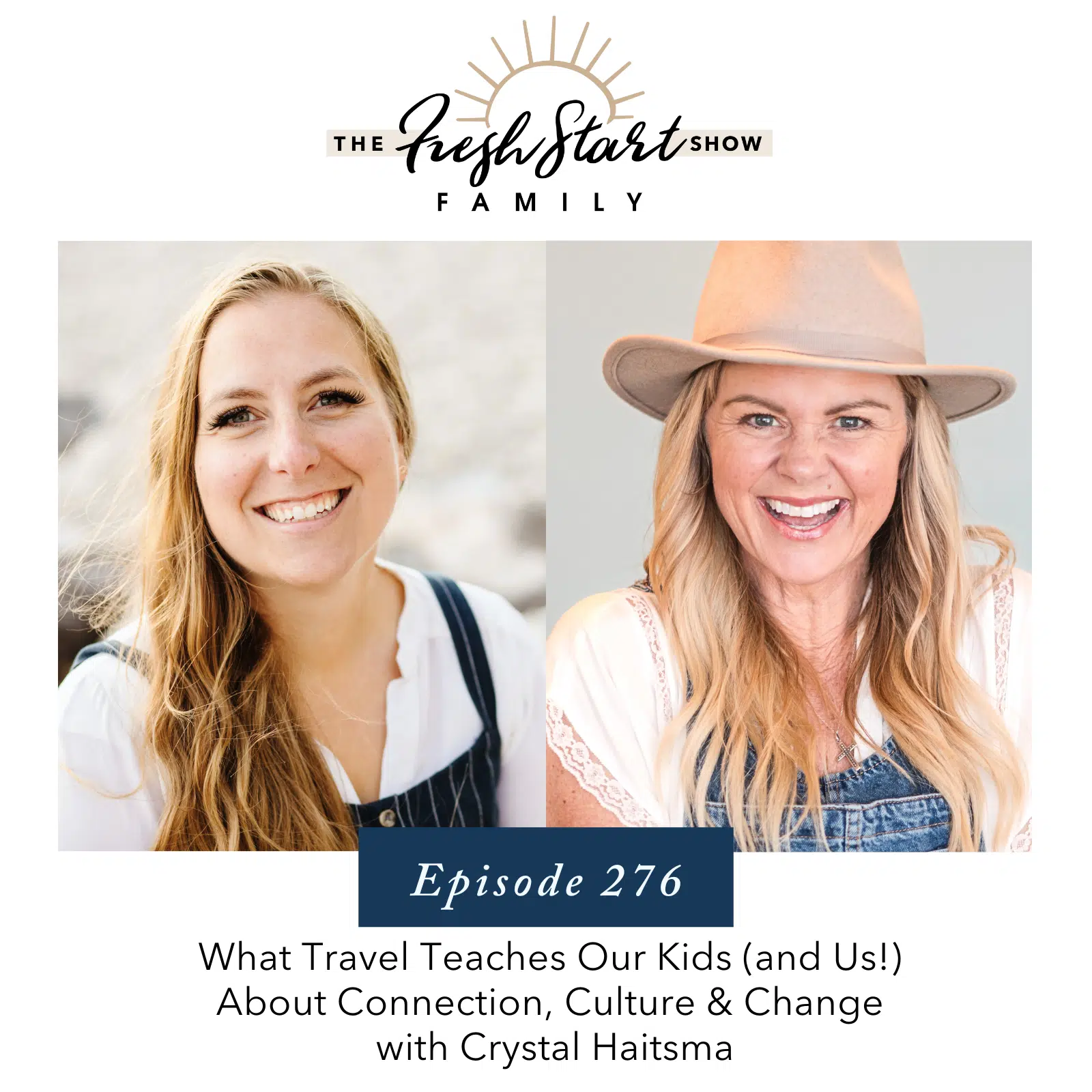
Have you ever dreamed about packing up your bags, hitting the road (or the sky!), and showing your kids the world? In this inspiring episode of the Fresh Start Family Show, Wendy is joined by parenting coach and worldschooling mama Crystal Haitsma. We explore how travel can become one of the greatest teachers of connection, flexibility, compassion, and shame-free parenting—not just for our kids, but for us too.
Crystal shares how her family of six spent eight months circumnavigating the globe (yes, seriously!) while navigating flight delays, language barriers, missing luggage, and a lot of unexpected emotional growth. You’ll hear how embracing travel as a life-learning opportunity helped her family grow closer, expand their worldview, and tap deeper into intuition and trust.
This conversation is a beautiful blend of wanderlust and wisdom, full of laughs, real talk, and powerful takeaways on how travel transforms not just our itineraries—but our family legacies.
Raising A Strong Willed, Intense or Sensitive Child? If yes, I have a FREE gift for you!
This free bundle comes with an extensive learning guide & FREE workshop with me, where I’ll teach you ways to build connection & methods to work WITH your strong willed kids instead of trying to MAKE THEM change.

You’ll learn:
*Firm & kind strategies to navigate challenging behavior with firm kindness & connection (vs. fear, force, yelling, threats & bribery)
*Ways to build connection instead of pushing your child away w/ heavy handed “hand me down parenting tactics”
*How to work WITH your kids instead of forcing them to comply or trying to MAKE them change
Grab your FREE bundle now & start learning today!
Episode Highlights:
- Crystal’s story of shifting from yelling and shame-based reactions to leading her parenting through connection and intuition
- What inspired her family’s global travel journey—and how they made it happen
- Why travel magnifies our triggers and how that can be an invitation for healing
- The link between flexibility, nervous system regulation, and parenting with compassion on the go
- How different cultures shaped her family’s view on simplicity, joy, and what “success” really means
- One powerful story about losing everything on a beach—and choosing peace over panic
- What it really means to “breathe belief” into your children and how to trust their inner wisdom
- How shame can be sneaky—and why naming it in community is the first step to healing
- Why modeling compassion is the way to raise compassionate kids
Resources Mentioned:
Follow Crystal on Instagram
Crystal’s Podcast The Parenting Coach Breathing Belief into Our Kids Part 1, Part 2
Grab Crystal’s FREE resource The Feelings Wheel for emotional regulation
Catch Wendy’s episode on The Parenting Coach
Watch this full episode on YouTube!
Unable to listen, or prefer to read along? Here’s the transcript!
00:02
Well, hello, community, and welcome back. Today on the show, have Crystal Haitsma, who is going to be talking to us about what travel teaches our kids and us about connection, culture, and change, and how we can have a mission to wander and grow with our families. Welcome to the show, Crystal. Thank you. And I’m just so impressed that you said my last name correctly, because that 0 % of the time happens. So good job.
00:28
It’s a miracle when I get it right. So I’m happy that I did. It’s a beautiful name. And I am so pumped to get to know you today. We’re actually going to spend the next few hours together as we’re recording an episode for your show and recording one here for our show. And so start us off by just telling us all about you and your story and how you became so passionate about advocating for shame-free parenting and
00:54
traveling all over the world with your kids. I’m so excited to hear your whole story. It’s actually all interconnected, which is funny, but I mean, besides the travel part, I’ve always, always wanted to travel, but never figured out how that would work full time. my name is Crystal. I’m a parenting coach. I specifically work on shame-free parenting. I feel like I’m mostly just like the Brené Brown of parenting. like, wait, there’s shame here. There’s shame from my childhood. It’s all connected. Let’s like move through that so that we can parent with connection and empathy.
01:23
the ways that we want to, but sometimes feel a little bit blocked from or feel like it’s draining. So shame-free parenting is taking the shame out of it. So if we were parented in the eighties or nineties or really anything before that, shame is popping up in your parenting in ways that you don’t even recognize or notice. And you’re probably trying to parent with connection and compassion, but sometimes it doesn’t feel as genuine or as simple as you want it to. So that’s what I deal with people with is shame, which is just funny because shame is the thing that like people don’t really want to talk about. I’m like, and now this is the thing I talk about every day.
01:53
And it’s so true. It’s freaking everywhere. It’s everywhere when we were raised in a different way. So we’re going to talk so much about shame in all aspects of our topic today. is my favorite topic for sure. so going to my real life, my real life, my regular life, I’m a mom. I have four kids. I’ve homeschooled them for 11 years. My oldest just went to college two weeks ago. that’s all been a whole new transition of all the things.
02:23
Um, which has actually been really fun. It’s we, it’s been really, really good. So, um, I homeschooled in the beginning because my parents gave me this book called, hold onto your kids by Dr. Gordon Neufeld and my kids were like four and two or five and three or something. I think my oldest is maybe in kindergarten. And I just remember thinking, I want this for ourselves. I want a parent with more attachment. My parents gave it to me and kind of said, like, here’s a book.
02:49
We did not do it this way. We parented you totally wrong and you should probably stop the way you’re parenting also and do it differently. Don’t do it the amazing parents. Yeah. You don’t hear that often, Crystal. No, no. That’s My mom also went back to school and became a therapist in her 60s and now she runs her own practice and we do women’s retreats together and it’s like a lovely happy fairy tale ending that I know most people don’t have. And so even just that of like here, by the way, like let’s do it a different way.
03:18
Um, so I loved it, fell in love with the book, fell in love with the principles, decided to keep my kids home for just a couple of years so I could spend more time with them. That couple of years ended up ballooning into this is our 12th year now. Um, because I just loved, it wasn’t even so much the time spent with them. Now I love that. I did not love that back then. It was really hard back then, but I think that now, um, it really ballooned into this like love of education and of learning and of growth and of like my own personal journey. Like I get to learn what I want to learn.
03:47
I have something that uniquely is inside of me that I can give to the world and really just a totally different view of education than what I had ever had before. So that kind of ballooned into homeschooling. I’ve always wanted to travel. I’ve always made travel like an important part of our whole lives ever since we were married and on with our kids. And I wanted to travel full-time forever. I was on this page, this Facebook page called World Schoolers.
04:11
And I would just like be so envious of like people that were doing it. I was like, Oh, like sometimes it was hard. Sometimes I had to mute it because I was like, I want this so bad and I can’t figure out how to do it. Um, so the homeschooling philosophy that I followed loosely is like leadership education or Thomas Jefferson education. And basically like you’re supposed to model learning to your kids because kids learn everything through modeling. So at that time I’m like, you know, nursing my kids and up all the time at night and exhausted. And I’m like, I don’t do learning. Like
04:39
What would I even learn? And I’m so tired. And so I started going back to psychology books because that’s what I did my degree and that’s what I loved. started reading Brené Brown. So fast forward, fast forward, I ended up falling in love with what I had loved, which was psychology and mental health and emotional wellness. And that’s what guided me to eventually become a certified life coach. And through that, my husband had just finished his MBA. He started like,
05:08
helping me with some tech stuff. And over time he actually became like a tech support person for coaches and entrepreneurs and started his own business because he came to me one night and was like, we could keep doing it this way, but we will never get to travel in the way that you want to, or we can take the leap and do this totally wild thing that might not work at all. But also it’s really the only way we can do what you’ve always wanted to do. And I was like, in that moment I actually didn’t want to because I was like so nervous about it. But I also was like,
05:37
But I do. Anyway, so he did that. And the rest is history. We were able to travel full time. We circumnavigated the globe. And that’s all. That’s my whole story. That is wild. And tell me again, so how old are the kids when you started traveling and how old are they now? Yeah, so we started traveling a year ago, last September. So they would have been seven and 10 and 14 and 16. And they all had birthdays while we were gone.
06:06
So they turned eight and 11 and 15 and 17. It’s the 17 year old that just went off to college. yeah, so he’s a little young, but he’s, he’s doing good. Yeah. So though it’s, those were kind of the eight, ages and stages that felt good. Also, like we’ve ran into so many world schoolers that had all these little kids were like eight was their oldest. And they were like going home for nap time and their kids were like having a hard time on airplanes. And I’m just glad we when we did.
06:35
Because that part of it I didn’t have to deal with as much. Yes. And so you say you went all over the globe. Tell us kind of what did the itinerary look like? Yeah. So initially, my husband just said, wouldn’t it be cool to go hang out in Southeast Asia for the winter? He went there in high school. He loved it. He’s like, let’s do that. And then I was like, but if we have to fly to Southeast Asia, we’re pretty much flying over Europe. And I’ve always wanted to go to Europe. Let’s go to Europe. We had not done anything in Europe before. And he was like, OK.
07:05
And then eventually we were like, we could circumnavigate the whole globe. Like if we do this right, like we could make it all the way around and back, which just sounds so cool. Like let’s do that. So we started in New York to visiting my sister-in-law and we went from New York to the UK. We stayed in the UK just for a few days. We did Greece, Italy, Paris. Where else did we go? Turkey.
07:27
And then from Turkey, we moved on. We had like a quick stop in Oman in the Middle East and then went over to Southeast Asia, spent the winter in Southeast Asia, ended over there in Japan during like Sakura, during their cherry blossom festival, and then flew from there to LA where our car was. My brother had our car in LA and we drove up the Pacific coast and made it back to Alberta. So we like flew all the way around. was cool. Amazing. Oh my gosh.
07:55
I have never been a homeschool mom and we’ve traveled a lot with our kids, but at the same time, I think we’ve traveled a good amount. But the closest I got to like doing the homeschool kind of like, you know, travel and figure it out and be someplace else was we were actually in Hawaii when COVID hit. And we were there, Terry, my husband is a creative director. So he was doing this big shoot there with some really cool athletes and we had taken the kids.
08:24
We had actually done a double trip over there, two shoots back to back. I had gone alone and then I came home, got the kids, went back and we were on the North shore of Oahu, which is just the coolest little town ever and COVID hit. And we were like, maybe we just stay another week. And then it was like, maybe we just stay two more weeks. And then it was like four, five weeks later, we finally got on an airplane and came home like right before they like completely shut down the airplanes for a while. We had like homemade.
08:52
handkerchiefs that we like yanked from the Airbnb because it was like napkins. Nobody really knew what to do yet. And it was so lovely. And we were just figuring out like, hey, we want you to go walk across the street and go find whales today to watch. And then we’re going to find some educational program about whales and sea life. then one day they were like collecting. My kids have always been critter hunters. And they went and they were collecting lizards.
09:20
And like we didn’t have anything else to collect them in. So we just used a blender, which was the funniest picture ever. And then we did a lesson on like lizards or whatever. And it was just so fun and freeing. so homeschooling. So homeschooling. be outside of the Look at lizards, put them in a blender and then watch some YouTube videos and have a discussion. And Terry and I were like, oh, we kind of see how this could be.
09:43
amazing. then we never went down that route. But I just so respect everybody who does the homeschool thing. And then when you think about adding travel into it and new places and freedom and connection, I can just tell by your vibe that it’s just lovely, right? Like, there’s just so many different ways to do homeschool. I actually have a lot of clients who I’m like, oh, gosh, I feel bad because they you can tell they’re just not happy and they’re in a they’re in a box.
10:11
of like, have to do this, there has to be this schedule, they’re inside a lot. And so having more and more episodes like this where it’s like, look, just what if you could open up the fist a little bit and maybe make it a little bit more fun and reach into your desire, right? Like, what is your desire? And it sounds like with you, yeah, connection and experience and all the things. I think ever since I was really young, I always had these really big dreams and ideas. And I think that
10:38
When I became a life coach, was like, oh yeah, like this, just makes sense for me. Cause I’m like, I always had these, I would dream really big. And then I would be like, no, I’m actually going to do that though. Like whatever that idea is, like I’m going to do that. So I would tell people all the time we were going to travel and fly around the world and whatever. And we did actually buy a truck and a trailer and travel around the U S also for four months when we were like moving from one side of Canada to the other side of Canada for my husband to do his MBA.
11:03
We had already done some pretty crazy things like let’s drive all the way down to the Grand Canyon over the next couple of weeks or we bought one way tickets to Hawaii and stayed there and like didn’t tell the seat sales were good and came back. And so we’ve always had that be part of it and loved it and had a great time. And it was actually a lot harder traveling full time than I thought it ever would be. Like I, because I had put it up to be this, such this big dream in my mind.
11:27
And like, you know, you have kids that are still cranky and still tired and hungry and like want to be sleeping in their own beds and like just all the like real life stuff that comes with traveling with kids. Um, it was way harder than I expected. I expected it be just like rainbows and daisies all the time. And I was like, why is this so hard? Um, so it was hard and it was also a really good opportunity for me to really practice all the things that I teach and to be like, Oh, okay. So now we need to dig in in a way that we haven’t had to dig in for a while.
11:56
Because once I switched to parenting with more connection and empathy and I kind of did my own work, our relationships were pretty good. And like my kids didn’t really fight a lot. Like everyone was getting along. Like we all just like things were good. So to then go in this other container of like, now it’s actually really hard again. So how do we get to the good here? And yeah, so I would say 50 50 was like 50 % amazing and awesome and connecting and free and 50 % of like it was so hard.
12:25
That’s so great that you put that in there. Yeah, that’s really important. And we’re to talk about different ways that we can make travel easier and more connecting and have it be what you want, which I know you’ve learned so much about by doing this. But before we get into our subject matter specifically, tell me where the shame portion came in of your focus, right? Like I want to know why were you so drawn to that? I think a lot of times for me at least.
12:51
It’s like I’ve become the teacher of what I needed. And every time I teach, it’s just as much for me as it is for my students. It’s like the best job in the world, right? Because you’re constantly helping yourself. But maybe your story is different. why did that become such a focus for you? Yeah, no, I think it’s always the same. I think the thing that you get good at is the thing you get good at because it’s the thing that you didn’t do.
13:14
Well, and I think that, um, I remember reading about Renee Brown and her saying that like, shame was just so present for her. And that’s why she started researching at this. And I was just like, wait, what? She doesn’t seem that way at all. I thought she was just like uniquely good at it. And that’s why she’s sharing it with the world. Um, so that was a lot of my experience. had a neuro diverse, well, I have four kids and a couple of them are neuro diverse. And so they would have really big, um, emotions, really big meltdowns, really big behaviors. And so what I didn’t say after I saw, read that beautiful
13:42
book from Dr. Gordon Newfield when my kids were little is that I spent the next decade not doing everything in the book and feeling awful about my parenting because I had this high expectation of myself that I could never achieve. And I didn’t recognize that all of that was shame and that all of that was just adding more to my shame and that shame was adding to my reaction. I actually, you yell more, the more shame you feel. And I was a yeller. I was impatient. I yelled, I felt a lot of rage.
14:11
I had no idea that that was my shame. So over time changed my relationship with my one kid that I was really struggling with through just like pausing and kind of not reacting in the way that I had, not actually doing anything different or better except that I was walking away and not like just adding more to what was happening. And over time, I felt pretty good about how things were going. Didn’t really have any words for what it was, what the shift was that we had happened.
14:38
and decided I was going to go do a master’s in psychology. And as I was looking for master’s programs, I stumbled upon life coaching and it felt like such a good fit for me, way more flowy, way more out of the box, way more like I get to just do whatever I think is going to be helpful here. So I certified through a program called the life coach school and it was very mindset-based, very thought work focused, very top down and I loved it. And it was a great kind of like gateway into my, you know, my own awakening of what was happening inside of me.
15:08
But the next program that I took was through Brene Brown. And it was called- know she has one. Yeah. She might have more than one, but it’s called Dare to Lead. And so I took her Dare to Lead program. It’s for leaders. It was like me and all these like people that run corporations and stuff. And I was like, I’m a mom. Like, I don’t know, but I just wanted to take her program. So everything was shame. was like all just like recognizing it, noticing, calling it out. How does it feel? Like all the things. And I just started to see it everywhere.
15:38
I just started to see that that was the thing that people weren’t talking about. So then I started taking more trainings around the nervous system and some somatic stuff. And cause I noticed that it was something that we need to deal with that a little bit more of a subconscious and in the body level than just conscious. So that kind of directed my next several years. And, um, one of the things that I noticed within learning about shame was that even just calling it out and speaking about it starts to change it. And I stopped yelling.
16:05
in January of 2020. And I wasn’t trying to stop yelling and I didn’t tell myself to stop yelling. just, it just happened as I was doing shame work. And so, um, over the years, I just realized like, this is the thing. This is the thing that I need to be focused on. This is the thing for me. Um, and I realized how present it was and how to kind of tap into it with people. Um, because Brene doesn’t talk a lot about how to process through it in your body. She’s like, here, go talk to like Dr. Kristin Neff. She does a self-compassion thing. So I kind of went and did stuff over there.
16:34
Anyways, eventually kind of came to my own space of doing all this work on myself, seeing how supportive it was starting to take this work in with my clients and really shifting the way that I was coaching to be more based around shame and self-compassion. And yeah, that’s kind of, that’s where I’m at now. Now I, now I still feel shame, but I feel less intensely triggered. I feel less frequently triggered. I know I can call it out. Like yesterday, I had a shame day. I was just spiraling in shame all day.
17:03
I noticed it and I was like, this is what today is. Today’s going to be a shame day. And I accepted all the feelings and I did all of the work that I tell my clients to do is what I did yesterday. And I knew that as soon as I woke up this morning, I was going to feel better because I know how to do it. And I did. And I also know how to not just spew my shame at other people because shame is kind of like dirty laundry. like grab it and then we throw it at everybody else around us in ways that we’re not even really recognizing. Like even without our words, we can do it with like a look. We can do it with like our body language.
17:33
Yeah, so my shame story. I love it because and it is such an important niche of work, right? Like so we have students all over the world in our programs and we teach a weekend program. We’re actually like midway through our online one. We do one online in the fall and one in person.
17:56
And it’s very like deep healing, personal liberation. really when really, I mean, you know, it’s hard to explain these type of courses. We always just tell people, us, it’ll change your life. Get there. Like my teacher a long time ago was like, you just have to get there. Like, I don’t care. Even if it’s your kid’s birthday, you have to trust me that you just got to go because it’ll be the best gift you ever give your children.
18:20
So that’s cool. got to say to people. But what I now realize is that program is complete shame reduction program. That is it. And we know that it just unlocks so much for people. As soon as they start to love themselves more, have more compassion for themselves, stop beating themselves up as much, all of a sudden, it just unlocks the ability to do the same in your kids. So I love that you focus on that because it really is at the heart of what
18:49
really just gets in most of our way. There was two periods in my life where I very clearly got called to see what was happening. With shame, one of them was I was in a classroom with one of my teachers in a parenting program back when I was studying intensely. And we did this exercise around like something that had happened with your parents, right? It was like we had this situation. I’d gotten into a fight with my dad. We got into a physical altercation. I slipped and like cut my
19:18
But pretty good. Like I cut like a little cut on my leg falling off the chair. We were fighting over this TV in my room. I think he was trying to punish me by taking it away. And I remember we went through this whole exercise and afterwards my teacher, Susie, was like, okay, cool. And I raised my hand. I’m always the question asker of the room. And I was like, that’s a great exercise. I was like, but it doesn’t feel like a big deal to me. Like, you know, that didn’t affect me. And like that whole experience or whatever I’m like,
19:48
I feel like I’m fine now. Like, I don’t get how that’s supposed to help us understand, like, how that affected me. And she, I remember she just point blank looked at me and was like, oh, she goes, how’s your confidence? And I remember I was like literally wearing a cheetah jacket. And I like looked down and I was like, my confidence? I like, I wear cheetah jackets. Like, I’m a confident AF person. Like, I’m a little bit loud. I’m a little bit outspoken.
20:17
Even though I’ve learned that I kind of am an introvert, but I present as an extrovert, like I’m confident, right? And I was like, it’s great. And she just looked at me and she was like, oh, okay, great. And that was it. And after that day, I started to think about it. And like, all of a sudden, I just felt God like slowly introducing me to the concept that actually my confidence was shit. I doubted myself all the time. I talked to myself. I was critical.
20:47
And it was just like this opening of like, oh, a light started to be shined on maybe I’m not as confident as I thought I present as confident, but really the self-doubt and the inner critic was so loud. And then the second time that was like, it was probably six or seven years later and that like opened up the portal, right, to start to understand, oh, okay, something’s going on here that I wasn’t quite aware of. And then I was doing a somatic class with my friend Chrissy, who’s a marriage family
21:17
whatever, LM, licensed marriage family therapist. And it was the first time I’d ever heard of somatic stuff. And it was the coolest nonlinear class. It was online. And we were just doing this movement-based stuff. And all of a sudden, she’s just like, barely speaks during this thing. And the only rule is you have to keep moving like a finger. You have to keep moving something. And all of a sudden, my body started to speak to me. And it was all around.
21:46
I’d had an emergency C-section with my daughter and thank God we’re both still alive. Like it’s still kind of a miracle. Torn placenta, emergency C-section, absent birth. They couldn’t find the anesthesiologist and it was just so fricking traumatic. But I never did any work around it because it was like, we’re alive, yay. Now you need to get to figure out how to take care of this child. And we were just kind of thrown into it and that’s just nobody in the hospital.
22:14
was like, hey, so you might want to check out a therapist. Like what you just went through and your husband was very traumatic because you did, you were close to dying, right? Like your daughter was close to dying. Nobody ever mentioned it. And that session I did with Chrissy, like I just started bawling and I could hear my body talking to me of like, it wasn’t your fault. There’s nothing wrong with you. You didn’t do anything wrong. And it was like,
22:42
But was so thick in me of like, and I had no idea that I had silently, subconsciously been like judging myself or thinking like, what’s wrong with me? That I couldn’t get this child out into the world. Like, what had I done wrong? I had prepared. And like, it was just so odd. It was like the most interesting situation that I would have never come to if I was like, even with all the life coaching and therapy and mentorship, talking things out.
23:12
That was like a giant revelation that came out of this somatic class that then sent me down like three, probably four years up until this day. That was probably five years ago now. And that’s what really opened up the like, okay, we’re going to work on shame for the next four or five years. And it has been the next level of unlocking like the behavior and the peace within my soul that I never knew that I needed. So
23:43
We all have those things, right? But like most of us don’t realize that shame is the driver. so, yeah, you’re right. A quick story about that, because like you said, I think the piece you said that was really great was like, you had no idea. I think that this work is subconscious. And when I say like, it’s coming through us in ways that we don’t recognize, like we don’t, like there was no connection for you consciously that that was something that was still within you. And we do get
24:12
unquote better. We’re like, Oh no, like when I think about it, it’s fine. Right. But when something still has like a strong emotional charge to it, when you think of the memory, then like, there’s still some processing there to do. And I was working with this lady, um, just the other day, I think it was just last week and she was talking about how her daughter kept coming out of bed and she was really frustrated and eventually she’d feel drained and then she’d lose her cool. And then she’d feel bad that she lost her cool. And, um, it didn’t have anything to do with about her kids coming out of bed. we consciously, yeah, that’s what’s bothering her. Right.
24:41
And her subconscious thing under the surface that we got to was, don’t matter. And my feelings don’t matter. Because it was bringing up from childhood, like, wait, I wasn’t allowed to have this space. wasn’t, my parents didn’t, didn’t allow me to have this. So is it this okay for me? And like, there was so much more happening underneath at a subconscious level that she would have never been able to connect together or notice that was there. And when I talk about shame work, like that’s exactly what I’m talking about. Like those experiences that you had of like,
25:10
This is actually tied to something deeper. And then also that somatic work of like, can I shift this energy in my body and, and let my body speak to me? What a beautiful story, right? Like that my body has these messages for me that, that are actually truth and that, that, that non-truth and truth feel different in my body. Like when I first start working on it on myself, I can like, I’m like, no, no, no, this feels so true, but it feels true in my head. And as I shift through it,
25:38
there’s a different truth that comes and that one falls away and it feels true in my heart. feels true throughout my whole system. It feels true in this like grounding way that like moves through my body down to the ground. And I can always feel that difference in that shift. And, yeah, yeah. So I feel called to do this because I feel like I just feel a lot of shame. If you feel rage, if you’re like a ragey person, that’s really shame. Like, yeah, you feel anxiety. There’s lot of anxiety. Also shame.
26:06
we don’t call things what they really are. We think like, they’re up here. I’m just really frustrated. I’m just really impatient. And yeah, so I would just like, for those of you that are listening, like where might shame be present for me? Like where might it be popping up and like be calling it something different? It’s so good. Yeah. And it, and it’s just a lot. Like you just need, like we all need help with it because when you add, like I think because of the way we were raised, right? We often say like,
26:36
So many of our parents did the best that they could with the tools that they had. And we just now know the effects of punishment using shame to literally influence. my mom still to this day, she’s like 77 now, she still says it to the dog, still says it to my dad when he doesn’t put the liner in the trash can and said it my entire life growing up, shame on you. Like it was like, but that was the goal, right? Like you were,
27:05
parents and still to this day, you and I both know, right? Like we help people out of this all the time, but like you think that you have to make a child feel worse in order to make them behave better. And that was just the model for so long. And then you add in- driving factor for getting rid of negative behavior. Right. was like, and then thank God for social researchers like Brene Brown who have proven it false, but like then you add in religious trauma where it’s literally people use scripture.
27:31
to drive in this conditioning of you cannot listen to your body. Your feelings are false. are wicked. Your heart is wicked. at you. God is mad at you that you did this thing. He doesn’t want me hear your prayers today. And then I’m going to discipline, air quotes discipline in you in a way that hurts, harms, humiliate and shames you. And then I’m going to call it godly discipline. And then I’m going to blame it on you. You’re the reason why I had to hurt you. And it is just
28:00
thick, right? So it’s no wonder it takes so many of us literally decades, right? And I will say that I believe it becomes a joyous adventure. It becomes a joyous adventure because every time you find new little strings of it, you’re like, oh, OK, we got work to do. Let’s figure out how to escort this out. Whenever a trigger comes up for me, like, oh, I didn’t know this was going to happen. Who knew that this was going to be my next level? And I think.
28:29
The reason that we, think for one, like, yes, our parents did the best they could, but we also have to recognize our own inner child and also tell them like, yes, but it caused harm. Just because it was the best that they could do doesn’t mean that then I moved to, and it wasn’t harmful for me and there wasn’t like consequences and whatever. Like I think that sometimes when we say that and we move right to compassion, we skip over compassion for us first. It’s so true. And I think we have to hit on our compassion piece. Like we have to hit on like,
28:58
did this feel for you though? How was your experience as a child? And I’ll also mention that I think the reason that this work has to be done in togetherness is because it was done in aloneness. So, um, Dr. Becky at good inside said trauma is an event held in aloneness. And that really hit me cause it’s not this, like it’s doesn’t always have to be something really big that it can be just a time where we didn’t feel heard. We didn’t feel understood. We didn’t feel cared for. And that can be stuck within us. And in order to
29:25
opposite that in order to heal that we have to give it the opposite, which means it has to be done in togetherness, which is why those experiences you said where you come together for a weekend and you do all of this together and you were like, they didn’t necessarily call it shame work, but like that’s exactly what it was. And it was done in togetherness, which is like the key to getting rid of it. It’s true. And yes, like those internal moments of like processing, right? Like
29:51
what just happened to us and now we’re alone in our feelings, we are alone and at the same time, harm is often always done in relationship, right? So like healing it in relationship, like the harm, it’s 99.999 % of the time done in community. Like something happens between someone else that we have that emotional reaction to and then so healing it in community is so important too. And I find that the shame melts off a lot easier when you are witnessed.
30:19
in like a sacred safe place, right? Cause many of us growing up, it wasn’t safe to like process and ask questions and have your emotions or like be big or be like, it just wasn’t safe, right? So to have like a place where you’re like, this is crazy. I’m actually safe here. To have someone listen and witness me having like a big movement of energy and emotions.
30:42
Oh my gosh, Crystal, we should have just made this all about shame, but we’re going to implement shame into our conversation about travel. This is a multifaceted episode. But let’s hop into some of this travel stuff, because what’s interesting and why I love this is because I feel like so many families have such drama when they travel because, probably, of shame, because it is the ultimate fishbowl. I always say, when I’m coaching parents, I’m like, OK,
31:11
If you need to discipline, if you need to teach, if you need to solve a challenge with your kids, like take them in the backyard, take them on a car ride. But if you are at Thanksgiving and there is aunts and uncles and cousins and moms and dads who are like, positive parenting is weak and permissive and unbiblical, whatever, the fishbowl makes it hard, right? Like, because for me, one of my biggest triggers that I realized over time
31:37
that I’ve had specific stories about where I freaked the heck out on my kids is if someone was watching me in a moment when they were misbehaving and I was like trying to deal with it and I noticed someone’s watching me, boom, trigger blow up, right? Shame. So when you’re traveling, you’ve got people watching you on airplanes and planes and restaurants, right? So I feel like this is just like a recipe for shame to kind of show up. And you go to countries where shame’s even more. really? Oh, yeah.
32:07
And you’re like, wait a second. Now anyways, it’s shame. Shame around the world was pretty fascinating, actually. That should be some song or something. OK, so number one, as far as a tip of like, if we want to wander and grow with our kids, and if someone here also has this dream of traveling, I say one of some of my best experiences, we took the kids to Ireland to see Metallica at a concert. We’re like a metalhead family. And it was one of the best trips of our lives. And we actually.
32:37
Like, I look at that trip, I was like, we wandered and grew through Ireland, that trip. There were 10 in seven. But first off, in order to wander and grow and find connection and have all the benefits, we got to be flexible. So flexibility is the key to traveling effectively. Talk to us about that. Yes. I’ll also mention when you say grow that it sounds beautiful. And we’re like, oh, yeah, I want connection and growth, right?
33:05
I want you to think about anything that’s like grown. Like imagine you’re like, even my daughter, she’s eight, my youngest. She gets growing pains all the time, right? She wakes up in the middle of the night she’s like, oh, I have leg cramps and it’s so uncomfortable. Like literally her physical growth is so uncomfortable. So when you say like growth, like it was that uncomfortable. We were all having so many leg cramps throughout our whole emotional systems the whole time. And yes, the end was growth.
33:34
But I think that if you feel called to this, you have to also understand that it will be putting you on a different, a whole new level, a whole new plane. Well, you can imagine it, right? You travel for your kids for a week and you come home and you’re like, I need a vacation from my vacation. am tired. just need, I need a week alone and not having that. And not only not having that, but having to do it over and over and over again. And while you’re doing it planning the next place that you’re doing it over and over again at
34:01
Um, and then, know, all the regular travel things like my, I got pickpocketed in Italy and like, well, my purse was on me in a subway in front of me, like in the small little things they tell you anyways, um, all the things, there was so many little things that, that happen. And I think that the flexibility comes from trust. So there’s control versus trust control is my own ego space of like, this is how I want it to be. This is how I want it to go. That is what I got stuck in for the first two months of travel.
34:29
I have this and because I’ve wanted this for my whole life, I have this very clear picture of exactly what I want it to be. And it will be this, the very first place we went to, I remember in New York being like, no, no, no, no, no, we were supposed to go to all these places. We’ve only gone to like two of these places and everybody wants to just go home now. Like, no, we have this itinerary. By the time we were in Greece, I think it was about halfway through Greece, which would have been about a month and a half in.
34:53
I noticed I’m irritable all the time. was feeling irritable all day long. I was feeling frustrated. I was feeling just out of sorts. I wasn’t sleeping well. I wasn’t eating well. And on one of my calls with my own coach at that time, she said something like, is it okay that you’re just grumpy? Like, can we just be like, okay with that? And I was like, and in that moment, her just saying that made me realize like, Oh, my nervous system is dysregulated. Like I’m feeling irritable all the time because my nervous system is out of whack.
35:23
And the more I thought about it, if you think of Maslow’s hierarchy of needs, the very lowest level is basic needs like food and shelter and all those things. And we never had that. We were like, wait, what’s coming next? Where are we going to eat? Are the kids are even going to eat the food today? Where are we going to sleep next? Is the next country going to let us in? Cause we had some visa issues sometimes. So there was like, we were always in that, like constantly looking for those basic needs. So I was like, okay, my nervous system is dysregulated. Now I know what to do. And so I went into my own, the own work that I do.
35:52
that I tell other people to do and did that in a deeper way. And as I regulated my nervous system, I was able to lean into trust, which feels like the opposite of control to me. Trust that everything is working how it needs to work. We will get to what we need to. I don’t have to meet. I don’t have to go to every single country in the world this trip. Cause my brain was like, we can’t miss all the things we’re here. So we got to go here. So we got to go here. Instead it was leaning into, it okay that
36:20
not going to make it to everything. Is it okay that today’s just going to be a down day? like the trust of everything will be okay. I will be held and I will be able to make it through helped me also be kinder to people that normally I wouldn’t have like, you know, when you’re, get real angsty at like a flight attendant or like something within like travel that like, you’re like this, it should not be this way. And it’s not like, no, you need to fix this kind of a thing. is not okay. Right. And I noticed that I was doing that.
36:49
And I didn’t like that. I didn’t like that. was showing up like when somebody would do something quote unquote wrong, like when they got something mixed up with our Airbnb or with whatever that I would be so unkind to the customer service people because I was so internally frustrated. And so I decided to make it my goal that like by the end of it, I was always going to be kind to every single person that worked with me, even if it was their fault, even if it was hugely their fault, one of their faults cost me $1,200 one day. That was real hard to get to like, wait,
37:18
I’m about to yell at the sweet little customer service person that didn’t make up this rule, that wasn’t anyway. So I feel like the gist of it on this macro level is, can I move from control to trust? Can I just believe that whatever is happening, even if it’s really hard, is for me. I love that. And that second point of drop control and ego and lean into intuition. Do you remember some of the moments like
37:46
that intuition that comes in that we can easily override with like, but it’s not OK. But the intuition is like that soft smell, small voice of like, hey, you could be kind to her. Right. Like I just felt this yesterday on my talk with AT &T who like, there’s like fraudulent activity on my account and they like have no idea what to do. And I’m like, are you guys a giant corporation? Right. But the intuition was like, hey, you need to relax here. Right. Like the intuition was like,
38:16
you need to soften your tone. I felt like that was coming from with my innate or divine guidance from within, from without of like, I want you to relax, be kind to this person, customer service. This isn’t that big of a deal. So do you remember as you were traveling having some of those intuition moments, maybe it wasn’t like relax, chill out, but where you started to listen a little bit more to yourself versus that conditioning of control and ego?
38:46
Yeah, I think we went on like a test trip. So before we went to go travel and we’d wanted to travel and we actually had only ever done like road trip stuff. We’d only done North America with our kids. And my husband had been like, let’s wait till they’re older. So we also went to this little cute little town on the North shore of Oahu and decided to stay there for five weeks. And we flew there and we were at sharks Cove, which you probably know. And we had all of our snorkels there and we were all snorkeling. And I was like, you know what, like our stuff’s right.
39:14
close to the edge. It’s over on this rocky spot. Like I’m just going to go in and snorkel for a bit. Cause we had just had somebody always be with our bags. So for like maybe 10 or 15 minutes, I like popped in and was like, let’s all just snorkel. Anyways, we come out, can’t find my son, can’t find his stuff. We go look all of our stuff has been stolen. So this is like towels, clothes, bags, wallets, cash, cell phones, literally every single thing. And we’re dripping wet on the beach with nothing. And in that moment, Oh, I’m going to get teary about this. In that moment I was like, you have a choice.
39:44
You have a choice to be mad and angry and controlling and like, this isn’t okay. This isn’t fair. And how could they do this? Or you have a choice to show your kids and yourself a different way. And I could feel that control and it was bubbling and it was strong and it like wanted to go. And I leaned into the trust instead. And I walked over to the person next to us and I just said, Hey, do you have a cell phone I could borrow? And I called my brother. He was going to school down there. And I called him and I said, Hey,
40:12
this happened, like maybe you can go search for our phones. And so we did this, find my phone thing and him and his buddies get in the car and start tracking down where our cell phones are. And the guy said, you know what? I haven’t done anything kind in a long time and I would love to give you, I mean, he didn’t say exactly those words, but he said, I’d love to give you this cash. He gave us $20 to get on the bus. And I said, no, no, no, that’s fine. And he said, no, let me do this because I don’t get to do kind things like this for people. I just let me do this. And so we got onto the bus. We’re all shivering. It was so cold.
40:42
We get into the bus and it’s freezing cold because they’re air conditioned buses and we don’t have towels. And my daughter’s just crying next to me. And I just sat there and thought, but we’re going to be okay. Like I can be mad about this and I can be mad about everything that’s going to come after this or I cannot. And I chose not to, very intentionally chose not to. I, drove home, we contacted our credit card companies. They’d already spent 3000 on our cards by the time we even canceled them, maybe more than that. And, um,
41:12
But in and amongst that, our landlord offered to buy us dinner, came and brought us all pizza. A lady that I’d been on Instagram that I was supposed to connect with that day and couldn’t came and brought us a meal. police officer that came to take our reports was so kind. every, everything was so kind. I would have missed all those moments. I would have missed all the helpers. I would have missed all the beautiful connections. We had beautiful connections and people kept saying, how are you so calm about this? Why are you? And I said, it’s all going to be fine.
41:41
Like it will be, I always have that decision. And that happened to me multiple times on our trip, times when things were going to cost us a lot of money, take a lot longer, be really difficult. Maybe not even get into the country that we’re supposed to be flying to as a family. very, very, the most difficult travel things you could be thinking of happen because that’s what happens when you’re traveling full-time for eight months. And I always had a moment to choose.
42:09
And sometimes didn’t take that moment. Sometimes it didn’t even recognize that there was a moment there. And I just went right into my old like, this isn’t okay. And I felt terrible after it feels awful afterwards because I don’t like how I showed up. I don’t like how I interacted with that person. I don’t like how I modeled to my kids that and every moment that I decide to lean into the trust part, the intuitive part. I love how I show up there. It takes way less time to plan trips. If you’re doing it by intuition.
42:38
I just kind of would go on a map and be like, here’s the place. I’d message one person and be like, that’s the thing. So cool. Yeah. I think that obviously was the lesson I was supposed to learn around the world for myself. Yeah. Which brings us to our next point of just experiencing how people live in different places and expanding your family’s compassion. I think we mentioned this in the beginning. We talked to so many people. Maybe it was us. Maybe it wasn’t. But kids learn.
43:07
through what is caught versus what is taught. And so if you want to teach your kids about compassion, then be compassionate in the times that someone has stolen from you. And talk about what could be going on for whatever, which is hard AF a lot. And that’s how kids actually learn. I was just coaching someone yesterday on like, because I specialize in strong-willed kids, and strong-willed kids are notorious for.
43:34
not being super compassionate. And we were talking about how the little sister will fall down. And then this mom was like, she literally will look at her. she could have blood pouring out of her knee. And she just looks at her and keeps eating or steps away, steps over her. And she’s like, how do I teach this kid to be more compassionate? And the answer is always just be compassionate. Be compassionate.
44:02
Those kids just, take a little bit longer to mature into the compassion, but they have it within them, right? But what I think as we mature, as we get older and as we heal, honestly, like the work that you do, the work that I do, we’re always continuing to heal ourselves. It becomes easier to give the compassion over time because you’re not always in that like trauma response of like protection or closed down behavior.
44:29
And you just get a little bit better at catching, like getting in that middle ground, right? Between the stimulus and the response. then that’s where the kids actually learn the compassion. Yeah. And I think also, is learned through experiences. I absolutely like we teach it, everything that we want our kids to learn, we teach through modeling it. And we’re always modeling.
44:52
So it’s like, what are you modeling? So lots of times I was modeling not what I wanted to be modeling. And I feel like over time I was able to really intentionally switch that and have had credit card stolen again, my wallet stolen, my cell phone lost. Like we’re wandering around Rome trying to find a lost cell phone, which is like not the easiest thing, but to be able to stay in that trust or move to that trust and to be able to model that was awesome, but also experiences.
45:18
when you asked this question, like, cause you had to kind of type that in, let’s talk about, you know, compassion or whatever and travel. Um, the very first experience that I remember, the one that came to mind was when we were in Vietnam, we were in central Vietnam and we had found this driver that was great. And he kind of gave us his card and said, Hey, I’ll give you a discount. If you just book with me directly, like just, you know, shoot me a text in the morning. And I thought I said, great. So for 10 days we’re there and we’re just with this one guy. He’s like the most chatty guy.
45:45
also speak zero English. speak zero Vietnamese at this time. I had tried learning the languages of the countries that we were traveling to when we went through Europe. By the time we got to Southeast Asia, I was like, so still back in like Greek and Italian and also like, it’s so much harder when it’s squiggly lines and like they are not using the same alphabet. I’m like, anyways, zero Vietnamese.
46:07
And he has this like pad kind of on the front, you know, like Tesla’s have like those big computer things. And so he would have Google translate on and we would have conversations the whole time we would drive. No way. Yes. And 50 % of it did not make sense. Like it would be like something about like going into the bathtub or something. And then the kids laughing and then he’d be like, Oh wait, that must not have translated correctly. And he would get kind of embarrassed and delete it. And I’m like, no, no, no, it’s fine. Like it’s so funny. It’s Google translate is so funny.
46:35
Anyways, so we’re having these beautiful conversations and he really wanted to know about us. What is life like there? What is it like for you? And I wanted to know the same thing. I’m like, well, tell us what life is like for you. So we’re talking to him about things and we were able to have a few drivers that we got to know pretty well and we’re able to have conversations like this with, just learning about their experience. And with him specifically, I remember us asking about his life and I didn’t think he looked pretty young. So I didn’t think he had kids and he has a, he has a son.
47:04
And I said, well, how often do you work to get the weekends off? Whatever. No, no weekends off, no days off. He works every single day. He gets up at about five or 6 AM to work and he works till about 10 PM. And I said, well, how do you see your son? And this is all happening in front of my kids, right? We’re having this conversation. And he said, um, I don’t, um, he said, I don’t see my son because I work 15 hours a day, every single day of the week.
47:29
And the only times that I get to see him is on FaceTime when I’m like waiting for you guys to, you know, go on your hike or whatever. That’s, that’s the time I interact with him and his wife works at a factory and fabric workers don’t make very much money. So she makes around $400 American for the month. And, um, she also works 10 hour days. so this child is getting raised by the grandparents and my son who was 10 at the time in the middle of that conversation said, mom, did he just say that he never gets to see his son?
47:57
That little kid never gets to see his dad. And I was trying not to just weep in the car with this man, but I just thought this is never an experience that I could have given them in this way for them to see how privileged, really a privilege that they haven’t earned that they just get because of where we happened to be born that other people don’t have. And that happened time and time again with people
48:27
that were just in the most difficult of situations that their whole life is just working so that they can survive. And it wasn’t always that there was some really beautiful other moments as well. But yeah, for me, it was those moments that I felt like their compassion had to have grown. How could they see that and not have it changed them in a deep way? And I couldn’t have picked those experiences. I couldn’t have planned for those to happen.
48:56
And anyways, there’s a million other situations I It’s so beautiful, Crystal. Yeah. Yeah. And I mean, gosh, it’s like, and just knowing that your children now understand firsthand what it’s like to be in a third world country where it is very hard to survive. And
49:19
financially, all economic, all the things. like that gives them, because I mean, we live in America, it is a very polarizing time, right? And there is like immigrants and like people being like literally dehumanized to the point of just awful, makes me want to sob. And I just am like in shock about it. But like you try to teach your kids like that’s not okay. And like there is a reason why people.
49:46
escape, like, can you even imagine what it must be like in these these countries to have to leave everything that you’ve ever to try to make a home in America, right? Like we owe them compassion and not that we owe them, but like this is just the human way. Like this is human dignity. We have compassion. Like when we see people suffering, we go to them. We don’t ridicule them and all the things. like that’s how you teach it. And I think like there was times also like I remember being in Indonesia and like thinking
50:15
We do think our way is better sometimes. We’re like, oh, we love that we have all these things and this is better. And I remember being in Indonesia and we were giving a tip to someone like our helper or something and he wouldn’t even take it. He was like, I don’t need this. He was like, we don’t really need money. And I was like, don’t need money. And I would see these people out on the beaches and like even like the men, the like able-bodied people that normally would be working full-time, just like chilling on the beach during the day throughout the week. Like they’d be pretty busy on the weekend when tourists would come, but they just chilled and they always
50:45
They would live in houses like there was no door, there was no windows, there was no electricity, no running water. They burned their garbage in the front. And I went around thinking, don’t they want something more, whatever? And they didn’t. They loved, they were so happy, they were so calm, were so just like, life is great. Our helper would come and grab us mangoes that were growing on the tree and lilikoi and stuff and be like, here, everything, the earth provided for them what they needed.
51:13
And so I think the other piece of it too was understanding like there is beauty in other ways of living also. It’s not always this like really hard, sad thing. And just so many, there’s so many lessons that you learn as you travel that you couldn’t learn in other ways. And we didn’t do this to learn. I did it because I was just like, I love travel and I want to go see the world. And then I was like, oh wow, this is actually…
51:41
This is just teaching me, personally, so many things on different levels. Oh, such a good point. Such a good point. Yes. OK. Well, we got one last quick point to cover. And I know we’re going a little long today, but I could talk to you for hours. Let your role as a parent evolve as far as step number four, if we want to wander and grow with our kids, if we want to do it with connection.
52:04
and feel like travel is actually teaching us and our kids things, letting our role evolve as a parent and helping our kids access their inner wisdom. Finish us off with this point, Crystal. Oh, that is so good. I think our role as a parent, I love this point. OK, so I imagine that I’m like a gardener and I’m like, I didn’t get to choose what seed was planted there. The seed was already planted by the time I got to this garden.
52:28
And maybe it starts to grow into a lemon tree and I’m like, no, you should be a cactus or like, no, you should be an avocado tree. Right. And I’m constantly trying to change it. I’m trying to get it to bloom its fruit quicker and like have flowers when it doesn’t have flowers or whatever. I’m like getting in there and trying to do my thing. That’s like, right. Yeah. Like it’s like, I’m going to get there and control the thing, but I’ve decided this is what I believe now, which is probably not radical for you, but might be radical for people that are listening is that kids actually know everything already.
52:56
Like they are great little learners. They learn from the world around them. They are beautiful. They are amazing. They are already innately good. Your children are innately good and they want to be good. And when I choose to believe that I trust my kids, I believe my kids, I believe in my kids, I listen to my kids. And that is then what they manifest back to me. Even if there’s no evidence of that, even if my brain is like, no, no, no, no, but they don’t. I’m like, no, no, no, no, they do. Yeah.
53:24
My role has completely shifted and seeing them understand like what’s comfortable for their body and what’s not, what foods feel good in their bodies and what don’t, what sleepy time feels like for them and how they can feel that, what screams make them feel, what kinds of screams for how long, like those experiences they’re able to have in me trusting that they’re having them and that they’re learning and me just helping guide that to be like, oh, hey, how did that feel? Or how are you feeling about this?
53:53
I remember this, I think we were in Vietnam or Indonesia, but I think it was Vietnam. And I cannot get my son to sleep. And this had been happening over and over again, several nights in a row. He’s like, no, not going to sleep. I’m going to stay up and draw. I’m going to stay up and play. I’m going to stay up and do all the things. I think he was 11. And in that moment, I pause again, noticing that control happening, noticing that I was in this fight in my mind. And I just paused and I thought, what does your intuition say about that? What does your body feel? Great question.
54:24
And he was like, mom. And I was like, what? And he’s like, don’t use that on me. He said, you know, I can say no to you every single time you tell me to do something. I could say no all night long. He’s like, but I can’t say no to that. And he’s like, I know my body’s tired. And in that moment, I was like, what? My whole life, I’ve just been telling you what to do and then you’ve been not doing it. And if I don’t tell you what to do and I let you figure it out for yourself, then you’re okay with doing it.
54:50
So then his body told him, let’s draw for five more minutes and go to bed. And I said, okay, cool. He did that and he went to bed seamlessly. And- What a great fricking story. Oh my gosh, I love it. But even the words, like he had the words, cause we talk about intuition a lot, but I just thought, how fascinating and what is my role? And maybe my role is really different than what I think it is. Maybe I have to do actually a lot less. Maybe I cultivate the garden. Maybe I create the environment for them to grow and thrive.
55:20
And maybe I just get to believe in it. Maybe I just get to believe that it is meant to be, that it’s the seed that was ever whatever it was supposed to, that it’s growing at the rate that it’s supposed to, and that the fruit will come eventually and that it will be the fruit that needs to come in the way that it needs to come. that puts so the pressure is just gone then. And I see that that’s true. believe, I believe for them, their beliefs. And then I see the beliefs manifest in them. I breathe the beliefs into them and
55:50
It’s beautiful. And yes, I’m not able to do this perfectly all the time. hope I wasn’t, you know, I gave you enough examples of what I’m not doing that well to know that, but it is really beautiful space to really shift from that control versus trust and breathing beliefs into them. And we can, we can do that. We can manifest what we want in our kids. We can manifest those beliefs in them. That’s so beautiful. The, the idea of breathing beliefs into our children, which is so
56:17
amazing and such a journey of healing for I know so much of my community who again was raised with really hard, toxic religious teachings. Total depravity is one of them that just really has messed with so many students in my community where their knee-jerk reaction is to assume disintegrity, right? Because that’s how they were raised. That concept of just born awful.
56:47
And then someone has to make you good, right? Versus born in the image of perfect creation, completely, beautifully, fearfully made. And then, yes, we are human. Hello, every one of us is human. We’re going to have temptations, and we’re going to mess up, and we’re going to make mistakes. But so many of my parents in this community are really just healing from being taught that and indoctrinated with that belief. So to hear that beautiful story and just to remind parents that
57:17
Our children are innately good and that is wise counsel. That is wise counsel and they are so wise. And so often, I mean, in my life, Stella and Taryn both, they have been some of my greatest teachers. And for me, God has used them to teach me way more than I have taught them. Like they have changed me. Like after I had kids and because of this work, I’m just a different person, right?
57:46
Yeah. Oh my gosh. What a beautiful conversation, Crystal. We could talk all day, but we need to get going so we can record an episode for your show. So please tell listeners where they can come find you and get to know more about you and your work. OK. So you were just listening on a podcast. So you’re a podcast listener. So head over to my podcast. And I would actually encourage you to listen to the episode I just mentioned, Breathing Belief Into Your Kids, the part one and a part two just recently. And this is on season, I think I’m on season nine, season eight, season nine.
58:14
Anyways, whatever season it is that you find when you get over there, the parenting coach podcast and breathing belief into your kids. And I will also mention that if you are struggling with big emotions, struggling with like, I want to kind of parent in a different way, you can download a feelings wheel, which is coachcrystal.ca/wheel, W H E E L, um, to help you get started with emotional regulation, but, um, come hang out with me on Instagram too. I’m the parenting coach on Instagram. So the.parenting.coach.
58:42
And I talk about all these things over there. So find me there. I love it. And when you go find Crystal’s podcast, see if you can search up Wendy Snyder on the show. because we might have an episode by that time, we’ll see when both of ours air. But thank you for being here, Crystal. You are a delight. Thank you for the important work that you’re doing in the world. And thanks for spending time with us today. Thank you.