
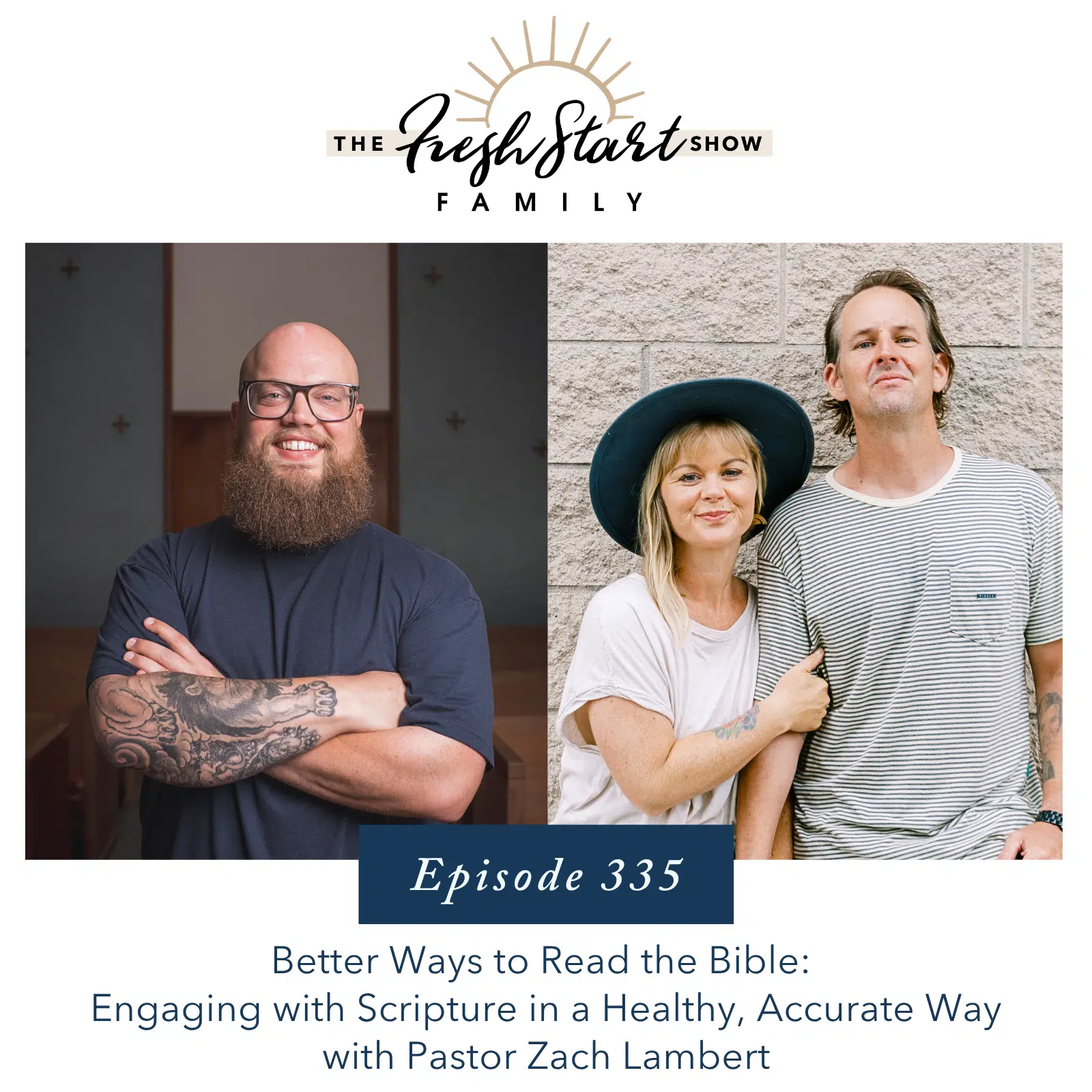
In this powerful episode, Wendy welcomes Pastor Zach Lambert, author of Better Ways to Read the Bible, for a hopeful and honest conversation about engaging with scripture in ways that bring life, not fear.
Zach shares how many people have experienced harm through rigid or fear-based interpretations of the Bible, and how a healthier, more Christ-centered approach can help families rebuild trust, deepen faith, and raise kids in a faith they don’t have to heal from later.
Together, Wendy and Zach explore why questions and doubts aren’t threats to faith, how harmful biblical interpretations often reveal themselves through bad fruit, and why parents can feel empowered to read scripture with humility, courage, and compassion.
This conversation is a beautiful invitation for parents who want their homes, churches, and faith communities to reflect the way of Jesus, rooted in love, justice, gentleness, and flourishing for all people.
Episode Highlights:
- The Bible was never meant to be read through one rigid interpretation, and understanding different lenses can actually deepen faith instead of weaken it
- Fear-based theology often disconnects people from their intuition, their bodies, and their understanding of God’s love
- Questions and doubts are not signs of weak faith, they are often the doorway to a stronger, more honest relationship with God
- The way scripture is interpreted directly impacts whether children experience faith as safe, compassionate, and life-giving, or something they later need to heal from
- Healthy faith communities create space for curiosity, critical thinking, humility, and growth instead of fear, shame, and control
- The “fruit” of an interpretation matters, if a belief system produces cruelty, exclusion, fear, or harm, it deserves to be re-examined
- Parenting and faith both flourish when relationship, dignity, compassion, and accountability work together instead of fear and domination
- Raising strong, thoughtful kids who feel safe asking questions helps prepare the next generation to build healthier churches, families, and communities
- Jesus consistently challenged systems that used power to harm vulnerable people, and that still matters deeply today
- Parents are allowed to engage scripture in ways that bring life, peace, justice, and flourishing to their homes and families
Resources Mentioned:
Find Pastor Zach on Instagram
Unable to listen, or prefer to read along? Here’s the transcript!
Wendy Snyder
Well, hey there families, and welcome to a new episode of the Fresh Start Family Show. We’re so happy that you are here. I am so thrilled to welcome our guest today, Zach Lambert, who is the author of Better Ways to Read the Bible. Welcome to the show, Zach.
Zach Lambert
Thanks so much, Wendy. I really appreciate you having me on. And like I said before we started recording, I’ve been a fan of your stuff for a really long time. It’s helped me and my family. So it’s an honor to be talking with you today.
Wendy Snyder
Oh, well, I have loved supporting you over the years and just have loved all your messaging too. We’ve actually been trying to make this happen, I feel like, for quite some time. So it’s so fun to finally get it on the books.
And I just love what you’re doing over there in Austin. I always say if I had to move to Texas, God bless Texas, but if I had to move there, it would be to Austin.
Zach Lambert
Hey listen, we could only live in Austin, really. Maybe there are a couple of cool neighborhoods in Houston, but that’s about it.
Wendy Snyder
Well, that’s cool because my daughter’s best friend is going to school in Houston.
Today we’re going to have such a great conversation about your new book, Better Ways to Read the Bible. We’re going to be speaking to some points around how to engage with scripture in healthy, accurate ways, to be able to grow our faith, feel connected with God, and all the things, and also be able to raise kids, as my friend Meredith Miller says, in a faith they don’t have to heal from.
Your work and your book are so helpful for parents who really want to grow a faith in their family that does just that, right? That does good, not harm, which is so much of what your book is about.
Before we get into that today, tell us a little bit about yourself. We already know where you live, you live in Austin. Tell us the ages of your kiddos and what made you want to write this book. I know you go over this right in the intro, but tell us a little bit about what made you decide to jump into this. Books take a long time to write, and you’re already doing such wonderful work in Austin, but what made you want to get this all down on paper?
Zach Lambert
Absolutely. I’ll start with family.
My wife Amy and I met in the sixth grade, started dating when we were 17, and got married at 21. So we’re at 16 years currently of marriage. We have two biological children. They are 11 and 7.
We were also foster parents for a few years and had a number of long-term placements and short-term placements. So we’ve been parenting together for a long time, with a diverse family for many years. Our biological kids were obviously raised in our church. We started Restore, our church here in Austin, when my oldest was, I think, six months old. So it’s really kind of all they’ve ever known.
But through foster care, we were also with kiddos who had no church background or really terrible church backgrounds. And then, obviously, we’re all just grown-up kids with our own church backgrounds and difficulties and all that kind of stuff.
The big reason I wrote the book is because we were having these conversations at our church for the last decade, really, around how we engage with our faith in healthy and Christ-like ways. Most of our folks come out of sometimes really traumatic faith backgrounds, sometimes just confusing or difficult ones, sometimes ones that just kind of stopped working for their current life or felt antiquated.
It runs the whole gamut, but the vast majority of our people have had some kind of gap in their church journey. Usually there was some baggage or some harm that was done.
What we discovered is that the primary weapon that was used against most folks was bad interpretations of the Bible. People can say really harmful things to you all the time, but if they do it accompanied by a Bible verse, it gives this divine credence to these terrible things. It can be really hard for people to disentangle that from who God actually is, who Jesus is, or what church is supposed to be.
So from the very beginning, we’ve taken a real trauma-informed lens with scripture and tried to engage with it in healthy ways. My reading background and academic background have helped me a lot in doing that. But for a lot of people in our church, they have jobs, they have families, they’re not going to go to seminary, and they’re not going to read a million books.
So I really wanted to have one resource that I could give to people in our community that was just like, “Hey, here are four harmful ways that a lot of us were given to read scripture. How do we identify and dismantle those? And here are four healthier ways that we can engage scripture.”
It was kind of beta tested in our community. I preached a sermon years and years ago that was just a mini version of this, and people were like, “We want more of that.” So we did classes. I was teaching at a seminary at the time and decided to do a semester on it. It just kind of grew and grew until it turned into a book.
It was like, this has really helped our folks here in Austin, and I bet it’ll help other folks too.
But there’s one more reason I don’t talk about that much, and it’s connected to my kids and the kids in our community. This is what I wrote in the acknowledgments section of the book:
“I also want to thank my two sons. They were not the reason we moved back to Austin to plant Restore, but they are a huge reason I keep getting out of bed every day to do this work. They have no category for a faith community that doesn’t pursue justice, equality, and flourishing for all people. They’ve never been a part of a church that has restrictions based on someone’s age, race, gender, sexual orientation. Watching you both grow into kind, caring, brilliant humans is a joy. I’m so lucky to be your dad.”
For me, that ended up being a huge reason because, like our good friend Meredith says all the time, how do you help kids have a faith that they don’t have to heal from or deconstruct later on? How do we start with a healthier version?
My hope was that this would really help equip parents to be able to do that.
Wendy Snyder
That’s so beautiful. Gosh, that brought me to tears just knowing that your boys have been raised in this world where they just don’t know anything else, right?
We’ve had students say that to us about our work. We actually have a little girl in Bulgaria named after me. Her mom wrote me after two years in the program and said, “This work has changed our life.” Her third child is her spiciest one, and she said, “She’ll never know anything besides this type of firm and kind, connection-based work. And by the way, she’s named after you.”
I was like, “What?” It was crazy.
But gosh, how beautiful. And to give these younger generations an opportunity to come up like that, I really believe they will be protected from falling victim to the authoritarian systems that we are seeing so many fall victim to now, because they will never have that experience, that lens, and that fear in their faith journey. And hopefully not in their parenting journey either.
What a time for this book to come out. This season of life that we’re in in America, we are in a pickle, Zach. And what a perfect time.
I mean, we laugh, right? But also we cry. What a perfect time for this book to come out to help people. I believe there is a rising of people realizing it is time to dissent from this craziness. And this book is actually going to give them the ability to stand with their shoulders back a little bit and say, “Actually, here’s the truth. Everyone is interpreting the Bible. Nobody gets to own 100% accurate interpretation of the Bible.”
It’s so beautiful.
Before we get into some of these sub-points we’re going to talk about today, I was preparing for this interview, and I wrote down a little bit of my journey to share with you, just to give some context for our community.
We have a worldwide community of parents who are usually moving from an authoritarian or autocratic system that they inherited with parenting. It really resembles all the autocratic or authoritarian systems of the world. They’re all the same. They rely on fear and force. They have a lot of hypocrisy. My way or the highway. Lots of punishment.
Most people who come into our world are dissenting from that. And for our families of Christian faith, we have a very diverse community, not all are Christian, but many are, the first thing that starts to challenge them in their faith walk and helps them start to ask questions, as Erin Moon teaches us are so great, and you teach this in your book too, right? Questions are so good. Questions strengthen our faith. They’re not dangerous.
But the first thing that shows up in our community is discipline. They’ll ask, “Yeah, but everyone said spare the rod, spoil the child. What does that mean?”
That was my journey as a parent. I’ve now been doing the work that I teach for 15 years. My daughter is now an adult. She’s 18 and heads off to college next year. My son is 15.
Fifteen years ago, we really hit the wall as parents. Our little girl was three. Our second had just been born. We were like, “Oh my gosh, what is happening? This is awful. I don’t want to be a parent. I want to run away.”
She had been blessed with this beautiful strong will. That same strong will helped her attain her Division I beach volleyball recruitment as an athlete. She’ll be headed there in the fall. But back then, we were like, “What do we do?”
You start asking everybody. Everyone from my boss to the neighbors who would watch her have a meltdown in the middle of the street. Almost every single person we asked told us, “You better get control of that kid. Don’t be afraid to hit her. Google this. Here’s this Christian book that’ll teach you how to go out in the backyard and get a switch, or you can use a piece of plastic if that’s better. This will break their will, and you’ve got to do it as young as possible.”
And then at church, I started to notice there were these books there.
My own parents, I did not grow up in religion at all. I came to know Christ when I was 19 on my own, which I think positioned me to be able to challenge the system so much because I didn’t have that deep indoctrination very young of the fear-and-force element related to God. I had normal autocratic parenting, so of course you were spanked when you got in trouble. But it wasn’t connected with, “I’m hitting you because God told me to.”
As I started to listen to everyone around me, especially people at church, I was like, “This is so odd.” And when I tried it, it blew it up. This kid was like, “Hell no, you will not.” It got worse.
Then thank God, literally thank God, God was like, “Hey, there’s going to be this free class at your kid’s preschool. Come on in. Let’s take care of some business. We’re going to learn a different way.”
That’s when we were mind blown. We started to learn these new tools and go in a different direction. That was 15 years ago, and thank God it changed our life.
It’s all firm and kind, connection-based, compassionate discipline versus punishment, responsiveness versus reaction, eliminating hypocrisy from your home, learning to see strong-willed kids as a blessing, not a curse.
That’s where a lot of people start out with us. When they start to ask questions around how they were taught to read the Bible, the first thing that shows up in our community is discipline. “Yeah, but you still have to spare the rod,” right?
For me, Jesus the Gentle Parent changed the whole game. As soon as I read that book, I was literally on my knees thanking God for L.R. Knost because she puts everything together so perfectly to show people how scripture and the life of Christ align with this type of parenting.
As time went on and we shifted our model, I became certified and I started to teach. At that time, we got deep into an evangelical church in our San Diego area. You get into it and you have no idea, especially for someone who wasn’t raised in the church.
Over about 10 years there, I started teaching. That was a big deal because I knew the autocratic or authoritarian stuff was being taught. So I found the courage to teach, and I had a ministry there for many, many years.
Then as the last few years started to stack and I became more educated in human development and the ways of the evangelical world, I started to realize there were some things that weren’t quite feeling right. The submission culture in marriage started to show up with different teachings. For sure, I started to sniff out that they were fully practicing exclusion with the queer community, and my belly started to be like, “Wendy, you need to do some exploring here.”
As I went on and started to help more and more people across the world, the people who were suffering most from low self-confidence, disconnection from their kids, struggling nervous systems, and the inability to have peaceful conflict resolution often had been raised with a heavy original sin doctrine that had been indoctrinated very young. They had been taught, “You cannot trust your heart. It is wicked. You cannot trust your emotions. Emotions are not good.”
Now, of course, people are even saying empathy is toxic.
Then I started to see that the evangelical system I was in had all of that.
After George Floyd’s death, I dove into three years of diversity, equity, and inclusion training. It was heavy, but thank God, my life coaching organization required it. They were like, “If you want to stay certified, you have to do this.” I remember at the time being like, “Really? This is a lot of time.” But thank God, it changed my life because it gave me the courage to finally speak up about inclusion.
We decided to leave the evangelical church after many years because we needed to find something that was a little bit more us. We found another church in our area that we thought was it. From the front, it was just the coolest. There were sermons on inclusion. I was creating a volunteer parenting ministry there that was so successful, they invited me back for a second year.
Then it turned out that they were not truly inclusive. They sniffed out that I had become vocal about being fully inclusive in my faith, and they asked me to step down as a volunteer parenting ministry leader. It was gnarly, Zach. It was so gnarly.
But of course, this is the way it often works out. Now it’s one of the most transformational experiences of my life because we left there and finally landed at a Disciples of Christ Church here in Oceanside, California, that sounds just like Restore. Fully justice, joy, Jesus, inclusion. We are so happy. I had my office there for a year and a half. That’s where I wrote the book.
Without getting kicked out of that last evangelical church, which again presented so cool and was so confusing, we wouldn’t have landed where we are now. Now we’re at this place where it’s so relaxing to know that nobody is advocating to hurt and harm children. Nobody is practicing exclusive theology. All of it is so in alignment.
The crazy thing is, it’s a Disciples of Christ Church. When I was 19, the Disciples of Christ Church was where I came to when I found my faith. So it’s just a full circle moment.
For me, the first exposure I had to these different ways of reading the Bible was Meredith Miller’s inclusive or affirming theology study. That’s when I learned, “Okay, there are these different ways.” She teaches it as literal, inerrant, infallible, authoritative, and contextual.
That really set me up to have the confidence to start using my voice and saying, “Okay, community and platform.” It was terrifying. I had a lot of healing and unmasking to do over the last few years because I had really been trying to make everyone happy.
It got to a point where that study I did with Meredith gave me the confidence to say, “This makes sense, and I can say it out loud.” I lost a ton of people. The daggers were gnarly. But it built me so much stronger in my faith.
That brings me to meeting you and your book, and the way you are teaching the different interpretations in the harmful lenses and the healing lenses.
Now I have this community where a lot of people, especially when it comes to inclusion stuff, are like, “Oof, we can’t go there,” right? People lose their mind. The parenting stuff, there are always going to be people who will fight to their grave to hurt and harm children and say the Bible tells them to. But those people have become less over the years.
But the people who want to dagger around inclusion, it’s still there. And that’s okay. I’ve come to be like, “Okay, those who have stayed really respect the exploring of it.” They might not be there yet.
I just got a message last week from someone who had invested in some coaching. We do it on a Voxer app. She said, “We’re not fully aligned there yet.” And I said, “Tell me more what you mean. Are you meaning the inclusive stuff?” And she said, “Yes. I live in a very small town in the Midwest, very conservative. Here, you do not talk about that.”
She said, “Even though I’m not where you’ve been, I haven’t done the studies, and I’m not sure still, it’s been so fun to watch you go for it with learning and exploring and changing your mind.”
That was really beautiful to hear.
I think people in our community really respect your type of work because they want to feel empowered. They want to make their own decisions. Because they learn about these different systems, right? We teach democratic, firm and kind parenting. We teach them how to dissent from authoritarianism or autocracy, and they start to see with their own eyes that the people saying, “This is what the Bible means and this is how you have to treat these humans,” don’t actually get to own the whole thing.
It’s safe to challenge that.
So with that said, that brings us now to 2026, where I have your beautiful book in my hands. When it comes to these better ways to read the Bible, start us off with this first idea: the Bible was never meant to be read one way, and understanding different lenses can actually deepen your faith, not dilute it.
Zach Lambert
Yes. First, thank you for sharing some of your story with me and with everybody else listening. I am really moved by your resiliency.
I get to pastor this church filled with people who just refuse to give up on their faith. A lot of them have been pushed out of places just like you. They’ve been made to feel less than because of some intrinsic characteristic, or made to feel like a bad Christian because they had too many questions or were wrestling through doubts. But they just kept at it.
I see that same thing in you and your family, and it’s just a really beautiful thing. So I wanted to acknowledge that and say that’s moving and beautiful. Thank you for sharing it with me.
The book is really built on this foundation that the Bible is big and messy and diverse. It was written over a couple thousand years, across three different continents, in three different languages, by 40-plus authors, with about 10 or 12 different genres of literature.
It’s really not a book. It feels like a book because you can pick it up and hold it like a book, but it’s a collection of books, a collection of writings, and they’re all different kinds of writings.
So with this big, messy, diverse book, we have to approach it with some level of humility, as you just said. Not everybody has it all figured out. There’s not one way to interpret and understand it.
In fact, I think it’s a huge red flag when somebody says, “I’ve got it all figured out, and here is exactly how you should understand it,” or, “It’s easy to understand,” or, “You just read it in black and white.” All those things are red flags for me because the stories don’t always line up. The biblical authors don’t always agree with each other.
I actually think that’s what makes the Bible so amazing. Far from taking away from the beauty of it, I think it adds to it. It allows us to engage with the Bible as it is and not assume that it needs fixing or that it needs to align all the time. We don’t have to make sure that everybody is right in here and interprets it the way I interpret it.
Letting go of that actually allows the Bible to be all that it can be in our lives in much more beautiful ways.
That really is the foundation of the whole rest of the book. The Bible is a collection of messy and diverse writings by human authors. I still think they were under the inspiration of the Spirit of God, but nobody really knows exactly what that means. There are a lot of ways that’s been explained, but it’s not easy to understand.
We obviously know God is constantly meeting people where they are. The biblical authors, the biblical characters, us, right? God is meeting us where we are. That means there are scientific limitations in scripture. There are moral limitations in scripture. There are all different kinds of things happening.
Trying to understand it with that as the foundation opens up the rest of these lenses to be a little bit more helpful in our journey.
Wendy Snyder
Yes. I love how you teach in the book a few different lenses that are a great checkpoint. We can get into this, but it’s like looking through the fruit it creates and whether it causes harm.
That’s the entry point for a lot of people in our community who start to explore different lenses. Is it safe to challenge the way the Bible is read or not? It’s a pretty easy question if you’re interpreting the scriptures that have traditionally been used to make parents believe they have to hurt and harm their children when they make mistakes and misbehave.
It’s so easy to see the harm being done. Of course, there’s the research and people like me who have thousands of case studies, but even just the physicalness of it, there are literal red marks there.
So I do like how you talk about this. It’s not rocket science. What is the fruit it’s creating? And does it cause harm, the way you are reading it and interpreting it?
Zach Lambert
Exactly. You alluded to this, but I present these four lenses that usually lead to harm, and then these four lenses that lead to healing and wholeness.
The last one I talk about, the very last chapter, the fourth healthy lens, is fruitfulness. It’s basically this understanding that Jesus said, “You will know my followers by their fruit.” He said that numerous times.
Then Paul enumerates the fruit of the Spirit for us. The fruit of the Spirit is love, joy, peace, patience, kindness, goodness, faithfulness, gentleness, and self-control.
Very simply, I’m advocating for this as a barometer to judge our Bible interpretations by. Are these Bible interpretations leading to more love, joy, peace, patience, kindness, goodness, et cetera, in me, in my family, and in my community around me?
If they are, then that is the fruit of the Spirit of God at work. Jesus said that’s how people could distinguish his followers, by the fruit they produce.
But the reality, as you alluded to, is that our Bible interpretations in many Christian spaces have led not to love, but to hate. Not to goodness, but to cruelty. Not to kindness, but to meanness.
I think that should, at the very least, cause us to say, “We need to re-engage these interpretations because they’re leaving literal marks on our children.” That should cause us to say, “There’s something wrong here.”
Wendy Snyder
Yeah. It’s so interesting to watch people, especially big leaders in the space who are teaching people to read the Bible and implement these harmful lenses, do pretzels to justify how this actually creates harm. They’ll try to explain how the fruits of the Spirit, for example, gentleness, or empathy, even though empathy isn’t listed there, actually cause harm.
It really feels like pretzeling mind trickery to prove how these fruits could actually be harmful to a human.
I call my work powerful parenting. My book is Fresh Start Your Family: Powerful Parenting to Restore Peace in the Home. For many years I referred to it as positive parenting. I have many colleagues who refer to themselves as gentle parenting educators. And man, the attack on that field by these people, I think they know that we don’t want to interpret the Bible in a way that harms people. So they do pretzels to justify how the people teaching patience, compassion, empathy, love, and self-control are actually causing harm.
Maybe just to put this in here as a question as we’re going through our bullets, how have you metabolized some of the rage or anger? We teach here that anger is a beautiful, healthy emotion. That’s where justice is often born. It’s where many of us set a firm limit from.
How do you do that on those days when it just feels so heavy, especially in 2026 in America, to keep answering what feels like such an attack?
Zach Lambert
That’s a good question. And you’re right, these things are under attack. Empathy, gentleness, meekness. I think if Jesus appeared today and preached the Sermon on the Mount, they’d kill him again.
It’s not just unpopular. It goes in direct opposition to some of the highest levels of leadership, Christian and political, in our country. Many of those are kind of one and the same currently, tragically.
So I think we have to be people who see it. I’m not talking about scrolling social media 24/7, but it requires some level of attentiveness, opening your eyes, listening to what other people are going through. Then it requires courage to stand up and speak out when these things are really wrong.
When we do that, though, as you’re alluding to, there is going to be pushback. People are going to get angry. People are going to be mean.
For me, a long time ago, I had to give up this idea that I was going to be pleasing everyone, that nobody was ever going to be mad at me.
My therapist gave me a tool for discernment in this. Number one, who is mad? And number two, why are they mad?
That gives me a helpful indicator for the work I’m doing.
If Amy is really mad at me, and she’s mad because I’m so wrapped up in my work that I’m never present with her or the kids, that’s a problem. I really need to listen to that. I need to take it in.
But if this crazy right-wing pastor troll is mad at me online because I posted that we should treat women with the same respect that we treat everyone else, I’m okay with that. That anger toward me, that meanness, whatever vitriol comes from that person, honestly becomes like an affirmation of the work that I’m doing.
Seeing those things through that lens has been really helpful. Who is mad? Why are they mad? And do I feel okay with my work upsetting these folks?
Because here’s the thing. People got really mad at Jesus. I’m not comparing myself to Jesus at all, but people got really mad at Jesus, and Jesus got mad.
I think one of the most effective biblical exercises we can do is to explore what made Jesus angry.
To put it very bluntly, what made Jesus angry were powerful people, specifically religiously and politically powerful people, wielding their power in ways that hurt the people they were supposed to be caring for.
That made Jesus really angry, really consistently. He didn’t get mad at the prostitutes. He didn’t get mad at people on the margins of society, or people struggling through sin. That’s not who he got angry with.
He got angry with powerful religious and political leaders who chose to wield that power to hurt people rather than help them. That should inform, number one, what we get upset with. And number two, how we gauge people who are upset with us.
Wendy Snyder
Yeah, it’s so true. I think courage and action can be a way to metabolize anger. Everyone does that differently.
Courage is a big thing right now. This is a season where so many people are developing that muscle of courage. I think a lot of people are going through the unmasking season where you just learn to be okay standing in your own values.
But it is so hard to watch. I remember we had a chaplain from the military speak at church a while back, and my question afterwards was so funny. He didn’t quite know what to say to me, and I was okay with that.
I said, “Sir, what do you do in this season? I feel like I’ve never struggled in my whole life, and I’m almost 49, with this much rage and hate.”
Hate was the word I used, Zach. I have taught my children for 18 years to have so much compassion and empathy, but I feel like there’s a garden growing in me and I don’t like it.
He responded in some way, and I forget exactly what he said, but I just don’t like it. I feel like we all are having to find these ways to metabolize the feelings that are coming.
In the end, most people, especially after working with thousands of parents and getting to know so many people on a deeply human level, are just scared. They’re scared people aren’t going to like them. They’re scared people are going to accuse them.
In the world we’re talking about, everyone is scared they’re being accused of being harmful, which they are. We’re saying, “You’re being harmful by interpreting this way.” And they’re saying, “You’re being harmful by being gentle with children, including people, and giving people empathy.”
So everyone is trying to figure out how to be okay with feeling scared that they’re not going to be able to make people happy, and that some people are going to think they’re hurting people.
Zach Lambert
Absolutely. And to your point earlier about the gymnastics people do, the pretzeling they do to make something seem okay or even divinely mandated when it’s just not, I talk about this all the time.
People do so many mean and terrible things in the name of Christian love. They’ll say, “This is loving. It’s actually loving to hit your children,” or, “It’s actually loving to exclude people based on an intrinsic characteristic about them,” et cetera.
What I respond all the time is, “The Bible was written in multiple languages, and there are a lot of different words for love. They all have their own little nuances, but exactly none of them mean hate, exclusion, or condemnation.”
Love is never those things. It’s okay for us to say, “That’s not actually love.” You cannot just redefine a word to say, “This is actually what God has called us to do,” when Jesus said the most important thing is to love God and love your neighbor. These things are not loving. It’s okay for us to say that.
One more thing I wanted to say about your courage comment, because I thought that was really well put, about how we’re all trying to metabolize the world around us and learn this courage muscle. It looks a little different for everyone.
I want to encourage folks who are listening to this. I know a lot of us feel like we can’t fix everything that’s wrong, or we feel like we can’t make a big difference. It’s true, you can’t do everything, but you can do something.
Some of the most courageous work you can ever do is invest in your kids and your family in ways that help them grow into kind, compassionate, empathetic individuals. That is courageous and hard and beautiful work.
It doesn’t have to be that you’re at every single protest or that you’re writing think pieces on Facebook all the time. Some people do that and it’s amazing. A lot of people don’t have the capacity to do that.
For a lot of folks, I think the most courageous thing you can do is invest in your family in ways that help them grow into people who really make the world a better place.
Wendy Snyder
It’s so true. And to raise critical thinkers.
Our next point is: you’re allowed to read the Bible in ways that bring life, not fear.
It’s so different, as you mentioned, with your sons. They’ll never know anything different. It’s such a courageous journey for parents who are learning to read scripture differently because so much of it was through a fear lens. Everything was so fearful. If you do it wrong, it’s going to be bad. If you ask the questions, you will get punished or kicked out.
Speak to us a little bit about that. You’re allowed to read the Bible in ways that bring life, not fear.
Zach Lambert
As I said, so much of what happens in fundamentalist or high-control religious environments is that you’re taught you can’t trust your own intuition, your own emotion, your gut. But you can.
I actually think that is part of being made in the image of God. That’s part of the Spirit of God within us, helping us intuit things and feel things in really helpful ways.
So if you’re hearing a sermon or reading a book and your gut is like, “I don’t think this is right. This feels like fear. This feels like hate. This feels like harm,” lean into that. Trust that. Continue to do your research and be critical thinkers, all of that.
It’s really an abusive control tactic to say you can’t trust yourself.
What people say is, “The heart is deceitful above all things.” They quote that verse out of context and then say, “So you can’t trust yourself, but you can trust God.”
But the issue is most people saying that are claiming to speak for God. So what they’re actually saying is, “You can’t trust yourself, but you better do what I tell you to do because I’m speaking for God in your life.”
That is classic religious abuse language that really sets people up to do harmful things to themselves and people they love.
Wendy Snyder
It’s so true. And there is one way that is right, right? Under that lens of inerrancy, infallible, literalism, moralism, hierarchy, apocalypse, all the things you talk about. There is one way, and this is the way, and I speak it. If you challenge it, it is dangerous.
You talk about the intuition thing. It all started to click for me when I started to read some of Meggan Watterson’s work around Mary Magdalene’s scriptures and the Christ within. That beautiful intuition.
In my life, I describe it like this inner intuition. It’s the feeling I had when my daughter was three and everyone was like, “You better get control of that kid. Just hold her down, hit her, get the switch from the backyard.” And your body is like, “Something is wrong.”
Then I feel like divine guidance comes from above. That part comes from the lower part of your body, and then from above, this divine guidance can come through anything and everything. Conversations, signs, literally the sign at the preschool the week after I had the worst moment of my life as a parent when Stella was three.
Divine guidance comes from everywhere, and then it meets in the heart. It meets right in the center. That’s where I feel like so much of our moral compass lives.
Learning about the Christ within, about how these early women’s involvement and partnership with Christ was actually integral to how we operate as humans, was so powerful for me.
But yes, it is safe. And for so many people in our community, it isn’t just a belief system that it’s not safe. It’s a nervous system response now around, “It is not safe to trust yourself.”
The next thing we have on our list here is: questions and doubts aren’t signals of weak faith. They’re often the doorway to a stronger, more honest one.
I think what people fear is that if they have this yucky feeling and they’re like, “That’s weird,” like I remember watching sermons from the evangelical church where they had all the couples on stage, couples I loved, and they were talking about the submission hierarchy model in their home.
I remember thinking, “Huh.” I didn’t know much back then because I was early in my faith journey, but I thought, “Something feels off here. What are they talking about?” Then I would go learn a little bit and think, “Something tells me that is a weird interpretation.”
People think, and I remember when I released my first episode with Meredith Miller, one beautiful student who had been studying with me for years and was deep in the evangelical space contacted me and said, “Wendy, I’m really uncomfortable with this episode and the things you said.”
We did our best to work through it. I think she stayed in the program for another year and then moved on, and we’re still great. She still touches base sometimes.
But she said, “I just think you’re on a slippery slope here.” She said, “I hear what you’re saying, and it makes sense, but if you start to challenge…” I think this is taught in those spaces, like if you start to pull a stitch, then the fear is that you’re going to end up this devil-loving, I don’t even know.
But in my experience, Zach, and I think you’re right about this, it’s the farthest from the truth. It’s actually the doorway to a stronger, more honest faith. That’s why it’s so essential to raise kids in an environment where they realize questions are great. Critical thinking is great. You ask as many questions as you want. This is your faith.
What would you say about that? Questions and doubt aren’t signs of weak faith. They’re often the doorway to a stronger, more honest one.
Zach Lambert
I love the doorway metaphor.
The slippery slope metaphor is hilarious to me because they’re right in one way. You do begin to unravel things, and you start to really see some stuff.
In fundamentalist spaces, the edges of fundamentalism are guarded so intensely. That’s why you can’t just kind of waltz into fundamentalism and waltz out and go back and forth. You’re either in or you are pushed out. Even if you’re close to the edges, that’s why they’re saying, “You better come back in before you go all the way to the other side.”
Because in one way, if you start to have questions about, “Why can’t women be pastors? I’ve been told this, but does that really make sense?” then yeah, you’re going to start opening up to questions about racial justice work in the church. You’re going to start being opened up to questions about inclusion for queer people in the church.
It is going to be a slippery slope, but I think you slip all the way into the way of Jesus, which is way better than whatever else they’re talking about.
I think we get there a lot with questions and doubts. I love the doorway metaphor.
A metaphor I use all the time is that fundamentalism and high-control religious environments are like a basement. A dark, damp basement. You are convinced by everybody else, “This is what Christianity is. Anything outside of this basement is not Christianity. It’s apostasy, heresy, devil worship, whatever. So you better not ask too many questions, you better not voice any doubts, or you are going to be in danger of leaving this beautiful faith community.”
But what actually happens is when you ask some of those questions and voice some of those doubts, it’s like you walk up the stairs of that basement, through a doorway, and you open it up and see that 2,000 years of Christianity is actually this big, beautiful, diverse house. There are so many different rooms, things we can learn from, and people we can engage with in such beautiful ways.
You just mentioned books that you’re reading about Mary Magdalene. I think about Jesuits who’ve been doing incredible social justice work in Catholic spaces for a long time. Liberation theology that came out of South America and made its way to the Black church in America. So many gifts of Christianity over these 2,000 years.
But if you stay locked in that basement, you never see any of that stuff.
The way up those stairs and out that door, a lot of times, is asking those questions and engaging with those doubts.
Wendy Snyder
Yeah, Zach. The slippery slope analogy, it’s also why those of us who get asked to leave, and I felt so much connection with you as you talked about the places you got kicked out of, it makes sense why we’re teed up as dangerous.
When you’re in it, it’s the worst feeling because you’re like, “God, I thought this was me.” But then you start to feel belonging with others.
That’s why we’re framed as dangerous. That last church, when I was asked to step down, the lead pastor didn’t even have the dignity to call me. He had the assistant call me. But it was like, “You will confuse people. You will lead them astray.”
I feel like that’s such a knock to God. Like God’s not powerful enough? You’re educating people that they have a choice.
The way I see humans, and it makes sense why I see humans like this because this is the way I see children, is if you empower humans and trust in their humanity, goodness will prevail when they’re not conditioned through fear and force into believing something.
I found that language so interesting. “We just think you’re going to confuse people.” I was given the message, “You’re going to lead people astray.”
What you said about the big, beautiful church, that is the good news about this process. After being in the evangelical church for 10 years, I had no idea there were different options until I got kicked out.
I remember the first few days, there were deep tears. Then I had a post go viral where I shared that I was moving on from this church. The first few days were very supportive. Some of the people I never would have known had been on this journey too reached out. Then day three, somehow it went viral to the trolls, and it was gnarly.
I found myself so depressed and saddened by the state of the world. How could this be a reality? How could people do this to someone?
Then when we found our church and I started doing research, I quickly realized, actually, there are five churches within two miles from me that don’t operate like this. We have an Episcopalian church, a United Methodist where my kids went to preschool, the small Lutheran one that had the preschool, even one of the Catholic churches was starting to feel similar. I thought it was just this basement that you had to make do with and still show up in.
Then I realized, “Oh my gosh, there is this beautiful, big house.” You have to look for it. And people in small towns don’t always have that. But I did find it really surprising to learn about all the people in the world who are practicing this type of Jesus-centered, justice, joy, inclusive Christianity.
That is good news that comes out of this.
Zach Lambert
Absolutely. It was one of the most beautiful moments for me too. That’s why I tell people it’s not easy. I’m not going to pretend that it is. The hate that comes your way, the losses that you’ll have to mourn and grieve through, all of that is real.
But the beauty, the freedom, and the people that await you on the other side of this, I would never go back. It’s just been such an amazing thing.
Wendy Snyder
Yeah. Let’s end on this last question or comment. Give us your thoughts on this.
If we really want to know how to have better ways to read the Bible, how to engage with scripture in a healthy, accurate way, and help raise kids in a faith they don’t have to heal from, riff on this for us, Zach.
The way we engage scripture today shapes whether our kids experience faith as safe or as something they need to heal from later in life.
Zach Lambert
My thought is that you said that really well. That is exactly how I would say it.
It was not the primary reason we started out to plant the church. It wasn’t the first reason I thought about making all this stuff into a book. But it has been a sustaining reason, and it’s actually probably the most important reason for me personally.
It’s the thing I end up talking to people about so much. I’ve been traveling around speaking about the book and doing Q&As. I get a lot of questions about the state of the world. I get a lot of questions about someone’s personal faith journey they’re trying to heal from.
But I get so many questions, maybe the number one category of questions, at least from parents, is, “How do I help my kids see this? How do I raise them in a faith, engaging with scripture in ways they don’t have to heal from later or deconstruct from as adults?”
That’s really the whole second half of the book.
My kids don’t really need the first half of the book. They’ve never been exposed to the lens of hierarchy where it’s like, “Only this kind of person is allowed to be in charge,” or the lens of apocalypse that says everything’s going to burn anyway, who cares, and the vast majority of people are going to end up in hell. They don’t need that, at least not at this point.
But what they really do need is the second half of the book. Here is how you engage with scripture in healthy ways.
Then here’s the magic of it all, Wendy. When they start to see the first half of the book in action, in their friends, on TV, or in the news, they are equipped to say, “That’s not how I understand faith at all. That’s not how I interpret that Bible verse at all.”
They’re able to have much healthier conversations because they were able to be immersed in these healthier ways of reading scripture.
That really is my hope. I’m working right now on adapting the second half of the book, those four healthy lenses, for student ministry work. We’re doing it with our youth group here at Restore. The hope is that it would be able to help youth groups and student ministries all around the country because of that exact thing.
Helping them find that firm foundation in these healthier ways means that when they see the unhealthy ways, they’re able to say, “That’s not right.”
It’s the same principle. When you have parents who treat each other with respect, dignity, and care, and then you see parents who don’t, you know something’s wrong. It’s the exact same thing.
When you see a healthy version of God, healthy versions of church, and better understandings of scripture, you’re easily able to identify, “That’s not right.”
When people act that way in church, like the way you were treated, Wendy, your kids are able to say, “That’s not right. I know that there are better ways than that.”
That’s my hope as we help raise kids in this way.
Wendy Snyder
I love it, Zach. Your work combined with my work, where kids are raised in parenting systems where it is safe to challenge authority, where no is not a bad word, where they are treated with dignity and respect even when they make mistakes, go against the grain, or disrupt the system.
We really teach parents, especially with strong-willed kids who are the red flag raisers, who bring parents to their knees, to see them as system disruptors for good reason. Like John Lewis and good trouble. We want to raise children in environments where it is safe to disagree and safe to challenge authority.
Many kids who are raised in a powerful parenting system grow up to be able to have dignified conversations, but not just stay silent when they see harm being done.
That is something I see so many suffering with these days. It is so hard for them to say at a gathering, “I actually believe differently.”
My dream for the future is that kids raised in churches like yours and like the one I’m in now, first of all, that these churches will become the norm of Christianity one day. I truly believe we are on the brink of the system flipping. Over the next 30 years, I have this vision where the pendulum is going to swing in a very different direction, and we are going to recover.
That is the vision I hold strong to every day. Restore and Oceanside Sanctuary will be the norm. You can still find the more harmful circles, but this will be the norm. And the children who will be the pastors of the next generation will have this foundation from early on to engage with scripture in healthy ways, in ways that bring life and thriving instead of suffering and all the things we see unfold when it’s not like that.
Zach Lambert
I’m praying into that vision alongside you, Wendy, and I’m working into that vision. I am so grateful to be able to do it alongside you and your incredible work. This has been such a gift of a conversation. Thank you for all the work you do to make that vision a reality in our world.
Wendy Snyder
Thank you, Zach.
I know you don’t touch too much in this particular book on the scriptures that are classically used to hurt and harm children, but I’m your girl if you ever want to have a conversation, whether it’s Substack or anything. I could really pour into your community around, “How do we read it differently? How do we do that?”
Zach Lambert
That would be so fun. We should absolutely do that. You should come to Austin and preach sometime. That would be awesome. Meredith came and preached a few years ago, so we’ll make it happen.
Wendy Snyder
Oh my gosh, I would love to visit Austin. We’ll talk. I haven’t been there yet.
Meredith is the best. But I think in our world, people really, really want to dig into the how-to of discipline. They’re like, “Yeah, but you still have to teach them.”
I’m like, “Friends, we teach. We hold them responsible. Trust me. And it is with so much compassion, so much dignity, and it creates so much connection and safety.”
Man, those kids learn. They learn so well when it’s done with safety and in ways they feel honored and lifted up by God instead of condemned and struck down.
Zach, you are such a light in the world. I feel like this is the most energy for an episode I’ve had in a long time because I was that excited to talk to you. Your work is so important.
Listeners, go get Zach’s book, Better Ways to Read the Bible. Zach, end us with where everyone can come find you, where they can get the book, follow along, and get involved with your work.
Zach Lambert
Thank you. You can get the book anywhere books are sold. If you go to zachwlambert.org/book, you can find discounted versions directly from the publisher. Obviously Amazon too.
You can also buy them directly from me, and I’ll sign them, inscribe them, and send them to you if you want. If that’s your thing. I always joke that if I write on the book, they go down in value, so just be aware of that. But some people are into it, and I support it.
I write long form on Substack, actually alongside my wife quite a bit, Amy.
Very exciting news, we just signed a contract with my same publisher to write a book we’re tentatively titling 40 Days of Better Ways. That’s going to be a Bible study format based on these four healthy lenses that we’re co-writing. That should be out summer of 2027. We’re super excited about that.
So that’s on Substack, and then that book will be coming out later on.
I’m also on Twitter, Instagram, Facebook, all that stuff. You can find me anywhere at Zach W. Lambert.
Wendy Snyder
You show up, man. I don’t know how you find all that energy to show up even on the hard days, but I see you, Zach, and we are so grateful for your work and this conversation. Thanks again for being here.
Zach Lambert
Absolutely. Thanks for having me.