


Enter to win a prize package worth over $1700 now by subscribing to our new channel on youtube. Click HERE to enter
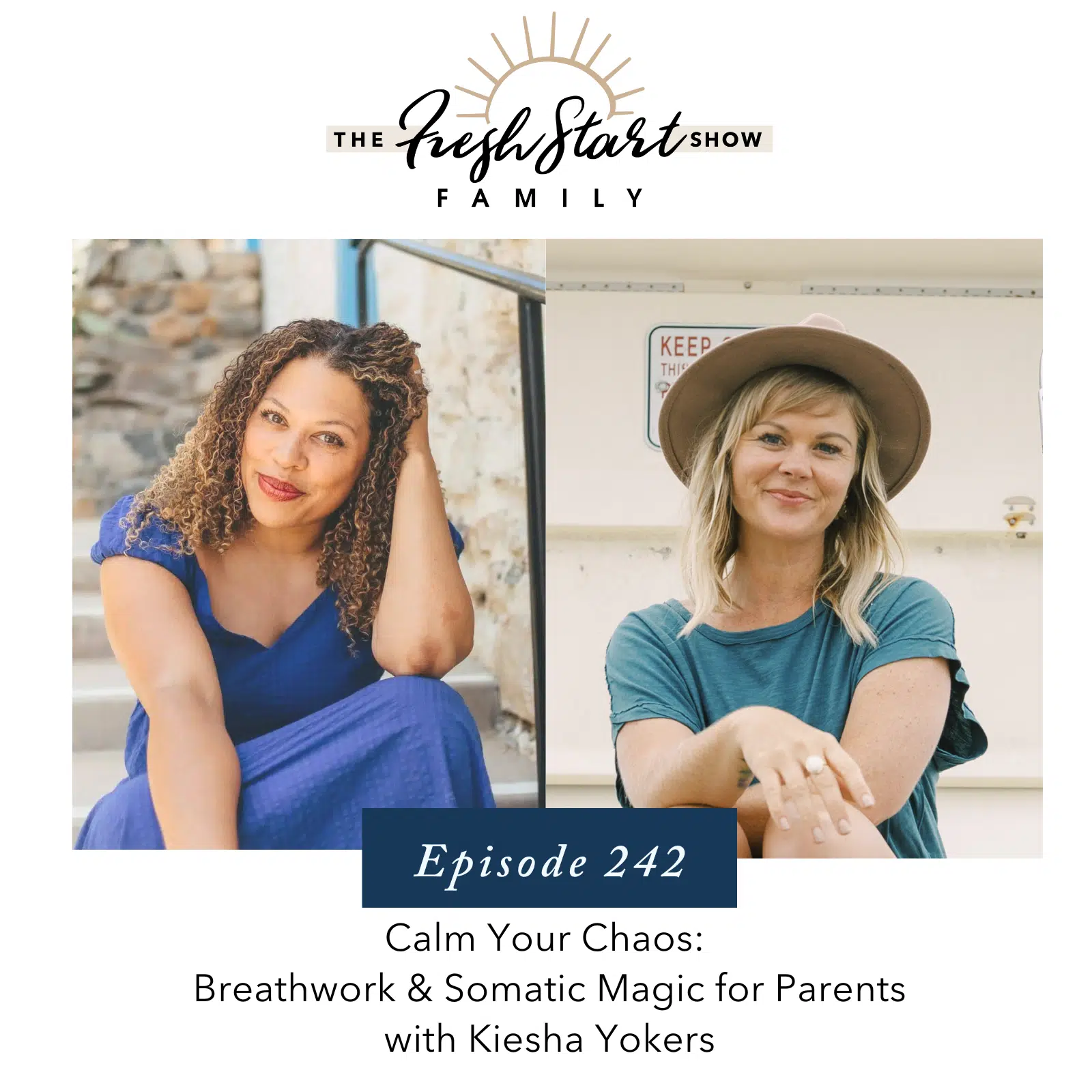
In this powerful episode of the Fresh Start Family Show, Wendy sits down with Kiesha Yokers, a trauma-informed breathwork facilitator and somatic practitioner, to unpack how nervous system health and inner calm can transform your parenting journey. Kiesha opens up about her own path through trauma and resilience, sharing how grounding techniques and breathwork have become her lifeline for regulating the nervous system.
Wendy shares her own experiences of personal growth, learning to tune into her body and emotions, and how addressing trauma has impacted her parenting. Together, they explore the importance of creating safe, nurturing environments for our kids—shifting focus from correction to connection—and how breathwork can be a game-changer for healing and self-awareness. Kiesha’s wisdom brings home the message that somatic practices are not just tools, but powerful catalysts for emotional well-being and resilience in both parents and children.
Get ready for an insightful and deeply relatable conversation that’ll leave you with practical tips for using breathwork and somatic practices to show up as your best self in parenting!
Are you ready to create the life you want – filled with strong healthy relationships –
+ live with high self-esteem, confidence, peace & joy?
If yes, join us for The Fresh Start Family Freedom to Be Online Course!

This immersive learning experience will help you heal relationships, learn to love yourself more, forgive others easier, shed limiting belief cycles, end protection behaviors & stop blaming yourself & others! Click HERE to learn more!
** There are very limited spots, and they are filling up quickly, so save your spot now!! I can’t wait to see you there!
Episode Highlights:
- Nervous System Health: Kiesha emphasizes the importance of practices that promote nervous system health and inner calm, particularly in parenting. She suggests grounding and centering the body, low and slow breathing, and cultivating gratitude as essential strategies.
- Breath Work: Kiesha is a trauma-informed breath work facilitator. She teaches that breath work can signal safety to the body, helping individuals recognize that they are not in danger. This practice can be a powerful tool for emotional regulation.
- Self-Compassion: Kiesha encourages self-compassion, reminding listeners that it’s okay to not be ready for change. Acknowledging one’s feelings and giving oneself permission to take small steps, like breathing for three minutes, can lead to significant healing.
- Accessible Practices: She advocates for simple, accessible practices that can be integrated into daily life. For instance, using a timer for short breathing exercises and journaling can help individuals reconnect with themselves.
- Community and Support: Kiesha highlights the importance of community and support in the healing journey, inviting listeners to connect with her through social media and her website for further guidance.
Resources Mentioned:
Follow Kiesha on Instagram
Kiesha at Lindywell’s Instagram
Kiesha’s website
Grab a FREE 2 week trial of Lindywell with this link and try out their bodywork and breathwork for yourself!
Full Episode now available to watch on Youtube!
Not able to listen or prefer to read along? Heres’s the transcript!
0:00:03 – (Wendy): Well, hello there, listeners, and welcome to a new episode of the Fresh Start Family show. I am thrilled to be here today with Miss Kiesha Yokers, who is a trauma informed breath work facilitator and somatic practitioner, and she’s the head of breath work and somatic programs at Lindywell. Welcome to the show, Kiesha.
0:00:24 – (Kiesha): Thank you. You did great. It’s always such a mouthful.
0:00:28 – (Wendy): I know when I tell people, when they say what I do, I’m like, I need to create a new title because I say powerful, positive parenting educator and family life coach. And they just kind of look at me like, what? I’m like, I know it’s too long.
0:00:42 – (Kiesha): Okay. I love it.
0:00:44 – (Wendy): But we’re so happy to have you here on the show today, and we are really excited to talk about three practices for nervous system health and inner calm in our parenting walks.
0:00:58 – (Kiesha): Awesome.
0:01:00 – (Wendy): Cheers to that.
0:01:01 – (Kiesha): I know. Me, too. I’m ready.
0:01:03 – (Wendy): Yes.
0:01:03 – (Kiesha): Yes, please.
0:01:04 – (Wendy): I know. As I was preparing for this interview today, I was like, oh, man, this is going to be so relaxing this afternoon because I get to be in your presence and just your vibe, and I know that what you’ve been focused on doing in your work and in your own life of healing and just really, the light that you radiate out into the world is just. Just beautiful to be around and in the presence of, and it’s just.
0:01:32 – (Wendy): I was like, look, this is going to be a fantastic hour. So here we are. And why don’t we do this? Before we head into our subject matter, why don’t you tell us a little bit about your story, Kiesha, and how you got here to be doing this incredible work? And I will tell you before you do that, I love how God aligns things, because, um, you at Lindy well, you guys started to bring in, so I’ve been a member of Lindy well, by the way, which is fresh start family’s favorite, Pilates and just, like, personal care programming. And Robin Long, the founder, is incredible. She’s been on our podcast before, but I’ve been a member since, I think now, like, eight years.
0:02:13 – (Wendy): Eight years I’ve been a member.
0:02:15 – (Kiesha): Well, thank you. We love our longtime members.
0:02:20 – (Wendy): Oh, my gosh. Yeah. I am grandfathered in at the best rate ever. I found you are. You are.
0:02:28 – (Kiesha): They love you.
0:02:28 – (Wendy): I found them, you guys, when I had a sea urchin, like, injury or whatever, I was surfing in Mexico, got this sea urchin, had to have surgery to get this darn little, like, 1 mm piece of urchin out of my foot. It was awful. And that’s when I discovered pilates. My neighbor Natalie was like, hey, you should check out my friend Robin’s work. And it’s just been such a blessing in my life. And then when I saw you guys starting to implement more breath work into Lindy, well, I was just really intrigued and started to learn more about you and the work you do. And then this last fall really felt God calling me and nudging me to, like, do start doing nervous system healing work. And it was interesting because it came in the form of financial healing.
0:03:16 – (Wendy): But the teacher and the mentor that I fell in love with, her name is Kate Northrup. It was so much nervous system regulation work, and I started to get into more breath work and using aromatherapy to, like, solidify new thought patterns and just all this cool stuff. And so I really have been looking forward to this interview for a long time. And now I’m excited to hear your wisdom today because we are incorporating more breath work and nervous system relaxation strategies into our fresh start experience program with new, like, month program or monthly workshops where we’re just practicing together what this looks like. Because I think in the end, it’s just one big practice, right?
0:03:57 – (Wendy): To make it become more like who you are and just what you do. But with all that said, hitchhike, please tell us about your story and how you became so passionate about doing what you do and how you got to where you are today, helping so many through your work.
0:04:11 – (Kiesha): I love it. Whenever someone asks you your story, you’re like, where do I begin? And also, by the way, I live in Seattle and it’s snowing here and it’s like raining and snowing and it’s really pretty and, oh, my goodness, I bet, yeah.
0:04:26 – (Wendy): I love that you’re in a window. My office is, like, in a converted garage. And I’m like, I want a window one day. It’s on my goals vision board.
0:04:36 – (Kiesha): So. Okay, where do I begin? I’ll begin at the beginning. So I have. I was an elementary school teacher for a long time, and I’m sure you have those listeners.
0:04:50 – (Wendy): We love our teachers.
0:04:51 – (Kiesha): Me too. They’re my people. And if you are listening to this and you can’t see me, you would probably guess you were a first grade teacher or kindergarten teacher or something. And I was. It was an early elementary school. I just love little kids. I love them so much. And I just believe in children. I like always, even as a child, I just thought children are the most wonderful thing. And so I just knew I wanted to do this since I was a kid, kid.
0:05:19 – (Kiesha): And I’m very grateful that I had this beautiful career in education. And I will say, I used to be called Mary Poppins because I would just sing and. But I was very strict. I was really strict because I just wanted kids to learn, and I ran a tight ship, and there was rules for it. And so it’s funny, because I look back, and I go, whoa. Oh, boy. The things I would do differently, the things that I see said and my understanding of the body, the nervous system, neurodiversity, the way kids show up.
0:05:57 – (Kiesha): And that’s a whole nother. That’s a whole nother talk on to teachers, but also to parents, is how we, you know, how we view, like, our norms of children, our norms of boys, girls, their behavior, how they should act. And so that is. That sort of informs the work that I do, is from the lens of teaching. And so my husband is in the military, and he just retired after 20 years. We’re so happy to be, you know, settled. And so, really, congratulations.
0:06:32 – (Wendy): We love military here. We have free curriculum for active duty military families in our fresh start family gives program. So thank you for your service, Kiesha.
0:06:41 – (Kiesha): Absolutely. And his. Yeah, so we’ve moved around for 20 years, and, you know, every two years, we move. And I’ve seen a lot of things. We’ve seen a lot of loss, a lot of suffering, a lot of pain. It’s a very extreme life. It’s like, I always think of that season as life that is concentrated, if that makes sense. It’s just, like, so intense, and, like, you know, I moved to a new place that I’ve never been. It’s like being picked up from a crane and dropped and looking around and going, are you gonna be my friend? Are you gonna be my. Are we gonna survive? Are we gonna do this together?
0:07:18 – (Kiesha): And it’s almost like being around people that, whether they know it or not, are in fight or flight, because that’s just sort of the life. And it’s like, how do we regulate together? How do we co write? How do we create consistency and safety and love and friendship and our kids. I’m gonna raise your kids and your. I mean, it’s, like, very beautiful and very, like, intense. And then you add, you know, we were stationed overseas in Japan, my favorite place in the world. And we were there in 2011 for the nuclear disaster, tsunami, and earthquake.
0:07:52 – (Wendy): Dang.
0:07:53 – (Kiesha): I could. In, like, 10 seconds, I could say, I could list tornadoes, category four hurricanes, you know, loss of active duty service members. I mean, I could just go on and on and on and on and say, one decade. What I experienced, my therapist likes to say, is more than most people do in a lifetime. And it was sort of normal to me. Right. And so then there came the point where. And I’m really cautious. I will say that I’m really cautious and mindful. So pardon me if I just sort of think for a second about what I say, because I don’t want to trauma dump on people. Like, you may not be ready for that. And so I want to be, you know, mindful, but, um. But trauma does inform my story.
0:08:41 – (Kiesha): And trauma that was recognizable and unrecognizable, and that is really. So, um, I got, you know, I had my infertility years that was, you know, tough time. And it’s so funny. I mean, like, I’m cutting to things so quickly, but. And then got pregnant, and then eight months into my pregnancy, moved to a new place and. And started with a new doctor and had the birth that I did not hope would happen that way, but it did. And I had this beautiful child, and then a few weeks later, I had a medical accident that caused me to have a stroke, and I.
0:09:27 – (Kiesha): In front of this person, and again, another really tough story. And I had a three week old dang girl. I know. And so when I say in that first year of my son’s life, I had to learn how to walk and talk again. And it was awful. It was really hard.
0:09:46 – (Wendy): I bet. Yeah.
0:09:48 – (Kiesha): You know, things that I didn’t know is like, there’s a whole category of people that have these really awful things that happen. Cancer or heart attacks or that are younger than the age of people that you would expect to have it. And so, you know, we’re always surprised if an 18 year old gets cancer. We’re like, what? That’s not supposed to happen. You know, you’re not surprised when someone is 65. I mean, I don’t want it for anyone, but. But we’re always shocked when a 30 year old has a heart attack that’s not supposed to happen.
0:10:24 – (Kiesha): So I was 35, and I had this stroke from. From this medical. It was caused to me, and.
0:10:32 – (Wendy): Which is, like, compounds the cause. There’s so many emotions, I’m sure, of hurt and anger and just intense emotions to process. I can’t even imagine.
0:10:43 – (Kiesha): And it challenged, you know, it challenged everything. It challenged my marriage. Didn’t know that people that have strokes and heart attacks naturally, like, they tend to be depressed and have lifelong depression and anxiety. They. High divorce rates. It’s incredibly hard on caretakers. Like, here we are with a brand new baby. I’m learning how to breastfeed and also navigating. How does my marriage work? How do we do this? How are we to be in the military? We don’t even know anyone here. Like, yeah, it is the hardest road I’d ever walked down.
0:11:17 – (Kiesha): That one was it. And it challenged my faith in God. It challenged the rules that I believed guided my, just oriented my life. Like, if I’m a good girl, if I am pleasing to God, if I do everything I’m supposed to do, he’ll keep me safe. And so this thing happened to me, and I’m like, how did you not keep me safe? Where were you? And so I say that, and I’ll probably come back to that because it really changed.
0:11:48 – (Kiesha): It really challenged, it just broke the structure of the rules I created for the world. And through my faith practice, and I say safety. It was like, God, your job is to keep me safe. My job is to be a good girl and make you happy. Yes.
0:12:05 – (Wendy): Oh, my gosh.
0:12:06 – (Kiesha): I didn’t know that until this trauma happened. And so as I moved, as we continued to move on to different places, pandemics hits. I watched George Floyd die in front of me. I that year, I lost my ever loving mind. I that year was traumatizing for all humanity and for people who have a lot of complex ptsd and complex trauma, that year brought it to the surface for a lot of people in ways that they just. It took us out.
0:12:43 – (Kiesha): And so by the end of the year, I was in a bad way. And I said some things to my husband, like, I said some scary things, like just some dark thoughts, and I was just casual about it. And he. I remember looking at me going, we’re gonna need to get some help now, right? So freaked out.
0:13:02 – (Wendy): And thank you for telling me, hopefully, right? Yes, thank you for not suppressing that totally.
0:13:07 – (Kiesha): And so I did. I’m so grateful. The first step in me getting help, it’s funny, is breath work. So I remember I can’t breathe. Was everywhere. Like, you could see that everywhere. And I remember sitting in my bedroom going, I cry now. I can’t breathe. I cannot breathe. There is nothing in me. And as a biracial black woman, it resonated. I mean, like, the idea of the black breath being so short and having my children going is, how many breaths do you get in this life?
0:13:49 – (Kiesha): And how do I have to, like, I’m going to be in fight or flight, I’m going to be on high alert. I was so high alert for those years, and we were stationed in a town that was very hostile towards people like me. And so remember thinking, like, I don’t. I don’t know. I don’t have it. God, I don’t have it. I have nothing left. And I googled how to breathe better and breath no way. And I didn’t know what breath work was.
0:14:18 – (Kiesha): And so I took. I saw a free class, and, like, on YouTube. Ten minutes. I did it. Like, what do I have to lose? And then I would love to say to you, I felt better, and all of my problems went away, but they didn’t. But what is even better, because also red flag people in the breath work world can say inflammatory statements like, it’s 20 years of therapy in one session, ma’am, non binary friend. It is not like, does it have the power to open up, release?
0:14:53 – (Kiesha): Yes, of course. And you want to do that with a person who is trauma trained and knows that there are times you want to have an opening, and there are times it actually could cause more trauma. And so interesting. So here I am. I do this ten minute session, and what happens is I was like, okay, energize. And I got online, and I looked for trauma therapy programs, and I got on several wait lists, and I found doctors, and I, like, I had this boost of energy. And you know what it was?
0:15:30 – (Kiesha): It was oxygenating my body. It was oxygenating my brain properly. Breathing will oxygenate your organs, your muscles. It’ll deliver what it needs, and especially to the brain. So the brain fog or the depression. Like, and I’m not saying the diagnosis of depression, but the feelings and experiences can be dense. And then when we properly breathe, it’s almost like, oh, parts of our body go, okay, now I can just sort of.
0:16:00 – (Kiesha): I can get all the nutrients I need, and I can function properly. It’s really like a physical level. Like something happened to my physiology. And so that led to the next step. So I kept doing it, which led to the next step, and the next step, it gave me a sense of clarity, and it calmed my nervous system. It brought me into what I didn’t know how to name then was my parasympathetic nervous system from being in a state of hypervigilance, which, long term hypervigilance is bad news for you.
0:16:34 – (Wendy): Yeah.
0:16:35 – (Kiesha): So. And then fast forward to. I got into a program. Really? By the grace of God, a program in Malibu. It was. We lived close. We lived in LA, and I would drive there. It was an outpatient six week program. I could never afford this. Right. They had a scholarship for military random. So I got in. Yes. And it was somatic therapy. So it was all therapists, psychotherapists, everyone, like everyone, was credentialed.
0:17:08 – (Kiesha): And they were all trained in different forms of somatics, meaning body based healing modalities. So whether it was breath work, meditation, trauma, informed yoga, energy work, neurofeedback, brain spotting, somatic experiencing, they did the best of the best techniques coupled with cognitive behavioral therapy, talk therapy, and the combination of that helped to move trauma out of the body. And it was life changing. If every human had this, we would. We would be.
0:17:46 – (Kiesha): Our world would look very different, but it comes with a price tag. It’s very expensive. I knew I would never have had access to this. And so, okay, so long story short, it changed my world. I did so much healing from the stroke and that year and that time. And, I mean, we did deep, deep work that they started in six weeks. And years later, I’ve been able to pursue that. What I didn’t know is we uncovered in the safety of this place what my real trauma was.
0:18:23 – (Kiesha): I had no idea. I had no idea that my real trauma was my very extreme evangelical background and that it controlled every thought I have ever had, every action I’ve ever taken. And that I had not been hyper vigilant since 2020. I had been hyper vigilant since seven. And that my OCD, which I literally have, that is sort of focused on death. It’s like a certain type stems on death, fear of death. I didn’t make the connection. I just thought I was that way, that it was because I thought about hell all day long.
0:19:16 – (Wendy): Yeah.
0:19:17 – (Kiesha): Since early childhood. And everything I’d ever done was avoidance of it. And everything was just. My thoughts were so black and white and so extreme. I had no idea that that was my real deepest trauma. So that really informs who I am and what I’m working through still. And the world has been very turbulent since 2020. I mean, it always has been. But, you know, that was when the world turned upside down.
0:19:47 – (Kiesha): And as I did this work for on myself, I got really curious. And as a constant student and a teacher, I just read and I learned and I studied. I just couldn’t get enough. I was like, if I knew this stuff about my nervous system and the control I have and the connection to it, then, oh, my gosh, I could be free. I could. I could feel so healed. And I. And as a person who’s a perpetual student, I studied it from a cognitive lens. I mean, I wanted to know neuroscience, so above my pay grade, but I just was like, I’m going to study the hardest stuff.
0:20:25 – (Kiesha): What I didn’t know, because I didn’t have the ability, is that the mind body connection, like, there is connection to my intuition, to my voice, to the. My soma, which is a greek word for the body in its fullness, it is an internal experience. So as I’m looking at you, Wendy, I see your body. I see your shape. I see. I can perceive you. And sort of, when I say shape, it’s not like your literal. I mean, I can see your literal shape, but also the shape that you take up, the way you show up, what you’re willing to show me in the mask or the hat or whatever you’re wearing right now, I can experience that.
0:21:09 – (Kiesha): What I can experience is your thoughts, your feel. I can’t tell if you’re hungry. I don’t know if you have pain in your arm. I don’t like all of those things, that interoception that is inside of you. I have no knowledge of that. That in that first person experience, that is your soma. So when we talk about somatic soma, your internal experience, which nobody else knows.
0:21:36 – (Wendy): So that is a great description. I’ve never heard that description before. Thank you.
0:21:42 – (Kiesha): Yeah, totally. Because most people are like, what is somatic? But what I didn’t have, and I find a lot of people don’t have, is the ability to listen to their own, to be connected to their gut, their intuition, their own voice, to feel attunement to themselves. Because I actually learned as a child that my voice was bad, and it would. To listen to my own voice would mean to cause me, like, I am filthy rags. That was the gospel that I learned, is that I’m filthy rags without God.
0:22:17 – (Kiesha): Therefore, God in me is the only thing that’s good. My own voice will cause sin, destruction, hell, death. And so when I’m now I became the somatic practitioner, I started going back to school. I changed my career, and I was approaching it from a cognitive lens, from a headspace, and. And not a body space, which is funny because it’s body work and because I didn’t know that for me to be in my body was scary and dangerous and could lead to death.
0:22:49 – (Kiesha): And so, of course I’m going to leave the body. The mind feels like a safe place to explore, but the body, well, that’s sin.
0:22:56 – (Wendy): So, yeah, and the heart is all things deceit and death. So, of course you can’t listen to your internal knowing. Yeah.
0:23:05 – (Kiesha): Yes. So. So that’s what brought me to this work into my own personal healing and transformation and then just a strong desire to go, well, who needs this? I believe that. Marginalized communities. I cannot. What can I do? What can I do for my people? Like, I don’t know. I don’t have the power to change entire systems. I vote like, my life depends on it. I make lots of phone calls, actually.
0:23:32 – (Wendy): Nice.
0:23:32 – (Kiesha): And. But what I can do is, from the inside, is teach individuals, how do you connect with yourself? How do you regulate? How do you experience calm? How can you experience safety in the body, even for just moments a day? And when you learn to do that, you know, you can also do it for your children. You can co regulate them. And when you do it for them, you can do it not only in your home, but you can start to do it outside of your home. And if we can start doing this, like, we change our world, our communities, like, we actually can do this. And so I felt like, all right, this is where I’m going to focus in. And it’s just sort of expanded. It’s like, well, everyone needs this.
0:24:15 – (Kiesha): But in my heart of hearts, I’m like, well, there’s a subset of us who grew up a certain way that are like, we don’t even know how to connect with the body that sort of informs where I am today. That was a really long walk, but I love it.
0:24:32 – (Wendy): I could sit here and listen to your parts of your story that you didn’t go into for hours more. So thank you for blessing us with your story and just sharing that from your heart and letting us into all that. And it’s like, when I hear you and your passion for this, it is so true that when it comes to dismantling systems and advocating to change oppressive ways, whether it’s in school systems or the church or corporate or communities, wherever it may be, you have to have a settled nervous system. Right? Like, there has to.
0:25:06 – (Wendy): What I’m learning is that you are, like, you’re able to be an effective change maker and honor your own justice button and advocate for change when you feel safe, even when there’s so much resistance or fear that kicks in. Right. Like learning. I mean, I think it couples with emotional literacy, right? Like the ability to, like, understand. Oh, this is the feeling of scared right now when I walk into my church and I say, hey, I’d like to advocate for you to take that Dobson book off the shelf of our kids ministry area.
0:25:40 – (Wendy): And I’d like to introduce you to the Jesus, the gentle parent book and the work of fresh start family and whatever? Or can we bring in somatic breath work or practices into the healing ministry in our church or into our school? Like, you will need courage. And in order to have courageous, you have to feel scared first. And like, that’s been my biggest life. Well, one of them I learned years ago I had a wonderful mentor say to me once, he said two things to me in one weekend course. This one time he goes, Wendy, when are you going to believe that you’re a great. And I’m pretty sure he said, effing.
0:26:17 – (Wendy): His name’s Dan. I love him so much. But when are you going to believe that you are a great effing mom? And I just remember it being such a pivotal moment in time where I was like, you know, my knee jerk reaction was to be like, I’m not. And that’s just stuck with me to believe in myself. But the second thing you said to me that weekend was, Wendy, you’re biggest. And this always brings me to tears. It’s so interesting.
0:26:41 – (Wendy): He said, your biggest job in your life as a parent is going to be to teach. Because all my stuff was always about Stella, my 16 year old. I found this work when she was three. He said, your biggest job is going to be to teach Stella how to feel scared. And I. Cause I had realized my whole life, I had so many moments where I was scared, but no one teaches you what to do with that when you’re little. And I mean, gosh, ever, ever, right? And so I had spent all these years like either suppressing or hiding because, like, if you’re scared, you’re weak. And I grew up like a tomboy in the country of Maryland. And I was like, I’m not weak. I have an older brother and I’m like an athlete. And like, it was just so it’s been so it’s probably been twelve years since he said that to me. And learning how to feel scared has been the biggest blessing in my life.
0:27:29 – (Wendy): But in order to feel scared, then find your bravery and courage to do big things in the world, whether that’s with your own kids, whether that’s like healing your nervous system or changing your parenting from how you were raised into something way safer. I hate to use the word better, but whatever it may be, you just. What I’m realizing, especially now in my last six months of my own healing journey, is that the nervous system, when it’s safe and when it’s regulated and when it’s settled, you become just so much more effective and able to influence and not shaken.
0:28:07 – (Wendy): But what a journey it is. Like, I just. I really had no idea how to connect to my body at all before. Gosh, I think it’s been two years since I took my first somatic course, nonlinear movement, with my friend Chrissy. Yeah, yeah. And my body spoke to me in ways that I’d never known. Like, I was like, what am I? I had no idea that I was carrying shame about my emergency c section, that, thank God Stella and I survived, like, torn placenta, like hemorrhaging, absent birth, which means, like, I was passed out when she came out into the world. It was so traumatic. I had never done any healing work around that. I had no idea. And in that one, I think it was a three part Zoom session. Somatic it might have been. During COVID my body was like, spoke to me and said, we need to heal the shame.
0:29:05 – (Wendy): And you’re carrying shame that you think you did something wrong. You think you were the one who did something wrong and caused this, and then other things that came out in that. But it’s just been such a joy to combine it, right? All the thought work and strategy work that powerful, positive parenting is, but then start to combine it over the last year or two, especially with the body and the interception work, and I’m just soaking it all in. So it just couldn’t be more of a blessing to be here and just soak in your wisdom. And I will tell you, Kiesha, that so many people I know can relate to the story of getting older and not really realizing what that kind of upbringing, with so much of the twisted and toxic, unfortunately teachings and ways in the unhealthy evangelical circles, so many people just don’t realize how much it damaged their nervous system and the amount of limiting beliefs and just the hardship until they’re in their 3rd, 4th decade of life. Right?
0:30:14 – (Wendy): I didn’t grow up with any type of that. My parents did not bring me to church. My mom would always say, I don’t want to indoctrinate you with something you need to decide on your own. She had come from, there’s healthy circles in every religion, and then there’s unhealthy circles. She had come from. I’m sure at times, healthy irish catholic nuns and boarding schools and all the things, but many times, many of her stories are really a lot of trauma that she experienced from the upbringing and the shame that was who she was. And so she was just like, I don’t want that, and I want you to decide on your own. And she became such a cynic of, I think she loves God deep down, but she is definitely just a cynic of religion.
0:31:01 – (Wendy): And thank God, because I think it caused me to be able to not have the deepest of all, deepest fears of what I call the scary christians. Right? So, like, as a believer of Jesus Christ, like, I’m like, I didn’t really quite understand the whole unhealthy evangelical world until about probably six years ago now, where I started to realize, oh, there’s this whole world of really scary, harmful, really tough things that are going on.
0:31:33 – (Wendy): And then my justice button became bigger and bigger and bigger to help people escape those systems and find a. A community and a home where they could still be families of faith and not partake in the hypocrisy or the hurtful, harmful thought patterns and teachings and things that go down that are really told to people. This is what you need to do if you’re going to be a godly person or, like you said, to be a good girl or. I, like, there’s just so much, like, danger and, like, around every corner, like, who’s gonna judge me and who’s gonna harm me and who’s gonna humiliate me? And it’s just so.
0:32:18 – (Wendy): It really is. There’s a lot of people that relate to that, I think, who are just now starting to realize, like, oh, I don’t have to just agree to this system. I can still be really strong in my faith and find a way to do that that is safe and that I heal from some of the things that were done to me. I mean, we just have so many parents in our program that were raised with just heartbreaking, Dobson esque type punishments and just the twisted stuff that just.
0:32:49 – (Wendy): It’s like a mix between wanting to sob and also just pummel people in the face. It’s like anger and sadness. But, yeah, just so many people connect with your story, I’m sure. So thank you again for being so open with it.
0:33:06 – (Kiesha): Absolutely. And, you know, I have to say that it’s a gift. Even, like, talking to you, I don’t know if you’ve ever felt like, well, because you didn’t have that crazy making up bringing. If that limits your ability, you probably don’t feel that. But to connect or support. Like, I am so blessed that I have, like, three close, like, my closest friends who are actually all either ordained or they all happen to be Elca Lutheran, and I didn’t even know what that was.
0:33:40 – (Kiesha): And so I grew up non denominational and so as I’ve moved to different parts of the world, I’ve just attracted these people, and they all come from the same denomination of just the way they experience and love God and talk about Christ is like, what are you? Are you sure you’re a Christian? Because, like, this is weird. And they’re my just closest friends, and they did not have that traumatic upbringing. And so these people have been my.
0:34:12 – (Kiesha): Have been a mirror for me. They’ve like, knowing. So I’ll say to Shannon all the time, like, I’ll send her a meme. Or I’ll be like, do you remember this part in time, the nineties when, you know, purity, culture? Or do you remember here? And she’d always be like, no, I did not. In fact, I remember Keith. I thought this. My parents taught me this. And it’s always like, wait, what? And then also, it’s like, such peace and relief to go, wait. There was another way to exist that still honored self God. Like, it’s like such a gift that they have that, too. There is that fun where you’re like, tell me about your crazy.
0:34:50 – (Kiesha): But, like, like, the people that I just keep very close, luckily, are like. And they’re always able to hold space, and they’re always able to look at me and say, I’m so sorry that happened, which makes me feel safe. Good. But also a reminder that’s not normal. So just in case your brain drifts back into, is that normal? Am I normal? So it’s a gift that, that you did not have that I know.
0:35:18 – (Wendy): It really is. I need to make sure I. I thank my mom for that, you know.
0:35:24 – (Kiesha): Community that it, like, it’s like somebody to check you when you’re. Your crazy is going a little, you know, on overtrive. No, that’s actually not normal. It’s okay.
0:35:36 – (Wendy): Yes. And that’s why I love to have, like, so many people on the show that are, you know, we’re, like, building so many amazing guests that we’ve interviewed that it takes courage to, like, put them on my platform because there’s always, like, this. Some of the weird, scary christians that are, like, make sure that they let me know that they’re leaving, but that just, that are, like, really choosing to reconstruct their faith in a way that is so beautiful and just so in line with the type of Christ follower that I want to be. And it’s so fun to be building in a building stage, right. And be learning about all these. Like, I have three team members, and one of them, her dad, she grew up with a dada whose priests. He’s a priest, and they’re greek orthodox. And she’s like, aaron, her sister, are always like, what is this world that you’re talking about? Wendy, that was not how things were done in our church. And they’re pastor’s kids, right? And they were like.
0:36:29 – (Wendy): And then another team member who is episcopalian, and she’s like, what is this world of, like, this weirdness? She’s like, we have, like, an assistant, or I forget what they call him. Like, our assistant pastor, but he’s fully gay and married, and our main pastor is going away on sabbatical for six months, and he’s stepping in, and we’re all so excited. And his husband’s there every week, and we’re like, what do you mean?
0:36:56 – (Wendy): And I’m like, oh, yes. The Episcopal Church is like, there’s a whole world of Christianity that is not scary and harmful and humiliating. And it’s like, okay, we are safe. We are safe to be wherever you are at in your faith walk and just the courage it takes, right? So thank you for bringing just the sense of safety by going first and sharing all that and just knowing that, like, you’re doing the healing work, right. And, like, finding that original trauma and realizing, like, I imagine we haven’t even gotten to your kids yet. Kiesha, how old are your kids? And I imagine you’re like, hell, no, I’m not passing this on.
0:37:36 – (Kiesha): Right? That’s right. Absolutely not. And it’s. Isn’t it interesting how we will take suffering? And suffering is a word that, like, was really conveyed as a value to me in my childhood. We are to suffer for Christ. Well, I am not a biblical scholar, so somebody could take that and tell me otherwise, but that without guard. Without guardrails or any sort of contextual understanding, I was like, okay, so then I am supposed to suffer at all times, and that would actually make me super godly. And so, of course, when I say, that brought so much danger and harm into my life, and so there’s no way that’s what I’m doing for my children.
0:38:23 – (Kiesha): And so it’s just funny how we could say we can be, yes, for ourselves, but no, when it’s our babies. And so as they started to speak, they’re. They’re seven and nine now. They’re, you know, they got. They started to grow. And you’re trying to. You’re trying to give them information. You’re trying to give them lessons. You’re trying to give them morals. You’re trying to give it. I would start to say things, these things that would naturally come out, and I’d be like, oh, wait, no, I’m gonna get back to you on that one. I like. And I would.
0:38:56 – (Kiesha): And I just, you know, like, was like telling my husband, how do we. How do we teach them these things? Like, how do we teach them how to exist in this world and not use the language and the fear and the anxiety? And we just didn’t realize that that’s what it is until you’re reteaching it to someone else. You’re like, oh, oh, this sounds off. And so, yes, this has absolutely shaped our parenting. We did a deep dive in 2021 and started with a gentle parenting coach, and it rocked our world and blessed these two women who weren’t ready for these former evangelical kids to come to them and be like, but, but.
0:39:46 – (Kiesha): And, like, they just were wonderful and held space and taught us how. Like, they just pushed our thinking. And I just took just one instance of, like, if my daughter spills water on purpose on the floor, she has to clean it. She has to do the whole thing. She has to apologize. She, like, what they were proposing was like, why? Like, she’s free. It’s within range of developmental. Like, she’s curious.
0:40:15 – (Kiesha): Even if she’s doing it on purpose, even if she’s trying to push your buttons, that’s how we interact in the world is, how far can I push? Where are my edges? Where are your edges? And they said, why don’t you get on the floor with her and help her clean it? Why is it. Why is it an against? Why can’t it be a towards and a connection? And they taught me connect. They given me a phrase that I’ve used in everything I do in my work is connection over correction, connection before reaction, connection before basically all things. And so it has changed the way we parent. Are we perfect? No way.
0:40:58 – (Kiesha): But that phrase lives deep is deeply embedded in my body now. And so when I want to act crazy and say something really big and to make a statement to my kids, the words connect always come first. And then that’s my action. And correction, or whatever comes later. It comes later. And it looks very different because I’ve got a nervous system that now has regulated, because I overrode that. Like, that. That desire to, like, explode.
0:41:31 – (Kiesha): I found a way in my. I have strategies now to walk away or even in the moment to regulate my nervous system, and then I co regulate them. And therefore, we’re in a different. We’re like, we’re in a different space altogether, and we’re good. And then I can come back and teach and share and shape later, and it’s the best thing I’ve ever done. And turns out nobody is able to hear anything when they’re being abused, yelled at, screamed at. I mean, basic brain threatened.
0:42:04 – (Kiesha): Yeah. You cannot learn when you are under threat. You can’t. So the fact that we threaten and then try to teach is so backwards and so. Yeah. And I just want. I want more connection in my life. I don’t. I don’t want more of conflict. I want more connection. And then I want my children to learn how to grow and to know that I’m safe. And I can say, both of my kids, I ask them all the time, is, mommy, am I a safe person to you? All the time?
0:42:37 – (Kiesha): And they’ll tell me. They’ll check me. They will come for me and tell me when I am nothing. Yeah. They will say. They will use that language, mom, I don’t feel safe right now. And I’m like, oh, tell me about it.
0:42:47 – (Wendy): Nice. Yeah.
0:42:48 – (Kiesha): You feel aggressive. You. You feel this way, you sound this way, and I’m like, thanks for the information, kiddo.
0:42:55 – (Wendy): Yep.
0:42:55 – (Kiesha): And I actually may feel aggressive about this because it’s safety and I don’t play when it comes to right in danger or I. Thank you for checking me on that. I will. I will think about it for a second. Like, is my ego so, like, important that I cannot receive feedback from the people who experience me, like, 24/7 no.
0:43:17 – (Wendy): Yeah. So Stella has gotten really good at. Because I just am about to make a reel today about, like, learning to love your strong willed kids is way easier when you learn to love yourself first. And I’ve done a ton of work on learning to love myself and my aggressive tendencies and just learn to shift from when I’m super passionate and, like, there’s anger, which is important. It’s a spotlight emotion. I get to honor that. But changing into, like, like, firm advocacy and teaching versus aggression.
0:43:44 – (Wendy): But she will check me very often, and I will have moments. I mean, 13 years now, deep, but I’ll have moments where I’m like, honey, I just don’t think you realize that you come across it as aggressive sometimes. And she’ll just look right at me and be like, so do you, right? And I’m like, dang it. Here we are again. We’re in this together. And then it’s just been lovely to develop the ability to be like. Like, okay, I received that. And you’re right.
0:44:11 – (Wendy): You’re right. I’m still working on it, and that’s okay. I’m still unpaving or unwiring. Repaving the neural pathway that causes me to go really fast to aggression. Like, that was the one emotion in our home, like anger, rage, aggression. That’s what you did to get your way. And so it just is wild how long it takes to unwind. I do it, and that’s okay. Like, I am worthy. I’m a great freaking mom, and sometimes I get really aggressive, and I’m learning how to turn that into firm and kindness, or firm like advocacy. So, a few things I wanted to mention real quick, and I love that you brought this into connection first, because we’re actually going to go into.
0:44:55 – (Wendy): And we’ll cover these points quick because I know we’re a little over time. We chatted quite a bit before we pushed record, so if you have a hard stop, you just let me know. But we have these three beautiful points that we want to take away when it comes to three practices for nervous system health and inner calm in our parenting walks. And the first one we’re going to come back to in a second here is grounding and centering the body, which I really believe is, like, centering first, connecting first. You’re connecting with your kids. Whether it’s empathy or I see you, there’s tons of ways we teach that. But then you’re also connecting with your actual body.
0:45:31 – (Wendy): But I want to come back to that. But the fear thing, I think, is so important for us to recognize that. Like, I think a lot of people are just so unaware of it before they start to do this work or any type of healing work. And I was cracking up because we watch the show, young Sheldon, as a family now, I don’t know if you’ve ever seen that really cute. And I’m so happy that my 13 year old was like, hey, I want to watch this show. Because a lot of times, I mean, we’re in, like, advanced shows now, like, where we just watched, like, the last of us, which was, like, the end of the world show, and I loved it.
0:46:03 – (Wendy): Like, dang, this is violent. And then now we’re on young Sheldon, which is just, like, the sweetest, cutest little show with, like, seven seasons. But it was so funny because young Sheldon is this very, like, cynical kid, you know, like, he’s very thought forward, and he’s, like, this brilliant kid. I think he’s in college when he’s, like, nine or something, and he’s like, you know, I just he’s like, I’m just very skeptical of the religious world because they use, you know, it’s been proven that they use fear and to control. He goes, it’s actually, like, a really smart, effective way to control the masses because fear is so effective at controlling people.
0:46:42 – (Wendy): He’s like, but I just want nothing to do with that. And his mom, probably her character is very in the evangelical, I would guess, unhealthy circles her character. And she goes, Sheldon, she goes, that’s not our religion. She goes, our religion is all about love. And he goes, well, what happened if you. What happens then if you don’t follow the rules? And she goes, well, you’ll burn in hell. And the dad looks at her, and Sheldon just looks at her, and it’s just the best representation of, like, it’s like a lot of people don’t even realize, like, it’s just fear mongering. It’s like everything is fear.
0:47:22 – (Wendy): If you don’t follow the rules, you’ll either burn in hell or you’re going to get hurt. And whether it’s humiliation, shame, or physical pain in those unhealthy circles. But I just thought that was so funny that young Sheldon nailed it just right. It was fantastic. So, with that funny story, let’s just cover this first point of when it comes to nervous system health and inner calm in our parenting walks.
0:47:46 – (Wendy): Number one, grounding and centering the body. And again, I’m seeing this as, like, connect with your body first. Is that an accurate way to think of that? And how do we do that?
0:47:57 – (Kiesha): Yes. And so. Absolutely. And one thing I tell people all the time is urgency is a trauma response in most of us. So if you. Speaking of that fear, if you feel a fear and it’s hard, there’s, like, a so much nuance to this, you may not, in the moment, your child acts a certain way, triggers you. In the moment you get big, you are responsive. You may not be able to, in the moment, name the thing it is, which could be fear for you and fear of what? Who knows? What if my kid. I don’t want my kid to be a felon. I don’t want them to be bad. I need to teach them these things, you know, like. And so I tell everyone, like, urgency is a trauma response. Stop.
0:48:47 – (Kiesha): Who told you you had to go in right now? You don’t walk away. Acknowledge. If you can think of nothing else. Remember, look at your child. Get on their level and say, I hear you. I see you. I think I need a moment. I love you. That’s it. Come back. They will not forget what’s going on, you know, and so walk away. And if you’re able or say nothing, at the very least, like, in massive crate, like, big, big, big tantrum. And I’ve got a fiery child who I would bet, I’d like to bet is the hottest fieriest, zero to, like, 120 in a second. I’ve never met any child like this one and sounds like Stella. Believe me, when this individual acts this way, the things that I think are not godly, they’re not even. Not like, they’re not even good parent thoughts. I’m just like, this kid is trying to kill me.
0:49:53 – (Kiesha): So what I. In that very moment, in the worst moments, I always hold her. I just hold her. And I’m actually regulating myself because I’m like, if I don’t hold you, Lord knows what I could do. I’m so angry. I mean, that is, like, my emergency tool is. And every single time, I’m telling you, it diffuses her. At the beginning, it would, like, shock her, because that is not what she’s expecting from me. But I will come in for a hold, and there is something.
0:50:21 – (Kiesha): There’s science behind this. Like, my heartbeat and her heartbeat going together and sort of creating this pattern of regulation back and forth, back and forth. And that is the thing that it’s like, okay, I’m okay. And then I will calm, and it’ll pause her, and I can walk away. But my advice is as if you can just press pause and walk away. And so go to your bathroom, go to your closet, give yourself three minutes, and all I want you to do is just breathe.
0:50:52 – (Kiesha): And so. And, like, breathe really slowly, and we’ll talk about breath, but just breathe really slow, as slow as you can to sort of slow your heart rate down and just sit. And a lot of times, what I do is just sort of open my hands and I’m. What is it? What is going on inside of me? It is a practice of asking myself, what is it? What is the thing under the thing? Here’s rage. Here’s anger. Disrespect. You are being disrespectful. What’s underneath? There is always something underneath.
0:51:24 – (Kiesha): And for me, a lot of times, it’s fear. Yep.
0:51:27 – (Wendy): Bingo.
0:51:28 – (Kiesha): And so. So it’s. It’s grounding yourself in the way you can do that. I mean, my gosh, you can. There’s lots of ways you can take your shoes off and get outside, like, literally putting your feet to the ground. There’s, like, there’s a whole science behind it. If you can’t, then. Then right where you are, it’s like, push into the ground and feel like you’re just trying to feel that you’re actually alive, that you’re in your body, that you’re, like, present in this moment. Because a lot of times when we’re enraged or we’re in fight or flight, we’re dissociated. We’re coming out of our body, so we want to get right back in. Nobody’s ever made good decisions from a place of dissociation.
0:52:06 – (Kiesha): So it’s like, push on the ground and just know that the ground is supporting you. Like, it as the sky hasn’t fallen, nothing has happened. You’re still here. And so I’m feeling the ground push against me, and I’m pushing against it, and it is supporting me. And I’m breathing in through my nose slowly and out through my nose, which is a more ideal way to breathe than through your mouth. So if it’s available to you, breathe through your nose. It is better for your health.
0:52:37 – (Kiesha): And. And then I just do a quick body scan where it’s, like, check in with the bottoms of my feet, the top of my feet, my shins, my calves, my thighs, my pelvis. And sometimes we stop there because there’s just, like, a lot of trauma and pain stored here. And then my gut, my intuition, can I feel it unfurl? Can I allow it even, like, 5% to just soften, send breath to it? And then my chest and my shoulders and all the way up. And so if that’s all I have time for, is just a quick scan of, like, all right, Kiesha, you’re okay.
0:53:15 – (Kiesha): And that kid is okay. There’s no damage here. We’re gonna go fix this. You can do this.
0:53:21 – (Wendy): And even if there is damage, 99% of life’s mistakes are repairable, irreparable.
0:53:28 – (Kiesha): There’s hope. There’s grace in that, and that is freeing. So. So, yes, it’s. It’s grounding and centering, and there I have a lot of different centering practices, but just for the sake of, like, practicality. Like, that is, like, my go to when I’m real hot of, like, I’m still here. I am checking in with different parts of me.
0:53:49 – (Wendy): So that’s so interesting. Yeah, because it’s like, you know, I don’t think I could have answered you if you were like, what is. What does it mean to center your body? I’m like, I don’t know. So I love that idea of just feeling the earth beneath you and really everything you just covered is, like, all three of our takeaways, grounding and centering the body, low and slow breathing to signal safety to our body. And I heard from you, like, I’m safe. I.
0:54:14 – (Wendy): My body is working. I am still here. I am not in danger. Like I always say to my students, everything is not a four alarm fire. Like, it’s okay. 99% of mistakes are repairable. And then bringing in gratitude for the earth, others, and ourselves. As far as, like, the earth is just such a natural source to tap into.
0:54:36 – (Kiesha): Right?
0:54:36 – (Wendy): Like, there is, like. And if we. Am I right, it’s like, if we can get barefoot, that’s phenomenal. But obviously, in the winter, that’s, like, often impossible. But if you can. Or if you can lean up against a tree or something, is that, like, I’ve heard, like, a great way to source? Like, because this God given, like, perfection of a tree that does not frickin freak out or worry about the. The birds that sit on it being entitled brats. Like, it just is so confident in its ability to grow and root itself. And, like, we can tap into that, right?
0:55:11 – (Kiesha): Absolutely. Yeah. And so, okay, going back really quickly to the breath. Functional breathing is a whole nother conversation, but if you just take anything away, it’s breathing low and low and slow. So breathing in through your nose and out through your nose and then trying to aim for low in your belly. A belly breath. So, if you picture a glass of water or a glass. And I’m going to take a picture.
0:55:39 – (Kiesha): Picture, and I’m going to pour water in it. The water doesn’t. The water goes all the way to the bottom, and then it expands and it fills up. And that’s the same with our breathing. Like. But we tend to breathe in our chest, which is shallow and has some really serious health effects that we all experience and don’t even know that we experience it. And so instead of breathing in our chest with these short, shallow breaths, we want to, like, take all that air in and let it go really deep into our belly. And it’s not just our belly. It’s our side. It’s 360 all the way around in our back.
0:56:13 – (Kiesha): And we just want to take low, slow breaths and let your exhale be longer than your inhale. That will slow your heart rate down. So if that’s the only. You are pro. Okay, so then the next thing is gratitude. Yes. So if anytime you can connect with actual nature, that’s why. That’s why people’s like, pets are so they love them. They’re like, I’m a. I’m a dog mom, or I’ve never had a pet. So it’s something that I’ve never understood until I started doing this work.
0:56:46 – (Kiesha): Because I’m not. Don’t hate me. I’m not the biggest, and I’m not, like, the one who’s running to, I will hold your baby. I don’t want to, like, just keep your cat away from me. And so, um. And so. But I didn’t know, like, your cat, the reason you love your cat. Your cat regulates you all the time. The peace, calm that you feel from your dog, from your. Whatever you have. It’s because actually they know how to co regulate you.
0:57:14 – (Kiesha): They’re bringing you into a space of calm, and that’s build. Guess what? That builds love and affection and connection. Imagine if you were the cat to your child, right? Like, you’re doing the same thing by building that connection and love and affection and safety. And so animals are so remarkable. So, um. But. But what I want you to do, this is just a practice that I do almost every day because I find gratitude to be very difficult in the world that we live in. And so this is just a part. I would do it either in the morning or at night.
0:57:51 – (Kiesha): And. And so what I do is I, um, take my arms out because I want to. I don’t care what I look like. I really want to get into my body, and I want to, like, use my body. So I always say, put your arms, face them, like, stretch, outstretch them towards the ground. And I say, thank something below you, like, say a gratitude for something below you. It could be the soil, it could be the ground holding you up, it could be the food that we get. Whatever below you find something every day to be grateful for because it’s doing your. This job for you, whether, you know, whether you think it or not.
0:58:34 – (Kiesha): And then I say, stretch your arms up above you and offer a gratitude for something above you. It doesn’t matter what, the clouds, anything, God, anything above you. The atmosphere, gravity, anything. And then. And then it’s stretch your arms out to the side. And that’s towards humanity. And so, naming the power in naming gratitude for humanity, it could be your neighbor, it could be whatever. Just be grateful for people.
0:59:05 – (Kiesha): Don’t lose hope that people are good and they matter and then bring that matter in toward your. Towards yourself. So I put my hands on my heart and my chest, and then the biggest practice is I’m. What am I grateful for. For Kiesha. You know, Kiesha, you are so fun, and I’m grateful that you bring fun to my life. I’m telling myself this right, and you cannot help but feel gratitude for what’s around you. Then bring it in and not feel something for yourself.
0:59:38 – (Kiesha): And so these are, like, daily practices. And so once they get into your bones, and, like, when I say practices, I mean daily. Like, you’ve got to do this. This daily. And once it gets into you, you start to see people different, like your kids. You start to see the PeoPle you interact with. In fact, all I do is, when I look at people, I’m just reading their nervous systems. I’m LIKE. I’m just trying to get a read on how your nervous system is showing up.
1:00:09 – (Kiesha): And so when I was at the parent meeting the other night, and there was a parent who was loud and belligerent and angry, see how people were moving and shifting and their shape was as a response. And believe me, I wanted to tell this man a few things, but I just was like, wow, this is how you’re coming today. Now, what in your story has shaped you to feel so passionate about being so aggressive and so angry? And why is this so easy for you right now?
1:00:40 – (Kiesha): And so I just got curious, and I was like, there’s a story there. This isn’t just him on a Monday because he’s mad. This is someone who has been shaped day after day after day.
1:00:51 – (Wendy): Yeah.
1:00:52 – (Kiesha): Doesn’t mean he was right. But I got. But it allows me to get more curious and less triggered and then to respond from a place of. Well, I’ve got some feedback I’d like to share. And even if my shakes, I’m coming from a centered place and not a response to that individual and their energy. That’s their thing. That’s their word. I want to respond from a place of, like, I’m good, so. Yeah.
1:01:17 – (Wendy): Yes. Dang, that’s so good. Okay, I have one last question before we wrap. I know we’re at time is. So I just actually came off of, let’s see, today’s Thursday. So I said, I guess it was Monday, Monday, Tuesday. I guess that’s called a three day, like, mini, kind of, like, depressive. I was in such a funk. It’s really, like, the biggest one I’ve had in a long time. I actually went to this incredible live in person event in Miami for my financial healing program. It was fantastic. It was, like, the best thing ever.
1:01:50 – (Wendy): And then I kind of came home and crashed was, like, triggered by this one thing and then another thing on Sunday, and I just went down, down, down, and I was, like, such a stinker like that. Well, because I’ve worked so, done so much beautiful work around, like, loving myself even when I’m pokey and not, like, shiny, happy wendy. Fresh start, Wendy. But I was standoffish. I was cold shoulder ish. I was suppressing with my husband, my best friend.
1:02:19 – (Wendy): We celebrated 30 years of Valentine’s Day last night, and I was just in a funk, you know, I was just like, what the heck? And my question. And now, thank God, after some really finally, I was, like, really good sex this morning, which I’ve learned is so hard for our nervous system. And also, what else did I do this morning that was. I finally talked? Like, I finally just stopped suppressing and, like, had conversations that I felt were really hard and all these things, right? And so it was like, there was one more thing.
1:02:49 – (Wendy): I forget what it was, but I think started laughing again. So I’m finally feeling better today. But my question for you, Kiesha, is why do we resist this so much? Because I hear this from my students all the time, is, like, when I’m in a pissy funk, I’m like, I’m not fricking doing this. I don’t want a deep breath. I don’t. Like, I’m fine. And you just. I just, like, move from one thing to another, and I’m like, like, like.
1:03:12 – (Wendy): But I’m. I. Even though I know a lot of this, like. And I’ve done so much of this in the program the last four months that I was a part of. Of, like, the nervous system, settling the things. I did not do them over the past three days. So is there something that happens that you can just speak to. To, like, pull us back? Because when. When we’re in the pissiest of moments, whether we’re pissed at our kids or triggered by something, like, I feel like those are the moments where you need it the most.
1:03:40 – (Wendy): And I find that I’m the most resistant. My students are often very resistant, and they’re just like, you’re almost trying to, like, prove to yourself that, like, life is hard and I’m not seen and, like, whatever your funky little limiting beliefs are, but it’s like, this clawing at, like, staying in the pit a little bit. And I would guess the more you practice this on a consistent basis, then it just becomes more easy to do even in. I mean, because that’s what. What we do with discipline in kids, right? Like, the more we practice how to express anger or feel angry without punching your sister or how to feel hurt without rolling your eyes at someone or saying something negative, then in the heated times, you’re more likely to do it. Is that kind of the concept here? Because what’s happening there?
1:04:29 – (Kiesha): Yeah, I think, well, this isn’t scientific, but this is just my read on it. And earlier, you were talking about your daughter, and was it teaching her to navigate? Was it fear?
1:04:41 – (Wendy): Scared.
1:04:41 – (Kiesha): Yeah, being scared. Okay, so because we haven’t been coached or someone has, most of us have not had someone come alongside us and help us as children to sort of shape our nervous systems or to interact with different emotions safely. Like, we have natural responses. So, like, when my mother comes over and says, gosh, your kids talk to you in a way that you would write me.
1:05:12 – (Wendy): Lovely.
1:05:13 – (Kiesha): Very triggered by that, because I’m like, I was so scared of you. And so I think it’s similar to that. Like, that’s the work we’re doing now with our kids, right? It’s similar in that we just don’t know how to inner what to do. Our bodies don’t know what to do. Dissociation is very easy. So we can start a diet, and for six months, we’re eating whole foods, we’re walking every day. We’re feeling great, our body’s feeling strong, we’re feeling confident, and we’re like, why have I spent my whole life eating Doritos for breakfast?
1:05:51 – (Kiesha): And then we pop out of it. Like, it could be like one vacation, one thing that pops out, pops us out, and we’re like, back to the way we are, like, so I don’t know why the science of why it’s so hard to do what you do, but I do know that there you have to give, first of all, give yourself permission, give yourself grace to know you just doing the best you can. And there are parts of you that are holding fast and surviving.
1:06:20 – (Kiesha): And so when it’s really hard and there’s things that you have a resistance to, you may not be ready for, and that’s okay. You may have never had anyone tell you, Wendy, it’s okay if you’re not ready. And you might go, well, I. You, as a type a perfectionist. No, I’m ready. I’m ready. I want to heal. I want to change. And it’s like, whoa, trauma response. What if in the healing change, it was acknowledging, this is hard for me. I don’t know how to come back to this.
1:06:47 – (Kiesha): What if that was part of the work? And then what is so good that you were like, okay, well, you know, I actually could set an alarm, and I could give myself, and I always tell my clients three minutes. I am not asking you to meditate for 20 minutes or an hour. Three. With an iPhone timer or Android or whatever you use. Use a timer for three minutes and just breathe for three. And then when you’re done, set a timer for two minutes. Get your journal, and write whatever you want. You can write the f word over and over.
1:07:22 – (Wendy): Two minutes.
1:07:23 – (Kiesha): Yeah, right. Two minutes. Give yourself 1 minute. It doesn’t matter. But what happens when you give yourself ease and permission to take a new shape? You start to go, oh, this feels good. There’s actually some real pleasure in this. And. And that, on repeat, is what starts to really change us. And so, yeah, I just. Great.
1:07:46 – (Wendy): Yeah, that is so helpful. Thank you. I feel like my soul is seen, and that’s exactly like, you know, what I needed to hear and remember, and that’s. That is where I was going this week. So that feels really good. I’m like, okay. And I think the key is to not do harm to yourself or others in the midst. Right? Like, we don’t need to be perfect, but getting to a point where you’re nothing, not harming yourself or others, that is the important part where we’d like to get there sooner than later. Right? And I do feel like 13 years into this work, I’m like, okay, cool.
1:08:16 – (Wendy): I’m not, like, the shiniest, happiest wife in the world. And for some reason, with Terry, he is my safest. He’s the one that I show up with the most authentically if, like, I’m still not okay, and I’m not hurting, you know, and if I do it all, I’m making sure I do repair and whatever the thing. So, my gosh, Kiesha, you are a breath of fresh air. That’s, like, no pun intended, but that.
1:08:39 – (Kiesha): Just came out of me. I love it.
1:08:42 – (Wendy): And what a delight to have this conversation today. We did run a little bit over, so thank you for your grace to be here. And we were just chatting it up before we started recording, and I think even the episode is going to go a little long, but that’s okay. I just am really excited to bring your message and your work to my community and the world. So tell everyone where they can come find you if they want to learn more about your work and how to get involved and supported by you.
1:09:09 – (Kiesha): Yeah, I love it. So, Instagram, I think, is the easiest you can. I’m just. Kiesha, I’m Kiesha yokers on Instagram, and I before e, except after C. And so, yeah, come find me there. And then my website is kieshayokers.com, and so you can, of course, interact with me there. I do somatic coaching, and I work with people groups one on one, but my main work is through Lindy. Well, and I just love that you remember so much. And so I teach breath work through the app and somatic strategies, and we have so much. You’re going to be so excited. So many things coming this year in the app. So I don’t know if you have a free trial.
1:10:02 – (Wendy): We do. We have a little link for.
1:10:04 – (Kiesha): Yeah, yeah. And so, yeah. And sometimes you’re like, I don’t know what to do. I know she said breathe, but I mean, come try it for two weeks for free, and I’ll guide you through it. Really short, impactful sessions of, like, how do I regulate right now? How do I get better sleep right now? I’ve got insomnia or I just, you know, I struggle with digestion. I mean, there really. There’s breath work for everything.
1:10:28 – (Wendy): So, yep, this morning I did one of yours about letting go of anxiety. I could feel like. It felt like a elephant inside of my chest, and that’s, like, not common for me. I was like, what the f. Is happening to me this week? And Terry’s having similar weird stuff. So I’m like, I think we’re connected and releasing something really big. I think God’s doing something really big for both of us right now together and blah, blah, blah. But that anxiety releasing meditation that I did through the app this morning, Washington was beautiful and short and lovely and, yeah, listeners, we’ll make sure we put that link for the free. I think it’s a free seven day trial, I think is our little link that we have. But it may be 14. I’ll check and we’ll make sure we.
1:11:07 – (Kiesha): Just change it to 14.
1:11:09 – (Wendy): Oh, thank you, Kiesha. That would be wonderful. So we’ll make sure we include that, guys. And then for your somatic coaching work, your group programs, do you do anything on Zoom? Are you pretty much in person where you’re at?
1:11:20 – (Kiesha): Yeah, no, all on Zoom and fantastic.
1:11:23 – (Wendy): Okay.
1:11:24 – (Kiesha): Yeah, yeah. So, absolutely, you can find me, like I said, on my website or Instagram and dm me and love to connect with people.
1:11:32 – (Wendy): It’s just amazing what you can do on Zoom now with somatic work. And it’s so effective being someone that personally had such a release and eye opening experience with it. It’s phenomenal. So, listeners, make sure you go check out what Kiesha’s offerings are. Thank you again for being here, and we cannot wait to share this episode in into our community. And thanks again, Kiesha.
1:11:54 – (Kiesha): So welcome. What a treat. Thank you.