

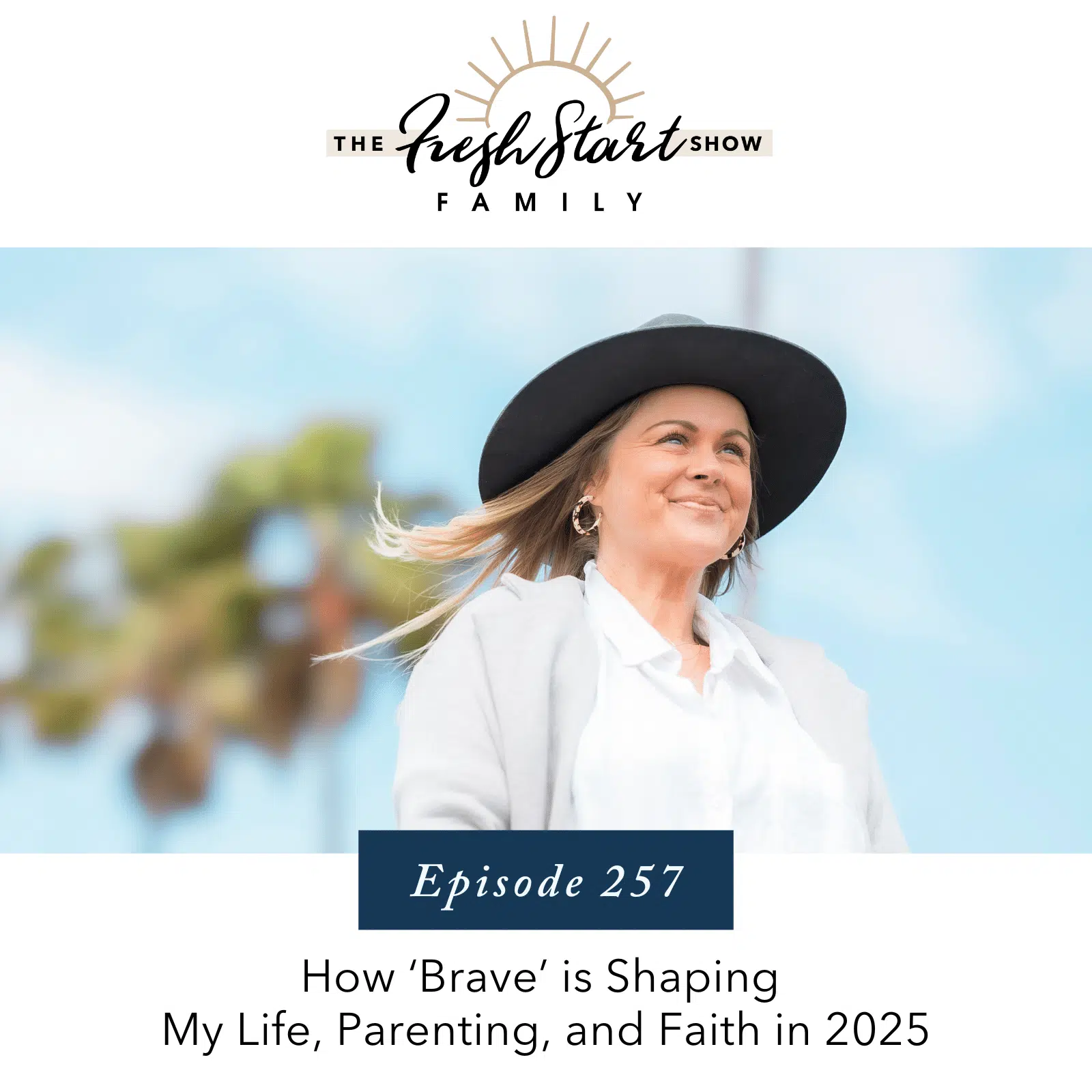
In this heartfelt and empowering episode, Wendy shares her “Word of the Year” for 2025: Brave. With a focus on courage as a guiding light for growth and transformation, Wendy invites listeners to explore what it truly means to step into bravery—especially when fear is present. Drawing from her own journey of faith, family, and professional evolution, she shows how choosing bravery can transform not only our lives but also the legacies we create for our children.
Through deeply personal stories and inspiring reflections, Wendy unpacks how bravery isn’t about being fearless but about embracing vulnerability and moving forward despite fear. From navigating a major church transition to witnessing her daughter Stella boldly chase her dreams, Wendy reflects on the power of discomfort as a catalyst for growth. She connects these lessons to the timeless wisdom of leaders like Martin Luther King Jr. and Nelson Mandela, weaving together themes of courage, authenticity, and generational change. This episode is a must-listen for parents ready to rewrite old narratives, break generational cycles, and create a family culture built on connection, compassion, and brave action.
What if you could be an effective, firm & kind parent WITHOUT relying on fear, force, bribery & rewards?
Imagine learning a new way of firm (AND kind) parenting so you can end painful generational parenting cycles and create family legacies & memories YOU are proud of?
All while getting your kids to cooperate with your rules and boundaries with ease.

IMAGINE …
Parenting your kids with calm & confidence each day in a way that causes them to do what’s asked of them because they WANT to (not because they HAVE to) … because you’re helping to build essential life skills that have them behaving well & being respectful when you’re NOT looking!
The Firm & Kind Parenting Blueprint is your step by step plan & video training to help you build the family of your dreams. Click HERE to learn more now!
Episode Highlights:
- Embrace Bravery: Choosing bravery as a guiding word helps individuals focus on personal growth and face challenges head-on, especially in parenting and personal development.
- Feel the Fear: Acknowledging and processing the feeling of being scared is crucial in the journey toward courage and self-empowerment.
- Practical Applications: Real-life examples and strategies illustrate how to manage emotions, confront conflicts, and implement positive parenting techniques.
- Breaking Cycles: Importance of being a “painful generational cycle breaker” by embracing new parenting paradigms and promoting healthier family interactions.
- Positive Impacts: Taking responsibility for mistakes and showing vulnerability can transform personal and family dynamics, leading to deeper connection and understanding.
Resources Mentioned:
Follow Wendy on Instagram
Make sure you’re on our email list so you don’t miss a thing!
Catch this episode on YouTube!
Unable to listen, or prefer to read along? Here’s the transcript!
0:00:02 – (Wendy): Hello families and welcome back to a new episode. I’m so happy you’re here. Today we are going to chat about my word of the year, which is brave. And I landed on this word for many different reasons, but I’m excited to have it at the forefront of my heart, my heart, my mind, my soul as I head in to a brand spanking new year. I love the energy of a new year so much. It’s really my favorite time of the year.
0:01:15 – (Wendy): It is the time of year that we have our biggest event, a free event here at Fresh Start Family called our New Year Kickstart Challenge that starts towards the end of the month in January. And as a team and as a community, we just get really excited for fresh starts. Obviously we are Fresh Start family and so headed in, heading into the new year with a strong intention and excitement and expectation for good things to come just really lights me up.
0:01:43 – (Wendy): So how about you? Do you decide on a word every year to keep at the forefront of your heart, mind and soul? I would love to know. Maybe send me a DM on Instagram if you love listening to this episode and feel inspired to choose your own word. But over the last few years I started to do this and it really has helped me carry an intention throughout the year. Last year I chose the word relaxed and we held that word as our strongest intention as a team here at Fresh Start Family, I have three incredible women who are on staff and help create the Fresh Start experience for our students all around the world.
0:02:22 – (Wendy): And we loved having that at the forefront of our business because we really wanted to create more flow and ease in our day to day hours operations. We are all full time mothers and running a business and coaching students and you know, hosting a podcast and producing a podcast and, and all the things that we do is a lot. And so that was a really fun word to have and it did help us kind of carry through the year with a more relaxed, flowy tone.
0:02:52 – (Wendy): So it was really, really good. But this year is brave. And I chose this word for a few different reasons. I think 2024 for me was one growth and evolution. And for many reasons. It included feeling scared and moving forward even though I felt scared, which I teach my students and we’ll talk more about today is the only way you get to experience what bravery and courage feels like. The people that have done the greatest things in the world.
0:03:25 – (Wendy): You know, my biggest heroes are people like Martin Luther King Jr. Malala Ufastai, Nelson Mandela, Jesus of course. But they did what they did and they spoke about and advocated for and moved forward and resisted with such courage. And I know that they had to have had so many moments of their days in their life that they were terrified, terrified of many things and they still chose to listen to their intuition, their moral compass and move forward. So for 2024, that was a big year for me to experience growth in that department.
0:04:05 – (Wendy): And a lot of it came in my faith evolution. And really when I decided to switch churches and find a new church home that was more truly in line with the way that my family and I practice Christianity. And it also came in many different ways and things that we evolved our organization here at Fresh Start Family. And as I head into 2025, I am currently looking at how can I change my patterning kind of my day to day way of being and a lot of it is around changing up what have become knee jerk patterns for me.
0:04:44 – (Wendy): And so that’s what I wanted to talk to you guys about today because my change up from my knee jerk reaction or knee jerk patterns that I have and I’ll share more about that in a minute. In 2025. I know many of you are also looking at some of your knee jerk patterns or conditioning of your nervous system or just kind of the way that you always do things and, and saying hey, I, I feel like there’s a better way here.
0:05:12 – (Wendy): Maybe you are someone who realizes that you have a tendency to react to misbehavior with yelling or kind of aggressive reaction. Right. I share a lot about how my early days when I first found positive parenting, I had just a lot of anger and almost like rage filled moments where I was in shock. But I couldn’t believe that my little three year old girl incite such anger and upset in me. But I became a yeller. I became a not so gentle wrist grabber.
0:05:44 – (Wendy): I became someone who just jumped to punishment very easily. I became someone who just went to feeling frustrated and irritated and annoyed quite often. And I could tell that I did not want to live my life like that. And it was not creating harmony and peace and thriving within my family. And thank God, that’s when positive parenting classes entered our realm and we started to learn a new way and we started to do healing through life coaching programs like Freedom to Be, our weekend retreat that we now teach here at Fresh Start Family.
0:06:21 – (Wendy): And you know the story. Probably everything changed for us. And within a few months and definitely within a few years, Stella was behaving so much more easily. I was behaving in a much different way. And our family was finally feeling that peace and joy that was missing for a big season. And so many of you might be coming out of the holiday season and thinking, gosh, you know, there’s a lot that I would like to change, but I don’t know how and maybe I don’t even feel capable.
0:06:52 – (Wendy): And that is something I can relate to because I realize as I get older, I’m now in my late 40s and every single year I get a little bit more clarity around how much self doubt and inner critic and really shame. Quite often I can see how it’s tied together exist deep in my soul. And it’s wild to me because I’ve always presented in my life as just kind of an outgoing, confident person and always felt confident and outgoing and kind of sure of myself, so to speak. I just recently found out that I’m an enneagram8, which is just so interesting to me.
0:07:33 – (Wendy): But as the years have gone on and I’ve started to embrace vulnerability and humility and really look at the areas that still might be causing suffering or hardship in my life or stress, I realize that that inner critic voice that I have and that self doubt and really the fear that something is deeply wrong with me, that is something I’ve been working really passionately to heal and change because I know it’s not truth. I know that there’s nothing wrong with me and that, you know, I am capable of doing anything that I want to. But sometimes when it comes to the simplest things, like just planning out my calendar on a Monday morning, like I’ve wanted to for probably a solid few years now, and I feel like I can’t execute it, I definitely have an inner voice of like, what’s wrong with you?
0:08:28 – (Wendy): Why can’t you do this? And. And really, you’re incapable of doing something so simple again, it always comes back to like, what’s wrong with you? Which was a phrase that we definitely had in my home growing up. Which is really interesting, right? We. We teach so much here at Fresh Start Family about nervous system conditioning. And when you have something that said over and over and over again to you, especially when you make a mistake or aren’t meeting expectations of the people that you love, it sticks with your nervous system, and that begins to feel safe the weirdest way. And so the thought pattern of, like, what’s wrong with me? I realize, does still come at me pretty aggressively, and I’m now more aware of it. Like, all of the deep work that I’ve done over the years as I continue to learn and grow and expand as a parenting educator and as a coach, I definitely have the awareness around it, which I believe is half the battle, and it’s still there.
0:09:30 – (Wendy): So when I looked at my word of the year this year, and I thought, oh, it kind of dropped into me. I was doing actually a nervous system healing exercise with one of my mentors, and it just dropped into me and felt like it was that small still voice of God saying, hey, I want you this year to be brave and continue to leave, lean into bravery and courage and just to trust me that I’m guiding you exactly where I want you to go, that you can trust yourself, that you are perfectly and beautifully and fearfully made, and that what I have put on your heart matters, and you can trust that it is safe to pursue, advocate, speak about all that kind of stuff.
0:10:15 – (Wendy): And then as I started to think more about it, I’m like, wow, that’s beautiful. Because I have also been on a mission to become very comfortable feeling scared when it comes into my body, and then also to teach my children, children how to feel scared, feeling scared again. And bravery is very connected because no one that has ever done great things in the world that took courage and bravery did not feel scared first. Like, you have to feel scared or frightened or afraid in order to feel bravery and courage. It just. It just doesn’t exist without the. The front part.
0:10:53 – (Wendy): And so a lot of people will miss out on the feeling of bravery or courage, which is a wonderful feeling. But they will miss out on that because they either suppress or deny or try to push away the feeling of afraid, because many of us were taught that it’s a bad, negative feeling. And so you know, and ask yourself this question. I think this goes for probably 95% of the students that I work with, the parents that I work with is when I ask them, were you taught emotional literacy in your home growing up, or were you taught just to stop it, quit it, get over it, there’s nothing to be scared of. It’s not even dark.
0:11:31 – (Wendy): And most of them will say their emotional literacy was not taught. Right. So a lot of us had anger modeled to us and it was something that our parents did if they were fighting with each other or they got really upset with us, or, you know, we’re super triggered by a mistake that we made or maybe we talked back or we were fighting with our sister. So there was a lot of anger in a lot of our homes, but we were never allowed to feel angry.
0:11:56 – (Wendy): And so it was still teed up as a negative, unallowed emotion. And it’s a bad emotion. And our parents also never took responsibility for the things that they did that were out of line and disrespectful to another human soul, which was their kids when they were upset. So we never got to learn that. Anger actually is a beautiful, healthy human emotion. That is where justice is born. Anger often precurses where firm limits are set.
0:12:27 – (Wendy): And it’s just a beautiful emotion and one that many of us will suppress when we grow up because we just were taught that it’s bad and you don’t want to be someone who is bad. Right. And another one is scared. Many of us were taught, oh, don’t be scared. There’s nothing to be scared of. Don’t be silly, your sister will walk with you. Oh, like there’s nothing to worry about, I’ll be back. Instead of, it’s okay to feel scared. It makes sense that you feel scared. And how can I help you here or what can you do to take care of yourself in this moment that you feel scared?
0:13:03 – (Wendy): Feeling scared is a strong, healthy human emotion. Right. A lot of times many of us grew up with the thought that feeling scared makes you weak. I grew up in a, in the country of Maryland with an older brother who was definitely very intense. I think my older brother was a strong willed kid to his core. And no one knew what to do with him in the 70s and 80s. And so they just, you know, did the traditional stuff and tried to spank the misbehavior out of him and, and punish and, and again, just do all the classics. And he just can always was the kid who rose up super hard against that.
0:13:41 – (Wendy): And life became pretty chaotic as, as time went on. And by the time he was in high school, he dropped out of high school, became like the school bully. Before he dropped out of high school, he was like, I’m pre. He was like taking steroids on the football team, like beating people Up. People were very scared of my brother, and he just. No one ever knew what to do with him. And so there was this vibe in my family of, like, you be tough.
0:14:09 – (Wendy): And watching my older brother grow up and watching him, like, be so tough and revered for, like, his toughness. And no one messed with my brother. Funny story, not so funny now, but he actually would have people beat up if they even looked at me. So he was five years older. So he was. He. By the time I got to high school, he wasn’t even there. But he had friends. And if anybody, like, there was even a word that got out that someone was, like, interested in me or might like me, he would literally have them punched or beat up.
0:14:42 – (Wendy): And so, yeah, it was just this toughness that was, like, kind of taught and modeled in my family. And so as I grew up, no one ever taught me, like, being. Being scared, feeling scared actually makes you strong. And it’s part of being a human being. It was always like, don’t be a wuss. You know, toughen up. I rode in the back of pickup trucks with no seatbelts and swam in the river and all these kind of tomboy things.
0:15:08 – (Wendy): And so now as I’ve. I’ve gotten older and done so much in the realm of growing and healing and life coaching work to evolve as a human, I realized that for me, learning to feel scared, one of the biggest, most important things in my life. And I actually had a mentor once tell me, as we were leaving a weekend Freedom to Be retreat, he said to me, wendy, he said two things. You might have heard me tell the story before, but he told me two things. He said. He looked me right in my eyes and said, wendy, when are you gonna believe you’re a great effing mom?
0:15:42 – (Wendy): And I remember it kind of just rocked me to my core. And it was one of the first times that I realized that I didn’t believe that. Because my first thought when someone said that was like, no, I’m not, or like, oh, thanks. But really deep down inside, I could have told you all the reasons why I was failing. And so I remember that in itself was like, I just remember dropping, like, into my heart and crying in that moment, like, tears coming to my eyes and just being like, wow, that was a profound statement that brought a lot of awareness to my body and my mind and my heart.
0:16:19 – (Wendy): And I think the first realization that I felt scared that I was failing quite often. And then he went on to say, hey, I want you to understand that in my opinion, one of your Biggest tasks in life is going to be to teach your daughter how to feel scared. And at the time, she was like 4 years old. And what he was saying to me was, no one ever taught you how to feel scared. Oh, gosh. I think emotion comes up for this because this mentor was just such a pivotal mentor to me in my life.
0:16:55 – (Wendy): But I think he saw something in me that he knew I was going to pursue a career that was going to ruffle some feathers. And perhaps he foresaw that I had this core element of me that was a bit of a challenger to the status quo or that I was a disruptor maybe, you know, that I had deep down within me that I was someone who just was meant to live a brave and courageous life. And of course, as he got to know my daughter, I used to talk about my daughter a lot in these weekend programs that I would go in for healing and growth.
0:17:40 – (Wendy): He knew that she was my mini me. And he knew that she was going to do great things in this world and that she was going to need a lot of freaking bravery and courage to do what she needed to do in, in this life. And that meant that she was going to really need to learn how to feel scared. And I will say that that motivated me so much. Over the years. It’s now been probably 12, 14 years. I think it’s been 13 years. Probably 13 years because she was 4 when he told me that and she’s 17 now.
0:18:14 – (Wendy): But I think I have been successful because as I watch my daughter at 17 pursue this high intensity D1 beach volleyball position at these top 10 schools, even though the, the like, it’s a long shot, essentially, it’s like still a long shot. There’s like a lot of NCAA that’s stuff that’s going on that is like having coaches maximize their rosters or not maximize, put caps on those rosters. And like, it’s just really scary because there’s a chance she could go for this with all her heart and like, she commits her whole life to this right now, that there is a chance that in the end these three schools that she’s really going hard at that are these top 10 schools.
0:19:07 – (Wendy): There’s a chance they could just be like, sorry, you didn’t make it, and that she will have to completely redesign her life and decide, oh, I’m just going to go to college and not play D1 beach volleyball. And that is so intense. Right? Like, I just, I don’t know how she does it, but she’s doing it as I record this right now her and dad are out there like making a new, a new edit from like all her top clips of 2024 to email more of these coaches and, and prep for a college camp that she’s going to by herself. She’s hopping on a plane to Hawaii.
0:19:41 – (Wendy): We did not have it in the budget to do another thousand dollar flight to Hawaii for us. So we said, you know what kid, I think it’s time that you go on your own. But all of this you can see, just takes so much courage and also to be a strong willed person in this world that does, does good things, that bucks up against systems that cares a lot about justice, that is willing to, to challenge the status quo and go for things even if the odds are against you.
0:20:10 – (Wendy): He just, my mentor knew that Stella was going to need that and, and so, and I do think I, I’ve been successful. I’ve had many times where Estella and I are having a moment. A lot of times it’ll come in moments of repair or in a moment where it’s like heightened between us and she’ll sl, okay mom, here’s what’s happening. I think I’m having an attitude right now. We’re pushing back so hard. She’ll say, because I just feel really scared. I just feel scared about X, Y and Z or I just feel scared.
0:20:41 – (Wendy): And every time she says it, I just smile within and it always like resets me really well and helps me come off my own attitude or you know, push back that I might be with her in a moment and I just remember that like, boom, that’s what I set out to do and that’s what I’ve done. And I also see her use that out in the world and in peaceful conflict resolution with her own friends and in her sport and school and all the things. So I think we’ve successfully taught Stella how to feel scared and I think she has the reward of feeling that bravery and courage quite often and fingers crossed, all the prayers in the world that one day she will really, you know, hopefully in the next six months or years she’ll be able to get that offer and become committed to one of these school where she can really say, wow, it paid off to live and to experience that emotion of scared so much and still move forward without giving up or giving in or feeling like this dream was an impossible dream.
0:21:43 – (Wendy): And then of course that will be that moment. Terry and I said last night at dinner, he said, you know, if she, when she, you know, because we try to speak like when she, when she gets this offer and when she gets committed, I think I might pass out. I think I might fall to the ground and pass out. And I’m like, me too, me too. But I can’t. You can only imagine the feeling of bravery and courage that she will feel when she gets that offer and signs that deal right to this dream school. And she, that she didn’t just settle and go to a school in some random state that she wasn’t interested in. Like, she just really went hard at it. And, and that takes a lot of bravery and courage. So that’s kind of a little bit of a backstory of me and realizing that feeling scared that I wasn’t enough was something that I wanted to navigate and work through.
0:22:35 – (Wendy): And I think that feeling scared is just, it’s just a part of life. And so the more you get better at addressing it and just saying, oh, here it is. It’s in my body right now. In our nervous system healing and regulation workshops inside of our Fresh Start Experience program, we teach a lot around how the first thing that happens when a stimulus comes our way is our body reacts. So we’ll actually get sensations in our body and then we label that. Right. With different emotions.
0:23:05 – (Wendy): Happy, mad, scat, sad, hurt, and scared are the big five that we teach here at Fresh Start Family. But it could be your stomach tightens up or your neck gets tense or your brow starts like you clench your, your jaw or your brow gets like tightened. Furrowed brow is what I’m trying to say. But a lot of times you will feel a sensation in your body when, when you get scared. And then we label that as an emotion. And then a lot of times is we’ll have kind of that knee jerk reaction that happens, that becomes our pattern.
0:23:43 – (Wendy): And so in parenting, a lot of times that looks like we, when we feel scared of not knowing what to do, when we feel scared that we’re. When we feel scared that our kids are going to grow up to be awful brats, entitled brats. A lot of times it’s very related to feeling scared that we failed as a parent. It’s our fault that they’re spoiled. It’s our fault. It’s just very interrelated. But we often will have these knee jerk reactions.
0:24:13 – (Wendy): Yelling again, grabbing wrists too tight, slamming doors, jumping to punishment. A lot of times we’ll move to defensiveness, justifying our behavior. And a lot of people never learn to slow down and actually just realize that they’re just scared as hell in that moment. And if we can slow down and create enough of a space between a stimulus that’s the misbehavior as parents and our response there. That is where the freedom lies to be able to actually choose how we want to move forward.
0:24:49 – (Wendy): And for all of you listening who you know, the grand majority of you, I’ve found are usually first time generational, painful generational cycle breakers. So you are the first in your family to learn how to do things differently. You’re the first in your family that, that has decided you’re going to learn to compassionately discipline instead of just punish and use fear and intimidation to, you know, cause make your kids cooperate.
0:25:21 – (Wendy): You’re probably the first in your family who perhaps has started going to therapy or joined a program like the Fresh Start Experience where you get life coaching and you start to look at your triggers and understand where you, your, your body, mind and nervous system is yearning for healing. You probably are one of the first in your family who is going to stop the yelling. I know in a lot of families the painful generational cycle of just yelling to get what you want is thick. Like it’s mom, grandma, great grandmother.
0:25:57 – (Wendy): And you know, that looks different as we, we move back. But a lot of times the yelling and the intimidation, that’s just how you got your kids to cooperate. And fear was most of the time in the mix, right. And so you might be a person that’s like, oh my gosh, like I don’t want to do this anymore. It freaking doesn’t work. It makes me feel like crap and I’m just ready to learn a new way. Right. Or you know, a lot of people in our world, they realize that their emotional reactivity in maybe other ways. Like we have a lot of students, you know, I’d say the grand majority of our students lean towards that more aggressive, overpowering type of thing that happens when they feel triggered, oftentimes which is when they feel scared.
0:26:47 – (Wendy): But we do have students that move to more of the permissive side. They just give in. They people please, they shut down their voice, they quit asking for what they want or they quit setting the strong limits and they become so scared of a meltdown or a strong reaction, whether it’s husband or kids or in laws, that they just will cave and not follow their moral compass and instead just do what feels easiest. Right. So there’s all these different ways. All of us have different reaction patterns when we feel triggered and we haven’t yet learned how to create that space and choose a more healthy response yet.
0:27:30 – (Wendy): But just so many people we work with they decide like, okay, I’m ready. I’m ready to create the change and I’m ready to learn how to influence my kids, especially my strong willed kids with true influence, which is relationship, which is modeling, which is being firm, sticking to strong boundaries instead of just moving towards those overpowering tactics that are the classic ways with especially strong willed kids.
0:27:58 – (Wendy): Families who decide I no longer want to want to be a family who uses shame and guilt as manipulation to make my kids comply. And there’s just a million examples we could give of what it looks like to be a painful generational cycle stopper or ender. Another way I say that is to be the first in your family lineage who decides like, it is going to be an intentional effort to upgrade your family legacy and create more health.
0:28:25 – (Wendy): We see a lot of students for the first time ever, creating peaceful conflict resolution in their homes. That includes taking responsibility for your mistakes and your faults and doing it without shame and guilt. Like, that is so new in families that it’s like, whoa. People start to experience it and they’re just like, this is wild to me. Like, I can’t believe how effective this is to influence kids. And I’m like, yes. We just had a student share in our Fresh Start Experience last week.
0:28:59 – (Wendy): He’s what we call a rad dad. He’s really shown up over the last year to transform his family lineage and legacy and grew up in a very, let’s just say, for lack of better words, toxic, harmful evangelical teaching. Home was definitely intimidate, intimidated into submission and raised in purity culture, like all the things that come along with some of those unhealthy evangelical circles. And he didn’t quite realize how he wasn’t fine until he had kids of his own and he ended up having two sweet boys.
0:29:41 – (Wendy): And as time went on and it became, you know, like, very clear to him that he would start to feel out of control when they misbehaved. And he had kind of one of those moments a lot of times in our students. And I can say this is the same for my life too. Some of the worst moments of your parenting life can be the most pivotal when it comes to actually changing. So some of the, the moments that you feel the most shameful about or want to brush under a rug and like, hope no one ever finds out, keep those, those windows closed tight and make, you know, hope no one was peeking in and saw what you said or did to your kid or what you didn’t say or do to your kid.
0:30:27 – (Wendy): Those actually, when you are Invited into healing, and you answer the calling. Those are often the reason why, because when you hit that low point and you’re just like, oh, my gosh, like, who am I? Who have I become? And I have a few of those pivotal moments and, and they can really just be really great because a lot of people will just stay in that stable misery loop until something like, really hits their heart. And they say to themselves, you know what? I can’t do this anymore. Like, I’m gonna get the support that I need so I can stop whatever it is. Yelling, grabbing wrists too tight, slamming doors, dealing aggressively with kids, spanking, or on the other side, the, the permissive kind of people pleasing, submitting type of stuff. That happens too.
0:31:17 – (Wendy): But anyways, he was sharing how he had, you know, yelled or I, I don’t know exactly what he had done with his little boy, but he had written a makeup note, which is something we teach as part of consequences line up, which is compassionate discipline. But a makeup is basically when you take, you know, you teach your children that you take responsibility for your mistakes and you do an act that mends the relationship. It, it, you know, it repairs a relationship. It make amend, it makes amends. And it’s way more than just, I’m sorry, it’s an actual something that you take time out of your day.
0:31:54 – (Wendy): We have, have lessons on it. And it’s just really changes. Changes dynamics in family homes. But he had written this makeup note where he just took some time to write down, you know, hey, I’m so sorry that that happened. I want to take responsibility. You didn’t deserve to be yelled at. And, you know, thank you for your grace and your patience with me. I’m learning, I’m healing, and this is what I’m doing to change.
0:32:20 – (Wendy): And I just want to make sure, you know, you, you did not deserve to be spoken to like that or yelled out or whatever it was that he had done. And he said he went into his kid’s room when his child wasn’t there. He was at his mom’s house. He separated and he found this makeup note. And the little boy had gone in and drawn like him and his dad holding hands all over the makeup note and had written messages like, I love you, dad. Or, you know, I don’t know his. I forget his name maybe, maybe it’s Joseph or something like, Joseph loves Daddy.
0:32:56 – (Wendy): And it was all these, like really beautiful drawings of them together and loving each other around this makeup note. And he, when he wrote this hashtag success story in our private group he just said, I am blown away at the power of makeups and taking responsibility for your mistakes without shame with your children because it is transforming my home. These boys, like, they are all of a sudden taking responsibility.
0:33:22 – (Wendy): They’re apologizing on their own. They’re no longer covering up. They’re no longer scared that I’m gonna hurt them. Because again, he grew up in a spanking home. He thought spanking was the way to go. When he first had kids. He thought that was what was gonna make him a godly parent. And he just was like, I am just blown away by the power of humility and grace and using connection to teach and true modeling to get my kids to do the behavior. And so big celebration moment. But for many families, that is so new, right? Like peaceful conflict resolution and doing things like that.
0:33:59 – (Wendy): Going back and saying, oh my gosh, that got crazy last night. We had that big fight. Everyone went to bed, like without speaking to each other and let me take responsibility for the part I played. You didn’t deserve to be talked to. I think I was just feeling triggered about this and I think I was just feeling scared or, you know, whatever it may be. But let’s talk about it. Let’s talk about it. What do we learn from our mistakes? How are we going to do it differently? Tomorrow parents get the opportunity to say, here’s my firm boundary, like, you didn’t deserve to be yelled at. And we’ve got to figure out a way where you’re gonna put the toys away without me.
0:34:37 – (Wendy): You know, whatever. It’s like, we’ve gotta meet in the middle here. And then you do a win win. We teach peaceful conflict resolution. We teach a lot of different ways when your kid is not moving to action or saying no, which we call a power str. But we’ve got to create a plan of action. And here’s. I’m going to get real clear on what I want. But I’m leading the conversation with I take responsibility for my part.
0:35:01 – (Wendy): That is so new to so many people, right? That is something in my home that never existed. There would be really big drop down, drag out fights. I remember them happening so often with my brother when I was really little. And then as I became a teenager, it would happen with me. My parents and I would fight. My parents would definitely fight with my brother. And then the next morning it would be like, do you want a pancake?
0:35:26 – (Wendy): And then that’s it. You would just go on with your day. And I just knew that when I started learning this work that that was something that. That was a pattern that I wanted to break in my family lineage, that my parents, I think, never were taught how to address or approach conflict with respect. And. And they also were taught that mistakes make you bad. And so coming the next day, I will add that they also were probably taught that you, as the parent, can do whatever the f you want. Right? Like, children are there to.
0:36:01 – (Wendy): To do what you say, and you get, like, you rule the roost, and they have to do what they’re told, right? And so taking responsibility like that just felt weak and. And like, dealing with it the next day, like, conflict. Approaching conflict in a healthy way, I’m pretty sure was, like, passed down to them, passed down to me. And then I was the first one in my family who decided, I’m going to do this differently and teach my children all the things right that we teach here at Frustrated Family. So my point of all of this is doing new things in your family lineage takes a lot of courage because it is scary as hell. Let’s just be real honest about it, okay?
0:36:44 – (Wendy): When you don’t have proof in your nervous system that something is, like, gonna work, so to speak, because you haven’t seen it, you will. You will feel scared. You. Your. Your nervous system is designed to keep you safe. And so let’s just say you grew up in a home where your mom and dad just yelled at you. Like, there was aggression. Like, if you weren’t listening fast enough, someone was gonna get really loud and intimidating and probably threatening to punish or harm you. Right? Like, that’s. That still is just the way it is in most families.
0:37:20 – (Wendy): But you had the Data for probably 18 years, because it’s not like the teenage years get easier, right? Like, a lot of families have such so much conflict in the teenage years, where yelling and intimidation becomes even more pronounced than it was in the first decade of life with kids. But for 18 years of life, you saw someone use that strategy, and in theory, it worked because maybe you cleaned up your room or did the damn dishes, right? But then behind their back, you were rebelling or not telling them things or lying or covering up whatever it may be. That’s like, that’s how it works with a lot of. A lot of people is, you know, if you were raised in the autocratic home, a lot of times by the second decade, you just get really good at hiding, lying and covering stuff up and not being honest.
0:38:14 – (Wendy): But you. Your nervous system does have data, so to speak, that that is the way, because you didn’t die. You didn’t die. You watched it happen. You watched someone intimidate others, puff up, get big scare people into submission. And so to your nervous system that means that is safe and it’s very, very weird, right? But remember that the nervous system, you know, and our like our amygdala which is responsible for like that fight flight part of our brain that’s like, okay, there’s danger here. I need to get away, I need to stay alive.
0:38:49 – (Wendy): It will always choose a comfortable hell over an uncomfortable heaven. And so when you have kids and if you’re anything like me and all of a sudden you’re like, who am I? Like, I was never a yeller in my 20s. But then once I had a small human, once I turned 30, really it was like 33 when Stella became a toddler and I stayed, decided to leave my career and stay home full time. But once I had this mini human being who I could not figure out for the life of me how to get her to frickin put on her shoes or get in the car or keep her hands to herself, right? Like even the threats and the spankings and they weren’t working. Like I, I didn’t, I didn’t realize that like, whoa. I was ill equipped to understand how to actually influence another human being because to me my nervous system was just like, you get bigger, you intimidate, like that’s what you do. I didn’t realize that that was my nervous system conditioning until I got the help that I needed to unravel and unlearn those patterns, right? And it took quite some time. It took me eight years to stop yelling.
0:39:59 – (Wendy): Took me about the same time to stop slamming doors. And it was quite the journey. But you just have to remember that that will become your go to because your nervous system has data that it’s safe because you survived it. So doing something new is going to trigger a feeling of danger to you. So this is why a lot of people, when they go into learn and implement compassionate discipline versus punishment.
0:40:27 – (Wendy): A lot of times you’ll revert and go back to punishment. Quite often we, you know, we’ll have students that even they might finish our foundations course and then they’ll have these big triggering moments. And honestly it’s often. Well, I’ll just say this. They have these big triggering moments where they revert to punishment. And then once they get coaching, once they get into our Fresh Start Experience program and they start to be able to ask questions and we’re able to help them look at what happened yesterday and make a Plan for the next day and learn from it. Instead of judging themselves and thinking, oh, this will never work. See, it doesn’t work. My kid’s too crazy.
0:41:06 – (Wendy): But instead, look at the data of what went down, what happened, what was the trigger, what was going through your mind that caused you to snap and revert to the punishment. But a lot of times it’s just, there’s a lot of like backwards movement, so to speak, that happens. Even though even once someone learns a new way, they still like knee jerk back to punishment until they, they have enough data for their nervous system to show, okay, this actually is going to work.
0:41:39 – (Wendy): It feels really good to, to address the conflict and to get through the conflict without hurting, intimidating, scaring my kid into submission. And once you start to get some of those wins and, and that’s why our community is so important. Like to be in a community is so important because what you, you can get your own wins, which gives your nervous system the data that this is safe. Safe to, to keep pursuing this route even though you feel scared as hell that it’s not going to work or that you don’t know what you’re doing or that you’re incapable.
0:42:11 – (Wendy): But once you start to see other people share their successes of like, whoa, I did it and it worked, or that success story I shared about that rad dad with the makeup, like, whoa, you know, maybe makeup, a makeup is one example of a logical consequence which is part of a compassionate discipline toolkit. But maybe a parent was scared to try a makeup versus like a forced apology. Forced apologies are like the classic, like your body is going to be screaming at you that you have to make your kid do a forced apology if he pushes someone at the park. Right? Like, that is just cold. Like, that is both cultural conditioning and it’s nervous system conditioning. Because safety for you just feels like doing what has always been done. Even though it does nothing to teach your child how to have more self control at the park when he’s waiting in line for the slide.
0:43:03 – (Wendy): But, but to have to, to learn how to, to navigate through that, scared of like doing it different and instead do a makeup. It just takes time. It just takes practice. Right? So that’s kind of an, a few examples of how you, you will want to start realizing that it, it’s, it doesn’t mean that you’re incapable or that it’s not going to work when you feel terrified to do something in the realm of positive parenting. It just means it’s very new to you. Right? So when I’m Coaching my students inside the frustrated experience. I’ll often encourage them to change their wording when they write a question. And they’ll say, this is just so hard to keep my cool or to stay patient or to not punish.
0:43:52 – (Wendy): Right? They’ll just say, it’s so hard. And I’ll make sure, you know, they either rewrite it in a comment if we’re doing coaching, or sometimes they’re on camera with me and I’ll just have them resay it and just say, this is new. This is really new to me. To show compassion to a child that just hit his sister. Like, that would have never flown in my house growing up, right? Like, I would have gotten my ass handed to me.
0:44:20 – (Wendy): This is really new. But it’s like, it, it. It means a lot, lot how we talk to ourselves. It means a lot to our nervous system. So slowly making kind of some of those verbiage tweaks can really help. So, so, yeah, so let’s let me highlight maybe just a few more areas that you may feel scared in 2025. And I just want you to remember that you are at choice with what’s on the other side of that feeling. Right? So one of the, the easiest options that you know how to do. You don’t need me to teach you, nor will I teach you.
0:44:59 – (Wendy): Start to feel that tense, that constriction in your body of you feeling scared. You can just ignore it. You can push it down. You can, you know, act like it’s not there and then react out of anger. And that is not the recommended route, but I will tell you that that is going to be air quotes, the easiest route because you know how to do it. Again, we weren’t taught how to feel scared. So slowing down to feel scared is like, what the hell does that even mean? Right? It feels new. It feels imp.
0:45:31 – (Wendy): So just moving through it, snapping, puffing up, getting bigger, bribing, rewarding, forcing, overpowering, scaring, threatening. All the things that’s what’s gonna come easiest. But if you can start to slow down and just start to pay attention to what’s happening in your body and ask yourself, okay, is there anything in this moment or any way that I. I could be feeling scared right now? Maybe it’s scared of judgment. Maybe it’s scared of not knowing the answer.
0:46:04 – (Wendy): Maybe it’s scared that you’re being permissive. Maybe it’s scared that you’re failing. Maybe it’s scared that it’s your fault. I have this one flare up a lot for me when my Kids don’t do their chores. So if they’re not like, and especially if they give an attitude when I say, say hey, I need you to do this. And if, if we have like a bit of an argument, I can see because again I’ve, I’ve practiced so much building my awareness that it’s like a very important element. So at least that feels good that I can see within me that I think to myself, I’m doing something wrong here. I am the reason why these kids feel entitled, like they don’t have to put their dish in the dishwasher and that I’m gonna friggin do it. Like, like I’m doing something wrong. I can just feel it now in my soul that it always comes back to me and that I better up my game because it’s my fault that they’re having this moment of pushback.
0:47:06 – (Wendy): And that’s not true. They’re just being kids, they’re just being teenagers. And I have the power to choose a response that is going to be very influential and firm and kind and get them to do their damn dishes right. Like, but we’re always at choice with how we respond. And so when something happens and you feel that trigger, I just want you to ask yourself, okay, is there a chance I could be feeling scared here? And then I want you to really speak to it.
0:47:37 – (Wendy): Just start saying things like, oh, hey, yeah, of course this can be to yourself because your kids will probably. If you’re, if your kids are little, you can still do this. Once you have teenagers, they’ll think you’re crazy, but you can just say, oh, hey, scared. I see you. You make sense to me. No wonder you feel scared in the moment. To walk away from this child that’s giving you an attitude, it makes sense. That feels weak.
0:48:04 – (Wendy): You feel scared of being permissive. You feel scared of being taken advantage of. You feel scared that you’re not being respected. It makes sense. Like it’s just a feeling. Feelings are neither right nor wrong. They come and they go just like storms, just like clouds. It’s just a feeling. And being able to fully feel that feeling all the way through and out your body. Sometimes that can come as you go to the bathroom and just. We actually do an exercise in our Freedom to Be Healing retreat weekend where we teach you how to like move an emotion up and out of your body.
0:48:41 – (Wendy): And usually it’s like 90 seconds is all you need. Need all you need to be able to fully feel an emotion. Remember the strength of that emotion, what comes on the other side of it. And then, then to respond to whatever misbehavior is at hand. I would say even 60 seconds of doing that can really change the game for people. But also at the same time, speak safety into your nervous system because it’s going to actually feel life threatening because your body is like, whoa, whoa, whoa, whoa, whoa. This is, this is not, this is not safe.
0:49:17 – (Wendy): So here’s some common, common ones that I see. Parents really like freezing up and not slowing down to realize they just feel scared. When you have a kid that is like in a season or just has always been a kid who has a lot of meltdowns. So high emotions, meltdowns, screaming. I can, I see often that parents become scared that they’re not going to be able to handle, handle the meltdown. They’re not going to be able to handle the big mess that comes when they set the limit and say no to the candy, the extra show, the, the bedtime, whatever it is.
0:49:52 – (Wendy): And so that often will lead to sometimes permissive behavior or just letting the kid do whatever they want. Or oftentimes it’s like the tea kettle effect. Like parents will try their best to just be patient and calm because a lot of times parents think that’s what positive parenting is. They think that it’s like, oh, you just, just be kind and ask your child nicely. And then when that doesn’t work and you are not stop slowing down to feel scared and choose a path that is new, like power struggle dissolving.
0:50:25 – (Wendy): Instead of intimidation, threats and punishment, you will snap like a tea kettle. All of a sudden, boom, there’s an explosion and then you’re reverting back to the old ways, the tactics that you were raised with that you swore or you wouldn’t repeat, right? So that’s an area that you get to choose to be bravery and brave and courageous. When you remember that you are capable of getting through what I call the rainbow with children where they might freak out, they have this big meltdown and then you decide you’re not gonna fix or make them calm down, make them do what you want, all the things and then you get to the other side and everyone calms down on their own own, and then you move forward with the conflict resolution or getting them to do what they need to do without the intimidation factor.
0:51:16 – (Wendy): And holy smokes, like that changes the game for families. I remember specifically two times in my own parenting where I successfully got what I call over the rainbow and didn’t force Stella to stop and instead just went into my bedroom One I’m thinking of, I went in with the baby because I was nursing the baby who was like 11 months at the time. Stella wanted my nursing stool which I would not give to her because I wanted to be like ergonomically correct when I was nursing so I wouldn’t get a stiff neck.
0:51:50 – (Wendy): And she freaked out. And my pattern had been to threaten her that if she kept freaking out she wouldn’t get her show after nap or whatever it was. She was like three years old at the time or four. But that day I remembered, oh, I get to choose. And I do feel scared that I like this meltdown is going to be so big that it’s never going to end or whatever you feel scared about. But I went into my bedroom, I closed the door with the baby and yes, she banged on that door for like it felt like an eternity, but it was probably like seven minutes.
0:52:21 – (Wendy): I did my self regulation and self calming stuff and I just allowed her to calm down on her own. And, and there’s a whole strategy to that. By the way. We coach students all the time. You’re not just locking your kids out of rooms and, and exiling them. And it’s like it is a, it is a very tactical strategy to replace forced punishment of timeout where you are putting a kid in a room or a corner and making them stay there with a modeling of what healthy self regulation and self calming look looks like.
0:52:55 – (Wendy): So it’s a whole strategy and there’s a whole way to do it and you want to show your kids in advance where you go blah blah, blah. But that’s for another episode. But when I came out that day and we both had not like we, we both, I had not reacted to her in a way that I later regretted and she had brought herself from level 100 down to like just you know, know like it was actually a very heartbreaking memory because she was, she was still crying like catching her breath because she had been crying so much. So she was still like almost not hiccuping but like maybe you can, you can relate to this is like when it, when it usually it’s a toddler, they like almost can’t breathe when they’ve been crying so hard and, and they’re kind of coming back down to neutral so to speak. That was what that was like in that moment. And I just remember, remember hugging her and saying like what’s wrong? And, and it was this very pivotal moment where she basically in her own little 3 year old words told me, mom, I’m so Sick of getting so mad.
0:53:58 – (Wendy): And I don’t know why I fly off the handle, but I do, and I don’t want to do it anymore. And those were not her exact words as a three year old, but that’s finally how I heard them. As her mother, I finally saw the suffering in my little girl instead of a little girl that I thought was, was just trying to be a pain in the ass. And I just got down on her level and I said, me too, me too. And right now I am.
0:54:21 – (Wendy): We are, we are learning how to do things and get what we want in ways that respect ourselves and others. And you’re not alone. You’re not alone. I’m learning the exact same thing as you right now, actually. And so you’re not crazy. You’re not crazy. And you, Yes, I will teach you how to feel mad without hurting others or disrespecting others. And guess what? I’m learning the same thing. We’ll do it together.
0:54:46 – (Wendy): So, yeah. So the fear of child meltdowns. It’s okay. It’s okay to feel scared that you don’t know what to do, that you won’t be able to handle it. And you will, you can, especially if you get the support from us within the fresh start experience. Okay. Another one is with conflict resolution. We see a lot of parents, parents who either with their own spouse, a lot of times it’s with the spouse, they again, have never been taught healthy conflict resolution, so they just never deal with the problem.
0:55:18 – (Wendy): So we have a lot of families who, you know, they’re on. Mom and dad are on very. The parents are on very different pages with discipline. And so a lot of times confronting that and having a conversation and coming to a place where there’s a plan on how to move forward. It doesn’t usually happen until a parent who is scared of the con, the, the confrontation takes the first step to do it. And then from there it opens up dialogue and it creates safety.
0:55:55 – (Wendy): And it’s, you know, the nervous system gets to see that. It’s. You didn’t die. You didn’t die by saying, instead of going, instead of talking about random stuff, this, after the kids go to bed, I want to sit down and have a glass of wine or a cup of tea and actually create a plan or watch our parenting as a team lesson inside of our Fresh Start Experience lesson. So we can stop having such huge arguments about what to do with this particular child. Right? Like, we can do this. Like, I’m here to listen. Whatever. It just takes a lot of courage. Right?
0:56:28 – (Wendy): Same goes with in laws. There’s a lot of in laws that watch kids a few times a week. And when you’re on different pages and there’s stuff going on to confront that can feel so scary. But once you find that ability to feel scared and still move forward, you, a lot of times there’s resolution and you just feel so brave and courage, courageous. And then I think we touched on it. But just shifting from punishment to compassionate discipline and really navigating that external judgment from family and especially if you come from one of, you know, one of those unhealthy evangelical circles or maybe you’re in one now, we just have endless stories of parents who are still, were.
0:57:11 – (Wendy): Are still in unhealthy evangelical circles, whether it’s Bible studies or just the church in general who are still teaching that hitting and harming kids is godly discipline. And so the fear of judgment that comes along with when you, when someone finds out that you have stop spanking your kid, holy smokes, is it intense? And it’s worth it. It’s so worth it. And just know that when you feel that feeling of scared come over you just think of me and just think of my voice, that you are safe and that I see you, I admire you, I’m over here cheering you on.
0:57:49 – (Wendy): And you have the power to create safety within your home a lot, a lot of times, times it’s the safety that you never had as a child, especially when you made a mistake. And so that’s what you’re creating in your home. And just it unfortunately, I hate it. But it’s true that just so many church circles have those people who are going to send you the articles Gentle parenting isn’t biblical. You know, I’m worried that you’re getting into new age stuff and that you’re getting, you know, coerced into thinking, you know, non biblically, whatever it may be. And just, just know that bravery and courage is going to feel so good when you move forward anyways.
0:58:33 – (Wendy): And then five, 10 years down the road, you will get to have a very different experience with your children. Not, not. It won’t even take that long. You’ll, you’ll have a much different experience within six months, a year, two, three years of changing your model into compassionate discipline versus punishment than your friends or church colleagues or members or in laws who decided not to find the courage to change that model and just decided to keep going with the hurting and harming kids is godly discipline. You’re going to have a much different experience That, I mean, you’ll feel it sooner, but man, now that I’m 14 years into this and my little girl is 17 and my son is 14, I can’t even tell you the feeling of courage and bravery. That just feels so good deep in my soul that I chose to go a different direction when so many people were just telling me to hit my kid and to read another freaky deaky air quotes Christian parenting book that told me that breaking her will was the way like I’m just, I just feel like when I think of that that I am so dang proud of myself. And it just took so much courage and bravery over the years.
0:59:52 – (Wendy): Okay, another quick, a few quick. Another examples is like canceling a play date because maybe your child’s had some big misbehavior and thrown a block at a sister’s head. And instead of just moving forward and going to the play date, you decide, you know what, we’re going to stay home this morning, do some logical consequences, which is just learning. Remember logical consequences. They’re just learning. We’re going to teach you so much about compassionate discipline.
1:00:18 – (Wendy): I think it’s day four of our new year Kickstart challenge, which will be happening at the end of January. Make sure you’re on the email list if you’re not yet freshstartfamilyonline.com/email and that’s the email is always the first place that gets the invitation to join our free events when they happen. But we’ll teach you a lot about discipline. But you know, logical consequences is just teaching.
1:00:40 – (Wendy): And so in those moments when you’re like, oh, this child had this big misbehavior and we have this playdate set up where my friend’s going to be disappointed if I don’t show up. And you know, I’m going to feel like I’m going to feel bad and then it’s, my kid’s going to freak out when I say we’re no longer going to this play date. Right, but, but you follow through anyways because you know from your coaching inside the Fresh Start experience that it’s important to teach. Like you gotta teach, you gotta set firm boundaries and then you gotta teach your kid the life skill that they’re missing. And when they’re throwing blocks at their sister’s head, they’re definitely missing a life skill probably around peaceful conflict resolution and self control and self regulation and emotional literacy.
1:01:23 – (Wendy): But that’s gonna take courage, right? And then on the other end, you’re gonna feel really brave and courageous. That you made that tough call, and your. Your friend’s gonna totally understand. She’s gonna be like, look, I get it. I was so tired that it actually was really nice to stay home. And anyways, right? Like, I feel like I’m fighting a cold. Like, there’s all these silver linings. We have a silver linings lesson in our frustrated experience video library that I love because so often times, if you just trust yourself and do things, even though when you feel scared, there’s. There’s often a silver lining that you’re like, oh, it’s like a God wink.
1:01:57 – (Wendy): Maybe I wasn’t ever meant to go to that play date. Right? And your. Your little one sometimes is. Is like, the reason I had that happen so many times in my own parenting journey. Journey. Sharing feelings. Honestly, with. When friends ask, that’s another place that you might feel scared. You might be tempted just to say, oh, I’m doing pretty good. When your friend, you know, at a dinner party asks, like, hey, how’s it going? Like, it’s gonna feel scary to actually admit maybe you’re in a season where you’re like, actually, I, like, have some days where I’m, like, pretty depressed or like, I’ve been battling anxiety lately.
1:02:31 – (Wendy): But we know, I mean, vulnerability and humility is two traits that we absolutely admire so deeply within the Fresh Start Experience community. But it often will bring you closer to people. But it takes bravery and courage to move through those. Scared of feeling judged or scared of being an alien or scared of, like, being a Debbie Downer with your friends. I actually had a dinner with some girlfriends just a few weeks ago, and one of my friends, she’s just about to turn 50, and she actually said she did that when we asked her, she said, you know what?
1:03:07 – (Wendy): You know, I’m just okay. She said, I’m really just kind of questioning, like, am I. Am I doing life right? Like, what is the purpose of life? And am I. Am I failing? Like, have I failed this whole thing? Like, I’m. It’s like I’m over the hump of, like, middle age, and I feel like I’m. You know, she just went into, like, this whole thing, and it was so refreshing to be, like, real with someone. And I texted her afterwards and just said, you know what? I just really am thankful that you said that, because I can relate, right? I have those kind of those moments where I’m like, am I even succeeding as a human being or not?
1:03:42 – (Wendy): And then taking responsibility for mistakes. We covered that one a little bit. But a lot of times that feels very, very scary because especially if you’re doing it with your kids, the traditional conditioning is that that makes you weak and that your kids are going to take advantage of you if you take responsibility. And it could not be farther from the truth. Another one is living a Christ centered life authentically, even when it diverges from traditional definitions. There’s a lot of you in this community that are really realizing that you are kind of backstepping from some of the toxic evangelical circles and teaching and, and finding more healthy Christian places. And that takes so much courage because a lot of people just will lose entire communities kind of a little bit. What happened to me in 2024, you know, the.
1:04:29 – (Wendy): It was scary. It was really scary to step away and find a whole new church home. And now things like couldn’t be better. I’ve never felt more at home and more excited about my new church community, but definitely big feelings of scared there and on the other side. I definitely feel so brave and courageous now and renewed in my faith. I will say just so much stronger in my faith with God, fraud and then what else? I think finances is the last one I have on my list. You may feel scared as hell to talk about finances with your spouse, especially if you’re thinking about getting some mentorship or starting a positive parenting program or getting some coaching because you realize like, it’s time, it’s time that we, we really address some of the things that are going on in our home behind closed doors and not behind closed doors, like to actually sit down and have conversations about finances with your spouse when maybe you’ve taken the position of like, oh, I’m just a stay at home mom and so I don’t bring any income into the family. But realizing that you actually have such value and worth and the, the dollar amount that should be put on if you happen to be a stay at home mom. The dollar amount that should be put on your role as chief, you know, know what would that be?
1:05:49 – (Wendy): Chief Care Officer, cco. You know, knowing all the schedules and the meals and the doctor’s appointments and the school schedules and the conferences. And I know so many of you are homeschool parents and like, it just takes a lot of courage to be a woman who ends the generational cycle that stay. Being a stay at home parent has no worth. Like it has no dollar amount that you don’t have a say in what gets spent as far as the budget goes. And I’ve seen just so many people do do it with such grace where they start to have the conversations with their spouse where they’re like, hey, this is really important to me that I go to this healing retreat or that I invest in this parenting program so we can strengthen our family and learn new tools. And, you know, here’s the value that I bring to this family. And yes, I don’t get a paycheck, but this if, you know, I probably should and this is what the dollar amount would be. So I kind of love having that conversation, too, because it’s an important one. So I hope that gives you guys a lot of examples of where you might feel scared in the new year. And.
1:06:56 – (Wendy): And I hope that you will just remember that you are at choice, that scared is a healthy human emotion, and it is where bravery and courage is born. And so I know all of you will benefit so greatly from actually slowing down to let the emotion move your body instead of suppressing or denying it or acting like it’s not there. And I’m just excited for you guys to practice this one in the new year. Let’s do it together.
1:07:26 – (Wendy): So I am going to be so brave in the new year when it comes to my schedule every week, when it comes to time blocking my calendar, when it comes to saying no to things, when it comes to writing my book. I start writing my book on January 2nd, and the manuscript is due August 15th, so that’s going to be just so, so cool. I’m going to find courage when I feel scared to keep speaking aloud and advocate for the things that I feel called to within my faith and within the parenting world.
1:08:00 – (Wendy): And so it’s going to be a really, really great year as we press into bravery and courage together. All right, well, thanks for being here. Please share this episode if you’d enjoyed if you have enjoyed it, it maybe take a screenshot and Tag me @freshstartwendy on Instagram. Thanks so much for listening. Thanks for being a family who really gives a damn and someone who is really interested in expanding your heart, learning new tools, and strengthening your family. I’ll see you on the next episode.