


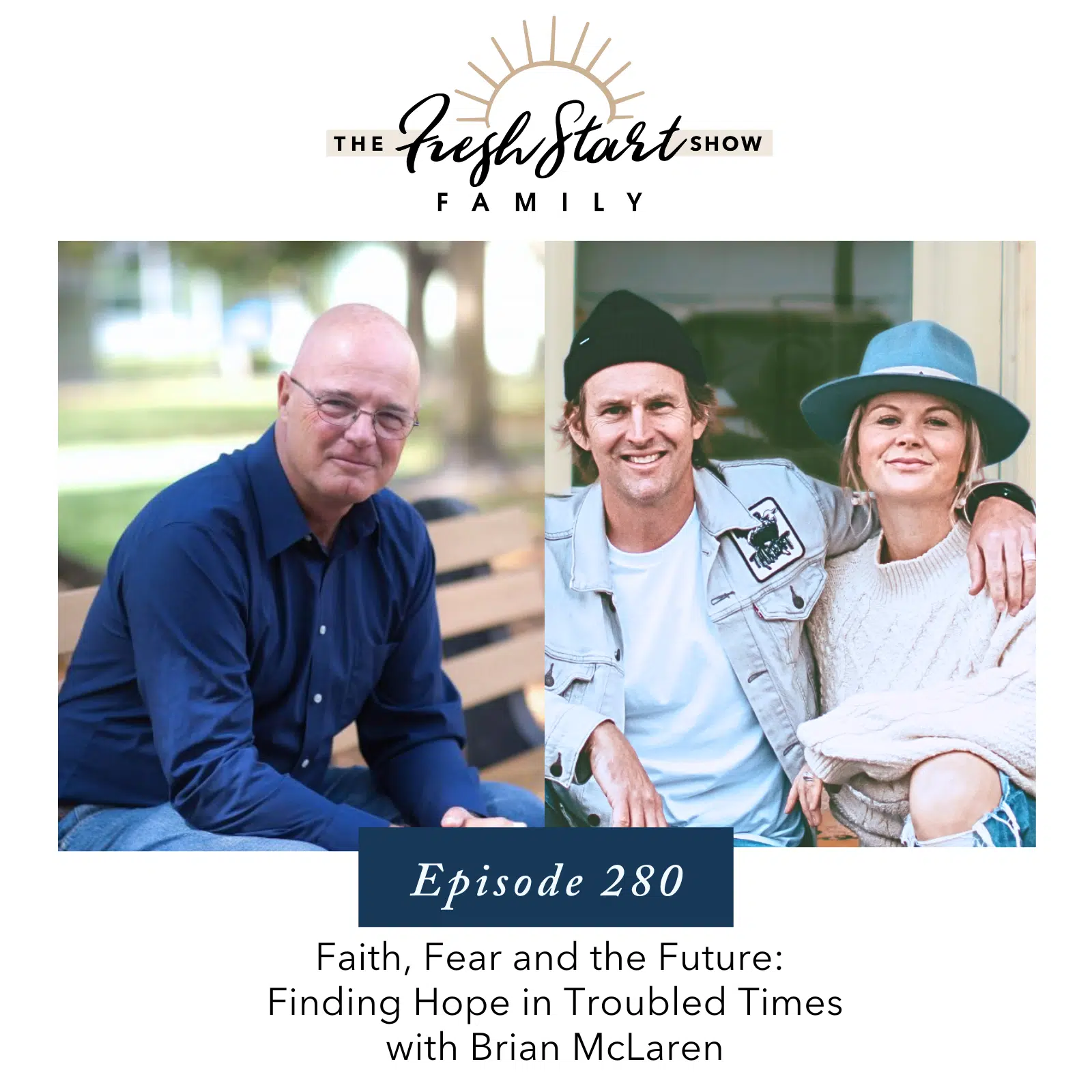
Feeling anxious about the future? Discover how to show up with love, courage & hope in troubled times.
In this powerful and timely episode of The Fresh Start Family Show, Wendy and Terry sit down with author, activist, and thought leader Brian McLaren to explore themes from his latest book, Life After Doom: Wisdom and Courage for a World Falling Apart. Together, they unpack what it means to stay rooted in love, compassion, and courage as we face the intersecting crises of ecological overshoot, rising authoritarianism, and societal upheaval. With deep honesty and hope, Brian shares his personal journey of evolving faith, practical strategies for nervous system regulation, and the four-part process of letting go, letting be, letting come, and setting free.
You’ll be inspired as the conversation moves from naming the hard truths of our current reality to discovering how we can show up with integrity for our families, communities, and the world. Whether you’re wrestling with fear for the future, seeking ways to raise brave, compassionate kids, or wondering how faith fits into the work of healing our planet and society, this episode offers both comfort and challenge. Tune in and be reminded: we may not know what the future holds, but we can choose how we show up for it.
Raising A Strong Willed, Intense or Sensitive Child? If yes, I have a FREE gift for you!
This free bundle comes with an extensive learning guide & FREE workshop with me, where I’ll teach you ways to build connection & methods to work WITH your strong willed kids instead of trying to MAKE THEM change.

You’ll learn:
*Firm & kind strategies to navigate challenging behavior with firm kindness & connection (vs. fear, force, yelling, threats & bribery)
*Ways to build connection instead of pushing your child away w/ heavy handed “hand me down parenting tactics”
*How to work WITH your kids instead of forcing them to comply or trying to MAKE them change
Grab your FREE bundle now & start learning today!
Episode Highlights:
- Brian McLaren emphasizes love as the core of faith.
- The journey of faith can lead to transformation and hope.
- Understanding the structure of ‘Life After Doom’ is crucial for navigating crises.
- The four phases of dealing with challenges are letting go, letting be, letting come, and setting free.
- Ecological overshoot is a pressing issue that connects to social justice.
- Authoritarianism often rises in times of ecological and social stress.
- Parents must prepare their children for a changing world.
- Anger can be a healthy response when rooted in love.
- Creating safe spaces for children is essential amidst chaos.
- Showing up with love and calm is vital in challenging times.
Resources Mentioned:
Brian’s website
Follow Brian on Instagram
Grab a copy of Brian’s book Life After Doom: Wisdom and Courage for a World Falling Apart
Make your voice heard – 5Calls.org
Learn more with Wendy’s America IG story bubbles
Catch the full episode on YouTube!
Unable to listen, or prefer to read along? Here’s the transcript!
Wendy Snyder (07:51.342)
Well, hey there, families, and welcome to a new episode of the Fresh Start Family Show. We’re so happy that you are here today. We are just thrilled and honored to have Brian McLaren on our show, who is the author of Life After Doom, Wisdom and Courage for a World Falling Apart and a new book coming in July that we can’t wait to hear more about. But welcome to the show, Brian. Thanks for being here.
Brian Mclaren (08:16.257)
So glad to be with you both.
Wendy Snyder (08:19.95)
Yeah, man, we’ve been looking forward to this interview for a while now. We were just chatting about, we got to meet you when you spoke at our children’s preschool. Our kids are now 14 and 17, and they went to preschool at this little school. And the United Methodist Church that is associated with that preschool is just such a special place. And to be in that
same sanctuary where we watched many of our kids, you know, our kids go through many Christmas pageants and just have very special moments for Easter and all the things was really incredible. And when we first saw you speak, Brian, what a wild moment, should say. I you hear this probably often about, especially your latest book today, we’re going to be talking about faith, fear and the future, finding hope in troubled times. But yeah, it was
So much of what you speak about and what you write about in your latest book is a hard pill to swallow. And at the same time teaches us and helps us find hope and the ability to run our race as well, as I’ve heard you say, know, anchoring down in that hope and in our faith that we believe so strongly in. But as we push record today, it is Juneteenth, happy Juneteenth.
Brian Mclaren (09:42.197)
Yes.
Wendy Snyder (09:43.642)
And it is a time where many Americans are really starting to flip the F out. I know you like to use curse words in the appropriate places, not everywhere, but I think it is- might be it. It is rather appropriate right now. I think there’s a lot of Americans where we’re really seeing red and to the point where our nervous systems are starting to…
And I’m a nervous system teacher. I’m an emotional literacy teacher. And I’m even starting to have nightmares and really struggle. So what a perfect time to have you. feel like God is just like, here you go. It’s such a blessing to our community right now to have you just dropped into our world and to be able to bless our listeners today. So we’re excited to dive in. So can we get started, Brian, with just
Telling us a little bit about how you got here. I know you’ve written, I think, is this your 17th book, Life After Doom?
Brian Mclaren (10:40.371)
It’s just way too many, however many it is.
Wendy Snyder (10:46.786)
How would you wrap up your life? How did you get here? How did you become the kind of Christian that I want to hang out with, the kind of Christian that is advocating for just a new way of Christianity? Or for many of us, we kind of look at it as the ancient way of Christianity. But how did you get here? How would you summarize it for us?
Brian Mclaren (10:48.971)
Yeah.
Brian Mclaren (10:55.286)
Hahaha
Brian Mclaren (11:05.825)
Sure. Well, I’ll try to keep it very brief and then you can ask me for further details on anything that would be of interest. But I was born in upstate New York and then spent most of my life in the D.C. area in Maryland. And I was born into a loving, kind, wonderful, fundamentalist family. We were a very strict form of Christians.
You know, my parents were less strict than their parents, and I think it often goes that way. So, you know, when I say that my family was fundamentalist, they are not the kind of people to storm the Capitol or chant, hang Mike Pence in the name of Jesus or anything like that. They were my dad was a medical doctor. Anybody who was in pain, he wanted to help them, you know, and my mom was one of the kindest people in the universe. So but.
Wendy Snyder (11:48.29)
Yeah.
Brian Mclaren (12:00.683)
Growing up in that background, I knew I was in trouble at a young age because I loved science. I was kind of a budding hippie. I’m totally bald now, but I had long hair and a beard then. And and I just knew that the way my life was going didn’t fit with fundamentalism. And I remember being a young teenager thinking, well, you know, four more years and I’ll be out of here.
Wendy Snyder (12:13.294)
Amazing.
Brian Mclaren (12:27.221)
And I knew it would break my parents heart and cause a lot of trouble, but there was just no way I could see to be a Christian. I ended up having this very powerful spiritual experience. I won’t go into the details except that some friends who went to church invited me to go on a retreat, a youth retreat with their church. Our church didn’t didn’t have youth retreats. They weren’t in the Bible, so we didn’t have them. But but.
Wendy Snyder (12:49.941)
Okay.
Brian Mclaren (12:51.137)
These guys were liberal Southern Baptists. If I’m irony intended. And so they invited me to their retreat. And I only said yes, because there were two girls who were going who I really wanted to hang out with. And but on the Saturday night of the retreat, a couple of us snuck out of the retreat. And and we actually weren’t trying to cause any trouble. We just sat on this hillside and talked. And as we sat there,
Wendy Snyder (12:55.586)
No, it’s…
Wendy Snyder (13:02.968)
Smart. Two of them.
Brian Mclaren (13:19.955)
I had this kind of very profound spiritual experience. And from that point on, I knew that whatever God was, God was love. And in some ways that became my new fundamental, like my only one fundamental, that whatever God is, God is love. And so that really became my kind of, I don’t know, guiding star through the years to come. I became a college English teacher while I was teaching at a university near DC.
Some friends of mine and I got together and we said, gosh, you know, we really can’t bring any of our friends to any church that we know about. And we said, well, why don’t we start a little faith community? And so we started this little experimental faith community. And I ended up leaving teaching and became the pastor of it some years later and did that for 24 years. During those years, I tried to grapple with what is the
goodness that it’s at the heart of the Christian faith. And how could we focus on that and shed some of the ugly and problematic parts? And then I started writing books. And since I left the pastorate after 24 years as a pastor, I’ve been a writer and speaker and activist. And in some ways, I feel like what has happened to me is that I I’ve kept expanding my circle of concern. So first I cared about church and Christians and then
I started caring about human beings. And now I realize if you care about religion, you need a healthy human society. If you care about healthy human society, you need a healthy planet. now sort of I just see how it’s all interrelated.
Wendy Snyder (15:04.184)
So beautiful. Well, how cool. I don’t think I picked up that you’re from Maryland or DC area. We’re from Maryland, DC area. We’ve been in California for 30 years, but born and raised there and kind of same story. A few years before we left, left at 18, Terry was about 20. We were like, we need to get out of here. We need to go and create this kind of different type of life. So how cool. Yeah. I think so much of what you share, so many can relate to. And I think that’s
Brian Mclaren (15:10.334)
Is that so?
Brian Mclaren (15:20.705)
Hahaha
Wendy Snyder (15:33.408)
also been my journey. Our journey is that extension of who you are caring about is so beautiful, right? And such a great representation of what an evolving faith looks like in the name of Jesus. So I love that. So when it comes to your new book, Brian, there are different, I think you break it down into three or four different parts, right? And it’s so funny because as I was reading it, it’s like,
I’m just dying to get to the hope part. Just tell us it’s all going to be OK, right? Tell us everything’s going to be all right. There’s just so much hope, I think, towards the end for sure. And we’re going to get to that part. But would you break it down how you broke this book into sections to walk us through? And I will say before you go into that, loved how you write with such care for the reader to check in on us quite often and say, how you doing? This is a lot.
Brian Mclaren (16:18.581)
Yes.
Wendy Snyder (16:31.02)
Like you could just watch, you know, it, me as like a nervous system, embodiment teacher, emotional literacy, helping, we help parents really upgrade their family legacy, break painful generational cycles. A lot of parents who grew up in fundamental evangelical Christianity hurt and harm their whole life and now they don’t want to repeat it, but really paying attention to the body and like, how am I reacting to this is, so beautiful. But will you, will you share with us how you broke it down into these different sections?
Brian Mclaren (16:58.795)
Sure. Well, let me begin by saying, I think in some ways the the spark for this book, there were many different sparks, but one of the main sparks came out was participating in a protest. live now. I live in Southwest Florida and our governor was planning to frack the Everglades. And we thought, my gosh, that’s all we need. And so I was a group of several hundred people. We had participated in this very fun and creative.
protests and I’m marching along with a woman who I’ve met on many different protests and that’s an activist work. And I said, how are you doing? And she said, I have no hope. I don’t think anything we’re doing is going to make a difference. I think the rich people are so powerful and they’re going to do whatever they want to do to make their money and the rest of us are going to have to suffer.
And so we just sort of walked along and I felt her pain. You know, she’s like she’s someone I’ve seen out there. And and finally I said, well, you’re here, though. And she said, yeah, I guess I’ve given up. I’ve given up hope, but I still have love and I’m here to protect what I love. And I remember thinking at that moment, that is a deeper kind of hope than I’ve ever heard of. It’s and it made me think of the verse. It’s in the New Testament in the Book of Romans.
Wendy Snyder (17:58.488)
Yeah.
Brian Mclaren (18:23.125)
where the Paul who writes this letter speaks of Abraham who had hope against hope. In other words, like his one kind of hope had crumbled, but there was another kind of hope that arose from the ruins. And and that, think, is what’s happening to a lot of people. And I’ll just add one one thing to that. You know, we.
we all were born in an era of increasing prosperity. Just about everybody could be sure that they would do better than their parents. And that went on for a pretty long string of generations for a lot of people, not for everybody. Lots of people were kept in conditions where they couldn’t get ahead. They did not have equal opportunity. But for people, would say, you know,
a cutoff. It’s hard to make a single cutoff, but I’d say for people younger than 45 or so, they’ve grown up in a different world where they don’t have the confidence that they’ll do better than their parents. And the farther you go below 45, they face a world where they say, gosh, I don’t think I’m ever going to be able to afford a house. Gosh, I just was interviewed for a podcast yesterday by a young
Guy says, yeah, me and my romantic partner have decided we’re not going to have children. We just think the world’s too big a mess and we can’t afford we don’t think we’ll ever be able to afford giving them a good life. And so when you reach a place where more and more people are thinking things aren’t getting better anymore, that creates this when that awareness comes over you, it’s very disruptive. And and that’s where.
paying attention to the nervous system becomes so important because a lot of us have never in once in our life had the feeling that we face problems bigger than we can solve, bigger than we know how to solve. We’ve had the sense that technology will solve it. AI will solve it. The government will solve it. And some people’s religion, God will solve it. And yet when we start to think, we’ve got some tough stuff to deal with. We’re not going to get through this.
Brian Mclaren (20:42.554)
with life getting easier. We’re going to have to go through some tough patches. Yeah, that’s a new thing to get used to.
Wendy Snyder (20:48.718)
It is a new thing to get used to. Yeah. I rent an office at a beautiful church and our pastor walked in the other day and she’s like, how you doing? Good morning. How are you? And I was like, not good. Not good. And I do remember when you spoke, you said, when we saw you speak, said people under about 45, 50, whatever, when they read the book, they have this sense of relief of like, oh, I’m not,
Brian Mclaren (21:03.968)
Yeah.
Brian Mclaren (21:12.436)
Yeah.
Brian Mclaren (21:17.195)
Yeah. Yeah.
Wendy Snyder (21:18.158)
crazy, right? Like, and I, when I found your work, was so, I felt that inside of me because I do have this part of me that is weirdly like intuitive and really like I’m a positive parenting teacher. I’m like the smiley, smiley-est person on the planet. I teach people how to have hope, joy, all the things, but like I have this deep intuition about like the darkness of what’s happening and the evil and the future. And I’m like, what is this?
Brian Mclaren (21:33.536)
Hahaha
Wendy Snyder (21:46.22)
And then when I saw you speak and you said, yeah, a lot of people are just like, thank God there’s relief. Let’s talk about it. Let’s stop brushing it under a rug. And then the older generations had a different experience. And then Brian, please go into those different sections of the book just so that can kind of maybe guide our conversation a little bit. Because each point is, each section is very important.
Brian Mclaren (22:02.411)
Yes, yes. Yeah.
Brian Mclaren (22:08.725)
Yes, so I divided the book into four parts and the first part I call letting go. And this is where we have a set of assumptions. Life, I’ll be richer than my parents or we can pump as much oil out of the world, out of the earth as we want and burn it into the air. And there will be no serious consequences. Right. Their beliefs like that.
Wendy Snyder (22:31.598)
or use as many plastic bottles as we want and it’ll just be fine.
Brian Mclaren (22:34.241)
And they’ll go nowhere. Right. So so we have these these assumptions. And when we begin to have those assumptions stop making sense, that’s the letting go process. It’s letting go of assumptions that now we think are illusions. And in some ways, it’s very it’s a very good thing to get rid of illusions. But being disillusioned.
is not, is a very painful place to be. Often before any breakthrough, there is a kind of depressing reckoning with realities that we wish weren’t the case. And so that is the letting go phase. And what’s happening is, like, for example, I’ve been deeply concerned about climate change for a long time. I think climate change
is the tip of a very big, fast-melting iceberg. It’s not even the biggest problem, but it is the problem that is becoming visible to help us see the deeper problem under the surface. But for a long time, people said, we can’t let the temperature of the planet go above 1.5 degrees centigrade. And then we let it go above 1.5. And then they’re saying, we can’t let it go above 2.
And it’s very possible in next couple of years it will go above two. And so for people who keep saying we can’t let this happen or we’ll really be in trouble when those things happen, you know, we can’t let there be an insurrection to try to take down the capital. We can’t let these norms of the courts be violated. And then it happens. And that’s where we start saying, OK, something deeper is going on. The letting go.
phase is painful because we all want to fix it, especially I’m kind of like you, Wendy. I’m a very cheerful, upbeat person, right? But those of us who work really hard at being cheerful, in some ways, this is the hardest for because we feel that we’re being dishonest if we’re excessively cheerful and we don’t want to be dishonest and and to be stuck with saying.
Brian Mclaren (24:53.363)
If I tell the truth, it’s a little scary. And if I don’t tell the truth, it feels dishonest. That brings us to the second place I call letting be and letting be is where we say, I don’t know what to do. I don’t know how to process this. I am out of familiar territory. I’m beyond my coping strategies that I developed to this point in my life. And the letting be phase is very, very difficult, but it’s very important in recovery. In the recovery world, this is often called hitting bottom.
Like, I don’t know what to do, but I know that my life has become unmanageable, you know. And what’s interesting is if we stay, if we let that phase do its work on us, we we are able to say, I don’t know how we’re going to get out of this. I don’t know how I and we are going to handle this. It’s funny that new things come. There’s a certain sense that the old paradigms collapse.
Wendy Snyder (25:48.44)
Yes.
Brian Mclaren (25:51.379)
and new things come into view that we never could have seen before. And so that’s the letting come phase. And then once enough comes, we feel like, you know what, I’ve got the tools I need to face this new reality that I didn’t want to face before. And that I call the setting free. So letting go, letting be, letting come, setting free. That’s it seems to me a process that happens. And what’s unique about what’s happening is it’s happening to
Wendy Snyder (25:57.198)
So true.
Brian Mclaren (26:21.513)
like a billion of us right now on the planet. And probably three or four more billion are going to have that process begin in the next few years. And probably 20 years from now, you know, the majority of people will have gone through something like this process, I suspect.
Wendy Snyder (26:42.658)
Yep. Well, as you described that, I also was just thinking about how you came to know God and how it was like a very, what can be a very complicated, very, it has so many layers to it. The way that you said, you know, I’m going to operate like my, my compass is just going to be like, I know God is love. So it’s like, you know, it sounds like a similar kind of process where it’s like, you know, we’re
we have so much information coming at us, whether it’s, know, what science is discovering, what governments are doing, which way everything’s going. There’s so many layers and so many complexities to it, but then it’s a certain point. It’s like, okay, now what, where am going to operate from today? because, you know, at some point it’s like, you know, you can’t solve all of those things or you can’t, your, your mind can’t wrap.
itself around how you would even solve all of them. But so then it’s like, well, how do I simplify it to a point where when I wake up today, where, where is my heart centered? How can I be on the right side of history? And how can I just look at, you know, the gift of today? Because, you know, and thankfully, I mean, especially like, I mean, I look at, at Wendy and I’m like, you’re in a, you’re in a
Brian Mclaren (27:40.161)
Yes. Yes, yes.
Brian Mclaren (27:50.603)
Yes.
Wendy Snyder (28:07.424)
a position in a place to affect change, know, you know, within homes, within families, you know, your, your whole world is that same with you, Brian. mean, it’s like, what a beautiful place to, you know, center yourself and actually be able to make change today. But yeah, it’s, it’s almost like the complexities of everything becomes so overwhelming. You have to like simplify it down to just like, okay, where am going to operate from? Yeah.
Brian Mclaren (28:35.893)
Yes, yes. And I love the way you said that it becomes kind of your operating system. My operating system is going to be love. It’s not going to be revenge. It’s not going to be fear. It’s not going to be greed. It’s I actually would like to become the most loving version of myself that I can. And the worse the times are, the more important that will be. Right. So I think that in fact, that’s a sentence that I wish I would have put in the book. And here’s the sentence.
I don’t know what the future holds, but I know how I want to show up. I think that’s, you get to, don’t know what the future holds in that letting go and letting be process. And then I think you start to figure out how do I want to show up for whatever’s ahead in the letting come and setting free process.
Wendy Snyder (29:29.326)
it, Brian, because that, that process, letting be letting come, it is to me, again, like, when I look at the nervous system, when you’re in, kind of panic mode, or denial or suppression, that, like pre frontal cortex, that, like logical thinking creative, curious part of our mind, like just can’t operate. And so this idea of just like, letting
Brian Mclaren (29:40.799)
Yes. Yes.
Wendy Snyder (29:57.014)
yourself settle down into the safety of not knowing. we know the nervous system when it feels safe, even though it’s bizarro to think like, this is safety. It is like thinking there’s no answer. There’s no hope. Like, my gosh, this is reality. Like this is actually happening. Like right now, most of us are like authoritarianism is actually taking over our nation. Like when you
Brian Mclaren (29:59.829)
Yes.
Brian Mclaren (30:06.943)
Yes.
Brian Mclaren (30:20.566)
Yeah.
Wendy Snyder (30:21.784)
can just settle into the safety of acceptance. There’s something really odd, I think, that happens in the body that opens up your ability to show up in a way. And you start to get those answers, right? I always think of our bodies as like, we’re like conduits of light, right? And to be able to receive that divine guidance, you gotta have this clear channel. And if there’s suppression and blame and denial and like…
Brian Mclaren (30:36.715)
Yeah. Yeah. Yeah.
Wendy Snyder (30:47.502)
we’ll talk about anger in a little bit, anger, whatever, but it just doesn’t flow. Speaking of the letting go part and that section really was so difficult for me. found myself just wanting to like get through it, you know, and get to the next chapters. I might’ve like actually breezed through that section probably too fast. But I remember I saw, I had the honor of seeing Yvonne Chouinard speak. He’s the founder of Patagonia. Back when I was really young, I was like 20, probably 25 maybe 25 years old.
Brian Mclaren (31:09.91)
Yes.
Wendy Snyder (31:15.95)
And I saw him speak in the backyard of a, like this, it was gorgeous on the ocean, La Jolla, California. And I’ll never forget, it was kind of one of those moments where he just looked at us and he was this big group as the company I worked at at the time. And he was like, basically, hey, so y’all know we’re fucked. And I don’t remember if that was exactly his word. So sorry, Yvonne, if that’s not your language. But it was essentially the message of like, just so you know, it’s too late.
We are, it is too late. We are past the point of saving this planet. And it was such a like, he’s just kind of an intense person, right? And I was so young and I just remember being like, whoa, this can’t be true. This can’t be true. No, no, no, we can, we can save it. can avoid. And he was just very, very clear that like, we are past the point of no return. And that’s the biggest thing that I remember about his speech that day.
Brian Mclaren (31:59.947)
Hmm.
Brian Mclaren (32:12.011)
Mm.
Wendy Snyder (32:13.71)
But of course, you see him lead Patagonia in ways that they still care. They still show up in a way where they’re like, we’re going to source the stuff correctly. We’re going to make sure we are respecting the places where we get our fabrics and the way, you know, our business is done. But it just reminds me of that. was he’s been very honest from the beginning with the wisdom and expertise that he has that we are, as you would call it, ecological overshoot. Is that the word that you use, Brian? Yeah.
Brian Mclaren (32:36.747)
Yes.
Brian Mclaren (32:41.907)
Yes, that’s right.
Wendy Snyder (32:44.258)
that it is, we’re knee deep in it. And yeah, it’s just wild. So, So we understand this kind of four step process of like approaching this idea of life after doom and still being able to show up in a way where we are finding joy and still walking the walk of love, right? Like not just.
Like, cause some days I look at Terry and our little girl is going to go to college in a year in Los Angeles for four years. So we’ve got to be here for a while, but some days I’m like, honey, should we just, should we just move to Ireland or should we just, but even then, you know, you’re not escaping the world’s problems, but America is so heavy right now, but you have this, this kind of system set up for us to be able to show up and still do life. And
Let’s kind of shift now into like these two main sections that I see you talk about a lot. One is the ecological overshoot. And then one is this, another one is like this authoritarianism that we are, we are really standing tall against. And what would you say about each of those as far as like, you know, not putting our head in the sand, but yet still kind of showing up in a way where we are.
actually getting up and taking the steps forward. Because I think a lot of people in America right now are just frozen. They’re just frozen. And we have the rise, the authoritarian playbook is the rise of threats against anybody who uses their voice speaks out. And so you start to become scared. I mean, I know the day of the peaceful protest here. You know, I couldn’t sleep, there’s nightmares. And then, you know, the day of you’re just like, wow, this is the most beautiful thing I’ve ever been a part of. that
Brian Mclaren (34:07.361)
Yeah.
Wendy Snyder (34:30.008)
four hours leading up to it, you’re just thinking about the threats and this authoritarianism that’s taking over. what would you say, like, let’s start with the ecological overshoot and we know it’s all connected, right? Like we know any type of abuse of power, whether it’s authoritarianism or the ecological overshoot is not what we want to partake in, but we are partaking in it. So what would you say there, Brian?
Brian Mclaren (34:44.181)
Yeah. Yes.
Brian Mclaren (34:56.981)
Yes, sure. Well, first, I’m glad you focus on this because it’s really it’s one of those concepts that once you understand it, it’s very simple and very far reaching. If you think of ecological overshoot, it has to do with our relationship to the earth. And if what we do is we take out from the earth more resources than the earth can replenish. And if we pump into the earth,
more wastes and toxins and pollution than the earth can detoxify. Then what that means is every generation inherits an earth that’s poorer than the previous generation. And that’s the simple idea. We make the earth poorer. Now, in people who study this sort of thing often talk about tipping points because you can do a little bit of damage to the earth for a very long time.
And then suddenly you find out that that damage now catches up with you. You seem to be getting away with it. You know, I remember I was a college when I was a college teacher. I had a student come to see me once. He said, Mr. McLaren, I really need your help. I don’t know who to talk to. You’re the only professor who knows my name because it was a big university with big classes. And he said, he said, look, I’ve really been stupid. I’ve been snorting cocaine every day since I got here. And he said,
I’ve been getting cash advances from my dad’s credit card. So you think here’s a human being who was doing some things that were going to have consequences, but he got away with it for several weeks. He overshot. Exactly right. so both that’s that’s right.
Wendy Snyder (36:34.68)
Yeah. Big overshoot.
That’s a great example. Big overshot.
Wendy Snyder (36:43.854)
that he came to you. You had this aura of safety for a long time, I’m sure. That’s amazing.
Brian Mclaren (36:50.879)
Yeah. So we’re in that situation with the Earth. And here’s what that means then. It means that every year the temperature is going to get a little warmer on average, right? There might be one or two years that are anomalies just for other reasons. But the general trend is unmistakably the Earth is getting hotter. When the Earth gets hotter, it gets wetter. When it’s hotter and wetter, there are more
storms and droughts because the weather patterns change. There are more fires, there are more dead coral reefs, are more crop failures. So ecological overshoot happens when we human beings push the earth beyond its capacity to keep rebounding from the last tragedy or catastrophe that it suffered. But here’s how that relates to authoritarianism.
And Wendy, you’re very insightful for connecting them when people are under stress sooner or later, their stress levels become high enough that they want to find some confident person who will promise them to fix everything. And if that and. And there are certain people who are not really interested in the common good, they’re only interested in their own power, money.
Wendy Snyder (38:00.91)
Exactly. And blame, yeah.
Brian Mclaren (38:15.775)
and pleasure. We call those sociopathic people. They don’t have any sense of concern for other people. our culture breeds, our culture shapes a lot of people to be sociopathic. And there are certain people who when they see the anxiety growing among people, the economy isn’t working as well as it used to. Well, of course not, because the ecology that it depends on has been pushed to its limits.
then these people say, I can make big promises or I can give them somebody to blame. And then they amass huge amounts of money and power. And this is an old, old story happens again and again and again. yeah.
Wendy Snyder (38:58.668)
Yeah, and then they turn on each other and then you are the saving grace amongst a citizenship of mayhem.
Brian Mclaren (39:07.253)
Yeah, yeah, yeah. I remember years ago when I first started getting more involved in politics, you know, like a lot of people, when my kids were small, we had four kids in six years. We were changing a lot of diapers and going to a lot of soccer games and then paying a lot of college tuitions. Right. So but but.
Wendy Snyder (39:21.134)
Amazing.
Wendy Snyder (39:25.388)
Yeah. That seems like a world record. Four kids in six years? Well done. Yeah. Yeah.
Brian Mclaren (39:28.925)
Yeah, a lot of I mean, a lot of people have beat it, but we did pretty well. But, you know, I wasn’t thinking about the climate and I wasn’t thinking about ecological overshoot, except in the back of my mind. But I was very busy. But you get older and you start thinking about the well-being of your children and the well-being of your grandchildren and beyond. You start being less worried about yourself and more worried about the future. And when that happens, you say, OK.
If ecological overshoot happens, authoritarianism will be close behind. And that’s certainly what is happening.
Wendy Snyder (40:03.618)
Wow. Dang, that is so incredible. Yeah, I mean, we’re here in California, so we’ve just seen it play out so exactly like you’re talking about, right? Like we had these devastating fires. We know many people who lost their homes and we watched how certain people would go down in the authoritarianism spin on it and just would not.
Brian Mclaren (40:24.043)
Yeah. Yeah.
Wendy Snyder (40:28.0)
even like they just were not able to look at the ecological overshoot of the situation. And someone with, you know, big words comes in and exactly like you say, promises the solution. It’s all this person’s fault. you know, it’s so much, it’s like, it feels like it’s so much easier for people to fall into like the blame and the vicious cycle of, of a…
Brian Mclaren (40:50.272)
Yes.
Wendy Snyder (40:52.906)
not taking any responsibility or this idea of acceptance, this letting go of like, shit, this is what happens when we like, ooh anyways. But we saw that play out, right? And we saw people turn on each other and then we’re still in it where, you know, the authoritarian ruler of the nation consistently refers to our governor as scum that becomes normalized and
Brian Mclaren (41:00.533)
Yes.
Wendy Snyder (41:22.732)
And then you just have like, it seems like the fall of humanity is like happening right in front of us. So how do you stay in a place of compassion with that, Brian? Because like, I think, again, it’s such an interesting season of life where I think the faith that we’ve built our lives on is based on
humility and justice and inclusion and serving others. And we’re starting to live more and more. And again, we know it’s like a tale as old as time. It’s not the first time it’s happened. It’s definitely not in America. We have a very dark history. We have a dark history of the world. But it’s just wild to watch so many people get taken down.
and get sucked into this vortex of authoritarianism and also the Christian nationalism world, how do you stay compassionate? Because man, even as an emotional literacy teacher and someone who has been knee deep in learning to have empathy and how that plays out and even how to process the emotion of anger and the beauty of anger, it’s where justice is born and it’s a spotlight emotion and it’s all good, but man.
Brian Mclaren (42:41.291)
Yeah.
Wendy Snyder (42:46.634)
It feels like rage and hatred is growing in my heart. that’s just a real honest statement because I know people are feeling that. especially as Christians, we’re just like, whoa, whoa, whoa, we don’t want this. How do you stay compassionate? Because it’s infuriating, the hypocrisy and the hijacking of a faith that is like, dude, Jesus has got to be like.
Brian Mclaren (42:47.873)
Yeah. Yeah.
Brian Mclaren (42:55.531)
Yes.
Wendy Snyder (43:14.354)
What is happening? How do you stay compassionate? Please give us the magic pill.
Brian Mclaren (43:15.829)
Yeah. Yes, yes. my. That’s right. We can sort of imagine God walking around saying, myself, what are these people doing now? know, but.
Yeah, mean, yeah, there’s so much. And obviously, as you know, I as I work through this process myself, the little phrases that I was saying, I need to hold on to this, each of those became a chapter title in the book. And so I feel like there are a number of small practices that we can put together that actually help give us
a fabric, a woven fabric to get through a lot of what we’re a lot of what we’re struggling with. But specifically to your question about anger and compassion. And I think it’s very good to link those two. First, the anger, as you said, is really, really important. And even though I I’m not a you know, I don’t think it shows.
But I’m furious. I have so much anger inside of me. But what’s happened to me is I’ve stopped seeing this as individuals and I’ve started to see it as systems.
Wendy Snyder (44:37.688)
system exactly. That does help.
Brian Mclaren (44:39.137)
And I think when we shift. I look at Donald Trump and in one way, I think he’s, you know, I’ll give you an example. My son is an entrepreneur. He started a very successful business, computer information systems business. And one of his top clients was USAID. So my son went from owning a very valuable business to a business that was gutted by
Elon Musk and Donald Trump in the last six months, like this business was doing great. And then suddenly something that was stupid and clam hamfisted. you know, so and I’m watching my son and he’s got an incredible. Patience and maturity in it more than I have, think, but I feel anger, right. And and I look at where I live, I’ve lived here in southwest Florida.
Wendy Snyder (45:32.256)
Well, yeah.
Brian Mclaren (45:38.624)
for 17 years, 16 years. And in these years, the number of beautiful, wild places that have been bulldozed and turned into parking lots and strip malls. I just think we don’t need more strip malls, but but somebody wants money. And my goodness. See the number of things that make me angry. But here’s what I I come to realize. I’m angry because something or someone that I love is being harmed.
My anger is actually a fruit of my love. If I didn’t care, if I didn’t have love. So then I focus on the love and I say, well, I love these things, these people and these and and these places. And I’m angry because they’re being destroyed. Why are they being destroyed? And then I can focus on an individual. But then I realize there are so many of these individuals. And if you got rid of that one, somebody else would step into his place.
Wendy Snyder (46:12.523)
Exactly.
Brian Mclaren (46:38.281)
And then I start have to say the problem is a system and the system leads people to do harm. And they don’t even realize. And in fact, they often think they’re doing good while they’re doing harm. You know, it’s interesting. There’s a scene in the Gospels where the Pharisees who are sort of the religious elite in Jesus time look out at a bunch of people who are following Jesus, coming to hear him speak. And they say this.
damned crowd that doesn’t know the law. They say a curse beyond them, which is the way of saying damned this crowd that doesn’t know the law. Right. And then Jesus looks at the crowd and says, they’re like sheep without a shepherd. In other words, when somebody comes on who really does care about them, of course, they’re going to come to me because so many other people are abusing them and and making false promises to them and so on. And so he he doesn’t he doesn’t personalize.
He sees the system that’s at work. That helps me. That helps me. But it then takes me even deeper in that journey from letting go to letting be. Because when I say the systems are a problem, systems that give rich people, know, one rich person might have the power of, you know, 50 million poor people.
Maybe way more than that, right? You think, how do we ever deal with that system? And here’s when a book like Life After Doom that scares people actually can be a source of hope, because you might say, if this system were to collapse, what would come on the other side? Could be something better, could be something worse. If it could be something better.
What’s keeping the better from happening? The current system, because the people who are making money from the current system keep it going. And so then you step back and you see, this is how things change. Change happens when systems deteriorate and collapse and lose their power. And then that’s when new things become possible. And it’s scary and it’s dangerous and it’s chaotic. But that seems to be the pattern, you know, and it’s the pattern Christians should be familiar with.
Brian Mclaren (49:01.569)
It’s a pattern of death, burial and resurrection. Something has to end for something new to begin.
Wendy Snyder (49:06.018)
Yep.
Wendy Snyder (49:09.848)
So true. It’s wild because, two, two scenarios that I see, or it’s two times I’ve seen that spoken about a little bit. We have an intuitive friend who’s incredibly insightful and seems to always know what’s going to happen. And she’s basically just keeps saying, I keep saying, my gosh, is there going to be a civil war? Like, are we going to be okay? Is this the end? Right. and, she just keeps saying, you got to trust me, love wins. And the collapse of the white supremacy system is happening. And then, another,
author, her name’s Erin Moon. I love her work so much. She was on our show a few months ago, but she wrote something in her book about like how maybe you’ll know this from like your pastoral knowledge, but like every certain amount of years, there’s been like a collapse of the Christian, like awful systems and then a rebirth of something new. And her book just came out this last year and she was saying, we’re right about that time. And I forget if it was whatever, every X amount of years this happens.
And I remember saving that page and being like, this gives me some hope because the cult, like, and you can feel that in the nation right now. There seems to be this light that’s being shed finally where people are really finally realizing, this is a F’d up system. This is not Christ-like. And it does feel there’s a certain element that is imploding, so to speak. So that gives me hope.
Brian Mclaren (50:36.107)
Yes. Yes. And you know, I’m thinking about parents too, because then if parents understand this in one way, we’re parents of young children, especially we’re in the nesting phase of life, we want everything to be quiet and safe to raise our babies. Right. That’s understandable. And it’s amazing how parents in terrible situations create can create a safe, a relatively safe nest for their kids compared to the chaos that’s happening outside.
But then comes the next phase of parenting where we have to prepare our kids for how they want to show up in the world and what they want to do. And this, me, is something that will become more and more important for parents to think about, is they can think about how like, do I want to teach my kids make the most money that you can, whatever the cost? Because if I teach my kids that.
They could end up getting employed by some people who would want them to do some horrible, horrible things and pay them very, very well for it. And then I think, well, what do I want my kids to do? And so then you think a parent can then say, my job is to help prepare my kids to live the best life they can, no matter what happens. And when we have that framework, in a sense, we’ve lost the ability to trust that the system itself will give them a bunch of safe options.
The system will give them some very dangerous options and it’s going to be our job and their job to try to find some better options as they learn to make their way in the world that’s going to be going through the changes that we probably can’t even imagine right now.
Wendy Snyder (52:20.12)
Yes, it’s so true. And as we’re talking about, like as you speak, especially to the parents who I think are finding courage always every day to really step outside of the norm that they’re seeing, to raise their voice, to advocate, to have the uncomfortable conversations with their in-laws, their neighbors, to dispel lies and truth and just stand tall for love, let’s say.
Holy smokes, it just takes so much courage. especially when you start to have the rise of authoritarianism in a nation where people are getting murdered and the sitting president is threatening big force against anyone who speaks out against him. But Brian, I know you told a story when we saw you speak at the kids’ preschool about the time when you got called in.
to, was it the, I think it was like a white supremacy event and was it rally in North Carolina? Would you just, would you tell us that story and like what was going through your mind when you got called in for, I think you got called in for pastoral support to be a presence there of light and just maybe finish us off this episode with like, how can we find the courage to still show up?
Brian Mclaren (53:26.645)
Yeah, was a, yeah, go ahead.
Brian Mclaren (53:48.565)
Yes.
Wendy Snyder (53:48.846)
and walk that walk of love and do our work. you know, we’re doing this work, right? We’re a podcaster, we’re educators, we’re all the things, but the people listening, they’re doing the work in their home every day when they choose to raise their children without an authoritarian leadership system, again, a firm and kind democratic system. They’re doing the work when they have the conversations with their neighbors.
Brian Mclaren (53:54.08)
Yes.
Brian Mclaren (54:01.184)
Yes.
Brian Mclaren (54:06.229)
Yes. Yes.
Wendy Snyder (54:12.94)
with compassion instead of judgment and disgust. there’s a million different ways to walk the walk of love right now, but it takes so much fricking courage. So if you could share that story with us and just share any points of advice or tips you have on how to keep showing up with courage in the name of Jesus.
Brian Mclaren (54:28.641)
Yes, yes. Well, yeah, in 2017, I got a call from a couple. I’d actually I think I introduced them and then they got married. So and they both and they both became clergy and they and they called me. And in fact, I remember it was a Sunday afternoon and they said, hey, Brian, you may not have heard this, but they lived in Charlottesville.
Wendy Snyder (54:40.782)
Awwww!
Brian Mclaren (54:54.751)
Virginia. And they said, you may not have heard this, but there’s been a lot of Ku Klux Klan rallies and these other white supremacist groups. They’re planning a civil war and they want the new capital of the Confederacy to be Charlottesville, Virginia. And so there’s going to be this big event later this summer and there’s going to be a lot of white supremacist groups there. And we’ve been trying to organize the clergy of our town.
and invite clergy and from other places to help us have a presence that’s an alternative to the message of hate and white supremacy that’s going to be purveyed there. And they said, we’ve had great success in having clergy of color come and we’ve had great success in getting white women clergy to come. We’re having real trouble getting white male clergy to come. And and they said,
Wendy Snyder (55:51.127)
interesting.
Brian Mclaren (55:52.127)
You know, we know you live long way away, but is there any chance you’d come and help us and be part of a clergy presence and kind of counter protest to what they’ll be doing? So I said, I said, well, like any good Christian, I said, well, let me ask my wife and and and she said, if you get killed, don’t come home. That’s right. And so.
Wendy Snyder (56:02.894)
thing.
Wendy Snyder (56:10.979)
Yeah.
Wendy Snyder (56:15.886)
I’m gonna kill you if you get killed.
Brian Mclaren (56:22.045)
I went that weekend. It was called the Unite the Right Rally. And all I can say is I never thought in my lifetime I would see people walking down the streets of an American city carrying Nazi flags, chanting Nazi slogans. It was just amazing and shocking and horrifying. But as clergy, we were deployed to different areas and they created a little safe zones because there was a lot of violence.
and
Wendy Snyder (56:54.146)
Surprise, surprise.
Brian Mclaren (56:55.265)
And and so there we were, you know, I in that day I wore my clergy collar and a stole. So they wanted us to stand out so people would see we’re there to help if we can. And I was there later in the day this when a woman was killed by a violent guy who’s part of this. He ran over several people and.
A group of us were just standing up the hill and somebody came running up and said, hey, we need you guys down here. We need you guys. And so we went running down. We were there before the first responders were people were on the ground. And it was it was it was chaos. But we were there and we were helping people as we could and calming people as we could and being just sitting with people where we could. People, so many people came up to us said, thank you for being here. Thank you for being here. Thank you for being here. And
And so I think we were able to to just say, look, there are some people here who believe in peace and want to work for peace. there’s and yeah, and that was an important presence. And I think that’s in many ways, that’s the one gift that we can always bring. We can bring the gift of a centered presence of people who know how they want to show up. We don’t want to show up with hate. We want to show up with love. We don’t want to show up with panic.
Wendy Snyder (58:04.141)
Yes.
Brian Mclaren (58:18.761)
want to show up with calm and presence and confidence. And yeah, that’s our challenge, I think, should we choose to accept it.
Wendy Snyder (58:25.71)
And how did that, and was there a memory of like, you know, knowing that crew, obviously a great representation of authoritarian leadership, you know, was there, do you remember the, how your bot, like the fear or like finding the courage to go forward even though there was a chance of harm, right? Like that is such a wild concept for most of us and that.
Brian Mclaren (58:35.702)
Yeah.
Brian Mclaren (58:42.013)
yeah.
Wendy Snyder (58:54.86)
That same fear gets you ignited when your father-in-law texts you something snarky or you are like, hey, I’m gonna show up to a peaceful protest and I’m concerned someone might mow us down in a fast vehicle. Like whatever it is, it’s the same nervous system. Did you have that in that moment? Like, is there anything that you just tell yourself that’s like, I don’t know, more important to do X, Y, and Z than to, I don’t know, like what?
What did you tell yourself in that moment and every day that you walk this walk?
Brian Mclaren (59:25.493)
I mean, obviously I was I was nervous getting there. I arrived. My plane was late. And so I arrived the night before when there was a prayer service that I was supposed to be leading a prayer in. So I was rushing across. It was hard to find parking. was rushing across the campus. And I see these gangs of guys running around with baseball bats. And and I thought, OK, something’s going on. And when that night ended, the prayer service ended.
They came and said, you can’t leave. There’s gangs of people going around and it’s not safe to go out. So we were sort of detained inside the church. And then the next day going out in the street, I’ve never seen so many guns and people, arrogant young white men looking for a fight. And and and then in the days after I was given access.
Wendy Snyder (59:59.842)
Bang.
Wendy Snyder (01:00:11.212)
Yeah.
Brian Mclaren (01:00:16.947)
to the sort of secret communications that the the United Right White Supremacists were using a video game platform to communicate with each other. And there were informants who then gave some of us access to what they were saying. So you just realize these are mean people. They’re they want to have a war. They want there to be violence. And and so that was.
Wendy Snyder (01:00:35.255)
Ow.
Brian Mclaren (01:00:42.515)
I lost some of my illusions. had to let go of the illusion that that sort of thing would never happen. But here’s the thing. Our nervous system, if we treat it well, if we know how to take care of it, it has the ability to get used to new realities. And so the years since then, I have known the reality that was there more than I did before. And that helps me devise a better strategy for response. And so I think.
Wendy Snyder (01:00:46.818)
Yes.
Brian Mclaren (01:01:09.075)
And that’s a process that it’ll keep changing in the years ahead. But I think as long as we get used to saying this is the process we’re in, let’s let’s try to show up as best we can. That’s that’s a good thing.
Wendy Snyder (01:01:09.678)
so true.
Wendy Snyder (01:01:21.954)
Yeah. And there’s going to be danger no matter what, no matter if you face it now or if you just become permissive and let a system of authoritarianism or ecological overshoot unroll or roll out. There’s going to be danger. So I love that idea of just knowing like signaling safety. There’s going to be like, this is part of humanity. This is part of being human. This is not something we’re just going to brush under a rug. We’re going to step forward and get out of bed and do the work.
Brian Mclaren (01:01:50.033)
Exactly right.
Wendy Snyder (01:01:51.35)
You talk about taking care of your nervous system. How do you, or what are some ways that you take care of your nervous system?
Brian Mclaren (01:01:58.409)
Yes, and I should say I have to jump off in just a couple minutes, but
Wendy Snyder (01:02:04.864)
Okay. Yeah. We got you. Yeah.
Brian Mclaren (01:02:08.225)
The two things that helped me the most, actually the three things that helped me the most. First is I get outdoors and I take a walk and my prayers happen outdoors among the trees and the sky and the weather, things that are bigger than human beings and vaster than human beings. And that helps me a great deal. Second, I have contemplative practices like I know how to be still and let things calm down. And I know how to
Wendy Snyder (01:02:37.262)
Mmm.
Brian Mclaren (01:02:37.963)
breathe deeply and let my body recollect itself. I’m so glad I learned those kinds of practices. And third, thing that helps me is creativity to try to do something beautiful and constructive, whether it’s writing a book or having a podcast like you do or volunteering somewhere to do something creative and constructive helps.
Wendy Snyder (01:02:53.496)
Yeah.
Wendy Snyder (01:03:00.758)
That’s perfect. I think that’s the best way we could have wrapped this up. Thank you so much for spending time with us today. We just want to wrap up by asking where can listeners find you? And we heard there’s something about maybe a new book coming in July. creative book, which I can’t wait to dig into. Tell us more.
Brian Mclaren (01:03:16.097)
Yes, that’s right.
So my website’s BrianMcClaren.net and there’s links to my social media and podcasts I do and other things I do. So BrianMcClaren.net. And yeah, the same ground that I grappled with in Life After Doom, I’ve been working with in a trilogy of novels and the first comes out in July. It’s called The Last Voyage and it’s a science fiction story that I think I think people enjoy.
Wendy Snyder (01:03:50.262)
Amazing. I’m going to get that for us so we can have a fiction. We’re going to Mexico for Terry’s 50th birthday. So I wanted to find a fiction. It’s kind of like sci-fi is like kind of fiction, but kind of not, right? I have a feeling.
Brian Mclaren (01:03:58.609)
good. Yeah. No, it’s no, it’s fiction. It’s character driven, plot driven, that sort of thing. Yeah.
Wendy Snyder (01:04:06.722)
Very cool. So good. Well, thank you so much. Have a great day, Brian. Thank you for being here, Brian. We so appreciate you.
Brian Mclaren (01:04:10.753)
Thank you. Great to be with you.