

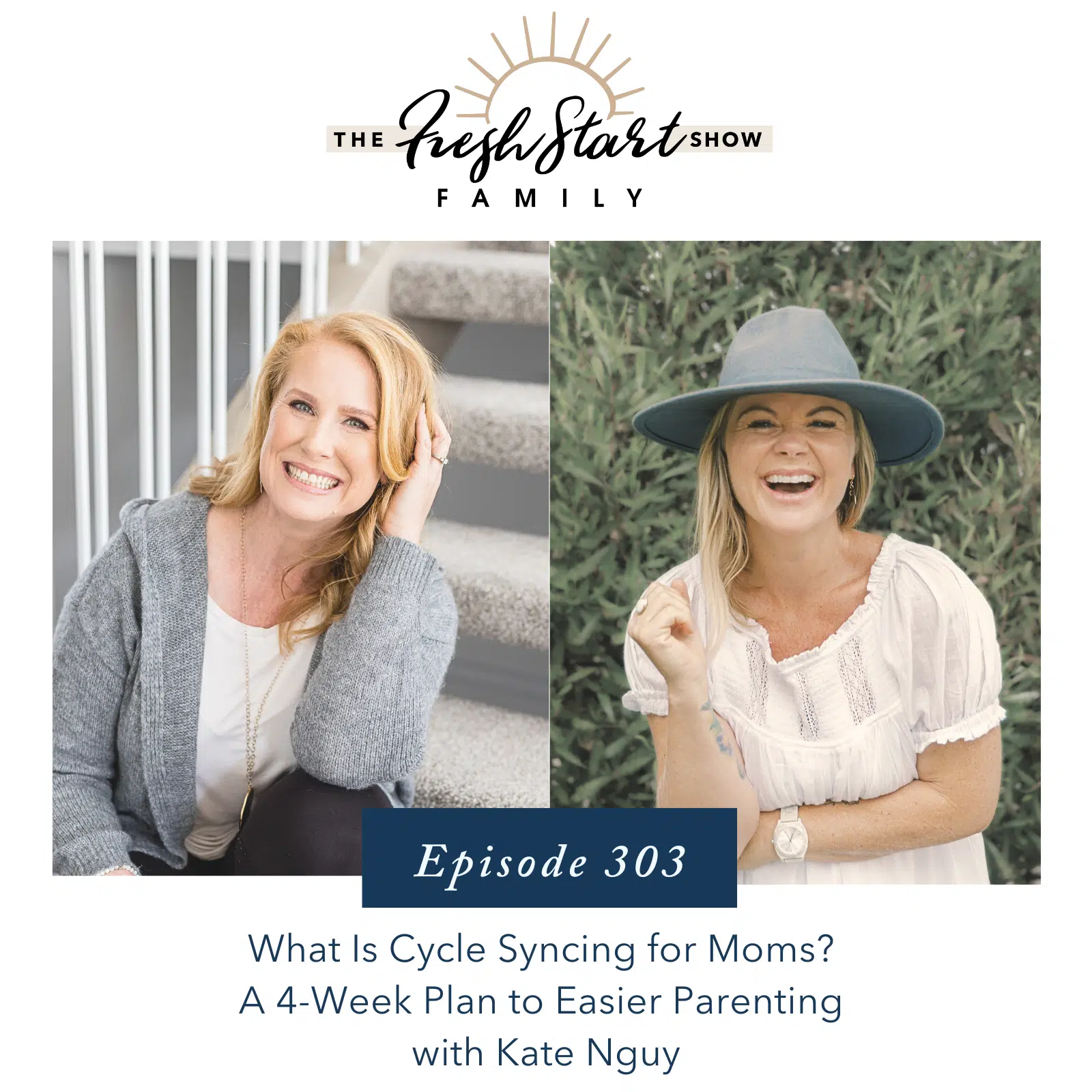
What if your cycle wasn’t something to “get through”—but a secret superpower?
In this empowering episode, Wendy sits down with hormone health practitioner Kate Nguy to explore how syncing with your hormonal rhythm can transform the way you parent, work, and care for yourself.
Kate shares her personal story of healing infertility, the surprising truth about cortisol and stress, and how understanding the four seasons of your cycle—spring, summer, fall, and winter—can help you regulate your nervous system, communicate with more ease, and parent with greater patience and presence.
What You’ll Learn:
- How your cycle impacts mood, energy, communication, and parenting capacity
- Simple ways to align your life with your hormonal phases
- Nervous system support through hormone awareness
- Real-life parenting hacks for each “season” of your cycle
Whether you’ve felt unstoppable one week and overwhelmed the next—this conversation will help it all make sense. You’ll walk away feeling seen, validated, and equipped to stop fighting your body and start honoring it.
Want to learn how to escape a punishment mindset?
This free bundle comes with an extensive learning guide & workshop with me, where I’ll teach you ways to build a strong, compassionate, FIRM & effective discipline toolkit that works with kids of ALL ages!
Inside this FREE learning bundle, I’ll teach you:
- Methods to build intrinsic self-control muscles
- Strategies that unite you
- The importance of self-calming
- Natural Consequences
- Logical Consequences
- Creative Problem Solving Methods
Grab your free bundle & start learning today!
Episode Highlights:
- Cycle syncing can help women use their hormonal fluctuations to their advantage.
- Open conversations about puberty and menstruation are crucial for normalizing women’s health issues.
- Understanding the male and female hormonal systems can improve communication and relationships.
- Each phase of the menstrual cycle has unique strengths and challenges that can be leveraged in daily life.
- Community support is essential for women’s health and well-being.
- Setting boundaries and saying no is important for self-care during the luteal phase.
- Tracking your cycle can provide insights into your physical and emotional health.
- Using visual aids like stickers can help families understand and support each other’s cycles.
- Women can experience different versions of themselves throughout their cycle, and that’s okay.
- Embracing the cyclical nature of life can lead to greater harmony and balance.
Resources Mentioned:
Find Kate on Instagram
Shee Revival website
Aligned Womb, Aligned You Podcast
Wendy on Aligned Womb, Aligned You Podcast
Free Resource – Maybe it’s Not You (The Truth on PMS)
Unable to listen, or prefer to read along? Here’s the transcript!
Wendy (00:02.19)
Hello families and welcome back to the Fresh Start Family Show. We are so thrilled to have our guest on the show today, Kate Nguy. Did I say that right, Kate, your last name?
Kate Nguy (00:12.795)
You totally said it right. You nailed it.
Wendy (00:27.916)
I have to admit my team did spell it out for me with like the linguistics spell out. But we are so happy to have you here, Kate. This has been an episode that I’ve been really excited.to record because I personally really have a huge interest in learning about this. And it’s one that I feel like kind of feels impossible. So I am excited for you to like bust that myth out of me that this is absolutely possible to learn how to cycle sync and how by doing that we can actually make life easier for us even in our parenting walk.
Maybe even in our work walk. I know as a team we’ve been talking about because I have three women that work for me and we’ve always been like wouldn’t that be amazing if we could like actually implement this in our business? But I just have so many questions. So will you start us off introduce yourself to our listeners and our viewers Tell us what you do and just a little bit about why you do what you do Like what brought you to this place where you’re passionate about helping women in this capacity?
Kate Nguy (01:07.792)
Yeah, so I am a hormone health practitioner with a special interest in stress and in cycle syncing strategies. Essentially, I like to help create hormone hacks for women so that way we can use our cycle as our superpower and not feel taken down by it. And my journey started almost 15 years ago now when I was going through fertility issues.
Doctors specialists, they just kept telling me that surgery was my only option removing body parts was my only option Which did not feel good and it was that moment that I first time I ever listened to my body when it was like a big resounding hell no, like we are Going to explore this and we’re gonna trust that our body has the ability to be able to heal and balance and I went on to have three kids naturally which I was told was impossible, so
To all those women out there struggling with fertility, if you’re listening to this, even if it’s secondary infertility, nothing is impossible. But in that journey, I learned so much about the body and in particular about women’s hormones. And then as I started to dive deeper into understanding hormones, it fascinated me so much about the stress response because cortisol is one of our top tier hormones. If cortisol is out of whack, every hormone we have in our body is gonna be out of whack. And that includes our progesterone and our estrogen.
Wendy (02:18.509)
Dang.
Kate Nguy (02:48.785)
So we have all these women out there who are wondering why they feel crap, wondering why they have no energy, why they’re snapping at their kids, why they just feel like they’ve lost their full identity when they become a mom. And I have two girls and a boy. And I think what really triggered my interest deeper is when I had these two girls, I was like, something has to change. There is no way that we are meant to feel this way, to feel…
this gross in our own skin. And as I started to heal my own self and understand, I started to discover these little methods that we could use in our parenting, in our work life, in our relationships that, for as long as I have known, for probably centuries now, the cycle has been something that is a woman’s issue. We don’t talk about it. We do not get anyone else included in it. And it’s something that’s hush, hush.
bury the pad in the bottom of the garbage can, like something to be ashamed of. But in fact, this is like our inner guide to really how to thrive in life and to be like robust with energy. And so I, because I have three kids, I get it. You know, I’m an entrepreneur, I own my own business, I have three children. Life is busy. I understand hustle, but it breaks us because especially women these days, I think,
Wendy (03:48.044)
Yeah.
Kate Nguy (04:15.165)
Parenting is very different than what it was back then, or back when I was a kid. Because we have women that are having children later in life, that are building these big careers that are demanding, that are trying to be the best versions of themselves as parents, and are always overcompensating their own health and well-being in order to make sure everybody else in the home is happy. And it’s burning us out. It’s burning us out.
Wendy (04:39.277)
Bingo.
Kate Nguy (04:42.011)
And we don’t know how to ask for help. And it’s not that we can’t have all these things, but it’s starting to understand how the internal stresses that we might not even be aware of, of carrying the mental load, of being in the sandwich generation where we’re taking care of elderly parents and young kids because we had kids later in life, all of these, how they impact us and knowing that there is resources and there’s tools and there’s a way for us to tap into a new way of moving through
our day-to-day life in a way that really honors our rhythm, which is not a nine to five rhythm.
Wendy (05:17.877)
Yes, my gosh, it’s so fascinating. How cool. And how old are your kids now, Kate?
Kate Nguy (05:25.085)
I have an 11 year old, so we are talking about periods all the time. I have a 10 year old who just the other day was like, I really want puberty to hit. And I was like, oh, I love this. And then I have a six year old boy. So like, this is just it is that this like when we start talking about this openly in homes and in front of people and making this just mainstream conversation, our kids get excited about something that is natural that happens in their body.
Wendy (05:29.9)
Yeah.
Wendy (05:38.218)
my god.
Wendy (05:44.961)
Yeah.
Wendy (05:54.886)
Yes, all that’s so cool. I love that. just yesterday or last week scheduled someone to come on the show. She’s like a sex educator, but like she is like legit. I love the way she’s doing stuff. And she had shared a study online that it’s like the Netherlands has like the highest rate of kids that like wait the longest to have sex, which is like great. We want to avoid things like teenage pregnancy and all the things. And there was two statistics of why. And one of them was the normalization. I know this is totally a
Kate Nguy (06:16.764)
Mm-hmm.
Wendy (06:24.719)
thing like sex but it’s similar it’s the body it’s it’s like it’s so natural right but the normalization of the discussion from a very young age it’s like not weird over there no one like nothing is shameful about it and this she said statistically
they have like these incredible rates over there and it just comes from like normalizing the conversation and not making it a big deal. And so I’m excited to have her on the show, but this reminds me of that type of vibe, right? To hear that one kid is like, cool, let’s talk about periods. And even though there’s obviously men and boys in the house and then the other kid, you said, what is she talking about again? The puberty, that’s right.
Kate Nguy (06:47.803)
Yeah.
Kate Nguy (07:04.88)
puberty that she’s excited about having puberty. And I was like, this is great. Like there’s no shame here, right? And it was so awesome. It was a few months ago now. We were making supper and everyone was sitting around the table. just my husband and I dishing up plates. And my son out of nowhere was like, what is the uterus? And so my 10 year old jumps in and she’s trying to describe it. And I just looked at my husband and said, see, I’m so good at my job. Even my kids can explain what a uterus is.
Wendy (07:11.913)
It’s amazing!
Wendy (07:25.482)
nice!
Wendy (07:33.624)
Seriously, you can tell what a parent does by like the way the kids just like interact and all the things. my gosh, that’s so good. Okay, cool. Well, that’s great. yeah, and I do, it’s really important. Like we have such power to change the next generation and with the normalization of this. And I really see it in my community since I’ve been learning. I think we met each other in Kate Northrup’s group, right? Which is like all about nervous system healing and we’ve just both enjoyed that work so much.
Kate Nguy (07:40.835)
Yeah.
Kate Nguy (07:51.772)
Mm-hmm.
Wendy (08:04.045)
But I often mention how I had no idea about cycle syncing until I met Kate. And then I met you, which is like the Kate’s are the cycle syncing educators in my life. And she writes about cycle syncing in her book. And so I’ve been mentioning it here and there in my private group, the Fresh Start Experience, my coaching program. And it’s funny because just like last week, I knew I had you on the schedule, so it was on my radar. I mentioned something and people were like commenting and they were like,
sorry to the men, because we call them rad dads in our group, but we have some really active fathers who are learning and educating themselves and learning from and kind connection-based parenting strategies. And the women are apologizing to the men.
Kate Nguy (08:37.116)
Mm-hmm.
Wendy (08:48.373)
because we were having conversations about the cycle. in my head, because I knew I was interviewing you, was like, hmm, isn’t that interesting? And so your work is changing that. And we have these young people who are just like, it’s just like an arm. It’s just a woman has a uterus. And yeah, the cycle is important. It affects the family. It’s like, yeah, we co-lead with our partners. Yeah, it’s so much more.
Kate Nguy (08:56.325)
Mm-hmm.
Kate Nguy (09:13.404)
Because it’s so much more than a bleed. Exactly, it’s so much more than this physical bleed which we’ve been led to believe. Like for any mom out there, the reason we want to take care of our hormone health, the reason why we want to have a period is because it is linked to every function in the body. Like we’re talking osteoporosis, we’re talking heart health, we’re talking brain health and Alzheimer’s, we’re talking depression, anxiety. All of that is linked to our estrogen and our progesterone levels.
Wendy (09:21.355)
Yeah.
Kate Nguy (09:42.813)
Right? And so this isn’t just about a sex hormone, right? I’ve actually said that estrogen and progesterone are not just sex hormones. They’re actually neuro hormones as well because they are so linked to the brain. And so this is where we need to talk these conversations and we need to expand it to the men in our life. And we need them to. It totally does. You know, I have my best friend.
Wendy (10:05.069)
Because it serves them too. Yeah.
Kate Nguy (10:09.348)
I love her. we first met and started learning about my work, she was like, my God, because she’s divorced. And she’s like, I need you to create a course just for dads. So that way, when her daughter goes to his house, then he has resources of how to help her if she’s on her period or if she’s in her luteal phase and is not her normal bubbly self. Like dads need to understand that girls, women were four different people, were four different versions.
We’re not meant to be the same every day. And those four versions are going to continue to cycle every month. You’re going to see the same person in week one that you’re going to see in week five again, right? But we have to give this space and this acceptance for women to have different desires, different emotions, different reactions. We’re just four different people.
Wendy (10:50.763)
Yeah.
Wendy (11:02.571)
Yeah. Yeah, the only way the world has ever brought cycle sinking into it is to make fun of women in their PMS phase, right? Like that is the only time you have heard the general world knowing about the cycle, right? That like, is it traditionally like the week before, the week of?
Kate Nguy (11:12.166)
Mm-hmm. Yeah.
Kate Nguy (11:24.294)
The week before, yeah, of our period. Yeah.
Wendy (11:25.493)
Right. And so we’re going to get into this, right? Like, what can you actually see? like, that’s not that I love your work because it helps us to see that there’s actually benefits to being a little bit maybe more cynical or aware. Right. And I’ve seen Kate Northrop teach about this too, is that there’s a design behind that. And it is good for the world that a woman has a week where she’s a little bit more like on edge for. But let’s let’s actually get into it. And Kate, would you start by explaining the difference between
Kate Nguy (11:35.302)
Hmm?
Kate Nguy (11:51.504)
Yeah. Okay.
Wendy (11:55.36)
a woman’s cycle of 30 days or 28, whatever, and a man’s cycle and like why that’s important. I have loved to learn about the male brain versus the female brain over the years. It’s been really fascinating. But when it comes to the cycling, will you tee that up for us the difference?
Kate Nguy (12:09.061)
Yeah.
Kate Nguy (12:13.551)
Yeah, so every human being is cyclical. Our hormones, our rhythms are cyclical. There are cycles all around us. And I think we take this for granted of how much as humans we interact with all of these cycles. So a male’s hormonal system, they’re primarily running on testosterone. Testosterone resets every 24 hours. So the nine to five schedule that we see or the 24 hour clock that we operate our lives around really fits
the male hormonal system because they rise in the morning, let’s say around six o’clock testosterone starts to come into the system and starting to peak, right? So it gives us this lift of like excitement of like, okay, the day’s about to begin. And then around lunch hour throughout the afternoon, they become really social butterflies. If you work in an office, you’ll notice that men are in each other’s offices at that time or they’re wandering the halls, right? Like they’re social. And then they come home from work.
And I always joke about this. They come home from work at like six o’clock. They just want to sit in the chair and turn on the TV. They just need an hour to decompress from their day. Or maybe they disappear to the bathroom for 45 minutes with their phone, their computer, their tablet. And like, let’s be serious. It doesn’t take that long to poop, right? But it’s because they need to remove themselves. This is they’re like winding down, right? And then from like, let’s say 11 o’clock,
Wendy (13:28.321)
Such a weird new world. Yeah.
Kate Nguy (13:41.788)
throughout the night, they’re sleeping, they’re resting. This is exactly what’s happening in the women’s hormonal system as well, but it’s over a 28, well it can be anywhere from like 21 to 35 day cycle. Depending on what your rhythm is, it can be longer sometimes. If it’s longer, it generally means that there’s some hormonal imbalance happening, which we have the moon cycle then to get us back to being regulated, which is really cool. But the women’s hormonal system, yep.
Wendy (14:05.203)
so cool. And wait, before you get into that real quick, the women’s hormonal, well, this sounds, I’ve learned to just not shy away from stupid questions, because they’re not stupid. Can you remind, can you tell us what is a hormone again? Like what is it, what is it again? It’s like a, what is its job? It’s a messenger, okay.
Kate Nguy (14:15.429)
Mm-hmm. No.
Kate Nguy (14:24.685)
a messenger. It’s a messenger. So we have all these cells in the body that dictate how things have to happen. We have all these highways and hormones are like the little messengers that are bringing the message to that area. And so each hormone has a role or a job. And when we look at the women’s hormonal system, in particular, we’re looking at progesterone, estrogen, testosterone. We’re looking at some minor ones as well. I shouldn’t say minor, but there are ones that
Wendy (14:53.249)
Those are hormones, progesterone, testosterone. Okay, they’re it, got it.
Kate Nguy (14:55.055)
Those are hormones. Estrogen, are thyroid, melatonin, DHEA, cortisol, insulin, these are all hormones as well. And those hormones impact our sex hormones, which is our estrogen, progesterone and testosterone. So when we’re looking at the women’s cycle in particular with this conversation, we’re talking about the sex hormones, but just know, like when women come to work with me with hormone imbalances, we’re looking at all.
the hormones. We’re looking at your thyroid. We’re looking at what’s happening with cortisol in your body because they directly impact the others because they’re messengers. They’re communicating with the other ones saying, like for instance, with cortisol, if it’s like, my gosh, life is stressful right now. It’s going to go and talk to your ovaries and say, hold up, do not produce any kind of things that might create a pregnancy because we can’t have that right now. So then our estrogen and our progesterone
Wendy (15:50.017)
that makes sense.
Kate Nguy (15:52.316)
right? Well, our progesterone is the cause because an egg is released. If an egg is not released, we don’t create it, right? So this is where like, I know our body is so smart. So, you know, when we look at hormones, hormones are really just always communicating with other organs of like, okay, produce this hormone now because we need it for this, or don’t produce it because we’re overloaded, or so it’s always a communication process happening. So yeah.
Wendy (16:01.025)
The body’s incredible.
Wendy (16:18.775)
Got it, okay. Thank you.
Kate Nguy (16:22.095)
So when we look at the sex hormones that kind of regulate our hormonal system, our reproductive system, we’re looking at estrogen, progesterone, and testosterone. So when we finish our bleed days, I always like to start after our bleed. This is what we call the beginning of our cycle, which is our follicular phase. So the follicular phase is when estrogen starts to come into the system now.
Wendy (16:45.005)
Okay.
Kate Nguy (16:49.787)
Because during our bleed, everything kind of shut down, right? So this is when it’s starting to ramp up to say, hey, ovaries, we got to start thinking about pulling out a follicle and making it ready to become an egg that’s going to be released during ovulation. So it’s calling the systems to come and like prepare for pregnancy. This is the time that we got to get all the soldiers going. So when you think of it, estrogen is a high motivator kind of hormone. It’s also
Wendy (17:09.165)
Yeah.
Kate Nguy (17:19.405)
a hormone that is highly linked to the brain. activates our vocabulary. It activates our memory. So I always laugh. Like if you want to win an argument, you have to pick a fight in the first half of your cycle because you have like all this extra juice that’s like, hey, I can outtalk you any day. Yeah. And even like our speech skills develop. So this is how estrogen is really important. So when we look at the male system, how we said like from 6 a.m. to like lunchtime,
Wendy (17:38.132)
Okay.
Kate Nguy (17:48.291)
This is our follicular phase. For a guy, it’s just a few hours. For us women, it is about a week, right? So we’re here for a while. Yeah, so we have this high energy. And then ovulation comes and ovulation is when estrogen has primed the follicle enough so that it is ready to be released out into the world to potentially become a baby or to become the production of what we’re gonna need for our progesterone level.
Wendy (17:56.973)
Cool.
Kate Nguy (18:19.298)
So our cycle is not just about making babies, although that can happen from it, right? Like so many women are like, I’m done having kids. I’m just going to go on birth control. No, we want to actually cycle like we need the creation of this. And the egg is so incredibly important. They say it’s the most important part of the cycle, more so than the bleed, because it’s what is going to create your progesterone. And we’ll get into that in a second. So ovulation is this time in our cycle when
everything’s rising because it’s a big event. It’s midday, right? Lunchtime is midday where we feel energized. We’ve already gotten through the morning rush. Now we’re just like we’re in our rhythm, right? Which is why often we want to socialize and we want to be part of a community and we want to connect. So this is midday for men, right? Once again, we are here for a bit, right? Ovulation is only a one day event, but that rise in hormones
realistically is about a five day event, right? Because it does take time for the hormone to like peak for the egg to release and then it does take time for those hormones to, or for estrogen to come back down. So this is our midday, if we’re looking at the 24 hour clock kind of feel. And then once that egg is released, we’re going into our luteal phase. The luteal phase is famously known for the PMS phase, right? The grouchiness.
Wendy (19:35.306)
Okay.
Wendy (19:44.077)
Okay, okay, yep.
Kate Nguy (19:45.935)
But this is where the egg is released. This is where women’s bodies are so incredibly crazy is the shell of that egg. When it busts out of the ovary, that shell actually becomes a gland that is a temporary gland. Like our body builds a gland in just a few hours. It is crazy. That’s completely vascular, which means that it is fully functioning. Right. Like we do this every month. We are amazing creatures. But the corpus luteum is what then produces the progesterone.
Wendy (20:02.476)
Wow.
Kate Nguy (20:15.896)
And the importance of this is that it helps create that incubation, right? It helps to really soften the lining of the uterus so that the egg could implant if it is pregnant. And then it would provide the progesterone for the placenta to be able to develop, right? So it’s a really important hormone. And so this hormone is, you know how estrogen was like primed for our brain? Well, progesterone is primed for our nervous system.
So it makes us feel more calm, more sedated, more relaxed, right? And a lot of women are like, but I don’t feel relaxed during this phase. Like I feel grouchy and edgy and all the things, right? And I always ask, is that because you’re still trying to be your pre-obulation self in this time of your cycle when it’s asking you to slow down? Like our body is trying to like slam the brakes and say, can you just sit?
Wendy (21:05.261)
That’s interesting.
Kate Nguy (21:11.118)
Can you just do nothing? And we’re like, nope. We’ve got all these 10 tasks that we have to do. And we still got to hustle because that’s what society wants. And so then we push and push and push. And then that’s why we’re so dysregulated in our nervous system is because we do have a hormone that’s like begging us to like just stop. And we’re like,
Wendy (21:15.883)
Yes, I am.
Wendy (21:21.961)
I’m so good at bulldozing.
Wendy (21:33.07)
And the body is so brilliant at like, unfortunately forcing you. It’s like sometimes, you know, when you get sick or even I got a knee injury last month and I was like, my knee had been swollen. I have really bad knees. I’ve had two surgeries before I was even 17 with sports. But like my knee before that injury was swollen for three weeks and I did not slow down. I was like, you’re fine. I would literally, I would look at it and I was like, stop it.
Kate Nguy (21:39.887)
Mm-hmm.
Kate Nguy (21:55.706)
Mm-hmm.
Wendy (21:58.194)
stop it and I would just go for my hike and I would do my surfing and I’m and then eventually it like it broke essentially like it turned out to be a cartilage injury but it was like no you have to sit down so I actually sat for four weeks
And now thank God it’s healing and I don’t need surgery or anything, but it’s like, I see that happen a lot with sickness, right? Like you’re go, go, going, and then the body will literally force you. And so that’s interesting that to think of that PMS phase as like a stop, slow down, like just slow down, like maybe nest a little.
Kate Nguy (22:32.634)
Well, and here’s a really cool thing I heard on a podcast lately is that our nervous system, the way the female nervous system regulates is through oxytocin. The male hormonal system, or not hormonal, yeah, the male hormonal system, nervous system, sorry, nervous system regulates through dopamine. So they regulate by doing and achieving. Women regulate by community and being supported.
We think of oxytocin as like the sex hormone, but really it’s also about community. It’s about connection. And so if we think of that, we have this hormone in our body that is supporting our nervous system, that’s helping our gut and our neurotransmitters, the supportive things, right? We have what our body is really asking for is for us to lean on community. And as women, we’re like, no, we’re going to keep doing it because and not because we’re doing something wrong.
because this is how society is now set up. We’ve moved away from our parents. We’re living somewhere else where we don’t have a bunch of family to take care of our kids. Our neighbors are all working moms as well. So it’s not like we can say, hey, can you take our kids? And so we’re not set up like we used to be with community for that support. And this is when women really need the support. If we delegate here, if we discern, we are able to regulate and we are able to find common peace.
And so we talked with the male hormonal system, how this is when they disappear to the bathroom. This is essentially what we need to do, is we need to shut our doors for seven days and say, listen, nobody can come in here because I’m in my private zone, but we don’t, right?
Wendy (23:57.025)
Yeah.
Wendy (24:10.571)
Yeah, and a lot of that I think is conditioning too, right? Like there is factual evidence. We don’t have that. I remember there was a family that lived across the street. They moved about a year ago. But it was just this like beautiful Mexican family. And I feel like they do it really well in their heritage. And they had like multi-generational the home, right? So was like grandma, mom and dad, and then the kids. And they were like packed in there. But they were so, they were just happy. And like their parties were so much fun because it was like all three layers, you know?
So like factually, yes, we have less of that, right? Like we, in our society, most many of us, like my parents are in Maryland, like we’re in California. But then there’s actually, there’s also the conditioning that causes you to think that you can’t ask for help and that you have no one to help you and so you don’t ask your neighbor, right? So I think that’s really interesting when you look at this phase. Or a partner, exactly, Kate, yeah.
Kate Nguy (24:59.703)
we don’t ask our partner. We don’t ask. Like how many of us do not ask our husbands to step up? Right? And this is another thing that has become conditioning through the generations, which is so ridiculous. Like this is when they need to step up and help. And then our last part of our cycle is our bleed. This is what we traditionally know as our cycle is the period. Right? And this is when all of our hormones come to an end. The reason why a bleed happens is because
Wendy (25:07.671)
Right, exactly. Yeah.
Wendy (25:19.148)
Yep.
Kate Nguy (25:29.281)
estrogen slow, podestro now has dropped and all of a sudden our body’s like everything’s low levels. Let’s let the gates open and let’s like flush out the uterus. Our body’s doing so much here and it’s according to Ayurvedic medicine, this is when our body cleanses itself, not just physically, but emotionally, mentally. This is when we allow all of our body to release whatever’s not serving us. But as women, once again, I know, isn’t it so magical?
Wendy (25:55.02)
It’s like a good cry, Kate. It’s like a good cry, right? Like, you know, like a good cry, but we don’t see it as that. We’re like, period. It’s like, I love that. Like just the cleansing that like the analogy of crying.
Kate Nguy (25:59.704)
Yeah.
No. Yeah.
Well, tears are okay, but blood is gross, right?
Wendy (26:12.077)
Why? Yeah.
Kate Nguy (26:14.467)
And this is, it’s so funny, because like I’m always telling my clients, like, what does it look like? Look in the toilet, look at your underwear. What is the consistency? What is the color? And it kind of gets them gross. But I’m like, if your child cuts their hand, you’re not afraid to touch that, right? You’re not afraid to clean that up. But when it comes out of our vagina, all of a sudden it’s like, this is toxic material.
Wendy (26:30.646)
Yeah.
Wendy (26:39.693)
Yes, you know what’s so cool by the way about that. I am interviewing a woman. I think she might be on the calendar in a few weeks. I don’t know. Her name is Mickey. I think it’s Agarwal. She was on Kate Northrup’s show, but she has designed three businesses now all from.
what comes out of us. So her first first business was like, I think it’s called Thinks. She was the inventor of period underwear, which has just changed my life. The second one was the Tushy, which is like a very affordable bidet that you can add to your toilet, which is just groundbreaking. Again, we our family is like, how come we didn’t ever have bidets before? And so second company and then her third company now that she just launched is like a
diaper company where
They have plastic eating mushrooms. And so these diapers break down over like, I want to say it takes it like 30 years maybe versus 400 in a landfill. But all of her, all of her companies are about what comes out of us. And I just, I’m like, I love it. Cause I’m like, you’re just normalizing. Like this is just part of life. Like this is not gross. This is just being a human. Like why have we decided that everything is so gross, you know? So it’s kind of funny.
Kate Nguy (27:39.865)
Wow.
Kate Nguy (27:44.238)
love it.
Kate Nguy (27:49.006)
Yeah.
Kate Nguy (27:56.568)
Yeah. So yeah, in this phase of our cycle, our body has low energy. So if you’re wondering, why does it feel like I’m hauling myself everywhere? Why does it feel like the emergency brake is on and I’m still trying to push the car? It is because our body’s asking us to stop. And so we’ve kind of went into a lot of clinicalness of this. And so how I like to help women understand it in a way that’s way more gentler and just
Wendy (28:21.41)
Yeah.
Kate Nguy (28:26.105)
I think we get it more when we think of it this way, is that we are really representative of the seasons, right? So our summer season, our, sorry, our follicular season, which is when the estrogen’s starting to come out after our bleed days, this is our spring, right? Like if you can imagine the start of spring when the grass is starting to come through, especially if you’re somewhere where there’s snow like I am, we are so excited. It’s like the sun is here, the days are longer. Oh my gosh, it’s gonna be beautiful outside.
Wendy (28:32.748)
yes!
Wendy (28:47.957)
I love spring.
Wendy (28:52.129)
Yeah.
Kate Nguy (28:54.883)
And we get so excited, we get ramped up with energy. But here’s the thing when it comes to our inner spring is that just like in spring, especially if you live in a cold climate like me, we see all this stuff happening and we’re like, yes, summer’s here. And we go outside in our Capri pants and our tank top and we’re like, holy crap, it’s still cold. And we go back inside and put on our running shoes and socks and so forth. So the same thing happens in our follicular phase and our inner spring season is that we get this rush of energy
But if we push ourselves too fast, too much, we’ll burn out because our energy is still gradually building, right? It’s a building hormone. And so if we go too much head in, then we’re going to crash and we’re going to feel grouchy and we’re going to feel tired again, right? So when we start to see those things in our follicular phase of being like, I’m edgy today, it’s like, maybe I just need to like take a five minute break. Maybe I need to do a nervous system tool. Maybe I need to put the TV on for the kids and just sit back and
Wendy (29:47.915)
Yeah. Yeah.
Kate Nguy (29:54.317)
have no expectations, right?
Wendy (29:55.98)
Yeah, and if we’re looking at the four week cycle, did I hear you say that this is the week that you might feel more playful and that you might look at like scheduling the month ahead or scheduling some things that week?
Kate Nguy (30:05.315)
Yeah!
Yes.
Yeah, so let’s bring in the parenting stuff at the same time as we’re talking about the seasons. So when we look at parenting in our follicular phase, this inner spring season, this is the time where we plan out the month because we know our cycle length approximately. Even if it’s off a little bit, it doesn’t matter. You know, we always say like give a week in each phase, right? So for this week, we know we have an uptick of energy, but we might crash mid-afternoon. So we might have to have like little five minute breaks here and there.
Wendy (30:15.775)
Okay.
Wendy (30:24.501)
Okay.
Kate Nguy (30:40.408)
But this is the time where we want to get playful because remember how it primes the brain for language. It’s excitable. Spring is a time where we really get excited about getting back outside, even if it’s a little bit of a crisp air. We’re like we’ve been locked inside. We need to move. Right. So the same kind of energy is there. So we can be playful with our kids. We can explore with our kids. We can go on walks. We can do all the kind of fun activities. We can do new things here. This is a great time for us to start to get adventurous as well.
In the closer to the end of this week, testosterone starts to spike as well. And testosterone is our risk one, right? Where it’s risk taking, right? Like, what can I do that’s a little bit fun, right? So testosterone comes in at the end of our spring, beginning of our summer. So this is a time where, you know, you might want to go and do rock climbing with the kids, or you know that if you’re somebody who’s super anxious all the time, this may be where you have a little bit more stress resiliency and a little bit more resiliency with your anxiety.
to go do something with kids without feeling like your heart’s gonna go into palpitations, right?
Wendy (31:42.83)
And I’m going to add, like so many of our parents are rewiring the nervous system to see compassionate discipline as safe. And so this, you just made me think of it when you said risk taking opportunity. Like this is a great opportunity to, because you always want to be doing compassionate discipline, but especially during this week to like.
do some activities if your kids are always fighting and laying hands on each other. Or if you have kids that are constantly not struggling to get out the door in the morning, this is probably a great week to sit down and make some charts that your kids might be resistant to because they are going to feel like it’s punishment. But instead, you have the resiliency to be like, OK, I’m empowered. I can do this. Know what to say to them to get them to actually sit down and follow through on the charts or do the redo, whatever it may be. So I love that idea of
this is a great week to maybe have a little bit more risk tolerance and maybe the nervous system can handle that a little bit better. That’s interesting.
Kate Nguy (32:36.289)
Yeah.
Kate Nguy (32:40.822)
Well, also, if someone’s working with you and they are learning a new technique and it hasn’t been working, they just feel like it’s frustrating, it’s like, where are you at in your cycle? Because if you try to implement something when you’re in your bleed days or in your luteal phase, it might feel hard, right? So it’s like, you know what, let’s just pause that if that one’s hard and let’s try it again when we have estrogen in the system. Because now you’ll be able to have a little bit more patience, a little bit more tolerance.
Wendy (32:48.812)
Yeah.
like that.
Wendy (32:57.346)
Yeah.
Kate Nguy (33:07.476)
And you will also have a little bit more ability to communicate better about what it is that you’re trying to get across, Our vocabulary once again. So don’t just throw the baby out with the bath water, right? Like we want to wait until it’s an optimal time with our energy levels sometimes. So that’s, yes. So week two is our ovulation. This is our summer phase. So if you think about summertime,
Wendy (33:17.261)
So cool.
Wendy (33:24.979)
So good. Okay, I love it. What’s week two? Is week two summer? Okay.
Kate Nguy (33:35.992)
This is where often we have a lot of energy. We maybe stay up too late. We snack a lot, eat unhealthy, but our body doesn’t feel as gross as what it maybe feels in other phases. This is where we want to be around people all the time. It’s like, yeah, I can do this. I can do that. And so this is our time of connection and community. We can look at it as the inner summer. If we want to look at it through the archetype lens, this is the mothering time in our cycle.
So this and what that means is that this is the time where we have deep empathy. Like we’re so good at listening, but also being able to still have those vocabulary skills to share what our perspective is. This is a great time if you’re fighting with your husband to have those conversations here because you’ll be able to hear their side of it. And you’ll also be able to share your side in a way that has layered with compassion and proper tone. Like we’re just way more empathetic in this phase.
Wendy (34:07.277)
Mmm.
Kate Nguy (34:31.68)
So this is where the phase where, you this is where you want to cuddle your kids more. I often want to read longer like Harry Potter books to my kids during this phase because I have the capacity to sit still and just, you know, have them close to me to be able to smell their hair. Right. Like this is where we just feel all those things in us. And this is where we often want to have other kids in our house. Like this is a great time to host the play dates.
Wendy (34:45.485)
Yeah.
Kate Nguy (34:56.79)
Right? To be like, yeah, send over the whole neighborhood over here. Like I have the energy capacity to take it on. For me, this is a great time where I do more connection stuff, where I will bake with my kids or maybe we’ll start doing a different kind of recipe for cooking at supper time. Right? Because I have the patience to help them walk through it. I don’t want to be left alone. I want them near me. So like this is the time where we can really build.
good memories. have lots of energy like we still had in our follicular phase, our inner spring phase, but this is just layered with another layer of closeness, right? We just wanna be with people here. And so we can really use this. Yes.
Wendy (35:36.782)
So maybe a great week to plan one-on-one dates. Just even if it’s like that you put it on your calendar. And we’re going to talk about it once you get through these four. My kind of ending question is going to be, gosh, this seems so out of reach. How do we get this? And this one feels doable. I’m like, OK, you could look forward to the month and say, here’s the week. I’m going to put.
Kate Nguy (35:54.253)
Yeah!
Wendy (36:01.279)
make sure this afternoon is clear, I’m gonna take this kid to frozen yogurt and I’m gonna take this kid on a solo date to, for me it would look like surfing or younger kids, the trampoline park, right? Like I can, that one task, I’m like, okay, I could get ahead of that. So I love that idea of like the one-on-one dates.
Kate Nguy (36:04.653)
Mm-hmm.
Kate Nguy (36:11.756)
Yeah.
Kate Nguy (36:18.018)
Yeah.
Totally. We would do our one-on-one dates with our partners here. Why wouldn’t we do them with our kids, right? Like this is the same kind of thing. And this is going to build that oxytocin for your nervous system, which we’re going to move into that we really need, which is our inner fall, right? So our luteal phase is our inner fall phase. This is, and when we look at the archetype, this is the enchantress, the wild woman, the person that wants to just go in the woods and forge mushrooms and wants silence. Like she just wants to be connected with herself.
Wendy (36:23.28)
yes, yes, Yeah.
Wendy (36:31.713)
Yes. Okay.
Kate Nguy (36:50.07)
Right? And this is where women struggle so much because we are so used to being everything to everyone else that it’s really hard for us to be everything for ourselves. Like it’s really hard for us to be like, I need to come first at times. And this is the week that I need to come first. And so this is also really crazy that this time in our cycle is when our senses become really heightened as well. So.
Wendy (37:03.927)
Bingo.
Wendy (37:17.677)
Mmm.
Kate Nguy (37:18.57)
If you’re wondering why you’re like, sounds like the kids are always fighting or, my gosh, I can’t have music on in the house. That’s because our sensory, we’re in sensory overload in our luteal phase. And so one of my loving things that I do for my family is I use a different room during this week. I know it sounds really weird, but for suppertime, they wanna have fun. Like they’re laughing and my husband’s somebody who likes to make lots of jokes and like, it’s just nonstop all the time. I love him in every season, but this season sometimes.
Wendy (37:37.005)
That’s amazing, Kate.
Wendy (37:46.125)
Sounds like mine. Sounds like Terry.
Kate Nguy (37:48.92)
He gets them so riled and like it’s so much activity that I cannot take it. So I literally go and just eat in a different room because I don’t want to diminish their fun and say everyone eat quietly. I also find that I can hear everyone chewing during this phase. it’s like can everyone just chew a little bit quieter? Everything is just so much more sensitive. So yeah, so I just eat somewhere else. I just take that time to be by myself and
Wendy (38:09.076)
Yes. Bugs you. Yes, that’s so interesting. That’s cool.
Kate Nguy (38:18.345)
Everyone’s happy, right? It doesn’t hurt anyone’s feelings, but this is, remember, this is like that bathroom break, right? We’re carving out time for ourselves. Does this mean that we have to remove ourselves from our family all the time? No, it just means that we have to make time for us as well, so that way we have a little bit of battery life left so that we can give that little bit back to them, but we have to put ourselves first. And so some of my favorite hacks for this time is eating by ourselves.
Wendy (38:28.886)
Yeah.
Kate Nguy (38:45.739)
You know, I always have conversations with my kids during this week. They know when I say that I’m in a blue week that I can’t have the sound on in my car, like the radio has to be off. They get it, right? Yeah, we’re going to get into that right away. Yeah. So this is like my week where it’s like, can’t, the main floor of our house, I always call it our sanctuary. They can be on any other floor or outside, but the main floor where I’m going to be at has to be sanctuary, has to be quiet.
Wendy (38:54.949)
You call it a blue week? I love that. Okay.
Kate Nguy (39:12.501)
Right? And so they get it, right? They’re adjusting to what I need. And I think as women, the more that we’re able to do this, it can be really helpful for our nervous system. Plus, hot tip, a lot of us women in our ovulation phase the week before are like, yeah, I can take Nana to her appointment next week and yeah, bring over Johnny and Susan and whoever next Thursday. We forget that next week.
we’re gonna be a different version of ourselves because in that ovulation phase, we just wanna be that people pleaser. We’re like, yeah, I can take it all on. But then a week later, it’s like, my God, this is so much work. I’m exhausted, right? So only say yes to things that you can tend to in your summer week, right? Because Alexander Pope says this beautifully in our luteal phase and in our period, this is actually the two phases that are the power of no.
Wendy (39:49.804)
Yes.
Kate Nguy (40:07.5)
where we have to say no, where we have to have boundaries here. And when we have the power of no, we actually take care of ourselves. And so that’s really important.
Wendy (40:17.121)
is profound. Yeah, we talk a lot about the power of no and man is it a breaking
of conditioning to see that as a gift and not a weakness, right? Like you’re one example of eating in a different room. I know so many moms that are listening are like, but that’s when we’re supposed to be spending family time. And like, I don’t see my husband. Isn’t that like bad? You know, like that’s like the knee jerk, but then to see that as like, what are you saying yes to? And you say no to that. It’s so beautiful, Kate. It really, really is. That’s amazing. And this, yeah, what are you gonna say?
Kate Nguy (40:48.215)
Listen, I was going to say I remove myself for suppertime, but that means I can read stories at bedtime. Right. So it’s a give and take. Right. You’re not cutting yourself off forever. But if I want to read stories to them and have the patience and at the grounding, I need to eat my food in silence.
Wendy (40:55.244)
yes! That’s so awesome!
Wendy (41:08.79)
Yes, my gosh, beautiful. As we move into this last week, the bleed, I do have a question about that one. like, maybe it’s just my age or whatever, but like sometimes there’s like spotting that goes like long time. Is that still considered the bleed or are we again, not trying to get perfect? We’re just looking for approximate here.
Kate Nguy (41:23.511)
Mm-mm.
Kate Nguy (41:27.659)
Yeah, we’re just looking for energetically. So when we have spotting, that could be a lot of things. It’s going to be linked more to your hormones. We count the bleed day as the first day of full flow. So the spotting days would just be our body. You know, it could be for many reasons why it happened, but it’s just the body preemptively starting to prepare for the bleed. But the bleed is actually when the full day happens. Now, listen. Yeah.
Wendy (41:39.798)
Okay.
Wendy (41:45.995)
Yeah.
Wendy (41:51.949)
And then at the end, just like the same, it’s it’s mind’s at like the end, right? So I’m always like, is that considered? And I have gotten better at tracking just now. I’m 48 now, just in the last year. No one ever taught me, right? Like, and my daughter, she’s a strong-willed cookie, but she’s doing pretty darn good with the tracking. And she’s 17, she’ll be 18 soon. But I’m like, oh my gosh, what a beautiful gift and a legacy upgrade.
Kate Nguy (42:06.55)
Yeah.
Kate Nguy (42:16.066)
Yeah. Yeah.
Wendy (42:17.958)
just you know i’m like just even tracking just even knowing but that was a question about that like k taper down but you’re saying like really track those first five days or whatever of the main bleed okay
Kate Nguy (42:24.982)
Yeah.
Yeah, the first like bleed days, the spotting is just, it’s just lingering, right? So we want to, now, if we look at it from a conventional medical point of view, they always say day one of our cycle is the first day of full bleed. Now, when we look at it from an energetic lens, meaning that we’re looking at it from the seasonal lens, right, of calling this our inner winter, I always say that our inner winter begins when our energy begins to crash. Mine is two days before my actual bleed. I know my, my bleed is coming.
On day 26, when I wake up and I’m like, my gosh, do I have to do life today? Right? Like you just get hit and it seems like it comes out of nowhere. And that for me is the swap. I don’t have a bleed yet that day, but my energy begins to crash. And so if you’re talking to your doctor, they’re going to want to know the first day of your bleed. But if we’re looking at it seasonally, our inner winter might start a day or two before our bleed when our energy comes down. So our bleed is our winter season. When we think of winter,
It is cold outside. We normally don’t want to go outside. We normally want to sit in front of a fireplace. We want to eat warm foods, drink warm things. We want socks on our feet. This is exactly what our body’s asking for too. Stillness, slowness, reflection, right? Like it’s just wanting peace, right? And so this is how we can really nourish ourselves. Once again, as moms, this is hard to do because we have little people that we’re trying to take care of. And so we always say like in an ideal world,
rest these days and delegate all tasks. know, Ayurvedic medicine says no cooking, no cleaning, no stress the first two days, right? And so that works for some women. Some women are like, that’s too much. Can you just do 30 % less? Like what would 30 % less look like?
Wendy (44:11.404)
Yeah, or just put your to-go meals maybe on the calendar for the month on those days.
Kate Nguy (44:18.262)
Yeah, I always, I always call my husband. I’m like, okay, period’s coming. I can feel it. I can’t cook today. And he has to make the decision if he’s gonna come home and cook or if he’s going to order in. I don’t care. I’ve already made my steak in the ground that I am not cooking. And then my kids also know that before that, I’m really good at getting laundry done and so forth. On my bleed days, if you can’t find a sock, you’ll have to wear a dirty one. Like it’s like nothing in this time is life threatening, right?
Wendy (44:29.825)
Yeah.
Wendy (44:33.9)
That’s amazing Kate.
Wendy (44:43.988)
Yes. Ugh.
Kate Nguy (44:46.462)
And so how can we just lessen that load? If you’re at work and you’re like, my gosh, I feel crappy. Why push yourself to public speak or to, you know, go to five different meetings? I always say plan this time in your schedule, just to like clean up your inbox, right? File those papers that haven’t been filed. You know, I look at my office and it gets chaotic during the month. And then also my bleed comes in like, okay, I can start tackling some of the stuff that has to get done. That doesn’t require lots of brain power.
Wendy (45:01.79)
Mmm.
Kate Nguy (45:15.168)
that doesn’t require a lot of me. Yeah.
Wendy (45:15.52)
going through your mail pile. I can’t be the only one. am literally like a hoarder with mail. I just put it in a pile and I’m like, my gosh. And then I like once a month go through it and it is like redonkulous, but that’s an activity that you could do and just sit there. Why? Maybe you have some Netflix on or something. I’ve got older kids now, Kate. So I’m like in this super fun season where I can just like watch whatever I want. Cause the kids are like 15 and 18 almost. And the Netflix, I find that if I just put a little Netflix on, I can do any time.
Kate Nguy (45:30.133)
Yeah.
Exactly!
Wendy (45:45.454)
It’s like not that bad.
Kate Nguy (45:48.915)
Exactly. So those are our seasons. And that’s how like, if it feels too hard clinically, start just thinking about it as the seasons, like the environmental seasons. And you had mentioned charting. Like this is a really important thing for women. If we want to start to learn our rhythm, it is so cool. And it blows my mind every time when people chart their cycle.
Wendy (45:51.596)
Amazing.
Kate Nguy (46:10.743)
what you feel on day three, you’re going to feel the pretty similar on day three, a month later, two months later, three months later. Like we are pretty repetitive to the day. And so why I always say to women that want to start to learn their cycle and learn like where their energy levels are at, map out your how you feel physically, emotionally, energetically and mentally. And this can just be one word for each of them. You know, mentally, I have brain fog. Energetically, I feel like I can barely get out of bed.
emotionally, I feel like I’m going to cry physically. I feel okay. Right. Like not very motivated.
Wendy (46:44.702)
I’ve been using the health, just the regular old health app on the Apple iPhone. And I think it does have, I haven’t gotten to this point yet, but again, I’m a work in progress. I’m praying that I can teach my daughter how to do it differently, but I’ve got to model it first. And I am good with the tracking, the, I don’t think, it, it doesn’t give you a write-in area. It gives you a bunch to check, but I wish there was like a write-in area where you could just make some notes.
Kate Nguy (47:08.032)
Yep.
Wendy (47:13.334)
Do you have a favorite app that you like? As we wrap up, I have that question. And then I also want to ask our last question. So your favorite app to track. And then last question is, how do we actually implement this? Because it feels so.
Kate Nguy (47:25.43)
Huh.
Wendy (47:28.074)
Like, great, this is a great idea, but like, for someone who’s not the best planner, me, I have people on my team who are rock solid, that’s why I hire them, but I’m like, I’m just averse to planning, so what would you say for those two questions as we wrap up today, Kate? I could talk to you for hours, but, it’s so good.
Kate Nguy (47:45.27)
This is my favorite topic. it’s so good. Oh, and one other thing I’m going to mention too, inner fall. This is just a Kate thing, but some people out there might resonate. I don’t do arts and crafts this week because having sparkles all over my floor and glue that stuck to people’s hands and people freaking out because something wasn’t perfect, I’m just like, I can’t breathe. Right. And so I refuse.
Wendy (47:57.816)
Wendy (48:10.176)
doing it.
Kate Nguy (48:11.189)
I absolutely refuse to do crafts and arts during this phase of my cycle because I know that I do not have the compassion. So if anyone else is like that, just know that it’s okay to say no during this week. That’s my hot tip for you. Yeah, so some apps that I really like, I really like spinning wheels or spinning wheels, sorry, no ass on it. Because if you do spinning wheels, you get like the Wheel of Fortune, but spinning wheel.
Wendy (48:15.2)
That’s a good tip.
Wendy (48:21.684)
Amazing. Okay, good tip.
Kate Nguy (48:34.248)
It is created by one of the first women to ever really work on the menstrual cycle in this kind of symbolic lens of the seasons. so hers, it does, when you put in your cycle, it will give you a version of like, in her autumn, what are your strengths? What are you making a struggle with? It’s really beautifully mapped out. And it’s like $1 a month. I think it’s $12 for annual. It’s really feasible. Another one I like is Stardust, especially if you want to track temperature and things like that.
Wendy (48:58.143)
Okay.
Wendy (49:03.604)
And the first name of the first one you said, Kate, real quick again. OK.
Kate Nguy (49:04.095)
spinning wheel. I’ll send you the link for it as well. And then another one that I like is called Stardust. I like it because it doesn’t sell your information. Big thing. But it also kind of has that like it’s not as in depth as spinning wheel is, but it’s like the medium in between. It’s for also has like a lot of like where you can put in your temperature and your civil communique. It’s like a lot of things like that. Like it’s
Wendy (49:20.876)
Okay.
Kate Nguy (49:36.116)
I do like it as well for people that want to track a little bit more heavily.
Wendy (49:40.0)
Yes, spinning wheel doesn’t come up easily on the app, so it must be like a special link or something. Spinning wheel.
Kate Nguy (49:48.438)
sorry, it is spinning wheels. It is an S. I thought it didn’t have an S. Yeah. Yeah.
Wendy (49:52.043)
Wheels, got it. There we go. Because I know people are like, tump popping this up real quick. Spinning wheels, wisdom of the cycles. OK.
Kate Nguy (49:57.992)
I thought it was without an S. Yeah. So it’s a really beautiful app. It’s really nice. But then if you want more of like a hybrid between like that symbolicness and like the cultural or the clinical, sorry, I would suggest Stardust as my next favorite, especially with this work. Yeah.
Wendy (50:18.252)
Amazing. And what do you recommend for like, is it a family meeting once a month? Is it, like how do we get over this hump of like, you know, we can do this, but like you have to get ahead of it, right? Like you have to look at the month ahead.
Kate Nguy (50:28.309)
Okay.
Kate Nguy (50:36.337)
I’m gonna blow your mind on this, because this is my favorite thing to do. This is what I teach women all the time. This is my favorite hack. So I do this at the first of the year, January. I map out the full year. Now you can just print off, like go on the internet, print off the calendar months from January to December, and then tape them all together so that you have like this linear calendar thing if you want to. If you’re just new to this and you’re like, I wanna play with this a bit, just print off the next month and
Wendy (50:37.868)
Okay, please blow my mind, Kate.
Kate Nguy (51:06.427)
month or two, right? And so you can map it out. Now, for most of us, our cycles are pretty predictable. Some of us are going to have irregular cycles, which is fine. It’s fine because remember, we can always reprint this and do this again. It’s not a big deal. I like to use little tiny round stickers, but you can also do this with a highlighter if you wanted to. And so I go for my bleed days. I map out and I take my cycle. I’m a 27 day cycle girl. I just do about a week in each.
Wendy (51:18.89)
Right, okay.
Kate Nguy (51:33.947)
in each phase minus one day on my bleed, because my bleed is a little bit shorter because I’m in my 40s. Just take the length of your cycle, divide it by four, and then just do that for now. And as you play with it, you might notice that you actually have more time in your follicular phase and less time feeling like you’re in that luteal phase. You’ll figure it out. But for the beginning, just make it four equal weeks. so my bleed days, my menstrual cycle, or my inner winter, I do in red because of blood.
I do everything because of visual. Yeah, so you can highlight it or you can buy little red dots and just map out like your seven days. Then for my follicular, because it’s inner spring, I do green because of grass. And so I map out a week in green. And then for summer, I do yellow. So I do little dots or yellow highlighter for my summer for a week. And then blue, you could do blue or purple or whatever kind of color calls to you for your luteal phase.
Wendy (52:03.968)
with little dot six, okay?
Kate Nguy (52:32.277)
More of like that, so dude, like I’m just gonna slow down. And then I have a little legend on my, like I have my whole year mapped out. And then I have a little legend that says red, tired, green, wanna have fun, yellow, I wanna cuddle, blue, I’m grouchy. And my kids get it. But the fun thing about this activity is that I do, well, I have a full year, so it’s on my wall in our dining room.
Wendy (52:49.612)
How cool.
Wendy (52:53.258)
And it’s on the fridge. Is it on the fridge?
I have a full year calendar too from Lindsay Letters. People always ask me about it. It’s gorgeous. I could do it there. It’s at my office though, but that’s a great idea.
Kate Nguy (53:03.914)
Yah!
And if you do little stickers, you just put a new sticker on top of it if your cycle changes. Like it’s no big deal. Like a lot of people get caught up in like, what if my cycle changes, right? Or I have a new regular cycle. Then just do three months and then map out the next three. if you, like for me, I just invest in the full year and I just know that if my cycle changes, I just have to put a sticker over top of the other sticker and it’s all okay. But the really cool thing about doing this is that when I first did the full year, my kids were so excited to look at where their birthday landed. They were like,
Wendy (53:09.644)
Wendy (53:14.379)
Yeah.
Kate Nguy (53:35.047)
my, I land on mom’s ovulation. And I was like, OK, so if ovulation meets cuddling, when should we have your birthday party? And they’re like, we should have it in the green days because the blue days you won’t have energy. I’m like, yes. So let’s plan your birthday party the weekend before. Right. And so literally, I’m not lying to you. We use this for family vacations. We use this for birthday parties. Even my kids, when they’re asking if they can have a play date, I’m like, what day is it and where will I be? What’s the color on the calendar? And they go and look.
Wendy (53:37.224)
No way.
Wendy (53:42.828)
That is amazing, Kate!
Kate Nguy (54:04.735)
And here’s the thing, it’s… Yeah.
Wendy (54:04.926)
And mom leads the way, right? Because I’ve got an 17-year-old, right? So we might be able to add her to the calendar. She probably isn’t ready for that because she didn’t grow up in this family, right? She probably doesn’t want that on the calendar. But I’m thinking of my team or my kids or whatever. the mom, the leader, leads the way, right? And then if you sink to that.
Kate Nguy (54:12.337)
totally!
Kate Nguy (54:23.967)
Yeah. Yeah.
And if you’re using little stickers, you can put like, like for me, Kate, I put a K for mine and my daughter’s Malia. So I put an on her stickers that we would just know like with all the colors, who’s who. And you just, and especially with girls that are gonna be going through puberty, if I’m in a yellow day and my daughter’s cycle is not a sync with mine, which is pretty rare, usually we sync in the same household, but let’s say hers isn’t, at least I know why like I’m high vibing and she’s like crashing. I can’t expect her to meet me where I’m at.
Wendy (54:37.238)
There we go, okay.
Wendy (54:50.454)
So cool.
Kate Nguy (54:57.811)
Right? So as a mom, this is where we can also start to discern, like, how can I best support my child? Right? Because I know where they’re at. And one way this is really powerful that I like this. This was like the catalyst for me wanting to learn this so much so that I could help my daughters. I read this book called The Female Brain, and we know that with estrogen dropping in the second half of our cycle and especially around the bleed.
Wendy (54:58.104)
Mmm, so good.
Kate Nguy (55:24.469)
Like in our fall phase, that’s when we start to get a little sluggish and our brain doesn’t fire very quickly, we forget words. But in our period, we really crash. And if our girls are trying to excel at school or like those high achievers, like our people pleasers are scared to maybe making a mistake and they do a final exam during their period and they get 3 % less than what they were like, maybe they’re a 75 student and they get like a 69 and they’re like, oh my God, I suck.
Wendy (55:49.237)
Yeah.
Kate Nguy (55:53.577)
It’s like, no sweetheart, you don’t suck. You had no brain power. Like you did this on Zero Juice. Like that is a high five that you got that. Like let’s celebrate that. And I think.
Wendy (56:04.492)
as having a high level athlete still is a high level beach volleyball player and there’s those weeks where she goes down hard in her cycle. I mean, is like, it has helped since she’s on birth control, which is a whole, I wish I had time to go into that because I’m like, okay, that I know is probably not ideal, but there’s all these benefits and her acne is finally gone and I know there’s so many women listening who are on birth control, know? And so I will say this,
Kate Nguy (56:07.731)
Yeah!
Wendy (56:34.598)
Gosh, maybe we’ll do part two one day, Kate, but I know that you probably have information to help people. How do you do cycle syncing when you’re on birth control, right? Because we have a lot of women, a lot of moms are on birth control. So I assume that you teach to that too, right? Okay, perfect.
Kate Nguy (56:36.628)
was gonna say part two.
Kate Nguy (56:51.198)
Yeah. What are some ways that we can work around being on birth control and are there better options? Like what is birth control actually really doing? Because we see it as this healer, but there’s more to birth control than just that. So, yeah.
Wendy (56:55.988)
Yeah, oh, there are better options. Yeah.
Wendy (57:03.74)
Yes, yes, it is such a, such a in-depth conversation. There are so many alternatives, right? I would like to learn more from you on that to definitely support Stella. It feels so nice to be in a season of my life where there’s nothing. Terry took care of business after we had kids and I was just like, thank you, it’s the biggest gift. And there have been days where I’m like, I can’t believe I have cramps again, right? I was on birth control for like, I don’t know.
Kate Nguy (57:12.488)
Mm-hmm.
Kate Nguy (57:19.014)
Yes
Kate Nguy (57:26.322)
Yeah.
Wendy (57:28.746)
must have been like 20 years or something, I don’t even know. But it was so nice to not have cramps and I do have cramps again, but then I realized what I’ve learned is like, it’s beautiful to go through the, because the body is communicating to slow down, right? And I wish we didn’t have to have like physical pain, but I bet you even have tricks for that, Kate. I have a feeling you’re, you’re bag of tricks.
Kate Nguy (57:47.774)
Well, here’s the thing is that often when we slow down, our pain goes away. When we actually start to honor, I had a client who had extreme endometriosis who was in the emergency room every cycle when her bleed started. And just with cycle syncing alone of starting to give herself permission to do less in the luteal phase and during her period and how to prepare for that and how to deal with the anxiety about the pain coming back, she went to having no painful, no pain periods. Like going from emergency room
Wendy (57:52.872)
Ugh.
Wendy (58:15.488)
That’s incredible, Kate.
Kate Nguy (58:17.705)
And we only worked together for six months. And within about the fourth month, she had a pain-free period. So this just goes to show like when we push against everything all the time and we override our body’s instincts, so much happens.
Wendy (58:20.469)
my God.
Wow.
Wendy (58:30.876)
Exactly. Injuries happen. Like, yeah, it is clear that the ideal world is to be this like clean body. And there’s all this other discussion, right? That is like, So, Kate.
Kate Nguy (58:42.58)
It’s trying to exist in the circadian rhythm clock or the male hormonal system clock when we are completely different. But know that we can find ways to operate in a system that currently exists while still honoring our body.
Wendy (58:47.563)
Yeah.
Wendy (58:57.836)
Kate, you are such a wealth of wisdom and you’re so fun to learn with. Tell listeners and viewers where can they come find you, how can they pop into a program that you’re doing, how often do you do programs, what does it look like to work with you? Tell us all the things as we wrap this episode.
Kate Nguy (59:14.972)
Yeah, you can find me on social media. I’m on Instagram. I’ll be honest. I’m not on there a lot, but I try to. I try to give some wisdom there so you can find me there.
Wendy (59:23.082)
You probably do a good job of taking a break during your, what is it called? I’m still gonna call it just the period phase, but I’m gonna learn the word. The winter phase, yes. We call it the storm at our house, but I’m gonna remove that word and make it winter. The inner winter, is that what you said?
Kate Nguy (59:30.428)
Yeah, the inner winter phase. Inner winter phase, I’m like, check you later.
Kate Nguy (59:42.697)
Yeah, the inner winter when we just want to rest. So you can find me there. It’s my tagline is the Aligned Womb. And then you can also, I have a podcast that’s free to everybody to listen to called Aligned Womb Aligned You. And then there’s my, yes, that you were on not too long ago.
Wendy (59:58.465)
that I got to be on. I don’t know what episode, I’ll put that episode in the show notes, because that was really fun. We had a great conversation on your show.
Kate Nguy (01:00:04.807)
Yeah, it was so much fun. And then you can find me at my website at sherevival.com and she has two E’s because it stands for sacred healing through embodiment and empowerment. And on there, I work one on one with clients a lot where we really start to figure out what your rhythm is, how to reduce some of the stress, some cycle syncing strategies specifically for where you’re feeling challenged. And then also
tools and resources to get you back hormonally balanced, whether that’s through nutrition, liver detoxification. We go through the whole body. We get kind of clinical in that aspect sometimes. And then I have two programs. They are Living in Flow, which I am just working on rerecording so that it can become an evergreen where you can just sign up whenever you like. And so that one is teaching women how to live in flow with their cycle through parenting, through
Wendy (01:00:51.498)
Nice.
Kate Nguy (01:00:59.966)
their work life and through their relationships. How to get your partner to know your cycle and to help be a co-partner or co-parent in understanding how the cycle wisdom affects both of you. So there’s that program. And then I have a nine month long program called cyclical where we start to really go into how we are cyclical creatures, how we interact with all these different cycles and how that plays in to us creating hormone strategies for ourselves.
Wendy (01:01:07.968)
Amazing.
Kate Nguy (01:01:29.832)
but then also looking at how can we cycle sync our fitness routine, our eating, our self-care routine, how can we start to bring in some sacred practices to really honor the feminine and how that plays into our energy as well.
Wendy (01:01:45.462)
So good. All right, listeners, you heard it. Go find Kate, give her a follow on Instagram, and then check out all her programs. Kate, thank you again for being here. This has really been just so educational and really inspiring, and I cannot wait to implement some of the things that you’ve taught us today.
Kate Nguy (01:01:46.77)
Mm-hmm.
Kate Nguy (01:02:03.922)
I can’t wait to hear how it goes for everybody. Please, you know, just start listening to your rhythm and playing with it and knowing that it’s OK to be four different women. You’re allowed to be four different versions, and every one of them is awesome in their own way.
Wendy (01:02:17.24)
So thanks, we’ll see you next time listeners.