

Want to help your child build real emotional resilience—without power struggles or shame?
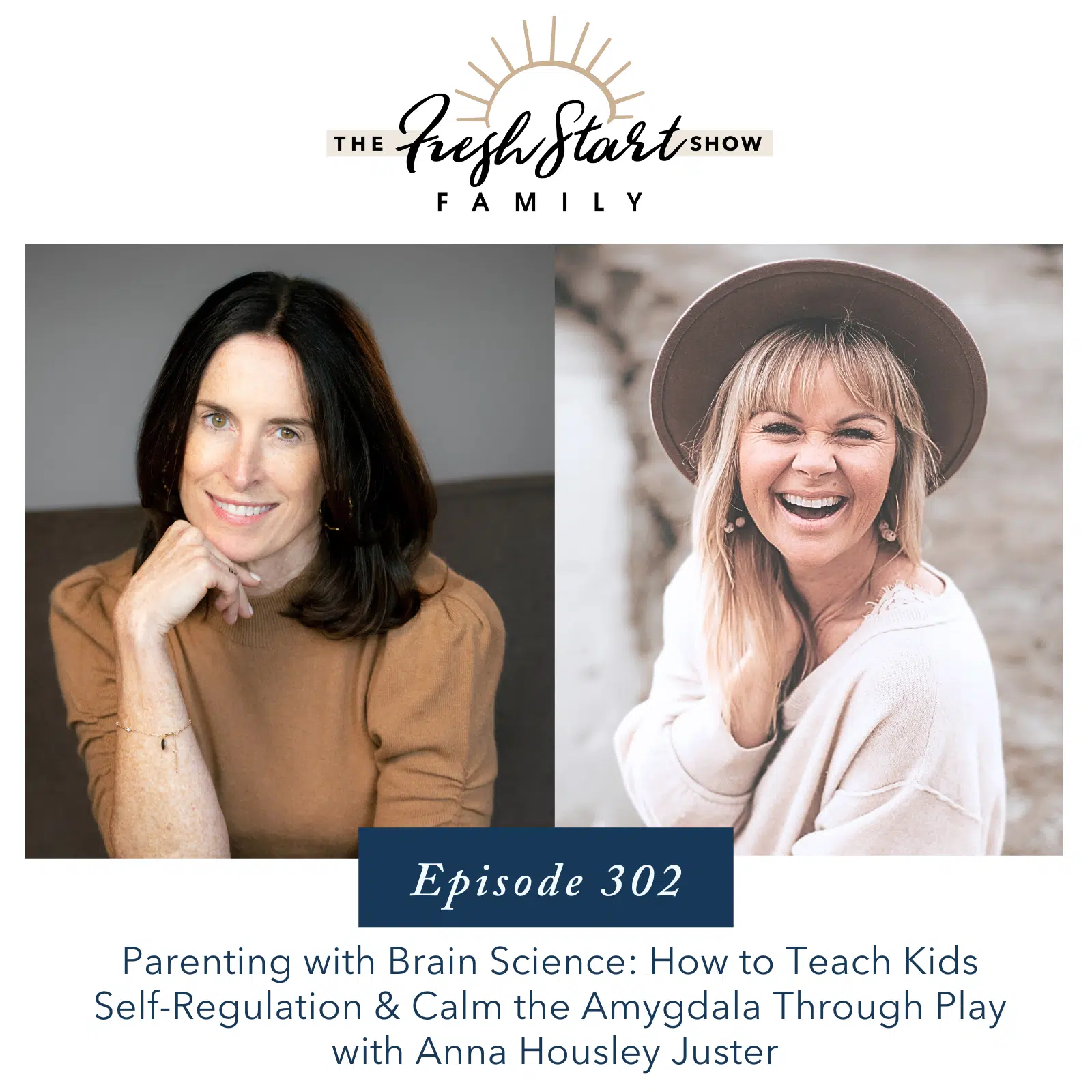
In this heart-centered and science-backed episode, Wendy sits down with educator, content creator, and former Sesame Street director Anna Housley Juster, Ph.D., LICSW to explore how play, brain science, and emotional literacy help kids build true self-regulation.
Anna explains how the amygdala works, why threat responses show up so fast, and how connection, storytelling, and simple co-regulation tools can help both kids (and parents) feel safe and calm during big emotional moments.
🧠 What You’ll Learn:
- How to spot real vs perceived threats in kids’ behavior
- Why emotional literacy is key to nervous system regulation
- Playful, brain-aware tools that soothe big feelings
- How to model co-regulation without being perfect
This is a grounded, hopeful conversation filled with practical strategies to build emotional safety, resilience, and lifelong mental health—starting right where you are.
Want to learn how to escape a punishment mindset?
This free bundle comes with an extensive learning guide & workshop with me, where I’ll teach you ways to build a strong, compassionate, FIRM & effective discipline toolkit that works with kids of ALL ages!
Inside this FREE learning bundle, I’ll teach you:
- Methods to build intrinsic self-control muscles
- Strategies that unite you
- The importance of self-calming
- Natural Consequences
- Logical Consequences
- Creative Problem Solving Methods
Grab your free bundle & start learning today!
Episode Highlights:
- “Name it to tame it” helps kids (and adults) calm their brains through self-awareness.
- Play signals safety to the brain—it’s biologically incompatible with feeling threatened.
- Co-regulation means calming with your child—not demanding calm from them.
- You can rewire emotional reactions at any age—it’s never too late to teach your brain a new story.
- Asking “What am I afraid of?” is more powerful than “Why am I angry?”
- Fight, flight, and freeze are survival strategies—not signs of bad behavior.
- Your calm is the most effective discipline tool you have.
- Teaching kids to “feel hurt without hurting back” builds lifelong emotional strength.
Resources Mentioned:
- Grab a copy of How to Train Your Amygdala or Cómo entrenar tu amígdala (Spanish Edition)
- Find Anna on LinkedIn
- Anna’s Website
- Catch the full episode on YouTube!
Unable to listen, or prefer to read along? Here’s the transcript!
Wendy (00:03)
Hello and welcome to a new episode. am so happy to be here today with Ms. Anna Housley Juster, the author of the new book, How to Train Your Amygdala. Such a beautiful, important book. We’re so happy to have you on the show. Anna, welcome.
Anna (00:19)
Thanks so much, Wendy. I’m happy to be here.
Wendy (00:22)
Yes. So today we are going to be talking about a very, very important subject. And that is essentially how we can parent with brain science. So how to teach our kids self-regulation and calm the amygdala through play. And my goodness, your career and what you have done, Anna, is just so inspirational. Will you take a moment just to introduce yourself? Tell us about your work that you’re doing now and your story about how you got here and what you’ve
some of the things that you’ve done through the years to help families and children. ⁓ We’d love to hear.
Anna (00:54)
Sure. I started my career as a Head Start teacher, so I’m coming from a background in education. But since I was a very young child, I had wanted to work at Sesame Street. And so I went to grad school in New York and ended up interning, then freelancing, and then getting a full-time job there. I was there for years as the director of content for the show and then across the Sesame Street brand.
Wendy (01:16)
So cool.
Anna (01:17)
Yeah, my gosh, it’s a great place to work and people are fantastic and it continues on for decades and decades more to just do amazing work globally around the world. ⁓ Yeah, and then I was, while I was at Sesame, I was working on my PhD in education at NYU and I was studying time use for three year olds by talking with moms and I was getting really interested in.
the early phases of sort of what we now see as sort of a decline in play and access to time to just play. Don’t love that because it makes it sound insignificant. It is highly significant. ⁓ And then when I moved up to Boston, I used to live in New York, now near Boston, I worked at Boston Children’s Museum, bringing in this merging of education and play and got really interested in the increase in anxiety in young kids and
was doing a lot of work in communities with various agencies supporting kids in different ways and taking play out into the world, right? To where kids are and started working with social workers who were working on children’s mental health. And I was like, wait, this is what I love too. So I got an MSW, I’m an LICSW and I work at this intersection now of mental health, education, play. ⁓
And I do a lot of parent guidance. And so this book, How to Train Your Amygdala, evolved out of sort of all of those ⁓ goals to reach kids where they are, help them learn early some really critical skills that could help with future needs holistically, mental health, physical health. Everything is obviously connected in the brain and the body. And ⁓ yeah, working with families. So that’s where the book evolved from. ⁓
I’m so happy that now I can sit down with a child in my office and read it because I used to just kind of tell the story out loud. Yeah. Yeah.
Wendy (03:14)
Yes, that is a big deal. Yes, and
we should give props to the illustrator, Miss Cynthia Cliff. Wow. Yeah.
Anna (03:20)
Yes, Cynthia Cliff. Fantastic. She did such a
good job. And I was so happy with, you know, you write a book and that you don’t ever get to talk to the illustrator during the process. The art team talks to the illustrator and I talk to the editor. then, but after it came out into the world, we got to connect. And that was really special for me. Yeah.
Wendy (03:33)
Mmm.
⁓ that’s so cool. Yeah, because we, I mean, your work has been so good at showing us this, just the power of play and art to teach children, right? Like you can talk all day long and try to teach kids lessons, but until you bring in art and play and of course modeling, modeling is like something we talk so much here about at Fresh Start Family, but it really is a big deal.
Anna (03:52)
Yes.
Wendy (04:07)
And so I love this, Anna. Thank you for your work and your dedication to helping ⁓ humanity in this way as we push record on this episode. are on the day after another mass tragedy and shooting ⁓ in our American school systems. We know that we are the only.
country who has this crazy problem and everyone’s just scratching their head and processing anger and rage and sadness and scared and all the things and to have and be sitting here with someone who is really in the trenches doing the work day in and day out to teach our children emotional literacy and prevent mental health tragedies ⁓ and reduce anxiety and our children who then grow up to become adults who ⁓
are either able to use their voice and advocate for healthy change in our world or not. Right? In your book, you talk about this little amygdala character ⁓ who’s really good at a few things. One of them is shutting down, freezing, right? Another one of them is fighting. And it’s just all so, important. And so thank you. And I think what I love about this type ⁓ of work is parents will read this to their children, and they will
teach them and educate them about brain science and the way their body perfectly is designed to work. And while they do that, they will also learn because most of us were not taught this growing up, right? We were taught that ⁓ the good emotion is happy and the negative emotions of mad, sad, scared and hurt are just like, whatever, make them go away. We all know that like most of us, it’s like, if you were hurt, was like,
Anna (05:37)
Yeah.
Right.
Wendy (05:57)
please don’t make such a big deal out of it. You’re fine. Like you’re not even bleeding. And scared was like, don’t be scared. It’s like not even dark in here or it’s fine. I’ll be back in an hour. And of course, sad was like anything but like, my gosh, here’s a cookie. Just stop crying, right? Like we just weren’t taught that emotions are actually part of the beautiful human design. ⁓ And out of an emotion like anger is where justice is born.
Anna (06:16)
Right.
Wendy (06:27)
That is where I’m praying so many people this morning are able to use that feeling of anger and rage and the inability to watch hypocrisy any longer and actually move that into action. But I know this character in this book really, this character has to learn about fear, scared, and also anger is talked about. So just thank you. It’s so, good. So let’s get into our breakdown.
Anna (06:27)
here.
⁓
that means so much to me. really thank you. You know, I mean, you know this too. You do the work you do all day long and kind of go through the steps and you have a certain story that you’re telling yourself in your head about maybe how you’re not good enough and not doing enough. So I really appreciate the moment of just sitting and like that some work can make a difference and that like life can feel especially hopeless, especially when there’s overwhelm.
to the brain. mean, part of what happens when we get all the information we get all the time about legitimately horrifying, scary things that are happening in the world is that we are living in a constant state of threat response. Our amygdalae are all kind of, for various reasons, extra ready ⁓ to fight, freeze, or run away, including in myself, right? So it’s just, it’s really helpful to hear you say that because it’s a reminder that there are ways that we can take an action that might seem small, but
also can go a long way to help people. And I don’t believe in teaching everything early. I think sometimes we push kids too fast, too soon, and that actually contributes to anxiety and depression. But I also think that some things we could teach ourselves. There’s never a late time, even if we didn’t learn it when we were young. You could be 85 years old today on this day. Today is Wednesday. I don’t know when this will go out, but Thursday. Today’s Thursday. You could hear it today.
Wendy (07:53)
Yeah.
Yeah.
Today’s Thursday, yes.
Anna (08:20)
And it could be the first time in your life that you’ve ever thought to yourself, there’s some understanding, there is actual science about what’s happening in my brain when I feel like my muscles tighten and my heart rate beat and I don’t know why I’m so angry and I’m yelling at someone. And understand a little bit of the neuroscience and learn to change the wiring in the brain no matter what age you are. So there’s always time, always. And I feel like this is one of those things that in my opinion,
Wendy (08:45)
Yes.
Anna (08:50)
we could benefit as a world from teaching as early as possible and ⁓ in playful ways, not in ways that feel didactic or like another thing a child is being forced to sit down and learn, but just in the way of being in the world, yeah, 100%.
Wendy (09:00)
Yeah.
Yes, exactly.
Yeah, we do so many different things here, but one of the things that we really teach is ⁓ how to redirect revenge misbehavior. And revenge misbehavior in our world is really when a child misbehaves in a way that…
They just haven’t learned how to process the emotion of hurt fully in a healthy way yet. And so they have a tendency to hurt back often because that’s what’s been modeled to them. And so the parent comes along and learns how to do things different in a world and a society where revenge misbehavior and eye for an eye mentality is so normally like culturally normalized. And instead they learn by teaching a child how to feel hurt and not hurt back in themselves, how to feel hurt and not hurt back. ⁓
Anna (09:45)
Mm-hmm.
Wendy (09:53)
and just the concept of like the perceived threats versus what’s a real threat. ⁓ It’s just so important. And so I just think to myself, the kids who are learning this from a very young age, the emotional literacy and the like the actual how to move emotions, how to work with your all the different parts of your brain, see it for what it’s worth. They just understand what they’re going to understand what’s happening when there are teenagers and young adults and adults. And the sooner we can help them understand that, right? Like
Anna (09:59)
you.
Wendy (10:23)
the more likely they’ll be able to operate in a healthy way as an adult. ⁓ So I love it. Let’s get into it, Anna. Our number one point, if we want to parent with brain science and teach our kids self-regulation and how to calm the amygdala through play, the first thing we want to do is teach our kids to name it, to tame it. Teaching about the amygdala. Riff about that for a minute, please.
Anna (10:46)
Mm-hmm.
Yeah, well, first of all, it is a fun word to say, right? Like, I mean, coming from a background at Sesame Street where there’s so much literacy and like thinking about like, how do, why would a child care? You have to have a hook. You have to have something interesting. And I think saying the word is kind of fun. And at first it seems like some parents are like, I don’t think I can say that word. And no, you can. And it’s broken down on the page in the book where the amygdala says, I know it’s a funny word. I have a, I have a unique name, but I love it. And I’ll teach you, you know, how to say it. ⁓
Wendy (10:53)
Yeah, it is.
Anna (11:20)
So it’s a fun word.
Wendy (11:21)
And if you’re watching on YouTube, listeners, I am showing pictures of Anna’s book.
So just keep that in mind in case you want to hop over to YouTube for this episode. But yeah, go ahead. Fun word.
Anna (11:30)
Yes.
The other cool thing is I have right here in front of me the bilingual. I’m so excited that the Spanish English version came out awesome. Came out a couple weeks ago and the word is the same, right? So you can like, obviously the book is in English and Spanish throughout the whole story. But in this way, we have this cool word that’s pronounced the same in this language, amygdala, amygdala. And it’s fun to say. So also it’s kind of a cool character because it is
Wendy (11:36)
I do too.
You sent it to me too, look at that!
cool.
Anna (12:00)
really overzealous. Like it has all kinds of desires to keep us safe, right? Like it is strong and ready, but it’s tiny and mighty. You know, it’s this very small part of the brain. But it’s kind of like an underdog because it’s trying and trying and trying. And sometimes it makes mistakes. And that’s what happens in the book where it mistakes, thinks something dangerous at the door. turns out to be a kitten delivering a large cheese pizza. ⁓
which was one of the most innocuous things I could think of, like the most kids would not be afraid of. ⁓ And so that there’s this kids look at the book and then like, ⁓ I feel for the amygdala. Like I also make mistakes, get angry at times when I don’t have to or really anxious. And ⁓ the amygdala says, will you work on this together? Can we be a team? And so what I mean by name it to tame it,
Wendy (12:33)
It’s brilliant.
Anna (12:59)
is, and I love that phrase, is this happens to everyone, like normalizing it, name a detainment. Like there’s an amygdala in my brain, there’s one in my mom’s brain too, and there’s one in my friend’s brain and my teacher has one in her brain too. And all of us could have the capacity to go quickly into a mistake, fight, fight, freeze response. And we have some control. Because I think the one
The that we tend as humans to think about our emotions is that we, they just happen to us. But if you attach a little bit of brain science to these emotions, you can learn that actually there is some control that I have. And you talk about this all the time. I know in your work that we don’t have to tell the same story over and over again as parents. We don’t have to tell the same story about ourselves as teachers and kids don’t have to tell themselves the same story. can, if they can slow down long enough, you can actually rewire in that moment.
And every time you come back to it with a child, you’re rewiring away from direct threat response and into a more, ⁓ it doesn’t mean you don’t ever go into real threat response, but we need it. We need to know when we need to be, like you said, very threatened, very angry, very reactive, and very protective. ⁓ We need that. We tend to do it more than we need to, especially today. So I think…
Namotainment for me means naming the part, thinking about a little bit of neuroscience, being armed with that knowledge. And I want equity with that. I think everybody should have this knowledge. And then figuring out what we do with it. Yeah.
Wendy (14:38)
Yeah, so naming it, detaining it, like in our world is like, it’s creating that space between the stimulus and the response, right? Like classic Viktor Frankl work of, ⁓ okay, and in that space, signaling safety, like, okay. ⁓
Anna (14:46)
Yep. Yep.
Mm-hmm. Mm-hmm.
Wendy (14:54)
This makes sense. This is part of my body that’s taking good care of me. It’s working well. And now I get to analyze, do some nervous system response work, which we do, which we’re going to go into. You do in the book. You cover in the book. But really calling on that story and processing a little bit of, is this a perceived threat? Is this a real threat? Which is easier said than done. ⁓
Anna (14:55)
Mm-hmm.
Mm-hmm.
Wendy (15:20)
But I love that. And so the example in the book is like, hey, you are going towards the street and a safety guard is like, stop, stop, careful. And the body, because we work with our clients so much with how to understand and how to teach their children as early as possible is there’s a body response. And I really love the work of Dr. Anita Phillips because she’s taught a lot about how ⁓ the body actually comes first.
before the emotion. like the emotions is like what we label it as, but like the heart beats fast or the fist clenched with anger or the jaw or like our facial, like whatever. And so in the book, it’s like the little girl’s running and it’s like, your heartbeat might get really fast and it might really beat fast. ⁓ And so that’s like a real threat, right? And then. ⁓
Anna (15:45)
Okay.
Mm-hmm.
Wendy (16:11)
And then of course, I think about as adults. And I’m just in this season of life where I’m just applying everything in regards to our adult life too. Because I work with so many clients who were really conditioned with authoritarianism growing up. So authoritarian parenting, my way of the highway, lots of punishment. If you challenge authority, there is a price to pay. A lot of people who were raised in really ⁓ heartbreaking, high control religious circles. And as adults, that amygdala,
is like on overdrive with the threats. And so they almost are like, the fear when someone like, it’s just really such a journey for them to learn what is a perceived threat, what is an actual threat, and then you have this like cultural conditioning that comes in. ⁓ And so just yesterday, I had someone in my DM, she’s been a kindergarten teacher for 22 years.
Anna (16:43)
Yeah. Yep.
Wendy (17:08)
And there’s parents advocating like, hey, we need more social emotional education. They have the data behind like ⁓ how to teach your kids this type of stuff. Here’s the brain science. Here’s the social emotional stuff. And they just have so many people who say no, no, no, because there is a perceived threat that emotional literacy education is like this, I guess, woke.
Anna (17:26)
Yeah.
Wendy (17:32)
And it’s just heartbreaking, right? But like, that’s a great example of it’s a perceived threat. There is no data. The data actually shows us that the more we educate our children on their nervous systems, on their brain, how it works, on their emotions, all the things like the safer our societies are, the more peaceful, the less violent. So I just think of all the parents who are, again, learning to name it, to tame it, while also teaching their children to name it, to tame it. And so…
Anna (17:38)
No.
Thank you.
Wendy (17:58)
Just
another way that we’re just doing this together, which is why kids are like the most beautiful. I just think like kids are angels. like, the most triggering moments are often when you’re like, oh, I’m just learning this lesson with you. Because my amygdala is flared up right now. So yeah. Okay.
Anna (18:12)
Yup.
Yeah, kids will go
home and tell their parents, like, I can tell that my amygdala was really feeling threatened today because my heart was racing. Or I can tell that my amygdala was doing jumping jacks or like running in circles. Like they’re visualizing. The funny thing about the brain is like, you can look at your hands, you know, can look down at where your heart, you can’t see it, but you can feel it beating. We don’t really have a way to connect with the brain for kids that are really visual.
And so I will sometimes actually ask them to imagine, like you see this in the book, picture in your brain that this is a character and the character says in the book, this is what I look like in this book. But there’s also a diagram of the brain to show how small the amygdala is and where it is. Picture it in your brain so that you could actually visualize it getting escalated. Like go inwards, picture it and actually imagine that you yourself
this whole part of you could give it a hug. Like, and tell it, I got this, you know? I know you wanna protect me right now and you’re doing such a good job, but we are actually okay. And I am gonna use some strategies with you to calm down. So I don’t yell at my child or my child doesn’t hit a sibling or another kid because they tuned in first and actually looked inside. And cause you can’t see it, so.
I like the idea of to tame it, you bond with it and you become friends with it and you see it and you almost imagine that you could have this little moment of giving it a hug to let it know that it’s gonna be okay. Even if scary, really scary things have happened to you in the past, in this moment, I got you, this is gonna be okay. Like we’re here together to name it, tame it, yeah.
Wendy (20:07)
And that is really helpful, that visualization again, not just for kids, but for parents. I can see that helping parents really. ⁓
just put that pause in before the reactivity comes in. And I just love the idea of hugging it and really just thanking it for the red flag too. Because again, being in a day where it’s like, okay, sometimes it’s gonna be important to yell. And right now, it’s great. Let’s yell very loudly. Like when our kids are running across the street or about to touch the hot stove, it’s like, yes, the amygdala. It’s like the hug and it’s like, okay, I got this and I’m gonna take action.
Anna (20:26)
Mm-hmm.
Great.
Wendy (20:46)
that comes across as like really big, you know? So it’s just such a nuance, like it’s not always just like relax, chill out, you know? Like we got the, it’s more like, okay, we’re together. We’re gonna assess this in a empowered, truth-filled lens. And then we’re gonna take action after we like just give it a moment to that like connection point. We teach so much about.
Anna (20:49)
Mm-hmm.
Mm-hmm.
Yeah.
Wendy (21:10)
Like our strategies are connection-based, firm and kind tools. And so it’s like, love this concept of connecting with the amygdala and then moving towards action, whatever you’re going to do.
Anna (21:14)
Mm-hmm.
Yeah, like what are we gonna do together? Like with choice. What am I? I and my amygdala together are gonna make a choice. Of course we’re working with the rest of the brain and the whole body, ⁓ because it’s all about the choice. And if you slow down long enough, you have choice and control. But what makes us really anxious as humans is being out of control. And so it’s, and we can’t be in control of everything and sitting with uncertainty is also something that humans don’t generally love. So.
Wendy (21:24)
Yes.
Anna (21:52)
to do because it feels threatening. And then it triggers that whole system response we just talked about. when you slow down, just even for a moment, picture the inside of your brain, decide to align with control. You’re basically getting control that can help you be less threatened, which will help you be less reactive. And to your point, then the child sees someone who is calm and connected and more likely to be predictable. And then the child is also problem solving with the parent.
versus the parents seeing a lion like threat and just going straight on autopilot to that state in the body. And once you’re there, as you know, it’s really hard to get back. It’s harder once you’re already at your 10, if 10 is your anger peak to get down. If you notice your amygdala doing little jumping jacks at four or five on your scale, it’s a lot easier to then never get to 10.
Wendy (22:47)
Yeah, and maybe just touch on those three ways that the amygdala takes us in. ⁓ a lot of parents do know this, but just in case they don’t, touch on that for us,
Anna (22:53)
Yes.
Yeah, so once the brain is really in threat response mode, it’s trying to survive. And the ways that we know, innately, how to survive are to fight, to freeze, or to run away. Often the freeze is when you’re making the decision, am I fighting back or am I running away? Sometimes, you know, we know the kids that get stuck in freeze are the adults where it’s just complete paralysis. Like they can’t move, they’re so scared, they’re hiding under a desk at school and really like going in like a turtle I talk about.
Those three states are the only options that we have once we are really in threat response mode. And all we’re trying to do is win. We don’t hear what someone’s saying anymore. We are just trying to prove that we’re worthy of survival, essentially. And it’s a really hard place to be, especially if you really love the person you’re talking to and you want to talk to your child, but you’re so much in threat response mode that you can’t.
So if you tune into your body in the moment and you think there’s this amygdala in my brain, what is it telling me to do? Am I feeling like I just want to rage and scream back? That would be fight. Am I feeling, which would mean like my child now looks like a lion to me and I have to defend myself against my child, even though the only thing that they’re doing is trying to get 20 more minutes on their iPad. The brain says.
Wendy (24:19)
Yeah, because the lion is
the fear that they’re going to grow up to be an entitled brat who thinks they can step all over anybody and it’s going to be your fault and you’re going to be a total failure as a parent. That’s the lion.
Anna (24:25)
Yeah.
Right. Everything tracks
back. Exactly. Exactly. And that all happens. The reason this is hard to stop, obviously you know, is because that all happens instantaneously. Because if we were in the wild and a lion came around a corner, you’re not going to be like, let me just slow down for a moment. How do I feel about this lion? what, am I hungry? Maybe I should eat something first before I decide what to do.
Wendy (24:51)
Bye.
Anna (24:59)
It’s the instantaneous reaction. So there’s no time unless we become aware of it and slow it down. So what I like to do is say like, when you were yelling at your child, you thought your child was a lion. What was the actual threat? And it’s exactly right. Most of it tracks back to I’m not good enough. you, the inside of the onion under all the layers is like, exactly. If my child’s on an iPad all day long, their brain is getting destroyed.
Wendy (25:01)
Yeah.
Anna (25:28)
Therefore, I’m not a good parent and I’ve known my whole life that I wasn’t good enough. So this just intensifies that understanding that feels very threatening. I’m going to prove that’s wrong. And all of that comes out at the six year old ⁓ who’s not a lion, but it’s in fact just trying to get through another episode of blah, blah, blah, blah, blah. And that’s what happens. And then you say a bunch of stuff that you wish you didn’t say because you’re fighting or you’re like, I’m done. I can’t do this anymore. This is not for me.
I’m walking away. Like, run. Wait, wait, I don’t care.
Wendy (26:00)
Whatever, play all the iPads you want. I don’t care. I’ve tried everything. If you want to grow up to be an
addicted, fine. Like I’m done, you know? Like yeah. And I even think of… Yes.
Anna (26:11)
That’s the flight. That’s the runaway. But the fight, flight,
freeze. Like you wouldn’t notice in the, that is flight. And when kids say, I just want to die. Like if they’re escalated and it’s in the moment, that’s the biggest avoidance statement there is. Like you just want to get away from the whole of everything because it’s too painful to stay with it. That’s the flight. That’s fleeing from the feeling of being totally threatened and not able to.
manage with or cope with what’s happening in the moment. Yeah.
Wendy (26:44)
And then the freeze, feel like, a lot of just, ⁓ like the way I see it in parents, which again, everything I teach is like, we work on modeling, like first and foremost. So a lot of stuff, like if a parent is able to change, the child then doesn’t inherit the same patterns. But like that freeze, I see a lot of just like silence and submission, or like. ⁓
Anna (26:59)
Mm-hmm. All right.
Wendy (27:09)
permissiveness of course, but like that can come out in the flight, but like the phrase is just like, you just don’t know what to say. And so you just let people talk to you, or you let, like it’s definitely the permissiveness thing.
Anna (27:20)
Mm-hmm.
Mm-hmm.
Wendy (27:23)
So it’s
interesting. what’s so interesting, Anna, to add complexity to this educational process for both parents and children to learn about the amygdala is really understanding where is the true threat. And so I’m always trying to help my students see as they’re analyzing, there’s all these different beliefs and thoughts and blah, blah. One parent thinks it’s no big deal to have tech. I have a client right now. It’s just like, she’s like, why won’t my husband understand? And then other people
Anna (27:49)
Mm-hmm.
Wendy (27:53)
are
like, no, it’s a big deal. So it’s all these opinions. And it’s like, how do you understand what’s a real threat and what’s not? Well, you look at data. You look at research. You look at the science. You look at someone like Jonathan Haidt’s work, who has done the work to give us the data. ⁓ And so the real, like the amygdala in that moment when we talked about the iPad or.
Anna (28:02)
Mm-hmm.
Wendy (28:16)
kid begging for social media, let’s say at age 10, there is a real threat. Like the real threat of increased anxiety, depression, suicide. Like my daughter’s high school last year, we lost three kids to suicide in six months. Like this is, these are real. These are real threats. So it’s like, I’m constantly trying to help my community honor the amygdala, honor it.
Anna (28:23)
huh.
⁓ no, I’m so sorry. Yeah.
Wendy (28:44)
Right? Like it’s not always like shut it down. It’s like no, like that really is the lion. Right? So it’s like the lion is not like you’re gonna grow up to be an entitled brat and blah, blah, blah. It’s like no, the lion really is like when you are not able to set firm boundaries around technology and your child has massive ⁓ in… ⁓
Anna (28:51)
Yes.
Wendy (29:04)
nature deficits and the increased social isolation and comparison and the addiction to the dope and like all the things like there really is a very strong chance they’re going to be more likely to have those anxiety, depressive, suicidal issues or eating disorders or whatever it may be. So I just think that’s interesting part of the conversation, right? Because you have to learn that sometimes, yeah, stop everything and listen to the fear.
listen to the amygdala.
Anna (29:36)
Yeah, and the really important thing to note there is, as you know, the most protective factor we have in all the cases you just said with depression and suicidality is relationships. So I always, with the parents I work with, I always talk about preserving the relationship. So in that moment, what is more important? I’ve discovered this summer that I will always lose to Netflix, the show Wednesday. Like, it’s so good.
Wendy (30:03)
that show.
Anna (30:05)
And I like it, and if I’m going up against my 16 year old, so if it’s me or Netflix, I’m never gonna win. In that moment, I’m never gonna win. It’s not the battle you wanna have, really. What you wanna do is preserve the relationship in the moment, acknowledge that this is a really good show and it’s summer and like, everyone’s doing their best.
at it after at some point when the show is not on and you’re not trying to win against Wednesday.
put out some cards and play a card game. Like, there’s a few card games that are my go-to games with the kids I work with in my office and that I love to play at home. Then you’re connecting and you’re not trying to win. You’re not in threat response mode because you’re not trying to beat Wednesday. You’re just there for the sake of the connection. That calms the amygdala in both people because play in that serve and return and going back and forth is
is wired in the brain also. We’re wired biologically for play, just like we’re wired biologically to understand threat. And it’s calming. It’s both protective and therapeutic. So I recommend to parents to just choose your moment well, and then come to that time with your child in a way that feels where you feel like you’re in control and you know what you want to do and you’re not trying to go to battle with Netflix because Wednesday doesn’t care.
because that was recorded a long time ago and she’s not actually in the room. The person in the room is your child and all that anger that you feel and the line you’re trying to protect yourself from gets displaced onto the person that’s in front of you but that person needs relationships more than anything in the world so that’s my little spiel about choosing your time.
Wendy (31:58)
Yes.
I love that, Anna. We would call that like
teaching a calm time, right? Like teaching a calm time and also again, know the data, know the research, right? It’s like I always tell my students, this is the way I’ve rolled is like my kids actually have like a TV where they’re allowed to watch actual TV in their rooms. Never tech, never technology. Like the interactive devices, the social, like again, the data is showing us that the interactive video games, the violent video games, the social media, like these, these are the real lions, the tigers.
Anna (32:18)
huh.
Wendy (32:31)
⁓ The TV shows, these days it’s tough because they just roll right into another one, but still long form content, right? Long form content, ⁓ especially a show like Wednesday that’s pretty darn innocent, ⁓ is really not the lion, right? But I love that concept, teaching in a calm time. And let’s move into that second one, play to regulate, use fun tools for real calm as a way to use brain science when we parent to teach kids
Anna (32:32)
here.
Not for me.
Mm-hmm.
Wendy (33:01)
self-regulation and calm the amygdala. I’m so excited to hear about your work with like play therapy. You mentioned cards. Like I’ve been dying to have a play therapist on the show. We haven’t found anybody that specializes in that, but it sounds like you do a lot of that in your practice. Like what ages are you working with? Tell us more.
Anna (33:19)
So traditional play therapy is more for younger kids. And I see kids between the ages of four and 16. So I have a really wide range. But for me, so we could talk about play therapy for a long time. There are so many good strategies you use. And essentially, it’s about watching kids in their own self-directed play to look for themes and think about what’s coming up for them that they can’t necessarily communicate in words, but it comes out in their actions as they play. And that’s something that a parent can do.
anytime. You don’t need to study play therapy to like, you know, watch your kids at play and understand what they’re interested in. Also, maybe they’re playing through some feelings that they haven’t been able to name, especially if they’re younger. But the thing about play for me is that we don’t grow out of our need to play. It’s neurologically wired at birth and we don’t grow out of the need, but we grow out of the ability and we lose touch with who we would be if we were being playful.
So when I have even kids as old as 15 and 16 in my practice, we are using tools like this, like these squishies that you are playing with, meaning just manipulating in the world. like also like what’s in the book, we would do some strategies with tightening and releasing on purpose to control that threat response in our bodies. So I have a lot of materials to touch, Play-Doh, pipe cleaners, crayons, like all kinds of stuff for expressive.
play work, even with kids that are teenagers. And they love it, right? And I’ve always kept that stuff out in my house too. But you can also play with ideas, right? This is just an approach to being playful in general. if kids are making up a story in their head about who they are, I’ll be like, great, let’s play that through. Like, let’s talk about it. Like, who would that character be if that’s who you think you are now? And then what are you working towards? So it’s like coming at…
Wendy (34:54)
Nice.
Anna (35:18)
even cognitive behavioral therapy, which I do a lot of work with kids in my practice. It’s about coming at all of these evidence-based practices, but in a playful way. a lot of that can be, pieces of that can be picked up and brought into the home or the school. And I do a lot of teacher trainings to try to help bring that into the classroom as well. Yeah. Yeah.
Wendy (35:37)
Thank you. That is amazing.
That is amazing to train the teachers. Beautiful. ⁓ Yeah, we love to bring in play through. we teach.
how to build a compassionate discipline toolkit, it replaces traditional punishment, right? So instead of like, you keep smacking your sister. Instead of you get a time out and you get grounded and you get your iPhone taken away or your iPad, it’s like we come back the next day and we teach. And one of the ways that we love to teach that is so insanely effective is role plays and re-dos. And you can do that obviously by acting. You can do that with toys. ⁓ But I’ll never forget we had, it was years ago, probably four years ago now,
Anna (35:53)
Yep. Yep.
Right.
Mm-hmm.
Wendy (36:20)
of our students.
Somewhere I forget where her little girl girl Harper. I think her name was Janine and she she sent in a video into our group. We call it hashtag success. And she’s like, guys, look at this. I’ve been with Harper doing some role plays and redos where we bring in toys and matchbox cars for, whatever ⁓ bath toys sometimes. And she said, I walked in this morning and Harper, this little three year old child was on the ground and we teach something called a win win, like peaceful conflict resolution here.
Anna (36:51)
Huh?
Wendy (36:52)
and
Anna (36:52)
Mm-hmm.
Wendy (36:53)
her mom had printed out our template and ⁓ she just walked in and Harper was sitting there on the living room floor with like her bath toys, it looks like her little toys that were like hippos and lions and she was like, Harper, what are you doing? And she was like, I’m just doing a win-win because…
Lions stepped on hippo’s toes and he is not okay with that. And it’s like literally barely able to talk three year old and she’s sitting there and her mom just kind of like filmed from the side and she was like, hey.
I feel mad when you hurt me and I want you respect my space and how are going to make this work? And I’m like, ⁓ it’s like one of my favorite videos of all time. That’s a three year old that has learned at that tender age how to feel hurt and not hurt back. Right? Like that’s what I’m talking about when it comes to like using play to engage a child to understand how to process an emotion, how to work with your amygdala.
Anna (37:35)
Fantastic.
Mm-hmm. Mm-hmm. Mm-hmm.
Yeah.
Wendy (37:55)
and not hurt back.
Anna (37:55)
Yep.
Wendy (37:57)
Which is literally like we are not living in a society where this is normalized and prioritized. ⁓ And so you end up with people who do really make really big mistakes and hurt people because they were never taught as a child. Or maybe they were lectured at or punished. Like you don’t treat people like this. If you touch your sister again, you know, and it’s like, it doesn’t work. What works is play. And so I just, I need to reach out to that mom and say,
Anna (37:58)
Right?
Mm-hmm.
Mm-hmm. Yeah.
Wendy (38:27)
because Harper must be like six or seven now and I want to say how is she doing? Has she applied this coaching and teaching? I bet you she’s doing real well in life because that was a beautiful lesson through play to learn that early.
Anna (38:30)
I love it.
Yeah, it sounds like, so what’s really nice there is there are a lot of factors that had to lead to that being happening in the first place. So I like to talk about like affordances for play, right? Like there was the permission. So the girl was by herself with her toys and led not in an organized activity every single day all day long, like had the downtime to be able to do that. Had the materials. It doesn’t have to be much.
Wendy (39:02)
⁓ yeah.
Anna (39:07)
Kids will pick up, as you know, like rocks and pinecones and like make them into people, et cetera. But there’s the affordances of the materials, the permission to be doing that. And then the interest gets layered on because that’s insight. The parent can come in and see that that’s something that she’s playing through and is excited about and happens to be something that’s super useful SEL tool and is doing it. that doesn’t always happen because a lot of times everyone’s rushing around.
A lot of people are looking at their screens, the kid, the parent, everybody might be. So you lose the even capacity for that to happen, even though the innate ability is present. So 100%. I like to say, think about what you can say yes to, because we know that through play kids develop agency and some regulation skills just by playing. And if they’re constantly being told no,
Don’t climb up that thing. Like schools, this happens a lot. Nope, you can’t do that. No, you can’t do that either. No, you can’t take that in your hand and climb up at the same time. And so the child is in tears by the end because they’ve just been told no to just about everything that they were trying to do and the relationship has been damaged. And it could go so many different ways other than that. Yeah.
Wendy (40:22)
Yeah, that’s one of the reasons why I feel like… ⁓
the nature don’t pack much, right? Like we live here at the beach in San Diego, California, and that really was some of the most magical times to see my kids at the beach where they didn’t have much and they just made and created these worlds with like rocks and sand crabs. And my little girl who is our strong willed little girl, and we found this work when she was three, she’s now almost 18 years old.
⁓ Has just like is the reason why I’m a teacher and taught us so much, right? But like we spent a lot of our life helping her understand what to do with our big Dillon like she just was a Feisty still is a feisty one. It helped her now be able to play division one beach volleyball in college because her feistiness got her there Yeah, but ⁓ but it really was beautiful through the years to see how that like unstructured play there stuff comes out right, especially if you’re teaching consistently and
Anna (41:07)
Yes.
Nice.
Wendy (41:27)
We have a lot of clients who… ⁓
They’ll teach, teach, teach, it’s like, my gosh, is this kid even listening? And then one day they’ll see them roll it out in a friend disagreement. like, know, Stella used to make songs. Like she’d be at the beach and she’d just be like dancing in the ocean with her arms up and she’d be making these songs. And sometimes we would like hear like what we were teaching come out in these songs or poetry. Yeah. So, so I love that. So we often say that touch is the road to a child’s mind, but it’s
Anna (41:34)
Mm-hmm.
⁓ huh.
Fantastic. Yep.
Wendy (41:59)
So
is play, right? Like you really have a great chance of the learning digesting if you can bring in nature, ⁓ toys, play, redo, role play, and then the connection being at the centers, which is why I love to hear that you use card games, like in your actual practice to just.
Anna (42:01)
Definitely.
Yeah.
Wendy (42:20)
talk through stuff, because I think a lot of ⁓ kids, Anna, do you see the ones that you’re like, OK, sit still, look in my eyes. Now we’re going to talk about how to take a physiological sigh. It’s like, sit still, let’s talk. It’s like, no, but if they’re moving or if they’re in a rocking chair or throwing the football to you, if there’s some type of movement, sometimes they retain the lesson a little bit more. Would you agree?
Anna (42:45)
Yeah, I mean, I usually, I never expect a child to sit down and like look in my eyes and talk through something. The exception would be if I’m at a school and the child is already really dysregulated, sometimes like sitting just nearby and saying like, hey, can you look at my face for a moment? Because you’re essentially getting maybe them shifted slightly out of threat response mode because to do that, they have to orient to your face. ⁓ Cause when we’re in threat response mode, we go to tunnel vision like,
Wendy (43:11)
and your eyes, right? Like the windows to our soul.
Yeah.
Anna (43:15)
Yeah,
yeah, exactly. So just that connection. And then I try to be playful as an invitation. The best way to teach a child that you value their play is to be a little playful as an invitation in because yeah. And the other reason play is so therapeutic and so important for relationships is that it’s vulnerable. So like in the wild, animals don’t play when they’re in danger, right? And humans also don’t play when they are in threat response mode. So it’s both therapeutic and protective.
Because if you’re playing, you’re teaching the rest of your brain and body as you’re playing that you are not in danger. And an adult who is willing to play sends a message to the child, I don’t think I’m in danger. Or I wouldn’t be playing either. And I’m speaking your language and we’re engaged in this serve and return. This back and forth is really the most important part. Once it’s connected, once you’re playing, you’re serving an idea, the child is returning that back to you. You’re throwing a ball.
The child is throwing it back to you. You’re engaged in a mutually understood acceptance of like, this is what we’re doing right now. And it’s very different from, yeah, hold on. going to, I just, I just have to let me, I just have to get this message out and then I am going to talk to you. I am, I am going to see your play. I’m going to see you. We all do that at some point. You can come back to it and do like the,
The therapeutic healing part of that later is like, would like to sit down and just like know what you’re up to and play with you if you’re up for it. And if you’re doing something with your hands, every parent knows this intuitively, but I think we forget sometimes. If you’re doing something at the same time that you’re talking, mixing a bowl in the kitchen together or like looking at two separate books or playing around with any materials at all, it’s way more likely that you’re gonna be connected in play. And it’s less likely to the child or the teen that you’re coming across as like,
I’m in threat response mode and I’m gonna tell you why and you’re gonna listen to me now. Doing anything playful is helpful, yeah.
Wendy (45:09)
Yeah, which often, with a strong-willed kid,
invites the power struggle, because any time a strong-willed kid feels like you are trying to speak up them, they’re like, resist, resist. Well, OK. Yeah.
Anna (45:20)
Right, because they go into their own fight mode, right? And then you’re both,
once you’re both in your amygdala just doing this, it’s very unlikely that that’s just gonna resolve nicely, right? Yeah.
Wendy (45:31)
That, Anna, I had never heard anyone describe that play thing like that. It’s, thank you. That is so freaking helpful because we have a really big husky and a really big black lab and they are so funny. Sometimes they will just break into play and it’s ridiculous. Our house is like a zoo. There’s like 90 pound animals running, zooming through the house and they’ll run upstairs. They’ll jump on the bed and then they’ll come downstairs and then they’ll put the toy between each other and they’ll look at each other in the eyes and then they’ll freeze and then they’ll go.
Anna (45:52)
Yes.
Wendy (46:00)
and then they’ll run around and we just crack up at them. But you’re right, it is a sense of safety. my husband, who’s amazing, he’s like an angel, but one of his superpowers is comedy. he, like, there’ll be a stressful moment, because Stella and I are like spitting images of each other. both like these strong-willed, sassy little girls, sassy women. so. ⁓
Anna (46:20)
Okay.
Wendy (46:24)
she might say something and I get rubbed a little wrong because she’s just like me and we found that like there’s a million reasons for that. And then Terry is more sensitive to get rubbed by his mini me, which is our son, Taryn. It’s hilarious. But Stella will say something and I’ll start to get a little like probably in my amygdala and I’m like, and I’ll respond a little edgy. And then Terry will just pop in a joke.
Anna (46:35)
Mm-hmm. Mm-hmm.
Uh-huh.
Wendy (46:46)
and like
laugh it off and then all of a sudden the whole conversation is like safe again and it like redirects us back. And so I just think that’s so interesting because it’s like this way of signaling safety to the nervous system. I just never thought of it that way but it is very effective and I see him do it all the time and he’s really funny. Like all the time I’m like Terry, write that one down. Like you’re gonna do a show.
Anna (46:52)
Mm-hmm.
That’s a good one.
Wendy (47:14)
You’re gonna do a show at some point. I’m gonna make you, because he’s really got a gift. So, okay, our last, yeah.
Anna (47:19)
Well, if you think about it, like
quickly from a neuro psych, this is how I teach talk to parents and kids. If you were being chased by a lion, would you play? No. So what is the message? We talk about it’s neurofeedback, right? So if your body is playing, the message to your brain and to the amygdala is that like the same as when you take a deep breath, why that works.
If you’re breathing like that and not up in your chest, the message back to your brain and when you’re playing is, we can’t be in danger, little amygdala buddy, because if we were, we wouldn’t be doing this. So that’s why breathing works and that’s why play can work if you’re thinking about it from the perspective of slowing down the fight, flight, freeze response.
Wendy (48:06)
Now it’s making even more sense. One more thing to add to that is one of the, so we teach 10 ways to dissolve a power struggle with integrity. So when a kid, you’re like, hey, put on your shoes. And they’re like, no. And you’re like, dude, put on your shoes. And they’re like, no, you can’t make me. So we call that a power struggle. And the traditional way, obviously, is like overpower the kid, like force them, threats, blah, ⁓ And one of the 10 ways that we teach in our power struggle dissolving class is,
Anna (48:16)
⁓
Mm-hmm.
Right.
Wendy (48:36)
is to use a funny accent. Like it’s called do the unexpected. And so now I’m realizing the funny accent, like I have always been real, the only one I can do is the English accent. Can you do accents well?
Anna (48:39)
Uh-huh. Nice. Mm-hmm.
Nice.
I’m not very good at it. And my mom is British. And so while my whole family is there and I really want to be able to, I know both my kids can. No, I know my strengths and that’s unfortunately not one of them. Actually. Okay, nice. Okay.
Wendy (48:57)
It must be a certain part of the brain, but I can only do English. I can’t do Australian, I can’t do Mexican. It’s
like I can only do ⁓ English, but it’s funny because that must be a reason why it deescalates is because it’s bringing in safety. I just never put two and two together. So thank you for that.
Anna (49:13)
Mm-hmm.
Yeah, because
then you’re saying the message, I don’t think I’m in danger, so you’re not threatening to me. And if I don’t think you’re threatening to me, then maybe I’m not, maybe neither one of us are threatening. It does, it disarms for a moment and stops at pause. Do you ever listen to We Can Do Hard Things, the podcast with Glennon Doyle? ⁓ my gosh. They had.
Wendy (49:36)
No. I mean, I think I’ve
listened once, but no, I should listen more.
Anna (49:41)
I learned
something the other day listening in my car that I’m gonna take with me just for the rest of my life. It was so good. were talking about high conflict and healthy conflict and the difference between the two. And in high conflict, the reason I was mapping it onto my work is that essentially what they were talking about is being in fight, fight, freeze or being angry, but not in fight, fight, freeze. Because you can be angry and you can…
Wendy (50:06)
Perfect, yes, important.
Anna (50:08)
Right? Like that’s the difference. But they were using the language because they were talking to this ⁓ Amanda Ripley was the journalist that studies conflict and was fantastic. She gave me this advice. I’m going take it with me forever and give to my kids and families that I work with. You know how people always say like, don’t get a bit angry, like take space before you talk to your child and like take a break before you do that. She was like, it’s really not about the taking space or the time. It’s what you do in that time.
If you say, I’m going to take a break so that I don’t, so that can play better or like engage my child more. And then you go in the other room and you sit there for 30 minutes thinking about all the reasons that you’re right and all the ways you’re going to win. You don’t come back with your amygdala regulated and ready. So the real pause is do something else. Dis…
engage from that. So when your husband says something funny or you do a funny accent, you’re not just taking a pause. You’re doing like a fully different activity versus just I’m going to take three deep breaths, but the whole time taking my deep breath, I’m going to be thinking all about how I’m still going to fight this fight and I’m still going to win. And it totally changed. It really, really helped. I am so grateful for that conversation because ⁓ it really matters. The neuroscience of that matters. What we’re doing in the wiring.
Wendy (51:20)
Yeah, it’s true.
Anna (51:32)
makes just as much difference as the time that we might take, you know, trying to do something differently. Yeah. Yeah.
Wendy (51:38)
Yeah, that
is really helpful. Yeah, one of my other do the unexpected things was like I grew up a springboard diver, was a diving coach for a long time, and so I would do a handstand just up against the wall.
Anna (51:49)
⁓ nice!
Yes!
Wendy (51:50)
And again,
I feel like up until this point, I never really understood. Now I’m realizing that there is literally, it really is probably a nervous system regulation strategy. And that’s what we’ve been really focusing on our community for the last year or two since I’ve taken a deep dive as the leader here in the nervous system, understanding regulation, health, healing. ⁓ And that’s been really fun to net. Because we used to just teach, do the pause button, right? Find a healthy intention.
Anna (52:01)
100%. Yep.
Wendy (52:20)
your thoughts and now we’re realizing okay you really in order to find the faster success they’re bringing in the body is really important and so that’s really helpful. Our last point Anna is lead with co-regulation, be the calm coach your child needs. Riff on that for a minute as we wrap up this incredibly helpful episode.
Anna (52:29)
Yes.
Yeah, so our kids are always, as you know, watching what we’re doing. They watch our behaviors and they are listening to what we say. And I always try to help parents understand that you also have an amygdala. It is understandable why you go into threat response mode, but Ellie Leibowitz at Yale Child Study Center talks about like striking when the iron is cold. And I think that’s kind of what you just were saying about.
the interventions you do in your program. I just think that if you think there’s any chance you are in threat response mode when you tune in, look at your amygdala, do what we did before at the beginning. If you think you’re in threat response mode, preserve the relationship, do something different, feel yourself being regulated and come back to see if you can help the child do the same thing. And at that point, offer
the strategies that you maybe just used. Like, I felt just now, like, you were a lion, and I thought I was in danger, and I was about to get so angry, for no reason except that I love you. And now I wanna come back and talk about how that love turned into fear that turned into anger.
And then in the book, there’s a whole section at the back for parents about the actual strategies of the breathing and the progressive muscle relaxation and the visual imagery and the play and everything you can bring to it. But the fundamental first step is to know that you have this threat response in your brain and that if you think your child is being a lion, there’s something else going on. And figuring out what that is first, then come back to the conversation, model the skills and like heal and live and love together.
versus trying to just go to battle and survive.
Wendy (54:34)
Yeah, love, yeah, that section where basically these two pages where you’re, here’s all the things you can do when you realize that your amygdala is in a spike. That’s like essentially what we teach is like our number one step in compassionate discipline is self-calming. Self-calming for kids, self-calming for parents, like parents have a calming kit, kids have a calming kit, and then moving into understanding why. But like that is, I’d say,
Anna (54:50)
Yeah.
Yep.
Wendy (55:04)
like the hardest step for a lot of our families because they just being raised in those authoritarian homes, especially when there’s like the religion indoctrination of fear layered on top in their first, it is like the co-regulation. Like their first step is they can, they can.
Anna (55:08)
Yes.
Mm-hmm.
Wendy (55:24)
go away, that is still hard for many of them. But then I’d say ⁓ being able to stay present, that’s like that second level, right? Which is really interesting to graduate to. And I love what you said, having no shame in going away if you need to and then coming back once you really have, come back to a place where you can handle the conflict in a way that you feel good about, which preserves the relationship, right? When you resist the relationship destroying statement or movement.
Anna (55:34)
Yeah.
Wendy (55:55)
Right? Like, I’m not gonna let you be an entitled brat name-calling shame. What’s wrong with you? Or slapping the wrist, grabbing the wrist too tight. So it really does preserve the relationship. any last thoughts there on like ⁓ that ability, like that graduating into staying present? And I guess that’s getting outside of the book, but you know what I mean.
Anna (55:55)
Yes.
I would suggest, totally
no, a quick flip would be instead of ask yourself, instead of saying, why am I angry? Ask, what am I afraid of?
Wendy (56:27)
Yes, I love that. I think, and to answer that real quick, Anna, I think honestly, a lot of our parents are scared that they are going to hurt their children if they stay there. So I think maybe it just takes time.
Anna (56:28)
Right? And then, yeah.
Yeah, Okay.
Yeah, well, if you’re saying like, am I, why not? Not what am I angry about, but what am I afraid of? And you’re afraid of yourself? Then give your amygdala a hug. Like look inside and say, buddy, you have been protecting yourself. Us, you and me, amygdala and I, for decades.
Wendy (56:55)
That’s true, yes, back to that.
Anna (57:07)
What are you protecting yourself from now? Like, what are you afraid of in this moment? Literally, I tell people look around the room because that’s actually regulating to the brain is to look around the room and not be in ⁓ tunnel vision at the problem. There is no line here. And the person who used to hurt me in my life is also not here. What am I afraid of? And then think, what could I do with my fear?
that isn’t an adaptive coping strategy, not a maladaptive coping strategy like drinking too much or using substances, etc. But what is an adaptive coping strategy scrolling? Yes, that I could do so that I preserve the relationship and come back being friends with my amygdala aligned and wanting that child to feel this and not wanting them to be afraid because I know that fear leads to anger in them too. So
Wendy (57:45)
scrolling, social media.
Anna (58:06)
Yeah, biggest quick hack is just like, not what am I angry about, but what am I afraid of, just to shift the what’s happening in the brain out of, well, a little bit further out of high fight, fight, freeze response and into a more verbal space before doing your next step, whatever that is. Yeah. So, it’s so good to talk to you. I’m so grateful for this time together. Yeah.
Wendy (58:08)
helpful.
So helpful. Anna, what a delight you are. Thank you for…
Me too,
me too. listeners, viewers, go get a copy of How to Train Your Amygdala. This is already out or is it soon to be out? Okay.
Anna (58:43)
yeah, that came out in 2024 and then the bilingual
Spanish English is out now also. Yeah. Yeah.
Wendy (58:48)
Amazing so go
get a copy. We’ll make sure that we link this and just tell everyone where they can come find you best places to ⁓ Order the books again. We’ll make sure we link but please tell everyone where they can come find you and as we wrap
Anna (59:03)
Thank you so much. The books are both on Amazon and a lot of places books are sold and in libraries. I love to support independent booksellers and also libraries. So ask at your local place and they probably can get it from the publisher. If you do go on Amazon and you like it and you want to leave a review, that’d be awesome because I never asked. It’s been out for a year and I never asked people. So I finally started getting over my own.
what that brings up for me from a threat response standpoint that I would ask. ⁓ And I’m saying, yeah, if you like it, please let me know. And I am at AnnaHousleyJester.com where you could connect with me through my website and reach out and email me and I would love to hear from you. Yeah.
Wendy (59:30)
Yeah.
Amazing.
If you request this to be like either put into your library or you’re reading it there, can you leave a review on Amazon if you didn’t buy it? Can you just or do you have to buy it? You have to buy it.
Anna (59:57)
I don’t think so. think you
have to be, I think there’s like verified purchase that it will say. So I’m actually not sure. You might be able to go on and leave a review even if you don’t get it there, but ⁓ it’s also being sold at Barnes and Noble and like tons of different booksellers are selling it. And some people have it like where you’re buying it and there’s a donation that’s made to ⁓ like, I know locally the Boston Globe had it.
Wendy (1:00:03)
Hmm. Okay.
Anna (1:00:22)
because I was interviewed by them and then you could click on that and get it that way and then certain amount of percentage was going back to the Boston Globe. So I’m always thinking about how to you know, help in as many ways as I can. So thank you so much. I really love this conversation. I’m grateful that you invited me. I’m so happy to have been able to chat with you.
Wendy (1:00:27)
Nice. Amazing.
Awesome.
Thanks, Anna.