

What if your reactivity isn’t a character flaw… but a program you can actually rewrite?
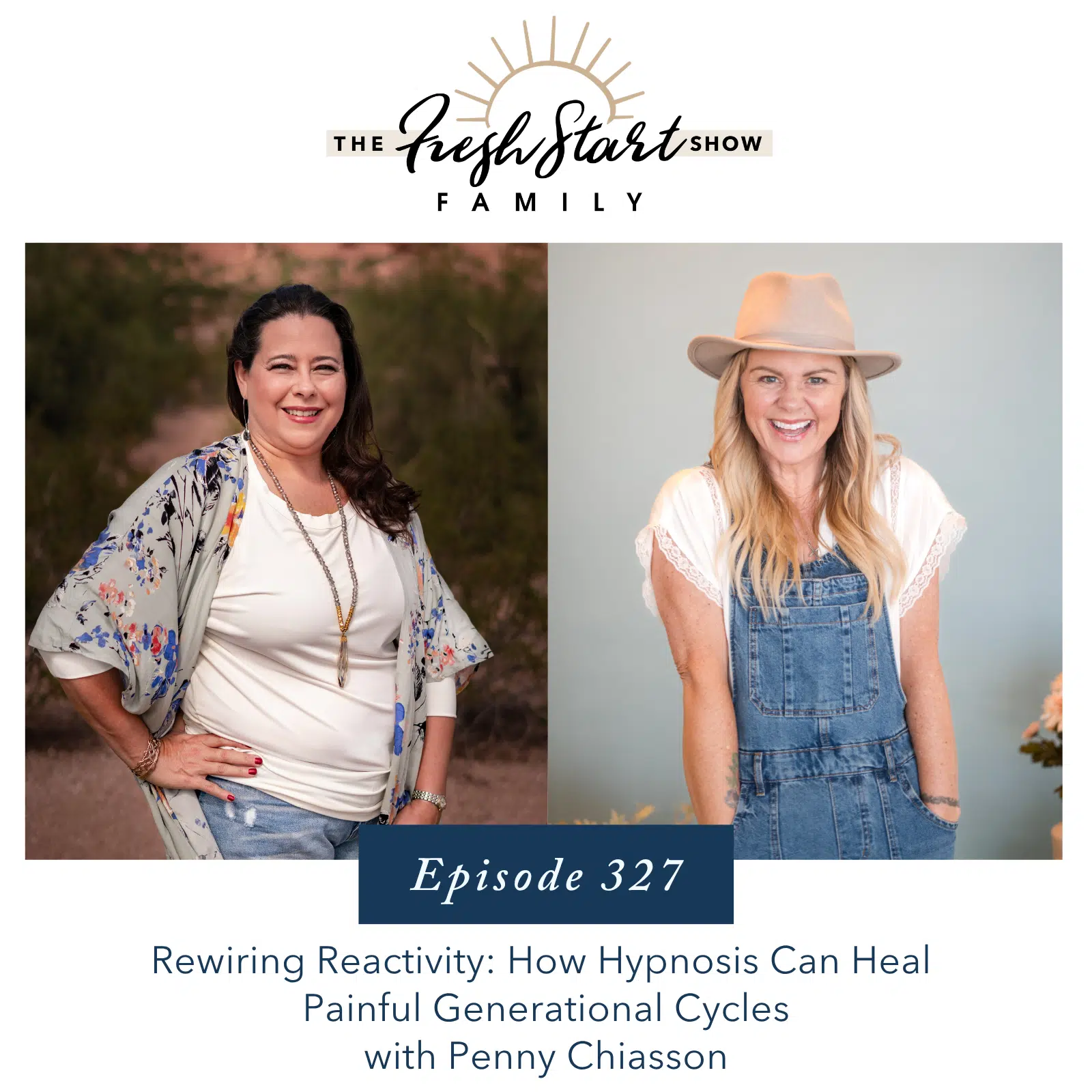
In this fascinating and deeply hopeful conversation, Wendy sits down with board-certified hypnotist Penny Chiasson to explore how hypnosis can help parents break painful generational cycles and finally respond the way they want to, not just react on autopilot.
Penny shares her powerful personal story, from a high-achieving medical career to a life-altering mental health crisis that ultimately led her to discover the profound healing potential of hypnosis. Together, she and Wendy unpack why so many parents feel “out of control” in triggering moments, and how those reactions are often rooted in subconscious patterns formed long ago.
This episode offers a grounded, approachable look at hypnosis (no, it’s not scary or mind control), along with practical tools parents can start using right away to calm their nervous systems and create real, lasting change.
If you’ve ever thought, “Why do I keep reacting this way when I know better?”… this conversation will feel like a lightbulb moment.
Special thanks to our sponsor!
Click here to check out the award winning Pep & Perk’s new album It’s Cool To Be A Kid — music designed to support and celebrate everyday family life, promoting positivity, because after all, it is cool to be a kid.

Episode Highlights:
- Reactivity isn’t random, it’s a learned subconscious pattern that can be rewritten
- Hypnosis helps access the part of the brain where automatic reactions are stored
- Many triggers are rooted in childhood perceptions that no longer serve you
- Changing your interpretation of past experiences can shift present-day responses
- The reticular activating system filters your reality based on what you repeatedly focus on
- Simple tools like breath + physical anchoring can create calm in seconds
- Emotions that are suppressed don’t disappear, they build until they demand attention
- You can create new patterns of calm, connection, and confidence with practice
- Healing yourself directly impacts how your children experience you
Resources Mentioned:
Follow Penny on Instagram
Check out Penny’s website

Unable to listen, or prefer to read along? Here’s the transcript!
Wendy
Well hey there, families, and welcome back to a new episode of The Fresh Start Family Show. I am so thrilled to be here today with Penny Chiasson, who is a board-certified hypnotist. She’s going to be talking to us today about how we can rewire reactivity, specifically how hypnosis can heal painful generational cycles.
Welcome to the show, Penny.
Penny
I’m excited to be here, Wendy. I’m really excited to speak to your audience and what they’re dealing with, because it’s something 100% of my clients end up reflecting back on. So I just want to normalize what they’re experiencing. There isn’t anything wrong with you.
Wendy
Yeah, parenting, man. I know you have three kids and grandkids now, right?
Penny
Two grandchildren now, yes.
Wendy
Congratulations. Parenting is one of the wildest, most rewarding, most beautiful, but also most intense jobs and journeys we ever go on in life.
I want to hear two things today. I want to hear your journey into hypnosis, because I know you have a really interesting story of stepping out of something that felt unhealthy and stepping into creating the life you wanted.
But first, would you set us up with what hypnosis actually is? Because a lot of people have a limited understanding. I’ve had the honor of doing some hypnosis with you in a business mentorship group I’m in, and it’s beautiful. But some people might only know hypnosis from magic shows, or if they’re like me and have teenagers who make them watch horror movies, they might think of something like Get Out, which is freaky.
So talk to us about why it’s not scary and what hypnosis actually is.
Penny
I get that a lot. The thing to know is that we go in and out of that state all the time. Hypnosis is nothing more than a state of focused attention.
When we’re in that state of focused attention, our analytical mind, almost like a gatekeeper, is not a barrier to the change we want to achieve, whether that’s letting something go or programming something new in.
The key is that we naturally go in and out of this all the time. I haven’t seen the show you’re talking about because I don’t watch much TV unless it’s reruns of something I already know. I don’t listen to talk shows or things like that because I’m very much a gatekeeper of what goes into my mind.
I know that if I slip into a state of mindlessness and I’m listening, and something emotionally triggers me, whatever is said after has great potential to influence my subconscious, especially if I hear it on repeat. So I did away with the news and things like that years ago.
Wendy
Amazing. I’ve experimented with that this past year, and I do feel so much better. And then these darn teenagers, they love horror movies. They’re like, “Come on, Mom, it’s Halloween.” And I’m like, “No, I’m going to interview a hypnotist and she’s going to help us remember that what we put in there matters.”
Penny
I think it’s the steady diet that matters more. We can’t take all the fun out of life.
Wendy
True. Okay, so hypnosis is this state we go in and out of, but when I’m in an actual focused hypnosis session with you, I feel that deep sense of focus. Are you saying when we’re naturally calm in the world, we might be going in and out of it too?
Penny
Exactly. Have you ever started cleaning your house and gotten so absorbed in what you’re doing that you don’t realize you’ve tuned out your thoughts and everything around you?
Wendy
Yes, that’s a great example. Or driving.
Penny
Yes. Anytime we’re doing something that we have good muscle memory around and we don’t have to consciously think about it, we can go into a state of inner absorption. That’s another way to describe hypnosis.
If you’re having a lot of inner chatter and self-talk, you’re probably not in that state because the mind goes quiet.
There are also things that can trigger access to the subconscious without formal hypnosis, and emotions are one of the biggest triggers. As soon as we get emotional, our mind becomes open. It creates an open loop, and our mind looks for the solution, safety, or something to replace what feels lost.
People don’t need to be afraid of hypnosis. Every time you move into or out of that state, it doesn’t mean something covert is changing you. For most people, unless you’re doing insight-based work, you have to experience something repetitively for it to influence your neural pathways.
We have protective mechanisms in the mind. Beliefs, perceptions, and behaviors the mind has identified as protective don’t fall away easily. You’re not going to watch one emotionally intense TV show and become a completely different person.
Wendy
That makes sense. And of course, when you choose hypnosis as a healing or rewiring modality, you want to choose someone you trust. But there’s healthy data now that this works. I’ve seen you speak about how it helps with PTSD, religious trauma, abandonment issues, triggers, cravings, and reactivity.
So tell us your journey, Penny. How did you step into this world? You were a successful nurse, right?
Penny
I was a nurse and a nurse anesthetist. I was working in nurse anesthesia when I discovered the body of research supporting hypnosis for pain.
The world has known hypnosis works for pain since the 1800s. James Esdaile performed over 700 surgeries using only hypnosis because he didn’t have access to anything else to help his patients.
When I uncovered that research, it sparked something in me. This was in 2008. I was teaching nurses about pain management in the hospital, and hypnosis kept coming back into my awareness.
Most trainings I found were taught by people who had trained with another hypnotist but didn’t have a healthcare background. I wanted to understand what was happening in the brain.
In 2012, I found a training by Ron Eslinger. He was a retired captain in the Navy, a nurse anesthetist, and had been a hypnotist since the 70s. I was able to get anesthesia credits, and I had no intention of becoming a hypnotist.
During that training, he volunteered me to demonstrate glove analgesia. He guided me into hypnosis, gave me suggestions that my hand was numb, then clamped a surgical clamp shut on the back of my hand.
I knew what he was doing because I’d seen a video on his website. I told myself, “Just follow his instructions. He knows what he’s doing.”
And it worked. He asked what I felt, and I said, “I don’t feel anything. I know what you’re doing, but I feel nothing.”
The mark stayed on the back of my hand for more than two hours. My classmates kept asking, “That didn’t hurt? Let me see.”
I left class that day and called my husband. I said, “I’m starting a hypnosis practice alongside anesthesia.” He thought I was crazy.
Wendy
I love it.
Penny
My plan was for hypnosis to be something I built on the side so I wouldn’t lose the skills. I thought I’d retire at 60 and open a hypnosis practice. But I ended up doing it much sooner.
In 2015, we moved back to Mississippi. I was an only child. My parents were here, and I had been in Connecticut. My dad had been diagnosed with Alzheimer’s, and my stepmom had become very ill.
After they both passed away ten months apart, my husband said, “We need to go back to Mississippi. The house is paid for, the land is paid for. Why are we paying $7,000 a year in property taxes?”
I didn’t want to come because it meant closing my hypnosis business. When we got here, I didn’t have an anesthesia job that allowed me to see clients naturally. I was on call all the time.
Frustration began to build. I had never really had the opportunity to grieve. There were things I was angry about, but I gratitude-bypassed them. People would say, “You should consider yourself fortunate. God blessed you. You shouldn’t be angry.”
So I spiritually bypassed a lot of my feelings.
I didn’t know the word dharma at the time, but I had discovered my dharma. The frustration of not doing what I loved began to build up.
In 2017, I was going through my day with no idea that I was dealing with high-functioning anxiety and depression. I thought anxiety was freaking out and depression was lying in bed unable to get up.
Then one day, in the middle of a normal conversation, I lost it. It was like the cork coming out of a champagne bottle. You weren’t putting that cork back in.
Within a few hours, I went from feeling “okay” to being suicidal. Not just, “I don’t want to be here anymore,” but I was literally in the car driving to work formulating plans.
I wanted to live, but the pain was so intense. There was this voice that wouldn’t stop.
I pulled into the parking garage, put the car in park, and thought, “If I can just get into the hospital and get into the OR, I’ll be busy and this will all go away.”
Then the next thought was, “If I get into the OR, I can get propofol and fentanyl and end it before anybody finds me.”
That scared me. I immediately went inside, locked myself in the locker room, and called my nurse practitioner. I said, “I need help now. I can’t walk out of this room.”
She knew my boss, so they came to help me. I found a place where I could go and unpack what I was dealing with. I started counseling. They put me on medication, but it was a Band-Aid. Every time I went to counseling, it felt like we ripped the scab off, everything oozed out, and nothing was getting better.
What we uncovered was that anger was driving everything.
There was a nurse named Vernetta. She said, “You understand you’re under spiritual attack, right?” I didn’t fully understand what she meant then, but now I do.
She had me sit and write a letter. As I poured everything out, the anger came. I realized exactly what was driving it.
When counseling and self-hypnosis hadn’t worked after a few months, I reached out to my mentor. He had created this hypnosis method and knew how to go in and remove the seed of the anger.
In three two-hour sessions, it was like a cluttered whiteboard had been wiped clean. I had peace and openness inside myself.
Not everyone can do it in that many sessions. I had already done a lot of work before. But in that moment, I realized hypnosis had saved my life.
Wendy
Dang, Penny. That’s incredible. What a personal testimony to this work. And it really shows how when we push things down, the body doesn’t allow it. It starts screaming in different ways.
What a beautiful story to help us remember that it’s worth seeking support. You often say this feeling isn’t the problem. It’s a signal.
Suppressing and repressing emotions is so rampant, and it causes so much suffering. In our work, that’s painful generational cycles being passed down.
Now you see clients worldwide, right? And you even have a certification program?
Penny
Yes. In 2018, I reopened my practice. I knew I had to get out of anesthesia because healthcare no longer aligned with my values.
I started building my business with the intention of leaving anesthesia. I discovered online courses and decided to take my business virtual.
I was in a coaching program for my own development, and a few people reached out to work with me. One person did a Facebook Live in the group describing their experience with hypnosis.
They described how, in hypnosis, they found themselves in the womb with their twin. They felt peace, safety, and love. But at birth, the moment of separation created a fear of being alone and anxiety they’d lived with their whole life.
After that person shared their experience, my calendar completely booked with consults for the month of August.
I gave my resignation two and a half months later.
Wendy
Amazing. I’ve heard you describe your work as energetics, ancient wisdom, and hypnosis together. I love those three together.
Before we get into rewiring reactivity, would you speak to how you see the energy part of this?
Penny
Part of this may feel a little out there for some people. I don’t do what most people consider energy work in a session. But our thoughts are electric, and our emotions are magnetic.
Our nerves are electrical wiring. Our thoughts generate meaning in the brain, which causes us to feel an emotion. That emotion is a chemical state that creates a vibration, which is magnetic.
So we attract what we’re vibrating into our world.
For me, the energetic part is also about the place I hold myself so I’m not emotionally entangled with my clients. I can allow them to process emotions without getting into it with them.
The self-hypnosis I teach is a mind-body-spirit approach. It includes somatics when the client is holding the energy of emotion in the body.
I’ve also trained with a shaman. What has been imparted to me is that we can only assist others in healing to the degree that we have healed ourselves.
So I stay in my work. I look at where I have limiting beliefs or attachments that could unintentionally limit my clients. I try to be compassionately detached, extremely compassionate, but not emotionally entangled.
Wendy
That is so cool.
Let’s get into the first point: reactivity is a program you can rewrite. In hypnosis, you bypass the critical factor and work with the subconscious, where classically conditioned reactions live. Tell us about that.
Penny
Anytime we’re experiencing a reaction, the subconscious mind is seeing something in the situation that resonates with something in the past.
When we react quickly, our mind is seeing something familiar.
If we’re talking about reactivity, I’ll assume we mean irritation, control, anger, or frustration. In my experience, anger is usually a secondary emotion.
Think fight or flight. Usually, when someone experiences something for the first time, their first response isn’t anger. It’s often freeze, fear, or going along. Our first instinct generally isn’t to fight because we don’t yet have the awareness to know something unfair has happened.
So there’s usually something underneath the anger.
Let’s say your child is making you late. You’re almost out the door, and they say, “I need my blanket.” You know it’s going to be a disaster if they don’t have it, but you also feel like you don’t have time.
Suddenly you feel out of control.
There might be thoughts like, “What will people think if I’m late?” or “Why doesn’t anyone listen to me?”
Those beliefs may go all the way back to childhood. Maybe you weren’t given space and time. Maybe you learned, “If I want Mom’s love, I have to have it together and be on time,” or “If I don’t want Dad to scream, I’d better toe the line.”
So even though we never intend to become our parents, the subconscious program from the child inside us overrides what we consciously want to do.
With hypnosis, through emotional resonance, we can identify the belief or thought that planted the seed.
Wendy
That is amazing. And yes, hindsight is always so clear after a full night’s sleep.
Penny
Exactly. With this style of hypnosis, you can go back and rewrite the misperception.
Maybe Dad was a yeller, and Mom went along to keep the peace. Are we going to change the fact that Dad yelled? No. Are we going to change the fact that Mom didn’t teach us how to stand up and hold boundaries? No.
But we can change the perception that there was something wrong with us.
When you’re little, you don’t have context. Your brain is still building its model of reality. Hypnosis can help rewrite those old perceptions.
Wendy
That’s huge. Unfortunately, I don’t think anyone gets out of parenthood without leaving some marks. But hopefully we’re raising kids in a world where healing modalities are available.
Let’s talk about perception. I recently had a moment with my daughter where she asked for something from Lululemon for her birthday. I didn’t get to order it in time, and it sold out. She sighed, and I felt so triggered.
I realized I perceived criticism. Underneath that was fear. Fear that I was failing, fear that I wasn’t being the mom she deserved.
Later, she said, “Mom, I wasn’t criticizing you. I was disappointed.”
That changed everything. My perception was not accurate.
Penny
Once you have insight, that’s where hypnosis differs from coaching.
In hypnosis, we can let the part of the mind that created the perception re-experience the event and shift it.
Maybe a child part says, “Dad needs to stop yelling.” That shift changes the psyche.
Instead of “I’m afraid because Dad is yelling,” it becomes, “Dad has a problem. This isn’t about me.”
When that happens, everything built on the old perception starts to crumble. The brain changes its mind about the event. Then we become more suggestible to a new story.
Wendy
Wow. That’s wild.
Penny
Before the hypnosis, I do identity work with clients.
When they achieve the change they want, what do they want to think? How do they want to feel? How do they want relationships to look?
We create that new foundation. It’s like knocking down a chaotic Jenga tower and rebuilding it into something intentional and beautiful.
Wendy
I love that.
You mentioned a phrase I think all parents should hear: “I love you, but…”
Penny
Yes. If listeners take nothing else away, avoid saying, “I love you, but…”
The word “but” negates what came before it.
Instead, say, “Mommy’s upset right now, but I still love you.” Put the love after the “but.”
If you say, “I love you, but I’m upset,” the brain registers the upset, not the love.
Wendy
Yes. I’ve worked hard to replace “but” with “and.” It changes so much.
Penny
Exactly.
Wendy
Let’s talk about the reticular activating system, the brain’s filter.
Penny
Hypnosis itself doesn’t directly influence the reticular activating system.
The reticular activating system has two roles. One is waking us up if the brain detects potential danger. The other is prioritizing information so we can move in the direction we want to go.
It was designed to help hunter-gatherers notice what mattered for survival.
It responds to what we hear, what we see, and other sensory information. The way hypnosis influences it is through the words and suggestions spoken in hypnosis.
Everything we listen to and expose ourselves to programs that system.
So I tell clients, “You can do hypnosis with me, but if you leave and go back into toxic conversations and environments, you’re still priming your brain for that toxicity.”
You have to change the way you speak to yourself out loud. The reticular activating system is primed by what we hear.
Wendy
That makes sense. We look for what we believe.
Penny
Yes. When we shift insight and work with the reticular activating system, we can see our experience through a new lens.
I had a client with lifelong people-pleasing. Eventually they realized, “His anger was never about me. It was about his own abandonment trauma.”
That shifted everything. They had compassion, but also boundaries.
Wendy
That is powerful.
Penny
We often think we’re alone, but the things that feel most personal are often the most universal. We just don’t talk about them.
I love that we live in a time where the internet has normalized talking about feelings and working through things.
I’m not a fan of the “no contact” culture when it lacks insight. Not all repressed emotion is trauma. Sometimes people think, “You made me feel bad, so you traumatized me.”
The deeper work is understanding context.
Wendy
Yes. Perception and context are everything.
Penny
Exactly.
Wendy
Let’s talk about anchoring calm on demand.
Penny
If you’re feeling reactive, use the 1-2-3.
One, what am I feeling?
Two, what exactly about this is causing me to feel this way?
Three, is this based on an accurate perception in this moment?
Then, to calm the nervous system, use breath paired with a physical anchor.
Take an abdominal breath, not a chest breath. When you inhale, pinch your thumb and finger together firmly. Hold the breath, then release your fingers as you exhale.
Inhale for five, hold for seven, exhale for eight.
Do this once an hour for one or two minutes throughout the day, and for five minutes before bed.
Over a couple of weeks, your body pairs the thumb-and-finger anchor with relaxation. Eventually, if you’re in traffic or triggered, you can pinch your thumb and finger together and your parasympathetic nervous system will activate.
Wendy
That’s incredible. And practicing it when you’re calm makes it available when you’re triggered.
Penny
Exactly. It becomes an instant interrupt. You don’t have to do anything obvious.
The deep abdominal breath activates the vagus nerve through the diaphragm, abdominal stretch muscles, and stretch receptors in the lungs.
Wendy
So good. And calming the nervous system helps us access creativity, curiosity, and problem-solving instead of reacting.
Penny
Yes. It also reduces the impact of everyday stress we’ve normalized.
Wendy
Last point. Identify statements that down-regulate fear.
Penny
From a spiritual perspective, we have nothing to fear.
Fear often comes from attachment. What am I attached to? What do I need this to look like?
A book I recommend is The Five Levels of Attachment by Don Jose Ruiz.
In hypnosis, when we shift perspective, fear often goes away.
If Dad was a yeller but never laid a hand on anyone, what are you actually afraid of now? Many fears are built on top of an old foundation.
People say, “What if I lose my job?” Well, what would you do? You’d find another job. If you lose a job for speaking up for what’s right, is that a job you even want?
Wendy
That is powerful. And I’m checking myself right now because fear has risen in me this year.
I want to live in trust instead of fear.
Penny
You don’t have to have all the answers. You simply have to trust yourself to figure out the answer. Sometimes being resourceful means reaching out to someone who does know.
Wendy
I love that. Penny, you are such a gift to the world. Thank you for sharing your wisdom with us today.
Where can people find you?
Penny
The best place is Instagram, at penny.chiasson, or my website, pennychiaasson.com.
You can find ways to work with me there, including trainings. One popular resource is Resonance 2.0. It’s $11 and includes self-hypnosis and emotional work.
There’s also the Soul Fusion podcast if you like spiritual conversations.
Wendy
Amazing. And people can book private sessions with you too?
Penny
Yes. Private sessions are usually four-week or eight-to-ten-week containers, depending on what someone needs. They can book a consult.
Wendy
Amazing. Thank you, Penny. Listeners, viewers, thanks for being here today. We’ll see you in the next episode.