

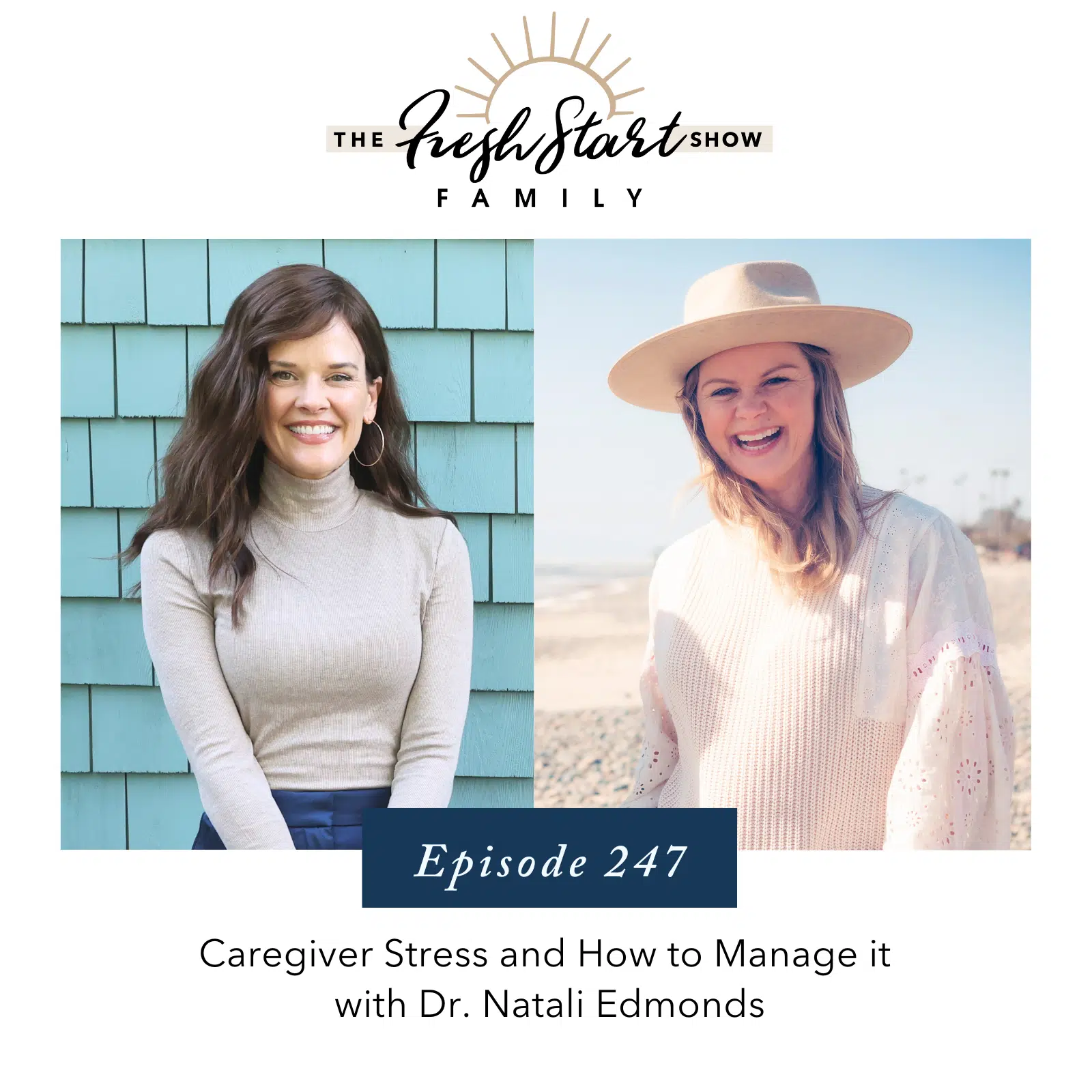
In this heartfelt episode of the Fresh Start Family Show, Wendy Snyder sits down with Dr. Natali Edmonds from Dementia Careblazers to dive deep into the realities of caregiver stress, especially in the demanding world of dementia care. Wendy opens the discussion by drawing powerful connections between the challenges of caring for young children and elderly loved ones with dementia, highlighting the emotional roller coasters that both journeys often share.
Dr. Edmonds offers profound wisdom on managing the unique stressors of caregiving, emphasizing the critical need for self-compassion and the well-being of the caregiver as much as the care recipient. She tackles the common misconception that a caregiver’s role is to always keep their loved ones happy, urging instead for a focus on emotional resilience and thought management.
This conversation is filled with practical, actionable strategies that can transform how we approach caregiving—from learning to be our own best friend to finding strength in the most challenging moments. Whether you’re new to caregiving or deep in the trenches, this episode is a beacon of hope and guidance.
What if you could be an effective, firm & kind parent WITHOUT relying on fear, force, bribery & rewards?
Imagine learning a new way of firm (AND kind) parenting so you can end painful generational parenting cycles and create family legacies & memories YOU are proud of?
All while getting your kids to cooperate with your rules and boundaries with ease.

IMAGINE …
Parenting your kids with calm & confidence each day in a way that causes them to do what’s asked of them because they WANT to (not because they HAVE to) … because you’re helping to build essential life skills that have them behaving well & being respectful when you’re NOT looking!
The Firm & Kind Parenting Blueprint is your step by step plan & video training to help you build the family of your dreams. Click HERE to learn more now!
Episode Highlights:
- Understand Behavioral Reactions: Recognize that challenging behaviors in both children and dementia patients often stem from their struggles, not as personal attacks.
- Practice Thought Management: Adopt strategies such as the “thought buffet” to reframe negative thoughts and foster a more positive mindset.
- Bridge Thoughts Gradually: Use laddering techniques to shift thoughts gradually to more positive ones, ensuring they are believable and effective.
- Be Your Own Best Friend: Treat yourself with the same compassion and kindness you offer to others, acknowledging your humanity and forgiving your mistakes.
- Build a Support Network: Surround yourself with others who share similar experiences and values to gain perspective and emotional support.
Resources Mentioned:
Find Natali on Instagram
Careblazers on Youtube
Dementia Careblazers Website
Catch this episode on YouTube!
Not able to listen or prefer to read along? Here’s the transcript!
0:00:02 – (Wendy): Well, hey there, families, and welcome to a new episode of the Fresh Start Family show. I’m so happy to be here today with Miss Natali Edmonds from dementia care blazers, who’s going to be talking to us about caregiver stress and how to manage it, which you guys, I’m telling you, there’s going to be so much here about parenting that we’re going to loop in, and I’m just so excited to have Natali here. Welcome to the show, Natali.
0:00:28 – (Natali): Thank you so much for having me, Wendy. I’m excited to be here.
0:00:31 – (Wendy): Nice. Well, I was so pumped when I met you, Natali, because for years, I have been thinking to myself, if we could help the world see how much there is in common between the end of our lives and the beginning of our lives. It’s just so fascinating to me whether, um, someone ends up going through dementia at the later stages of their life or just naturally is in the tail end of their life, how much similarity there is and how much support and care that you need from loved ones.
0:01:08 – (Wendy): And I see so much difficulty in the world in that space. So much is lacking as far as support for caregivers, whether you’re on the front end and you have little, teeny ones who are often kind of, what? Just not cooperative or have emotions that we, you know, big, strong emotions that we don’t know what to do with, or you’re caregiving for someone in the later parts of their life or that has dementia, and they have such similar qualities, I think. And I just look at so many of centers for the elderly, and it’s just so common. How much, you know, what would you say? It’s, like, so much heartbreaking, like, behaviors that are going on, but it’s so similar to the heartbreak of the behaviors that are going on for young children. So do you see the similarity, too, of, like, if we could empower the world with the first part and the latter part and how much they have in common, then the whole world would be better.
0:02:14 – (Natali): Yeah. I mean, it boils down to you’re caring for a loved one whose, like, well being is in your hands, and that person is their own person, and they’re going to have their own reactions to life and their own behaviors and their own experiences, and it’s not always going to be great. And here you are trying to not only help the person you’re caring for, whether that’s an older adult with dementia or whether that’s your, you know, child, you’re also trying to care for yourself and live your own life and take care of yourself and make sure you’re okay. And that kind of can be a difficult balance.
0:02:47 – (Wendy): Oh, absolutely. Well, before we get into this conversation about how to manage the stress of caregiving for another human soul in any capacity, but especially in the dementia world or elderly care, and again, we’re going to just have so much ties, I think, to parenting. And this is such an important conversation, but will you tell us a little bit more about your story? Natali, how did you become passionate about what you do now?
0:03:12 – (Wendy): And I love this jaro psychologist. Like, tell us more about that. So how’d you get here?
0:03:20 – (Natali): Yeah, so I am a board certified geropsychologist, which means I have a doctorate degree in clinical psychology. I went on to specialize in geriatrics and then get board certified in Gerop psychology, which there’s only a handful in the entire country. I worked at a busy hospital, large hospital system, primarily working with the person who has dementia, doing the initial assessment, like, do they have dementia? Is this normal? Thinking, what’s going on? Then eventually shifting to caring for the family members who were there to care for them?
0:03:50 – (Natali): And as I’m sure a lot of people can relate to, the healthcare system is difficult sometimes for caregivers, they’re short appointments. You have to wait a long time in between appointments. There’s not a lot of time for you to get your questions answered. If you are facing a difficult situation or a challenging behavior, you don’t often have the luxury to wait six months to find out the answer of what to do. You need help right now.
0:04:11 – (Natali): And so, in my practice at the hospital, I just found myself getting so frustrated that the healthcare system was not meeting the needs of the patients. So I started recording videos online, answering common questions and talking about the common challenges that family members face. And then it morphed into what is now dementia care blazers.
0:04:30 – (Wendy): So cool. And when did you started the company? When did you start the company? How many years have you been doing this now?
0:04:38 – (Natali): So, I’ve been doing this full time as my primary career in business for just over two years. It was two years in October that I left the hospital.
0:04:49 – (Wendy): Amazing. And, oh, my goodness. Your way of educating and helping this community, who is now caretaking for someone, is just so beautiful, Natali, and I love your style and your creative ways to, like, encourage and inspire this community, and so it’s just amazing. So that’s awesome. Yeah, yeah, yeah.
0:05:11 – (Natali): No, I think it’s helpful, and it’s great because I’m sure, like, a lot of your listeners can relate to there’s a lot of scary stuff out there. There’s a lot of really negative stuff out there. There’s a lot of things that are, you know, scary. And it’s important to know, like there, there are other ways to go through these journeys. And while there’s, it’s never going to be always easy, there are things to make it easier.
0:05:33 – (Natali): And a lot of that starts with just how we treat ourselves and how we frame things and how we look at things.
0:05:38 – (Wendy): Yes. I love it. Well, let’s just get right kicked off because I think, listeners, whether you have someone that you’re caretaking for that has dementia right now, which is going to be a lot of you, and I’m so excited for you guys to get to know Natali’s work because it’s just wild as you look at the seasons of life, right? Like we’re in a season right now where our kids now are 16 and 13 and our parents are in their eighties now and no one has dementia. My grandmother did have Alzheimer’s. So that your work is very, very near and dear to my heart. And I lived with her. I lived with her when I was a teenager.
0:06:14 – (Wendy): But there are so many listeners who are getting ready to embark on, like, like Terry and I really on that next, that, you know, the next 20 years or ten years where we are caretaking for our parents, which, like you said it, there’s a lot of fear happening, right? Like there’s in my mind. And even this week we have our 81 year old mama who’s getting total shoulder reconstruction surgery. And just caretaking.
0:06:40 – (Wendy): Like stepping into caretaking when you never have before is so intense, right? Like, for someone that’s in their older years of life and, or if you’re listening and you’re just like, wow, this is an interesting conversation. Like, how in the world are they going to tie this into parenting? Young kids, stay tuned because it’s going to be such a good conversation. But let’s start with number one, Natali, of how can we manage caretaker stress? And you talk to us about how it’s not, it’s not about always trying, trying to make the person you’re caring for happy. And this is the same in parenting. So tell me more about what this means to you.
0:07:21 – (Natali): Yeah, I think whenever we’re caring for somebody we love, we always want to make them happy. That sounds like such a beautiful thing, caring for your child or caring for your loved one with dementia, we want to make them happy. But if that’s your goal, when we really think about it, it’s not actually a goal we want because it can be quite dangerous and detrimental. For example, if you wanted to make your eight year old happy all the time, you’d probably let them stay up drinking a two liter of coke and a bag of Cheetos till 02:00 a.m. in the morning on a school night.
0:07:52 – (Natali): But, you know, like, that’s actually not in their best interest. That’s not good for them. So you lay the boundaries and you do what’s needed, even though you know in the moment that is not going to make them happy. And so I think really being clear and in your mind about why you’re doing what you’re doing is a really important thing to be aware of. Otherwise, if we’re just trying to make our loved ones happy all the time, we’re going to feel like we’re failing, when in reality we’re actually winning and we’re doing the best thing possible for the people we’re caring for. I often say it’s okay to be sad and it’s okay to have a hard time when you make the best decisions. And sometimes the best decision is going to be telling your child no or not today. And sometimes the best decision is going to be, you know, allowing somebody else to come in and care for your loved one with dementia when they really only feel comfortable with you.
0:08:44 – (Natali): And so our brains, like being a clinical psychologist at foundation training, our brains are wired for the negative, and they’re always going to tell us what we’re doing wrong and find out what’s what we’re not doing great. And so it’s really important to realize, like, wait a minute, it’s impossible to keep somebody happy 100% of the time. First of all, they’re their own person. And second of all, like, in the dementia caregiving world, if you wanted to make your loved one happy all the time, you’d give them the car keys when they’re no longer safe to drive, or you’d give them the wad of cash that they want when they’ve been victim to scam. It’s like we have to constantly remind ourselves, wait a minute, I know this is making them upset right now, but I’m doing this for their best interest, even if they don’t understand it. And I think that’s the unique role as caregivers and as parents. It’s like that’s what we are here for, to help guide and protect and to love, even if the other person doesn’t quite see the full picture.
0:09:36 – (Wendy): It’s so true. And I have so many thoughts on this one subtopic. Tell me, Natali, how you help your community embrace compassion amongst that, right. Because we know, right. Like, there’s such beauty in all emotions, right. Whether the person that you’re taking care of is angry or sad. Like, I’ve heard there’s just so much in the dementia world that can spark sadness or they feel hurt or scared, whatever it may be, like kids, elderly.
0:10:08 – (Wendy): And that it can be so frustrating. Right. When you’re just like, stop freaking out. Right. And again, I see it as, like, most of the world, it does not get the education to understand how to compassionately approach and detach from a child. That is super high emotion. You could even call think. You know, a lot of times we think it’s irrational. Like, we make fun of toddlers, like, you know, all day long, but, like, really approaching it with compassion and knowing that the more we’re able to do that, the less, like, fuel we’re putting on the fire. Is that the same in the dementia world? And how do you enable or empower your community to be able to do that? Because isn’t there, like, I think that there’s a high level of frustration and really anger, right. Like, I’ve heard, and I don’t remember talking to my dad. My dad’s a very quiet man from the south and doesn’t talk much. But I remember watching my grand mom, and there was times when she would accuse my friends of stealing her underwear and she’d be, like, out in her bra and underwear in the house, or she was sure the house was on fire.
0:11:23 – (Wendy): My dad actually, thinking back now, he was very, very compassionate with her. But I’ve heard that I have another friend whose mom is just starting to go into dementia, and she just gets. She’s like, I get so frustrated and angry and it seems to, like, make things worse. Right. So how do you help your community with that?
0:11:42 – (Natali): There’s so many different things. One of the things that is helpful is just to understand whenever the person is, like, having a difficult situation or behavior, rather than thinking, oh, my gosh, like, they’re giving me such a hard time. It’s really. They are having a hard time. Like, those challenging emotions and situations as a sign that they are having a hard time. I promise, as much as it might, you know, not seen this way, they’re not doing this to purposely make your life miserable. They’re not doing this to ruin their whole day. This is the way they’re trying to make sense of the world and just being able to understand that. And I think it’s a little bit more difficult when we’re talking about dementia, where there’s not a visible sign outward, their arm isn’t in a cast. They don’t have anything visibly wrong with them, at least in the earlier to moderate stages of the disease.
0:12:30 – (Natali): They look like their normal selves in the beginning. And so when they show these behaviors, it’s easy for us to just think they’re doing things on purpose when in reality, like, their brain cells are dying. I imagine the same is true. You know, when you’re raising kids or having kids, they’re having their own emotions. When they’re having some of those outbursts, they’re going through a hard time. And this is how they’re making sense of the world, and this is how they’re communicating.
0:12:53 – (Natali): One of the things that I think could be helpful is to practice the skill of observing what’s happening without absorbing it all and also without interpreting and judging it. Sometimes when somebody is showing a behavior, it’s like we want to interpret it and put a label on it right away. They’re being difficult, they’re being manipulative, you know, they’re being, you know, ruining everything. And the minute we put those labels on it, it’s immediately going to spark a reaction in us that’s not very great.
0:13:26 – (Natali): And so sometimes just literally stating what they are doing without the labeling can be helpful. Like they’re talking in a loud voice. They are, you know, waving their hands around. They are moving around really quickly through the house. Like, it sounds silly and simple, but it really helps lower our own frustration and anger to just describe what is happening versus labeling, labeling it. Because if we label it, it’s like, oh, they’re ruining everything. Well, of course you’re going to be upset and angry if you think they’re purposefully ruining everything.
0:13:58 – (Natali): But if instead we were able to say, you know, they’re doing x behavior, their brain cells are dying, or this is a really complicated disease, or for a parent, this is a hard phase of life for them, or they’re having a hard time grasping everything that’s going on, or this is the way they’re showing their emotion. Like, we get to make things mean whatever we want them to mean. And so it’s a practice and a skill to if you want to label something and interpret something, at least make it mean something, that’s going to fuel a more positive response, because I teach something called the formula for change.
0:14:30 – (Natali): But what we think essentially impacts how we feel and how we feel. Is going to impact how we show up and what actions we take. And the actions we take from a place of frustration and anger are always going to make the situation worse and make the behavior we’re witnessing worse versus being able to show up in a compassionate way. And I do teach, like, a little exercise I can share if you would like to know, for your.
0:14:52 – (Natali): So sometimes I, you know, there’s, we can’t predict all the challenging behaviors that are going to happen, but we can upfront ask ourselves, like, what kind of parent do I want to be? You know, I ask my careblazers, what kind of careblazer do you want to be? We know there’s going to be challenges. Like, what are the characteristics? I say, like, the top five characteristics you would love to have. And of course, they can’t just be like, kindness and peacefulness. Like, we need to really think about, like, those really hard situations.
0:15:19 – (Natali): What kind of characteristics would show up in those? And so it might be characteristics of love for sure, compassion for sure, but maybe determination, maybe confidence, maybe those. Those kinds of characteristics. And so if you can come up with your top five characteristics that are really meaningful for you that you think would serve you in hard times, then you get to ask yourself, when the hard situation you are faced with is right in front of you, you can say, what would determination look like right now in this moment? Or how would compassion show up in this moment?
0:15:50 – (Natali): What would the compassionate caregiver do? What would the compassionate parent say right now? Or the confident parents say right now? And you can just start to relate to this version of yourself that you already are. It’s just that in the moment, we forget it when the stress takes over.
0:16:08 – (Wendy): Oh, that’s so beautiful. Yeah, I’ve heard you share before. Instead of focusing on happy, focus on the meaning. And what you’re talking about is such a great description of that, right? Like, this is a season you will look back on and you can find such meaning in how you were able to develop into the person that you want to be through the challenge. Right? Like, whether that’s you, all of a sudden you’re like, oh, my gosh, I did not think parenting was going to be like this. Like, so many of our students get blessed with strong willed kids when they did not expect that and they just thought they were going to be able to, like, do the standard stuff, put a kid in time out, like, punish them or, you know, make them feel bad and then they wouldn’t misbehave tomorrow. Not with strong willed kids. No. Like, so many parents get into a position where they’re like, how did I get here? This is crazy.
0:16:58 – (Wendy): And it is often a season, right. And those really, like, really hard seasons that sometimes can be five or ten years. Right. But, like, to focus on the meaning part of, like, who you want to be and look back on in your life legacy and realize, like, wow, I took care of my loved one with compassion, with confidence, with determination, with unconditional love, with grit. I would imagine so many of your community, like, is open to learning.
0:17:29 – (Wendy): Right? Like, it’s just so beautiful. We forgot to share in your story, Natali, or hear about your story, but do you were a caretaker or are a caretaker? Is it for your dad now or was or.
0:17:43 – (Natali): So my mom passed away last June. I helped care for her. And then my dad currently is going through his own health conditions. His cognitive issues are more related to chronic alcohol use and drug use, but, yeah. So currently in the midst of caring for him as well.
0:18:00 – (Wendy): Wow. So, yeah, you were a caretaker to two, to both of your parents. Wow. And so that is a big season. So, so much of what you teach is, like, you are and were and still are applying it on a day to day basis.
0:18:16 – (Natali): So, yeah, and I think it’s important for everybody to realize, like, even though it’s a season and even though we talk about, like, okay, how do you want to show up as your best self and, you know, have compassion for yourself? We’re also human, and so we’re going to get frustrated, we’re going to get angry, we’re going to get down on ourselves. And I think the most important thing is, like, realizing, number one, we’re human. Those emotions will happen.
0:18:38 – (Natali): But number two, you don’t have to beat yourself up for having those emotions. You don’t have to beat yourself up for being human. And the more you do that, the harder you’re going to make your situation. And I love the metaphor of seasons. It’s like we’re approaching winter, and in winter, things die. Things aren’t bloomingden, things are cold. And so I don’t make it mean that something’s wrong, that right now my life is compiled with doctor’s appointments and making sure they’re taking medicine and, you know, doing all of those things. It’s like, this is winter right now, and in winter, this is what we do.
0:19:07 – (Natali): And then I know there’s a spring coming. I know there’s a summer coming. Maybe it’s a longer winter than I would like, but I know those things are on the horizon. And so I think when we try to resist reality or we have this image of perfection that we’re always supposed to be, like, totally perfect all the time, we just make things so much harder on ourselves.
0:19:27 – (Wendy): That’s. Yes, it’s so true. And that kind of ties in to your second point of, like, getting rid of the guilt, right? So I imagine, like. And I. And I know, again, it’s. There’s so many similarities, and with our students, there are so many times where you do just lose it. Like, I imagine that that’s just such a norm when you’re caretaking for someone with dementia that you might just yell at them or tell them to stop being so freaking difficult, or what the hell is wrong with you? Or, like, you know, this. This is like, you’re acting like an idiot. I don’t know, but that has to have happened, right? So, like.
0:20:01 – (Wendy): Or feeling guilty about, like, wishing your kid was different or some days where, you know, we have, again, parents blessed with these beautiful, strong willed kids that some days you just don’t like your child and you just don’t even want to be with them. But, like, these, again, we’re talking about humanity. This makes us human beings when there’s. We’re shooting for progress and growth and over perfection. So talk to us about getting rid of guilt when you’re caring for another human soul.
0:20:32 – (Natali): Yeah, I think a lot of what we feel guilty over, too, are totally natural human emotions. I shared something on my instagram recently. It was a statistic, and it’s. 73% of dementia caregivers report feeling relief when their loved one with dementia dies and passes away. So many people were like, oh, my gosh. Thank you for saying this. Thank you for sharing how we feel. I felt like such a horrible human being. I’m like, 73% of you feel this way. Like, the thing that we are ashamed of is actually a natural human emotion in the dementia caregiving world.
0:21:04 – (Natali): And I imagine there are similar statistics out there for parents, you know, sometimes not liking their kids or sometimes wishing, you know, their kids would grow up quicker and like those. So, number one, it’s realizing this is normal. And then I think what’s really a helpful practice is to imagine somebody you super duper love and care about, whether it is your child now or your child ten years from now, or a best friend or a spouse, so long as it’s somebody or you truly, truly care about.
0:21:36 – (Natali): Imagine that they came to you and shared with you. Exactly what you are struggling with is shared with you. And whatever it is that you’re struggling with. They said the same thing. Oh, my gosh, I feel so guilty. I want to go out and be with a friend, but that means I have to leave my kid back with the babysitter they don’t like or I have to leave my kid with, you know, the. I have to leave my loved one with dementia, with the caretaker they don’t like. And I feel so guilty. Like, imagine somebody you cared about coming to you with this situation.
0:22:03 – (Natali): What would you say to them? I guarantee you, you wouldn’t tell them. You are horrible. You should feel guilty. I can’t even believe you would consider going out. You would never, ever say those things. The things you would tell that person who care about. That’s exactly the type of stuff that we need to tell ourselves, and that is something we can do, and that is a skill we can build. I think that if somebody in our lives talked to us the way we talk to ourselves in our minds when it comes to how we show up in caregiving, we wouldn’t keep that person in our life very long.
0:22:33 – (Natali): Yet we do this internally in our minds, every single day for hours a day. And it’s important to catch yourself doing that.
0:22:41 – (Wendy): I love that. Makes me think about something for a minute because we’re starting to talk about our minds and how much we beat ourselves up. And it’s like, in our world, caring for these many human beings, there’s so much healing that comes out of the challenge and the struggle. So you’re put in this fire, so to speak, and you’re like, oh, my gosh, this feels tough. There’s things that come out that you just never realize that were part of you or insecurities or even memories of stuff until you have these children and are so challenged. So it does the same thing happen for a lot of people when they are tasked with this and they’re so triggered. I would imagine it’s so triggering all the time, whether it’s fear or frustration or anger or confusion, not knowing how to help this person or worrying, like, all the stuff do you see, like, a lot of. And is that something you guys do is a lot of healing work?
0:23:47 – (Wendy): Because that’s what ends up making everything so much easier to actually do. Right? So if we want to be compassionate, if we want to follow through with a strategy or a tool, there’s like, you got to heal first. So do you see that a lot in your community?
0:24:01 – (Natali): For sure. And I think healing is an ongoing process. Like, it’s constantly being done and happening, and it happens a lot in our community. Because sometimes people are caring for spouses where maybe they didn’t have the greatest relationship, maybe, you know, there wasn’t the greatest marriage. Sometimes people are caring for parents where the parent was never a great parent to them, and now they find themselves sacrificing their own energy, their own time, their own money to care for somebody.
0:24:26 – (Natali): And so it’s really hard. It’s a little bit like, well, why am I doing this? Like, I know they would never do this for me. And so sometimes it can be really hard because you’ll hear stories, and a lot of what’s shared on news is like, oh, I’m caring for my loved one because I know that’s what they would do for me, or because we said to death, do us part. And I want to honor our marriage vows. But not all relationships are that beautiful and that loving and have that great history. In fact, I find at least half of them are the complete opposite, yet people are still caring for them. And so there’s a lot of healing that has to happen, that happens in the process of caring.
0:25:02 – (Natali): I also think that’s it’s. That’s why it’s really important to know your reason for doing what you’re doing. Like, why are you showing up to be the best caregiver? Why are you standing by your loved one’s side? Why are you trying to be this great parent for your kid when you never had a great parent yourself? Like, those are important questions to answer. So we’re not just doing it because we think we’re supposed to or because society says we’re supposed to, because then we start to breed resentment.
0:25:28 – (Natali): We start to feel resentful of the person we’re caring for, which is going to make things harder. So that’s definitely part of the deep work.
0:25:36 – (Wendy): Yes. And I can imagine there’s so much forgiveness that comes up and understanding those triggered knee jerk reactions, or we call them protection or closed down behaviors in our work, but looking at it afterwards and what was underneath of that that caused you to yell at them that then I’m sure they come to you and they’re like, Natalie, help me tomorrow. Be more patient. Because today I just couldn’t do it. What is getting in my way of being able to detach or be compassionate?
0:26:10 – (Natali): Right? Yeah. And that’s why I love your Instagram handle. Right? Fresh start, Wendy. It’s like everything can be a fresh start. You can just start over again. I tell my care pleasers, you could just choose again. Like, choose again. Another thought to believe. Choose again. Another behavior to do, choose again in another moment, it’s okay. Like, life is always 50 50. There’s always hard, there’s always easy, there’s always bad, there’s always good, whatever it is, and there is nothing you can do. There’s no amount of medication, meditation, exercise, or gratitude you could ever do to wipe away the hardships of life.
0:26:42 – (Natali): And so one of the practices is, okay, how do we, if we know they’re going to happen, how do we want to think about them when they happen? How do we want to, you know, talk to ourselves when they happen? What do we want to make it mean when life goes off the rails? Like, those are decisions we can make right now.
0:26:57 – (Wendy): Yes. And. Okay, talk to us a little bit about that, because I love hearing every psychologist life coach has a different way of, like, mentoring the change of thoughts. Right? So tell us the Natali way. So, like, we. We get that. You know, I think we always say that there’s awareness, there’s self awareness, and there’s self acceptance, and both have to be really big in order to, like, actually change your behavior tomorrow. Right? So. So many people become aware fast. They’re like, oh, I’m yelling at my kids every day, or I’m raising my voice at my mother in law that I’m caretaking for. Like, there’s so much awareness, and then you start to. I think it’s easier to become aware of your thoughts of, like, oh, I’m thinking, like, earlier when you said, just observe. Right? Like, they’re walking loudly through the house versus, like, they’re being a pain in the ass right now, or they’re making the day difficult.
0:27:51 – (Wendy): But, like, in order to do that, it’s easier said than done.
0:27:54 – (Natali): Yeah.
0:27:55 – (Wendy): So what it like to be able to capture the thoughts, though, and then change them? Like, what is your method to help your community do that? Because changing the thought is so powerful, but it’s easier said than done. And oftentimes, like, in my work, parenting now, I’m 13 years deep, and I feel like that’s my fluency land. I can help people do it all day long. I can do it. But I’m actually, like, in a financial healing program right now, and I’m like, oh, I feel like I’m a kindergartner again. Like, I’m. I get these thoughts that I’m like, if I change it, I kind of feel like it’s bullshit.
0:28:28 – (Wendy): So I’m like, how do you change it? Believe it. Like, lean into it and then act from that thought. How do you coach your community on that.
0:28:37 – (Natali): There’s a lot, I mean, a lot of what I do, at least half of what I do is all about mind management and managing your thoughts. No behavior, tip or trick is ever going to last for very long, and the disease is always changing. So rather than learning just one tip or trick, we have to learn our own mind management before we can apply any of those things. So the very first step to being able to change a thought is to be aware that you even had one. And a lot of people aren’t even aware of these thoughts are happening. We call them automatic thoughts in psychology.
0:29:06 – (Natali): Life happens, a situation happens. Maybe your kid just called you a mean name, or your loved one with dementia just called you a mean name. And then we have a feeling, and most people think it’s whatever just happened, that the situation caused our feeling. And that’s not true. There’s no situation that causes your feeling. It is always that you have a thought about the situation, because if you lined up ten people in the same situation, they would all feel differently. How do you explain that? You explain that because everybody had a different thought.
0:29:31 – (Natali): And so, number one, you just have to become aware that you are having a thought. And the best way to do this is just to pay attention to whenever you have a shift in your mood. If all of a sudden you notice you’re super happy or all of a sudden you notice you’re super scared or anxious or sad or mad, it’s. That’s a cue to say, wait, what just went through my mind? And this is the hardest part in the beginning for people who don’t realize, like, we’re having thoughts all day long, every day, and that is what is causing our feelings.
0:29:55 – (Natali): And our goal is not to stop our thoughts. We cannot do that. We can’t even control all of our thoughts. Like, there are some thoughts I have on a daily basis that I’m like, there it goes again. There. It’s kind of like observing that one’s still popping up. Okay, like, I see you.
0:30:08 – (Wendy): Hello.
0:30:09 – (Natali): Like, I don’t have to, like, make it mean a big thing. I don’t have to make it mean. Like, you know, I have to fix it until it goes away. It’s just that I don’t have to give it the power, and I get to choose another thought instead. In fact, I have an exercise with my careblazers that I take them through. It’s called the thought buffet. And so once they start to learn to, like, make the connection between how they’re thinking and how they’re feeling.
0:30:31 – (Natali): I give them this exercise at the thought buffet, and I say, imagine, like, you go to a buffet restaurant, and there are all these food options on the buffet. And, like, there are definitely foods you probably don’t like. Are there certain foods you don’t like, Wendy?
0:30:44 – (Wendy): Yes, there are.
0:30:46 – (Natali): Yeah. Like, for me, I don’t like ham or jell O or eggs. And so if I were to go to a buffet and I saw eggs and ham and jell O, I’m not going to call over the manager and say, what in the world is this doing on the buffet? Take it off. I don’t like it. I don’t want it. Meanwhile, my favorite french fries are sitting right next to it, right? No, I just grabbed the french fries, and I leave the eggs. Like, that’s what I do when I go to a buffet.
0:31:09 – (Natali): So we can do the same thing with our thoughts, but we don’t. What we end up doing is we have this negative thought, or we have this thought we don’t like that doesn’t serve us. And we get so frustrated that it popped up again. And I can’t believe I’m still thinking. This is still making me feel upset. And it’s almost like we’re trying to call the manager over to take something off of the thought buffet, when in reality, we could just go pick up something else off the buffet.
0:31:31 – (Natali): And so it’s a never ending buffet. There’s going to be all kinds of plates. You’re going to find that you are going to pick up thoughts, and you’re going to notice thoughts you don’t like, and that is okay. As soon as you notice them, you can go get a clean plate. Now, sometimes you’re not going to notice it until after you ate it and your stomach hurts. You’re like, oh, man, I did it. I ate. You know, I can’t believe I stayed in it that long. And that’s okay. But the more you increase your awareness, next time you’ll catch yourself when maybe you’ve only had one swallow, and then the next time you’ll catch yourself when you’re putting it on the plate, and then the next time you realize, I’m actually going to pass up on those eggs and I’m going to go over here to the fruit that I really like and put that. And so it’s kind of a nice metaphor of thoughts are never going to stop, and your negative thoughts are never going to stop. We have the negativity bias. It’s okay.
0:32:13 – (Natali): What are you paying more attention to? What are you purposefully feeding your mind? And what are you purposefully trying to believe and think when you notice the negative thought? And like you said, with the whole financial course, like, sometimes you try to have a new thought, and it’s like, this feels like phony baloney. You can’t just think a fake thought that if. Unless it. It has to resonate with you and it has to make you feel better. And so what I would say, like, taking the financial example is if you were trying to say, like, maybe you have a thought, like, I’m horrible with money, and you’re trying to have a thought like, I’m great at money, and you say that, and immediately your body will tell you, like, yeah, I don’t believe that at all. I’m not great at money at all. Yeah, well, you can do something called a ladder thing thought.
0:32:52 – (Natali): And so instead of going straight to, like, the belief that I’m great at money, you might say, like, one day it’s possible I might be great at money. It’s possible that some people are great at money. There was one time on one day that I actually was okay with money. And then you bridge yourself up, like, on yesterday, I was good with money. I’m becoming good at money. I am good with money. And so you bridge yourself up like that. Like, sometimes we try to force ourselves to jump so quick to a belief.
0:33:17 – (Natali): It’s never going to work. You have to actually believe it, and it’s okay to work yourself up. And I always say, if there’s somebody in the world who is proof that that’s possible, then it’s proof. Why not for you? And so you can say, well, it’s possible for some people. You might even say, it’s possible for some people to be good with money. And you can start there. Yes.
0:33:35 – (Wendy): Oh, my goodness. And that’s why it’s like, there’s so many different takes on how to do this. And it’s so important that you have a mentor in your space of difficulty to give you these ideas. Right? Like, so I feel like sometimes it’s not so easy to change the thought, right? Like, to think, like, what would be a thought that would make my nervous system feel more settled or feel easier on me or help my body feel more capable.
0:34:05 – (Wendy): Right. But when you have mentors, like, I’ve seen you serve up a thought change that’s so significant in the idea of wishing it was easier instead to focus on the thought of, how am I going to create this to be the easiest that I can? Or how can I create a more supportive, or how can I create ease here? And then you start, like, fixating on that instead of. And so you’re allowing, like, you’re passing up on the buffet option to like, oh, I wish this was easier. Which parents of strong willed kids can relate to all day long, because there’s just so many times where you think that you’re like, why do you have to be so difficult?
0:34:47 – (Wendy): Why can’t you just, just say yes? Like your three siblings, right? And those strong willed kids are just like, no, they’re never going to do it. They’re not going to just be, yes, easy yesers. But if you fixate on that thought, you’re literally going to drive yourself insane. But instead, like, kind of choosing to engage with the thought of, like, how am I going to create an environment here that has more ease or has more cooperation or where I’m setting the tone. I can imagine, like, how much, like, energy setting of a tone there is, I would imagine, tell me, Natali, if this is accurate. But, like, is there, like, mirror neurons that fire when you’re taking care of dementia loved ones, like, with younger kids, where the energy you bring is often matched? Does that happen?
0:35:38 – (Natali): Oh, absolutely. Yet your nonverbals and how you show up is extremely important, especially because people with dementia oftentimes start to lose their ability to fully understand what you’re saying. So you can be saying something totally lovely. You can be saying, you look great today. That hat looks beautiful on you. But if you’re stressed out and you’re tensed, they’re going to pick up more on that than your beautiful words.
0:36:00 – (Natali): So we have to be very careful about how we’re showing up. The facial expressions, our nonverbals, our energy, absolutely play a role in caregiving.
0:36:09 – (Wendy): Yeah.
0:36:10 – (Natali): Yeah. And sometimes that’s hard because you’re in a hard situation. And, you know, I am never one to say, like, you have to feel good all the time. I think that’s impossible. I think it’s unrealistic and it actually makes us feel worse, even. And this is why it’s important when you say, like, I wish it was just easier. Wishing it was easier actually makes your life harder because you have to. That’s why it’s important to notice the connection between your thoughts and your feelings.
0:36:32 – (Natali): And so just sometimes realizing, like, this is stating the obviously, like, this is hard and that’s okay. Like, this is just hard. And in those really, like, sometimes to try to prevent myself from breaking down, you know, if you’re in the middle of a care task because they pick up on your emotions so much. Like in the moment, I’ll sometimes say, like, care now, cry later. Like in my mind I’m like, get through the care now. I can cry later. And so I just do still give myself that permission, whether it’s, you know, in the shower, in the bathroom five minutes later.
0:37:03 – (Natali): But we have to be realistic too. Like, we can’t just stop and process our emotions every time, especially when you have somebody in front of you who really needs your help, like a child in need or a loved one with dementia, but we can still give ourselves that time later.
0:37:18 – (Wendy): Yeah. So beautiful. Okay, talk to us about point number three. When it comes to managing caregiver stress, the importance of being your own best friend.
0:37:32 – (Natali): Yeah, this really gets kind of like I was talking to later. Like, what kind of best friend would you be to somebody going through your challenge? What would you be saying to them? How would you be showing up to them and then practice saying that to yourself? I don’t think we do a very good job at supporting our own selves. We do a fantastic job, even though it doesn’t feel like it all the time. Supporting our children we’re trying to raise, supporting our loved one with dementia, being for them, caring for them, caring for our loved ones in our lives.
0:38:02 – (Natali): Yet we hardly put any of that amount of effort into ourselves. And that’s something we can do. And when you catch yourself beating yourself up, it’s, it’s literally like, okay, what else could I tell myself right now? What would I tell somebody I cared right now? Like, how can I be my best friend in this moment? And you just start there?
0:38:19 – (Wendy): That’s beautiful. Yeah, that. I mean, again, I tie so much of the struggle, most of us. I mean, it sure feels like the majority of people face in their 3rd, 4th, 5th decade of life with the amount of like, self inflicted shame. I really see that we have an opportunity to change that with the way we are raising our children, which then creates an entirely different experience for human beings. So then when they care for their elderly parents and especially if they have dementia, then it’s just a whole different thing, right? But that self compassion piece just really starts to become so blatantly clear in your 3rd, 4th decade of life because it’s like you just so fast beat yourself up, right? And so, like, for me, like, the shame on you was like a big one used in our home growing up. And it’s like, I don’t, it’s like, that’s old school, but it’s essentially I’ve been trying to break that one for, like, years, and I do it in a different way, but mine is more like, what were you thinking? Like, you did it wrong.
0:39:26 – (Wendy): You’re going to be found out, like, that kind of stuff. So I recently had a mentor share how maybe the idea of making it a game could be fun of, like, okay, I see I’m beating myself up, but, like, what would it look like? Let’s just see if I can do, like, what else could I tell myself right now that’s a little bit more self compassionate of, like, you know? So that, that clicked with me. I was like, oh, I can make this a little bit of a game.
0:39:53 – (Wendy): Yeah.
0:39:53 – (Natali): Sometimes I tell my curb lasers, because, you know, we all have that voice and those, those. Some of the thoughts we tell ourselves are literally just habits now. We have good neural net, you know, pathways in our brain where it’s just easier to think. So sometimes I imagine, like, we’re driving a car, and, like, you’re driving the car, you’re dictating where it’s going, but it’s in the backseat. Like, you should have turned left back there. Oh, really? That’s the speed limit you’re going to go. And so it’s a little bit like, okay, come on, this road trip. I hear you.
0:40:17 – (Wendy): Yep.
0:40:17 – (Natali): Okay. But I’m still driving. I’m still in control. And, like, sometimes they’ll joke and they’ll be like, I’m sticking it in the trunk right now. Like, I don’t want to hear from it, but if we have this expectation sometimes, like, it should be gone right now. I shouldn’t be struggling with this still. I can’t believe this is still hanging out. It actually makes it stronger and helps it stick around and have more power over your life versus, like, okay, I see you. Let’s go. You can hop in the car. You’re not going to drive this car, but you’re there, and that’s okay. We don’t have to make it mean, like, we’re still failing or, you know, we’re doing something wrong, that it’s still there. A lot of this is because probably for 20, 30, 40 years even, you’ve been thinking these things. And so it’s going to take some time for it to lose its.
0:40:56 – (Natali): Lose its control and hold and power. And, you know, for some of us, we haven’t even been practicing the new beliefs for a good month. You know, we haven’t even been really, like, making. Those are more habit thoughts, so we just have to be kinder. To ourselves.
0:41:14 – (Wendy): Yeah. And do you see in your community where that’s, like, a great concept, like, let’s be more self compassionate, let’s be kinder. It’s, like, lovely, but, like, no, it works. Like, the reason why we want to do that is, yes, that’s because of what we deserve as human beings. We don’t need to be so freaking hard on ourselves. But at the same time, it works to change our behavior tomorrow. Right. So, like, if we want to calmly walk away when we are so frustrated that we’re about to raise our voice or say something that we’re going to regret, or.
0:41:43 – (Wendy): It’s like, I know in the caretaker world, like, especially in centers, that there is, like. Like, physical aggression that comes out. And I don’t know if you see this in your community, but I imagine the shame that comes along with that. Just like it is with younger kids. Right? Like, I’ve written articles before about when I grab my little boy’s wrist or upper arm too hard. Like, these are human things that we do. Right.
0:42:07 – (Wendy): But, like, when you are stuck beating yourself up, your behavior won’t change tomorrow. But if you can come beside yourself and say, no wonder you were angry. You made a mistake, it doesn’t make you bad. It just means that there’s something we got to get under or heal from. You’re doing a great job. We’re in this together. Whatever it may be, then you’re more likely to not grab the wrist too tight tomorrow or make an aggressive raising of your voice. Right. Like, do you see that in your community, too, that the people who are able to really start being kinder to themselves and being their best friend then come back to you the next day, and they’re like, I was patient today, or, I followed through on what you taught me. Natali, do you see that?
0:42:47 – (Natali): Oh, for sure. Absolutely. Beating yourself up part, that’s entirely optional, but the learning part, that’s what we want to grab onto. Okay, I did this. I don’t really want to do that next time I see what I did. Like, maybe I can try this different. The beat. Like, sometimes people think, well, if you don’t beat yourself up, then you know you’re not going to improve. Actually, that. That’s not true at all. Like, you can still improve and you can still learn without beating yourself up. I always say if beating yourself up was somehow going to give your child a better life or give your loved one a better life, I might advocate for it, actually, but it doesn’t.
0:43:18 – (Natali): It doesn’t give them a better life, it actually hurts them because you’re not showing up as your best self. So. And that’s where I think it’s really important to surround yourself with other people who have similar values or goals as you do, like with other parents, you know, with strong willed kids. Surround yourself with them so that, you know, number one, you’re not alone, you know, number two, the thing you’re so embarrassed to admit that you’re ashamed of, actually, everybody else has been going through, you know, that’s what people find in our support groups. It’s like, you know, they’re talking about, you know, their frustration about dealing with their loved ones, you know, feces or something like that, and they’re so embarrassed about how they responded or how they feel.
0:43:55 – (Natali): And then one brave soul mentions it, and everybody’s like, oh, my gosh, yes. And, you know, and it’s like, wait a minute, like, this is normal stuff. Like, we don’t have to keep hiding from this.
0:44:06 – (Wendy): No, the hiding and the shame is what keeps us stuck. It’s what keeps us stuck. So. Oh, my gosh. Well, gosh, Natali, I just love your work so much. Are you out in the world yet, like, certifying people or teaching professionals? Because I know you’re really, like, forming communities and you’re working directly.
0:44:26 – (Natali): Right.
0:44:26 – (Wendy): But are you doing any type of, like, certification work yet?
0:44:31 – (Natali): So we have a certification program people can apply for, but right now we do consultation with care facilities, consultations with healthcare providers, things like that. Our main. The biggest group we have right now are actual family members caring for loved ones with dementia, trying to get through it without running themselves in the ground. Ultimately, what we’d like to do is certify facilities to show that this is actually a dementia friendly facility with staff members who are trained in dementia care.
0:44:57 – (Natali): The majority of healthcare professionals have zero to little training in dementia care. The majority of memory care facilities where it’s over $100,000 a year for your loved one to go stay in a shared room. The majority of those individuals have zero to little dementia care training, if any, maybe an hour video. And so I’m. Our company is here to change the average. To change the average of everything in the dementia care world because the numbers are quite frightening and scary.
0:45:20 – (Natali): And so we’re doing that one bit at a time.
0:45:24 – (Wendy): Yes, Natali, that makes me so happy to hear that, because, again, it’s very similar in the parenting world. Like, it just blows my mind that this is, like, the most important thing in the world is caring for another human soul. And there is no. Like, there’s really no real support. Like, there’s no funding, there’s no education. Like, you just get given this human soul, and you’re expected to know what to do, and then it just. There’s so much messiness in that. And if there was just more support there, and then at the end of life, too, with everything you teach, with everything I teach, if that were to come together at both ends, then, oh, my gosh, it would just be so much better, because I’m not even in your world, and I see what’s happening in these care centers and with people who are caring for, and it’s just heartbreaking because all of it, they all need more support and what you are teaching. So I’m so happy to hear that you’ve got the certification going that you have this vision to get all of these centers, like, quality, you know, trained and qualified in what you teach. Because this is like human dignity work.
0:46:37 – (Wendy): This is every single human being on the planet. No matter if they’re a crazy, wild three year old or a crazy, wild 97 year old that has dementia, they deserve dignity and compassion and respect, and so does their caregiver. So I just love.
0:46:54 – (Natali): Thank you for those kind words. Yes. I always say, like, you are deserving of the same amount of love and care that you give so freely to your loved one. So same for your audience as well, I’m sure.
0:47:03 – (Wendy): Yes. Well, Natali, tell everyone where they can come find you and support your work and get into your programs and all.
0:47:09 – (Natali): The things you can. Go to our website, it’s www.careblazers.com. or just type careblazers into Google will pop up.
0:47:18 – (Wendy): I love it. And Instagram, you are @dementiacareblazers, right?
0:47:23 – (Natali): Yep.
0:47:24 – (Wendy): And I will say that one of my favorite videos you’ve ever done, I mentioned it in this interview, but it was about the idea of, like, if you like, instead of just wishing it was different, instead, like, focus on creation. And that I believe you have pinned up at the top of your Instagram page, and I believe you have a free resource that if they comment a word that they can get that that’s like, what I’m finding is so easy for people these days. Just find you on Instagram, find that one reel that is so easy to connect with and then comment to get that right into their hands. Is that right?
0:47:56 – (Natali): Absolutely. You can go to Instagram dementia care blazers, link in bio, or click on that very first pinned post. There’s a free survival guide you can grab. A lot of our resources are 100% free.
0:48:08 – (Wendy): Perfect. And you have a beautiful YouTube channel, too.
0:48:11 – (Natali): Right now, YouTube’s our primary. Yes. If you type careblazers, YouTube will pop up. That’s where we’re mostly at for more in depth training and support.
0:48:19 – (Wendy): Yeah. So, listeners, if you have someone who you know is caring for someone with dementia, please share this episode with them. Um, that would just be so wonderful. So, Natali, thank you so much again for doing your work. You are incredible. You are a light spreader. Your work matters, and we are so grateful for you. Thanks so much for spending time with us today.
0:48:38 – (Natali): Thank you for having me.