

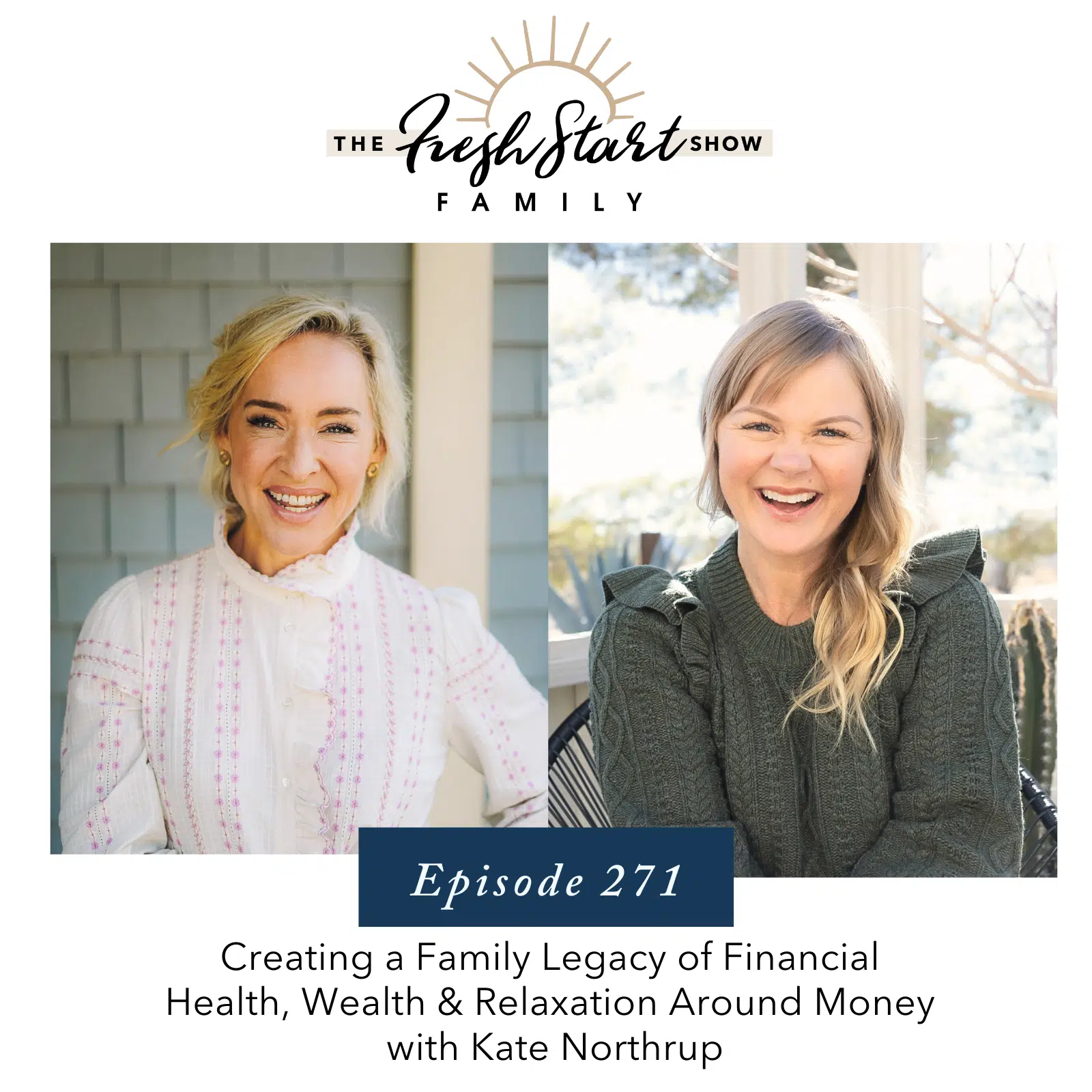
What if your relationship with money could feel peaceful, powerful, and even joyful? In this powerful episode, Wendy welcomes to the show author and financial wellness expert Kate Northrup to talk about breaking unhealthy financial cycles and creating a family legacy rooted in wealth, relaxation, and love. Kate has been a mentor for Wendy’s own personal journey around financial healing for a few years now. They explore how our nervous system, childhood patterns, and emotional wiring deeply shape our relationship with money—often without us even knowing it.
Kate shares her personal story of transforming from a debt-ridden, avoidant spender to a conscious, confident money steward—and how you can do the same. Whether you’re carrying financial shame, avoiding the numbers, or simply craving more abundance and ease in your family, this episode will encourage you to lovingly pay attention to your money. You’ll walk away with fresh hope and practical insight on how to model financial health for your kids and feel empowered to shift from surviving to thriving.
Ready to rewire your money patterns, build systems that support you, and unlock the abundance waiting for you…without hustle, sacrifice, or high-functioning financial stress?
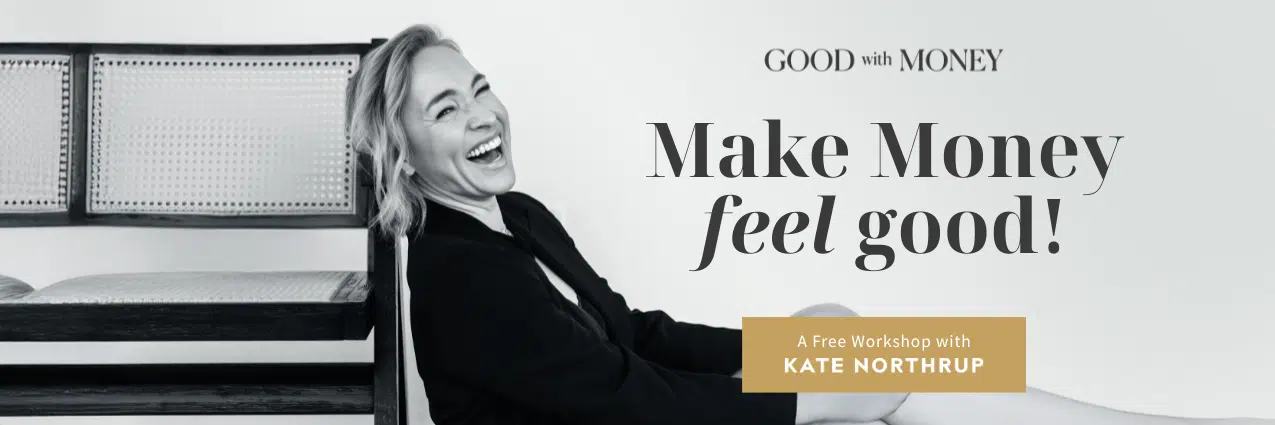
Register TODAY for this incredible FREE 3-Day Workshop, Good With Money, with bestselling author, entrepreneur, and financial wellness teacher Kate Northrup.
Episode Highlights:
- Creating a family legacy of financial health is essential.
- Awareness of personal financial patterns is the first step to change.
- Financial avoidance can stem from deeper emotional issues.
- Money healing is relational and involves understanding our emotions.
- Children absorb their parents’ feelings about money.
- Modeling healthy money management is crucial for children.
- Financial clarity brings a sense of safety and security.
- Healing the nervous system can empower financial decision-making.
- Being good with money is a learnable skill.
- Workshops can provide valuable financial education and support.
Resources Mentioned:
Follow Kate on Instagram
Kate’s Website
Wendy on Kate’s Plenty Podcast and featured HERE on the Fresh Start Family Show
Don’t miss Kate’s FREE 3-Day Good With Money Workshop starting April 17! Sign up here!
Catch this full episode on YouTube!
Unable to listen, or prefer to read along? Here’s the transcript!
Wendy (00:03.163)
Hello Kate, welcome to the show.
Kate Northrup (00:05.454)
Thank you. So happy to be here.
Wendy (00:08.174)
I’m so happy to be here with you today. When I had this on the calendar for bright and early here on this Tuesday morning, I was like, my gosh, I’ve never been more excited to get into the office early, Kate. So yeah, being here with you is such an honor. And today we’re going to be talking about creating a family legacy of financial health, wealth, and relaxation around money. Because what we do here at Fresh Start Family is we help.
Parents end painful generational cycles. help them upgrade their family legacy, mostly through firm and kind connection-based parenting strategies. We call it powerful parenting. A lot of people refer to it as positive parenting. But what I’ve learned through you is that nervous system regulation and health and healing and financial health is such an important.
generational cycle that we want to have our eyes on. So I’m excited to get your guidance today for our community on how families can really look at the legacy that they’re creating around their financial health, which we know is so tied to their nervous system health, and what to do about that. But Kate, if you could just maybe take a second to introduce yourself in your own words to my community. I know they know you well because they hear me talk about you so much, but just in case they don’t.
Give us a little quick synopsis of your story and how you got to where you are today.
Kate Northrup (01:32.078)
So happy to be here. so I am, I’m an author. I’ve written two books. First one was called money, a love story. And that was the curriculum that I created for myself after getting myself into a whole bunch of credit card debt due to my chronic financial avoidance in my twenties. I was. Yeah. Shopping.
Wendy (01:32.912)
Yeah
Wendy (01:53.839)
And you like that shoppin’. You’re like me, you like that shoppin’. You like that fashion.
Kate Northrup (01:58.622)
shopping and just, was misunderstanding the directive of the law of attraction, which was act as if, you know, if you’re, if anybody follows it, all the manifesting world, it’s like act as if you have what you want act as if it’s already true. And I misunderstood that. And instead I spent as if, and you know, the truth is that the law of attraction doesn’t, cancel out math. And so I just.
I just was spending more than I made, which ended up in a lot of credit card debt. And what I realized for myself is that I was using financial avoidance and overspending as a way to dim my light and as a way to play small because I knew what I was capable of. I knew how powerful I could be. And there was a part of me that was terrified of what it would actually mean if I went for it.
in my career financially. And so I was going for it in my career, but then behind the scenes, I was making sure to disperse all that energy by overspending and being disorganized. And, you know, part of that was my own nervous system set point around money and love and success. When my mom’s career took off in a big way, my parents got divorced. So I had a unconscious, semi-conscious coupling with
Wendy (03:08.048)
Mmm.
Kate Northrup (03:25.836)
financial success and being alone as a woman. And, that is how it manifested. So the good news is I, despite having followed like all the financial advice and trying to skip my lattes and trying to be more disciplined and whatever, none of that worked. Every time I tried to do the typical personal finance advice, I just felt bad about myself. And so instead I created my own program and I incorporated love.
Wendy (03:50.033)
Hmm.
Kate Northrup (03:55.68)
and fun into it. And I was like, how would things change if I paid attention to my money from a place of love? Not necessarily love for money, but from a place of taking loving care of myself. And so that curriculum worked. In six months, I was able to pay off all my credit card debt, which at the time was, I was making $34,000 a year. I had $20,000 worth of credit card debt. So relative to my income, it was huge.
And I was able to pay off all of that credit card debt within six months. I tripled my income. I doubled my savings. And it’s not because I married a rich man, got an inheritance, or got a high paying job. None of those things happened. I actually changed on the inside, and my life changed on the outside. So that’s my story, or part of it.
Wendy (04:43.217)
Amazing. A tiny segment of it, yeah. And now you’ve gone on to help thousands and thousands and thousands of people change their story too. And I am one of those people. I mean, my goodness, the change that I’ve experienced just in the last, I think I’ve been with you now for two years has been just insane, Kate. It’s been just on so many levels. I was thinking on my drive in this morning, just how many levels of positive change and healing have happened.
And it’s just been so beautiful. So, so, so good. let’s start. So we have three tenants when we’re talking about creating a family legacy of financial health, wealth and relaxation around money and just three kind of ideas or pillars here that I thought of in reflecting on what I’ve learned from you over the years. And one of them is just that you mentioned it, but becoming aware of your own patterns with money and taking responsibility for creating change.
I know for me, I was really unaware. You mentioned the words conscious, unconscious. I knew it because I would feel bad when I did it. I would have a hit, and we know feeling air quotes bad is not a feeling, but it would be this hit I could feel in my body of like, uh-oh, I’m doing something wrong.
I would avoid money. didn’t want to look at it. I would just kind of act like, it’s all going to work out, which it somehow miraculously did, which I think is so interesting. And I just had some weird habits. I remember sitting in an accounting meeting and finding out that a launch was more successful than I thought it was, because in my head, would always doomsday my launches at First Start Family.
And I remember sitting there, she was like doing some tax stuff on the other side, like shopping, like secretly shopping and being like, I gotta dump some money from PayPal so I can like quickly get paid or get some joy. But then it was like in a hiding way. I was just a mess and I didn’t even really know it. I also wasn’t paying myself. As a leader of this organization, I would pay my staff, I would pay…
Wendy (06:50.257)
My contractors and from the outside we seemed successful and like we were thriving but on the inside I was still living in this kind of suffering state and I wasn’t aware that I had this limiting belief around a People with money are bad. That’s a that’s a concept I grew up with my mom literally almost threw up in her mouth when she would drive past mansions and she still says it to this day and I was uncomfortable receiving money and so
there was these conscious patterns, but then there was these unconscious patterns that becoming aware of that was liberating, not shameful. And so what would you say about that process when you start to be open to becoming aware of some of your patterns? And you’ve taught me that the avoidance thing is one of the biggest patterns that I think people just kind of laugh at or they make a joke about, like, I don’t want to deal with it.
Or a lot of times in my community, we have a lot of people who grew up in high control, like Christian religious environments where they just default to the man in the marriage. But what would you say about the joy of bringing awareness to your patterns and then taking responsibility for creating change?
Kate Northrup (08:02.69)
that you framed this question this way because my approach is really joyful and really fun. When I, as I said, started my financial healing journey, all the experts were not fun. It was very shame-based and it was like, I always felt like I was in trouble and it was serious and it was like, honestly, really boring. And I felt like I was getting yelled at and I’m the girl who,
Wendy (08:19.729)
Still to this day.
Yeah.
Kate Northrup (08:31.214)
every sports team that I ever joined, as soon as the coach started yelling, I quit the team because I was just like, Oh, no, this is not motivating for me. I am unavailable to be yelled at. So I really believe, in fact, I know that when we bring in compassion, it softens our edges and it is an instant way to actually shift our, our chemistry, our
biological response to what’s going on. And when we shift our, what’s happening in our bodies, when we shift our physiology, what ends up happening is we begin to access more of our ability to be smart with money, more of our ability to be magnetic to more opportunities, to more money. What we have to understand is that anytime we receive money, it comes from another human.
Wendy (09:00.753)
trail.
Kate Northrup (09:30.582)
And so the money healing is actually relational healing. And if we are in a state of being financial repellent, that is because it’s an interpersonal dynamic, just as much as it is a dynamic with money. So when we first, as the first step, when we’re uncovering these limiting beliefs, limiting patterns, and quite frankly, the way those
embed themselves is in our brain and nervous system. So it’s not as easy as like, just change the thought, right? I wish it were that easy. It’s not. Our thoughts and our beliefs are wired into our neural connections that are all through our brain and body. So by the time we’ve had a limiting thought like, rich people are bad. Or one of the things we said that was said in my family is, those people have more money than God.
Which is in, like, what does that even mean? God does, like, commerce is not a thing with God. And also, like, yeah, I mean, regardless, we don’t even need to get into religious beliefs, and then also, like, it’s, that’s a pejorative thing to say. Like, underneath the surface, that’s judgment. That’s saying these people think they’re better than God, right? That’s what’s in that. Okay, so by the time that thought even comes to our consciousness,
Wendy (10:37.84)
Yeah.
Wendy (10:43.578)
Yes.
Wendy (10:48.408)
Exactly.
Kate Northrup (10:54.338)
there has been a cascade of physiological responses that have happened in our body that result in that thought. the origin of coming out the other side with a negative thought about money is essentially a fear response in our survival wiring, in our survival wiring, in our limbic system that says, hey, I’m scared.
I feel like I’m not safe right now. And so what’s so great about self-compassion is when we begin to understand our biology and that there’s not something wrong with us because we have a limiting thought, there’s not, we’re not fundamentally flawed. We’re not broken. Like none of that. just makes sense. If you grew up with these patterns being spoken of being modeled and then literally just being inherited, it makes sense. They’d be running in there. And so,
The first step is, oh, okay, I’m just, I see that I hear myself. If I’m saying rich people are evil, it makes sense that I’m repelling money from my life. And that is a physical response. And so what I need to do is learn how to signal to my body that I am safe, which is also really comes from compassion and love to just like be able to say to ourselves, Hey,
You’re safe right now. And again, that’s not spoken. That’s not a mental trip. That’s not a head trip. That’s a physiological practice that I love teaching how to do, because it changes our thoughts.
Wendy (12:34.435)
Yes, I love that so much about your work too. It is what makes it so unique and different. And what is such a trip to me that I mean, I just I love learning. love expanding. I love like your body at work has been so new to me after studying so much mind stuff and strategy for so many years as a life coach and parenting educator. But what was so trippy for me to learn over the years is that it really wasn’t conscious at all.
the money is bad. And it’s so funny because as a strong-willed person who, when I look at the way I was raised, I know I left when I was 18. I was like, hey, I love you, mom and dad, but I’m freaking out. I’m ready for something different and new. And I went on, I always felt very different. I went on to live a very different life than my folks back home and my extended family. So in a way, was like, here I am living this life that’s very different.
But then I had this deep patterning that I was not aware of that was in repellence of wealth. And we learned so much in your program about changing our belief systems around money. And everyone has their own thing. money is so good, right? I’m now able to rent an office in my church. And I’m able to give more money. I’m able to give more scholarships now that we’re more financially profitable here at First Dirt Family. I’m able to.
take care of my health better and invest in more therapy and acupuncture if I want, right? Like I’m able to buy more organic fruits and circulate money in my community and the world. But to uncover the unconscious because I wasn’t even, the thought wasn’t even coming of like rich people are bad. I was like, hell no. I really thought I was thinking, heck yeah, I would love a yacht. I would love to travel all over the world. Like I want that, I want that, I want that. But I was very confused.
about why I wasn’t getting it, now that I’m like gonna get a yacht, right? But like, maybe, who knows? Maybe I will, Kate, big Fresh Start family yacht. Seriously, we’ll be surfing off the back. But it was just a beautiful discovery process to realize that that belief system lived deep within my nervous system. And it intertwined so well with what I do here at Fresh Start family, because really,
Kate Northrup (14:37.23)
Who knows?
Yeah, I see you in your yacht life.
Kate Northrup (14:46.798)
You
Wendy (15:00.899)
It came down to feeling scared of not being accepted because in my family growing up, it was like the blue collared working man was like legit the hero, like hero. The wealthy person was the enemy. Again, throw up in your mouth, disgust. The tone of disgust is so strong, but the working man, if you were struggling, if you were like, and so deep down there was something about me that was avoiding
stacking cash because it would mean that I wasn’t accepted. It would mean that I didn’t belong even on a higher level. And so consciously I was like, heck yeah, I’m out of here. Like I don’t need to belong because I’m different and I love my family so much, but I am, I am born to do something different and help blah, blah, blah. But deep down inside there was still just a little kid that just wanted her parents to be like, I love you. I love what you’re doing. You know, and like I love, and really I, I think my body knew it was unsafe.
to be like sitting in a stack of cash and being like, hey, mom and dad. So just a little bit deeper there about me, but it was just a joy to discover it. was not harsh. was not depressing. It was like, now we get to do something about this. And that was just one or two of the patterns that I discovered with you. But when you aren’t aware of them, then you just stay in frustration and like, I can’t get what I want.
Kate Northrup (16:16.046)
Yes.
Wendy (16:26.981)
I just have to live in this scarcity reality and that’s not what we want.
Kate Northrup (16:32.525)
And it is a lot of wasted energy. So when you’re talking about the joy of discovering these patterns, again, I love that you phrase it that way because all of our attention and our literal expenditure of what we’re doing in a day and what we have the emotional capacity for and the bandwidth for is just our energy. Like, where is our energy going? And when we have these unconscious patterns that we’re unaware of, it’s like a giant hole.
Wendy (16:35.227)
Mmm, yeah.
Kate Northrup (17:01.528)
that we don’t know that all our energy is leaking. And so we can actually find ourselves in patterns of burnout because our unconscious patterns around money are like sending all these, all of our bandwidth unbeknownst to us out this sinkhole, if that makes sense. And so what I’m present to, as I’m listening to you is how joyful it is to reclaim
that amount of energy and that amount of bandwidth because that is a reclamation of our power. And then it’s like, now that I know that’s happening, I can plug up that hole and have all this energy back to serve my people, to be present with my parent, with my family, and maybe with my parents as well, but with my kids, to parent, to be present in my marriage, to, you know, it’s like, we want
all of our energy to be used in conscious ways. But when we have these unconscious patterns running the show about money, we’re leaking it in all these ways. have no idea. And then we’re like, ugh, why am I so tired all the time?
Wendy (18:10.885)
Yes, it’s so true. And that’s why I think your work is so fascinating and essential for every parent, every family, because it’s tied, the financial stuff is tied to everything. Like it’s one of the core parts of being human, right? Like money, sex, and like raising humans is what like most people, everyone’s gonna do it. Like pretty much, pretty much.
And yet it’s like stuff we don’t really teach about, we don’t really explore that much. And it’s just so interesting that like what happens when you don’t have clarity and understand what’s happening. so it’s just so, good. And yeah, so good. Okay, Kate, let’s move on to just modeling the main tenants of healthy money management to our kids, right? So we talk so much about modeling here at First Dirt Family and we know that
Even if, say we have a lot of families who have little kids, right? And they might be thinking, well, well, kids don’t know what we’re doing with money. And they have no idea. And we know that they’re like these weird little sponges. They just soak up whatever belief system we have. And we don’t even have to be like, hey, sit down. Let me show you how I either manage my money every week or month. By the way, we have a YNAB coach now, Kate, that we meet with.
every single week and it’s the most amazing thing ever. So we have grown so much in our ability to be like in our system every single week together. But even though like we don’t think they’re watching, they are watching and they’re soaking it up. And so the earlier you can start the better, but when it comes to like, when I was kind of riffing and brainstorming, I was thinking kind of some of the main tenants are clarity. So you know what your numbers are.
Kate Northrup (19:38.4)
amazing.
Wendy (20:01.871)
You know how much you’re bringing in. You know how much you’re spending. Comfort receiving, which we kind of just talked about a little bit, but you goes into so much more financial systems, creating like a rhythm where together as a couple or alone, like you’re just every day, every week, whatever it may be. And then having the long-term vision, which we talk so much about here too, that’s so important that most people are looking at the right now, which is a gift, right? We want to learn how to be present.
But with finances, that gift of looking long term and having those goals is so important. What would you add to that as far as when it comes to modeling for our kids healthy money management?
Kate Northrup (20:42.786)
Yeah, so it really comes down to learning to metabolize and work with your emotions around money. Because our kids, generally speaking, won’t be in on the money meetings, right? So they won’t really know specifically, like, this is what we’re allocating towards this, this is what, you know, it’s just not relevant.
for them to know every single detail. And certainly if you have little kids, it’s like completely irrelevant. But what you are teaching your children is how you feel about money. So how you feel about it is the most important part. Now, clarity does bring a feeling of safety and security. At first, clarity can feel like terrifying if you’ve had a history of avoidance.
Wendy (21:31.961)
It did for me, yep.
Kate Northrup (21:33.912)
looking at the numbers and seeing the actual numbers can feel terrifying, but I invite people to really look at those numbers, your financial numbers as a GPS, not as a judgment. So it’s like, this is just telling me information about where I am and where I wanna go. Unless we give it a story, money doesn’t have a story. Numbers are math, like numbers are the end, right? Like the number seven is not telling a story, it’s just.
And number seven, so money is neutral. And then we give it all this stuff. So our number one job as parents to give our children an inheritance of financial security is not making sure that they have generational wealth. And I’ll tell you a story about that in a minute. Our number one job as parents to ensure our children have a strong financial inheritance is
handling our own emotions around money so we can return to neutrality and joy. And really unplugging from money as our source. That’s the thing that so many people are so screwed up about, where it’s like our culture has made status and what things look like matter so much.
Wendy (22:47.822)
Mm, yeah.
Kate Northrup (23:01.814)
while at the same time completely villainizing people with money. So it’s a very confusing mixed message, right? It’s like everybody needs to look perfect and drive a Mercedes and have a big house and have perfect hair and the whole thing. But also if you do, you’re the worst.
Wendy (23:08.527)
Yeah, it’s so fucked up.
Wendy (23:19.447)
And in religion, give a lot to your church. And if you are obsessed with money, like if you love money, then it’s the root of all evil. Like it’s so true. It is so true. It’s so hypocritical. Yeah.
Kate Northrup (23:22.285)
Right?
Kate Northrup (23:27.886)
It is such a double bind. And so we need to do this work because what our children are inheriting is not our money systems. Our children are inheriting our money nervous systems, meaning how does our body feel about money? Because our children are co-regulating with us all the time. They’re absorbing the feeling, not
Wendy (23:44.878)
true.
Kate Northrup (23:57.09)
the actual money itself. So I grew up with parents who are from two very different backgrounds. My dad comes from inherited generational wealth that sort of ran out at his generation. And then my mom comes from a family of self-starters, entrepreneurial, self-made, you know, her grandmother, I mean, my grandmother grew up in poverty.
and really created a beautiful life for herself with her husband. And so it’s been fascinating growing up with two very different sides of my family, one with inherited wealth, like tangible assets, one with inherited wealth consciousness.
Wendy (24:27.153)
Mmm.
Kate Northrup (24:50.402)
Very, very different. The side of my family who has inherited wealth does not have wealth consciousness. There’s a lot of poverty consciousness on that side of the family. This side of my family that does not have inherited wealth, but has inherited wealth consciousness has a sense of resourcefulness and joy around money of like, I understand how money works. I understand how to add more value to the world so that I can create
more resources for myself, for my family, for my community, for my church, for my employees, for whatever. And it is fascinating to witness because we can get so focused as parents that like generational wealth is better or generational wealth is evil, right? Either way, that’s not it. What we want to pass along to our children is a healthy financial nervous system.
Wendy (25:29.297)
Yeah.
Kate Northrup (25:49.336)
that understands how money works. Now, learning to be good with money is a skillset that anyone can learn. How do I know that? Because have you ever met a baby who was born being good with money? No, no, just like no babies are born walking, no babies are born talking. Being good with money is a skillset that anyone can learn.
Wendy (26:12.614)
Yeah.
Kate Northrup (26:16.896)
as long as they can do sixth grade math. And even me, I’m borderline on sixth grade math. Already in second grade, my daughter brought home math homework that I was not able to help her with. Okay? So just to be clear, you don’t even have to be good at math to be good with money. But here’s what’s the most important thing to understand. If we are in a state of consistent financial stress,
Wendy (26:20.751)
Yeah.
Wendy (26:29.636)
I hear you, yeah.
Kate Northrup (26:43.968)
And we think that the only solution is making more money, which causes more stress because for most people we associate, if I need to make more money, I need to work more hours and most of us don’t have more hours. So that’s an endless loop that we can never get out of. When we’re in a state of stress, whether it’s financial stress or stress otherwise, and we don’t have the tools and the skillset to metabolize that stress, it is next to impossible for us to learn a new skillset.
because our brain is like, nope, it’s too expensive to rewire. Learning a new skill set just requires a lot of calories, literally. And when our bandwidth is being taken up by stress, our survival brain takes over and it’s like, we are living under threat. Our calories need to be used for survival, not learning anything new. So when we’re in a constant state of stress, we cannot learn.
Wendy (27:14.033)
Hmm.
Kate Northrup (27:42.892)
a new skill set. But when we first learn to metabolize that stress, then we free up all this bandwidth in our brain and nervous system to be able to learn something new. And then we can just get really good at it and pass those skills along to our children in a way of like, this is fun. This is exciting. These are the keys to how money is. This is how it all works. And then you can create generations of wealth builders.
as opposed to generations of passive people who don’t understand how money works and are essentially victims of it, whether they have it or not.
Wendy (28:25.583)
Yes, dang, it’s so true and it’s all so brilliant. And what’s crazy is that learning about how much our little nervous systems absorb in that first decade especially, but definitely the first two decades of our life has also been life-changing for me and helped me help my students even more. mean, just implementing more of the nervous system.
understanding and health and regulation and healing into our work at Fresh Start Family has been life-changing. That’s why, again, I want every single one of my listeners and my students and parents who are in my community in your free workshop, which you have coming up soon. Good with money. It starts April 17th, right? So exciting. But what I learned is that the tone or the temperature in my home growing up on one side, the feeling, like it didn’t matter
how good my dad and my mom were at balancing the checkbook. And my parents lived debt free. They did a great job, right? I mean, they pretty much came from semi-poverty-ish type of upbringings. But it didn’t matter how I watched the checkbook get balanced. It was that I watched my dad have a continuous tone of sadness around money. There was such defeat and sadness and worry.
like 24, I can like feel it in my body right now as I think back. And I remember sitting at, I had just started your programs and I was like sitting at the wood stove with my dad in Maryland one day. And it was like right back to being a child because he was had his checkbook out. Cause you know, my dad’s like 83 now and he was like 82 probably. And he’s like looking at his checkbook and he’s a Southern man. talks with a real deep thing and he goes, dang wow.
I’m barely gonna have enough to cover the heat. And I was like, what the literal fuck? I am 46 years old at the time. it was like the feeling came back to me of like, my God. But my dad, my parents sent me to college, right? Like they have a paid off home. They’re living comfortably as a retired, right? But like still it was the same like extreme. And then he just kind of like wrote it in and was like, huh, and like moved on. And I’m like,
Wendy (30:44.807)
my God, that is it. That was it, right? Like it didn’t matter that we were okay. It was just this sadness of like, my God. And then my mom was on the other side and her tone was just more, now when I think about it, it was more avoidance. Almost the same exact pattern. was like avoidance and wanting it a lot and wanting money to be fun and safe. remember us going to the mall once when I was a kid and her being like,
Hey, let’s get you that Benetton green. Do you remember Benetton Kate? You’re younger than me, but Benetton was the coolest. And there was like this green trench coat. And I was like, I love that. And she’s like, let’s get it. And she always would make this joke of like, you just put it on the little card and and like, you know, it gets taken care of. And again, my family never carried debt. We always paid it off.
Kate Northrup (31:17.25)
Do.
Wendy (31:34.607)
But it was just this little joke that was basically like, just avoid thinking about it. We don’t actually need to check our YNAB budget. They didn’t have YNAB, right? We don’t actually need to look to see. We just put it on the credit card and see. And it was like in this joking manner. But the thing is, I did not get that Benetton coat because already by the time that I was 12 or 13 years old, I felt so guilty receiving from my parents. I felt so guilty because I had this tone in the house of sadness and worry.
So it was that early that my little nervous system soaked that up. so now, and the craziest thing is, I’m so thankful I became aware of this because last year at some point, Stella was getting her first car and, and, you know, we were just doing our thing, trying to make all the numbers work. I mean, it’s crazy. You got kids getting ready to go to college and like they’re 14 and 17, but when you’re an athlete, you start thinking about this really early and Stella’s an athlete.
And Terry’s like, you know what? He’s got this fun, fancy, like race car ish car. And he’s like, you know what? Maybe I’ll just sell it and get like something different because he will do anything. He’ll give everything for everybody else. Like that’s, I suppose, one of his love languages. And he’s just like that. And he really is genuinely not in lack about it. He’s like, I like getting new cars, like dudes with cars or like whatever. And.
And he’s like, well, you know, this one car, like we could probably swing that. might like, let me look at the numbers. I might, maybe I’ll just sell my car. And I just remember watching her and I don’t remember when she said it to me, but she said to me, mom, I just feel so bad. I don’t want him to sell his car. And like, I just feel so bad. And it was such an honor to be able to look her in the eyes and say, that’s okay that you feel like that. And here’s the truth.
Like this is a neutral, like daddy is so capable of making his own decisions. if he loves doing this and if he wants to do that for you, girlfriend, receive that with joy and know that he’s gonna be so happy that you have that three row car, because we want her to drive, not her friends. We trust her. We know she’s not a drinker, like for the most part, know, and he’s gonna be so happy.
Kate Northrup (33:48.718)
Yes.
Yeah. Yeah.
Wendy (33:56.485)
to give you that money. And it’s okay that you feel a little scared receiving it, but right now you’re practicing and this is important for you, right? But it was, I saw it. And I think I would have missed it if I wouldn’t have examined my own unconscious, I think they were pretty unconscious beliefs that I was handing down to my daughter to feel sadness and guilt around money and receiving it and worry that there’s not gonna be enough. So thank you, Kate, for that gift to be able to just see it and
to do my best in addressing it and know that the real answer is just continuing to heal myself and tend to my own sweet little nervous system and my own health and now bring Terry into the mix too. And I always thought, he’s fine. He comes from generational wealth and he’s good, but he’s so enjoyed bringing in more of these financial health wealth.
nervous system, healing and regulation techniques too. So it’s just been such, such a blessing for our family. So our last point was tend and heal to your nervous system. So your children inherit safety, empowerment, and an ability to live and embody life with money as their friend. But I think we, we’ve covered that in our whole discussion today. Yeah. So good. I love you Kate Northrup.
Kate Northrup (35:12.654)
So good, that’s it.
Kate Northrup (35:19.832)
Wendy, thank you. Thanks for being such a beautiful example of how this work ripples through people’s lives and really blesses generations back and generations forward.
Wendy (35:20.804)
Yeah
Wendy (35:25.425)
Mm-hmm.
Wendy (35:31.345)
Thank you. Thank you so much for being here. And listeners, viewers, we’re now on YouTube. Also, if you don’t watch our show yet on YouTube, please come check us out. It’s so fun to get to see conversations, not just listen. But Kate’s Workshop, a three-day incredible series. Your free three-day series that you do, Kate, are absolutely so valuable. They are worth…
so much money and you do them for free and your first one starts on the first part of the three part series starts on April 17th. So listeners, please go get signed up. You can sign up at freshstartfamilyonline.com/goodwithmoney. And is there anything as we leave today, Kate, is there anything that you want to say about the free workshop series to just help people get fired up to clear their schedule? Because these are three days with you and like we know
Life is busy and we know many of us have scarcity mindsets around not just money but time. And we know you teach us that they’re interconnected. But what would you say to inspire people to get their booty to the free workshop?
Kate Northrup (36:38.454)
Yeah, so, you know, the world is different than it was last year at this time. And for many folks, it feels like things are wobbly financially. And this is the moment when our old programming can cause us to go into old protective fear patterning, which would be avoidance and constriction and contraction.
But my invitation is that there are people who thrive in every kind of economic climate and in a potential financial downturn climate. The people who thrive are the people making choices, not out of fear, but out of thriving, thriving choices.
And the only way to get yourself into your thriving wiring and your thriving choices is to learn what I am teaching in Good With Money, which is a skillset to metabolize financial stress, make smart money decisions, and the actual strategies to thrive in this particular economic climate. So there has never been a more important time than right now to put loving attention on your money.
and Good With Money has the nervous system, healing, the emotional healing, and then also the practical side of how to be good with money right now and forever.
Wendy (38:16.657)
So, so good. Amazing, Kate. Well, it is going to be so fun to spend those three days with you. Thank you for doing those. Thank you for putting so much of your heart and your knowledge and your wisdom into those free workshops. And I will tell you listeners and viewers that what you learn with Kate will not just help you with your finances. What you learn with Kate will help you in your parenting.
Because if you can understand your nervous system on a deeper level, it is going to apply directly to all of the patterns you are trying to update with your reactive parenting or with your whatever it may be, whatever your patterns are in parenting that you are trying to update and learn a new way. What you learn from Kate will directly help you in that journey. So Kate, thanks for being here. We love you so much. And we will see you at Good With Money.