


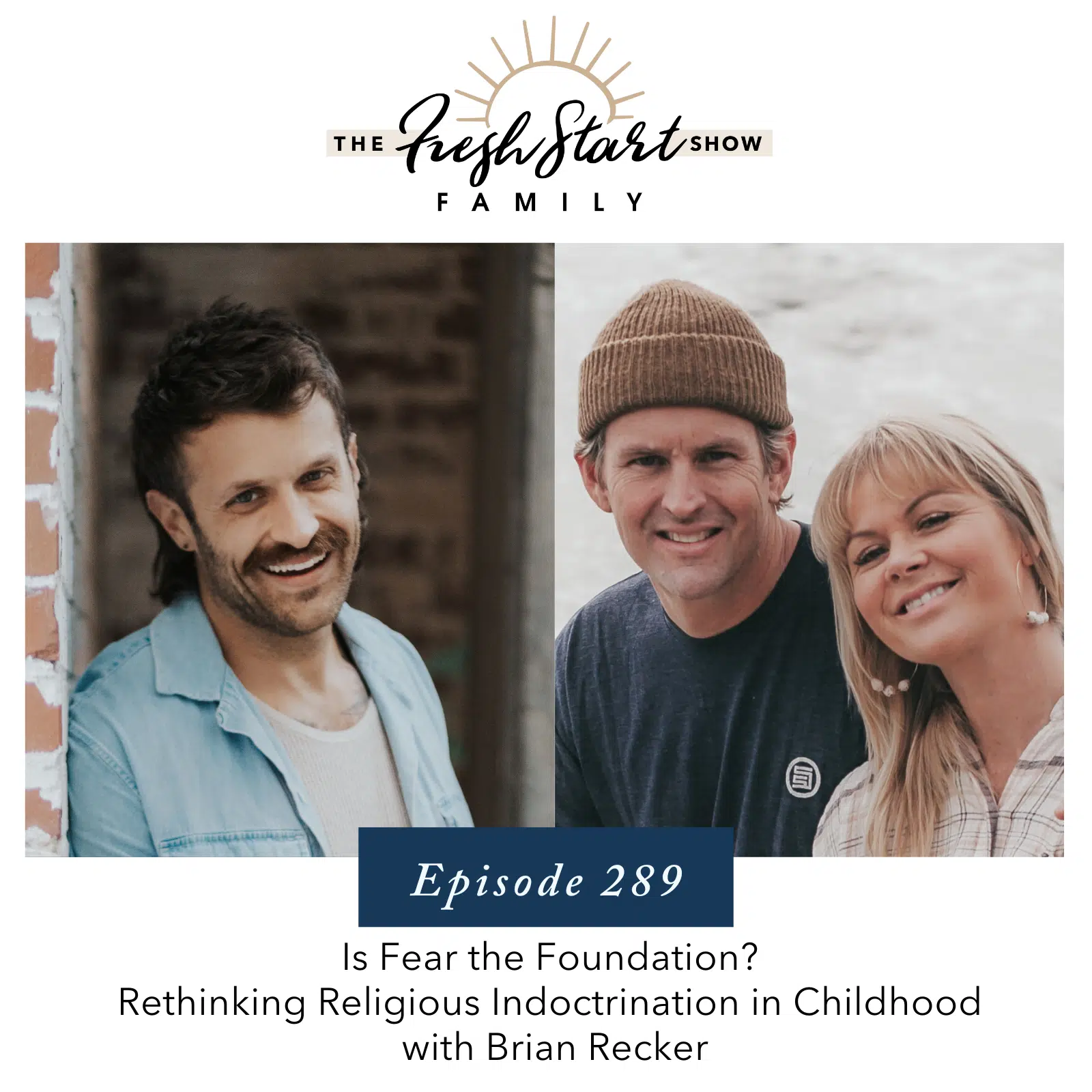
We’re kicking off Season 7 of the Fresh Start Family Show with a powerful, thought-provoking conversation! Wendy & Terry sit down with theologian, writer, and former evangelical pastor Brian Recker to explore how fear has been woven into the spiritual and parenting narratives of so many families—and what it looks like to begin breaking free.
Brian shares his personal journey from growing up in fundamentalism, to leading as a pastor, to courageously deconstructing fear-based theology and re-imagining faith through the lens of love. Together, we talk about how indoctrination in childhood shapes our view of God, authority, and even our parenting—and how we can begin to heal.
This is an honest, heartfelt, and deeply hopeful conversation. If you’ve ever wrestled with reconciling your faith and your parenting, or wondered how to raise kids without passing down fear, this episode will leave you inspired and reminded that you’re not alone.
Feeling stressed or short-tempered after summer? You’re not alone.

Join this FREE 4-Day live event to reset your mindset, bring peace to your home & step into a more unfrazzled, confident way of parenting. Start the school year with a fresh start . Register now – we start Sept 8th!
Episode Highlights:
- Fear is often the foundation of parenting styles.
- Many parents struggle with the transition from punishment to love.
- Deconstructing faith can be a painful but necessary journey.
- Political events can significantly impact personal beliefs and faith.
- Finding safety in new beliefs is crucial for healing.
- Teaching children about love and acceptance is essential.
- The gospel should focus on love, not fear or punishment.
- Healing from indoctrination requires community support.
- Parents can teach lessons without resorting to punishment.
- It’s important to recognize and unlearn harmful teachings.
Resources Mentioned:
Find Brian on Instagram
Brian’s Website
Grab a copy of Brian’s Book Hellbent
Catch Wendy & Brian’s IG Live
Watch the full episode one YouTube
Unable to listen or prefer to read along? Here’s the transcript!
Wendy Snyder (00:46.968)
Hello, families, and welcome back to a new episode of the Fresh Start Family Show. Terry and I are thrilled to be here today with Brian Recker.

Brian Recker (10:14.327)
Hahaha!

Wendy Snyder (10:32.588)
Today we're gonna be talking about how is fear the foundation? (Question mark) We are gonna be rethinking. I know my answer, but let's talk for almost an We're gonna be rethinking religious indoctrination in childhood. This is the start of our seventh season of the podcast, Brian, and you are our first guest. Welcome to the show.

Brian Recker (10:53.569)
very cool. very cool. I love that. Congratulations on seven seasons. That's incredible.

Wendy Snyder (10:59.926)
Thank you. Yeah. It's wild how like all of a sudden time is going very fricking fast. passage of time is a wild one right now. kids are teenagers now. Yeah, really hell of a thing. Good joke. Good joke, Brian.

Brian Recker (11:08.707)
hell of a thing time.

Yeah, I just brought my kids to their first day of school and just feels like I just did that last year, you know? And this is the last year that they'll all be in elementary school. Next year, I'll have a middle schooler, which is wild. That happened very fast.

Wendy Snyder (11:26.75)
Yeah, it really does. It sounds like such a cliche thing when your kids are little days feel super duper long and it just feels chaotic. And then that second decade, it really starts to go so so fast. So yeah, while I don't know how we got to our seventh season of the podcast, feels like just yesterday we started it. But we we really wanted to start the season off with a bang, Brian. And I think this conversation today, excuse me, is going to be.

Just solid gold, I respect, we respect your work so much. You are really helping to shape so many lives in a new direction with your work and your new book that is coming out, Hellbent, that we're gonna talk about today. And this conversation is gonna be really important for our students and our listenership. We are a parenting organization. We help parents go from stressed and frazzled to peaceful and empowered. And many of our days we spend

helping parents escape a reactive parenting cycle and replace an authoritarian parenting model with a democratic, firm and kind connection-based model that is life-changing. Like it is life-changing. We help parents really break painful generational cycles. We help them embrace compassionate discipline versus punishment. And I spend my days day in and day out helping families all over the world, tens of thousands at this point.

with how to do that and some have an easier time than others, right? To unlearn the patterns that we learned the first decade or two of their lives. And so as we talk about fear today, being this foundational element and whether as parents we really wanna use this as a tool, so to speak, to influence our kids, I'm coming at it from the angle of watching so many people that I've helped, the people who have the hardest time switching out and...

healing the nervous system, rewiring the nervous system, responding versus reacting, are the ones that were raised in high control religious settings. And so it's been really interesting to watch that unfold through the years. The people who found their faith later, I'm someone who wasn't raised in the church, I didn't find my faith till about 19, they have a much easier time adopting the strategies. And the ones that, again, were raised with more of the fear that we're gonna talk so much about today.

Wendy Snyder (13:48.333)
They just really struggle. takes them a lot longer. And it's just really interesting to watch. But they are equally as dedicated. Right.

Brian Recker (13:54.881)
Well, it feels like you're doing something wrong. Like it goes against your fundamental wiring of what you think God is like and what you're really supposed to do. I mean, I was taught that I was, it wasn't like we were bad parents when we punished our kids. We were taught that you were a bad parent if you didn't punish your kids. And so it does, it is like an absolute flip. I was judgmental of parents that were permissive and thought, yeah, those kids just need a good whack.

You know, like that was how I was trained to think. Cause I heard my parents say that kind of thing. When, when there was a parent that wasn't properly disciplining their kids, they would say, now there's a kid who needs a spanking. And that was something that like echoed in my head. And so when I had kids, that was a very normal thing to feel when I would see a kid acting, okay, that's a kid that needs a spanking. And I'd be a bad parent if I didn't execute that swift justice. and so it's a, it's a tough thing to completely. It's a real reversal. It's quite hard to do.

Wendy Snyder (14:45.388)
Mmm.

Wendy Snyder (14:53.876)
It really is. And that's why I'm so excited to chat with you as we dive deep into this subject of fear-based parenting, where it comes from. Obviously, we're going to talk so much about religious and indoctrination and all the things. But I know you're a father of four. And so you get it, right? You've probably been through a season where you're like, yeah, that's the way. And then now you're like, I don't think so, right?

Start us off, Brian, by telling us a little bit about your story. Your story is so fascinating, and I think like so many of us, it echoes what I really see as like a beautiful evolution, as Sarah Bessey calls it, like an evolving faith, right? Of growing and learning and unpacking, and that has been such a journey that's painful at times, but really, I know for me and us both has brought us closer to God.

But watching you do that publicly has just been so inspirational. So tell us your story. How'd you get to this point where you are a theologian and a pastor in the way that you are now?

Brian Recker (15:56.759)
Well, I was raised in fundamentalism. My dad is a fundamental Baptist pastor still. He has planted three fundamental Baptist churches in New York City. And so I grew up in a fundamentalist home, quite strict. And my parents are very kind people. It could have been a lot worse. Like when I watched some of the documentaries about kids raised in fundamentalism, I'm always like, wow, it could have been a lot worse. Because I think sometimes that...

fundamentalist way of viewing children gives permission to cruel parents and to baptize their cruelty as like It kind of says like hey, you're doing the right thing when you treat them like that Whereas I think my parents were fundamentally quite kind people, but they had they believed these ideas That's still leaked down, but I do think it could have been a lot worse But essentially, you know, I was raised to believe in obedience and hierarchy as kind of fundamental to the parent-child relationship

My, was, I grew up singing or listening to Patch the Pirate. I don't know if you're familiar with Patch the Pirate, but there's an obedience song in there. I don't know. That, that we would sing a lot. So Patch the Pirate is like a Bob Jones sort of guy. He's, he's passed away now, but basically he was a guy who lost an eyeball to cancer. And then he created this whole character creating videos and songs for kids and stuff. And one of them was obedience is the very best way to show that you believe.

Wendy Snyder (16:59.879)
No.

No. Delivered by a pirate?

Brian Recker (17:22.115)
action is the key. Do it immediately. Enjoy. will receive it spelled obedience. Basically the whole thing was obedience. just remember that because my parents would sing that song a lot when they would ask us to do things that was like this idea that, you know, even delayed obedience is disobedience. And the, yeah, I think the idea of rebellion was really essential to, they would talk a lot about how kids are just naturally rebellious. And all of that was undergirded by this belief that was ingrained in me from very young that I was deserving of going to hell.

from the age of five or six, I was first given the gospel and what the gospel meant to tell me at five or six that I was a sinner and that God's demanded that sin be punished and that if I was gonna stand before a holy God, I would either go to hell or heaven based on whether or not I had accepted Jesus as my savior, but that by default I was gonna go to hell. So I had to accept Jesus so that I could go to heaven and that was the whole deal.

Wendy Snyder (17:53.099)
tonight.

Brian Recker (18:21.411)
And so God was this big punishing guy who was going to damn me unless I was on the right side of that belief line, basically. was so, you know, evangelicals use this phrase like a relationship with God quite frequently, like, it's not a religion, it's a relationship. But for most of us, we entered into that relationship on the premise that if we didn't enter into that relationship, we would be eternally tortured. And so that is a hell of a way to start a relationship.

Wendy Snyder (18:32.011)
Yeah.

Wendy Snyder (18:46.613)
Bingo, yep.

Wendy Snyder (18:50.837)
Yeah. It's so effed up.

Brian Recker (18:51.427)
I mean, if you just think about any, yeah, if you just think about any of your meaningful relationships, like if it's like, listen, I love you so much. Um, and if you don't love me back properly, like I'm going to destroy you like forever. Um, like I'm going to come after you. I'm going to, I'm going to you on fire. Uh, it's, know, that, that's a talk. It's a toxic relationship that we, I, that I had with God really, because I was very afraid my, my relationship with God, the foundation of it was fear, love. And.

Wendy Snyder (19:04.031)
Yeah.

It's true.

Yeah.

Brian Recker (19:20.885)
I think having that belief that our kids are inherently wicked, that tends to be a theological support for a parenting style that sees your kids as, we're all inherently wicked. The best we can do is sort of bend them towards right behavior. And we do that via discipline and punishment, try to break their wills and that sort of thing.

And so that was, like I said, it could have been a lot worse, but that was like a fundamental sort of perspective. had a human nature of my own nature, and then it did begin to leak out on my kids when I had children of my own. But I ultimately did deconstruct at one level in fundamentalism. When I went to school, I kind of was disillusioned with fundamentalism, and I became a mainstream evangelical following college.

And that was like a big step of deconstruction at the time. You my parents were disappointed with me that I started going to a church that had a drum set because in fundamentalism, we was like no CCM even. Like Steven Curtis Chapman was too liberal for us growing up. Like, so no drums, King James only, no pants on women. Like that whole world was what I grew up in. And so for me to enter like a more mainstream evangelical church was actually an important thing.

Wendy Snyder (20:19.566)
yes.

Brian Recker (20:36.341)
It felt like a breath of fresh air at the time, even though the conservative theology was actually quite similar, the surface level felt a lot more refreshing. I could wear jeans to church. could come as you are type of a vibe. and I think, yeah, I did know literally I was a tattooed pastor at people at people sometimes assume that I got the tattoos all after my deconstruction, but I got tattoos while I was an evangelical pastor. Cause it was one of those hip churches, right? Where you could have, yeah, you had a cool band and the pastor had a tattoo or so.

Wendy Snyder (20:48.735)
Get some tats and not be exiled.

Wendy Snyder (20:55.029)
Right.

Wendy Snyder (21:01.065)
Yeah. Right, right.

Brian Recker (21:05.985)
I didn't have the hand tattoo. Like that would have been like maybe a little too much. I got that one after. But yeah, I think that was helpful because I think that initial deconstruction of fundamentalism, I had to lose my parents' approval, which is sometimes the hardest part of any deconstruction is it's not changing your mind about the beliefs. It's losing belonging. And that is often the tough thing for people stepping out of any high control religion.

And so even though was some years later that I ultimately left evangelicalism as well, it kind of gave me that muscle for trusting my gut a little bit and experiencing the loss of a level of belonging, which, you know, turned out to serve me. So I think, I think we all have things to deconstruct, even if you didn't grow up in that, like there are systems that are shaping us that we have to look at. So I'm kind of thankful that I grew up in fundamentalism because it kind of forced me to deconstruct because like, there's no way I was staying in that, you know?

Wendy Snyder (21:48.779)
room.

Wendy Snyder (22:01.567)
Right? Yeah, seriously.

Brian Recker (22:03.159)
It was like so crazy that it's like it had to be deconstructed.

Wendy Snyder (22:07.115)
Well, you had me at like no drum set. was like, no, that alone, we needed to do something else. no. Yeah. Our daughter's a drummer and we're like.

Brian Recker (22:12.383)
I couldn't listen to any music growing up. didn't know, but I still am very ignorant about like 90s music. Like people will be like, 90s hip hop is the best. I like, I wasn't allowed to listen to hip hop in the 90s.

Wendy Snyder (22:22.839)
No. my God. discover it now. Yeah.

Brian Recker (22:26.317)
Yeah, it's never too late.

Wendy Snyder (22:29.668)
It is never too late. Amazing. Okay, so you're yeah. Yep.

Brian Recker (22:30.925)
So that's the first leg of the journey. don't know if you, I could carry on into the evangelical pastor part, but I don't know if you wanted to pause there about anything.

Wendy Snyder (22:37.513)
Well, please, well, tell us so, no, you went on to pastor an evangelical church or co-pastor, whatever it was, for eight years, right? Before you decided, this is something, things kept coming up, right? That you're like, this feels a little off, or I'm gonna, I picture those of us who just silently backstep, sometimes not so silently, which is why we eventually get booted. But you just start to backstep, and you're one step back. Every month, you're like,

Brian Recker (22:46.381)
Yeah.

Wendy Snyder (23:06.155)
So like how did that look like for you to back step and then start using your voice to help people see things in a new light?

Brian Recker (23:08.631)
Right.

Yeah.

Brian Recker (23:16.419)
So what that basically looked like was I became a pastor when I was 25 years old in 2012. I was going to this evangelical church and I had already been leading a community group and you know I was kind of in their leadership pipeline and I was in the Marine Corps at the time and when I got out they invited me to help launch a new site. So I was a site pastor in a small coastal town in North Carolina and so we launched that site in 2012. It was the first site for the church so they became multi-site. I don't know if you're kind of familiar with that.

church model, but basically kind of a family of churches. So I was preaching every Sunday, which is really cool. And I was leading the community, but I was accountable to like this broader team that was made up of elders from all the sites. And so now I think they've got like four. Um, but I did that for some years and it was really rosy for the first few years. Like I said, I started in 2012, 2015, 2016, when Donald Trump came on the scene was kind of the first breaking moment for me where that was.

Wendy Snyder (23:46.825)
Yeah, that's we were there for 10 years. Yeah.

Brian Recker (24:14.763)
like where the rose colored glasses kind of started to shatter. And I realized, I've been very naive about what I'm a part of. And I kind of was, I just accepted that I was on the right side of things and that we were the good guys. That was kind of my default posture. was just going through the world like, yes, we've got the answers. We're in the right. I was raised to be kind of unquestioningly conservative. a part, I was homeschooled growing up. No surprise there as a fundamentalist.

And we literally listened to Rush Limbaugh for social studies. Like in my kitchen, we listened to Rush Limbaugh every day. So I was like indoctrinated, indoctrinated, you know? And so I hadn't been very politically.

Wendy Snyder (24:48.05)
Wow.

Wendy Snyder (24:54.111)
Yes. Yeah. So if you can get out of that, anybody can.

Brian Recker (24:59.851)
Yeah. And I don't know, maybe because of my, I think sometimes the deeper you go, the more obvious the rot is in some ways. And I don't know. So when, when Trump, first came on the scene, I thought, clearly we're going to laugh this guy off, right? Like he's not our guy.

And then I realized, like this is the front runner. wait, the people in my church are like excited about him. my parents are obsessed with him. Like what is happening? My dad, who sat me down in my kitchen after the Bill Clinton Lewinsky scandal and explained why character matters in leadership, blah, blah, blah, now is telling me, it's just locker room talk defending the Access Hollywood tape. So, like I was having some major, just like the hypocrisy was just hitting me in the face and...

Wendy Snyder (25:18.379)
night.

Wendy Snyder (25:34.475)
Bye.

Brian Recker (25:45.243)
I couldn't stomach it and I was watching people stomach it and I was like very confused. And that was my first sort of wake up call where I realized, we're on the wrong side of some things in some very dangerous ways. but I didn't, I didn't quit immediately at all. I, I instead began to really do some internal work and do some digging into my own political beliefs as well. I kind of came out of the other side of that really doing my first as opposed to, so basically here was my thought process.

Wendy Snyder (26:05.387)
Hmm.

Brian Recker (26:15.519)
I don't know everything. I'm not the smartest person in the world. I don't know everything about politics, but I could tell Trump was a bad dude. Like that was bad. I don't like I knew that was bad. And if the people who are saying that's good, in fact, this is one of the greatest presidents we've ever had. This is the best. Like, I don't trust your moral discernment at all. And then my next thought was what else were you lying to me about? Because I just literally swallowed what you were feeding me for years.

Wendy Snyder (26:24.319)
Right.

Brian Recker (26:41.603)
And if you think that's the best, then maybe I need to go back and do some work and not listen to you anymore. And so that was what I started doing. So I started re-investigating some premises, especially politically. And I kind of came out of that as a socialist. I also theologically started to do a lot of work. And one of the topics that I really began to dive into was hell because that one always bothered me. And I began to realize, oh, this is another issue where they were just telling me something that maybe actually

Wendy Snyder (26:48.348)
True. It's a great way to say it. Yeah.

Brian Recker (27:10.239)
isn't even in the Bible. And so over those next few years, I was, was doing a lot of work while still pastoring. And while I thought I was doing something good because, you know, a lot of these people were listening to Fox news every night and maybe being shaped in some very harmful ways. And I was able to sort of challenge that on Sundays and give them a different perspective about loving your neighbors. But it really wasn't until 2020 COVID epidemic, the whole crisis of, you know, you had a whole.

Wendy Snyder (27:29.995)
8.

Brian Recker (27:38.477)
whole country protesting over George Floyd. And when I preached about race, like I got all these angry emails from old white men telling me that it was like all made up. like, just, I got to a point where I realized I couldn't exist in this system anymore because I was giving it a stamp of approval that, that I couldn't do that anymore with my, integrity intact. And so I put in my resignation at the end of 2020. And when I was out of that position and that institutional pressure was no longer on me,

Wendy Snyder (27:44.712)
yep.

Brian Recker (28:05.473)
and I wasn't required to believe certain things as a part of my job. I realized how much being in that institution was keeping me from being my full self. And I was censoring myself in ways I wasn't even really aware of until I was out from under it. And so change happened even more rapidly. I had been evolving, but then it was like, once I was out of the institution, it was like my evolution kicked into overdrive in a way where it probably would have happened sooner had I not been kind of under that institutional pressure.

And definitely one of the things that really evolved at that point was my parenting because I was somewhat uncomfortable with the parenting that I was supposed to do. But in that world, all the pastors spanked their kids. We all like listened to, you know, regular evangelical mainstream voices on how to do parenting. And so I did spank my children for the first few years of their lives. And I'm so glad that I got out of that environment and was able to really deconstruct some of that stuff.

Wendy Snyder (28:40.971)
you

Wendy Snyder (28:47.285)
Mm.

Wendy Snyder (29:00.779)
so I'm so happy you did too, Brian. And so as you step back and you experience this new freedom and like, wow, I actually can use my voice and you felt some lightness, you just started speaking online, right? You just started to share some of the things. that you just kind of hopped on and started talking on Instagram? mean, obviously you've had...

Brian Recker (29:22.571)
Well, not immediately. It took me a little while. It was about a year after I quit that I did my first series of videos about why I believed Christians should accept queer people. And that was when, so like a year out, it kind of took me a little while to get my courage to do that. But I knew I needed to be public about it because I had been, as a pastor, at a non-affirming church. So our public stance as a church was that it was a sin to be gay. And so I knew I wanted to be public again about my change of belief because I was public before.

Wendy Snyder (29:33.728)
Yeah.

Brian Recker (29:52.213)
about this position, so that felt right. But I gave myself a little bit of time to get there because I knew what it would cost and it is costly. And all the people that were a part of that with me kind of view me now as a heretic, as somebody who's fallen away. They sent out a church-wide email about me. They took all my eight plus years of sermons down from the church website. And all of that was kind of to be expected, but it took me a while to...

to like be okay with all of that happening. When I did finally post that and all of that happened, I was really actually, I handled it pretty well I think, because I kind of knew it was coming.

Wendy Snyder (30:30.581)
You were ready, yeah. Yeah.

Brian Recker (30:31.969)
And it's not that everybody needs to post like that. I do think that if you have been publicly against a community that it's right and reparative to publicly repent for that. And so I've tried to be clear about that. And I was surprised at the way the platform grew. I wasn't like trying to do that necessarily, but I think...

Well, I do think it's a little bit rare. I mean, there are a lot of other people talking about these things, but I think in terms of someone who was an evangelical pastor, it can be tough because those were my people. Those are all your people. So even if you change your minds, a lot of people don't want to talk about that because it's like 90 % of my relationships are going to disagree with me and also think less of me for talking about this. And it's going to make those relationships strained. And so it is really hard. It's about a loss of belonging, I think, for people.

Wendy Snyder (31:27.477)
You're absolutely spot on and here at Fresh Start Family we teach parents that behind all behavior is four core needs for the most part. The need to belong, the need to feel powerful, the need to feel valuable, and the need to feel unconditionally loved. Like that's really what is driving almost every single human behavior and misbehavior and you're right, this questioning of these systems once you start to have your eyes open to like some of the harm.

that so many of us for years, just, like you said, you've got some rose colored glasses on, you're just going about the motions, you're stoked to be building your relationship with God, and then one day you're like, shoot, like one by one, there's some boxes that start to get ticked, and to step away from that and to step down takes so much courage, and then the next step is to start to not be silent about that, right, and to start sharing, whether that's at the Thanksgiving table with your mother-in-law, who you.

find the courage to say, actually, I don't believe that about this group of people. And I actually, this is how I support them, or this is how I now believe and teach my kids. Like it is just such an unwinding of the nervous system. And so we've already touched on kind of some of the common evangelical teachings that kids grow up with, especially when you're raised in the church, like the high control faith circles like you were, we touched on the the often

you know, the opportunity, so to speak, to give your life to Christ at such a young age, which really isn't a true, you know, free will moment, right? There's so many different things. There's purity culture often being taught that we know from, thank God, from Sheila Gregoire's work has been proven to be so harmful later in marriages for the, like a high, high number of people. There's just so much taught, right? There's the,

condemnation and the exclusion of the queer community to the point where parents are taught to literally disown their children, not go to their weddings and relationships. And what a timely, like I was just tripping on God's timing often in life, but like to have this interview beyond the week of James Dobson's death, where so many people are processing.

Wendy Snyder (33:46.153)
the harm that that man did for generations of human souls. And what I think is wild is even the people that weren't raised deep in the church, like again, I wasn't raised, I just had what I call like the normal fear and force, right? So I got spanked, it was an authoritarian model, right? It was just like, you do what you're told, because you're supposed to, like it was classic, my way or the highway. But what I think happened, especially since like the 70s, 80s, when Dobson came in,

to be, which is one of the most forefront authoritarian leaders of the Christian religion over the last 50 years, the culture followed behind. So was always that culture was there with the fear and force. But then I think that type of high control, fundamentalist, Christian, evangelical teachings, it really did influence so many others. And so I have students over at the UK.

Brian Recker (34:38.935)
No.

Wendy Snyder (34:41.95)
Right now they're in my high full mastery program, which is very intricately involved with me. We go very, very deep and help end these patterns and reshape their lives and their relationship with their kids. But to hear them about, it's kind of the same upbringing over there, the high control and the unwinding is so intense, especially for one of them where all the stuff that we're talking about was so rigid and enforced.

But my question is, Brian, our second point here today is just finding safety and doing things differently. And as you're talking about processing through the like that lack of belonging and you're like, you know what I did okay, I did okay. I stepped out and I did okay. But so many of my parents that I work with, it is a like mind fuck to get out of that because you are so terrified. You are doing it wrong. You are. And this comes down to this conversation around the indoctrination of like, if you mess up.

Brian Recker (35:39.661)
Yeah. Yeah.

Wendy Snyder (35:39.935)
The stakes are fricking high. If you listen to the wrong person, if you listen to a false prophet, like, I mean, it's very upside down, stranger things world, right? Like, who would have guessed that the following of Jesus Christ would be so like crazy, right? Like for those of us who are like compassion, empathy, patience, gentleness, self-control, like man, those of us who really take that seriously,

Brian Recker (35:44.642)
Right.

Brian Recker (35:58.915)
Yeah.

Wendy Snyder (36:08.828)
We are now, as you said, the heretics and like, but to go outside of that, it feels so dangerous because in my opinion, the nervous system has been conditioned in fear. And if you question authority, there was a price to pay, whether that was in physically getting hurt and harmed, emotionally getting hurt and harmed. And so that submission model is just so intense, which I think is why we have what we have in America right now, right? Where many of us are.

our jaws on the ground just going, how is this possible that a man like this could lead a movement similar to Dobson, right? Like how it is so clear to so many of us that this is harmful, crazy town stuff, but like so many people fall in line and submit under this authoritarian model. So the question is, is finding, what would you say to someone who was like, yeah, it's always felt like in my gut.

Brian Recker (36:55.715)
Yeah.

Wendy Snyder (37:03.4)
I didn't, I wasn't in line with the spanking or it doesn't make sense for me to like, if my kid was to be queer one day to be like, you are, you know, the love, the sin, it doesn't make sense to me. I've always felt it in my body that this wasn't right or all of it, like, but stepping outside and having my family question me or think I'm wrong, it just feels way too dangerous. What is your thoughts on that?

Brian Recker (37:31.671)
Yeah, I think that hell is a big part of that. It's like the ultimate trump card where if you step out of line, it's like, well, yeah, what if I'm going to hell? And I think a lot of people feel that. And it does trickle all the way down to, so your view of God.

I like to say it does matter what you believe about God, but not for the reasons we've been told. A lot of people think they have to believe the right things about God because if they're wrong about their God beliefs, then they might go to hell, right? So have to be right about God as if like the whole thing is about getting the answers right on the God test so that you can go to heaven instead of hell. I don't think that that's why it matters what you believe about God. So on the one hand, I don't care what you believe about God. I don't think God's going to punish you for being wrong. But on the other hand, it really does matter what you believe about God because what you believe about God

Wendy Snyder (38:03.539)
big debate. Yeah.

Brian Recker (38:17.483)
really does inform how you think you should live and how others should live and how the world should be arranged. And so if God is a punisher, a big controlling guy, an authoritarian dictator who tortures people that are on the wrong side of him, then yeah, of course that's the kind of president that you're okay with having. Like if God is going to send the majority of people who ever lived to hell for not being Christians,

then yeah, it's really not that hard to imagine why it's okay to send illegal immigrants to alligator Alcatraz. Like this is literally just like a small version of what you actually believe God is going to do for everyone. And so it does justify, and then also it really twists the very meaning of love because these same people believe that God is love. So then what they ultimately have to believe is that true love is about enforcing the right hierarchies and basically controlling people.

Wendy Snyder (39:03.977)
Mm.

Brian Recker (39:10.741)
And so it is quite a mutilated and harm, yeah, punishing, certainly. If God's love can include punishment, then our love can include punishment. And so for me, I think I got lucky in that deconstructing hell was pretty early for me, even while a pastor, because I was always uncomfortable with the idea. didn't like preaching about it. In fact, I didn't preach about hell. I would talk about death because that's much more biblical. There's a lot of talk about death in the Bible and how...

Wendy Snyder (39:11.739)
and harm.

Brian Recker (39:38.923)
Yeah, but hell, whenever I would get to a passage that seemed like it could be about hell, what I would actually find when you dive into the context is, this isn't talking about an eternal torture chamber that God sends people to. That's not what this is about at all. This is a metaphor. Is there something else going on here? I would dig into it. And I was like, wait a second, like, where is hell in the Bible? Because it's not in these passages that I was told that are about hell. These are about other things completely. And so I began to study it quite deeply. And

That was one of the things where it's like, well, what else are they lying to me about? And I began to realize that hell is not enforced as a rigid dogma because it's so clear in the Bible, but because the system demands it. The evangelical system demands it. In fact, when I first talked to the other pastors on my team about how I had begun to change my mind about hell, the, so my first step, didn't become a Universalist immediately. My first kind of

step was to go from eternal conscious torment, which is the traditional Christian doctrine that everyone who's not a believer is going to be eternally consciously tormented. Like it's as bad as it sounds. my first step was to become an annihilationist, which is, you know, all the image, most of the images that seem to be talking about hell are actually talking about death and destruction. And so a lot of Christians believe in annihilation, which really just means God's not going to make anybody suffer. Just that if you're, you know,

Wendy Snyder (40:44.169)
Yeah.

Brian Recker (41:04.547)
basically you'd be put out of existence. And so that was my first step. I don't believe that anymore. But I did talk to the other pastors about this because I was like, well, I don't believe this. And like, that's the official position of our church. So there was like an integrity issue. And when I first brought it up to the lead pastor, he was like, okay, so you don't believe that God's gonna torture people in hell. I was like, okay, but you believe something bad is gonna happen to them, right?

And I was like, yeah, you know, it's bad because like they'll be, you know, annihilated. So that's still bad. He was like, okay, good. It was like some, there is like a bad thing, right? As long as something bad happens to them, there has to be a them and there has to be a punishment or else the system doesn't make sense because why be a Christian unless non-Christians are punished in some way. So the whole worldview is based on punishment, on being on the right side of punishment. And

Wendy Snyder (41:36.872)
Right.

Wendy Snyder (41:43.965)
Yes.

Wendy Snyder (41:52.307)
Bingo.

Brian Recker (41:54.857)
It wasn't until, and I knew that I had to stop at an annihilationist, I couldn't become a universalist because once you really uproot the whole idea of a punishing God and realize that's not what spirituality is about at all, the whole thing is not about avoiding punishment, it's about growing in love. Once you do that, you really have to throw away evangelical spirituality altogether because the whole thing is built on a framework of punishment and hierarchy and control. So.

For me, I had already begun to do some of that work. As I stepped away, I really realized like, okay, I actually, I was only being an annihilationist because I was a coward and I didn't want to break fully with the evangelical structure. I wasn't ready. But I began to go even deeper in my theology and really just rejected the idea of a punitive God altogether. And that was really helpful because I was also, when in 2020, my oldest son was five.

And I was beginning to feel uncomfortable with the ways that I was parenting him, but those ways were rooted in the theology and philosophy that I had grown up with. so deconstructing a punitive God and punitive theology helped me to embrace even gentle and connected parenting. did you guys see that video that Ali Beth Stuckey posted this last week by any chance where she talks about gentle parenting?

Wendy Snyder (43:05.555)
Yes.

Wendy Snyder (43:11.241)
I have not had the, I cannot watch it. I can't do it. I just read the commentary. Yes, and I just, feel like I'm physically gonna vomit at this point, so no.

Brian Recker (43:16.833)
You know a video I'm talking about?

Brian Recker (43:24.215)
So basically, her and this other girl are talking about how, you know, they're critiquing Dr. Becky Kennedy and saying, you know, the whole idea of good inside, this is terrible. We're not good inside. You're not good inside. Your children aren't good inside. And this undermines, they go on in the video to say this undermines a substitutionary atonement. That if they're good inside, then Jesus had no reason to die. So in other words, their whole system is, of course they deserve to be punished.

Jesus is punished in their place because God had to punish somebody the whole thing is based on somebody has to be punished Okay, and so either you're gonna get punished for your sins or Jesus will get punished for your sins But the punishment has to go somewhere in that framework though when you think about it punishment is God not love Because if why can't God just forgive no no God just God has to punish so forgiveness doesn't win grace doesn't win

Wendy Snyder (43:53.779)
Yes.

Brian Recker (44:13.195)
Love doesn't win, punishment wins in that framework. And that is their gospel story. They said good inside, gentle parenting. They said it undermines the gospel. And so for me, I realized that was actually a tension, even though I wouldn't have said that out loud because I realized how cruel and like just bad that sounds. Like that sounds like an ugly gospel. I wouldn't have said it out loud like that, but I did have those beliefs. That is the story I was raised with.

And so I knew that I needed to have a better story. If I was going to believe in God at all, it had to be a new God. It had to be a better God. It had to be a God who is actually love, not a God who actually was subservient to punishment. And so part of the journey of me wrestling with, can I even hold onto the Christian story? Is there Christianity that exists beyond the spirituality of punishment is where my book even came from.

Wendy Snyder (45:07.72)
That's so interesting to like, I don't know, think about how everybody's view of Jesus dying on the cross could be so different. Because like, I've always looked at that as like, you know, like there's the saying like, I take a bullet for you type of thing or like, how much do you love somebody and how far would you go for someone? Exactly. That's the way I always looked at it was like, that's the display that there's like, there is no, there's no further.

like God could have gone or Jesus could have gone, he went all the way for us. And that was like a display of love. Like to think about it as like somebody's gotta get punished, wow. But it makes total sense with then how then people view children, view everything. It's a totally different view. Same story, totally different view. Yeah, and that's what I think.

Brian Recker (46:05.131)
I like how you said it. Well, I was just gonna say a lot of it has to do with taking a beautiful metaphor. And if you just, if you make it wouldn't be literal, it becomes toxic. like me saying like I would sacrifice myself for my son, that's a beautiful thing, but it's a metaphor. It's not a literal sacrifice. If I was to literally lay on an altar and sacrifice myself to a wrathful deity.

Wendy Snyder (46:25.479)
Right.

Brian Recker (46:29.043)
Also that my son could be like, that would actually be like, wait, what's happening here? That's very, that's actually gross, you know? But like the idea, the metaphor of sacrifice. So it is like taking a beautiful metaphor and when you make it woodenly literal, you actually lose what makes it beautiful. And then you end up with a very toxic view of God.

Wendy Snyder (46:34.778)
Yeah. Didn't ask you to do it. Yeah. Yeah.

Wendy Snyder (46:49.594)
Yeah, and I just I you know, I just want everyone to listening to remember that you really really are at choice with Christianity if you are choosing to be part of the faith and hopefully there's some people listening to this that are not even in the faith. Maybe we got some atheists. We got some Jewish families, some Muslim families that are just more interested in like how could this happen in our nation? And this is how when we're talking about this fear based model, this is how right? But like, yeah, for those of us who

who believe deeply in that Christian faith. It's like, I just think it's so important. You are, it sounds like, at a beautiful church that does things very different, right? Like, it sounds like, you're in North Carolina, right?

Brian Recker (47:31.989)
Yeah, so I go to a Methodist church and you know not all Methodist churches are exactly the same but as a denomination they did recently in the last couple years publicly move as a denomination to be fully affirming which is a big deal for me. But some people might not be comfortable simply because that only happened in the last few years too. you know I don't know that Christianity is always going to feel safe to people that have been harmed in that way. But my church really goes out of its way to be incredibly inclusive and

Wendy Snyder (47:51.101)
Yeah.

Brian Recker (48:00.451)
I do think it's a great community there.

Wendy Snyder (48:03.858)
Yep, and our children went to a United Methodist preschool. We've had so many full circle moments here. We're now at Disciples of Christ Church after, gosh, almost 12 years in the evangelical mega world, cool hip church world. And now we're at like 150 year old congregation, Disciples of Christ, fully affirming about justice, joy, and inclusion in the name of Christ. And it's just so rad to see how much different

Jesus' death is taught, right? Like it is fully, as Terry said, it's literally like took the bullet for us because he refused to step into this like overpowering of other people and literally like when it comes to turning the cheek, like what a great model of refusing to step into that type of power and overpowering other human beings and.

and starting a literal war that would have been started if he would have resisted, right? Like death and destruction would have followed a lot of people. So there's just, I just want everyone to remember that there's safety all over the place, but when you are deep in these circles, and especially if you've been raised by them, I wasn't aware until I essentially kind of got kicked out of the cool, hip, evangelical church in our town because I was an affirming person and I shared about that and I became dangerous.

Brian Recker (49:03.523)
Yeah.

Yeah, I mean, I think.

Wendy Snyder (49:27.004)
I didn't realize there was five churches in our two mile radius that operate in a much different way that are not teaching those classic things that we're talking about that are not preaching this like type of like punishment hell-based thing to children. So I just want everyone to remember that. you, Brian, and we are just great examples. Even you in the South have found a place that is...

is doing it differently and there is safety even though you lose people when you decide to step away from some of the harmful systems that you are realizing it starts in your body. You can feel it in your body like, uh-oh, something's off here. And when you develop the ability to listen to that, is painful to lose the belonging, but then if you just trust us, you can find a new belonging. And you're right, some people are just like, hell, screw that, I'm out.

Like I want nothing to do and some people never come back to the Christian faith, some people might come back a decade later. But there is, we have realized that there are a lot of spaces that are operating in a much different capacity.

Brian Recker (50:34.253)
Yeah, and I'm hopeful that my book can be helpful for both of those sets of people. know, if you're looking to hold on to a Christian spirituality that isn't rooted in fear and punishment, then I think I wanted to write a book to help people do that. But I also think that even for people who want to break up in a cordial way with it completely, knowing that those ideas can still haunt you even after you do that. Like, I think some people have said, OK, I'm not a Christian anymore.

10 years later, they still wake up thinking, what if I'm wrong and what if I'm going to hell? Because that's the only way that they were taught to think of about God. And so if your only mental model for God is a big punishing guy who's gonna send you to hell, and you're like, well, I'm not gonna believe in God, I'm an atheist now, okay, I don't believe in that God. But it's like, but what if I'm wrong? And so I think even if that's you and you're like, I don't have any desire to go back to Christianity, recognizing that that was never the God that was being revealed by Jesus, that wasn't ever what it was about.

Wendy Snyder (51:06.002)
Yep. Yep.

Brian Recker (51:27.681)
I think can be really healing for people, even who say, I don't think I want to identify as a Christian, but it's actually really good to know that even that's not what Jesus was talking about at all.

Wendy Snyder (51:38.845)
Yeah, and for someone who teaches the nervous system healing and regulation day in and day out, just for everyone to remember, it's just the nervous system being conditioned by the water you swam in growing up, right? Like it's literally just a nervous system setting and the nervous system is so incredibly capable of healing and it just takes so much dedication and good.

mentorship and therapy and finding a community that does it different, you know? But boy boy, it's like that nervous system again, so much of my days, I am working with people who have intense suffering from those type of things. The what if I'm wrong, it literally like, that is just one aspect that like Rob kills and destroys families. So like, it's just so cool to work day in and day out with people who are dedicated.

to unwinding that and it is possible, but sometimes it can take a decade or two or sometimes even three. So all this beautiful conversation, Brian, around some things that we know is coming to the light as far as like, yay, we probably wanna back away from teaching this to our children. And Terri and I, our oldest is almost 18, she goes to college next year. And I've kept so much from like her first 15 years of life specifically. And I have a lot of like notes and stuff from when

We were in the evangelical mega church and she went to Sunday school every week and we know that she was in that, right? And we watched some of the things and now that we know what we know, we realize, yikes, like we don't, if we could do it again, right? Like we wouldn't have her dropped into those environments. Like that example, if I'm sure you saw it, I know you probably commented on it. A lot of people might be familiar with the Jackie Hill Perry video.

 So like, we, you know, there's this very like viral video where she's sitting with these small children and she's like, you deserve to die. You know, it's just like, so it was such a beautiful like.

Brian Recker (54:24.001)
Okay, okay, okay, okay. Let's rock it.

Ha

Wendy Snyder (54:46.0)
a great opportunity for so many incredible pastors. My friend, Meredith Miller, did a great piece on that and how that's a horrible way to teach children. And it's just, we know it does damage, we know. But the people that are deep in those evangelical spaces, they continue to reinforce that message in Sunday school. And I think a lot of people are realizing they don't want to have that be what their children learn.

As we wrap this conversation, Brian, I mean, we could talk to you for hours. There's a million things, like the original sin conversation. That's what I originally thought I was gonna interview you on. And then it's like, okay, cool, let's dive deep into the hell conversation. There's so many things, but when it comes to like, what are the alternatives that we do wanna teach kids when it comes to the concept of eternity? like from your theological studies and

and your experience and your incredible wisdom that you bring to the table from a scripture perspective, what do you now believe that you are teaching your young sons? And even, I think you have a daughter in college, right? That I'm sure you're having conversations with her about like, hey, you might've learned this when you were young, but here's what I see as truth, which we know the word truth has been like fricking.

Brian Recker (55:53.88)
Yeah.

Brian Recker (55:59.789)
Yeah.

Brian Recker (56:03.768)
Right.

Wendy Snyder (56:04.727)
weaponized by the evangelical world that like there is this written in stone somewhere. It's like no, these are opinions. We are all interpreting scripture, right? Like those of us who do Christianity in this way, we read the Bible from a contextual lens, not an inerrant and fallible. Like it's just, so these are opinions, of course, but we are here in community and I would love to hear what you are teaching your young sons and what you recommend parents can dive into. And I know your book.

Brian Recker (56:09.581)
Yeah.

Brian Recker (56:24.461)
Yeah.

Wendy Snyder (56:32.251)
probably goes into this and then they'll walk away understanding a different way.

Brian Recker (56:37.399)
Yeah, in many ways, it's kind of the opposite of that, that you deserve to live and you deserve to be loved. God doesn't love you in spite of who you are because you're actually broken and unworthy of love, but God died for you anyway, but actually you are worthy of love. I think that's actually the foundation of a healthy self-image and also a healthy relationship with God. The very first words that God speaks over Jesus.

Wendy Snyder (56:42.565)
Yeah.

Brian Recker (57:06.655)
at the beginning of Jesus's ministry before Jesus does anything. Jesus hasn't healed anyone. He hasn't walked on water. He hasn't died for anybody or forgiven anybody or cast out any demons. He hasn't done anything. He steps into the water to be baptized and God speaks and says, this is my beloved son in whom I am well pleased. And for me, I think in some ways, Christian spirituality is learning how to live in that reality. It says that,

Wendy Snyder (57:28.295)
Hmm.

Brian Recker (57:36.301)
The passage says that heaven was torn open and that Jesus heard that voice. And heaven is not like, it's not like a crack in the sky opened up. The idea of heaven is a spiritual reality that's actually all around us. I don't think that heaven is somewhere else. It's God's space, but it's right here and with us. And I almost like to see it, it's like the other side of the veil. And it's like, it's what's deeply true all the time, but we're not always aware of it.

Wendy Snyder (57:52.763)
Mm.

Brian Recker (57:59.399)
And in that moment, it's like the crack did open, the veil was lifted. And on the other side of that spiritual reality, was this idea of belovedness. You're my beloved child and I'm well pleased with you. And the Old Testament has these pictures of God rejoicing over God's people. And I think that on the other side, if you could see what God was up to right now, I do believe God would just be speaking belovedness over you.

that God would be saying, you're my child and I love you. that it only goes in that one direction, that it's only ever love because God is love. And so that's the gospel. The gospel isn't you deserve to die. The gospel is you are loved. You've always been loved. You don't have to do anything to be loved. You don't have to earn God's love. You don't have to do anything at all. You only have to receive it and believe it. And because it's always true, we have a hard time believing that about ourselves.

And if you can't even believe that about yourself, you're never going to believe that about other people. So that's the gospel is that you deserve God's love that and that so does everybody else because we're all made in God's image. And unfortunately, many of us learned a story about God, a story about the cross, a story about ourselves that said that we weren't worthy of love, that we were something other than God's precious creatures, that we deserved death, that we deserve punishment.

And then we leak those beliefs out onto our kids. And it has been work to unlearn some of that. But actually, the act of parenting and reparenting, in parenting my kids, I'm often reparenting myself, they'll have some act of misbehavior or a dysregulation. And my initial response in my nervous system often is still to punish. That's how I was raised. And I will often feel like doing to them what was done to me or reacting to them the ways that

would have been reacted to if I would have acted in those same ways. And I will often have to stop myself and remind myself that, yeah, I know my inner child is like, that's not fair. And, you know, I want to punish these kids. But actually, they don't need my punishment. They don't need a dictator. They don't need some authority figure. Right now, they need a father. They need my love. They need compassion. They need presence. They need connection. They need boundaries and safety. And when I do that, I'm often able to tell myself, and you didn't deserve that either.

Brian Recker (01:00:18.177)
You know, you didn't need that either. They're worthy of love right now and you're worthy of love right now. And I do believe that it's love that will heal us, punish.

Wendy Snyder (01:00:28.007)
It's so beautiful. love that. What a journey from the very beginning of if you want to enter into this relationship, do it for fear of going to hell to what you just said. And it sounds like there was just so much that you needed to go through, unpack. I can't imagine all the conversations that you had and the courage that it took to

walk out of circles to risk losing friendships to just saying, know, this doesn't feel right. So I just commend you on your courage, your bravery, and then how you decided to break a generational cycle to do things differently with your kids and your family.

That's huge. So I think that's a message to so many dads out there right now. I know there's a dad right now listening that's just saying this, this doesn't feel quite right. And so I hope today is the day for that dad to hear what you just heard and look at God that way. And me too. And I love it because when you speak about the foundation of what you're teaching your children and

Brian Recker (01:01:38.775)
Yeah, I hope so too.

Wendy Snyder (01:01:49.923)
knowing that like you've done the work, right? Like you are a theologian, you are a pastor, you know, so many people that come in hot that are like, no, no, no, no, no, no, this guy says, it's like, do you understand how much thought and study I have put into this? You know, like, clearly you have done your homework, Brian, and what you are preaching and what you are encouraging parents to understand that there is a different way.

Brian Recker (01:02:06.339)
Yeah.

Wendy Snyder (01:02:17.304)
And studying hell and the scriptures associated with it and the teachings around it, especially to young children from a young age, that's just one fun section of becoming an evolving Christian, right? Of like really diving into these scriptures in this particular area. And I know your book is such a great way to do that. But really, that is, to me, it's a gospel of abundance. There is plenty. There is plenty of love. There is plenty of grace. There is plenty of forgiveness. There is plenty of time.

There is plenty of ability in all of us to teach with firm kindness, to teach lessons, life lessons, instead of punish our children, to let go of the concept that we need to make our children behave, or to make our children feel worse in order to make them behave better. We can let it go. There is plenty of ability. Even if your nervous system has been paved very, very deeply, that knee-jerk reaction to punish is what I'd say 60 to 75 % of our students face day in and day out.

that urge to react is the number one pain point in our community. But we know that studies have shown that when people live with that scarcity mindset of there's not enough, right? Like you are on edge, there is not enough and God is watching and there is gonna be punishment if you don't get it right. Like studies have shown that perceived scarcity fuels aggression and distrust. And it does it in homes, it does it in communities, it does it in the world.

And we just see it play out with authoritarian leaders of all kind, whether that's in the home, whether that's in our nation. And so to be together with someone who is really empowering families to do it differently and to do it from a true, like, gospel-centered way is just so beautiful and so refreshing. So thank you, Brian, for your work. I know you bust your ass to teach and in...

and to encourage people. And so we are really grateful for all that you do. And I cannot wait to finish your book. I've started it, but don't have a hard copy yet. So I am just going to dig through it as soon as I get that hard copy. And I can't wait to finish it. Please tell listeners where they can find it, the exact drop date. I'm pretty sure that it'll be dropped by the time this episode comes out in a few weeks. But tell listeners all the places that they can come find you in the book.

Brian Recker (01:04:34.881)
Yes. Well, first, just the last thing I'll say is those are really kind words. And I just want to say that I don't always get it right. And I still I still do punish my kids sometimes. And I always regret it. But it gives me the opportunity to to come back and repair with them when I do respond in ways that I think we're not loving. And they need to see that, too. So and that's another thing that a lot of us didn't see modeled is that is that repair because we're not God.

Wendy Snyder (01:04:48.294)
Ha!

Brian Recker (01:05:03.339)
You know, sometimes people will say God's ways are higher than our ways. And I'll say, yeah, I agree. Like my love sometimes, despite my best efforts, does still include punishment. But I don't believe that there's any punishment at all in a God of perfect love. But yeah, my book comes out September 30th. Anywhere books are sold. Audio, I'm doing the audio, which I'm really excited about. Hardcover and digital all on September 30th. So yeah, you can pre-order it anywhere. Amazon, thrift books, wherever.

You can find me on Instagram at B E Rekker, R E C K E R at Gmail, or I started to get my email address at B E Rekker. And yeah, no, don't email me. Well, you can. My, my sub stack. also do some writing on sub stack, which is beloved with Brian Rekker. And so you can find me there as well.

Wendy Snyder (01:05:39.11)
People are gonna email you.

Wendy Snyder (01:05:52.719)
I love it. And let's just hit the pre-orders then because this episode will come out still in pre-order season and you've got some hot, hot, hot pre-order bonuses. So yeah.

Brian Recker (01:05:58.723)
Okay. Oh yeah, a couple of incentives. Yeah, so if you pre-order it, and there's a link in my Instagram bio where you can just upload your receipt and download some goodies. One is an essay I wrote, Five Things That I Would Tell Myself When I First Started Deconstructing, which is kind of a personal essay of some things that have been just really helpful for me. So that's in addition to the book.

The other one is a cheat sheet that goes through the top five most fear-mongering hell passages in the Bible and just gives a very brief reframe of other ways to think about those. So if you're looking right now for like, wait a second, like Bible doesn't talk about hell, like what are you talking about? There's these, passage, this passage, this passage, this passage. That cheat sheet will just quickly go not through every passage, but like the top five and just give a quick reframe, which kind of will apply to many of the other passages as well.

And then the third one is chapter one of the book will also be immediately available for download when you pre-order. So yeah, if you pre-order anywhere and then you can find my in my Instagram link or Instagram bio is a link to those goodies.

Wendy Snyder (01:07:02.5)
Yes, I love that. Those are some good, good bonuses for sure. And with the punishment stuff, Brian, just remember, everyone does that in the beginning. my book's coming out May 2026, Fresh Start Your Family, and I tell so many stories about where I really got it wrong. And like, you know, like really good, juicy stories that are like, here's how you will continue to punish. You will continue to react.

but that's part of the unwinding of the nervous system, right? And now you know me, Brian, so I can teach you all my magic, know, compassionate discipline ways and responsive parenting ways that are gonna help you walk off that ledge when you're tempted. it's been May, 2026. So we got a little bit, but next spring. I know, we're so excited. Brian, thank you. Thank you for being here so much. Thank you so much, Brian. Yeah, it's been so, so good. Yeah.

Brian Recker (01:07:40.535)
When does that book come out?

Brian Recker (01:07:44.631)
That's very cool. That's super helpful.

Brian Recker (01:07:54.531)
Thanks guys.

Wendy Snyder (01:08:00.208)
Awesome!