

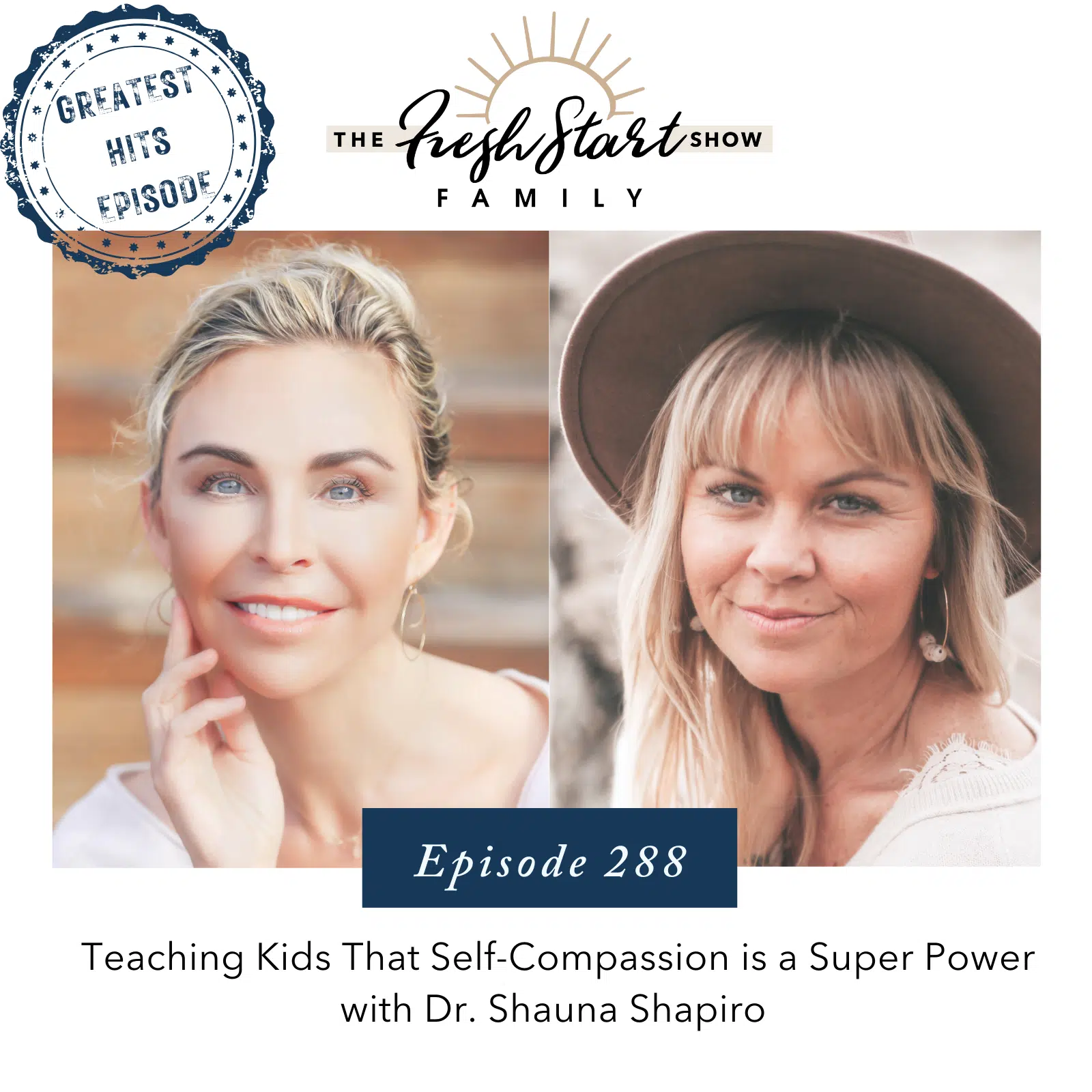
On this episode of The Fresh Start Family Show, Wendy welcomes back the incredible Shauna Shapiro, PhD, who is a bestselling author, clinical psychologist and internationally recognized expert in mindfulness and self-compassion. She was first on the show back in episode 49 but is back, joining Wendy to discuss her new book, Good Morning, I Love You Violet, which shows us how we can teach our kids to embrace the super power of self-compassion.
This episode will inspire you to begin – or continue growing – your self-compassion, which will create a ripple effect with your kids to show themselves self-compassion and resource themselves with this powerful tool.
What if you could be an effective, firm & kind parent WITHOUT relying on fear, force, bribery & rewards?
Imagine learning a new way of firm (AND kind) parenting so you can end painful generational parenting cycles and create family legacies & memories YOU are proud of?
All while getting your kids to cooperate with your rules and boundaries with ease.
IMAGINE …
Parenting your kids with calm & confidence each day in a way that causes them to do what’s asked of them because they WANT to (not because they HAVE to) … because you’re helping to build essential life skills that have them behaving well & being respectful when you’re NOT looking!
The Firm & Kind Parenting Blueprint is your step by step plan & video training to help you build the family of your dreams. Click HERE to learn more now!
Episode Highlights:
- We teach kids how to be kind to others, but not often how to show themselves kindness and self compassion
- Judgment and shame shuts down the learning centers of our brain by activating the amygdala, whereas self compassion activates oxytocin, serotonin and dopamine, which activates learning centers to change and grow
- Self-compassion is about learning to be on our own team
- Our brains are primed for learning the 60 seconds following a mistake, if we can avoid shaming and beating ourselves up and choose to learn from it instead.
- When we are hard on ourselves, others interpret us as hard on them, and likewise, when we are kind to ourselves, others perceive us as kinder with them.
- We’re not teaching that the mistake was ok, we’re teaching kindness around the humanity of the mistake so we can make a different choice next time
- People high in self-compassion are more likely to make amends around a mistake because they aren’t feeling shame around it
Resources Mentioned:
Where to Find Shauna:
Get your copy of her new book Good Morning, I Love You Violet
Ep. 49. Using Self-Compassion to Transform Your Family with Shauna Shapiro
Unable to listen or prefer to read along? Here’s the transcript!
Hey parents, quick heads up. Our free four day un frazzled workshop is coming soon. This is all about helping you reset, recharge, and step into the school year with simple nervous system regulation tools and a powerful parenting framework. Registration opens on August 29th and the first session kicks off on September 8th. But I want you to mark your calendar now at Fresh Start Family Online dot com slash save the date so you don’t miss out.
More details coming soon. Hey there families and welcome to a Fresh Start Family Show, greatest hits episode. I’m so happy that you are here as we take a little time to slow down this summer, spend some great intentional time with our kids and our family. Our team wanted to gather a collection of our most favorite guest interviews that we’ve done here at the Fresh Start Family Show over the last few years.
And we are really excited about the lineup that we’ve chosen for you. So enjoy these greatest hits episodes this summer. And I pray that you are making time to just be really present with your children too and that just maybe you’ve been able to slow down your schedule a little bit to create some more white space, hopefully some more time outside in nature. Soaking up the long light filled days that summer brings and just praying you have peace and empowerment and joy this summer with your kids and your family.
Enjoy this greatest hits episode. Welcome to the Fresh Start Family Show. I’m your host, Wendy Snyder, powerful parenting educator and family life coach. And together we are going on a journey to help you Expand your heart, learn new tools, and strengthen your family so you can build the family legacy of your dreams. I’m a mama two turned child and family advocate who went from being extremely stressed out back when my strong-willed little girl was a toddler, to now thriving as a parent and having the honor to support thousands of families each year who choose to go from frazzled and impatient to peaceful and empowered.
Each week we will dive in with experts, thought leaders, authors, and advocates with insights to help you thrive in your parenting walk as well as in your marriage and even in your career. And faith. Walk too together, sometimes alone. Sometimes with my better half and co-host Terry, we’ll explore the triumphs and trials we all face as parents and share practical tools to fill our hearts, minds and souls with inspiration. Take a deep breath and get ready to be poured into with some Fresh Start.
Inspiration. Let’s do this.
Well, hello their families and welcome to a new episode of the Fresh Start Family Show. I’m your host, Wendy
Snyder, positive parenting educator and family life coach. And today on the show I have my friend Shauna Shapiro, who is going to be talking to us about how we can teach kids that self-compassion is a superpower. But before I welcome Shauna to the show, I’m gonna tell you just a little bit more about her. Shauna has been on the show before and many of my students know her. She’s the author of a good, a book called Good Morning, I Love You, which we recommend to almost all of our clients inside of our fresh start experience.
But Shauna Shapiro is a PhD, is a bestselling author, clinical psychologist, and internationally recognized expert in mindfulness and self-compassion. She’s a professor at Santa Clara University and has published over 150 papers and three critically acclaimed books translated into 16 languages. Dr. Shapiro has presented her research to the king of Thailand, the Danish government, Bhutan’s Gross National Happiness Summit, and the World Council for Psychotherapy as well as to Fortune, fortune 100 companies, including Google, Cisco Systems and LinkedIn.
Her work has been featured in the Wall Street Journal, Forbes, Oprah, NPR, and the American Psychologist. Dr. Shapiro is a summa cum laude graduate of Duke University and a fellow of the Mind and Life Institute co-founded by the Dalai Lama. Her TEDx talk, the power of mindfulness has been viewed over 3 million times and now her new book, Good Morning, I Love You Violet is scheduled to release this fall. So welcome to the show Shauna.
We’re so happy to have you back. Mm, thank you so much. Thank you for that introduction. I’m excited to be here and so excited about this new children’s book. Yeah, must meet too. I can’t wait to get this into my hands. Good Morning. I Love You Violet. Tell us about this. Tell us about how this came up and in case listeners haven’t listened to our other episode that you were on, which really is a fan favorite. We, we recommend it in a lot of our coachings ’cause in our side of our fresher experience, we love individual unique coaching for our clients and a lot of them that your book comes up, your episode comes up and we assign it like it’s like homework.
Like we want you to go listen and go read this book. Actually, I was just had a private session today with someone who was finishing like the last chapter of Good Morning. I love you probably because we said you need to read this. So, but tell listeners a little bit more about you and your story and then lead us into your newest book. Yeah, so I think for me, you know, this has been a lifelong passion teaching mindfulness and self-compassion. And I learned about these when I was a teenager, so a long time ago, and they’ve really kind of set the path for my entire life.
So I feel that I have kind of this mission and this calling to share with others. And for most of my life I’m a professor and a scientist and I’ve spent most of my life as a clinical psychologist working with adults, working with parents, working with women with breast cancer and veterans and executives and lots of different people. And I really became interested in neuroplasticity in kind of how the brain changes. And as a clinical psychologist, this is really what I do is help people rewire their brain for a healthier, better life.
And as I’ve been diving into neuroplasticity, what really struck me is even though yes, it is possible to change your brain as an adult, which is radical and exciting and and new. We didn’t even believe that or know that back in the 1990s, what’s even more clear is that wiring your brain in a healthy way as a child is much more effective. That if we can give our children resources when they’re young, right? Just like learning to ride a bike that gets hardwired for the rest of your life.
You learn how to read, write, speak languages, and yet we don’t think about how can we cultivate, you know, emotional and cognitive resources for our children that make them resilient, that protect them against the inevitable life stressors that are gonna come. And so that’s really what prompted the writing of this new book was the realization that it’s so much easier when you’re a kid, right? That and that this idea of teaching children to be kind to themselves, this idea of self-compassion is radical.
We don’t talk about it. We teach children how to be nice to others, how to share, how to give, how to use your words. But we don’t ever talk about how do you treat yourself. Mm, it’s so true. And then you add on the level that so many parents are learning how to do this. Like you mentioned, like we weren’t taught, right? So we’re learning how to do this self-compassion piece in the third, fourth decades of our lives while we’re teaching our children the same thing, but we’re like learning together, right?
And so it gets messy at times and I think God’s incredible how he aligns life and there’s so much that hap has happened in my own life this week and my husband’s work that’ll tie into our conversation today. But it really is just such an incredible skillset that that drives everything and you don’t really realize how much it does. But when you are hard on yourself, it really affects The way you see the world. It affects The way you either take criticism and make it like destroy you or not.
It just, it really is like this in this odd way, the foundation a lot of our life is how kind you can be to yourself when you are imperfect. Exactly. And I, and I think it’s such an important skill and it’s one we don’t really talk about ’cause we don’t really even understand it. So oftentimes when people hear the word self-compassion or they, or you say, be kind to yourself, they kind of worry that it’s gonna make them self-indulgent or soft or they won’t ever get anywhere.
Yeah. And so that’s why I really kind of dove into the science behind it because it’s so compelling and basically flips everything on its head. It says actually people who are more compassionate with themselves, they’re more likely to reach their goals. They’re more likely to exercise or stick to a healthy diet or you know, get their work done. And so I think the first thing to kind of clarify is what self-compassion is and all the myths we have about it.
Because I think a lot of people have these kind of misconceptions that, you know, self-compassion will make you lazy or selfish or self-indulgent. But the research shows the exact opposite. That self-compassion actually helps you live your best life. Because what happens is when we judge and shame ourselves, it shuts down the learning centers of our brain literally and robs us of the resources we need to do the work of learning and growing and changing.
When you are judged by someone else or you’re judging yourself, what happens is the amygdala, you know, gets afraid. It’s stressed and the amygdala is kind of our early warning century and it says, Hey, you’re in trouble. And it basically shuttles all of our resources away from learning to survival centers when we’re kind to ourselves. It does the exact opposite. It soothes us, right? Kindness releases oxytocin, which is this kind of love hormone or safety hormone, and it releases serotonin, which helps kind of put us in a more elevated mood.
And dopamine is so interesting, dopamine gets kind of a bad rap in the addictions literature. But what dopamine actually is, is just the neuromodulator of motivation. So when I’m kind to myself, it actually releases dopamine, which helps me be motivated to learn and to change and turns on my learning centers. So self-compassion is kind of a superpower. And we can train it, we can teach it to our kids, we can literally hardwire it in. And as adults of course we need to learn how to do it.
But what our children see and and for all those parents who are listening, our children see us beat ourselves up, our children see us go into shame and guilt every single day because that’s kind of the ethos of our culture. And so we have to not only model it, we have to teach it. And that’s really why I wrote this book. It’s for parents and children, right? To do these practices in kind of a fun, colorful story. So it’s like you’re sliding in the medicine without anyone noticing.
Yeah, that’s good. I love that. Yeah, that’s beautiful and and I do love that about your work, just all the science that like ties it all in proves it, right? Like when I decided to learn how to meditate, I chose tm, transcendental meditation because the amount of research they have had is beautiful. Like you cannot deny the research that they’ve done on the brain to prove that if I sit in that chair and meditate for 20 minutes twice a day, I will. Like, there’s no guessing. Like you will be calmer and you will be.
So I love that there’s so much research around self-compassion to really prove to us that. ’cause I think a lot of times we can get in our own way and I love how the character Violet in the book is like a little resistant to the practice, right? Which I think represents us so well. But we’ll get into that in a minute. But yeah, it’s like I think of the importance of teaching and then as I touched on earlier, I just, my brain just always goes to that place of like doing it together with our kids. And I saw first hand the power of this week and I just like wanna remind listeners how influential it is too.
So it’s not only effective when to like motivate yourself to change your own behavior tomorrow. It’s influential to like influence your children to behave their behavior, to change their behavior too. ’cause when they watch someone do it and they watch someone move through it and then they’re able to do the same thing and move through it, then it’s just good for everybody. So we were headed out this week. Here’s a quick story I’ll show you, tell you, and the listener Shauna, and I think we’ll represent this well is this week we were normal afternoon, we have crazy carpool.
So I gotta get my daughter to beach volleyball, my son too surf practice. And I am a pusher to the last minute or person. So I procrastinate and I’m always in my head, I’m like, I can get water bottles and shoes and backpacks and surfboards and towels in like two minutes, right? So I push myself, I love my work. So I work, work. And on this day I realized that my truck was parked in the next neighborhood. ’cause we had repaving of our neighborhood. Went to get in the car, realized my husband had my key before I realized that I had looked all over the house for 20 minutes being sure that it was my fault.
Like I was like disorganized. I was beating myself up as I was looking for the key. And then when I finally didn’t find it and like fi figured out, Terry had it and finally got in the truck, then I started beating myself up around. I was gonna be late. I knew it was gonna be late. And so I picked up the kids, we realized that we’re gonna be so late that Stella’s gonna miss her practice to beach volleyball. And so she just starts kind of flipping out like, oh my gosh, I’m so disappointed. I really wanted to go today and I’m trying to stay calm.
But really honestly, Shauna, I could, I was just fighting that beat up, right? Like, and I have all these tools, but still I was just a very human moment where I was just like, man, I really blew it today. And so then we realized we have to pick up Taryn’s board at the ding repair place. And I’m like, man, I blew it on that too. Like I forgot we had to pick up a surfboard, then we have to get wax because they took off the wax on his board. And just one thing after another, I could just feel myself beating myself up.
Like, you should be better by now. Like you should have your time management skills. Like these kids are suffering because of you. And then it happened where I snapped at my daughter. Hmm. I was doing so well, right? I was like, do you use my tools, use my tools? And then she said, I just am so disappointed for like, I think the fourth or fifth time. And I flipped my lid and I was like, you just had to push that knife in and twist it again, didn’t you? And I started like shaming her to some capacity, but I caught myself and she started going, mom, are you mad at me?
I’m just saying I’m disappointed. And, and then I got silent and I started to like look within, realize what was happening. And she keeps going, mom, are you mad at me? Please don’t be mad at me. I’m just telling you. And, and at first I just was silent. And then finally I realized and I just told him, I’m like, look, this is what’s going on. I’m like, this is not you, honey, you did not deserve to be snapped at. I’m like, I’m just realizing that I’m really struggling in this moment to find compassion for myself because all I can think about is all the reasons why I blew it.
And I was late today and now it’s affecting you guys. And this car ride seems chaotic ’cause they were bickering with each other. They could feel the energy of me. I’m like, so that’s what I’m doing over here right now. I’m, I’m not silent because I’m mad at you, but I’m just trying to use like to just find compassion with myself and speak to me myself in a kinder way because I’m really, and this had come off of like a few days of something else flare up where I was pretty hard on myself and in that moment I could just feel myself like relax.
When I was honest about what was like actually happening. And they, Shauna, I looked at them and they instantly just melted. And they were like, mama, don’t worry. It’s okay. We’re not mad. This happens. And they drew closer to me and then I swear it was like soon after Stella was like taking responsibility and saying, mama, I, you know, I should be packing my water bottle and this isn’t all on you. We can work as a team. And it was just so wild how when I was able to like be kinder to myself and more compassionate, I was able to relax, like my nervous system relaxed.
But then the children responded and for the rest of the day, like through the crazy drop offs and there was more that happened. Like they were just, just in this vibe of like connection and, and joy and that sense and being on the same team. It was beautiful. That’s amazing. And that’s really what self-compassion iss about. It’s about learning how to be on our own team. And that’s radical. And so instead of using your energy to beat yourself up or to go into shame, which just shuts down your brain’s ability to even like think, you are able to kind of take that moment of pause, offer yourself kindness, right?
Realize you were disappointed. And I actually wanna make this point right now early on. ’cause it’s important, kindness doesn’t mean we lie to ourselves. Kindness doesn’t mean like you’re like, great job, Wendy, you know it, your brain and nervous system aren’t stupid. So even if you try to do this kind of positive self-talk, if it’s bs, your brain and nervous system know it. And they’re not gonna release the oxytocin and the serotonin and the dopamine. So for self-compassionate, truly work, you have to be authentic. Like, dang, this did not go well and you really care.
That’s the kindness, right? And darn it, you really wanted to do better. And so what it does is it creates a learning environment for you and for your children. And I think there’s something really important to show our children it’s okay to make mistakes. We’re all imperfect because that way when they make a mistake, they’re not like, Ooh, you suck. They’re like, oh, mom makes mistakes and she’s good. I can make mistakes. And it’s really teaching them how do you deal with the inevitable mistake? How do you learn from it?
How do we approach mistakes as learning opportunities? And what’s so fascinating is new research at Stanford, this is with my colleague and friend Andrew Huberman, shows that when you make a mistake, the like 60 seconds immediately after that mistake, your brain is so primed to learn. If you can stick with it and go the next round, you have released all of this kind of like, you know, all of the cocktails of chemicals that allow you to learn.
And so most of us waste that energy beating ourselves up. But if we can take that momentum of the mistake and learn from it, we have this whole new trajectory of our life. And, and that’s really the beauty of self-compassion is instead of making us weak, it actually makes us strong and resilient. And that’s what I want for my kids and that’s what I want really for every kid. Yes, absolutely. So you’re saying with Andrew’s work, he’s basically, his research proved that, tell me more of this.
So the 60 seconds right after you realize you’ve made the mistake, so since it just happened, right? This refractory period, this refractory period is actually the optimal period to then learn. But what most of us do is we use that energy because you release kind of adrenaline, norepinephrine, which are stress warrant, you know, they can lead us down a bad path. But if you can use them, so stress then, I, I don’t wanna make this too complicated, but stress can be both good and bad, right?
It’s really about how we see stress. And if we stress, see stress as, oh, like the mistake is actually something that’s gonna propel me forward, that’s then we can use stress as good. Because if you think about it, cortisol, adrenaline, norepinephrine, they actually help us focus our attention, right? They narrow our attention, they give us more energy. So if it’s for a short bout, stress is actually really good for you for very short learning, stress is good for you. Not shame, but stress. And so we can use that energy if we can be on our own team and kind to ourselves, we can kind of pick ourselves back up and go right back into it in that moment.
But what most of us do when we’ve made a mistake is we spiral down. We have the same, that’s exactly what I did. We can use it. Pardon? This is exactly what what I did. So did you say 60 seconds or 60 minutes? 60 seconds, right? No, you have this like, it’s, I’ll have to look at the paper. So it’s 60 to 90 seconds where there you’re in learning period. Okay? So in that moment, like I went straight in when I’m picturing like, oh, I’m gonna be late, like it, that is exactly the moment where I wanna catch you. We wanna catch it and teach our children to do, to catch it.
And right in that moment to say, what can I learn from this mistake? Well, well, right in that moment you still wanna be going fast, right? Right. In that moment you, you’re already on your way. So I think, you know, in that moment, if we can regulate ourselves, but we don’t wanna pause too long to kind of reflect because we still have to get going fast. And this is really what I do with my work with parents and with leaders and teachers, is that what we wanna do is regulate our emotions, right? In that moment, this isn’t going well, I’m scared, take a breath and say, I’m on my own team for this.
I’m gonna do the best I can. Mm. That’s, that’s the key. And then later on, I do think it’s important to go back and kind of unwind it a little and do some preparatory work, but that’s a different work. The key that I’m trying to teach our children is that first moment of instead of being your inner enemy and saying, you stupid idiot, you’re your inner ally. You say, Hey, this is hard and I’m here and we’re gonna, we’re gonna do it the best we can. And I know it sounds simple, it’s radical to know that you’re on your own team.
And one of the ways that I kind of the, I don’t like the word hack, so let me use a tool. One of the tools I use is when I’ve done something wrong or I’ve made a mistake, I imagine if my best friend came to me and said she had done the same thing, what would I say to her? How would I treat her? What would even be the tone of my voice when I was talking to her? And that’s The way I’ve kind of learned to then bring that same kindness to myself. Mm. Beautiful. But it’s challenging. Yeah. You know, and you know, in, in the story about Violet, you see how hard she is on herself every time she makes a mistake or misses a, you know, a a, a math lesson or misses the soccer goal, The way she beats herself up.
And as you go through the story and she self-compassion, you see the power of being on your own team, the power of being kind to yourself, that it seems subtle, but it’s significant and it carries you through the trajectory of your day and of your life. Yeah.
Speaker 0 (24m 22s): Hey parents, let’s be honest for a second, summer is wonderful, but it can leave us a little frazzled between endless snack requests, sibling squabbles, and maybe sometimes not so smooth travel. Many of us are rolling into the school year on empty. That’s why I am so excited to invite you to un frazzled, which is our free four day livestream workshop that is designed to help you reset, recharge, and step into the new school year with peace, confidence, and a powerful parenting toolkit.
You’ll learn simple nervous system regulation tools, how to flip the script, so to speak on old parenting patterns and a proven four step framework to parent with calm confidence. Now, registration opens on August 29th and the first session starts on September 8th. But I want you to mark your calendars now, Fresh Start Family Online dot com, forward slash save the date. It’s going to be incredible.
Speaker 2 (25m 26s): I feel like, you know, like it sounds, I mean I just backtrack like 13 years when I first started learning this stuff and it just almost sounds so silly. Like why would that affect your life? You know? But it really does because it’s almost like we get, we strengthen this skillset of beating ourselves up, which I think a lot of times, like our inner critic is like a lot of times like our parents’ voices when we are in our worst moments, right? Like a lot of times that voice that comes up is the voice we heard for so long, but then we strengthen that skill so much.
And so it’s like, it is a skillset of criticism. So then exactly that translates to people around us. So that’s why it becomes so easy to criticize your children instead of like, so it’s like to unwind that and learn to sharpen a different tool Yeah. Is such a beautiful journey because it just is directly, like, it directly translates if you’re really good at beating yourself up, you’re gonna be really good at beating your kids up or the be, you know, a different way. True. Same criticism or your colleague or the world.
They’ve actually done research on this. And what they looked at was therapists, right? Therapists are supposed to be unconditionally compassionate. And so they had therapists rate themselves, how compassionate are you with yourself? And then they had them rate, how compassionate are you with your patients? And then they videotaped all these therapy sessions and they had independent observers rate how compassionate the therapist was. And what was so fascinating is the therapists who rated themselves as compassionate with themselves were rated as more compassionate with their patients.
The therapist who said they were judgmental with themselves, they were rated as judgmental with their patients even though they thought they were being compassionate. So you’re exactly right. What you practice grows stronger if you practice self-judgment, it’s going to leak out towards your children and towards your colleagues and towards your husband and to the rest of your life. And so The way I like to think of it is, we have these super highways of habit, right? And they’re so fast, they’re like freeways where they’re going, you know, mock speed. We, we’ve done self-criticism for a long time and what we’re learning how to do as adults is carve out these little country roads, these new pathways of self-compassion.
And it just makes sense to teach that to our children when they’re young, when they haven’t grooved these neuro pathways so steeped in self-criticism that to teach them from an early age, you don’t think about it. I mean, when you think about a little baby learning how to walk, they’re crawling along, they’re super fast, and then they get up to walk and they’re like, whoa. And they’re like falling outta the room and then they just crash. What do they do? They don’t get up and be like, you stupid idiot. You know, they like go ha. And they stand up and they try again.
There’s no judgment, there’s no ego, there’s no self-criticism. There’s just this kind of life force moving them forward. And what’s sad is that’s starting to kind of erode as we develop and get older. And it’s happening younger and younger. It used to be that you would see young kids and they still had that free, joyful spirit. But now we’re seeing, you know, anxiety and depression even in three and four year olds. So I think we’re in a mental health crisis, we know with our teenagers that’s already been established.
And I think it’s really important to start to take care of our children’s mental health at an early age to really look at this as almost mental fitness, right? We want our, we make sure our kids exercise and go to soccer and surf and all the thing volleyball that you were saying, but do we take time with their mental fitness? Do we teach them resources that will serve them their whole life? I agree. Yeah. And it’s like I know that the compassionate discipline part is such a huge piece of that, right?
Like I just taught a workshop yesterday, we had fi, or no, last Thursday we had 1500 families come to learn how to escape a punishment set mindset step into building a compassionate discipline toolkit. And that is such a huge piece of this, right? To teach our children from very young how you don’t have to feel bad about yourself or beat yourself up in order to change your behavior tomorrow, right? It’s like that notion like where do we get the notion that in order to make children behave better, we must first make them feel worse.
And it’s like we’ve been operating like that for eons and now backwards. Thank God it’s backwards. Right? But remind them of their goodness and they’ll act better. Right? Teach them to be on their own team feel, make them feel resourced. And I love that you guys use the word discipline because the word discipline means to educate. And compassion does not mean that we let ourselves off the hook or that our children let themselves off the hook. It’s really a practice or a discipline or an education in how to relate to yourself and how to relate to others.
And in the book we really emphasize this idea of practice, of planting seeds that are gonna grow. The foundation of neuroplasticity is really that whatever you practice grows stronger, that’s the foundation of that entire field. And so we can teach our children, these are practices, these are ways of speaking to yourself. This is, you know, one of the practices is hand on your heart in the book. And we know when you put your hand on your heart, it release is oxytocin. We know that it helps you regulate your emotions.
We know that it helps you connect to your own body. So we teach our children these very simple practices that will continue to serve them for their whole life. And then they will be their super highways of habit. My hope are highways of compassion, highways of their default mode is to be on their own team. And in fact, I’ll tell you a story because it’s funny, I, I was teaching a retreat a couple months ago and I had to move some furniture around to get the room in order and I dropped this heavy chair on my foot and I was like, oh sweetheart, ouch.
And then I was like, oh my God, did anyone just see that I was so nice to myself? Like my default mode was to be kind instead of to snap at myself. That’s a big deal. Yeah. And I was like my, you know, my little country road has become my new super highway. That is such a good example, Shauna, because you know, most of us Yeah. Who are like, you know, expletive, you know, like an inside like, and I use words like, oh, I’m such a dingdong. Right? Right. Or I’m such an, I’m such an idiot.
Those are my two. Like, but if you think about it, I’m such a dingdong, you’re already in pain. Why would you heap more pain on yourself? It’s like, why wouldn’t if your daughter dropped a chair on her toe? You wouldn’t say you dingdong. You’d be like, oh, are you okay? And so to turn that same kindness to yourself is, it’s so obvious and yet it’s not our default mode. And my prayer is that becomes the default mode of every single child. I mean, if you asked me as a mother, what is your hope for your children?
Children, my number one hope for all of my kids is that they would love themselves. That they’d be on their own team. That they would treat themselves kindly. That I know they have a buddy through this life that’s never gonna leave them. Yeah. How old are your kids now? You got like a 15, 16-year-old, you’re the boy. So I have, so my son Jackson is 18 and then I have three amazing stepchildren. They are 21, 18, and 16. So we have had a, an amazing journey for the last five years with four teenagers.
Yeah. And have been very humbled and learned a lot. And yeah, really is what inspired me to start working with youth is I realized, my goodness, we have such a chance to shape them. I mean, up until age 25, your brain is so plastic. And so, you know, I tell the, the two in college, I’m like, don’t waste this time going to frat parties and doing like you, you have this last few years where your brain can absorb so much and you can carve out these pathways that are gonna be yours for life.
And then I start thinking, oh my goodness, you know, ages zero to nine. It’s even more absorbent and more plastic. Like what if we could make this just a natural part of their life? Like this is the stork book you read before bed and we can kind of imprint these teachings of neuroplasticity and self-compassion without even making a big deal of it. It’s just part of the ethos of our family. Yeah. It’s just what you do and it’s what we model. Right. And even if we’re learning that we allow our children to see the journey, we don’t think that there’s something wrong with us, but we just show them, oops, look, I’m learning this.
You’re learning it from the age of three. Oops. I’m learning it at 40, 46. Yeah. Oops. Oops is my favorite word. Oops. You know. Oops, Nancy, I, I made another mistake. There goes, mom, it’s normal. Just beat myself up again. Oh my goodness. Well I love that phrase. You say Shada, make them feel resourced. Like I’ve never heard that before. That’s so beautiful. It’s like I always talk about empowerment, right? Like make them feel empowered, help them believe that they can do it, trust that they have the tools, but make them feel resourced is beautiful.
Yeah. I think a lot of parents have this fear that if they teach their children to be self-compassionate with themselves, and it’s the same fear that shows up when we teach our life coaching weekends. And you probably see this in your work too, but when we teach about forgiveness, we have a lot of like beautiful forgiveness exercises of ourself and others. But people, a lot of people really get hung up that they think that is like, you mentioned it earlier, but like letting yourself off the hook and like making the mistake be okay. And so can you see a riff on that for a minute of Yeah, we’re not teaching our ourselves or our children that the mistake necessarily was good or okay, it’s just we’re teaching kindness around the humanity behind the mistake.
And then there that opens up, like you said, the creative brain to change the behavior tomorrow. But what’s, how can you, yes. And I love what you just said, kindness around the humanity of making mistakes. So yeah, the science behind self-compassion, as I said before, is so compelling because what it shows people who are higher in self-compassion, they’re more likely to repair when they’ve made a mistake because they’re not so ashamed of it. They’re willing to admit it, they’re willing to see it clearly. They’re willing to learn from it and take responsibility.
And this common humanity, this recognition that, that all of us make mistakes, that it’s actually normal to make mistakes that it doesn’t mean I’m bad or wrong, it then it gives me kind of more courage to then acknowledge the mistake. And so the three parts of self-compassion practice are one naming how you feel like, oh, I feel sad that I hurt my mom. Right? Or I feel scared that I’m in this place. Whatever you name the emotion. The second step is you bring kindness just like you would treat a dear friend, kindness.
And the third step is common humanity. And what that means is you think about all the other people. So in your case, all the other moms that pushed one more thing and then relate and then felt guilty. And you send all those moms, you send them out compassion, you’re like, sweetheart, I did it too. It’s not okay, it’s not great but it’s normal. And then you send compassion to yourself and that common humanity where you aren’t isolating in your shame or isolating in your pain, which is what we normally do.
We’re like, Ugh, I’m the only one that’s terrible. When you realize, oh, it’s natural, you know, everyone gets sick, everyone gets a flat tire, everyone makes mistakes, everyone acts selfish. Sometimes I’m not bad. Maybe the behavior is not skillful. Yeah. And when you separate that, then you have the strength and the resources to see your behavior. Clearly. It’s not so threatening. ’cause you’re like, I trust my good heart and I made a mistake. Both are true. Yes. And then you don’t have to justify, defend, hide, rationalize, hide, rational.
Exactly. Press and then you’re just free to change. And like it’s ’cause it’s the shame and the hiding and the like thinking that it makes you bad. Yeah. That’s what keeps us stuck, right? Like that shame piece of then we’re not making the changes tomorrow. Yeah. It’s like I keep thinking of the ones that come up for me. I also have a phrase, this is so sad to admit, but I have a phrase that I’ve heard myself say numerous times, I’m the worst mother on the planet. How gnarly is that one?
I’m like, my gosh, that’s not just like a little beat up. That’s like, that’s a big, that’s a big statement. And you know what? You’re not alone in staying that. And here was one of the biggest, for me, like radical shifts is when I would say I’m the worst mom. ’cause I have said that to myself. And I don’t say on the planet, on the planet, I thought you took it to a whole nother right? But I’ll just be like, you’re terrible at this or something like that. But then I’ll say, wait a minute, why do you feel so badly for being late or for whatever It’s ’cause you care.
It’s ’cause you actually really care about these kids. And then it brings me back to my good heart, right? Which is maybe I’m not perfect, but I trust my peer intentions. I wanna be a good mom. And that’s what kind of frees me from the shame and helps me crawl out of that and try to repair both with my children and with myself. It’s so true. So true. I love it. And I mentioned earlier that I wanted to hear you riff a little bit just on Violet in the story, the little girl’s resistance.
Yes. Right. Because yeah, this is like, so, you know, with our students from all over the world, doesn’t matter what country you live in, it’s like sometimes it can, we can be like get in our way the most, I heard a phrase the other day that was so awesome, the podcast I was listening to a, a woman said, you know, she learned once that like, if you really wanna fight for your challenge, then you get to keep it right. And I think a lot of times we wanna fight for that way of like, no, this day does suck and we are the worst and it’s ridiculous.
And we just can like get stuck in our ways of like just, this is like so hard. I hear that so much from clients, right? This is so hard and we resist. And I can even think of times when I do this. Like I have the tools and I’m, I just get in like this little bit of a funk of like, oh, I just wanna like stay there for a minute. So what is, what was Violet thinking in that moment? Me, she’s a kid, but Right. So the reason we said to include that in the story is I was trying to make it somewhat autobiographical.
And so if you recall, my experience of learning this practice was when I was going through a really difficult divorce and feeling a tremendous amount of shame and self-judgment that you know, that, you know, why wasn’t I good enough to make this marriage work? And I’m a therapist and I’m a meditator and, and I’m ruining my life, but really also I’m ruining my three-year-old son’s life. Like what? You know, just tons of shame. And my teacher suggested self-compassion. She said, you know, why don’t you start saying, I love you Shauna, every day, and I think that will help.
And I was like, no way. That just seemed, you know, I was skeptical and I didn’t believe her and it felt inauthentic. And so Violet, we kind of made her the same. Where when the scientists come to the class and she explains self-compassion and she says, I’m gonna teach you a practice, I want you to put your hand on your heart and say, Good Morning, I love you every day. And all the other kids are like, yay, we’ll try it. And Violet’s like, no way, you know what down good would that do? How’s that gonna help my life? Is that gonna make me a better soccer player? You know?
So she’s, and all the students are like, violet, you should try it. Come on. And she’s like, no. And I, I loved that her, you know, I love her character. She’s so lovely and so sweet and so authentic, right? And even when she first kind of decides she’s gonna try, right? She kind of puts her hand on her heart and she’s like, I feel a little bit of warmth, but is that a fit? Like, you know, it’s like all of us are like, am I doing it right? Is this okay? And by the end, you know, she feels the warmth, but what she sees is how she’s treating herself differently.
How when she spills her watercolors everywhere, instead of saying, I’m such a slob. She’s like, it’s okay, I can clean it up. And when she misses the soccer goal and her friend makes it, she cheers him on instead of spiraling into her self blame. And then he says to her, I love having you on our team. You know, so there’s this, you start to see the ripple effect. And I think that’s something that’s really important to understand about self-compassion. We’re never just practicing for ourselves. Everything we do ripples that.
And so far from being selfish self-compassion resources, me to use that word again, resources me to live my best life to have the most to give to this world. It’s so true. It really is. And I think that’s very motivating because as mothers, and we have, you know, most of our listenership is, is moms, but we have some rad dads in the house, and I think that are similar, but we will do so much for our children. Like we will jump, we will be motivated so much faster to do things for our children that then when it comes to helping ourselves, we often put ourselves lost.
And you know, but when we remember that they are tied together and that when you help yourself, you help your children, you really do. And you just can’t teach your children how to do anything. But especially this practice, if you’re not doing it for yourself first. Yeah. And it does, it ripples out. And and that’s really one of the reasons I wrote the book is, you know, my first book, Good Morning, I Love You for Adults, which is the Neuroscience and Psychology Must Read. Thank you. Yeah.
So all of these parents were sending me videos of how they were, they were like, look, we did it with our kids in the morning. They, we, they say, Good Morning, I love you. We say it all The way to school and it’s become part of like our household ritual. And I was like, that’s genius, right? That you’re practicing yourself, you’re practicing then with each other and instead of starting the morning with like, I don’t wanna get out of bed or it’s cold, or all these things, you have a ritual that orients your mind and body and heart in this direction of kindness toward yourself and towards everyone that you meet.
That’s beautiful. Shauna, I could riff for hours with you on this and all of your amazing expertise. I just, I love you and I love your brain and I love your work and it’s just so inspiring. So thank you for continuing to write books and this one is gonna be such a great one, I think for Christmas and the holidays and Hanukkah. So we’re gonna make sure we get this episode out before the holidays. So listeners go find Shauna’s new book and order it. But why don’t you go ahead and tell everyone where they can, we’ll make sure that we add it to our shop page so everyone can find it easily.
But, but tell everyone where they can find you and get to order your book, the new book, right? So it’s at all books, sellers, Barnes and Noble. Amazon Sounds true. It’s called Good Morning. I Love You Violet. And you can find me on Instagram, Dr. Shauna Shapiro or my webpage, it’s dr Shauna Shapiro dot com. I always respond. So if you send me an email or questions or ideas, I would love to hear from you. And yeah, I just, I really appreciate the work you’re doing, Wendy. I think there’s nothing more important than how we educate and teach our children.
And we have such an opportunity right now to impact the individual but also our collective. And I just really thank you and all the mamas and rad dads that are listening for the work you’re doing. Aw. Well thank you Shauna. It’s been so fun chatting and we’ll see you next time listeners.
Speaker 0 (45m 41s): Alright families, that’s a wrap. Thank you for being here. Thank you for listening. Thank you for watching. Thank you for hanging out and it has been so much fun. So friendly reminder that if you are not on our email list yet, make sure you hop on. You can head to Fresh Start Family Online dot com slash email. Just drop in your name and your email and that will allow me to keep in touch with you to keep you updated on our latest episodes of the Fresh Start Family Show.
And sometimes I write blog posts. Oftentimes I do guest spots on other people’s podcasts, and we often have specials and promotions on our programs and free events that we love to keep you in the know about. And so head on over there, sign up to be on our email so we can keep in touch that way. But mostly just know how much you are loved. We see you, we honor you, and we are over here cheering you on. And we are so happy to have you here as part of our community at the Fresh Start Family Show.
I’ll see you in the next episode. Parents, before you go, don’t forget to save the date for our free four day un frazzled workshop. That is your chance to reset, recharge, and learn powerful parenting tools for calmer and more connected days with your kids. Now registration opens on August 29th. The first session starts on September 8th, but now is the time to just save the date to make sure you get all the details sent your way and that you actually register once the registration door is open.
Head to Fresh Start Family Online dot com slash save the date to mark your calendar….