

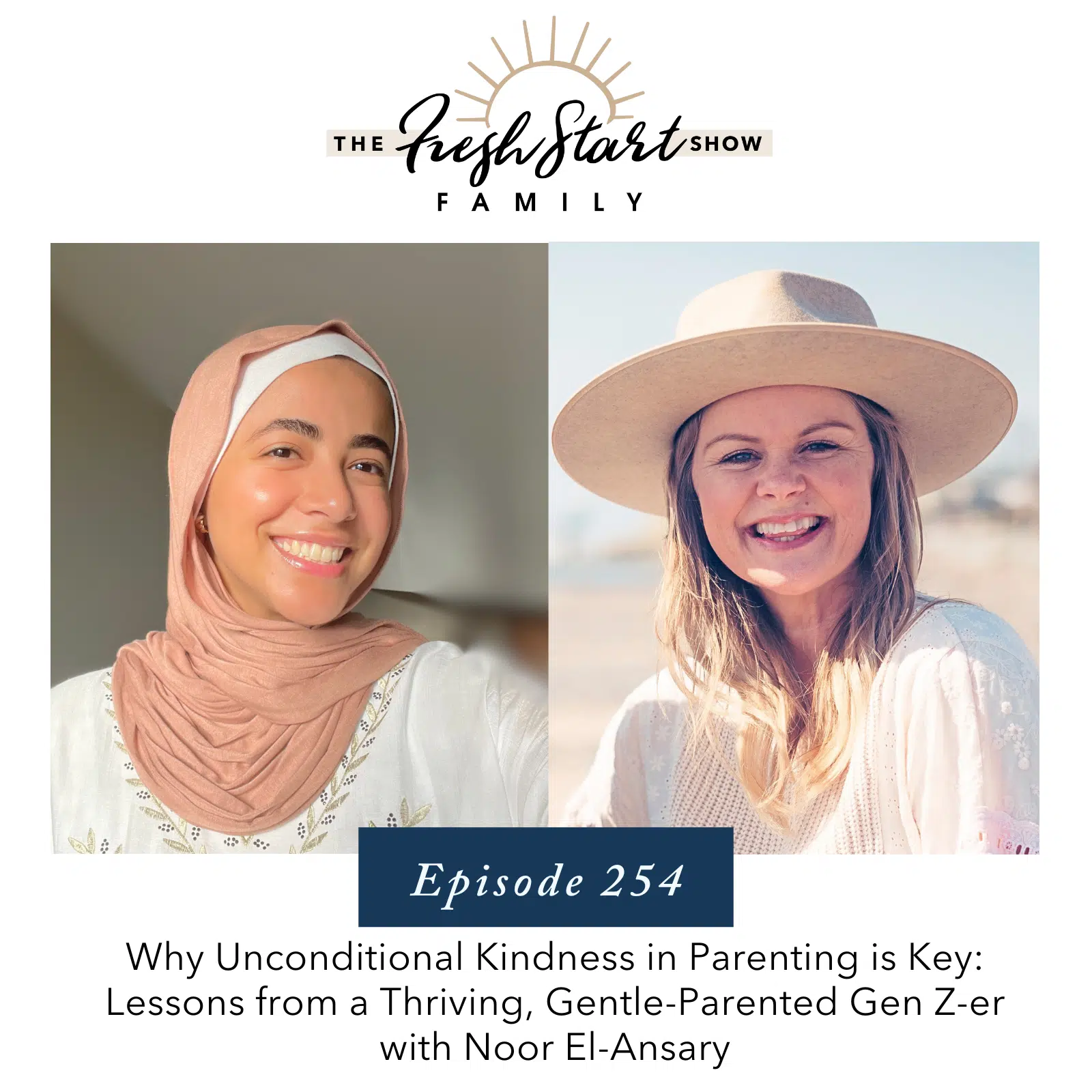
In this heartwarming episode of the Fresh Start Family Show, Wendy sits down with Noor El-Ansary, the inspiring author of “The Kindness Book.” Growing up in an immigrant household with gentle parenting at its core, Noor’s journey is a testament to the incredible impact of unconditional kindness. Wendy and Noor dive into how these early experiences shaped Noor into a thriving adult, offering hope and actionable advice for parents aiming to raise confident, well-adjusted kids.
Noor opens up about her path of self-discovery, revealing how her background in Montessori education deepened her understanding of the powerful parenting techniques passed down by her mom and grandmother. She passionately shares why it’s crucial to teach children they are worthy of love simply for who they are, not what they achieve. Noor also provides practical tips on building confidence, honoring kids’ emotions, and fostering a healthy relationship with failure and rest. This episode is a beautiful reminder that gentle parenting doesn’t just grow amazing kids—it cultivates resilient, emotionally intelligent adults. Tune in for a conversation full of wisdom, warmth, and inspiration!
What if you could be an effective, firm & kind parent WITHOUT relying on fear, force, bribery & rewards?
Imagine learning a new way of firm (AND kind) parenting so you can end painful generational parenting cycles and create family legacies & memories YOU are proud of?
All while getting your kids to cooperate with your rules and boundaries with ease.

IMAGINE …
Parenting your kids with calm & confidence each day in a way that causes them to do what’s asked of them because they WANT to (not because they HAVE to) … because you’re helping to build essential life skills that have them behaving well & being respectful when you’re NOT looking!
The Firm & Kind Parenting Blueprint is your step by step plan & video training to help you build the family of your dreams. Click HERE to learn more now!
Episode Highlights:
- Children are worthy of love simply because they exist, not because of their accomplishments.
- Mistakes should be viewed as opportunities to learn, not reasons for shame.
- Encouraging children and focusing on their internal growth is more beneficial than external praise.
- Honoring your body and knowing when to take a break is crucial for long-term health and wellbeing.
- Emotional literacy allows children and adults alike to healthily process and express their emotions.
Resources Mentioned:
Follow Noor on TikTok and Instagram
The Kindness Book – Noor’s ebook offering 56 phrases to switch out the inner critic for a kinder voice.
Noor’s viral IG post about Gentle Parenting & Thriving
Catch the full episode on YouTube!
Watch Wendy & Noor’s IG Live
Not able to listen, or prefer to read along? Here’s the transcript!
0:00:03 – (Wendy): Well, hey there, listeners. Welcome to a new episode. I am so happy to be here today with Noor El-Ansary, author of the kindness book. Welcome to the show, Noor.
0:00:13 – (Noor): Thank you for having me, Wendy. I’m excited to be here.
0:00:15 – (Wendy): Me, too. Your energy is just so fun and sweet and, my goodness, you have, you seem to have wisdom that is, like, well beyond your years because you’re pretty young, right? Noor, and you don’t have kids yet.
0:00:32 – (Noor): No, not yet.
0:00:33 – (Wendy): Yep. And you are able to speak to all of the beautiful things that you do in such a wonderful way that is so impactful. So I can’t wait to dig in today and glean your wisdom. But today, listeners, we are going to be talking about why unconditional kindness and parenting is key lessons from a thriving, gentle parented Jen Zer. So we found you Noor when we found one of your reels, that was one of those ones that went viral where you talked about how you were parenting. It parented in a way that was with kindness and in a way that aligns with what we would call gentle parenting. Or here at fresh start family, we call it powerful, positive parenting. Other people call it conscious parenting, but it’s often very different than a lot of the other models in the world.
0:01:28 – (Wendy): But you talked about in this reel how you were parented in this way and that you are just now thriving as an adult. And it just was, it lit me up when I saw this reel, and I was so excited to reach out to you because this is what happens, right? So I can’t wait to dig in more. So will you just tell us a little bit about your story and why you decided to start helping people in this way, why you decided to author this book, the kindness book, and kind of what your background is and your story with how you were raised before we get into our subject matter of the day.
0:02:06 – (Noor): Yes, of course. So I was raised in, you know, what people would call an immigrant household. My dad was a first generation immigrant, and my mom basically came here. So I’m kind of like, first from one side, second from the other side. But, you know, unfortunately, a lot of immigrant families just don’t have the concept of, like, gentle parenting or conscious parenting or respectful parenting, whatever you want to call it, just because they come from a long line of struggle.
0:02:38 – (Noor): And so I noticed growing up that I was thinking in a very different way from my peers. I was a lot less anxious from my peers. I had, like, I would say, a more positive outlook, and it really confused me. I was like, guys, we’re so young. We’re like twelve years old. What is stressing you out so much? And I kind of didn’t really know what the cause of it was until I got older and I decided to study Montessori education as my minor during my undergrad.
0:03:10 – (Noor): And it really unlocked me into this world of child development and how malleable basically children’s brains are and how the slightest of things can impact them in the greatest of ways on both the positive and the negative side. And so when I started learning more about child development and learning more in schools and, you know, with my field experience, I really started to see the things that my mom was doing that is backed up by research in my own life.
0:03:39 – (Noor): And that was just very cool to see. And I think I have a much greater appreciation for her as a mother now that I’m older than I did when I was younger.
0:03:48 – (Wendy): That always happens, right? Like, oh, man, we just have no idea. And then you grow up and you’re.
0:03:54 – (Noor): Like, no, literally no idea. And I’m so amazed by the way that she did it because she did it so naturally. Like, I really genuinely thought that all parents were like this. And that’s something that, you know, a lot of people ask me, where did she learn it from? And she learned it from my grandmother. My grandmother was the same way. And so we basically have this whole village of gentle, gentle parents and gentle mothers specifically in our family, which is so amazing to have.
0:04:22 – (Wendy): What a legacy. What a legacy. Because that’s exactly how it works, right? Like, most people get what’s handed down to them. And so our community here at fresh start family, you know, most of the people that come and find me and start working with me in our community and coaches is they most often get the hand me down fear and force model. And it just takes so much work and intention and courage to break that chain so you no longer pass it down to your children. But to hear a real life example of a family lineage where grandma passed it down to mom, pass it down to daughter, and now you are passing it down in the world is just so beautiful. It makes me want to ball because it is my dream.
0:05:14 – (Noor): Exactly.
0:05:15 – (Wendy): My dream for the world.
0:05:16 – (Noor): Yeah. That’s what a lot of parents hope for. And I think that is where most of the shock is coming from in my audience, like on TikTok, on Instagram, it’s just people have never, you know, we hear about the research, we hear about how it affects the parent child relationship when the child is still young. But what does that look like when the child actually grows older. Like, do they have the life skills needed to thrive as an adulthood? And do they have, do they still maintain that strong connection with their family? And I’m here to say, I think me and my siblings honestly are here to say that, yes, it really does make a huge difference in our lives.
0:05:50 – (Wendy): Oh, my gosh. Amazing. And so were your grandma and mom a little bit of, like, rad outcast? Like, because, like, we so, like, in your either religious or other areas circles was. If that wasn’t the norm, were they outcasts? Like, we work with a ton of families that come from, like, um, really harmful, toxic evangelical christian circles or. And then I have another student right now who she says it’s like, kind of the same in their hindu circles. Like, it’s just the fear and force model is preached and taught so intensely that to be an air quotes outcast. Right. And to, like, really stand tall and do things differently, it just takes so much courage. So do you know anything about if your mom and grandma were outcast or was it in your community? In their community, this was more normalized or were they these rainbow unicorns?
0:06:46 – (Noor): I definitely agree that it does take a lot of courage, especially if you’re a cycle breaker. But my mom and my grandma have this sort of confidence. It’s almost an intimidating confidence where it’s like they know what they’re doing and they believe so strongly in what they’re doing that no one can say anything to them. You know what I mean? Like, some people might question it. We definitely are an outlier. So my family’s from Egypt, and culturally in Egypt is. Is still very much like fear based parenting.
0:07:15 – (Noor): And in our religion, though my grandma says this all the time, she gets a lot of her parenting from the life of the prophet. Peace be upon him. Everything he preaches about kindness and gentleness and the way that he parented his own children was her inspiration. And so religion wise, it was very strongly tied in a positive way to the religion. But, yeah, culturally, they were definitely an outlier. But because they believed so strongly in this type of parenting, they could always respond to any questions that they got. They could always respond to any, like, clapbacks, almost like, oh, you think your child is really going to have any life skills if you’re not hitting them? Like, they could respond to that very strongly. And so it didn’t feel like they were outcast, but I’m sure there were, you know, maybe some friendships along the way that were strained because of this.
0:08:04 – (Wendy): Yes. Yes. Amazing. So, yeah, culturally and then. But it sounds like in your religious circles, that fear enforced model or the autocratic model is not taught. Or is it taught in some of the circles or not at all.
0:08:19 – (Noor): I mean, honestly, if you’re truly following the religion, it’s not taught in any of the circles that I know of. I mean, obviously, you know, with any religion, it will be taught in circles, but all of the circles that I’ve been in, it’s. It’s not taught at all, thankfully.
0:08:32 – (Wendy): Ah, that’s lovely.
0:08:34 – (Noor): It really is.
0:08:35 – (Wendy): It is not the same. I mean, there are so many beautiful, healthy circles in Christianity, but then there are. It’s like, heartbreaking how. It sure seems like the massive. The majority, which I try to. I try to not say that because I have students and team members who are like, no, no, no. We grew up in this section. Like, my one student is greek orthodox and she’s like. Or she’s actually my team member.
0:09:00 – (Wendy): She’s like, Wendy, we never had this. My dad was a priest. Like, this was not taught and preached and just such celebration and other types of circles. But in the grand majority, a lot of our students come from the really toxic teaching. So I was love to hear that you have a religious circle that is not teaching that because it serves as.
0:09:23 – (Noor): Like another support system, almost as another village that helps you with your parenting journey, which is honestly very, very, you know, we’re very grateful to have that.
0:09:32 – (Wendy): Yes. And that’s the way it should be, right. To have more than just more guidance than just us earthly guidance, like, more to call on and to tap into beautiful noor. Okay, well, that’s so fun to get to know your story and your mom and your grandma’s story. Okay. Dive into this concept of unconditional love and how it has really just shaped who you are. But the first thing we were going to talk about is how we are worthy of love because we exist and our self worth is not tied to our looks, accomplishment, or productivity. So talk to us about how when you were raised, this really came through and you know, how that you carry that now.
0:10:17 – (Wendy): And it’s all making sense to me hearing about your mom and your grandma now, watching you and how you carry yourself. But talk to us a little bit about that.
0:10:27 – (Noor): Okay. So it’s a little bit hard to explain if you know when you’ve known kindness your whole life and then you’re trying to explain to someone who unfortunately hasn’t known kindness at all. I’m like, where do I even start? I think number one would probably be my confidence and like you said, the way that I carry myself, confidence was always the number one priority for my mom. And I don’t know, it’s almost like I have this delusional confidence of some sort that, you know, I’m very capable to whatever I set my mind to, I should be proud of whatever that I do.
0:11:05 – (Noor): If I make mistakes, like, that’s okay. That’s part of life. Failure is a part of life, as well, and you can only grow from those mistakes and those failures. And so I just have this very growth mindset, pretty much, and, like, positive outlook on life because of all of that unconditional kindness. It’s not like. I mean, also another part of it is I was a very gifted child academically, and unfortunately, a lot of gifted children experience burnout really early on in their career because of the pressure to continuously exceed or continuously gain that love that they get and that safety and connection that they get from being smart.
0:11:44 – (Noor): And so I’m very grateful that my parents never emphasized that they realized that school was easy for me. And so, yeah, they’d say they are proud of me for my accomplishments, but they’d also say they’re proud of me for other stuff, for just existing. And so that unconditional kindness really showed me that I’m worthy as a human. They love me because I’m a human, not because I do this, this and this, but because I just am.
0:12:11 – (Noor): And that’s just a very, very beautiful way to live.
0:12:14 – (Wendy): It really is. Noor. And it’s wild how this, as you speak to, and I don’t know how you know all of us so well since you don’t live like this, but it is so heavy, this whole, like, most. I mean, maybe not. I want to meet more people like you, so I can stop saying this, but it sure feels like most of people live with a huge tie to accomplishment, and their worth is in how they perform, how much they get done in the day, productivity.
0:12:51 – (Wendy): And just. I remember years ago learning about this concept of, like, you’re worthy just because you are, and just being like, what are you? What does that even mean? Like, that is the stupidest thing I’ve ever heard. And by this time, I was, like, knee deep in life coaching certifications and parenting education education certifications. And I was just like, this is so foreign to me because who even am I if I’m not accomplishing a lot or being praised or proving myself or whatever it may be? And that. That’s not logical.
0:13:24 – (Wendy): That, of course, in my. If I think about it, of course I’m worthy because I am. But I could tell that I really didn’t have a deep confidence about that. So to hear that that’s what’s happened for you is so beautiful. And really, when I hear you speak about what happened with your parents is it’s around. What we teach is encouragement versus praise. So praise is more like, good job. You’re such a good girl.
0:13:48 – (Wendy): Right. You know, a lot of people even will pay their kids for grades when you do good, you’ll get hugs and love, and, you know, and if you don’t do good, then you’ll get punished and not get paid and not get love and shamed. Right. But. And we teach encouragement, which is just basically, like, when you do great and have accomplishments, it’s like a, congratulations, you did it. What did you do? To do that like, that must have taken a lot of effort.
0:14:19 – (Wendy): Tell us how you did it. Share with us. How did that feel, exactly?
0:14:24 – (Noor): And I’d say that part of it was also, like, talking about my process and my enjoyment in that process. So a lot of the times when I would come home with straight A’s, it’s like, oh, nice. Congratulations. Which was your favorite class? Who was your favorite teacher? Did you enjoy the semester? Like, what did you learn? Is there something that you might continue later? So it’s really, at the end of the day, ends up being about me more than about my grades.
0:14:50 – (Noor): And, yeah, that’s exactly the praise versus encouragement. Encouragement is so, so important. And, you know, as a Montessori teacher, because I ended up getting my master’s in Montessori for three to six years old. And, yeah, we learn that all the time. It’s like, how are you praising the or encouraging the internal work of the child and their internal development versus just their external accomplishments?
0:15:17 – (Wendy): Dude, I want to meet your mom and your grandma, because they were like, oh, geez. Oh, geez. And they didn’t even need anyone to teach them this. Like, most of us come in and we have to have, like, a full 180. We have to let go of all these limiting beliefs and learn all these new strategies, and it sounds like they just had it from the beginning.
0:15:35 – (Noor): So that’s radhe. Naturally. It comes when you’ve been basically taught it your whole life, you know, gives.
0:15:43 – (Wendy): Me so much hope for the future. Okay. And then you mentioned it, Noora. But our second point is we deserve grace when we fall. And so this idea that mistakes are opportunity to learn. Opportunities to learn. Like, it sounds like you really lived that out in your childhood and your parents probably weren’t perfect, but it sounds like they had the understanding that mistakes are simply opportunities to learn. Or as I always say, failure is just unfinished success.
0:16:11 – (Wendy): Right?
0:16:12 – (Noor): Yes. Very true.
0:16:15 – (Wendy): What was that like?
0:16:16 – (Noor): Yeah. So one of the things that, in hindsight, I really appreciate, but something that I really did not like as a child, was my mom made us do a lot of things that we were objectively bad at. So I was very good at academics. Right. But I was very bad at sports. But we were always doing sports, regardless of how many times we told her, like, mom, like, take us out, please. We’re not good at this. This is embarrassing.
0:16:43 – (Noor): It was very much like, okay, it’s embarrassing now, but you’re gonna learn. You’re gonna make mistakes now, but that’s how you learn. And also that it’s okay to be bad at things and do it for the sake of doing it. Like, as long as you’re enjoying it, it’s okay to be bad at it. And so that’s something that, as an adult, I’ve definitely, really appreciated, because I felt like it built up my confidence.
0:17:05 – (Noor): And I actually made a video about how confidence isn’t just doing well, but it’s also overcoming failure, and it’s overcoming challenges successfully. And so the fact that she basically artificially put us in different challenges and then helped us move through that failure is a huge skill that I’m very, very grateful for.
0:17:29 – (Wendy): It’s so big. It is so big. And, yeah, it’s like, so often we think that failure means we need to give up or that we’ve done a bad job, or, I mean, especially when it comes to, like, misbehavior in kids, when really, it’s just. It just means we’re in progress. Right? And it’s like, I always think of the analogy with the. When a baby learns to walk. Like, something happens when we have babies, and then they become toddlers, and all of a sudden, a lot of people just switch into, like, you should know better. But when a baby learns to walk, it’s like, what do we say to them when they first learn to walk and they fall down? We’re like, it’s okay, hey, get up. You can do this.
0:18:07 – (Noor): And we got you. Like, we clap so hard for them, and we’re so excited that they’re making this new step. But you’re right. Once they turn into toddlers or, you know, even a bit older, like, six, seven, eight, we expect them to know so much. And I think, honestly, it’s just a reflection of how hard we are. On ourselves because the parents who are very hard on kids are often very, very hard on themselves.
0:18:32 – (Noor): And, you know, that’s why this type of work that you’re doing is so transformational and so important, because it’s not only helping the child, but it’s literally changing how the parent thinks about themselves and about their own life, which is really great.
0:18:45 – (Wendy): Yes. And you are the queen of riffing on that. Like, so much of your incredible wisdom that I’ve seen is around replacing and nurturing, I should say not nurturing, escorting or letting the inner critic move along. Right. And, like, ways to really tactically and realistically replace that voice with a kinder voice. And so how do you know us so well when you speak to it, right. Like, you say things like, you know exactly what’s going on in our head, but it sounds like you don’t struggle with this. Has this just been watching maybe other friends or people in life, like, just tell you? Because the inner critic, again, for a lot of people, especially people who were raised with the autocratic model, is gnarly.
0:19:35 – (Noor): It is. I mean, imagine. I can imagine. I can’t really. I mean, yeah, fortunate for me, but unfortunately for my audience. But you know what, Wendy? I really did not know you guys for the longest time, and I was so confused. I’m not going to lie. I was one of those people that was like, what if you just, like, say positive things about yourself? You know, like, why don’t you just do that instead? I really did not understand where that inner critic was coming from until I started studying child development.
0:20:07 – (Noor): And my program was an amazing Montessori program. I’m very lucky to have gone through it because it was very holistic in understanding all the different types of things that can affect children, including trauma. And so we studied trauma for a long time, how it literally changes the architecture of the brain. What are things that you can do, like, developmentally appropriate things that you can do to kind of help the child repair that trauma? Because at the end of the day, especially when it comes to childhood trauma, it’s all relational.
0:20:40 – (Noor): And so if you can find ways to create a safe relationship with a child and kind of make up for all of the things, all of the unsafe relationships that they’ve had in their trauma and teach them those skills to regulate and then grow up into adulthood having those skills and having maybe a slightly less critical inner voice, that’s the most important thing that you can do as a teacher. And so after studying that, really realized how detrimental this critical inner voice is.
0:21:12 – (Noor): And then after I graduated from undergrad, I lived alone for a while, and it was the hardest thing I’d ever done. And I went from being this, like, super bubbly, happy person to, like, literally just not knowing how to manage my life because I was working. I went immediately to grad school. I was, you know, taking care of myself for the first time. It was just a lot all at once. And I think I started because, you know, society always tells you, like, you have to be doing this. You have to be succeeding in this. You have to be doing this. And I think I let that get to me for a little bit, to the point where I had to quit my job. Like, I had to quit my job and move back with my family for a little bit because good for you.
0:21:54 – (Wendy): Noor, good for you.
0:21:58 – (Noor): Yeah, it was a lot. And that’s kind of when I started diving deeper into everything that I. I studied for children and started seeing if I could apply it to myself. And it was the most life changing thing ever, even for me, who had already come from a kind background and a safe home. So I was like, if this impacted me, then this is very, very important to share with others. So I started talking about it with my immediate family and then my friends, and every time I was talking about it, they were like, oh, my goodness, noor, this information is so important.
0:22:34 – (Noor): And so I finally took the leap of faith and started my TikTok page and wrote the kindness book. And, yeah, that’s. The rest is history.
0:22:44 – (Wendy): It’s so good because that inner critic is. Destroys lives. And it’s so sad because it does. Like, I watch over and over again once I get to know about people’s childhood and the things that were said to them and the way punishment was so rampant in their home, or even if they weren’t hit and harmed emotionally or hithenne and harmed in a physical way, they were often shamed. Right? Like, what’s wrong with you? What you were thinking? What were you thinking?
0:23:16 – (Wendy): You know, why can’t you just be easier? Why are you so difficult? I’ve told you a million times, like, these type of things. And what we know now is that, like, that it just becomes a second nature to, like, snap into that voice once we become adults. And then when we’re really good at beating ourselves up, we then are really good at beating our kids up. And so it’s like when I can tell when parents come my way and they want to be more empathetic and compassionate and grace filled with their kids, usually 99% of the time, what we uncover is that they’re pretty darn hard on themselves, and they’re carrying so much shame, which I’ve seen you riff so much around with the idea of when someone wants to do better air quotes better. I kind of hate to use the word better.
0:24:04 – (Wendy): When they want to act differently, when they want to behave differently and speak differently to their children, and they just feel like it’s impossible. And I’ll just have you riff on this. I’ve seen you share that it’s often a huge sign that there’s shame present. So talk to us about that one.
0:24:19 – (Noor): Yes. So shame is one of the biggest, biggest, biggest, biggest core reason behind a lot of our problems. And it drives me crazy how easily it’s perpetuated in society. If you don’t get it from your parents, you’re gonna get it from the beauty standards. If you don’t get it from the beauty standards, you’re gonna get it from the toxic, like, hustle culture and productivity culture. If you don’t get it from that, you’re gonna get it from somewhere else. Right? Like, it’s so easy to internalize the shame that is just everywhere in our society.
0:24:51 – (Noor): And that’s why I think I focus a lot on shame in my kindness book. Like, the first eight pages of it is literally just talking about, why were you taught shame and how can you get out of the cycle? Because neurologically, shame actually turns off the learning centers in your brain. It puts you in a state of fight or flight. And I think, unfortunately, parents utilize shame because, one, it works really well discipline wise, surprisingly, because when the child is scared, they will do whatever they need to do to survive.
0:25:23 – (Noor): And in this case, surviving is following the parents order. And so shame works very quickly and very well in terms of discipline, but it is, like, completely detrimental for, you know, the inner development of the child.
0:25:36 – (Wendy): And not sustainable long term, because I see a lot of times, by the time they’re teens, a second decade of life, you know, that’s when the poop really hits the fans.
0:25:49 – (Noor): Exactly. And the second reason is because they genuinely think that it works. They think that if you are hard on yourself, you won’t want to repeat the same mistake, that somehow if I say, like, oh, this is bad, I won’t want to do it again. But with shame, you’re not saying this is bad. You’re saying you are bad. And that’s a very, very different neurological response between this is bad and you are bad, and saying, you are bad just shuts off everything. And it is literally impossible to learn from anything if you are consistently telling a child or consistently telling yourself you are bad.
0:26:32 – (Noor): And so that was kind of my entry into the kindness book because it’s something that unfortunately, a lot of people just don’t understand yet. And it’s crucial to your well being.
0:26:42 – (Wendy): Yeah. And it just is such a natural. It makes so much sense why, as humans, because we go to shame when so many people were raised with, like, the model of when. When you do something bad, you literally get hurt, you must have pain. Like, mistakes equal pain and suffering, and that must mean you’ve done something wrong, because that would be the only way. Like, it just. You think about it, it’s like, it makes sense why we just adopt the shame so young.
0:27:14 – (Wendy): Cause it’s. And then in our religious circles, it’s super creepy, Noora, because parents are taught in the super creepy circles to teach their children that they’re the reasons why they’re hurting them. Right? Like, I don’t wanna hurt you, but I have to, right? Like, if you. If you weren’t so sinful, then I wouldn’t have to do this. This hurts me more than it hurts you. And you’re the reason, and it’s just so sad. Like, what it does to create just deep shame wells in people.
0:27:45 – (Wendy): And so this idea that we all deserve grace when we fall is just so important. And we always say in our world that grace is sufficient for all or it’s sufficient for none. It’s like, our children deserve the same type of grace that the rest of us do. But for some reason, society has deemed them to be these little boogers that we can just hit and harm and talk to. They’re scum of the earth. And it’s like, no, where did we. Like, let’s get back on track. Let’s get back on track and go a different way.
0:28:19 – (Noor): True. And I think going through the Montessori program as well and reading her works really enlightened me, too, because honestly, to be completely honest, I did not like children before starting this program. It was crazy. I really did think they were kind of funny, these misbehaving little humans who, like, don’t know how to listen yet. But then going through the Montessori program really, really showed me how. At the end of the day, it’s all about unmet needs.
0:28:49 – (Noor): And if you have a little human being with an underdeveloped logical brain, you know, prefrontal cortex, and you are not meeting their needs, like, of course they’re going to go crazy. Like, what else do you expect even as an adult, if you have unmet needs, it’s going to be completely different life than if you are truly meeting your needs. Needs. And so, yeah, just going through that transformation was really enlightening for me as well. And I think that definitely shows in my work today, which I’m very happy about.
0:29:18 – (Wendy): Yeah. In the monastery world, when it comes to needs, are they basically speaking to power and belonging and value and unconditional love? Are those the four? Is it like Dreyker’s face?
0:29:28 – (Noor): Yeah, we have those as well as needs for your internal development to like order, repetition, vocabulary and language. Like a lot of times we kind of just assume that the child, because they live amongst society, that they’re going to absorb everything in society when in reality they have to have very specific environments for them to really thrive. And so whenever you walk into a Montessori environment, you’ll see that there’s a lot of order.
0:29:59 – (Noor): The routine is the same every day. The works, the materials that we work with in the classroom are in the same space every day. They are allowed to repeat whatever they need to repeat as many times as possible. We also talk about physical needs, like the need for movement, the need for activity, the need for cross linear movement, like moving across the midline of the body. All of those different types of things that we have to integrate into our school environment so that they can really thrive.
0:30:28 – (Noor): We can’t just have kids sitting in the same space all day and expect them to focus. Like, that’s just not developmentally appropriate for kids. So meeting their physical needs, their emotional needs, their social needs, all of that stuff.
0:30:41 – (Wendy): I love that. I’m going to start referencing that more. Those additional needs, order, repetition, vocab and language, physical cross linear movement. Then I always add to experiential. I feel like that is a need to, for so many strong. I specialize in helping parents with strong willed kids. And it’s like those kids especially, they learn by doing, and it’s so, and that’s why it’s so important they do it.
0:31:08 – (Wendy): They just, it’s like we can tell them 17 times, like put your shoes on or you’re going to step on a bee and you know, they’re just, they’re just resistant, right? And then one day they step on that darn bee and they look, they learn, right? They learn so well. So the experiential part or I just. The jumping off the couch, things like that is like a lot of times just simply that experiential need for a child. But I love all those other ones that you talked about.
0:31:37 – (Wendy): Okay, well, let’s jump into our next point, which is how unconditional love and being raised with unconditional kindness honors our body and to take a break when needed because, oh, my gosh, this is huge. And I love hearing you just talk about how you actually decided to stop working and move home to, like, center yourself for a while, because that is something that I feel like is really tough for people who were raised in a different model.
0:32:09 – (Wendy): It’s almost like we learn to ignore our body and discount our feelings and just shut ourselves down and listen more to the external world than to our internal world. So what? You just casually mentioned that you were like, I just quit my job and moved home for a little bit to take care of myself. That’s, like, groundbreaking to me. So riff on that a little bit.
0:32:37 – (Noor): I mean, I do think I’m very privileged to be able to say that financially I was able to still be supported. Of course, I had a supportive family to accept me. And this started from a very, very young age. My mom would always tell me in Arabic, and which means I’m not going to do anything that would overwhelm me. And hearing that from a young age kind of put in my mind that, oh, okay, as humans, our bodies have limits.
0:33:09 – (Noor): And first of all, it’s not sustainable to always be maxing out that limit. And second of all, I have the choice to not exceed that limit and the choice to take care of myself. Myself. And again, with the whole praise versus encouragement, when I was encouraged for being me and basically thriving in the fact that I was me, I got to choose what I wanted to do and I got to be encouraged in that space.
0:33:35 – (Noor): And if I chose one day that, oh, this is kind of stressing me out, I don’t want to do it anymore, then I had that option, too. And, yeah, I mean, once I realized that my job, my masters, being alone, all of that was overwhelming for me. I was like, okay, time to make a different choice and quit my job and move back home for a little bit to kind of, you know, protect myself and protect my energy and protect my body, too.
0:34:01 – (Wendy): Yeah. And just that, like, to know that it was not foreign to you, to slow down and that it didn’t mean you were failing. You just needed to recenter yourself and be around unconditional. Like, it’s so interesting, like, my emotional response to this, this, because, like, I look at my kids, my kids are 13 and 16, and to think that this is going to be their reality, like, just makes me so happy because as 46 years old, like, the amount of therapy and personal development work I’ve personally done to get out of, like, over giving, overworking, like, running myself into the ground with, like, building an organization and, you know, helping thousands of people all over the world and a podcast. And, like, I just go so naturally into denying myself.
0:34:56 – (Wendy): And that’s not like a, that’s not like a. Look how cool. It’s a problem, and it’s not, it’s not like, you know, it’s not out of. It’s. It’s not all good. You know, it’s like, yes, we. I’m a person who loves to help people and I love my work, but there’s something really, like, not great at the bottom of that, right. It’s almost like approving or what I’ve learned in all my work. And I’m still, like, shedding these layers and learning to become a healthier version of myself in my fourth decade of life.
0:35:29 – (Wendy): But there’s a striving there, like a clawing, a desperateness that brings suffering in that I just am so excited that my children will have less of that and then their children will have less of that the more they are given. This message. And the way I see it roll out now is like, my daughter, we actually just got a notice from her high school that she was at 20 absences, and I think it’s an automated response, but they were like, uh oh, you know, you gotta watch this. What’s going on? And I looked at Terri and I was like, that’s so odd because there hasn’t been, like, anything crazy. It’s not like we’re darting off to Europe for long trips or anything, but when she, she doesn’t feel good or when she has cramps or when she’s just exhausted from going to concerts all weekend with daddy or just working a ton and having a big beach volleyball tournament.
0:36:22 – (Wendy): There is, like, no problem. Like, we. We almost have to tell her, like, no, I want you to slow down. Your body comes first, your mind comes first. We will help you get caught up in chemistry, or you are safe to slow down. It is okay. And she, you can tell she spins out a little bit, but we’re like, you know, we’re just trying our best to be like, you’re safe. You got this, number one, you take care of yourself, and then the rest, the rest will fall in place. And we try to do that with Taryn, too.
0:36:53 – (Wendy): And it’s not like I remember my parents ever teaching me grind, hustle, prove your worth by killing yourself and getting straight a’s and all the things, I just somehow became this person that just overextends, and it really has a tough time slowing down. And so, like, my current season is all about how do I slow down and feel safe? How do I do less and feel safe? And just to hear that that has come a little bit more naturally to you is so beautiful. Noorn.
0:37:28 – (Noor): Thank you. Yeah, I mean, I. I definitely consider it as a huge blessing, especially in this type of society where, like you said, you’re kind of rewarded for ignoring your body and doing the most and grinding yourself to the ground, but having that message growing and, I mean, you know, how painful it was to live that type of life and, yeah, to know that your kids don’t have to go through that same pain is a huge gift and commence, like, to you for doing all that work so that they don’t have to when they get older, I.
0:38:02 – (Noor): But, yeah, having that message growing up that it’s literally, like, an option to slow down and that option is actually preferred then to grind yourself is something that’s definitely impacted me today. And I think some people think that it creates lazy children. But I can tell you from my experience. I’ll just tell you some of my accomplishments in college. I graduated undergrad with three majors and three minors, and I was, like, president of four different clubs, and I studied abroad for a semester, and then I ended up my senior, like, you know, after graduating, I ended up giving the commencement speech at graduation.
0:38:41 – (Noor): And when people hear that, they think I’m literally insane. They think, like, grinding 24/7 that I have no social life, that I’m just, like, very. Maybe not stressed, but I have lots of work to do all the time. And I always say, like, no, I love every second of it. I chose every second of it. And I’m not proud of the accomplishments, but I’m proud that I followed what I loved, and I’m proud that I spent my four years in undergrad doing things that were important to me. And, yeah, the outcome is pretty cool to say that I spoke at my commencement, but at the end of the day, that wasn’t the goal. The goal was to, like, enjoy myself and take care of myself.
0:39:21 – (Noor): So, yeah, it’s really a beautiful experience. Experience.
0:39:26 – (Wendy): Literally just, like, so much emotion. I feel like I’m, like, talking to Stella in, like, ten years or something. Stella’s 16. You look younger than 26, but I don’t know how old you are. But she’s 16 and a half, almost 17. But it’s just so cool to, again, hear someone that’s just a little far out from it, because I can see how. So she’s been raised with this work for 13 years. We found this when she was three, and we had to do the full turnaround, but her little brother was raised with it, was born with it.
0:40:02 – (Wendy): He’s the lucky guy. Right. But I can just see the way she operates in the world is like, she’s the sponge for all of this. Right. And so I can just imagine that that’s going to be her college experience. Like, to find the joy in the journey, not the accomplishment, is, like, one of the biggest life skills you can ever teach your kids. And as a high level beach volleyball player, high level drummer, high. With our academics, like, all the things, it’s just so easy to fall into the wrong understanding of where your worth is. So this has inspired me so much to just continue to do my best, best to teach her and also to model. Right. It’s like, we all know that if we’re not healthy, then they won’t be healthy. And so I still have a lot of work to do in this area. And to hear that beautiful phrase that your mom would say that seemed to be rooted in her boundaries. Right.
0:41:01 – (Wendy): Is that what I heard from it, is that she’s not going to do anything that overwhelms me? Was that the statement? And so it was at the, like, hey, Noor, don’t do anything that doesn’t overwhelm you. She just kept saying, look, I am not going to do. I. Watch me, watch me, watch me. And that’s how it really soaked in.
0:41:23 – (Noor): Yeah. And, you know, they always say, kids, do what you do, not what you say. And so my mom was definitely a great model, especially for that slowing down aspect of life and really taking care of our bodies and our health.
0:41:37 – (Wendy): So rad. All right, Noora, our last point is it’s okay to feel sad, angry, frustrated, and disappointed, because we have the tools to work through those emotions and riff about emotional literacy and what it was like to be raised with unconditional kindness and love and how it affected your emotional literacy.
0:41:58 – (Noor): Yeah. So I think a lot of parents think that they kind of have to sit their child down and say, like, okay, if you feel sad, this is what you do. To not feel sad. If you feel angry, this is what you do to get through that anger. But for me, again, it was really just a model experience. My mom would say, like, feel your emotions, Aidi. And Aidi in Arabic means normally, like, without any hesitation. So feel your emotions without any hesitation. Express your emotions without any hesitation.
0:42:30 – (Noor): And knowing that emotions are okay is the first step before ever getting to okay. What can we do with these emotions? And having that kindness tied to the emotions, like, it’s not like, oh, she’s only kind to me when I’m happy, or she’s only kind to me if I’m excited or if I’m, you know, doing something that’s kind of like a comfortable emotion. But she was very kind to me when I was anxious. She was very kind to me when I was disappointed. She was kind to me when I was frustrated.
0:43:02 – (Noor): And having that kindness across all the different emotions taught me to be kind to myself with all of those different emotions. I think a lot of people categorize emotions as good and bad when in reality it’s comfortable and uncomfortable. Neither are, you know, better or worse, but they’re really just different types of emotions that need different tools to regulate them. And so just having that understanding from a young age helped me in my transition to adulthood, where I had all of these emotions of being overwhelmed, being frustrated, especially as a first year teacher.
0:43:39 – (Noor): That was my first year teaching, and it was the most overwhelming thing I’d ever done. I was like, okay, I really can’t continue doing this without stepping back and really evaluating what am I doing for my emotional health? And, yeah, having all of that modeling when I was younger and all that language when I was younger really empowered me to take that step back and examine my emotions as I got older. And now I went back to teaching, I came back to live alone, and I’m thriving now again. So it’s really a blessing to have that emotional understanding from a young age, too.
0:44:17 – (Wendy): My gosh. Yeah, it really is. I love your mom’s phrases. Just normally just be normal.
0:44:23 – (Noor): Yeah, exactly. It’s like, there’s no problem with having emotions. Like, it’s literally a human experience.
0:44:30 – (Wendy): There’s no problem. Yeah, yeah. The idea I like to been playing around with when it comes to fear, especially with the clients I coach a lot, and then also their kids, whether it’s especially if kids struggle with anxiety or something, I’m just like, your fear is not a problem. You being scared is not a problem. Right. But we all those ones that, as you said, can be uncomfortable. Right? We suppress or we hide or we deny, and that’s what actually creates the feeling. But what a journey for most people.
0:45:05 – (Wendy): They start to learn about emotions when they’re like 30, 40 years old. Usually it’s after kids because they’re like, what is happening?
0:45:14 – (Noor): Which is crazy, because I’m like, how did you survive before them? Like, what do you mean?
0:45:20 – (Wendy): Yeah, so, like, you. So you’re saying, like, in, let’s say, middle school and high school, you remember? Just if you were mad. Let’s just say if you were sad, your mom wasn’t like, oh, Noor, you’re fine. Here’s a cookie. Don’t be sad. Stop crying. She was just like, so you’re sad. It’s okay.
0:45:36 – (Noor): Yeah, exactly. And I remember, oh, my goodness. I really feel bad for my mom, actually, for my preteen and teen phase. I was such a stubborn child, and I was frustrated very easily. And, yeah, I was very anxious as well. Maybe not anxious, but I was a bit insecure. And, yeah, all of those emotions she handled with, like, okay, yeah, you’re feeling that. Okay, that’s fine. And then she would give me some other phrases that kind of got became ingrained in my head.
0:46:09 – (Noor): One of the phrases which I found really funny is, if I had, I didn’t really like how I looked that day, or I just didn’t like the outfit I was wearing. And I told her, she’d be like, it’s fine. It’s not your wedding day. I think a lot of parents say, like, no, you’re beautiful. You’re so amazing. You look great in the outfit. What do you mean? And that’s not genuine to the child’s experience. That’s not letting them know that, yeah, it’s okay to feel ugly sometimes. It’s not that deep.
0:46:39 – (Noor): You don’t have to feel beautiful all the time. Yeah.
0:46:43 – (Wendy): I’m obsessed with your family. I literally just. I can just remember saying to Stella the other day, I think she was like, I don’t even remember. But I just know it’s been recently that she’s like, oh, I look. And I was like, especially about. What are you talking about? You look beautiful. You look beautiful. I just remember saying something like that. But what a fantastic way to respond. Just like, it’s okay and it’s not your wedding day.
0:47:04 – (Noor): Yeah, exactly.
0:47:05 – (Wendy): I’m gonna start using that, and I’m gonna see if they’re a. Like, what? And I learned it from. Noor, you should follow her because she’s amazing. Oh, my gosh. Noor. I could talk to you all day long. You are such a light. I am praying that you get a big book deal and a big Ted talk and that.
0:47:25 – (Noor): I hope so.
0:47:26 – (Wendy): That would be amazing. You are brilliant, and the world needs to learn more from you. So please keep doing your work. Please having the courage please keep having the courage to show up online. Even for someone like you, it’s got to still be intense. I play that game of content creation online and it’s just a lot to put yourself out there. But thank you because your voice is so beautiful and fantastic and your perspective and your experience really matters. And it’s going to inspire a lot of people because there is a lot of people and a lot of really false information out there that air quotes gentle parenting is ruining the world and we need more and more incredible lights that are standing tall and being like, actually here I am.
0:48:16 – (Wendy): I’m awesome and I’m thriving and I have a beautiful inner cheerleader and I am happy and healthy and I have firm limits and strong boundaries and I stick up to for myself and I’m kind to people and I process emotions in a healthy way. Look at me.
0:48:37 – (Noor): Yeah, exactly. I really appreciate it. Thank you. It’s so wonderful to always see the comments of the parents saying, like, you really are showing me that it’s worth it, that all of this hard work is going to pay off. And I can’t wait to see it in my own children, which is so encouraging to hear. Right? Because especially online, like, you’d never think that you can reach this many people, but it’s really a wonderful and empowering experience and I’m so lucky to be able to share this with everyone.
0:49:04 – (Wendy): Amazing. Well, let’s finish off this episode by letting listeners know where they can come find you and purchase your ebook. And where’s the best place to get in touch with you, of course.
0:49:15 – (Noor): So I mostly post on TikTok under the username NoorElans. That’s Noorelanss. And then same name on Instagram. And in my bio, there’s a little link that points to my book. And I have two books out actually right now. The first one is the kindness book, which I always recommend as a first step. It literally gives you 56 phrases to switch out your inner voice because a lot of the problem is that you just do not have the language. You literally do not know how to be kind to yourself because you’ve never been shown that kindness.
0:49:53 – (Noor): And so I manually write it out for you. I’m doing the work for you so that you can practice it. And my second book, which is kind of a step two to the kindness book, is the mindfulness bootcamp. And it’s a 30 day program that helps you use that new inner voice to then build more emotional regulation and literacy. So yeah, you can find both of those in my – on my social medias. And my DM’s are always open. I love reaching out with people, and it’s just a wonderful experience to be able to share this life with everyone.
0:50:26 – (Wendy): Oh, I love it. Yeah, go. Go download those resources, families, because Noor is legit. And, yeah, I mean, we didn’t even get a chance to riff on, like, the replacement for, you know, the inner critic doesn’t have to be or it won’t work if it’s like this, if I’m like, I feel ugly today. No, you are beautiful self. Look at how gorgeous you look like. No, it can actually be kind, which is just different than air quotes.
0:50:54 – (Wendy): Positive, so to speak, or whatever. And I know you probably just go totally into that in both. So, like, to really have the language with the replacements of just more of, like, a neutral, loving, compassionate. You’re not alone. As, like, for a lot of people, it’s a remothering voice. Right? Like, it’s that. It’s that what we never had. And so you get to give yourself the gift of that. But to have scripts is something I think our audience will really connect with. So that’s beautiful. Well, thank you, Noora, for being here, and we just appreciate you and are so inspired. So thanks again.
0:51:33 – (Noor): Thank you for having me. It was really great talking to you.