

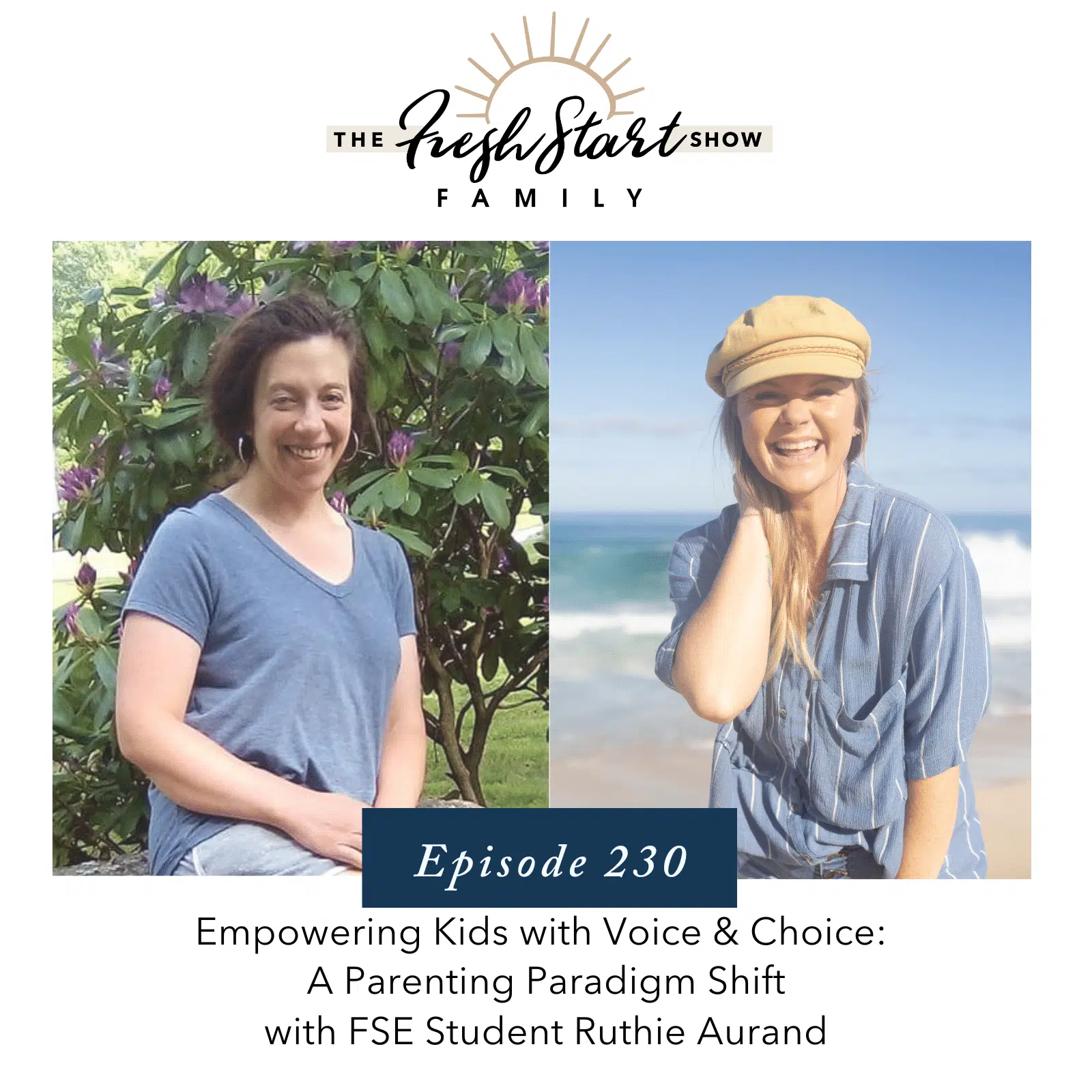
In this heartwarming episode, Wendy sits down with one of the Fresh Start Experience’s standout student, Ruthie. Ruthie shares her profound journey of transformation from using traditional parenting methods to embracing a more compassionate and effective approach. The conversation explores how Ruthie, influenced initially by a deep-rooted belief in spanking and authoritarian control, discovers a more heart-centered way to connect with her children and herself. This episode is a treasure trove for parents looking to break free from reactive parenting and cultivate a home filled with trust, love, and respect.
Ruthie delves into the pivotal shifts in her mindset, describing how she moved from a reactionary, control-driven approach to one that prioritizes empathy and self-awareness. She underscores the significance of seeing children as individuals worthy of respect and how this perspective has transformed her family dynamics. Wendy and Ruthie also discuss practical strategies, including the power of proactive agreements and co-regulation, which assist in navigating everyday parenting challenges. This episode is a shot of inspiration for any parent eager to infuse their home with more peace and connection.
What if you could be an effective, firm & kind parent WITHOUT relying on fear, force, bribery & rewards?
Imagine learning a new way of firm (AND kind) parenting so you can end painful generational parenting cycles and create family legacies & memories YOU are proud of?
All while getting your kids to cooperate with your rules and boundaries with ease.

IMAGINE …
Parenting your kids with calm & confidence each day in a way that causes them to do what’s asked of them because they WANT to (not because they HAVE to) … because you’re helping to build essential life skills that have them behaving well & being respectful when you’re NOT looking!
The Firm & Kind Parenting Blueprint is your step by step plan & video training to help you build the family of your dreams. Click HERE to learn more now!
Episode Highlights:
- Transformative Self-Compassion: Ruthie learns the importance of self-compassion and how it positively impacts her parenting and personal growth.
- Empathy and Respect: Recognizing children as individuals deserving of respect can fundamentally transform family dynamics and enhance emotional connections.
- Mindset Shifts: Transitioning from a punitive, control-based parenting style to one rooted in empathy and proactive communication fosters stronger, healthier relationships.
- Effective Practical Strategies: Techniques like proactive agreements and co-regulation can help manage challenging behaviors and promote mutual understanding.
- Holistic Growth: This new approach not only enriches parenting experiences but also brings about profound personal healing and development.
Resources Mentioned:
Not able to listen or prefer to read along? Here’s the transcript!
0:00:07 – (Wendy): Hello, families, and welcome, welcome. I’m so happy to be here with our incredible, cherished student, Ruthie. Welcome to the show, Ruthie.
0:00:17 – (Ruthie): Hi, Wendy. Thanks so much for having me. I’m really excited for this opportunity to be on here with you.
0:00:23 – (Wendy): Yeah, I’m so excited, too. Ruthie, you have been just someone that the team and I have just enjoyed supporting and coaching and pouring into over the last. I think it’s been maybe about eight months since you joined the fresh start experience. Is that right now?
0:00:41 – (Ruthie): No, it’s actually just been, well, just since February, so a little less than that, but it seems like it’s been a while. And of course, I’ve been following you off and on for probably a couple years now listening to your show before I actually joined the fresh start experience. So are you still with me?
0:01:17 – (Wendy): And just see what happens. Just maybe that’ll free us up front some bandwidth.
0:01:24 – (Ruthie): Take off the video.
0:01:25 – (Wendy): Yeah, take off the video, Ruthie, and let’s just see if that’ll free up some bandwidth.
0:01:30 – (Ruthie): Okay.
0:01:31 – (Wendy): Okay, so let’s go back. So it’s been since February and you were saying and then you went in to say and it’s something.
0:01:40 – (Ruthie): Yeah. So I’ve been with fresh start, like in the fresh start experience since February, but I’ve actually been following you kind of on and off for about a couple years now. So, like, listening to your show and I think I did take one of your challenges, too. So definitely been following on and off.
0:01:58 – (Wendy): For a little while. I’m so praying that our Wi Fi works itself out. I’m trying to think I’m going to come back on video because it’s. It didn’t help. Let’s see. I wonder if there’s anything else we could do here. I’m pretty sure it’s not my Wi Fi. And so I wonder. And there’s no place in your home that’s closer to the. Your router, right? Like, we don’t have video and you don’t have to worry about the background at all. I wonder if there is something closer to your router.
0:02:43 – (Ruthie): Well, I’m pretty close to it right here now. I’ll see if I can sit actually right next to. To it. I’m moving.
0:02:51 – (Wendy): Yeah, maybe that’ll work.
0:02:53 – (Ruthie): Okay.
0:02:54 – (Wendy): Okay.
0:02:55 – (Ruthie): Okay, I’m right next to it now. Can you still hear me?
0:03:00 – (Wendy): You are sounding so sharp right now. So third time is going to be a charm. And then hopefully it’ll just flow from here. Okay, so start again with like. Start again with like. Yep. Started in February and boom. Go for it.
0:03:13 – (Ruthie): Yep. I joined in February at the end of the year challenge you had in January, which was awesome. And so I’ve been in the fresh start experience since then. And I also just wanted to say, too, that I’ve been following you for a couple years before that.
0:03:29 – (Wendy): Ah, okay. Do you remember how you found me, Rizzi?
0:03:33 – (Ruthie): Yes. Yes. I found you through Sheila Wray Gregoire. Now. She is awesome, and I’ve been following her for about a little longer than I’ve been following you, but she was posting one day on spanking, and I was just absolutely fascinated by the fact that you could be a Christian and not spank your kids. Like, that was just such a new concept to me.
0:03:57 – (Wendy): Yes.
0:03:57 – (Ruthie): And it just went from there. It was. It was truly an eye opening and kind of like a whole 180 experience.
0:04:06 – (Wendy): Oh, that’s so cool. It’s amazing how many of you who literally dive into this work with, like, all your heart and soul find me through Sheila. So I can’t wait. Just, I had, you know, an interview before this with another fresh heart experience student who’s amazing. And she also found me through Sheila. So I can’t wait to tell her how many of you have found me through her. So she. Yeah, we love her work, and her and Rebecca are just doing amazing things in the world. And so I love it. And talk to me, Ruthie, about how you like some of the things that were going on in your parenting life or inside your heart and mind or your soul or with your confidence level or with your marriage, like, whatever parenting life that felt like a big pain point and just felt unsteady or rocky or stressful or your nervous system.
0:05:01 – (Wendy): What was that feeling before fresh start experience or fresh start family that caused you to be like, oh, I’d really like to learn more and step into getting some support around this.
0:05:15 – (Ruthie): Yeah. So, for me, I really hit kind of a turning point when, like, in my family, just, like, it kind of just broke open all of the trauma that had happened, and it just kind of came to a head, and I just really started questioning everything that I had believed in. And I think before that, I was just kind of on autopilot. I was, I guess you would call it kind of like unconscious parenting, but also really, and I really like your listeners to understand this. When I was in that mindset with spanking my kids and those kinds of things, I really, really wanted to do the right thing and raise my kids the right way.
0:06:06 – (Ruthie): And I just took all this advice from people without really knowing my own heart. And my own mind. And I think that is probably one of the main things that sets your work apart, Wendy, is really the self awareness. One of the major, major points, like, major, major things I wanted to get across today in this interview was how, when I stopped spanking my kids, I realized how much I was missing out on.
0:06:39 – (Ruthie): And just, like, looking at it now from the other side, like, the before and the after, I see how much of a connection and togetherness I have with my family, where before I was missing that and didn’t even know it. So I think, like, just before, there was a lot of. Just unconsciousness, unawareness, a lot of trauma, a lot of triggers, a lot of. A lot of not knowing my own mind, heart, and voice. Like, just kind of being disconnected from myself and then also from my family, but without realizing it.
0:07:20 – (Wendy): Yes, yes, yes. Just, yeah, that. And how about this? We forgot to say for the listeners, how old are your kiddos, Ruthie, and what part of the world do you live in again?
0:07:31 – (Ruthie): Yes. So I have two daughters. They’re six and four, and I live in central Pennsylvania, so. On the east. Near the east coast. Yep.
0:07:39 – (Wendy): I forgot that you were in Pennsylvania. I was just there yesterday at Hershey park with the kids.
0:07:44 – (Ruthie): Oh, wow. I used to work at Hershey park, actually. Yeah. Hershey park is so much fun. Yeah.
0:07:52 – (Wendy): That’s so cool. Yeah, I did it, Ruthie. I did, like, 17 roller coasters, you know, to connect with my teenagers. The things you do to build relationships sometimes are, like, okay. It’s, like, so different at 46 to be on those coasters than it was when I was younger. But, man, I think I did a pretty good job. So. Pennsylvania is gorgeous. Okay. So, yeah, so you were. You were feeling all of this, and how did it show up? Like, you know, how did it show up in the way you operated on a day to day basis as a parent or felt within your body?
0:08:27 – (Wendy): Hmm.
0:08:29 – (Ruthie): I would say I was very much operating out of a shame based parenting. So I would say, you know, whenever my kids would have a behavior, I would just rush in to fix it and see how that reflected on me. You know, they had to be perfect so I could look perfect. And I think kind of just, like, a lot of control, a lot of what was modeled to me, and a lot of. A lot of shame, like, when I messed up, a lot of shame and a lot of beating myself up and getting into that cycle of, you know, I’ll never be different, I’ll never change, and I’m broken.
0:09:18 – (Wendy): Yep. Yeah. And so basically, like, reactive parenting. Right? Like, which is what we’ve been covering all week during unfrazzled. So it’s perfect. But yeah, we find that, like, when for all of our students that are inside the fresh start experience beside you and you’re even in our higher level program, become a parenting coach. It’s like the reactive parenting is one of the biggest pain points that we see across the board. Right. Many of us, like, have the strong willed kid, but not everybody has the strong willed kid, but almost entirely everyone that we welcome with open arms into the fresh start experience.
0:09:55 – (Wendy): We all have that in common. That reactive parenting, where you just. You just want it gone, that misbehavior. It’s like, fix it fast. And that for some of us, comes in, like, overpowering and, like, the aggressive tendencies. And then for others, it comes through permissiveness, which is like, just fix it fast by giving in.
0:10:14 – (Ruthie): Right.
0:10:14 – (Wendy): But yeah, the reactive reactivity. And so I know, Ruthie, you have talked so much, and lately I’ve just been loving hearing you really riff deeper and deeper into this. And not only are you such a, like, an active, contributing member in the Fresh Start Experience, but you also, like I mentioned, are in the become a parenting coach program. So it’s been such a joy to get to know you on even a deeper, more personal level. But you’ve just been sharing so much lately about this idea of the different paradigm and seeing yourself and your children in this new light. Could you talk a little bit about that and how that affected you versus, like, the way you were raised?
0:10:58 – (Wendy): And we always say, right, that our parents did the best that they could, most of them, right, with the tools that they had. And there was just not the same level of education so freely available. Right. Like, it just, you know, I was born in 77. I know you’re younger than me, but, like, just for those decades. So it’s like, when we talk about our upbringing, we do. We do it with respect, and we also highlight what we were missing, what we didn’t have. Right. And so will you riff for a minute about that and how that’s really changed your entire parenthood journey?
0:11:32 – (Ruthie): Yes. I can remember the moment when I had the realization that my children are people, too. And that sounds so funny. It sounds so funny to say, but it really was kind of just like an eye opening thought. They are people, too, and they deserve the respect and dignity that every other person does. And the way that I was taught or modeled doesn’t really give them that respect and dignity that they deserve. It kind of treats them as less than.
0:12:06 – (Ruthie): And, like, that old paradigm is kind of like, I know everything and I’m going to teach you. And now that I’m on the other side of that, I see so much that my kids have to offer in this world right now. You know, at six and four years old, I can learn so much from them. And we have this new motto in our family now. Everyone has a voice and a choice. Now, that doesn’t mean, like, as you say all the time, that we let them do whatever they want, but it also means that their voices count and their voices matter.
0:12:39 – (Ruthie): And for me, that’s been one of the most huge shifts. It’s just seeing them in that light and seeing myself as willing to learn rather than. I just know everything. Because when you know everything, you can’t grow, you can’t move, and you’re stuck. And that’s. That’s where I was, um, I was just really stuck. And, you know, at the time, when you’re in that mentality, you think it’s working because, you know, as you say, things like spanking and timeout and all the punitive measures, they work for a while.
0:13:13 – (Ruthie): But now that I’m on the other side of that, I see the damage that they can cause and the fear that they put on your kids and just undoing that and unworking that and giving my kids freedom to be who they are and to make mistakes. I love how mistakes are just opportunities to learn, because that’s like valuable life lessons right there. Life skills building in the resilience to make mistakes, own your mistakes and learn from your mistakes.
0:13:41 – (Ruthie): And so, yes, I. Growing up, mistakes were dangerous, as you say. You know, you could do everything you can to stay perfect. And just being free from that is so empowering for me and my kids and my husband, all of us.
0:14:00 – (Wendy): Oh, I love it. The way you are, like, leading your family right now with such courage and compassion and just. It’s so beautiful, Ruthie. And so, like, also talk to me about how the shift into seeing the goodness, even in the worst moments, right? Like, to be able to trust that there is deep goodness within you and your children, even when you’re imperfect, like, how has that affected you and being different than the way you were raised? Right?
0:14:35 – (Ruthie): Yes. Oh, my goodness. I think one of the most important things in that shift has been self compassion. And first with myself, it’s so beautiful how, when you can begin to see that in yourself, it’s not selfish to have self compassion. It’s not selfish to love yourself and be gentle and kind to yourself, it actually just flows out naturally to other people. And yes, seeing myself in a different light has been truly transformative.
0:15:13 – (Ruthie): When I was seeing myself as bad as, you know, broken, you know, doing everything wrong, it’s really a dark place to be in because it’s really hard to. To come up with the ways, you know, the tools to get out of that. It’s really kind of a trap that you kind of just get stuck and go down in. And when you start to see the good in yourself and to really just embrace that and nurture it and have that compassion on yourself, I’m growing. I’m learning all those mantras.
0:15:56 – (Wendy): Wait till you come back here.
0:16:01 – (Ruthie): Can you hear me now?
0:16:02 – (Wendy): Now I can. So go. Keep going from. It’s a trap. You get stuck in then keep going.
0:16:07 – (Ruthie): Yes. Yes, it’s a trap. Really, when you have that mindset, you can’t get up out of it very easily. It takes a lot of work, a lot of white knuckling, and this new way of looking at yourself as, you know, having that compassion on yourself, knowing that you’re learning and growing, knowing that you are good, that you are created to do things in this world that only you can do, you know, wonderful things.
0:16:33 – (Ruthie): It really brings out the best in yourself. It really helps you get creative. It really helps you to learn and to move and to grow and just all the beautiful things. And then you pass that on to your kids, and that’s really one of the best parts about it.
0:16:52 – (Wendy): Yeah, it’s so true. And what you’re talking about with that stuckness, I think Brene Brown does such a great job of teaching and so many of her books. She shows the social research she’s done around this just to prove the ineffectiveness of shame. Right? So it’s like, obviously, as parents, we are interested in behavior modification, right? Like, we are interested in our children putting on their shoes, are getting to school on time, or keeping their hands to themselves when they’re upset. Right? But like, that feeling of stuckness that so many of us get in when we are operating and parenting in a way that not only feels like it’s not working to get the long term sustainable results we want in our kids being more cooperative, but also it makes us feel stuck in, like, what is wrong with us? Like, what kind of parent would have a child that pushes back around every corner or doesn’t sit still at church or has the audacity to throw a fit in the grocery store? And then it just comes back to like us, judging ourselves and enter in the shame, which, then again, Brene Brown has proven right. Like, it just keeps us stuck and it traps or it prevents us from tapping into that creative solution.
0:18:10 – (Wendy): Part of our brain, right? Like, that logical thinking part of our brain that is responsible for the, like, oh, I could do a, b, and c here. And that fear brain. Or that. That, you know, fight, flight, or freeze mechanism that kicks in is like, just go the old way. Right? Just threaten.
0:18:29 – (Ruthie): Yeah.
0:18:29 – (Wendy): Yell, raise your voice, punish. And instead, when we stay in this, like, you’re doing a great job. No wonder this is hard. You didn’t get this same grace growing up, and it just all of a sudden unlocks this. Like, okay, well, I could just give them a choice in this moment, or I could just gently guide their hand into another room to talk to them about, oh, I need them to be quiet for 20 more minutes or whatever. So.
0:18:56 – (Wendy): I love that.
0:18:56 – (Ruthie): Yeah. Yeah. And I love, too, how I think one of the biggest areas that I’ve grown in this work is just the ability to slow down. I think when you’re in that old mode, you’re just. You’re so reactive, you can’t. Everything is a reaction. You can’t, like, be present and notice things and breathe and so just that whole, like, calm, slow learning, you know, that peaceness, like, that inner peace. This work has been amazing for just helping me be calm.
0:19:36 – (Ruthie): Yeah. So the ability to slow down and not just be, like, on. On that reactive mode.
0:19:45 – (Wendy): And would you say, ruthie, that that has affected, like, your marriage or, like, your. The way you show up in other areas of your life other than parenting, too, that, like, that ability to slow down kind of signal safety and then respond.
0:20:00 – (Ruthie): Oh, yes. I would say with my. With my husband, with my kids, with my friends, with myself. This is kind of funny. I’ve suffered a lot of, like, OCD around germs and things like that. And just being able to be like, it’s not a big a deal as what I was always taught to think it is, you know, like, it’s just germs. It’s just dirt. So just, like, the ability to let things go and to. Yeah. Just stop being so.
0:20:36 – (Ruthie): So rushed. So, like you always said, like, stop that emergency thinking. Like, everything’s an emergency. And when I’m. When I’m able to slow down and be calm, it’s crazy. I’ve. I’ve noticed things that I’ve never noticed before. Like the birds singing, you know, watching my kids play on the playground. You really just live in the moment and take everything in. And it just. It really affects everything. It affects being able to respond versus react and how other people respond back to you. It changes your tone, you know? So then you’re able to really connect with people versus just kind of getting trapped in these cycles of reaction and reaction.
0:21:23 – (Wendy): Yes. And I know you shared last week or the week before, too, you were just. You were kind of tripping in the best way on how effective it is. You were like, this is so cool, because I feel better. Not only do I feel better when I see my children in the world in this capacity and myself, but it works so well. It sounded like from what you had shared in that success story, that you just see your children responding so much better and differently and maybe your spouse, too, or your friends, you mentioned, like, they just.
0:21:54 – (Wendy): It’s. So you were saying how effective it is to actually help you get what you want. Is that an accurate representation of what you said?
0:22:02 – (Ruthie): Yes. And I’m. I’m still just so surprised and stunned by how we can actually use our feelings as good and true indicators of things. So to sort of explain that, like, the old paradigm where I came from is you can’t trust your feelings. Your feelings are bad, you know, try to disconnect as much as you can from your feelings. And, oh, Wendy, I wish I would have learned to listen to my feelings so much sooner.
0:22:29 – (Ruthie): I can tell you, like, the exact moment, like, it’s still in my mind of seeing my little daughter there in her high chair. And I was taught, you know, like, to spank and to swat her, like, if she dropped her spoon. And I remember just sort of going to, like, swat at her and just seeing her, like, flinch and, like, sort of cower and blink her eyes. And I remember thinking, like, my heart broke when I saw that.
0:22:55 – (Ruthie): And I just wish I would have learned to listen to that. And rather than, you know, all these other voices telling me that, you know, to be a Christian, you need to spank your kids, make them listen, and dot de dot dot. So, yeah, I I am just. I am loving feeling good and being able to rest in that, knowing it is good. And my feelings are good, and they’re good indications, and they’re tools to help me learn how to teach how to respond to my kids by what I am feeling versus just controlling and reacting.
0:23:33 – (Wendy): Yeah. So many families were, you know, negatively affected by the, like, the unhealthy teachings around the heart is wicked scripture, right? And just how many people. It’s heartbreaking, right? Like, how many people were taught to just completely, like, you said disconnect from their intuition and their heart, which I really believe is such a channel for divine guidance. Like, the. The heart, to me, is the center of the being. And I know I’ve done a deep dive on that scripture and really just been so blessed to learn how the heart is such a center of us and holds all the things right. Of course, it holds the temptation and the judgment sometimes and our envy or whatever it may be, but it also holds the compassion, and it holds the patience and the unconditional love and the grace.
0:24:28 – (Wendy): It’s all in there to learn how to really see that as a strength and something you can trust. I can see how groundbreaking that was for you. And I know that the same for so many parents. And that that moment you’re talking about with your little girl in the high chair, it’s like, you know, ruthie, that we study. Like, we. We. We focus on the big five here, right? So happy, mad, sad, hurt, and scared. And I was just kind of, like, thinking in that moment, what would that emotion have been when you go to swap your kid and you see them flinch?
0:24:58 – (Wendy): Like, it feels like that is sadness, where you’re just like, oh, right. Like heart. Like you said, heartbreak. And, you know, for listeners, like everyone, what we need to know is that sadness is an emotion that shows how much you care when you allow yourself to feel it, when you suppress it, or when you ignore it, you just mow right over it. And often you have these closed down or protection behaviors, but the sadness will show how much you care. And so, in that moment, it was so clear, right? Like, as you’ve learned now, to slow down and listen to your intuition, to listen to, like, your body when it reacts, is to slow down and say, I care so much about this little ten month old in this high chair.
0:25:39 – (Wendy): And then that signals safety, that you are safe to listen, because it is good that you care so much about this little girl, and then that probably, you know, snowballs into. So, what can I do that would honor her and honor what I want as far as keeping the spoon on the high chair, right? And so it’s just this beautiful path of exploration. When you’re like, it’s good that you feel sad. That is a signal that shows you how much you care.
0:26:05 – (Wendy): And when you honor how much you care about your children, you get creative so you don’t have to hurt, harm, and humiliate them into submission. You learn just like you have. You learn ways to influence. You learn with true power how to get those little people to do what you want and work as a team and collaborate and all the things. So it’s just beautiful. Awesome. Yeah. And what else has been, like, a big one for you?
0:26:36 – (Ruthie): Well, I wanted to say along with that, that it’s been amazing how creative I have gotten since I’ve been learning this work. And it’s like you said, you know, when you. When you step out of that old control mentality, it opens up a whole new world of limitless possibilities of how you can, you know, connect with your kids and learn new things. And it’s. To me, it seems like the possibilities are endless now.
0:27:08 – (Ruthie): And just being able to get creative is something like just a huge, huge benefit to this work. And just being able to have those, like, win wins with your kids, it’s not like one of us has to win and one of us has to lose. We both can learn and grow together, and I love that togetherness. So, yeah, that’s definitely one thing I just wanted to share, too, that I, looking back, and I know I kind of touched on this in the beginning, but we are so much more connected now as a family.
0:27:44 – (Ruthie): And I think that when you’re in that old paradigm, you don’t realize how disconnected you are. You know, you think you’re connected, but when you step in or step out of that and then into this new growth, you can look back and be like, wow, I didn’t realize how, you know, we were sort of closed off from each other, and now we’re free to be ourselves around each other. And I really noticed that with both of my daughters. My daughters are both so different from each other. My older daughter, she’s very sensitive and kind. She has a very tender heart, and she’s just so loving and gentle. And when I think back of when I spanked her, that really disconnected her from us.
0:28:35 – (Ruthie): She was kind of closed off. Like, she didn’t want us to hug her and things like that. And then my second born, she’s my strong willed daughter, and for her, it just got us trapped into this. You know, she got very defiant, and we got trapped into these power struggles, which really disconnected us. And I was taught to break her will, you know, which. Which breaks my heart now because it’s such a beautiful part of who she is.
0:29:01 – (Ruthie): But now that. Now that we’ve been a few years into this work and, you know, taking a break from, you know, the fear and force, and it’s just amazing to me how we can all be so connected, so in tune with each other, and there’s so much more safety in our home now. And thinking back to when we were in that fear and force, there was a lot of unsafety. And just being able to, like, not only signal safety to myself, you know, I’m safe to make mistakes and learn and grow, but also give my kids that space.
0:29:38 – (Wendy): Yeah. And there’s so that. So for go from unsafety, there was a lot of unsafety and.
0:29:44 – (Ruthie): Yes, unsafety, just to be ourselves and to make mistakes. And now we are in this new place where we are all safe to be ourselves around each other, and it’s just. It’s grown us all so much. I can see how we’re all growing, but also just so connected to each other, and it’s just something. You don’t know what you’re missing until you get it.
0:30:08 – (Wendy): Yeah. It’s so true. And I love that you mentioned the difference in the kids, right? Like, the having the one that is so. Just more tender hearted. Right. I think what I’ve learned from my experience as a coach is that a lot, you know, people. Kids will just respond differently in different situations to the fear and the force. And a lot of times, those. Those kiddos that are the more tender hearted, soft hearted ones, they often will end up getting into that people pleasing, disconnected, not listening to themselves kind of lifestyle, which I know so many, once they become an adult, like, so many of us think, we’re fine until then. Later, you have your own kids and you realize, oh, my gosh. Or you get into a marriage or a career where you need to be able to speak up for yourself in a boardroom or with a boss that’s not respecting you, and you realize, dang it, I’ve really gotten into this, like, people pleasing or not speaking my truth or not using my voice or whatever it is. And then, of course, you have the strong willed kids who are just respond so different to the fear and force, and just like Stella did, are defiant and like, hell no, this is not going to be the way. And then they often step into their own coping mechanisms, and as they get older.
0:31:25 – (Wendy): But I still relate to that and just the. The fact that this work helps all of them, right? Like, when I. The first few years, um, I just knew it was, like, Stella that had brought me to this work because she is my strong willed one. But then I know when I look at Taryn and his tender heart, like, and especially being a young man, like, for him to have these tools and to have the safety in our home is just crucial because he is that more tender hearted.
0:31:53 – (Wendy): Like, he’s in my bed with me this week because I’m visiting my childhood home in Maryland, which is just such a trip because it brings up so many emotions, and every year, it’s just such a wonderful way to, like, work through so much that I’m still working through 14 years into this work. But he loves to sleep with me still, and he’s my little snuggle bug. And he woke up this morning and sneezed, like, we were still sleeping. It was like, 05:00 a.m. but he rolled over and sneezed, like, right in my face, and I was so disgusted.
0:32:22 – (Wendy): And we had, like, it’s a small bed. It’s like an old country bed. It’s probably, like a 40 year old bed. And so we’re already, like, a little uncomfortable. And he sneezed in my face, and I just was, like, so annoyed, and I don’t even remember what I said, but I was probably like, oh, gross. Or something like that because I was tired, you know, and, like, not whatever. I was just reactive at the moment. And he.
0:32:44 – (Wendy): He woke himself up, and he was like, mama, I’m so sorry. I’m so sorry. I was. I was sleeping, and then I came in to get dressed later on, like, get my clothes, and he was still sleeping, and he’s, like, woke up again. Mama, I’m so sorry that I did that. I didn’t mean to sneeze in your face. And it was just. I was just laughing because I’m like, he is so different than his sister. Like, would probably just roll over and be like, mom, whatever it was, it wasn’t my fault. And she has so many blessings that she’s.
0:33:16 – (Wendy): She brings into our home and teaches us. And then Taryn, with his different personality, has so many blessings and things he teaches us, but it’s such a reminder that this works, helps all of our children. You know, we have a tendency to talk so much about the strong willed ones here, but those tender hearted ones, their life is transformed by this work, too, where there is safety and unconditional love and emotional literacy. So I love that. Okay.
0:33:41 – (Ruthie): Well, yeah.
0:33:43 – (Wendy): And I want to know this, Ruthie, and then I think it might be fun with you to, like, maybe, like, have a little impromptu coaching question that we could do to give listeners an idea to, like, experience what it’s like to just be in coaching with us and be working through some of the tools and the concepts that we teach. But. And actually, let’s do that first. Let’s give an example of what’s been something on your heart or that’s been a little bit of a challenge parenting wise, that maybe you would love some ideas or ways, you know, different ways to look at it or see it that we could cover.
0:34:16 – (Ruthie): Yes. So I’m going to pick this question, and this is one that leaves me feeling frustrated and kind of a bit powerless. Like a little bit tool less, I guess you could say. So I’m looking for ways to implement some tools. So whenever we make a statement to our little girls that we know is going to be disappointing to them, like, you know, transitions are really hard. No snacks after supper. Like, anything like that, they go. They often go immediately to whining and just kind of crying.
0:34:50 – (Ruthie): And when that happens, like, I know it’s going to come, I know it’s going to happen, and I’m not sure what to do about it. So I know that you teach the proactive agreements, which are really helpful, but I’m not sure, you know, how to walk if that’s the tool I need here. You know, like, okay, I’m about to give you some information that you’re not going to like. It’s going to be disappointing. So can you agree to try to handle it? Well, so what I want.
0:35:20 – (Ruthie): What I’m really looking. Yeah, what I’m really looking to, I guess, is I’m a bit confused, I think. So on the one hand, I want to hold space for them to have their emotions and be able to express their disappointment. But on the other hand, I also want to teach them to build that emotional strength where they can handle disappointment without going straight to, like, whining or crying. So that’s kind of been a big one with both the girls lately, is.
0:35:50 – (Ruthie): Yeah. Any kind of thing that’s disappointing. Like, you know, time for a bath, transitions, time to clean up. Sorry, no snacks after supper. Like, all those kinds of things.
0:36:02 – (Wendy): Yep. Okay, well, here’s. Let’s ask this question. First, is, what are the thoughts? Like, if you just get into your body for a moment and just remember the last time this happened. So maybe it was last night, yesterday afternoon. And, like, right when you. It’s interesting because it’s like, I’m already looking at even what you’re thinking when you go to say, remember, there’s gonna be snacks. Right? Like, even that is.
0:36:31 – (Wendy): We could highlight. And then. So maybe we’ll highlight that. Of what is that thought? And then also when they start the wine. So when it’s like, this is not fair, mom. You never. Yeah, what is. What is that thought? So just take a moment to get in touch with those two things. And let’s bring a light, so to speak, to those two things that are going through your head. What are you actually saying to yourself?
0:37:00 – (Ruthie): Well, I think right before I say it, I’m thinking to myself, oh, no, here we’re gonna go. You know, it’s gonna happen. And I sort of, like, tense up and brace myself for it. And then the second part, what’s going on in my head when they actually react? I’m probably thinking, we’ve been down this road, like, how are we ever going to learn this? What are. What are we going to do? Kind of like a powerless feeling, I would say.
0:37:33 – (Wendy): Yeah, how are we ever going to learn this? Or, like, make it change, maybe.
0:37:41 – (Ruthie): Yeah. Or I should be working on this. You know, you go to the shoulds. Like, I should be teaching them these skills and I haven’t yet. And how am I going to. And when am I going to.
0:37:56 – (Wendy): Okay, that’s so beautiful. So that’s. A lot of times what’s really helpful to find is the shame piece. So the should be is like this. The reason why they’re doing this is because I’m not good enough. Can you see that? The reason why they’re whining is because I, like, if I was better, then they would be better. So I am not good enough, therefore I’m incapable. Like, can you see how that starts to go a little bit?
0:38:24 – (Wendy): But it all just comes out with the simple awareness, the. I should.
0:38:29 – (Ruthie): Interesting. Yeah. So when you first yourself. Oh, go ahead.
0:38:35 – (Wendy): Yeah. So, so, yeah, just go ahead. You. You say it because this is, this is important for you to kind of put it into your words.
0:38:43 – (Ruthie): Well, I guess I was just going to say, whenever you catch yourself using those should phrases, I should. That’s kind of a clue that you’re. You’re sort of dipping down into shame.
0:38:54 – (Wendy): Exactly. And that’s where it’s so effective. Whatever you can do to bring that safety into your body and self compassion combined. Like, I am safe to be imperfect. I am safe to not know the answer. I am safe to have an imperfect child who whines sometimes. Like, I am safe to feel scared right now. A lot of times it’s just that feeling of scared that we’re failing, scared that we’re not good enough. Right. Like, it’s just. And it’s just not a problem.
0:39:25 – (Wendy): It’s just not a problem that we feel scared that we should be more. Because, again, so many of us were given the messages for years, like, what is wrong with you. Shame on you. You should know better.
0:39:36 – (Ruthie): Yes.
0:39:37 – (Wendy): So, of course that you should know better. Of course that’s still present in our brain. It just takes so long to undo those. Those neural pathways and create new ones. And so, as we were talking about earlier, the self compassion and the safety is what unlocks the creativity. And so that’s important. And then just remember, in the initial part is, you know, just knowing, bringing awareness to the fact that you are coming to the table with an expectation.
0:40:07 – (Wendy): You know, as we talk about a lot inside the frustrated experience. So inside our visioning lesson, inside of our abundance versus scarcity lesson, or even our mindset lesson, where we talk a lot about growth mindset is what. What we focus on grows. And so, you know, like, so if you could start just trying to gather any data possible of where you. Where they do respond in a way that maybe not perfect, but at least in a way that’s not completely whiny, melting down, freaking out, and just telling yourself that there actually are places where they respond to you in, like, what feels pretty magical. And you. You’ve talked so much about, like, how you.
0:40:55 – (Wendy): When you change the way you’re thinking and the way you’re looking at them and the way you’re seeing things, how effective it is and how much it affects other people, right? So, you know, you have data about where by you changing the way you think and the way and your expectations that all of a sudden, it’s like this magical effect on them. And so kind of just doing whatever you can to envision that and spend time thinking, like, oh, I wonder.
0:41:24 – (Wendy): Just like that I wonder phrase, right? Like, I wonder if I experimented with this or that, if there might be a different response. I wonder what that would look like. And then spending a little time, even if you’re doing the dishes and, you know, lunch is gonna end in, like, five minutes, and that’s when that trigger happens. Just spend time. Like, I wonder what it would look like if they respond really well if I tried something different or if I break a pattern or if I, you know, like, and just as you’re finishing up three minutes or two minutes of just picturing, envisioning, like, they’re like, okay, mom, fine. Like, that’s. That was always a growth for me. When.
0:42:05 – (Wendy): When my kids would, like, when I would see a shift from maybe they’d be like, no, I don’t want to. And then they’d be like, okay, fine. Like, the okay, fine for me was like a total win. It was like, okay, cool. I didn’t move to fear and force. I didn’t threaten them. I just stayed steady. And then the okay, fine was, like, essentially a win. And so, again, not going for perfection, but just going for any type of growth could. Could help there.
0:42:33 – (Wendy): And then the other question is, why do you think the whining is your problem? Hmm.
0:42:44 – (Ruthie): Wow. That’s a good question. I guess I haven’t really explored that very much. So why is the whining my problem? And we just did this lesson, so I. This is a good practice.
0:42:57 – (Wendy): I just. I freaking love the way you come to the table with, like, curiosity, and it just feels like you. You really strengthen your ability to not be, like, I should know this by now. I know we just talked about, like, where you do have that, but for the most part, like, the way you show up in this work is like, oh, that’s so interesting. Let me look at that with curiosity versus, like, oh, we just watched this lesson. I should know this.
0:43:20 – (Ruthie): It’s.
0:43:21 – (Wendy): It’s just very inspiring, Ruthie. But, yeah, the reason I ask is because really, like, a lot of times the whining comes down to a practice of detachment. And it’s like, I know for me, I’ve had a lot of growth over the last few years in learning how to take care of myself when things are triggering me. So, like, yesterday at the roller coaster park at Hershey park, there was a lot of loud noises.
0:43:49 – (Ruthie): Yeah.
0:43:50 – (Wendy): And also a lot of people over talking each other. We were in a car of five people, and there was a lot of over talking. I am very sensitive to headaches and standing in line. Like, this one ride, there were fans everywhere. And then the ride had, like, a jet sound that it would have. And I just remember thinking nowadays what I try to do is just signal safety. And instead of panicking and being like, I can’t handle this, I’m going to get a headache just asking myself, what could I do to take care of myself in this moment? Like, what would.
0:44:26 – (Wendy): Maybe. Maybe it’s breath. Maybe it’s looking like, turning my body till I find a tree that I can, like, channel the natural calm of the nature instead of, like, staring at the fan or the roller coaster loading zone where the sound is coming from, or the thought pattern of, like, wow, this person that I’m with maybe, like, talking too much and that’s, like, fueling the tone of irritation, right? Of, like, this is driving me nuts and just directing things more to what could I do to support myself right now so I’m not engaging, like, pouring fuel on the fire. Of, this is driving me nuts. And more focusing on, okay, this is tough for me.
0:45:11 – (Wendy): So what can I do to self regulate and take care of myself and detach? And remember that detachment is not. Is different than ignoring. Detaching is like, basically, yeah, it’s like, how can you take care of yourself and remember that we are capable of not having external things destroy our peace. And even though it’s a high degree of difficulty when kids are whining, it is possible. And so the more you just experiment with that, of like, okay, how can we take, like. And also the past story, right, of, like, I can’t relax if this is happening. And more just like, oh, what would it look like if I step outside or if I head into the bathroom right now for two minutes and wash my hands in warm water?
0:46:00 – (Wendy): That kind of stuff. And the last thing I’ll say, ruthie, and then you can riff with any questions, is, let me think of it. What was I going to say? Oh, yeah, the last thing is just kind of an easy, more tactical tool that we just covered. Like, a lot of kind of mindset stuff which we know in the fresh start experience. We do. We do the life coaching mindset work, which is a lot of what we do, right. And then we just have our tools, right? Like, what is. What is a tool?
0:46:25 – (Wendy): And so one of my favorite tools for whining is just really, like, bringing in the co regulation and the breath. So you come right beside them, friendly eye contact, lift them right in their eyes, and then just say, okay, I want you to try again in a way that you know is going to help us communicate a little bit better. And then you breathe together so it looks like this. It looks like, okay, stop for a second and then breathe. Maybe you hold their hands and look in their eyes, and then you say, okay, breathe.
0:46:55 – (Wendy): Okay, try again. Ask me for what you want. And then they’re like. Then you’re like, okay, hold on, hold on. Let’s breathe together. Try again. Ask me for what you want. And that can be a form of, like, getting the breath into your own lower back, which brings in the oxygen and, like, the cleansing kind of energy that you need to stay grounded. But then when you do it in, like, a co regulation way, then they are doing it also, too. And oftentimes you’ll see just at least a small de escalation of the whiny voice, at least enough to be able to communicate. And so that’s kind of a way to stay engaged and be teaching.
0:47:39 – (Wendy): How do you actually self control to control your voice and the things that you say when you are feeling highly triggered, which is, of course, we know a lesson that we get to do at the same time we are teaching our children because it’s, it is advanced and most of us were not taught how to do that as young children. And now. So that’s like an example of your healing yourself and you’re healing the future generations by just being there to co regulate.
0:48:07 – (Wendy): So those are some ideas.
0:48:09 – (Ruthie): Yeah, no, that’s super helpful. Being able to like just sit down and do it with them, right beside them and show them what it looks like and, you know, like it’s not exactly a quick fix, but over time, they’re going to learn to do that just automatically. So that is really helpful.
0:48:27 – (Wendy): Good. Okay, well, that was fun. Little impromptu coaching and, you know, like, that’s what we do all the time inside of the fresh start experience. Right? Like families come in and you ask, you ask a hashtag FcDen question that signifies to us that you’ve finished the foundations course and you’re ready to do some deeper coaching. And then we come in with some coaching, give you some ideas, and then we gather live every Friday and we just do this like what we just did in a live format.
0:48:54 – (Wendy): So, Ruthie, let’s end with this because this has been such a beautiful conversation and I’m so thankful to you. But what would you say to someone who is thinking about joining the fresh start experience but is like a little unsure because like, I don’t know, there’s people who think this work is permissive. Like, also, like, what if this is something like, I don’t, I already don’t have enough time.
0:49:15 – (Wendy): What if, blah, blah, blah, blah. Like, what if this is something that, where I’m going to like, step in and someone’s going to tell me what I’m doing is wrong or there’s going to be judgment. Like any type of thoughts that are like, might be holding someone back. What would you say to someone who’s thinking about joining?
0:49:32 – (Ruthie): Oh, wow. No, thanks for the opportunity to answer this question because this is really, really good. And I would say don’t be afraid to step into something new. And I would also say, so for me personally and just like offering my own personal experience, I feel it can be one of the best things to kind of show or tell people when you’re inviting them into this work. But before I stepped into this parenting journey, I feel like a lot of. So I’m a Christian. I come from the christian faith. A lot of my christian walk, my parenting walk, my life was kind of just hoping and praying for change and stepping into this work.
0:50:21 – (Ruthie): And I’ve tried explaining this so many different times and hopefully I can get it across here, but it’s really made these things real to me. And I like to go back to love, joy, peace, patience. Those virtues that you find in the Bible, I feel like they are genuine in my life now. I really feel those things. And I would say, just give it a chance because this work not only transforms your parenting, which is, like you said, what everyone’s looking for, you know, to, like, get your kids to do it, do what you want them to do and all those things, like, it definitely. It definitely helps and works. It’s a journey. It’s not a quick fix, but really, it really heals.
0:51:07 – (Ruthie): And this is my big thing right now. Like, just healing my. My life. And it’s really made these things genuine. They’re. They’re almost like tangible things now. Like, I’m. I’m thinking a lot of, like, peace. Like, just so much peace. Like that ability to be quiet deep down inside and to find my voice and to listen to myself, to listen to my kids, to drop that rushed tone. Gentleness, you know, just the joy of gentleness with other human beings, whether your husband, your children, kindness, you know, I.
0:51:47 – (Ruthie): Those fruits of. The fruits of the spirit, right? They’re real. They’re real. And I don’t think they were really real for me before. Like, I didn’t really feel them all the way. I don’t know if that makes total sense. But kind of before it was, you know, just pray, pray. And praying is good. Praying is wonderful, you know, but it didn’t. It was kind of always like, hoping for something you were trying to catch.
0:52:18 – (Ruthie): And now I’m actually feeling it in my heart and they almost feel tangible, like I can grab onto those things and just being able to have that in my life, stand on my own 2ft, know my heart, be connected, be able to stay present through triggers and meltdowns. It’s just. Oh, my goodness, wendy, I’m loving it. Just give that a chance. Because, boy, it’s like I said before, you just don’t know what you don’t have until you have it.
0:52:55 – (Ruthie): I don’t know if I said that, right?
0:52:57 – (Wendy): Yeah.
0:52:59 – (Ruthie): Oh, my goodness.
0:53:01 – (Wendy): That’s perfect, Ruthie. That does say it so well. And we just love you so much. And you inspire me every single day with the way you show up in this work. And I feel like I am learning so much from you. And the way you bring the things you bring, the energy you bring, the curiosity has been such a blessing to not only the freshwater experience, but also the become a parenting coach cohort that we’re traveling through this year. So thank you. Thank you so much for being here this morning.
0:53:31 – (Wendy): And, yeah, just keep inspiring us, girl. We love you so much.
0:53:37 – (Ruthie): And I want to tell you too, Wendy. Thank you so much. I actually, I wanted to mention this. I was listening to one of your lives recently and I can’t remember. I’m probably going to mess this up, but you said something to the effect of you’re not so much like going out into the world now to, like, reach people for Christ, but you are. Your heart is like, reaching people who are leaving the church. And that is. That is really hit me because I was that person that was leaving the church.
0:54:10 – (Ruthie): And I just feel like it’s people like you, you know, people in my life here that just really help me hang on to God and rediscover God. That God was not that harsh, punitive judgment God that I thought I knew, but he is loving, kind, gracious, and I just want to thank you so much for having that heart to actually reach out to those people who are this, what’s the word? Like, disillusioned in their faith. You know, that.
0:54:45 – (Ruthie): No, there’s something here. It’s not what you were taught, but it’s something worth hanging on to. So I just thank you so much for the work you’re doing, and I’m so honored and empowered and excited to be part of it. So thank you so much.
0:55:03 – (Wendy): Oh, my gosh, I am balling Ruthie. That means so much to me. Yeah. This career path is so beautiful and at times, you know, you just sometimes get. There’s a lot that goes into it. And so hearing that from you, I accept that. And I thank you so much for that gratitude, and it just means so much to me. So you are welcome. We love you so much and thanks again for being here.
0:55:33 – (Ruthie): Well, thank you.