


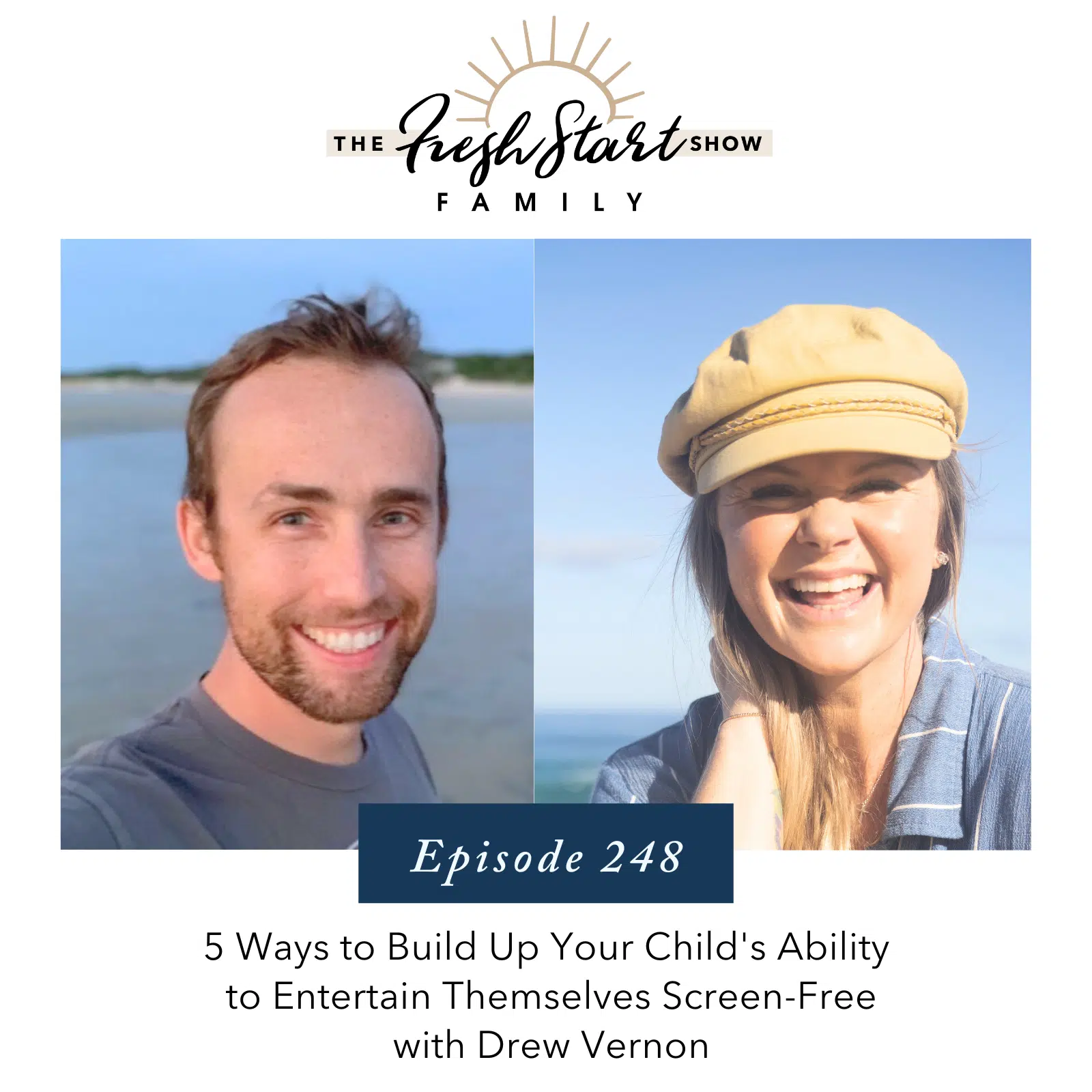
In this dynamic episode of the Fresh Start Family Show, Wendy Snyder is joined once again by Drew Vernon from Tonies for an eye-opening conversation about helping kids develop the ability to entertain themselves—without relying on screens.
With screen time becoming the norm in today’s digital world, many families are searching for healthier, more creative ways to engage their children. Wendy kicks off the discussion by sharing a thought-provoking observation from a recent trip to Disneyland, where she noticed the increasing use of screens by kids, sparking a deep dive into how we can redirect that trend.
Together, Wendy and Drew explore practical strategies to encourage screen-free play that fosters creativity, independence, and imagination. They share tips on setting boundaries, being a role model for mindful technology use, and introducing self-directed play options like Tonies that empower kids to take charge of their own fun. The conversation also touches on the power of nature in childhood development, while highlighting how Tonies is expanding its range with educational content for older children. Whether through home use, libraries, or school programs, this episode is packed with actionable insights for parents and educators looking to raise screen-free, creative kids!
What if you could be an effective, firm & kind parent WITHOUT relying on fear, force, bribery & rewards?
Imagine learning a new way of firm (AND kind) parenting so you can end painful generational parenting cycles and create family legacies & memories YOU are proud of?
All while getting your kids to cooperate with your rules and boundaries with ease.

IMAGINE …
Parenting your kids with calm & confidence each day in a way that causes them to do what’s asked of them because they WANT to (not because they HAVE to) … because you’re helping to build essential life skills that have them behaving well & being respectful when you’re NOT looking!
The Firm & Kind Parenting Blueprint is your step by step plan & video training to help you build the family of your dreams. Click HERE to learn more now!
Episode Highlights:
- Modeling Behavior: Parents should demonstrate alternative activities to screen usage, such as reading or playing music, to inspire similar behaviors in their children.
- Empowerment Through Play: Drew highlights the importance of providing children with toys that they can manage independently, fostering a sense of control and creativity.
- Setting Agreements: Establishing clear agreements about screen time, rather than dictating terms, helps children understand the importance of balanced play.
- Education on Effects: Educating children about how screens impact their mental health is crucial for developing healthier relationships with technology.
- Integrating Educational Resources: Tonies new educational content and involvement in libraries and schools offer accessible, enriching options for screen-free learning.
Resources Mentioned:
Find Toneis on Instagram or on Facebook
Tonies Website
Catch this episode on YouTube!
Drew’s 1st Ep on FSF Show Helping Kids Become Problem Solvers and Critical Thinkers Through Play & Literature
Learn more about why FSF is passionate about Tonies HERE!
Don’t miss your chance to win a FREE Toniebox! Enter HERE!
Use promo code FRESHSTART15 for 15% off orders $99+ at Tonies – good 11/06/24-12/06/24, limit one use per customer.
Not able to listen or prefer to read along? Here’s the transcript!
0:00:02 – (Wendy): Well, hello, listeners, and welcome back to a new episode of the Fresh Start Family show. I’m thrilled to have Drew Vernon here from Tonies, who is going to be talking to us today about how we can build up our child’s ability to entertain themselves screen free. Welcome to the show, Drew.
0:00:22 – (Drew): Hi, Wendy. It’s great to be here. Thanks for having me.
0:00:25 – (Wendy): Yeah, we are so happy to have you back. We adore what you guys are doing over at Tonies. We love Tonie boxes. We recommend them to the students that we coach all over the world multiple times a week. It feels like when we’re counseling students on how to make bedtime easier or nap time easier or free play time easier. So we just really love what you guys are doing over there at Tonies, and you guys have always been so supportive of our show, Drew.
0:00:52 – (Wendy): And so when we were chatting about connecting again and recording an episode, I wanted to record on this subject because I know that it is becoming more and more hard for parents to just resist the urge to hand their kids a screen. It is becoming more and more normalized. I actually was just at Disneyland with my almost 17 year old. We snuck away and played hooky for the day from school and work last Wednesday.
0:01:20 – (Wendy): And I hadn’t been. I guess it’s been a year. It had been a year. I took them for their 16th birthday and their 13th birthday as a family. We went to Disneyland, but just tell. And I went this year, and I swear I don’t remember this last year, but this year, there were so many kids on screens, visual screens in strollers and at lunch and dinner or, like, eating their ice cream. And I was kind of like, wow, this. It felt like a big difference between this year and last year. And I’ve been doing this for quite some time, so I think I would have noticed this last year, but it just seems like it’s increasingly becoming more and more common and more culturally the norm to just kind of let your kid be on a screen. And we all know what it’s like to be a parent, right? Like, sometimes you’re just desperate and you just. You need help.
0:02:14 – (Wendy): And also, I’m just so passionate about normalizing conversations that empower parents to choose an alternative route that, yes, sometimes makes you a little bit of a black sheep or a rainbow unicorn, and, you know, you will be different. Right. But the data that is coming out of, you know, as Jonathan hate put in his new book, the Anxious Generation, it is just so clear that this is a really important topic. Like, this is a topic that could quite literally save our children’s lives if we educate and empower ourselves as parents on how to teach our children this life skill of entertaining themselves screen free. So thank you for being here today with me as we just kind of chat and riffe on this topic, Drew.
0:03:01 – (Drew): Yeah, it’s my pleasure. And it’s something that I’m obviously very passionate and enthusiastic about that’s crazy about the Disneyland story, you know, happiest place on earth, and we’re spending how much money, and just to put our kids in front of screens. I had a similar experience not too long ago, taking my. My kid to soccer practice, and some of the younger kids, the siblings of the kids playing soccer.
0:03:28 – (Drew): We’re sitting there at the park on a sunny day, just watching. Watching stuff on a tablet, and it just blew my mind. So I agree with you. I think this is becoming a national conversation, and, you know, I think I’m trying to be part of the solution.
0:03:46 – (Wendy): Yeah. Yeah. And the more it’s normalized. And again, this you and I speaking about, like, wow. What we’re witnessing is not from a place of judgment, because it’s, like, we know, right? I mean, we know what it’s like to just want to have some more peace, but it is from a place of advocacy. Like, I mean, we’ve. We’ve got to do something different and help parents choose a different path. Yeah. When we were at Disney, I couldn’t believe it that at dinner, Stella and I there, we got into this restaurant that we were so shocked that we got into, because normally, I mean, it was so crowded on a Wednesday, we were like, it’s mid September. Like, what the heck?
0:04:21 – (Wendy): And there was a. The incredicoaster going right next to this restaurant. So we’re on this lake. The incredicoaster is going right there. There’s the Disney Ferris wheel, which is beautiful. It’s sunset, which is, like, majestic. And there’s, like, swings going. There’s, like, music. There’s, like, over in this one area, there was, like, a little quartet playing music. And all of that wasn’t enough to, like, have the children just be able to eat their macaroni and cheese without the screen. Right. So, again, it’s pretty wild what’s happening in our culture, and let’s just talk about how we can do it differently.
0:05:00 – (Wendy): So we’re gonna. We’re gonna cover today five ways that we can build up our child’s ability to entertain themselves screen free. And, like we do here at fresh start family, we cannot start by focusing on the kids, we gotta start by looking at ourselves. So I know you have. I think your kids are like eight. Are they 812 and 15 now? Cause it’s been a few years.
0:05:22 – (Drew): That’s right. Yeah. Good memory.
0:05:24 – (Wendy): Okay. And mine are 13 & 16. And so this first concept is we have to look at our own behavior around the interactive screens and really ask ourselves, are we modeling to our kids enough of kind of the alternative behavior, so to speak. So whether it’s a reading, knitting, painting, journaling, playing guitar, drums, or audible entertainment, which so many of us love, our podcast. We love music, of course, like, but some stuff that doesn’t involve the visual screens. That first question of, like, how are we doing with that and are we modeling it? And I know I still have a ton of work to do. I actually just had an incredibly inspirational interview before you that inspired me. Like, okay, I got to give back on track a little bit with what I’m modeling because for me, it is. It is tough to disconnect as an entrepreneur, especially since my office is in my house.
0:06:25 – (Wendy): I hate that we have these, these devices that’s like your whole business is just in your pocket. And at any time you can just access anything to just get one more email sent or everything’s online, right. It’s like I could just place groceries, or if I need to get back to grandma, it’s via a text. And so I was reminded that I really want to change that behavior and I want to build in more activities after the 05:00 p.m.
0:06:52 – (Wendy): hour, especially that does not involve looking at a screen. How are you doing with that? What are your thoughts on that? Like, do you constantly kind of have to remind yourself on that, or are you pretty good with boundaries around that?
0:07:05 – (Drew): I would say I’m getting better. I’m not perfect at it, but I am mindful of it. And I think that’s the first step, is just to. To be mindful. I really think of it in a couple of different ways. Number one is just to set boundaries with yourself. To say, I do my best not to look at a screen before 08:00 a.m. i usually wake up somewhere between six and 630, and I at least have an hour and a half where I don’t check a screen because the last thing I need, I try to meditate and things. Last thing I need is something else coming into my mind.
0:07:38 – (Drew): And that’s the first thing. If you go to it, it’s that email. It’s, you got to do this today. And similarly, you know, my personal limit is after 09:00 p.m. after 09:00 p.m. the phone goes off and I don’t touch it again until 08:00 a.m. so just setting some boundaries I think is good. And the other thing that I try to do is I try to be intentional with the use of my phone. Am I using it as a tool? Do I need to text somebody to take care of an issue? That’s great.
0:08:07 – (Drew): Am I using it as an entertainment device or as a boredom killer? That’s where you start to get, I think, in dangerous territory. Because if you’re just on it because you’re bored or because you don’t have anything else to do or you’re doom scrolling, I think that’s where you get into the more problematic and addictive behaviors. So I try to use it as a tool. Not to say that it can’t be an entertainment device, but if it’s intentionally entertaining, if you’re going with a specific, you know, mission to watch this video or listen to that song, that’s great.
0:08:40 – (Drew): But if you’re doing it just to kill time or out of mindlessness, that’s where I think it’s a little problematic. And to your initial point, it does go back to the modeling and your kids seeing what you’re doing. If you’re on your screens when your kids are around, they’re going to note that and they’re going to adopt similar behaviors.
0:09:00 – (Wendy): Yes, exactly. Yeah. It’s wild how every year that goes by, it’s becoming more and less and less likely when you walk into a home that you would see the bookshelf of books or the box of knitting needles. I don’t know. I feel like we’re just becoming more and more accustomed to just having the free time be on devices versus actually doing some of those other things. So in your home, do you have music?
0:09:30 – (Wendy): Taryn used to play electric guitar. He actually has stopped, but Stella still is a drummer. I actually have a double drum kit behind me, which drives me nuts because she’s supposed to be teaching kids lessons and it just hasn’t happened because she’s so busy. But half of our garage is two double drum sets, and that does give her an option to do something else in the home. And we have a ping pong table that we use. But in your home, what are some things that are fun that you guys are modeling and doing that are outside of screen entertainment? Besides Tonies, of course, which we’ll talk about in a little bit.
0:10:07 – (Drew): Yeah, sure. You know, we, we do a lot of games together. You know, board games, card games. We’ve got a ping pong table. We started gardening this year, so just getting out.
0:10:18 – (Wendy): Oh, nice.
0:10:19 – (Drew): I had to pull weeds every day as a kid. I don’t make my kids pull weeds every day. Spending outside time outside. And then, you know, I am an amateur potter, so I’ve got a pottery studio in my garage, and my, my youngest eight year old old is just like begging and begging for pottery lessons. So we started doing that together. And it, you know, it all requires a little bit of planning and, you know, getting, you know, active and engaged.
0:10:47 – (Drew): And, you know, we have screen time, too. We try to balance that as well. So I don’t mean to make this perfect picture of a perfect household. It’s not that, but we do try and we try to keep things in balance.
0:11:01 – (Wendy): My gosh, that reminds me, I have wanted a pottery wheel for years. And you actually have one.
0:11:08 – (Drew): Yeah, I’ve got a pottery wheel. I’ve got a self contained sink so I can wash up. I also have a kiln so I can actually fire in my garage as well.
0:11:19 – (Wendy): Wow. All right, you’ve inspired me, drill. You’ve inspired me. All right, our point number two, if we want to build up our children’s ability to entertain themselves screen free is we have this idea of building empowerment through self managed toys, resources and activities that your child can be fully in charge of. And obviously, Tonies does a great job of this because they’re so, they’re so unbreakable and kids can just push them forward back when it comes to stories or music, whatever they’re listening to.
0:11:52 – (Wendy): But this idea of empowerment is so important if we want our kids to actually get excited about entertaining themselves screen free is to really put them in charge of things, right? Like things that they don’t necessarily need our help with. Even if it’s like painting, where they for sure know how to create an area with, like, a big splash mat where they can make a mess and know how to do it right. So safe places to be, messy things that they can fully manage on their own confidence in areas.
0:12:25 – (Wendy): Like if we can help them ahead of time, I think with baby proofing areas so they can really freely know that they can just do what they need to do and they’re not going to break something. Any thoughts on that as far as, like, building in empowerment through self managed toys or activities? Like, do you see a lift with your kids when they’re in charge and you don’t have to micromanage their time, which we know comes so much with screen time. Right. Like, you have to micromanage how many minutes do they get on the iPad or the tv?
0:12:54 – (Wendy): This is kind of the opposite of that, of letting them be fully in charge, charge of their own activities.
0:13:01 – (Drew): Yeah, I fully agree with you. I think that a lot of this comes down to setting a boundary and having guidelines, but giving autonomy and freedom within those guidelines, within that boundary. So when you’re able to give a child a closed system, in this case, like a Tonie box, you know, they’re not going to be connecting to the Internet. They’re not going to be, you know, making, you know, purchases or having, you know, things spy on them. It’s a self contained system, and they can play any type of story or content within that and operating the device, as you mentioned, and they have kind of full freedom within that environment because we do want to keep our kids safe.
0:13:42 – (Drew): We do want to make sure that, you know, it’s not going to be damaging or get out of control. I like what you said about the kid proofing spaces. Even if they are going to get a little bit messy, it’s all kind of contained within a system. And so I’m a big proponent of teaching that because really, it’s a maturity issue where as they grow and progress, they’re going to be getting additional responsibilities and privileges within that system.
0:14:14 – (Wendy): Yeah, I love that. And I do love how Tonies seems to be unbreakable. We. I’ve been playing around with aromatherapy a ton with our students lately, and we have, like, a kids kit that sometimes if I’m on an airplane or somewhere, I was just teaching a class in person, and I let the little boy play with. He was, I guess he was like 16 months, maybe. And I handed his mom the kids kit, and he was unscrewing these oils, and they’re glass, but they’re very thick.
0:14:43 – (Wendy): And I was like, don’t worry, he can’t break it. And she kind of looked at me like, are you sure? I’m like, yes, he can totally be in charge. He’s not going to break them. Even if he puts them in his mouth, it’s safe, it’s okay. And he ended up playing with those little aromatherapy oils for quite some time while I taught a class. And she was able to engage, so that was cool. But when I think about Tonies, it just feels like they’re unbreakable.
0:15:05 – (Wendy): So my question is, has there ever been a Tonie box that you heard that got broken because in the ones I’ve seen and the ones we had for a while. It doesn’t. It feels like they’re so durable, like a kid. Can you break a Tonie box? I guess if you put it in a bathtub.
0:15:23 – (Drew): Well, yeah, I would not recommend the bathtub because of, you know, the charging station. It’s not waterproof. Yes, I have seen the ears. So these are the volume. Ears up, volume down. It was actually was from a dog. It was not a kid, but.
0:15:38 – (Wendy): Oh, there we go.
0:15:39 – (Drew): Off the ears. But even that, you know, is easily replaced. You can find kind of the replacements, but I have seen the ears get chewed off, but the box itself is pretty near indestructible.
0:15:51 – (Wendy): Yeah. Oh, I love that about Tonies. Okay, cool. All right, let’s move on to our next point, which is if we want to help our children ability build the ability to entertain themselves screen free, we’ve got to make agreements ahead of time. And so here at fresh start family, we love to teach our parents a four step process. We teach it in our firm and kind parenting blueprint, and that’s just setting strong limits and sticking to them consistently, which we know when it comes to technology, we’ve got to learn and be able to do this as parents.
0:16:24 – (Wendy): Like, our children’s mental health depends on it. But one of the biggest parts of that is the making agreements part, which is very different than compliance statements. Right. Compliance statements is just do it because I said so. Right? Like, no iPads, no whatever, because I said so. Whereas agreements is more. Let’s talk about this as a team, and let’s truly make this something where you understand why we have such a firm boundary and how this boundary respects you in addition to respecting us. And I think the earlier we can educate our kids on the difference of how their nervous system gets hit or their body feels when they’re interacting with a screen versus interacting with a non screen entertainment. In the case of Tonies, it’s an audible.
0:17:13 – (Wendy): It’s just so different how it hits their system. Right. So this idea of making agreements ahead of time. Right. Like, do you advocate for, like, I think you’re similar to us, right? Like, no screens in the bedroom, but Tonies are totally cool. Right?
0:17:32 – (Drew): Yeah. Yeah. You know, I think having the guidelines and setting the expectations is a good start. Obviously, the boundaries with where the screen can be used. And I find the best success as a dad when, you know, we try to, like, talk through the day or we talk through the next few hours. Okay. Yeah, you can go watch your show. How long is the show? It’s 25 minutes. It’s 45 minutes, whatever. At the end of that, you’re gonna turn that off, and we’re gonna go to another activity. So it’s helping map out their day and their expectations, because, you know, these services, Netflix and all these others, they. They go right on to the next step.
0:18:09 – (Drew): They want to keep you hooked. Like, that’s their business model, is to keep you glued to the screen. So I think you need to anticipate that and kind of walk that through with your. With your child to make sure that they know what to expect after the show is over.
0:18:26 – (Wendy): Yeah. And so many kids, they do just want to know what to expect, where the fence is. And then we come in here at fresh start family, and we teach parents, okay, when it is time to turn it off, like, how do you. When they are like, no. And they’re, like, pushing go on the next episode, how do you actually come in with the rest of that process where you’re gonna follow through? The tv’s gonna get turned off, but it’s not gonna end in, like, threats or this disconnecting moment of chaos between you and your child.
0:18:52 – (Wendy): And so that’s so important. But so many kids, just. Their soul will settle if you just let them know in advance. Here’s what’s gonna go down. And then to always, like, Tonies is just such a nice option because they always have that as an available entertainment form. But the screen, right, the iPad, the tv, all that kind of stuff comes to an end. But I do think that if we can educate our kids as early as possible on the effects on the body, and I know it’s easier said than done with a three, four, five year old, but, I mean, when it comes. When it came to keeping Stella off an iPhone till high school, we were definitely rainbow unicorns in our town in southern California, but we just had so many conversations between, I’d say, 6th and 8th grade is really when it flared up of why we have this strong boundary, which really brings us to our next point of setting firm limits and knowing what your yes behind your no is.
0:19:46 – (Wendy): But really, there was just so much education work that came in there to help her understand how the interactive screens, especially the social, the constant being on the dopamine hits that are coming from those interactive screens, the science, the research behind that, how that was actually leading to suffering for children and to be able to put the data in front of her was really important consistently. And by the time she did get that device in her hand once she was later in high school.
0:20:21 – (Wendy): I think she really did understand it, but it was such a stark difference to most of the kids being given the devices, interactive devices, very young, and not having explained to them, this is how it’s going to hit your body, and I just don’t think they understand. Right. When you’re a young kid, you’re just going to need someone to explain that to you multiple times because it doesn’t make sense. Like, what’s the big deal, right? This is just interactive games. It’s not a big deal. We’re playing, like, you know, there’s little monsters, mom, what’s the big deal? But to have a parent stay patient and say no, like, you can play with this, this, this, and that? Here’s your options.
0:21:01 – (Wendy): We’ll make agreements. We’ll give you tons of different things that you can do. And here’s the reason why. Behind our no, here’s the. Yes, it’s your mental health. It’s healthy friendships, it’s good sleep, it’s confidence versus shame about an addiction. Would you agree that just teaching that to kids as early as possible is important?
0:21:23 – (Drew): Yeah, I think so. And, you know, you mentioned doctor, Doctor Haidt in his work, and I’ve been actually learning a lot from his work and learning a lot about Gen Z. And it seems like they have, the upcoming generation kind of has a strong sense of this, and sometimes even more so. Their parents, they’re seeing the effects. They don’t want to be on social media at the older ages. I don’t know if the younger kids are feeling this way about the excessive screen time, but I think there’s something inherent in us and in childhood maybe, where kids want to be curious, they want to be social, they want to be solving problems and going on adventures.
0:22:09 – (Drew): And just all of these playful aspects of childhood, I feel like, are being kind of muted by putting them in front of a screen. So, yes, we do need to set those guidelines and paint the big picture, especially for developing minds. But I also think we should put some trust in our children to explore their own curiosity and to, you know, we have to give them, you know, opportunities and activities and make it easy for them. But I think that it’s definitely something that they have a sense of.
0:22:42 – (Wendy): Yeah, it’s true. And speaking of Jonathan Haidt’s work, I actually had got to interview the co founder of an organization. So he co founded an organization called Let Grow with a woman named Lenore Skinnaisy. I want to say her name is. She was such a cool interview a few weeks ago, but their whole organization is about basically helping parents understand how a lot of the data that’s coming in around the increased anxiety and depression and even suicide that’s happening in our youth in the second decade of life, in the last 1015 years, they’ve created so much data to bring it back to not just the screens, but they actually refer to themselves as like agnostic on screens, which is really interesting.
0:23:32 – (Wendy): But they had, they have the data and, and the thought pattern is it’s actually from the constraint of the parents. So as the world we. The information spreads, right, and we find out more and there’s more information about danger in the world. We’ve actually, actually, like, tightened the grip on children and there’s less free range happening in the world, right? Like, you’re not just allowed to go out on Saturday and ride your bike and disappear until dark anymore, right?
0:24:01 – (Wendy): And it just makes me think of this conversation because a lot of times with the interactive screens, whereas Tonies is much different, none of this is happening with Tonies, but because it’s not a problem, but with the interactive screens, there’s so much control being put on it of, like, I have to control it. So I’ve got to check you. And we teach a much different way here, but most parents are operating from the place of we’re watching you, we’re watching. We’ve got apps on your phone, we’re going to monitor your texting, which is great to some extent, sometimes not, but we’re controlling it. We have the ability to flip the switch.
0:24:39 – (Wendy): We’re going to try to protect any mistakes. You can feel that there’s, there’s a control element that is a bit of an interesting situation we’ve got going on. And you can see how with a Tonies box, there’s no addiction being formed. It’s just entertainment. It’s ending boredom. It’s helping them with boredom, it’s helping them have creative imagination and all the things, but it doesn’t come along with those negative, those things of, like, my parent is controlling this and I’m not fully in charge of it.
0:25:15 – (Wendy): Does that make sense? Like, I. That’s just made me think about it.
0:25:18 – (Drew): And I think maybe what it stems from is that, like, the stakes are so high because when you have a device in your pocket, you literally have the world at your fingertips for good or for ill. And so I think a lot of parents want to control that because. Not because they don’t trust the child, but because any number of things could happen from the outside coming in. And I, you know, I think that’s probably a healthy caution or guard, but to put, to, to give the child a device or to put them in an environment where that’s not required because you don’t have the concerns of the entire world, I think is kind of freeing as a parent. And it leaves the child in a scenario where it can just be about childhood and imagination, like you said. And so I think that’s a really interesting kind of dynamic between the two.
0:26:16 – (Wendy): Yeah. And it is. It’s like once you introduce it and it’s an option. Like, I mean, I. Once you start to introduce that screens at dinner, when you go out to a restaurant is the option. It is now the way, that’s what I’ve noticed with families. And, and again, I’m just like, wow, every time we go out to dinner now, I’m like, okay. Kind of just scanning, not in judgment, more in observation. And just, again, from an advocacy’s perspective, I can feel the little, like, inner, oh. Going off because it feels like if there’s 100% of kids in restaurants, it feels like at least 20% to 30%, maybe probably even more 30% to 40% are watching a screen during their meal as the parent is trying to just enjoy a meal, like have a conversation, which I get, but it’s a slippery slope. And as soon as you bring it in, then the child is not going to be able.
0:27:13 – (Wendy): They’re going to expect that every single time. Right. So just, again, the longer we can prolong that being our norm. And if you just have entertainment for airplanes, restaurants, even Disneyland, when they’re starting to get tired in their stroller and they might be winding down for a nap. But just imagine just having earphones and a Tonie box, which is just an audible play device or audible story and music box versus an interactive device, it’s not too much of a switch. It’s just enough, though, that it makes a difference. And it doesn’t have that addictive quality that fully brings the human out of their surroundings. They’re still able to see people around them. They’re still there.
0:27:58 – (Wendy): Not like a little zombie. Right. Like that happens when we just let the child go into the screen.
0:28:07 – (Drew): Yeah, yeah, I can echo all of that. I think the screen kind of shows them exactly what the stimulus is. It puts them in the zone. And by removing the screen, it leaves it up to interpretation and to creative imagination and a little bit less stimulation.
0:28:27 – (Wendy): Yeah. So that’s our last point. And we’ve kind of already talked to this, this point a little bit, just about teaching our kids young about the brain and how our bodies, hearts, and minds thrive when given white space, nature, and opportunities to use our imagination. And so I do love how you can take these story boxes that you guys have and bring them into the backyard, as we’ve talked about, they’re super durable, and then they still are giving the child an opportunity to use their imagination because a screen is going to provide it all right. Like, it gives you, what does the character look like?
0:29:05 – (Wendy): What is exactly happening? So you’re getting the audible, you’re getting the vision. But with a storybox, a child still has to use their imagination to what does this character look like? Even though the Tonie sits on top and it shows you the little character, but there’s other characters and stories or music, and so there is that imagination element there that is so important for our children that I think so many of them are missing out on when we, when we have less and less of that in their day. Would you agree?
0:29:36 – (Drew): I would. I would say that imagination and creativity are muscles that need to be developed, and you need repetition. You know, listening to stories, listening to descriptions, learning new words, formulating how things, you know, different ideas come together in your mind. That’s all better done when you have the freedom to do that in your own brain rather than having that be given to you. So I think it’s critical for kids to get the practice of doing that. And that’s why I think, you know, listening to stories, you know, listening to someone read to you is the first step to literacy.
0:30:14 – (Drew): And you take that and you build on it, and you get a lot of stories from a lot of different sources, and you begin to learn what the creative process is like so you can learn how to, you know, imagine and create your own stories.
0:30:30 – (Wendy): Yeah. Yeah, totally. It’s like, I was watching a show on Sunday morning, and I was recently, and I noticed how so much of our learning nowadays, at least in the US and the educational system, is done on the interactive screens. And I kind of thought, because I knew we had our interview coming up, I was like, gosh, I wish that we could create more just audible learning, but, like, everything, and it seems to be more and more screen based, and it just feels like we’re missing out, that we could possibly accomplish the same thing if we had more audible stuff going on. So a kid can look out the window at the tree that’s changing color in the fall while they’re listening to something, but the teacher doesn’t have to.
0:31:13 – (Wendy): I don’t know. Just an idea. Educational world. I had looked up some research and some different studies I had found. One of them says, research shows that children who actively use their imagination through imaginative play experienced significant benefits in their cognitive, social, and emotional development, leading to overall thriving as they grow up. This includes improved creativity, problem solving skills, communication abilities, emotional regulation, and a strong sense of self, all stemming from the ability to explore different scenarios and perspectives in their minds.
0:31:49 – (Wendy): Another research that I’d found as I was preparing for this interview was just about nature. We know that the more our kids are on the interactive screens, the less, like, many kids are starting to experience nature deficits, because, like, the more we bring in the interactive screens, the less they’re in nature. But researchers found that engaging in nature can improve kids working memory and attention.
0:32:14 – (Wendy): A study even found that children who grew up in greener spaces had increased volume in the areas of the brain that deal with memory and attentiveness. So, just important data that we can point to, to just know that it’s really important that we get this stuff into our kids hands. Okay, Drew, so we’ve talked about all of these incredible ways that we can build up our children’s ability to entertain themselves screen free.
0:32:38 – (Wendy): And now I just want to talk a little bit about why Tonies does such a great job of this. Again, we’ve been advocating and using Tonies here at Fristhart family for years now, but will you talk to us just a little bit about the educational benefits of Tonies and. And really using them for home based learning? We have a lot of homeschool families in our community, and we just have a lot of families who love to have their kids in constant learning. Like many of our students just cherish being lifelong learners.
0:33:08 – (Wendy): And so what are the educational benefits of Tonies?
0:33:12 – (Drew): Yeah, where to begin? I mean, I guess begin with the Tonie boss. So, you know, this is the speaker that works with the figures. Figures are called Tonies, and it starts with kind of the play pattern. So this isn’t just an audio device, but this is a multisensory tool. So kids, you know, at very young ages can grab the figure, they can put it on the box. It’s magnetic, so it’ll stay on the box. They can manage the.
0:33:40 – (Drew): The volume control and the chapter selection. So we talked a lot about that sense of autonomy that’s kind of the first stage and everything else, you know, once you have the lay back system down, which takes about, you know, 10 seconds, then it’s all about the content. So the content can start as young as infancy. You know, this can be a white noise machine. You buy this for a brand new baby.
0:34:05 – (Wendy): Yes, that’s right.
0:34:06 – (Drew): You know, for the first year, it’s just white noise and lullabies and nature sounds. And then it actually can grow with the child because then you get into your songs and your shapes and your colors and your farm animals and your princesses, if you’re into that, or superheroes, and you start to progress with the content as you get older. And then as you get through those years, it can become, you know, an educational device as well. So we’re, we’re coming out with an increasing number of educational titles. We’re in partnership with National Geographic and we’re doing our own series on, you know, I’ve got bugs right here. This teaches kids all about bugs.
0:34:50 – (Drew): We’ve got other ones that are teaching them, you know, egyptian myths or greek myths or west african tales. And so we actually just launched this week, we launched our audiobooks for older kids. So, you know, kids even as old as ages, you know, six to ten, can now listen to chapter books on the Tonie box. So it really is a versatile device for a child, again, you know, from infancy, age zero to ten.
0:35:17 – (Drew): And then you get into the creatives, which are the blank ones where you can record your own audio content that promotes creativity, that can get you into the early teens. And so it really is a device that can be used throughout childhood for a multitude of purposes.
0:35:36 – (Wendy): I love it. And I will say that Taryn used his for white noise to go to sleep all the way up until he was like twelve. So maybe, maybe like eleven and a half. But he used his even after he stopped listening to the stories because for a while, I remember there was like diary of a wimpy kid and there was, what else was it? There was like one more something that was like, for the older kids. So I’m glad that you’ve got, you guys have expanded that. And then what else was I going to say? Oh, yeah, one more thing, too, of just the benefits that I know, I’ve heard from my students over the years is military families have, and grandparents have used those blank tonies to record and then be able to record a story and then to be able to have that child listen to it while the parent is deployed or the grandparent is far away. And so that’s been a really cool way to have this little toy serve and connect families. So I’ve heard a lot of those stories over the past.
0:36:40 – (Wendy): Okay. And then also how do we get Tonie? So obviously we can buy Tonies. But you had mentioned that nowadays you can request them from your library and some state voucher scholarship money possibly happening. So tell us about that drill.
0:36:55 – (Drew): Yes, so all the traditional ways are still there. We’re expanding in target, Walmart, Amazon, tonies.com. so that’s kind of all the retail locations. But I lead the education program now. So part of my goal is to make Tonies available to as many kids as possible and by putting them in educational settings. So, so we’ve started creating kind of educational accounts for libraries. We’ve got, you know, over 500 libraries carrying Tonies now.
0:37:24 – (Drew): So check your local library. If they don’t have it, then you can ask your librarian to reach out to us to carry Tonies. So a lot of them are circulating them, making them available to their patrons. Same goes for, you know, your local school. We have an ambassador program where parents are actually donating Tonie boxes to their, their kids local classroom or if you’re doing home based learning, as you mentioned, we are working with an increasing number of states on scholarship programs where if you have received a voucher or scholarship, typically you can spend it on different curricula or vendors that have been approved as educational.
0:38:07 – (Drew): And so we are increasingly becoming an approved educational vendor so that home schooling families can purchase Tonies using these vouchers.
0:38:16 – (Wendy): Oh, thats so cool. I need to look into that for fresh start family. I feel like because we have a big kids program for social emotional learning, im like I feel like I need to be an approved vendor for. So ive got to get that information from you. And then you also had mentioned something about you could write a grant. What is that all about?
0:38:31 – (Drew): Yeah, weve had some teachers. Im learning a lot about early education and teachers and how scrappy and resourceful they are. But there’s a variety of state and federal programs that teachers can submit for and they can request funds to purchase Tonies for their classroom. So anybody who’s interested in that learning more can reach out to me and I can give some tips on how to write a successful grant for Tonies. But it really comes down to just illustrating the fact that they do promote literacy, that they do promote creativity and imagination. And we’ve started doing some studies that help prove that, which are helpful to put in the grants. But again, it’s really encouraging to see teachers getting government grants to purchase Tonies for their classes.
0:39:18 – (Wendy): That is so exciting. Okay, so we can put your email maybe in the show notes and people.
0:39:23 – (Drew): Can reach out education dot usonies.com. we can put that in the show notes. That’s the best way to reach out to the education program.
0:39:30 – (Wendy): I love it. Oh, my goodness. All right. Well, what a great conversation today. I hope listeners and viewers, this has really inspired you and helped you feel motivated to bring in more ways to help your child build out their ability to entertain themselves screen free. And as Drew said, go see if you can get some Tonie boxes at your library and into your school system. That would be incredible. So, Drew, finish us off with where can everyone come find you and the world that you’re doing over at Tonies? How can we?
0:40:05 – (Wendy): We talked about a few ways, but just leave us off with where they can come find you. Yeah.
0:40:10 – (Drew): One thing that I didn’t mention is our community groups. So Facebook, if you’re a teacher, look up Tonies for teachers. If you’re a librarian, Tonies for libraries. We’ve got Tonies on foot is our ambassador program. A lot of our homeschooling families are also in Tonies for teachers. So I would recommend coming there because we have a growing network of families that care about reducing screen time.
0:40:37 – (Drew): They care about promoting early literacy, and they’re all sharing with each other different ideas, tips and tricks. And, you know, how do you, you know, how do you record onto a creative Tonie? How do you store your Tonies? How do you do this? How do you do that? So it’s just a wonderful community resource to jump into one or more of these groups. But other than that, you can reach me at education dot us.com,
0:41:01 – (Drew): and that’s the best way to get started.
0:41:04 – (Wendy): I love it. Tonies on foot ambassador program. I can’t believe I’m not a part of this yet. I got to jump in and be a part of that. That sounds great. And, yeah, that community piece, because it does take a village and every single one of us who has the courage to press into advocacy in this area and really be someone who’s willing to be different in our communities and our school systems and our faith communities. All the things.
0:41:29 – (Wendy): It matters. It matters. So. All right. Well, Drew, thank you so much for being here today. We appreciate you and all the work that you’re doing over at Tonies. It’s been great to chat today.
0:41:39 – (Drew): Thank you, Wendy. It’s always my pleasure. And it’s always great to see you and thanks for having me back.
0:41:45 – (Wendy): Yep. We’ll see you next time, listeners.