


Enter to win a prize package worth over $1700 now by subscribing to our new channel on youtube. Click HERE to enter
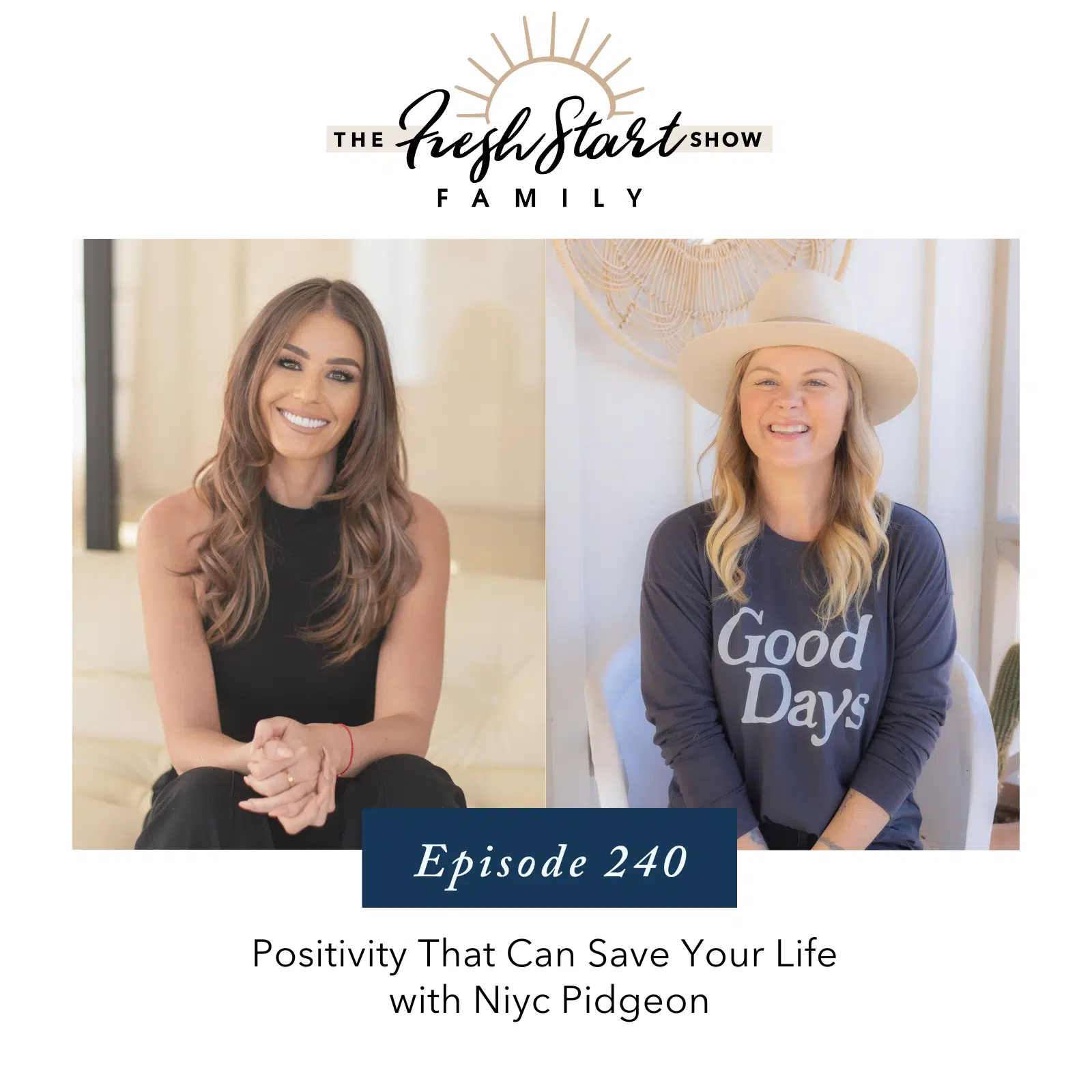
In this episode of the Fresh Start Family Show, hosts Wendy and Terry welcome the illustrious positive psychologist, Niyc Pidgeon. Together, they delve into the transformative power of positive psychology and its life-saving potential, especially in suicide prevention. The conversation weaves through Niyc’s personal journey, the foundational elements of positive psychology, and practical strategies for fostering a supportive family environment that emphasizes strengths and resilience.
The discussion kicks off with Niyc explaining the essence of positive psychology—its focus on human strengths and virtues rather than disorders. As she narrates her unexpected career shift from mechanical engineering to psychology, she highlights the crucial role of gratitude, meditation, and daily positive practices in boosting mental well-being. Wendy, Terry and Niyc explore the alarming statistics around suicidal thoughts among high schoolers, emphasizing the necessity of normalizing mental health conversations to dismantle stigma and foster open dialogue.
Are you ready to create the life you want – filled with strong healthy relationships –
+ live with high self-esteem, confidence, peace & joy?
If yes, join us for The Fresh Start Family Freedom to Be Online Course!

This immersive learning experience will help you heal relationships, learn to love yourself more, forgive others easier, shed limiting belief cycles, end protection behaviors & stop blaming yourself & others! Click HERE to learn more!
** There are very limited spots, and they are filling up quickly, so save your spot now!! I can’t wait to see you there!
Episode Highlights:
- Understanding Positive Psychology: Positive psychology focuses on what is right with people, emphasizing human strengths and virtues.
- Early Intervention: Discussing feelings and understanding emotions from a young age can equip children with the tools to manage life’s challenges.
- Connecting with Others: Building strong, supportive communities where individuals feel they belong can significantly reduce feelings of isolation and hopelessness.
- Practical Tools: Introducing daily rituals and positive practices like gratitude and identifying strengths can prevent mental health crises.
- Breaking the Silence: Normalizing conversations around mental health and suicide prevention can save lives and reduce the stigma associated with these topics.
Resources Mentioned:
- Follow Niyc on Instagram
- Niyc’s Website
- Grab her best selling book One More Day: Find Strength and Resilience through Your Darkest Times with Life-Saving Tools from Positive Psychology
- CBS Saturday Morning spot with Jonathan Haidt on teen mental health and suicide stats
- Catch this episode on Youtube
- Watch Wendy & Niyc’s IG Live together
Not able to listen or prefer to read along? Here’s the transcript!
0:00:03 – (Wendy): Well, hey there, families, and welcome to a new episode of the Fresh Start Family show. We are thrilled to have Niyc Pidgeon here with us today who is a positive psychologist extraordinaire and just such a light in the world. And we’re going to be talking about the life saving importance of positive psychology and three ways to implement it into your family legacy. Welcome to the show, Niyc.
0:00:26 – (Niyc): Thank you for having me. I can’t wait to have this conversation. So excited.
0:00:30 – (Wendy): Me too. Terry and I have just been actively just soaking up all of your incredible wisdom and guidance as we prep for this interview. And this is so important, Niyc. So we are just in such deep admiration for your work and the book that you’ve been writing. And I thought it’d be great to just chat first about what is positive psychology. If you could just give us kind of the, you know, the foundation there and then we would love to hear your story about becoming a positive psychologist and then why specifically you’re so passionate about what your new book is all about, which we’re going to have such a rich conversation around today. But let’s start us off with those two things, if you could.
0:01:15 – (Niyc): Okay. Amazing. Yeah. So I’m always astounded that not everybody in the world knows what positive psychology is. Someone said to me the other day, they’re like, I’ve heard of psychology, but not positive psychology. And the difference between the two things is that psychology, as usual, focuses on disorder, disease and what goes wrong with people in the world rather than what goes right with people.
0:01:40 – (Niyc): So in the year 2000, positive psychology was born as a kind of counterbalance to look instead at human strength and virtue, to look at how we can feel better, be better, do better, create more. And we’ve looked at the performance side of things, but now there’s also a lot of research that shows that positive psychology doesn’t just work for the days where you’re feeling good and you want to feel great. It also works on the days that feel really, really hard as well.
0:02:10 – (Niyc): So I originally was supposed to be a mechanical and automotive engineer. I don’t know if you guys knew that the most random career change, but it’s also something that was so profound because at the age of 1718, I learned about the power of the mind and I learned about the potential that we have of shifting human behaviour through the small shifts that we make in the way that we think and we feel. So I decided that I was going to go on and study psychology and cancel all of my engineering degrees.
0:02:47 – (Niyc): And so I went to study psychology with bought, first of all. And then I’m going to try and think about what year this was. I think it was probably 2010. I saw, I’m old school, right? I can see you’ve got clips and things in the background when we’re filming this. Notice boards were a thing when I was at university. So I saw on a notice board a advertisement for an after hours lecture and it was this thing called positive psychology.
0:03:17 – (Niyc): And I thought, you know what? I’m going to stay behind after class next Tuesday and I’m going to go with that thing. And my mind was just completely opened because it was this lecturer talking about the power of gratitude and the power of meditation and how we can put these principles into our daily lives that can make us feel better more of the time. So from there, I knew that this was my path and I went on to study my master’s degree and then set up my coaching businesses and have really just put 1ft in front of the other step by step to carve a career in this industry that just has so much potential to do good.
0:03:59 – (Wendy): That’s so rad. And it’s so new to hear that. It’s just really the beginning of unleashing the power of this realm of psychology, so to speak, is just so amazing. And I know from seeing you speak in person, what you teach about and what you speak and the tools that you incorporate is just fire. And I feel like, of course, there’s so much in alignment here because with, with the work that we teach in the parenting realm when it comes to firm and kind, connection based parenting strategies, really is that strength based approach. It’s about assuming integrity in children and lifting them up and teaching them about their capabilities instead of them making them feel bad about their mistakes or making sure they know there’s nothing wrong with them when they smack their sister.
0:04:45 – (Wendy): It’s. Something’s going on deep down. And we’re going to help you understand how to understand your own emotions and self, self regulate and choose a different action that’s more in line with who you are and learn how to process emotions in a healthy way and all the things that we teach our parents.
0:05:03 – (Niyc): I did not have that when I was a kid. I wish that I had you guys when I was a kid because it wasn’t available, or maybe it was available, but just. I know my parents certainly weren’t going to see therapists or work with coaches or doing personal development. So I just think the opportunity that we’ve got for the next generations is absolutely massive. When you look at the shifts that we can experience in ourselves as adults.
0:05:33 – (Niyc): Imagine like a little kid that grows up with these tools and who they get to become because of that.
0:05:40 – (Wendy): It’s so true. And the life saving results of that. Right. That’s why I’m so excited for your field to continue to blossom and grow because I assume the research is going to continue to flow in that there is a difference, right, when humans are raised with this type of upbringing versus the traditional stuff, which is just a lot different. So I love that. And Niyc, you are a superstar in the entrepreneurship world. I mean, your businesses over there are just booming. I mean, you’re hanging out on Richard branson’s private island and other things, but you have really slowed down to write this beautiful book that is so meaningful, you, meaningful to you about how can we save lives moving forward, specifically with suicide prevention. So will you tell us a little bit about your story and why you’re so passionate about it and why you are sitting here today with such hope and belief that you can change the world and save lives and that we all can?
0:06:46 – (Niyc): Yeah, for sure. And I was actually able to share part of the story with Richard on Necker at Breakfast last week, which felt really special because I finished the edit for the book while I was there. So it’s infused with all of the magic. And I’ve got a massive smile on my face right now when I’m sharing about this book. Even though it’s a book about suicide prevention, even though it’s a book about getting through tough times and some of the tough times that I’ve got through for myself.
0:07:17 – (Niyc): And the big smile on my face is that essence of being able to look forward to a brighter, more hopeful future. So when I started writing the book, it came from personal experience. So when I was eleven years old, I actually had a suicide attempt myself. And looking back on that, it feels, number one. It feels like it was a different human. It doesn’t even feel like it was me now it feels like I’m watching a movie of someone else’s life.
0:07:48 – (Niyc): And at the time I remember, it felt like there was no other choice for me because I was so scared to go into school and I didn’t have the emotional, psychological, spiritual resources to be able to get through the days in the way that I might teach someone to do now. So back at that time, it was, I mean, it was, for me, incredibly challenging. And I went on to become stronger and more successful. Ever since, I’ve been met with challenge and I’ve had suicide touch me in my life more than just that one time, both through me going back into that space probably another three or four times across my life, but knowing now that I would never, ever, ever do something like that.
0:08:41 – (Niyc): But also because ive lost three close friends who died by suicide. And im not exaggerating when I say probably a dozen more who werent super close inner circle friends but who were on the peripheral. So when these experiences kept presenting in my reality, I started to think, why is this happening, first of all? And why is this happening and why can’t I help? The people are closest to me who have been a big stand for my work. They’ve read my first book. They’ve even taken some of my courses.
0:09:18 – (Niyc): And then it really connected me with this fire and this fight and this big mission inside of me that actually now is my chance to make a big difference in this space. So I’d started to really do a lot of research into the field and the science of suicidology, and I started to look at where there might be some overlap between positive psychology and the body of work that was there for crisis intervention.
0:09:48 – (Niyc): And there’s a lot that is buried that hasn’t been brought forward yet into the mainstream. So one of the unique opportunities that I have is I don’t have a huge audience, but I’ve got a small, loyal audience. I’ve also got a loud voice. I love to speak, I love to share, and I’ve got my own personal experience as well as the professional expertise. So it felt like this really big aligned purpose and calling for me to now speak out on the topic of what we know now as positive suicidology.
0:10:24 – (Niyc): So the research shows that the tools can be used for prevention. We’re not talking crisis because if someone’s in crisis, you go and call the crisis hotline. So you can call 988 in any country in the world. And I’m sure we can share some links as well underneath the show. That would be great if we can put like crisis hotline links in there. Amazing. But the stuff that we can do beforehand to stop the slippery slope before we get there.
0:10:51 – (Niyc): So the work that you guys are doing, it’s like getting these tools into the hands of parents so that they can share them with the kids, so that the kids now know how to have a conversation or how to share a code word or how to speak up if they feel like they’re having a bad day. And then the parent gets to intervene with an exercise or an intervention to help.
0:11:14 – (Wendy): Oh my gosh. It’s so good. Yeah. And so much of what I hear from your story, too, I mean, you teach so much around the tools, and then there’s also just reducing the stigma of just talking about it and even sharing your story and just raising your hand and saying, hey, this was something that’s in my personal story as an eleven year old, I think you said eleven. It’s like, you know, and it’s just every time a story is shared, and a story is shared in this capacity, through a book like this, especially of your dear friends that were lost, the stigma gets reduced a little bit.
0:11:53 – (Wendy): And it’s wild how deep and thick the stigma is that we do not talk about this. Terri and I were just watching a Sunday morning. It’s a show that we love. My parents watch it. I love it every Sunday morning. I love it. But they had the most beautiful clip on suicide prevention, basically, and what we’ve learned and just hearing them highlight the stigma that most people feel like. Like it’s just something you don’t want to burden people with. It’s not something you talk about. It makes you weird.
0:12:29 – (Wendy): And then you add the religious spin that so many people have if they grew up in a unhealthy circle. But even though even, it’s just the dogma of, like, if you were to even think about doing something like that, like, if you do, you’ll go to hell. It’s the sinful thing. So it’s no wonder that people suppress it. But to hear how common it is, as we were watching that show this morning, it’s like the stat that they had put out, Washington, that one in five high schoolers will have the thought one in five was a stat that they shared. And that seems pretty accurate, because in our town here in southern California, in Encinitas, we’ve lost three kids in my daughter’s high school just in the last year, and two were within two weeks.
0:13:14 – (Niyc): Wow.
0:13:15 – (Wendy): So it’s just, it’s alarming how common the thoughts are and how common the attempts are. And. But yet we have this culture where we’ve created suppression. And just the idea of talking about it, especially in regards to prevention, I feel like, is just as you say so many times in your book, is just so filled with hope and purpose, and you really just don’t think it’s gonna affect you. And, you know, I think there’s all different types. And Terry actually has a personal story of losing a girlfriend in high school to suicide, where it was more apparent. Right. Like, you could see it from a young age that she really struggled with depression. But then you, of so many people who present that, you just would never, ever, ever know.
0:14:04 – (Wendy): And that feels like it’s more of that suppression thing, that if we could just normalize it, that it’s not shameful. We had a little boy last week, for example. He was eight, and he told his mom that he thinks the world would be better if he wasn’t here anymore. And so obviously, it was a suicidal thought. And it was so wonderful that she brought it into the group. She asked the question, we discussed it in. In the group setting.
0:14:31 – (Wendy): We normalized, we gave love, we thanked him for telling her. We opened the line. And then, of course, we encouraged them to get support and maybe a little play therapist for him. Definitely a play therapist for him. But it was just the conversation, like, hey, guys, this everybody. It’s like, I don’t know if it’s one in five or one in ten, whatever. Like, okay, here’s someone who just verbally said aloud, my child had this thought.
0:14:54 – (Wendy): They’re not ostracized, they’re not judged, you know? And I just think, little by little, the more we do that, the more it’s going to help.
0:15:03 – (Niyc): Yeah, it’s a super complex issue, and I think one of the important things is that we are not on a crusade, saying, this is the only way that this can work. Positive psychology is the only thing that can save lives. It’s not that. It’s really weaving a new way of being in the world together and coming together as a society and moving forward step by step with intention. And I’ve definitely seen since the pandemic that people have been more mindful of their mental health because so many people, because we had to stop and we were so isolated, so many people realized, oh, you know what? I’m actually not feeling good.
0:15:46 – (Niyc): So the benefit of that is that mental health is now a mainstream conversation, and people are more willing to take action or to speak up again about it. But what you’re talking about in the high schools or just in the world in general, is a phenomenon called suicide contagion. So what can happen is when suicide becomes normalized, people see it happening, and they’re more likely to actually do it. So we need to normalize the conversation around prevention, the conversation around opening up. And there’s been some really great research and some results shown in high schools with strengths based interventions and also peer led, like peer led conversations or peer led almost like ambassadors in high schools.
0:16:36 – (Niyc): So rather than it just needing to be parents and teachers, there’s now actually kids within the school. It’s like, oh, you can go and talk to that person or that person’s going to ask you a question. And I just think mobilizing more conversations where. Where kids can feel like they’ve got somewhere to belong and they don’t feel like a burden speaking up, that’s going to be game changing.
0:16:57 – (Terry): Yeah, that word came up for me as I was trying to unpack this, too. And like Wendy said, I. Well, first off, I want to thank you for being so vocal and for dedicating, you know, so much of, you know, what you’re putting out into the world to this because, you know, even as somebody, if you’re trying to help others and it’s not necessarily something you’re going through yourself at that time, I think there’s additional stigma there, too. I mean, I lost somebody close to me when I was 19 years old, and it probably took me 20 years to even really talk about it.
0:17:35 – (Terry): And I think I. Not because I didn’t want to, I think I wanted to. And I always thought that I’d be able to help in some way. But I think I kept think at some point you’re going to feel healed or better and you’ll know what to say or what to do. But that made me feel like, I can only imagine then what she must have been thinking or what some of your friends might have been thinking. So it’s like, being quiet really didn’t help me much. I think, if anything, it just delayed my ability to sit here with someone like you or to be a part of that culture shift. So thank you for diving in headfirst on this and not waiting the 20 years that I waited to do something out in the world about it.
0:18:29 – (Terry): But, yeah, that word burden showed up when Wendy and I were talking about it this morning before recording because I was, you know, trying to imagine and remember what are some of the reasons that it may not get talked about. And I think there was this thought that you didn’t want to put any weight on other people. There was so much weight on the person who’s going through it. And the thought, you know, of, hey, I’m going to add some additional weight to those others, when really, you know, the thought was, I need to exit. I actually need to take weight off. I need to, like, take all the weight off everybody, including yourself.
0:19:16 – (Terry): I think that. That there’s just this kind of retreat mentality. So, yeah, normalizing, making sure that there, the message is that nobody’s a burden for having thoughts. Nobody’s a burden for struggling, and there’s certainly not a burden for being vulnerable. I think if we can all be more vulnerable together and all really share openly and not view that as being weak, I think, like you said, I think we start to shift the tides here and you can see that through. You know, everybody went through some version of COVID that created isolation in their lives. So it’s interesting to see what you’re noticing.
0:20:11 – (Niyc): Yeah, for sure. And thank you as well for the work that you’re doing. Because even though you say it took you 20 years to speak out on it, I really firmly believe it’s never too late. It’s never too late to speak up or speak out. It’s never too late to go and do the work on and for yourself because it might be something that a parent that’s listening to this right now has that feeling of like, oh, I feel shame because I didn’t do enough soon enough. It’s like, it’s okay, it’s perfect. Like, where you’re at right now is perfect and you’re listening to this for a reason.
0:20:44 – (Niyc): And now we can take a step. And actually, often the step is to resource yourself first before you go out to try and help everyone else. Because we want to make sure that we’re feeling super strong on the inside. And you are able to learn the tools, but then you’re able to practice them on yourself first, so you really embody them. So you really show up with a new sense of resilience and resolve to be able to handle whatever life throws at you. I think that’s the difference here. Like, life’s not going to stop life thing.
0:21:15 – (Niyc): Whether you’re an adult or you’re a kid, there’s still going to be challenges. But what we want to do is equip parents, ourselves, kids with the tools so that they can do life differently.
0:21:28 – (Wendy): Yes, it’s so true. I love it. Okay, well, we’re going to get to these points in just a minute. I’m trying to see if there’s anything else I wanted to share about it. But you know what? Let’s just hop right into it. There’s so many other little touch points. But when it comes to actually using positive psychology and implementing it into our family legacy and creating this new environment for future souls, that’s why I think I love this mission of instead of focusing on why we have such a problem right now, or trying to feel like we need to fix it or crusade it, save it, whatever it’s like I get so much hope and empowerment from knowing it feels easier to change the future generations than it does to create the change right now, right? Like, it’s.
0:22:18 – (Wendy): It’s beautiful to create the change now, but, man, do I feel like we can really get some traction with the future generation. And they’re just. They’re forming their belief systems, right? Whereas us, as adults, we have to, like, undo the neural pathways where the kids are just. They’re learning. So if we can come beside them from as young as possible, then hopefully they will carry themselves differently in the world. So, number one point we have here, if we want to bring positive psychology into our family legacy and save lives of our children and people around us, is this idea that we. Of understanding. We all have strengths, and when we focus on what’s good about us, we create a positive shift in the way we feel.
0:23:01 – (Wendy): And I know, man, this is going to be a lot easier for kids who are raised in the kind of work that we teach here. But for so many, right, they just. It’s almost hard to even imagine this, because a lot of times we were raised in areas or in a way where most of it was based on what’s going to be pointed out is your weaknesses. Like, when you misbehave, you’re going to get a lot of attention for it. There’s going to be shame, a lot of humiliation, suffering, whatever it may be. But now we’re talking.
0:23:30 – (Wendy): Let’s actually. What if we focused on strength? So riff on that for a little bit for us, please, Niyc.
0:23:36 – (Niyc): So this is. It was one of the most fundamental foundational elements of positive psychology. There was a classification of human strength and virtue that was developed that shows us that everybody is good at something. Okay? So we all have 24 measurable character strengths. We just exhibit them in a different way. So you can do a test online, and the test is [email protected] and it will tell you what your top five are. Okay, so your top five is going to be different to Terry’s, to mine, but it shows us that all of those things are already there within us.
0:24:17 – (Niyc): So imagine a kid, whether they’re suffering or not suffering now, instead of thinking, well, I’m not good at math and I’m not good at biology, they’re now thinking, you know what? I am actually good at all of these things on my list. So whatever’s happening out there in the outside world, in my internal world, I have these things that I know I’m really good at. So what we then say, even just identifying your strengths is known to boost your wellbeing, but you can take it one step further, and you can start to look at how you actually integrate them into your daily life.
0:24:52 – (Niyc): And I think that’s one of the great opportunities that we have, is looking at how can we practically use the science, rather than it just being the science that’s in some journal article somewhere with an experiment? It’s like, but what does that actually mean for us? So, one of the things that’s working for kids specifically is having a card deck with the strengths on the cards so they can actually touch it. It’s tactile, and they can see what the different strengths are.
0:25:21 – (Niyc): It makes it way more fun. The cards are colored, and then they can start to see. Okay, so my number one strength is love. So how can I show up and practice that strength of love today? Now, that gets your mind thinking more creatively. It also gives you the opportunity to connect with others. And what you start to see is that you’re then able to engage with other people and build relationships much more powerfully and easily as well.
0:25:52 – (Niyc): And if you take it kind of into the goal setting realm, it helps you make progress more easily as well. So I feel like strengths. When I teach positive psychology, it’s one of the first things that I teach. I used to teach it after a few months down the line, but then I was like, I’ve got this a little bit backwards. Why wait? Why wait to find out what you’re good at? Do it right now. So I think for everyone listening, I think it would be a really, really great thing to go and take that test and find out what you’re good at and get that boost of positivity today.
0:26:22 – (Wendy): Heck, yeah. It reminds me of how we teach parents to look at and raise strong willed kids because we specialize in helping parents of strong willed kids because those are the families that are on their knees, like, I’m dying, please just.
0:26:36 – (Niyc): I was one of them.
0:26:40 – (Wendy): We freaking love those kids. Love them, love them. We have one ourselves. So, our little girl is almost 17, and we found this work when she was three, and it just completely changed our life. We were doing things a little different the first few years, and then, thank God, because of all this work, we did a full 180. But we teach parents how to see the good in the strong willed child. I mean, they are our next generation of leaders. They are the ones who can get up on stages and buck against the system, and they have giant justice buttons. Like, they cannot stand inequality.
0:27:14 – (Wendy): They are not afraid to call out inequities of the world and challenge authority. Right? Like, that is a strengthen. Most people, when they have a strong willed child without mentorship or guidance, fall into the cultural way, which is like, please, can you just be easier? Why can’t you? Like, your brother does not throw a fit about his homework. Like, what is wrong with you? Like, let me just try this punishment angle, and maybe if I make you feel bad about your misbehavior, then you will, you know, behave better.
0:27:48 – (Wendy): And it just couldn’t be farther from the truth. It usually, usually sends those type of strong willed kids down the shame cycle, and they like their. They come at you even harder. They dig their feet in the mud even more. But a strength based approach of teaching them, like, you are a superstar. You are so talented. And here’s some tools on what you can do to have higher self regulation. Here’s why you feel so triggered. Here’s why, when you lose a game, you flip out and you feel like fire is going to come out of your head.
0:28:18 – (Wendy): This is why you’re designed perfectly. Here are your strengths. Here’s where you’re gonna have to, like, work a little bit. Whereas your brother is more like the easy going chill, but, like, he will never get up on a stage and play Metallica. Like, Stella Ken, she’s a drummer. Like, he just won’t do that. He would have to work his ass off to, like, to develop the skillset to be able to feel confident going up on a stage and doing that. Right. So the strength based approach, I love.
0:28:46 – (Terry): Yeah, I think it’s great for. Obviously, we’re talking to parents to understand the kids strengths, too, because it might uncover some interesting things and have them see them as actual strengths and not obstacles. But I think for the child specifically, though, is this idea that they can feel understood and valuable. I think the sense of belonging, I think, can just take your hopeless hopelessness meter way down. If you understand how much value and how understood you are and how you do belong in the world. And it’s not because you need to be good at everything, it’s just because of who you are. So I think understanding who you are more as a young person could be hugely beneficial to equipping kids with those really challenging days and those thoughts that just kind of hammer so many people.
0:29:52 – (Terry): I don’t think anybody’s immune to negative thoughts, but, I mean, obviously some more than others. And the more that you can understand that value and really love yourself from a young age, I think you can stand in those days those tough days and also have the strength just to say, you know, this is me, there’s something wrong with me.
0:30:18 – (Niyc): Yeah, exactly. There’s nothing wrong with you. And then I think the energizing of the hope and the seeing that hope is there. I think that you’re right, that that’s something that does become apparent when you look at what’s already good. And it’s the loss of hope that actually sends us on a downward spiral. So if we can activate that, knowing that these thoughts, the negative thoughts, are temporary, it’s going to be okay, it’s going to pass, there’s going to be a better day and just kind of keep moving forwards and keep going one more day.
0:30:53 – (Niyc): Having that sense of there’s a light at the end of the tunnel, and actually it’s going to be sooner than you think. One of the stories I share in the book that just was amazing to me, one of my friends who’s an entrepreneur. And what I found is when I’m talking about suicide prevention, people open up, and I’m so surprised at how many of us it’s actually touched. So I think it’s actually a very relieving conversation for a lot of us to be having because we’ve kind of been holding these experiences inside, and it’s like a release and a relief to be able to actually communicate them.
0:31:30 – (Niyc): So my friend had shared with me that she was actually about to take her own life, and she went to text her husband and her kids, and she couldn’t find her phone, so she went and tried to look for a phone, and by the time she’d found it, the thought had gone. So when you hear stories like this, it reminds you to keep holding on. And she now lives an amazing, flourishing, thriving life. And she’s like, I can’t even believe I ever thought that I was going to do that.
0:31:59 – (Niyc): So I think it’s important to know that these thoughts are fleeting. And actually, when you know that, you’re more likely to reach for a positive psychology tool or you’re more likely to phone a friend or a family member instead.
0:32:13 – (Wendy): Yeah, it’s so true. It’s wild. And again, I keep going back to also, if we can teach kids from as young as possible, it’s never too late. If you have late teenagers, start now. But teach the emotional literacy piece of, like, the emotions come and go, right? Like, there’s no wrong emotion, in my opinion. And scared, I would, I would think is an emotion underneath these thoughts. A lot of, like, I can’t handle this this is. I’m too much for people.
0:32:44 – (Wendy): You know, I’m scared. Just scared, maybe is in there. But when we learn that emotions come and go and they’re not a problem, and they can. They can move through our bodies and our minds, and we can trust that they will move along, even if we are someone who has them reoccurring. Right? Like, they often come and they go, and then they come and they go. And I love that idea of just remembering that if you can just get through 1020 minutes, oftentimes it’ll save your life. And then on our next point, Niyc, which was our second way to bring in positive psychology, was to build more connections with our communities where we feel more connection, support, and belonging, which I know, Terry, you just focused on. But the idea of knowing that, like, what can you do in those times when you need to move the emotion or you need to just go a little bit sick, take a few more steps to just keep the. Keep it moving. Right. But to, like, know you can reach out, or.
0:33:43 – (Wendy): I know. I saw on that Sunday morning clip that they’ve. They’ve shown in the research that if someone reaches out to just one understanding person with honesty about the thought or the desire to follow through, then their chance of ending their life comes down by 40%. And so it’s like, as you said, how can we advocate for more safe spaces in school systems where it’s not where it really is? Like, normalize that this is just something we talk about, and you can call the hotline or the friend or know that there’s, like, safe parents, right? Like, I know.
0:34:21 – (Wendy): With two teenagers now, I’ve just completely given up on the health food thing because I’m like, I will buy all of frickin junk food you guys want if you just come and. And I try my best to just extend. We try to be the carpool people. Fine. We’ll be the ones who pick you guys up at midnight, right? Like, we stopped drinking a year ago, so we’re like, we’ll be the drivers. We just want you guys to know that you are safe here.
0:34:45 – (Wendy): You are safe. You are safe. You are safe. Like, whatever you’ve got going on, how many times you’ve gotten grounded and in trouble and told you suck or, you know, are Stella’s gay buddies that are, like, exiled in their own ways. Like, you are all welcome here. You have a safe place. If you ever need anything, you can reach out to me and us. And I know at times, for a teenager, it’s probably creepy to have those parents that are like, hey, you know, you can just call us like kid. And the kid’s like, really? But I know that it affects them. Like, if they just know there’s one safe person and if we could just create more of those communities, it’s got to make a difference, right?
0:35:24 – (Niyc): It makes a big difference. And I think as well, it’s knowing, like, you are the go to person for those people. It doesn’t need to be because I think it becomes overwhelming if it’s like I’m going to tell everybody how I feel. Like that just is not realistic. It’s also not comfortable. It’s also not recommended. As long as you can find one person. And this is in the research, like you said, it’s also, I experienced that myself when I was really suffering and struggling.
0:35:55 – (Niyc): I felt like it was hard to show up to social occasions. I felt like it was hard enough to just try and walk through the kitchen to get to the fridge, never mind tell all of my friends and family how I was feeling. But I did have one friend who kept checking in with me who I could be honest with, who I did share how I was feeling with. And that really helped more than I perhaps understood at the time because it gave me that safe space and it allows you to release the shame, feel like you’re held and just have something that is kind of keeping you moving forwards because you really know that someone does care.
0:36:39 – (Wendy): Yeah, I have a question, Niyc, because so that whole conversation, if you could highlight for people who are maybe new to this conversation, and I, the knee jerk reaction is like, oh, gosh. Oh, don’t think that that’s like, oh, my gosh, that would be crazy for your wife or your husband. Are you kidding? Why would you ever do that? Or those type of don’t feel like that. So maybe you could just encourage us with what is the great response? Is it just thank you for sharing.
0:37:14 – (Wendy): Tell me more. You know, all the question type of things and how do you remember to prompt that too? Because so many people like your thing of checking in on somebody. I guess it’s like the question is so many people present and you have no idea. Like, maybe Twitch’s family knew, but I first read a lot that like, twitch, the famous dancer, like, a lot of people had no idea he was suffering. So to like, to even reach out and be like, hey, but I guess it’s just a genuine to add to your friendship lineup when you go out to dinner. Like, no, really, how are you?
0:37:56 – (Wendy): Because I am one of those people that I will just tell you, like, if we’re going to shoot the shit at the park or something, I want to really freaking know how you’re doing. I want to really, like, tell me.
0:38:06 – (Niyc): I’m.
0:38:07 – (Wendy): I’d rather talk about that than the weather. Like, I love wonderful conversations that are about real life and vulnerability and stuff that maybe, like, a lot of us thrust under the rug. Like, I love those conversations. But how do you tee that up? And what is the proper or the helpful response?
0:38:27 – (Niyc): Yeah, well, me too. I love a deep conversation and a real conversation, and I just think it’s so connecting. I think that’s one of the things that I certainly learned growing up and having this brand as a positive psychologist. I used to feel like, because I wasn’t feeling positive all of the time, that people were going to judge me because of that, and they thought, well, she just should be happy always, which is not real, and it’s not okay. It’s actually not good to be happy all of the time.
0:38:58 – (Niyc): Those ups and downs of life give us so much. They give us perspective through the contrast. They help us to find growth through the challenge. And one of the things that I’ve really experienced is, like, not blaming and complaining. We’re not showing up and kind of telling, like, moaning and telling everyone everything that’s wrong. But there’s a gentle grace and a deeper level of compassion and connection that we get with each other when we’re able to say, how are you really?
0:39:28 – (Niyc): Or how are you feeling today? On a scale of one to ten? That’s something that our friends will ask each other because how are you today? You say, I’m good. I’m great. I’m fine. It’s almost like an automatic conversation pattern.
0:39:41 – (Terry): Yeah. It comes out before you even. Yeah.
0:39:42 – (Niyc): What does it even mean? It doesn’t mean anything. So how are you feeling on a scale of one to ten and why? So, okay, I’m a six today. And now I’m actually going to think about the way that I feel, and I’m going to start to name and start to process and understand a little bit more about what’s going on in my day that’s making me feel good or not so good. So I think that’s a really simple conversation starter.
0:40:05 – (Niyc): I also feel like it’s important to acknowledge that positive psychology isn’t just about being positive all of the time. It’s not this toxic positive bypassing where someone comes to you at the park or the school playing field and they’re sharing what’s going on. For them and what’s been tough. And you say, oh, well, it’ll be fine. Don’t worry about it. We actually want to meet each other in the conversation and like you said, be present and acknowledge what that person is sharing.
0:40:38 – (Niyc): Say, thank you. Actually celebrate that it’s good that they are sharing and ask them to share more. So it might be okay. So it might be as simple as, like, you say, tell me more about that, or, okay, amazing. Thank you so much for sharing. I’d love to understand about how this is, how you’re feeling about this, or, like, what’s the next step with that thing? Even having these constructive conversations where we’re present and asking questions and in the celebration of what that person is sharing can help us build the relationship so much more easily.
0:41:16 – (Niyc): And I think actually, a lot of the opportunity. Yes, positive psychology is a science. Yes, yes, suicide is a big social problem, but the opportunity is within the words that we speak and the conversations that we have with each other.
0:41:32 – (Wendy): Yes. So let’s tee that up. Just to summarize, just to finish, this last part of this is with children, the whole, like, how are you feeling, really? Right. Like, on a scale of one to ten, how was your day? And then the last question I have for you is, it seems like there’s a lot of feelings in parents that if you bring something up, it’s now in their forefront and they’re going to be like, oh, suicide’s an option. Let’s.
0:42:00 – (Wendy): That’s like, it’s almost like, you know, so it feels like the knee jerk is like, let’s not talk about that. And I even felt this in my body today as Terri and I were discussing this. Like, Taryn, our 13 year old, had just woken up and come down. He was like, chilling on the couch, and we’re just like, casually having a conversation about suicide, and I’m like, oh, I could feel a little scared come up of, like, uh oh, what if normalizing suicide conversation brings it more into the forefront? What are your thoughts on that and how we can stay out of that kind of thinking?
0:42:31 – (Niyc): Yeah, and it’s a valid question. And we want to look at how we can actually be speaking to mental health and wellness and having conversations around what you can do to feel better and how it’s protective and preventative of having harder days or not being able to get through harder days. So it’s slightly different as well. The media in the UK is different to the media in the states. In the UK, they’re not actually allowed to report often even on cause of death or certainly not the situation of the cause of death because that can cause this suicide contagion effect.
0:43:16 – (Niyc): So you have to be very careful around what you speak out because it can be triggering for some people who haven’t processed trauma and it can also normalize, like you say. So it’s, again, this is the complexity or one of the complexities of this topic. So we want to be mindful to have conversations about prevention. And it’s almost like kids are finding the internal resources and the strength to be that army for good, that army for positive well being, knowing that these things can happen and not ignoring them.
0:43:53 – (Niyc): Because actually, if we don’t talk about them, let’s say your kids have had someone’s died by suicide in their school. Nobody ever talks about it. The fact is that kids probably going to do a Google search, is probably going to be looking it up anyway. So are you able to support them in a conversation more effectively then they can be supported through an online search. And I think that’s one of the distinctions in this.
0:44:21 – (Niyc): It’s like, how can you become the safe space? How can you become the person that has the tools? How can you become the person that’s supporting positive mental health, knowing that they’re probably going to hear about it anyway somewhere else?
0:44:38 – (Wendy): Beautiful. Thank you. That perfectly addresses my question. Okay, one more point and then I could talk to you all day, Niyc, but I know, me too. Your book is just going to be packed with like, all this information. So just everyone make sure you get it. But, okay, point number three, if we want to use positive psychology to save lives and really upgrade our family legacy, our point, last point is, know it’s okay to have a bad day. Teach our kids the same thing by looking for silver linings within past and present challenges, and know that we can feel lighter and experience a sense of growth. And I love this because this is why we teach parents to ditch the punishment mindset and bring in compassionate discipline. Because mistakes are just opportunities to learn and they mean you are human.
0:45:28 – (Wendy): Not that something is wrong with you or that you are bad. So it kind of plays into this. But if you could riff on that for a minute, please.
0:45:36 – (Niyc): Yeah, and I think it’s important as well. Like one of the, I mean, this is a tool that’s useful for adults, never mind kids having an emotions list. It could even be something that you stick on the wall. Or again, you could have cards that you use so that children can name the emotion that they’re feeling. So they got told off for something or something happened. Like how does it make you feel first of all? Well, I feel sadhesthe.
0:46:01 – (Niyc): I feel like I was left out or I feel jealous or whatever the feeling is. I say name it, claim it, choose to move through it. So they’re not bypassing the emotion, they’re saying this bad thing, bad thing. It’s always a good thing because there’s always growth within it, but you don’t want to ignore or repress that the bad thing happened. So it’s like, okay, cool, here we are. Amazing. Now we’re going to move through this together.
0:46:26 – (Niyc): So how are you feeling right now and are you open to seeing how we can feel better together in this? Okay, so let’s look at this thing that happened and I want you to look at it and see what might have actually been good about it. So what did you learn or how do you feel like you might be able to become a better person? Is there anything that you would change or do differently next time? And then, okay, so what actually can you be thankful for about either the experience or yourself?
0:46:57 – (Niyc): And shifting, its almost like moving the emotion, looking for what was it that actually allows you to be better moving forwards. And the energy of gratitude is such a great thing to instill within us because from that place you’re actually able to, you’ve got a higher frequency that you’re operating from. So now you’re like, oh, I’m really grateful actually that that thing happened because is it’s going to make me be a better friend to my friend in the high school class. Moving forwards, it’s going to help me show up with more kindness.
0:47:31 – (Niyc): Oh, cool. I wouldn’t have realized this unless that thing happened. So it’s kind of breaking down our experience like that. And as adults we can do it very quickly. Now we process really fast. Now that we’ve got the tools for kids or for parents that are working with kids, it might take a few times because you’re kind of altering the pattern of how someone thinks. So it’s just starting to gently, gently walk the path and approach these situations and scenarios with new perspectives.
0:48:04 – (Wendy): I love that. And it’s exactly what we teach and how parents in our work raise their children. And how does that aid in the prevention of someone ever following through one day? Is it just, just reducing shame?
0:48:20 – (Niyc): Well, there’s so many stats. So there’s stats that show that one suicide affects 135 people. There’s also a stat that shows that positive psychology tools and coaching affect 135 people. So if we can just focus on doing more of what’s good, which is the whole premise of positive psychology as a whole, then we can start to shift these statistics so now people feel better more of the time. What the research shows is that if there’s a prior suicide attempt, that’s actually one of the biggest factors in a fatal suicide attempt.
0:48:57 – (Niyc): So if we can prevent the attempt happening in the first place, it’s like winding it back ten steps. It’s like, we’re not talking about crisis intervention. We’re not saying, if you are really, really struggling right now, go and use one of these tools. We’re saying, and let’s build a society where it’s normal for us to work on our well being. And we have positivity boosters, we have rituals within our day so that everyone can live and feel better more of the time.
0:49:25 – (Niyc): And then when the hard times or the hard events come, we’re better resource to support ourselves and each other to move through them.
0:49:33 – (Wendy): Yes. Oh, that makes so much sense. I love it. A few just other things I had just on my notes to cover real quick before, because we’re going to wrap here, but I noticed that you had mentioned in the book how, you know, the whole idea of talking to just one safe person. And I thought it was so interesting that you referenced Deepak Chopra’s never alone initiative, where I think you were saying he used AI through a text app, and even that was shown to reduce suicide.
0:50:02 – (Niyc): And I think it’s important to look at the behaviors that we have and generations to come are going to have. I’m about to be 37, so I feel like I’m very vintage in this space. Like, I would probably talk to a friend in person or on a phone call before I would go to an app. But the reality is, the world that kids are growing up in now, they’re probably more likely to be on their phones or their iPads. So if we can communicate in a way that has access to them.
0:50:34 – (Niyc): And now we’re also able to relieve the manpower that’s needed and associated with that. Like, my grandmother was in the call center for Samaritans, talking people down from bridges when they were going to take their own lives, which is amazing, that lineage, and it doesn’t always need to be hundreds of people waiting on the phone. It can be a tool like AI, that can give access and give support in a way that people are ready to receive it.
0:51:03 – (Wendy): Oh, my gosh. Okay, well, I have one final story. This is where emotion might come in, and we love emotion. So that’s good. But that just made me think of man and, like, you look at your legacy and your lineage, and I had a friend who God put in our heart and just on our radar this morning because she just lost one of her good friends, it looks like, from college to suicide a week ago, a few days ago.
0:51:34 – (Wendy): And she’s an intuitive, so she’s gifted in this, like, amazing way. And we were chatting one day and she was like, wendy, you know, she’s like, Stella is going to be great. Like, so Stella’s our strong willed kid. The reason why we got into this work, she’s like, she’s going to be great. Your work is going to totally help her. But she was like, you know, it’s taryna that is going to help the most. Like, it’s.
0:52:03 – (Wendy): I just want you to know that that’s what I’m being told to share with you, that it’s your little guy. That, like, this is really profound, the work that you’re doing. And last, last summer, I was home in Maryland. So my parents live in the same house I grew up in in Maryland. And, like, they’re like, freaking half hoarders. They’re not really hoarders, but, like, my dad has, like, 77 button down shirts and, like, 16 leather jackets, and he just keeps everything.
0:52:33 – (Wendy): And in my, my room that I grew up in, I open up and I’m just like, oh, this is interesting. We’re going through, like, levi’s jeans. Cause the kids are at the stage. We’re like, oh, cool, vintage Levi jeans. Like, heck, yeah. They wear them like, 17 times too big. You know, like, big, big belts. And so they got some, some of pop pop’s jeans. And then I, like, they all went to bed and I was like, oh, what’s this file?
0:52:52 – (Wendy): And I found a file for my dad that was like, years of collecting articles from, like, newspapers and magazines around suicide. Wow. And my dad is such a. He’s from the south. He’s a southern man from the south, and he doesn’t talk much. I imagine there’s so much repressed and suppressed emotion in him. And for me, it’s always been like, I can’t. I’m not going to come at my dad and be like, dad, you want to talk about emotion now and life and vulnerable things, but I can help the next generation.
0:53:25 – (Wendy): And I just sat there and I read through all these articles, and I’m like, oh, my God, does my dad, has my dad been one of these statistics who has thought about this his whole life? And now, especially as he gets older, it’s like I’m not there yet where I can be, like, hey, dad, I found your file, but I can just have it in the forefront of my brain that I can do my best to open up the vulnerable conversations and show him what vulnerability looks like in the best way possible.
0:53:55 – (Wendy): But I can really help my son. And if that is in our family lineage of thoughts or whatever it may be, how beautiful that everything that you teach, Niyc, and that we teach here is really, really affecting our children. It is changing their lives. It is transforming the future generations and our lineage and all the things and upgrading our legacies. So that story just came to me, so I wanted to share, like, it’s just so powerful and again, just normalizing it, right? Like, I realize, like, oh, this is a thing in my family.
0:54:32 – (Wendy): Like, there’s no way you could collect articles for, like, 30 years without having a lot of thoughts around it, so.
0:54:41 – (Niyc): Well, thank you for sharing that. And then maybe you can go back and you can say to your dad that you did an interview on the show and you’re talking about this topic, and that can be a conversation opener for you.
0:54:53 – (Wendy): I think it’s perfect, Niyc. Yes.
0:54:55 – (Niyc): And it’s also. It’s sometimes hardest to help those that are closest to us. One of the things that I share in the book is, and it was an analogy that one of my team members gave me, you can plant a seed or shoot an arrow. You don’t always know where the seed is going to blossom into a flower. You don’t know where the arrow is going to land. But when you shoot with pure intention, you know that you’re helping someone somewhere, and the power of that ripple effect will go out far and wide.
0:55:24 – (Terry): That’s it.
0:55:26 – (Wendy): So beautiful. All right, Niyc, well, tell us, how can we get our hands on this book? We’re all jumping at the bit. When does it come out? Where can listeners come find you all the time?
0:55:37 – (Niyc): So it’s available for pre order right now. We can put the links underneath the show so you can grab the book, and there’s a free course that comes with the book as well. I just am so grateful for your support for the movement and the mission and just getting this message out far and wide. My website is niycpidgeon.com, so you can find the book on there. And then I’m active on all the social media channels as well.
0:56:02 – (Wendy): And also, I will just add, if you are an entrepreneur and you want to just magnify and transform your abundance and just all the things I feel like you are the queen of retreats and bringing positive psychology into your business and how to like all that stuff. Make sure you check out Niyc’s work for that side of the world, too. But, yeah. Niyc, thank you again for being here. We are so grateful and appreciate and admire you so much.
0:56:31 – (Niyc): Thank you so much for having me. Thank you.