
Didn’t start out as a gentle parent? You’re not alone — and the best time to begin again is today.
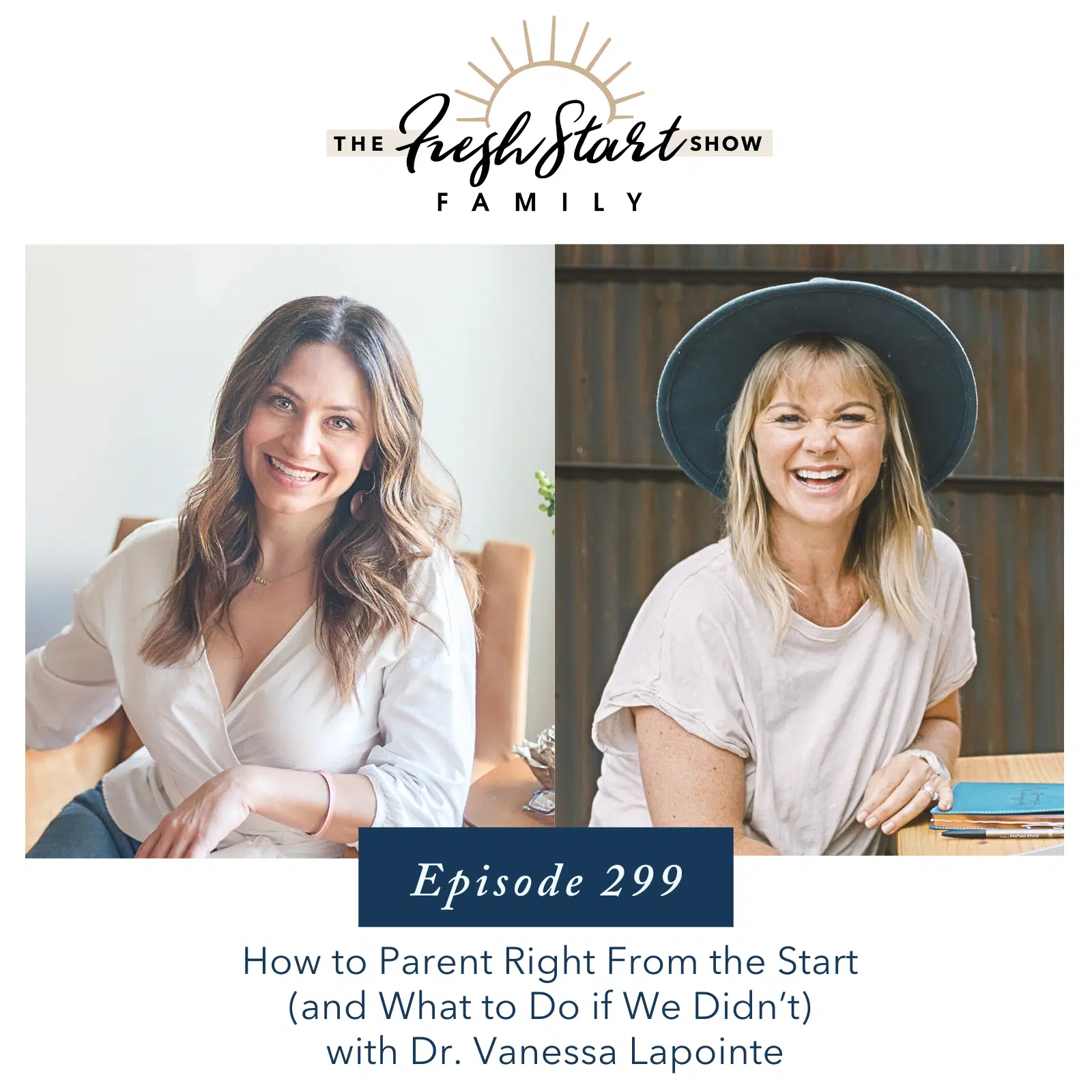
Psychologist and bestselling author Dr. Vanessa LaPointe joins Wendy to explore how to parent right from the start—and what to do if you didn’t. From inner-child healing and nervous system safety to practical, firm-and-kind boundaries, Dr. Vanessa offers a compassionate roadmap for raising kids without shame or fear.
You’ll hear why “we parent as we were parented,” how to spot (and soothe) your own age-regressed reactions, and what Dr. Vanessa calls parental swagger—the calm, confident presence kids lean into at every age. If you’re parenting tweens or teens, don’t miss her reframe: it’s not too late—it’s prime time.
Perfect for parents of strong-willed kids, caregivers rethinking punishment, and anyone ready to trade compliance for connection.
Want to learn how to escape a punishment mindset?
This free bundle comes with an extensive learning guide & workshop with me, where I’ll teach you ways to build a strong, compassionate, FIRM & effective discipline toolkit that works with kids of ALL ages!

Inside this FREE learning bundle, I’ll teach you:
- Methods to build intrinsic self-control muscles
- Strategies that unite you
- The importance of self-calming
- Natural Consequences
- Logical Consequences
- Creative Problem Solving Methods
Grab your free bundle & start learning today!
Episode Highlights:
- We parent as we were parented — our own childhood experiences become the blueprint that shapes how we respond to our kids until we consciously choose to change it.
- Overreactions in parenting are often signs of age regression — moments when our inner child takes the wheel. Healing begins when we follow the emotional “breadcrumbs” back to where those feelings first began.
- Gentle parenting isn’t about perfection; it’s about awareness, growth, and repairing when we get it wrong. Change happens from the inside out.
- Our children don’t need to earn love through compliance. When we make love unconditional, they learn they are enough — not because of what they do, but because of who they are.
- Nature knows what it’s doing — when we stop trying to rush or mold our kids into who we think they “should” be, their development unfolds exactly as it’s meant to.
- “Parental swagger” means leading with calm confidence, not control. Kids feel safest when their parents show up with steadiness, warmth, and conviction — even when they don’t have all the answers.
- It’s never too late to begin gentle parenting. Whether your children are toddlers or teens, growth and reconnection are always possible when you lead with empathy and presence.
Resources Mentioned:
- Follow Dr. Lapointe on Instagram
- Dr. Lapointe’s website
- Grab a copy of Dr. Lapointe’s book Parenting Right from the Start: Laying a Healthy Foundation in the Baby and Toddler Years
- Catch the full episode on YouTube!
Unable to listen, or prefer to read along? Here’s the transcript!
Wendy (00:03.208)
Hello families and welcome to a new episode. I am so excited to be here today with Dr. Vanessa LaPointe, who is going to be talking to us about how to parent right from the start and what to do if we didn’t. Welcome to the show, Vanessa.
Dr. Vanessa (00:20.61)
Thank you, I’m so happy to be here with you.
Wendy (00:24.154)
Yes, me too. my goodness. I feel like we’re a little bit of, I don’t know, sister from another mother type of thing. When I hear you teach, am like, so I am just so down with what you teach. And I have, I feel like I have a lot of similarities in what I teach and a lot of even the language that you use. like, wow, when I stumbled upon your work, I think it was a few months ago, I could just sense your passion for what you do. And
Dr. Vanessa (00:32.718)
He’s in a pad.
Dr. Vanessa (00:52.514)
Thank
Wendy (00:54.018)
And yeah, I’m just really excited to glean your wisdom today. So I wanted to record on this particular subject. This is a subject of one of your incredible books. And I know that we have a lot of parents here at Fresh Start Family who find this work, I call it the work, right? But they find this work, they kind of mimic my story. So I did a 180 with my parenting when my little girl was three. She’s now 17. That’s the same little girl who I was just sharing with you before we pushed record.
that just secured that D1 beach volleyball position, which is like such a testament to that strong will that because of this work, thank God, we were able to mentor and support instead of try to break the will, which is so common in the world and especially a lot of the Christian communities that I help people heal from. But it is often that our clients come in and they’re in that same season where they’ve been doing things
in a way that kind of the inherited model, right? Where it’s the hand-me-down parenting tactics, autocratic, all the things, right? Punishment versus discipline. And then they realize, this is not working and I’m just miserable.
Who have I become? And they do what we call like the switcheroo, right? So a lot of people enter this work when they’re in crisis mode. And I also have a vision for my company. One day I have a mission and a vision for Fresh Start Family. And the vision long term is to have this work be preventative, right? Like to have this work be 101 in high school, in college, where everybody gets this information before they embark on raising a human soul.
And so I love that your book, that title, Parenting Right From the Start, it’s or you have to tell us your exact title, it’s something along those lines. And I just love the idea of like, let’s speak to if we were to have a fresh start and we were to do this all again, or a lot of our parents have second, third, fourth children that they’re bringing into the world and they get to do this from.
Dr. Vanessa (02:45.079)
Yeah.
Wendy (03:01.149)
scratch again, right? And then we’re also gonna talk about how to have just grace on ourselves and compassion and the idea that it’s never too late to change the model, right? And that’s very, very effective. But yeah, talk to us about your book around parenting right from the start and what caused you to wanna write about that subject.
Dr. Vanessa (03:24.568)
Yeah, I mean it’s exactly sort of what you’ve just put into words that it’s a totally different thing to enter into parenthood already thinking about consciousness and development and attachment and all of the things. And I really have observed in my career, spending 25 years now, that a lot of families
myself included to be real transparent, they come into parenthood and they don’t actually, like nobody’s ever said, hey have you ever thought about it this way? Hey have you ever thought about this? Hey have you ever thought about that? And we just kind of like default opt into all of the ways that we were parented and you know some of us are like, you know what, I’m gonna do it better. I’m not gonna hit my children or I’m not gonna ABC X Y Z.
And then we find, particularly in our moments when things have become challenging, that our mother or our father are coming out of our own mouth. And we’re like, what? Like, I meditated on this this morning. Why is this happening? And so the idea behind the book was that, you know, in an ideal world, we would wave a magic wand.
Wendy (04:27.391)
Who have I become?
Dr. Vanessa (04:42.728)
and none of our children would need to recover from the childhood that they had experienced. Parenting Right From the Start is about how do you give children that experience. Now, having said that, what’s really interesting is the title itself, Parenting Right From the Start, can be pressed through one of two lenses. Parenting Right, and you interpret that word as like correct, parenting correctly from the start.
versus parenting right, now put that word as a time, parenting from the beginning. And so it’s interesting based on people’s wounding, their perception, their lens, they choose an interpretation of the title. And the choice for the people who are offended and who think, you know, which there was some of that in reaction to that title, I think, yeah, so you need to read the book because you…
Wendy (05:26.62)
so cool.
Wendy (05:39.023)
Exactly!
Dr. Vanessa (05:39.85)
you’ve got a wound in operation that is actually going to prevent you from being open to sort of flexing and flowing with a different way of moving through the raising of a human soul.
Wendy (05:54.784)
so good. Well, that’s so that’s so cool to hear more about the title and like the two different ways to read it, because normally when I coach my students, it’s like there’s a lot of like, I’ll help them reframe out of the right wrong paradigm, right? Like of like, hey, instead of I should, it’s like, hey, let’s just see how it feels if we change that to I want to do it differently. Right. And when I when I did first see that title, I was like, that’s interesting. Right. And because I could feel your spirit and who you are, I knew
Dr. Vanessa (06:07.79)
you
Dr. Vanessa (06:14.135)
Yes.
Wendy (06:24.577)
that it probably meant something even deeper and to hear that and I still didn’t think of it that way. And it’s funny because…
Dr. Vanessa (06:31.373)
you
Wendy (06:33.915)
those of us who teach this stuff, it’s like, yes, we encourage people to get out of the right, wrong paradigm and good girl, bad girl stuff and good parent, good, bad parent stuff. And at the same time, part of me is like, well, come on, let’s be real. Like it is the right way. I mean, come on, you don’t have to hurt and harm and humiliate and scare your children into submission. And so I love it actually both ways.
Dr. Vanessa (06:49.602)
Ha
Dr. Vanessa (06:53.678)
Yeah, sure.
Dr. Vanessa (06:59.048)
Nice, nice, that’s awesome.
Wendy (07:01.623)
Yes, and tell us how old are your kids? Are you a boy mom? Is that right? Did I see that?
Dr. Vanessa (07:06.454)
Yeah, I two boys. My youngest just turned 18 a couple of weeks ago. My eldest is 21.
Wendy (07:14.239)
Amazing. So yeah, we’re not too far off of and when and you’ve been a psychologist or former psychologist now you’re an author. Tell us about both your books. Tell us about like your day to day right now. What is your day to day Dr. Vanessa look like? I know you do Ted Talks. I know you know all the things. Tell us about that.
Dr. Vanessa (07:15.533)
Yeah.
Dr. Vanessa (07:34.862)
Yeah, yeah. So I, I mean first and foremost I’m a mom and I really work to walk my talk and so I like to be like very conscious about how I continue to show up for my children and you might think that’s interesting given that they’re 18 and 21 and we know two things. First off the human brain doesn’t fully mature until somewhere in the mid to late 20s a little later in that span for boys compared to girls. So I know that I’m, you know I’m not retiring yet.
Wendy (07:40.927)
Mm.
Dr. Vanessa (08:04.856)
from my primary role as mom, because I’ve got a few years left with both my boys in respect to that biological marker. The other thing is that it’s, I’ll turn 50 at the end of this month, and my first thought when something goes terribly sideways in my life, my first thought is to call my parents. I mean, I speak to my husband, of course, but also, I want to talk to my parents. I want to know.
Wendy (08:05.209)
Yeah
Wendy (08:30.055)
Yeah.
Dr. Vanessa (08:34.028)
Like what do they think and what would their read on this be and what would they suggest and all of the things. And so we, you’re never done. You never retire. And the wonderful thing about that is that, you know, particularly if you have listeners who have older children and they’re like, like have I already wrecked them? You know, I feel like I see the light and I want to do it differently.
Wendy (08:44.147)
That’s cool.
Dr. Vanessa (08:58.286)
And they get concerned that because they don’t have toddlers or preschoolers or early school-aged children that it’s too late. But the truth of the matter is it’s never ever too late. And so my day-to-day primary first and foremost is mom. I also have a clinic that I run and have done so for many, many years. And so I support my team there and we see families for all different reasons.
Wendy (09:09.033)
true.
Dr. Vanessa (09:24.558)
And I do a lot of coaching worldwide. And so I have clients all around the globe who are endeavoring to put one foot in front of the other and do so in ways that are conscious and ways that embrace both developmental and attachment parenting principles so that they and their children get to live their best lives possible.
Wendy (09:46.095)
Amazing. It looks like you travel quite a bit too. Do you do a lot of speaking engagements? Do you enjoy traveling all over the world to do that?
Dr. Vanessa (09:51.306)
Yeah, I do lots of speaking engagements all over the world. I’ve just come back from four weeks in Australia, which was lots of fun. And I really do love to connect with parents and other big people. like to call them anybody with a vested interest in the raising up of children, teachers, caregivers, aunties, uncles, grandmas, grandpas, whoever you may be. I love connecting with them in that way. There’s a term that I came in truth with.
Wendy (10:01.375)
So cool.
Wendy (10:13.395)
Heck yeah.
Dr. Vanessa (10:19.978)
through the work of Esther Perel and Brené Brown actually in an interview where they were talking about this concept of collective effervescence. And I think, you know, when I’m in a room full of a thousand, two thousand parents where I get to talk with them about the principles of parenting and the way that I see it, there’s something that comes out of that experience that’s bigger than the sum of the parts.
And there’s an energy and a collective effervescence that can bubble up during those stage appearances. And so I do really love, I love that feeling.
Wendy (11:00.031)
Oh, I love that. can’t wait to be there one day where I’m doing more of that type of travel. And I think when your kids are 18 and 21, that’s like naturally a cool progression, right? I’m at 17 and 14. So we’ll get there, but especially.
Dr. Vanessa (11:08.556)
Yeah.
Wendy (11:12.829)
I have a book coming out next year or so I’m like, I think I might be ready to do some more travel because there’s nothing. Yes, there’s nothing like that live, live energy of a collective group of human souls who really give a shit about this work. And it’s just the best feeling when you look around and you’re like, everyone chose to get out of their house and come and be here because they care. And they really give a damn about raising human souls in a way that’s healthy and connected and all the things. So cool.
Dr. Vanessa (11:15.278)
It’s coming girlfriend!
Dr. Vanessa (11:24.75)
Thanks
Dr. Vanessa (11:28.344)
Yeah.
Dr. Vanessa (11:32.514)
Right.
Yeah.
Wendy (11:42.756)
Well, thank you so much for sharing a little bit about what your day-to-day looks like. And let’s jump into our content for today, which is this idea of parenting right from the start. And our first point is that it’s great if we can make sense of who we are to be able to reflect on our own upbringing and how it influences our parenting style. So please speak into that, Dr. Vanessa.
Dr. Vanessa (12:06.518)
Yeah, I guess the core truth is that we will parent as we were parented. We’ve all, before we come into the parenting experience with our own children, we’ve all been in a parent-child relationship once before when we were the child. And so we onboard these messages, many of which live in the subconscious part of our being.
Wendy (12:20.702)
Yeah.
Dr. Vanessa (12:30.894)
And we often aren’t even aware that we have those messages, those programs, if you will, as part of how we see the world until we have our own children. And there’s something about having children that, you know, I have yet to meet a parent who hasn’t felt like the role of being the parent has called forward in them their best selves and their worst selves.
You know, we all have moments when we’re like, yeah, I’m totally nailing it. And then moments where we’re like, wow, that was not, that’s not good. That was a big no. We need to re-template that. And so there’s a real awareness that we are invited into as parents to know that we will parent as we were parented. And when we can do that, what we will see,
Wendy (12:58.111)
truth.
Wendy (13:04.801)
you
Yeah.
Dr. Vanessa (13:25.258)
is that the way we approach understanding our children, the way we approach responding to them at different moments over the course of a given day is gonna be really fueled by our perception of them and our perception of the world. We see the world as it is, not as, pardon me, we see the world as we are, not as it is. And so, you know, you could be listening to this podcast today and be like,
that that lady’s full of shit and she doesn’t know what she’s talking about. And you’re right. If you want to be right about that, you’re right. And then you will experience the whole conversation through that lens, which will probably color what you take away from it or not. On the other hand, if you come in and you’re listening to this podcast and your orientation is
Wendy (13:59.69)
Mmm.
Dr. Vanessa (14:14.006)
like you know I’m kind of interested in this topic and it feels like these two women might have something going on and I want to know what they have to say then your experience of this interview will be that and either way you get to be right the question is does your experience of being right does it make you happy and does it allow your children their best possible shot and if the answer to either one of those things is no then
Wendy (14:28.447)
Yeah.
Wendy (14:35.871)
Mm.
Dr. Vanessa (14:43.914)
The call, the invitation, is to shift inside self what it is that you have going on. So the perception that you view the world through, whether it be this interview or a host of other experiences, will shift in a way that serves you rather than works against you.
Wendy (15:01.853)
Yeah, amen to all of that. And that concept of like, you often end up repeating, right, the same behaviors or thought patterns is so interesting. I’ve been studying, I’ve been doing kind of a deep dive on nervous system regulation and healing study over the last few years. And it’s just been so interesting because our logical brain often will say, we would never, you know, we’re not going to repeat that.
or I’m not gonna become the yelling mom or the stressed out mom or the one who hurts and harms my kids. And then all of sudden there’s these knee jerk patterns that we get to look at and realize that the way we grew up does influence the way we parent.
I would love to hear you speak a little bit about this on how do you incorporate like the embodiment piece of it and maybe the nervous system or however you incorporate that because so much I’m realizing is we can wish ourselves out of the way we see things, but until we feel safe in a new learning environment or doing things a new way, for example, in our community, and I’m pretty sure in your community too, Dr. Vanessa, people are actively trying to replace the belief system that you have to
hurt and harm a kid in order to make them behave better, right? It’s like that notion, where do we get the notion that in order to make a child behave better, we must first make them feel worse? So many people logically are like, I don’t believe that you have to hurt and harm and humiliate and intimidate a child into submission. And then boom, that knee jerk pops in and all of sudden you catch yourself raising the hand or squeezing the wrist too tight or the intimidation comes out, right?
Dr. Vanessa (16:46.67)
Hmm.
Wendy (16:51.175)
so interesting to start looking at the subconscious and like what’s underneath and the nervous system, right? And be willing to look back. I’ve seen you really speak with such compassion and care about past generations and you know most of the time, right? We like to say they did the best with the tools that they had. Every once in a while you run into someone there who will say, no.
My parents had the tools and they chose and I actually see that quite a quite a bit in this modern day world, right? Like I put tools in front of people and they say, no, I’m good.
Dr. Vanessa (17:25.944)
Yeah.
Wendy (17:26.303)
Thanks, right? But like most of the time back in the 70s, 80s, even 90s, just people weren’t aware that they had a choice. So maybe just the question for you that before we go on to our second point is how do you incorporate the body and like signaling safety to these like this underneath of us or how does that look for you?
Dr. Vanessa (17:47.438)
Yeah, you know, and I’ve studied for several years now with my teacher whose name is Gila Golub and she’s taught me a lot of things that were really, to be fair, very unique to the world of traditional psychology, which doesn’t really incorporate a lot of layers of what it is that you and I are talking about. And one of the things that I have come to understand is that whenever we are
Wendy (18:04.276)
Yeah.
Wendy (18:10.271)
Mm.
Dr. Vanessa (18:16.296)
overreacting, grabbing the wrist too tight. We have the yelling shout starting to spill out of our mouth. Our tone is getting too whatever. Whenever we’re in these moments of overreaction, all overreaction is age regression. And so we’re not then in that moment showing up as our fabulous 38 year old self or 46 year old self or 52 year old self. In that moment,
Wendy (18:30.814)
Mmm.
Dr. Vanessa (18:41.964)
we’re actually probably showing up as a three-year-old or as a four-year-old or as a five-year-old. And I love taking the work of, you know, so many of these amazing healers and minds that have offered forward different kinds of tools and combining a lot of those pieces together in my work with families. And so one of the things that we’ll do is we kind of search for the breadcrumbs.
Wendy (18:47.492)
Mmm, so true.
Dr. Vanessa (19:06.177)
And the breadcrumbs are always the feelings. And so if we go back to a moment where you were really heightened with your child and you felt like in your own nervous system, you weren’t safe, things were bubbling over. How do we know it? Because you yelled, you shouted, you smacked, you reprimanded, you punished, you did all of those things that you said you weren’t going to do. Now, what was happening inside of you? Like, let’s now shelf the story. The story is my kid hit their younger brother. Okay. So.
What were the feelings as you felt yourself shouting? Just close your eyes for a moment. Go back to that instance. What did you feel? What was happening on the inside of you? Were you overwhelmed? Were you afraid? Were you ashamed? Were you shut down? Were you embarrassed? What were the feelings? Yeah. Yeah.
Wendy (19:56.2)
I’m thinking of one right now, scared of judgment, scared of failing. It often so much comes back scared of being criticized, scared of looking like a bad parent.
Dr. Vanessa (20:02.606)
all of the above. Yes. And so when we can say we were feeling ashamed and embarrassed and scared and less than and not good enough and all of those things. And then, you know, we can say, you know, in that moment, just like when, like when before in your life, did you experience this cocktail of emotions that was doo doo doo doo doo doo, whatever the breadcrumbs were and
Wendy (20:21.523)
Mmm.
Dr. Vanessa (20:31.032)
Don’t think about it too hard, but give me a story from the first six to eight years of your life when you previously felt that combination, that cocktail of emotion. And every single time, like nobody ever asked to work, know, every now and then I will have parents who don’t remember a lot about their childhood, which is probably a whole other conversation.
Wendy (20:53.982)
Yeah.
Dr. Vanessa (20:54.654)
But there will be a story or there will be a series of stories or there will be an enduring experience that they’re able to connect that to. I felt that way every day my dad walked in the door from work. Or I felt that way, you know, when I was in first grade and my teacher did ABC XYZ and I was so horrified and I thought about that every night before I went to sleep for the next five years. It was the worst day ever or the worst moment ever.
Wendy (21:08.265)
Hmm.
Dr. Vanessa (21:23.648)
it will take you back to somewhere. And the point is that those early years in particular, it can sometimes be a little bit later in our development as well, particularly if it was a very intense, very stressful, very acute kind of event. But those early years become, we are imprinted upon and that imprint becomes our blueprint for how we live out life going forward. So if we want to shift it,
for our children and for ourselves. We actually have to go inside and travel back in time to address those early wounds. Our children will hand us opportunity after opportunity after opportunity on a silver platter to do that work. 100%. And whatever age your children are, you know, like when my boys were little,
Wendy (22:10.257)
Yes, they will, especially if they’re strong-willed, right?
Dr. Vanessa (22:18.99)
I remember thinking, like what would have happened to me at three? If I had behaved that way, what would have happened to me? And my parents did the very best that they could for the times that they were in and given the circumstances from which they had come and what would have happened to me? And that’s why I’m reacting right now to my child behaving this way because inside I have this subconscious program that’s been like, hold on a second. This is not safe.
Wendy (22:28.468)
Yeah.
Dr. Vanessa (22:46.882)
Heads are gonna roll, somebody’s gonna get in trouble. This isn’t okay, you need to shut it down at all costs. And so when we can tend to that within self through inner child work, and also tend to that on the outside of self by providing for our children what it was that we didn’t receive when we were children, then we actually get to re-template that. I love actually how John Bradshaw, the author of Homecoming says, it’s never too late to have a good childhood.
Wendy (22:49.331)
Yeah.
Wendy (23:16.575)
I love that. That’s so cool. And I love how you bring us back to the emotions, right? Like we know that is an integral part of the body. And like what I’m learning is, you know, I used to a lot of times teach it as, okay, well, based on, you know, how you feel, then you might have an emotion. But now what I’m realizing, Dr. Anita Phillips, her book was really beautiful that I read around actually the nervous system in the body.
Dr. Vanessa (23:18.666)
Yeah.
then.
Wendy (23:44.316)
their response to something actually will cause the emotions, right? So like that, I love how you bring that back. And what I’ve found is that, you know, when I’m working with clients and we kind of roll that same thing out in a limiting belief cycle redo that we do together. But what I found is a lot of the times that people will say, I didn’t have parents, right? Like if they say I didn’t have, I don’t remember anything like that. Maybe a few months later, they might go.
Dr. Vanessa (23:50.254)
Mm.
Wendy (24:12.031)
Oh, like I’m thinking of one client right now where as she got into like our higher level certification program and it was like at a private session, she was like, well, I did have a grandpa who would threaten to hit me if I didn’t behave. And it’s like, there it is. There it is. It doesn’t necessarily always have to be the mom or the dad. And it’s not always about just being threatened to be hit. Like you said, it could be a teacher, it could be a coach, it could be something, but there was an experience that inner that
Dr. Vanessa (24:27.53)
Yeah.
Sure.
Wendy (24:40.115)
that inner child. I love that. I love it when I hear you teach about that inner child work. So that’s beautiful. Okay. Our second point is if we want a parent right from the start is understand our kids needs and develop the ability to allow them to develop and grow without rushing things. So talk to us about that, Dr. Vanessa.
Dr. Vanessa (24:45.719)
Awesome.
Dr. Vanessa (25:00.778)
I love, know, Shefali Sivari, one of my colleagues has this wonderful quote. She said, our children are born into this world throbbing with their own signature. And it really is about responding to the needs, the temperament, the iteration of the child that’s in front of you, as opposed to the child that you think you ought to have. And when we can trust,
Like nature really knows its way. And nature is no fool. know, nature lines up so many things so brilliantly and so beautifully for our children. Like I double dog dare you to get in the way of maturation and development because it’s a force. And so our job really is to come alongside the child that we’ve been gifted, the child who’s come through to us.
Wendy (25:32.925)
Yes.
Dr. Vanessa (25:57.282)
to come alongside that child and champion that child for who it is that they are, not for who it is that we think they ought to be becoming. And that every little child, no matter their age and stage, is a fully formed human being for that age and stage. And how can you meet them there and not put a bounty on development, that we just allow it?
to unfold in the way that nature had intended and that we retreat to the environment. We create conditions that are conducive to growth in that environment for that child, which might be different from your other child, which might be different from, you know, your little niece and your little nephew. Like, who is this child and how are you adjusting what is happening around them to suit the needs of that child so that development, nature, can just get to work?
and do its thing. And when we can create an environment that allows nature to just get to work, really spectacular things can happen.
Wendy (26:55.327)
Mmm.
Wendy (27:05.247)
It’s so true and it’s wild to be sitting at the point now where, know, 14 years later, we’re able to see what you just spoke to. We help a lot of families who have strong-willed kids because I don’t know about you, but in my experience.
Dr. Vanessa (27:19.106)
Thanks.
Wendy (27:20.443)
It’s the parents that are brought to their knees and like really given a run for their money, which we know strong willed kids will do. They’re the ones who actually get the help. They’re the ones who make the therapist appointment, who actually invest in the coaching program, you know, and other parents do too, you know, but I’d say like the majority of our students have a strong willed child or two or three. But to be in the position now to have this little girl who, you know, at three, we were just like,
Dr. Vanessa (27:22.786)
Yeah.
Wendy (27:47.08)
this is not working. We were trying to force her to be this like round peg and she was a square peg. And you know, we were trying to break her will because all the stupid Christian books told us to do that. Or, you know, it was just heartbreaking and to be invited into a different paradigm to completely change the system and the model and to have watched that unfold now for 14 years. And now to see this little girl.
score score this D1 beach volleyball position at a school that’s currently number nine in the nation for division one beach volleyball in the United States is just Unreal to watch because her need to feel powerful was always so strong like so many strong little kids have right like and I just am so thankful that we learned that we could help her get that need to feel powerful met in a healthy way she became a prominent drummer because
We would watch her push and shove kids like it was her job when she was three and four and I was just like please someone fix this child and then I realized wait She’s just a very very kinesthetic kid She is gonna be the one that always touches things She’s gonna aggressively shake the dogs and squeeze their cheeks with like cuteness aggression like the minions have she’s just that kid and that was able to be mentored into this
Dr. Vanessa (29:01.134)
Thank
Wendy (29:10.491)
insane skill set on the beach volleyball court and also as a drummer. And so it’s just so fun, right? Like you with older kids, I’m sure you have so many of those stories too, where you’re like, no, it really works when you learn to support the child that you have. And my other child is polar opposite. He’s the soft hearted and like has struggles with a little anxiety here and there, especially when he was younger. and they get, he gets to get supported in a totally different way. You know, so much of my learning with
of him was learning how to support him with like separation anxiety, which was really heartbreaking. So yeah, so I love the way you speak to that so beautifully. is there, you know, any other needs that you would highlight? I mean, I have a tendency to teach about the need to belong, the need to feel powerful, the need to feel valuable, the need to feel unconditionally loved, but any other needs that you would touch on there to keep in mind?
Dr. Vanessa (29:43.95)
Yeah.
Dr. Vanessa (30:10.104)
Yeah, you know, when I think about that, I think about a lot of what I would call behaviorist parenting. And behaviorist parenting is you don’t like the behavior that you see in your child so you squash it. You do so, yeah, however it works. You know, we’re gonna spank you, we’re gonna take things away from you, we’re gonna put you in timeout, we’re gonna separate from you emotionally, you know, we’re gonna ignore you, we’re gonna do all these things. And so why…
Wendy (30:18.079)
Mm-hmm.
Wendy (30:24.317)
Yeah, break that will as early as possible.
Dr. Vanessa (30:40.382)
Why do people continue to now to say, it works, what’s the problem, it works? Because what they’re doing is they’re focusing on behavior as the end goal. And what I would say in terms of like those programs and those needs, think about, okay, why do those antiquated approaches to parenting work? Why does it work when you hit your kid? Why does it work when you put them in timeout? Why does it work when you…
you know, take away their most beloved belonging as a means of teaching them a lesson. It works because it teaches them that love is conditional. And the problem is that our children, human children, need love. You can water and feed and clothe them, but if you don’t love on them, they die. It’s a core need. It’s like air. And so,
When we parent in ways where we’re, you know, playing, we’re toying with that idea of love and we’re making it conditional, what does the child learn? What the child learns is that I’m not enough. What the child learns is I’m not worthy. What the child learns is I need to perform in order to be loved. And so these are the programs that start to sort of like they they are laid down as narratives on our children’s very souls.
And then they go forward in life and they can’t see past the program. They become that program. The program becomes the way that they view the world. And then they grow up to be adults who are anxious, who are workaholics, who, you know, if they, if they aren’t getting everything perfectly right, then they’re not even going to try. Or adults who have very short fuses because they’ve used up all of their reserves to manage.
You know, the shame and the embarrassment that comes from the programs and they got nothing left to put towards empathy and compassion for other humans, etc, etc. So when we take it right back to what are those core needs, the core need is we are creatures of attachment. Our job as parents is to provide that come hail or high water to our children so that they never grow up with the ultimate limiting belief.
Dr. Vanessa (32:59.52)
That is, they’re not enough. They’ve got to work in order to be enough. You know, I have a colleague who’s now since left this lifetime. He was a wonderfully wise, if somewhat wounded man. And he used to call that death practice. Like when you force your children to stare at that every day, you’re ultimately forcing them to practice their own death.
Wendy (33:02.399)
you
Wendy (33:17.832)
Mm.
Dr. Vanessa (33:27.264)
because the human child in the absence of connection dies. And so imagine if we just rethought it, like we just rethought about all of those parenting practices. Like really you want your kid to practice dying? Your kid doesn’t need to engage in death practice. In fact, all of us as grownups are trying to overcome that. So what if instead of engaging in death practice, we allowed them to rest in the ultimate experience of life practice?
Wendy (33:39.124)
Yeah.
Dr. Vanessa (33:56.686)
How would that change the trajectory down the road? That’s the core need is the way that I see it.
Wendy (34:02.665)
Dang, mic drop, Dr. Vanessa. Yeah, that need to feel unconditionally loved and it’s like we know, right, from working with so many people that that is what most of us are paying the big bucks. Whatever kind of mentor you’ve picked out, whether it’s Dr. Vanessa or me or an awesome therapist, like that’s pretty much what it comes down to. Most people are healing from in their 30s, 40s is about the time where we check in and we’re like, so we’ve realized.
Dr. Vanessa (34:05.25)
No.
Dr. Vanessa (34:30.37)
Yeah, whoop.
Wendy (34:30.409)
We’re scared to death of not being enough, of having to perform for love and acceptance. And, it’s just so beautiful to think that we get to give our children, this next generation, a different experience. And what’s so gnarly, and especially in my world, helping so many parents heal from like the jacked up toxic religious teachings is it is taught that that is love. The unacceptance.
Dr. Vanessa (34:33.304)
Yeah.
Dr. Vanessa (34:38.158)
No.
Wendy (35:00.281)
is love. That pain is love, right? Like hitting and harming a child that jacked up inaccurate.
Christian teachings teach is like, that’s the way you love a child when you don’t accept a queer child You don’t go to their wedding. That’s love and it’s just like my gosh It just is so sad how twisted it gets people and they have to recover from that later in life And so what an honor to be able to do it differently What an honor to breathe life into our children every day and to let them know even when you make mistakes
there is nothing less valuable and worthy about you. Everybody makes mistakes and now you’re gonna learn from that mistake and we’re gonna teach you life skills and we’re gonna use empathy and connection and compassion and firm kindness. So, so good. Okay, our last point, Dr. Vanessa, if we wanna parent right from the start is to be able to step in, act with empathy and responsiveness to support our kids’ development with parent.
parental swagger or firm and kind parenting. I love that you use the term firm and kind parenting. That’s often also a term we use here at Fresh Start Family, but talk to us about parental swagger. What does this look like?
Dr. Vanessa (36:13.07)
Yeah. You know, sometimes like the other day, last week I was on a stage presenting to a room full of foster parents. And I had prepared, I had like an hour and a half on stage, I had prepared 200 slides. Which for real, like I know before I go into that, I’m obviously not gonna talk to all 200 slides. And my method of presenting is I often just let it come through me.
and then I just click around onto the slides that fit with whatever message is coming through. So I just walk in loaded and then we see what happens, right? And the best way that I can describe swagger, imagine that I get up on that stage in front of those foster parents and I’m like, listen guys, I don’t really know what I’m gonna be talking about. So if you could just have a little grace for me and like.
Wendy (36:48.137)
Nice.
Dr. Vanessa (37:02.626)
We’ll see where we get the next 90 minutes and like if you’ve got any feedback at the end, like I’d be happy to hear what you have to say. Can you imagine if I got up on stage and said that, people would be like, who hired this lady? And like why are we spending part of our morning listening to this dribble? Like is this really gonna be helpful, right? Instead, of course I didn’t say any of those things. I got up on stage and I knew, cause I had my laptop in front of me, 200 slides, gonna see how this goes.
Wendy (37:20.51)
Yeah.
Wendy (37:33.063)
Yes, I’m going to use what I need.
Dr. Vanessa (37:33.102)
And I know, yeah, and so I’m, you know, my shoulders are back, I’m making eye contact with whoever’s eyes I can grab out in the room, and we’re getting that collective effervescence established, and we’re getting moving with things. I would even if I didn’t know what I was gonna tell, I would never admit that on stage. Now, let’s put it in the context of parenting. Imagine that your kid is having a really difficult time.
and then you say to them something like, that’s one. And they’re like, okay. You know what happens when I get to three. Right? They’re like, wait, do you actually know what you’re doing though? Like that’s so weird. You’re gonna like, because you have no idea what you’re doing, now you’re gonna try and trick me into compliance? I’m not leaning into that. I’m not at rest in the presence of that.
Wendy (38:06.303)
you
Wendy (38:10.622)
they count to three.
Dr. Vanessa (38:28.908)
In fact, if anything, in the face of that, I’m gonna be like, yeah, you think you know what time it is? Let’s see. It’s on. Like, I’ll meet you toes at the line, let’s go. Right? Let’s do this. And so there’s something about swagger that is, it’s less about the words that you say, the thing that you do. In the words of Eckhart Tolle, the doing, how we’re gonna act in that moment, comes from our being.
Wendy (38:34.055)
Right?
Wendy (38:39.099)
Let’s dance. Let’s dance.
Dr. Vanessa (38:58.2)
So swagger is this like this built in knowledge. I might not know the answer right now, but I sure can be the answer. I might not know exactly the path that we’re going to chart through this. I know I’m going to figure it out. Like if you can step in, you know, with that kind of presence and that kind of conviction in your own ability to navigate even the unknown.
then your kids are gonna be like, okay, cool. Like I’ll just, you if we think about the parent as the steady backbone that can provide and the child just gets to lean in and be like, okay, cool. I can see that you’ve got this. You don’t, you know, and maybe you no answers. Yes, yes, exactly that. So swagger is the way that I speak about like that’s the energy that you endeavor to show up in as a parent.
Wendy (39:42.047)
Yeah, magnetic attraction and yeah.
Dr. Vanessa (39:56.214)
because it puts everybody in your midst at rest.
Wendy (40:01.343)
So cool. I have never ever heard that before. And it’s just so accurate. Right. And we know that like, so when I hear you talk about swagger, I also hear it like I get from that like confidence. Right. And I, and this is, again, I feel like this like tethered soul somehow, because I often teach like this. It’s like, we want parents to, you want to be able to have your shoulders back and
and have come from a place of confidence, not from intimidation, but confidence, right? Like, truly believing that most misbehavior is not a four alarm fire, that it is okay to not know what to do in the moment, that slowing down to respond versus react is actually safe and a wise way. And also just knowing that
Dr. Vanessa (40:40.942)
Yeah.
Dr. Vanessa (40:48.686)
Hmm.
Wendy (40:50.671)
when you invest in education or healing or learning and creating what we would call like a full toolkit of options like your 200 slides you just
rest easier because you have options, right? Like your back’s not up against a wall. Like most of our parents, when they come into this work, they have four things. They have fear, force, bribery, and rewards. And it’s all based on external controls, right? And so they feel like they have to yell or they have to bribe or they have to, air quotes, make their kid comply. And then when you end up like building out your toolkit and you realize, you can use empathy, you can use compassion, you can use firm kindness, you can use choices, whatever it may be.
then you’re like, oh, I’m chilling. I’m like, I can slow down and let my brain and my nervous system just have a moment to create a solution instead of reacting out of that fear-based mode. So good. And to finish us off here.
Dr. Vanessa (41:48.216)
Yeah.
Wendy (41:54.096)
Dr. Vanessa, what would you say now to, so as we’ve talked about, you know, these three ways that if we want a parent right from the start, these are things to keep in mind. So maybe you just had your third kiddo, right? Or maybe you are a parent who’s listening to our podcast for the first time and your kiddo is like 10 months old, right? We do get those parents every once in a while. Or maybe you have this opportunity to do it again from the start. And those, things we’ve talked about today are things to really look at and talk to your partner and keep in
from the beginning and at the same time it is never too late right to go back and we touched on this just a little in the beginning but what would you say for the families who have you know the older adolescents kids or the tweens or teens to say like what would your your guidance be?
be there for them, that if you’re realizing, I didn’t parent like this from the start, and I spent five, six, seven, eight, 10 years doing it in a way that I now realize I regret.
Dr. Vanessa (42:58.958)
Well, it’s never too late for anybody anywhere to have a good childhood and certainly, you know, you could even be a parent of a child in their now 30s who’s having grandchildren of yours and it’s still not too late. So what I would say is that we need to grow ourselves in order to grow our children and that’s true of any stage in life. Your children who are in their tween, teen, adolescent years
they’re still squishy and they may look, you know, they’re starting to grow facial hair and drive cars and do all the things. They still really are looking to lean in on you and you give them just a little bit of a hint, a little bit of an opportunity, make it safe enough for them to do that and they will. They will come full tilt into the lean in because that’s the natural condition of the human being.
They want that. Your children actually are looking for that. They may not know that they’re looking for that. It may not feel like that’s what they want, but what they’re really yearning for is that opportunity to lean in and to rest in the experience of your caregiving. you like not only is it not too late, it’s prime time. mean, ideally get at it from the start, but if it’s, if it’s something that you’re looking to make a life change in,
And you have tweens and teens like yes Do it and just be prepared for the miracles that are about to become part of your day-to-day life Because you can and will get that turned around and I you know, I am so humbled I’m sure you’ve had this experience as well to see what parents are capable of creating For their teens and tweens when they really set their minds to it kids who?
you know, are suicidal, who haven’t left their rooms for 12 months. Their parents get to work and they walk right out of those bedrooms. They walk right out of those bedrooms, yeah, right into life because they’ve just been waiting for their invitation. So don’t doubt for a second how powerful you are when you really buckle down and get to work. The brain, the human soul has this…
Wendy (45:01.661)
I’ve seen you speak on that. Powerful.
Dr. Vanessa (45:18.584)
self-writing tendency. It really wants to be okay. So you give it half a shot, give it a little bit of a chance, and it’s gonna go there. It’ll make it happen.
Wendy (45:31.779)
beautiful. my goodness, Dr. Vanessa, we love you. We are so thankful for your light-filled work that you do in the world. Thank you for showing up the way you do every day. Please let listeners and viewers, we’re also on YouTube now, so some people may be watching, please let them know where they can come find you, learn more about what you do, your coaching, your services, and then also where to get your book.
Dr. Vanessa (45:38.904)
I don’t know.
Dr. Vanessa (45:55.66)
Yeah, so Dr. Vanessa Lapointe, D-R-V-A-N-E-S-S-A, and Lapointe has an E on the end.com is my website. I’m very active on Instagram, Facebook, and TikTok. And so, you know, even if you just are looking for a little bit of inspiration, you can go through and watch all those reels and pick up some information from that. I do have a coaching program.
We typically do intakes in August, September, and then sometimes again in the new year. So we’ll have an intake coming up in the next few months. It’s called the PTJ, the Parent Transformation Journey. I have a couple of books, Discipline Without Damage and Parenting Right From the Start, as we’ve been talking about. And then some online courses to do with anxiety, discipline, how to parent in the best possible way. And so those are all options for folks that are looking for more information.
Wendy (46:44.713)
So much goodness, a lifetime of work, such a beautiful body of work you have, Dr. Vanessa. Thank you again for being with us today and listeners, viewers, we’ll see you on the next episode.
Dr. Vanessa (46:49.869)
Awesome.
Dr. Vanessa (46:57.454)
Awesome. Thank you for having me.