

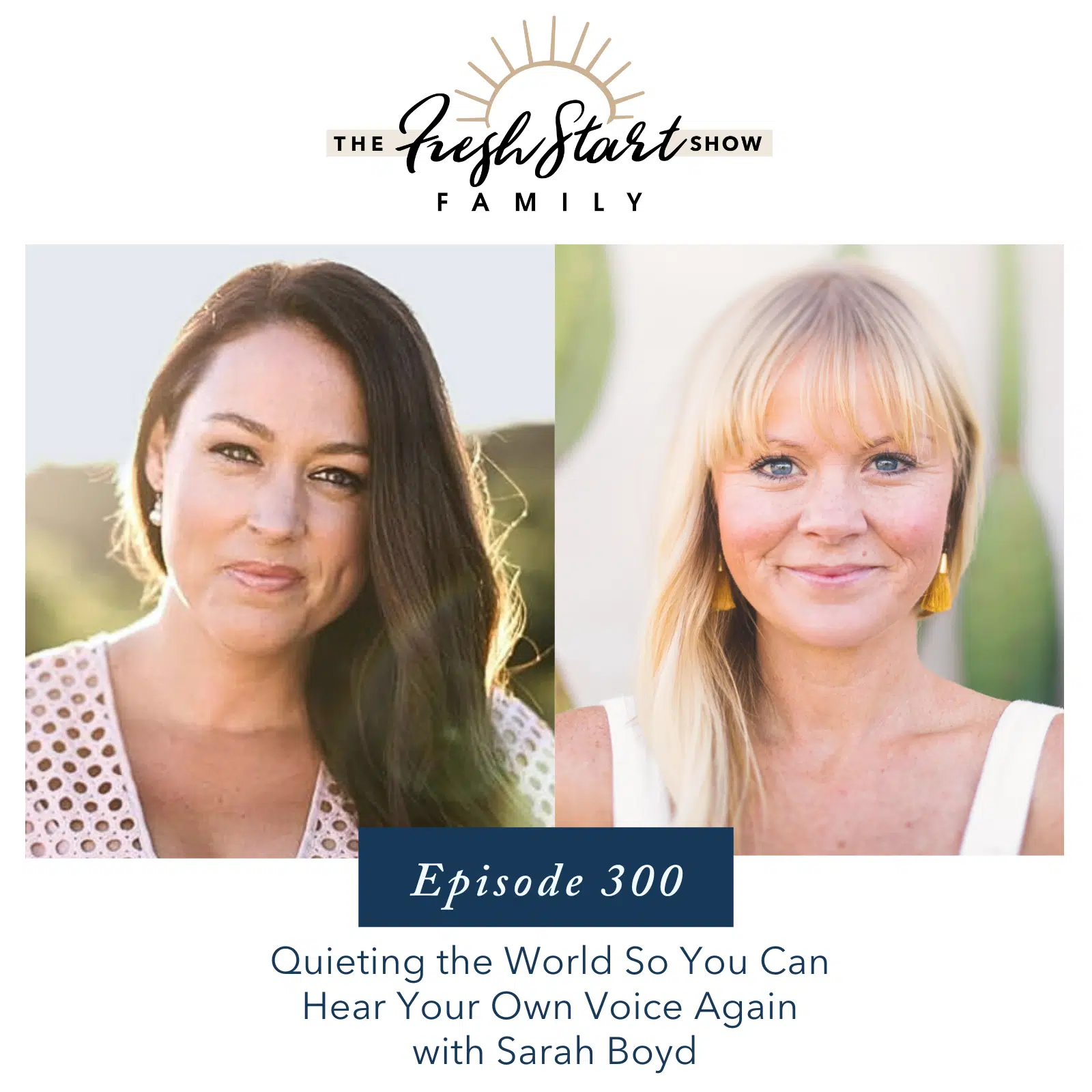
In this episode of The Fresh Start Family Show, Wendy welcomes Sarah Boyd—journalist, researcher, and author of Turn Down the Noise—for a powerful look at how parents can stay calm, connected, and steady in an overstimulated world.
Sarah shares her personal story of surviving aggressive thyroid cancer at 27, becoming a mother soon after, and realizing how essential emotional resilience is for families. Together, she and Wendy unpack why today’s digital culture overwhelms our nervous systems, how constant input affects the developing brain, and what parents can do to bring more rest and regulation into their home.
They dive into intuitive parenting, the stress kids carry without realizing it, and the pressure modern parents feel to “keep up.” Sarah’s insights are warm, practical, and easy to put into practice.
Want to learn how to escape a punishment mindset?
This free bundle comes with an extensive learning guide & workshop with me, where I’ll teach you ways to build a strong, compassionate, FIRM & effective discipline toolkit that works with kids of ALL ages!

Inside this FREE learning bundle, I’ll teach you:
- Methods to build intrinsic self-control muscles
- Strategies that unite you
- The importance of self-calming
- Natural Consequences
- Logical Consequences
- Creative Problem Solving Methods
Grab your free bundle & start learning today!
Episode Hightlights:
- Connection with a healthy adult is the #1 predictor of adolescent emotional health.
- Highly sensitive kids often appear strong-willed; resistance can be sensory/overstimulation, not defiance.
- Your brain’s “race car” (PFC) needs regular breaks—build them in on purpose.
- Protect small pockets of analogue rest (outside, hobbies, baking, gardening).
- Parent from your values, not the internet’s volume.
- Firm-and-kind limits land best when led by relationship, not fear or force.
Resources Mentioned:
- Follow Sarah on Instagram
- Grab a copy of Turn Down the Noise: A Practical Guide to Building an Emotionally Healthy Family in a Chronically Overstimulated World
- Catch the full episode on YouTube!
- Grab Sarah’s book Turn Down the Noise: A Practical Guide to Building an Emotionally Healthy Family in a Chronically Overstimulated
Unable to listen or prefer to read along? Here’s the transcript!
Wendy (00:03.0)
Hello, families, and welcome to the Fresh Start Family Show. I’m so happy you’re here. Today we have Sarah Boyd, who is the author of Turn Down the Noise. We’re so happy to have you here. Welcome to the show, Sarah.
Sarah Boyd (00:16.095)
Wendy, it’s a joy. I’m excited for this conversation.
Wendy (00:19.5)
Yes, I have been waiting for this for so long, Sarah. You and I met through a mentorship group of your husbands that I was in for quite some time. He was such a blessing to me. He taught me so much to help our business grow. And all along, I loved learning from him, but all along, I was like, I want to meet Sarah because I knew you were doing such incredible work in the world and had admired.
the community you had built and the beautiful work and teachings that you were putting out. So will you do, will you start us off by just telling us a little bit about your story, how you became so passionate about what you write about, what you teach, and how you help families.
Sarah Boyd (01:04.208)
you’re so sweet. mean, it was such a lovely moment to get to connect with you. And yes, I feel like my day job is co-running Colin’s business with him. So I get the joy of getting to meet some of his incredible clients. OK, so me, my background is kind of where I came to from this is I studied. I was really passionate about child and adolescent development.
and I was working with youth and I felt like I want to really upskill in this area. So I enrolled to a master’s of educational psychology and I did that in one full year, which for anyone who’s done a level of study, that was intense while we worked. And it was on my very last day of that master’s where I was getting ready to hand in my thesis, which back in the day you had to go into the university to physically hand it in.
And I was getting myself ready and I was having breakfast on the balcony where my phone rang. And it was my doctor who I’d seen on a routine appointment weeks before. And he said, Sarah, I’m clearing my schedule. You need to come in immediately. And my kind of world started shaking. And then I was like, I don’t understand what you mean. And then he said the word that really turned my world upside down and it was cancer.
And so I went through, I was diagnosed with an aggressive form of thyroid cancer and went through treatment over the next 18 months that really took me out of life. was the, the treatment was so fatiguing that I couldn’t work. I couldn’t maintain much social life and my life started to become very small, but I was only 27 years old at the time and it was very confronting to me.
I was still in that young adulthood stage of, know, nothing bad’s ever gonna happen to me. We’re gonna take on the world, you know? And the confrontation with my mortality, the confrontation with questions of suffering was huge for me. And it was also happening around the time that we were really desiring to have children. And so once we were given medically the okay after treatment, we fell pregnant very quickly and we had my son. And then two years later, we had my daughter.
Sarah Boyd (03:22.6)
And it was really the combination of all those events occurring in a few year time period that really made me aware that as much as we would wish as parents that we could protect our children from horrible things in the world. I think it’s every mother’s father’s heart. We just want them to be okay. We can’t, but actually what we need to do is to equip our children and adolescents in resilience and emotional health so that they can
and deal with what’s going to happen in the world. And that’s really where my work, I founded Resilient Little Hearts, that’s really where it all kind of originated from.
Wendy (04:01.794)
Wow, I didn’t know that about your story, Sarah. Dang. So resilience became at the forefront of your legacy. How amazing. And then your first body of work was around helping parents with sensitive kids. Is that right? I remember that right?
Sarah Boyd (04:19.432)
Yes, yes. So we started, I started to talk a lot about anxiety and fear and really teaching people about what’s normal in children. And it’s actually, I think sometimes in modern day, we pathologize almost everything. Whereas it’s also very normal to have moments of anxiety and have moments of fear is all if we know. And one of the things I was beginning to find is there were
parents raising children with a highly sensitive temperament. And these children were struggling with feelings of fear and anxiety more so than other children. And so I really worked to kind of build a lot of education and resources and that sort of stuff to support parents who are raising highly sensitive children. And essentially high sensitivity is a temperament or a trait. It’s not a medical diagnosis. It is our
our writers, our deep thinkers, you might be raising one of those and these children are such a gift. They’re deep processes, they’re high on empathy but they do tend to be more vulnerable to struggling with fear and over stimulation more than those without the trait.
Wendy (05:30.036)
Wow. Yeah, as I was reading your book, I had kind of a wild moment. haven’t looked, I haven’t studied that particular, you know, highly sensitive body of work that much. And at the same time, I work with families of strong-willed kids. That’s like our biggest common denominator with our clients is most of them have a strong-willed child. And as I was reading through your book, I was realizing that I would bet you.
that a lot of strong-willed kids often also have this like high sensitivity trait. And then I realized like, oh, this makes sense about myself. So I’m a strong-willed person. I always joke that the apple doesn’t fall far. My little girl who is 17, I found, you know, connected for mankind parenting when she was three. But as I was reading through those, was like, wow, okay, this makes sense. lately, you know, at the time of this recording, we’re having just such
you know, just heartbreak happening in California. And I realized that I I have, I usually say I’m an empath, but then I realized as I was reading your book, I’m like, my goodness, I think I have such a high sensitivity to not just the sun and perfume and the way jeans, high-waisted jeans feel on my belly. can’t stand them. I’m like, this trend, can this trend please go away?
But I also have a very high sensitivity to suffering. If there is someone around me that is suffering and I am aware of it, I just lose my shit. like, can’t, you know, I just, feel like the empathy gene got so deeply ingrained in me and I had to learn how to use it in my parenting because in the beginning I didn’t see the disconnect with my strong willed child. But thank God, because of this work, I was able to build it with my parenting too.
But have you ever seen a connection? Because when you describe these kiddos that are highly sensitive, do you see that sometimes they often have a strong will too?
Sarah Boyd (07:30.184)
Yeah, when we talk about the trait of high sensitivity, I think some parents just imagine these children who are like timid and they’re scared. And that is true for some highly sensitive children, but most highly sensitive children present strong willed. And one of the ways that you will see it is actually in their resistance to transitions, their resistance to you telling me what to do.
Wendy (07:50.072)
name.
Sarah Boyd (07:57.874)
especially if what you’re trying to get them to do, they have those resistances to like the high-waisted jeans, their version of that. You know, if you’ve got a child who is struggling with sensory and you’re like, let’s go to the beach with the sun and the sand and the loud people, their resistance to you to not go to the beach may not necessarily just be because they’re trying to be defiant or they want to get their own ways, actually because they are feeling a resistance to that.
And it’s true what you said. So many times we think, am I just an empath? Am I just this? A lot of times high sensitivity, it does run in the family. It’s separate to introversion or extroversion. But it is something that’s really great when you can become aware of it, because it really does reframe your approach to both yourself and also your child. Because people who are highly sensitive, we, I am definitely highly sensitive myself.
We’re more vulnerable to burnout. So like you said, when we’re, we’re so tuned in to the suffering of others and being aware of things that we cannot go at the same pace or do as many things. And sometimes that’s really frustrating. Like, I mean, you mentioned my husband before, he is not highly sensitive and he can just go. And sometimes I find myself jealous of that.
But on the other hand, it’s such a gift because I think for you, Wendy, I wonder if you would even be doing this work if you weren’t so in tune with a desire to help other people and wanting to help them thrive because you’ve seen the other side of it.
Wendy (09:33.582)
Yeah, it’s true. That makes so much sense and it’s so good to hear from your experience because I know you have so much experience that there is this correspondence or a connecting of the dots. And yeah, it’s like we often describe the strong-willed child or the strong-willed human. They have these big justice buttons too. So like it’s very hard for them to sit back and handle inequality or if they feel like life is not fair or again someone
there’s unjust systems, right? That’s why like a lot of times these strong-willed kids can’t play a board game until they’re like 10, right? Because they lose their mind if they think someone is cheating or it’s not fair. So that’s so fascinating. So I love that part of your work that you just really help us understand that because I do think that that’s something that a lot of our parents are working with when it comes to themselves and their children.
Amazing, Sarah. So today we’re talking about quieting the world so you can hear your own voice again. And in your new book, Turn Down the Noise, you talk to us so much about lots of stuff. But one of the first things I want to dive into is how we can regulate through overwhelm. So I know as over the last few years, I’ve taken a bit of a deep dive into nervous system education. No expert by any means yet.
But I love how you speak to the nervous system in a way that is easy to understand. But can you share with us some of your favorite tools or ways to stay, air quotes, calm and grounded in a fast paced noisy world? Because it definitely, with the introduction of the internet and it just, I mean, there’s other things too, but it just feels like life is getting busier and louder and more busy and especially
because it feels like our brains are not having much downtime anymore because of the electronics and it takes courage and like building muscle to be able to not fill every moment with stimulate, know, stimulants or whatever. So share with us a little bit about how we can stay regulated through overwhelm as parents.
Sarah Boyd (11:41.674)
Well yeah, I think you’ve got to the crux of every modern parent’s dilemma. So I mean, I won’t go over it in too much detail because I’m sure you’ve been sharing it, but the nervous system is supposed to work in a dance. We have the sympathetic nervous system, which is essentially our stress response, our fight, flight, freeze, and our parasympathetic nervous system, that is our rest and digest. And so
those two nervous systems are supposed to work in a beautiful balanced dance. Stress is good for us. If we didn’t have stress, probably none of us would get out of bed in the morning. But on the other hand, I think probably what’s happening for most people is we’re never getting that parasympathetic nervous system rest. And that is because like what you just said, we are never getting actual rest or actual breaks. So the neuroscience of overwhelm
really comes back to being aware and understanding the limitations of our prefrontal cortex. So in our brain, our prefrontal cortex is the part of our brain that makes us a healthy, mature human being. It is the part of our brain that helps us hold our tongue when our child is saying something, helps us regulate our emotions, helps us make healthy decisions, it helps us plan ahead of time.
And that part of the brain is very different to the rest of our brain from the sense it’s more like a fast race car for it to work optimally. We can just be in flow. And if you’ve ever had those times where you just feel like I am nailing everything today, you know, I’m so productive. Well, that’s your prefrontal cortex in high performance. But the problem with the prefrontal cortex is it sucks glucose and oxygen very quickly. And so
we only have short stints of time before it needs to pause, refuel, and then go again. And this is different from the rest of our brain, which is more like a trusty family car that you don’t have to refuel all the time. And so because of that, when we have these moments of productivity or really high self-regulation and really high, we’re just, wow, I’m killing this parenting thing. You know, I’m doing really well at it. If we don’t then also have those breaks,
Sarah Boyd (13:58.472)
where we’re away and allowing our nervous system to settle down and allowing our brain to take a break, we’re not refueling properly. And so then we’re going to find that the quote unquote performance of our prefrontal cortex coming in for the rest of the day is lower. And this is why parents tend to lose their temper towards the end of the day. This is why children seem to really struggle the more tired they are because
our brains really just have this limited capacity. And unfortunately, we used to live in a world maybe when we all grew up. I mean, I’m talking for myself, like 20 years ago, 30 years ago, where there were natural boundaries in the environment. Stores would close on Sundays, the television, you know, if you missed your 4pm special show, that was it. There was no other show on for you. And but now we have this situation in the environment where there is no inbuilt boundaries. And so because of that,
If we don’t build the boundaries in ourselves, we’re feeling all these feelings of stress and overwhelm because of our prefrontal cortex.
Wendy (15:05.908)
interesting. And it’s just like another example of how it takes so much courage and intentionality to go against the grain, right? Like both in parenting and just living a human life because it becomes culturally normalized because the majority of society start doing things in a certain way. And then if you’re not full of care, all of a sudden you’re just following along.
but what a skill set to build to build in those rest and digest. And so for me, for example, it took so much courage, especially as a business owner, but I decided to, I said I was gonna quit all year, but I kind of dissented from social media this year for the first six months of the year. And it was crazy how different I felt in my body.
And I am back now because I just felt like it was, I just couldn’t stay. Like we just have so much going on in California right now. And I wanted to be, to be present to that, but it did feel so good to create that fence or that boundary. But boy, did it feel awkward and scary and you feel like you’re missing out and you know, all the things. So what are, what are some like examples you can give us of ways parents can.
create those moments of rest, so to speak, when they’re parenting through the busiest season of their life and they’ve got two, three, four kids. well, just maybe one or two things you would suggest there, Sarah, that you talk about in the book.
Sarah Boyd (16:47.26)
Yeah, so obviously our connection to technology can be an easy one to start with. So like what you said, you might have boundaries on whether or not you go on social media. It could be that you decide to turn the news off of being on all the time. That’s a really big one. Putting your phone to bed at night in the kitchen rather than having it next to you late at night or first thing in the morning are definitely things. One of the other things to
consider and especially with families who have got multiple children with extracurriculars and we can just find that we never have any downtime. One of the things that I love to encourage families to do is if there is a pocket in your week and I hope that there is where you might have one night off or maybe it’s a couple of hours on a Sunday afternoon to actually protect that time in your calendar like you would another appointment.
So like you would if your child had a football game on or a soccer game on, you know, we can’t go to parties. No, we can’t do this. But if you’re finding that kind of overwhelm and you’re running at a pace, that’s getting too much actually protecting those times in your calendar, just for yourself and for your children to have that downtime can also be really, really helpful. And a lot of the times it’s what we do in those breaks as well of like getting ourselves a little bit more analog.
So any type of hobbies or physical activities or gardening or baking or going to the beach or being outside, anything like that is going to be great for your nervous system.
Wendy (18:22.07)
Yes, that’s so good. And a lot of times we have to get creative because especially if you’ve got little ones at home, it can feel like it, I think it’s easy to fall into like, well, that’s not like even a few hours away to not have kids on your hips and pulling on you and needing stuff. can be easy to be like, well, that’s impossible for me right now. But I think we can get creative.
I was blessed to have my mother-in-law in town for my kids whole, like they’re old now, right? So they’re self-managed. They’re basically like, they could move out tomorrow and probably be fine at 14 and 17. But when they were little, I was blessed to have my mother-in-law near. And I know not everyone has that, but the local gym, they had a max of like, I think two hours your kids could stay in the, my kids used to call it Kips Club, because they couldn’t say it right, Kips Club. And the little one hated Kips Club.
But I was like, we are gonna build this skill set to be able to stay in the damn Kips club because I just need a little time to breathe, right? So I think you have to get creative. Maybe it’s like swapping care with neighbors if you don’t have family nearby. I know that can get tricky.
Sarah Boyd (19:34.302)
So yeah, I would really encourage to parents with littles, like once you’re getting to the point where your child has skipping their nap, I always encourage parents to implement quiet time as part of the day, which is normally when the nap is on, you’re slowly teaching your child independent play quietly, maybe in their room or quietly in the lounge room independently with you. And it’s just quiet. They can listen to an audio book if they want to. But other than that, you’re trying to teach them that. And that is
That’s important for them. They need to learn that, like play for themselves and have that moment of downtime. But it’s also really important for us as parents to get a break because otherwise the only break that we’re getting is after our children are in bed when we’re absolutely exhausted. And then we have to choose between, I want to go to bed early or do I want to actually have some time to myself?
Wendy (20:26.946)
Yeah, it’s true. And to have grace with ourselves as we build things like quiet time, right? Because I know I get so many coaching questions of like, well, that didn’t go well, right? Or like, I mean, I can just think of so many clients that are like, please help me make this kid honor this quiet time. so you got to put everything takes effort, right? You got to get creative, keep trying, keep teaching, stay focused on your vision, be willing to bend with parameters if it needs to be 20 minutes instead of
Sarah Boyd (20:37.62)
No.
Sarah Boyd (20:46.762)
End time. Yes.
Wendy (20:56.974)
45 at first or whatever, but yeah, I love that. Amazing. Okay. Moving on to parenting with confidence, not comparison. So how to care more about your values and less about outside opinions or pressure. What are your thoughts on this when it comes to quieting the world so you can hear your own voice again? We know Sarah how, and this is one nice thing about.
Sarah Boyd (20:57.32)
Yes. Yeah.
Wendy (21:21.746)
of dissenting from social and the news, which I did this year, is you, I have noticed how you start to be able to just not, like you just be able to listen to your own intuition and divine guidance, would call it a little bit more. But what have you seen helps with this as far as like turning down the noise goes?
Sarah Boyd (21:42.598)
Yeah, I talk about in the book a couple of changes in our culture over the past few years that I think make it harder sometimes for parents to raise children. And one of them is exactly what you mentioned is because of the rise of information, which in many ways is helpful. Like we see lots of things and we think, I never thought of it that way. And that can be helpful if we are consuming it too much. One of the things we see is that parents
stop listening or trusting their own intuition. And I really believe that that’s God given. There really is no one that knows your child like you do, no professional, no other expert. They don’t know your child like you do. And ideally what we want is the perfect type of partnership. Say if maybe your child does need support medically or with learning diagnosis, a lot of the time it’s the parent that knows
this a sense of something first and then they find a professional that can work with and support you in that way. but it really is tough to keep that trust in your intuition because when people are sharing information, they’re sharing it from different value sets. They’re sharing it from different experiences and every child is different. We’ve all got our own little puzzle piece of like trying to work out how do I connect with this child? If you’re parenting multiples, do you know that
that connecting with one child is really different to another. But just like you mentioned, Wendy, if you can actually take that time away and actually trust yourself more, you’re gonna be more in alignment with parenting with your own family values and actually walking away from what maybe you feel pressure to do. I think I hear a lot in parenting communities is feeling really misunderstood, maybe intergenerationally with how they want to parent or…
even maybe the other mums at the local playground. And that can be, I think, really unsettling when it happens because it, can make you cross or angry. It can make you feel like doubt of whether what you’re doing is right. Or then it makes you feel uncomfortable being around that person because you’ve chosen then to parent a different way. And I do think that that is something on a more global scale that is…
Sarah Boyd (24:05.138)
that is happening because so many more people are saying, I think I want to do this differently. But when you’re pioneering something new, it’s not always accepted at first.
Wendy (24:16.718)
Exactly, right? And then I think it already takes so much courage to just even start down the path. Because here in America, I mean, it sure feels like eight out of 10 people are still using an autocratic parenting system, right? It is based in fear, force, punishments, rewards, all those types of things. And so going against the grain, it already takes courage. And then when someone like here in our faith circles, we just have a lot of people that
But someone at Bible Study will come in and share a why gentle parenting is unbiblical and ruining the world article. And it just, like, they do. We have amazing students from all over the world who do a great job at resisting that. But it rocks. It feels like it rocks your nervous system, because it already takes courage to do things differently. And then I think we know what I’ve learned. And tell me how you see this, if you see it different.
But our nervous system is looking for the comfort, right? So it’s like, it’s already scary. It’s something new. It’s unfamiliar being out here and kind of learning, growing, implementing, failing, trying again, but believing in this bigger vision of a parenting model that removes fear and force. But then when someone is like, you’re crazy, or you’re the reason why the world is going so wrong, or whether it’s your mother-in-law or a friend of the
play date, think it just takes so much intention to be able to know that that is scary and you can return to center again and just know that just because someone else says it doesn’t mean that it’s truth, right? But like the nervous system just struggles with that. Because to many of us, that is familiar because that’s how many of us were raised, right? Like, so I don’t know what your thoughts are on that.
Sarah Boyd (26:11.786)
I have so many thoughts. I’ve seen this huge shift in what people would call parenting styles over the past probably six or seven years. And I think there is a fundamental difference in definitions. Like I don’t believe that everyone’s talking about the same thing. Some people when they’re talking about gentle parenting, they’re talking about parenting which has no connection, no boundaries, just letting the child do whatever.
And other other person’s definition of gentle parenting is I’m very involved. have boundaries, but we do it in a way that’s like relational and, talking like that. And so you hear the words or the definition of gentle parenting and you think, my goodness. So I do think.
that it’s important to be clear on what it is that you’re doing. It’s also important to understand that people come from different value sets. For many in the past generation, or if you’re coming from a really traditional faith environment, a lot of times people are looking for well-behaved children. They’re looking for behavior that in the moment when they say, do this, the child does it. And that can be extremely hard, even if you…
trying to do it, which I don’t necessarily believe it’s the goal. But even if it was your goal, if you are raising a child who is strong-willed, like you mentioned, if they are neurodivergent and they have underlying differences, if they have come from a background of trauma, maybe if you’re fostering or adoption, if they are struggling with mental illness such as anxiety, it doesn’t matter how much you can demand a child to behave a certain way. It’s just not going to happen.
And then what you’ve got is you’ve got a child who feels disconnected like they have disappointed their parent. And so if all you care about is just behavior, I think we’re missing the point because when you’re just looking at behavior and you’re not also looking under it for connection and helping to really disciple them through and mentor them through their life, the child only has one of two decisions. It’s either compliance or it’s rebellion.
Sarah Boyd (28:23.984)
And that doesn’t help anyone because if it’s compliance, they don’t learn to grow into their own maturity and learn to foster their own decision-making over time and rebellion that just makes the whole family unit feel shaky from the start. So I’m a huge, huge advocate of however you define parenting or whatever your value set of how you want to do it to lead first with connection. And circling back to what I was saying before,
Most of my work revolves around how to build resilience and emotional health in children. The number one predictor of our child’s adolescent or adolescence mental and emotional health is a connected relationship with a healthy adult.
Sarah Boyd (29:12.724)
So that connection piece in my view is the most important thing that you can do.
Wendy (29:19.086)
I love that as like the takeaway from this one. Parent with confidence, not comparison and having that statistic, so to speak, of knowing that that’s the number one contributor. And it is like, I think it’s impossible to have that true connection when you are being hurt, harmed, humiliated, intimidated, forced, right? Like, cause we know that incident obedience.
usually requires some level of fear and force, right, or pain or suffering to make the model work. So I love that as a takeaway because people I think are really, they want to feel confident when someone just drops the snarky comment or the email comes through and you’re like, God, like what are, and they don’t know what to say, right? So just knowing like, hey, I, know, thank you for sharing and.
Sarah Boyd (30:07.156)
Yeah
Wendy (30:14.018)
the model we’re choosing is really focused on connection because we believe that, or not just we believe, but the data has shown that that is the number one contributor to having our children be healthy with their mental health. So I love that, Sarah. Okay, so last point we have is slowing down to connect if we wanna quiet the world so we can actually hear our own voice again as parents.
slowing down to connect, why reducing the pace of family life builds emotional resilience and deeper connection. What’s your thoughts on this? my goodness, is life in Australia slower than life in America? I wanna know.
Sarah Boyd (30:51.966)
Yes, it is actually.
Wendy (30:53.684)
Nice, nice, okay.
Sarah Boyd (30:56.106)
Well, yeah, I mean, there’s different, I think there’s different value sets in the culture. I will say, I think just it is slightly as a culture, but I think it’s normal. We run at a pace, whatever community that we’re involved in, we kind of have to keep pace to stay involvement with that community. So if it’s our faith community, our sports, our creative work or whatever it is, I do think that our parents today are feeling overwhelmed partly because of the pace of our lives.
And it’s really hard to live counterculturally when almost everything seems to be set up at a fast pace. A lot of this comes to a philosophical level, which I always love to talk about, but because our lives have become so intertwined with technology, we almost unconsciously believe we have to keep up with technology. These things that are limitless, that need no breaks, they don’t need sleep, they don’t need food, they don’t get emotional.
Wendy (31:39.8)
me too.
Sarah Boyd (31:54.554)
And we feel like we have to keep running to keep up with it because we’re going to get left behind. The other thing that’s happened. and I think there’s a lot of reasons for it. I think it started with, the pressure or the desire of parents to get their children into Ivy league universities. And the process of being able to get into those universities went from just academic marks to this holistic.
kind of show of look at all the things that I can do. I think placed a lot of pressure downstream for parents of like, well, if I don’t start them in sport right now, or if I don’t start them in scouts at whatever age, they’re not going to then get to the end point. And I think that that can be a good thing. I don’t want to like demonize that at all. If you’re aware of what you’re doing and it’s working for your family.
But I think if we’re just unconscious to it and we’re just getting in the slipstream of like, we just assume it’s the right thing to do for our family and our child. I think it can be harmful because there are some children that thrive on a lot of activities. There are other children that really struggle and we might see an increase in challenging behavior or that kind of strong-willed resistance. We might see an increase in them just withdrawing or heightened emotions.
And sometimes it just comes purely back to the pace of how we’re living life with extracurricular activities or all the other things that we’re trying to do. So I think those two things is just to come back and to remember that we’re human with limitations and learning to be aware of what our and our children’s limitations are. And obviously there’s, you know, we don’t want to live small lives. We still want to grow in our capacity and stretch, but there’s a difference between stretching and recovering.
than it is to kind of pushing ourselves. And so looking at the pace of how we’re running our lives, I think can be a really great place to start with reducing stress in family life.
Wendy (33:59.16)
Yeah, it is interesting how that shift is starting to happen with kids. It’s always like the next generation, right? That like really gets it. But I’ve been like kind of teaching the concept. I remember I saw a TED Talk years ago. I feel like it was probably 10, 15 years ago. It like this 13-year-old kid in Tahoe. And he was homeschooled. he was like, and the whole TED Talk was like,
Parents always ask, or people always ask me, grownups always ask me, like, what do you want to do when you grow up? And his whole TED talk was on, I want to be happy and healthy. That’s what I want to do when I grow up. I want to be happy and healthy. And his TED talk was about how he had designed this whole school system, you know, so he could, he wanted to be like a professional skier, I think. And it was just a really cool talk. And so it’s like, I’ve been teaching this and like, you can create whatever.
career and outcome that you want, like, but at the same time, like living in a system where it’s like, go, go, go, prove, prove, prove, like, you know, get your kids in sports young and the academics and the testing system here in America. But what’s really wild is that I’ve been watching. my daughter, my older daughter is just like, aggro pedal to the metal with competitive college sports and we’ll be playing division one beach volleyball and
going the college route, but my little guy already at 14 is saying to me, mom, I don’t want to go to college. And we’re like, OK. then so on the outside, I’m like, cool, let’s do this whole, like, let’s just make sure we’re redesigning our life where we’re focused on being happy and healthy. And then I feel like my nervous system is really challenging that inside. Like, God.
What if, you know, my logical brain is like, yes, we can reduce the stress. We don’t have to send every kid through this four year collegiate experience where half of it is pre-reqs that they’re never gonna use for the rest of their life. And we can ease back on the proving and the going, you know, and just help this kid build a career that he’s gonna love. Maybe it’s more in nature, maybe it’s on the mountain or.
Wendy (36:11.18)
Something to do with surfing, but I just have found it interesting that my nervous system is challenging that. Like, it’s like, it feels like it’s not safe to change up the system, but the younger generation is starting to raise their hand. My neighbor three doors down, who’s a good friend of mine, her little boy who’s like already homeschooled, he’s like wants to be a professional snowboarder. He’s already saying, save your money, but we’re gonna use it to start a company.
not to go the traditional four-year route. And I just find it’s interesting that they are becoming more comfortable challenging the system and the status quo of go, go, go, go, go. And as always, the youth often leads the way.
Sarah Boyd (36:54.694)
Yeah, no, it’s so true. And I think those feelings that we have as parents are normal because we worry, we’re wired to be concerned for our children. That’s biological. We want them to be, like you said, happy and healthy. And so when we got raised in a certain system of what success looks like, we want our children to be okay, you know? And so I think it’s really normal, but I just love, I love your approach to that, Wendy, because it’s like you’re approaching each of your different children.
with what’s going to work for them. I think where we get stuck is where we just assume that something’s right for every child. Yeah, and just paying attention to who our child wants to become.
Wendy (37:30.67)
Yeah.
Wendy (37:36.046)
True. Yeah, you see a lot of kids, especially in sports young, I see a lot of families who are stressed by all the activities and especially thinking that the earlier you get a kid in sports, the more likely they are to succeed later. We see this with the American system of
like homework too. And I’ve loved to see this actually change, right? Like we got blessed with the invitation and really like my teacher like was like, you have to watch this documentary Race to Nowhere when Stella was in kindergarten. So we got the memo that like the data was showing that like homework every night, kindergarten, first grade, second, it was not proving data wise to increase the test scores. And so here in California, I don’t know if it was the same for you when you lived here.
Sarah Boyd (37:58.728)
Yeah. Yeah.
Wendy (38:23.352)
But they changed the model. mean, kids here, they don’t even through middle school. My kids, not until like sixth or seventh grade, were having homework. And so it was really cool to see in my lifetime how the science came in, the data came in, and the system got changed. And you could see how it was resulting in as long as you have
parents present that it’s not just being replaced with like video game time and technology, but it gave the kids an opportunity to go be in the trees, climbing the trees and be outside and not be like bogged down by homework that was gonna create drama and stress with parents and they were able to eat healthy meals and get to bed on time. So yeah, so it’s interesting how the tides are shifting. They are, but we have to be.
willing to lead the way to and realize that if we have stress and there’s so much going on in our schedule that we can pull back. And one of my favorite teachers, she had four teenage boys and they were like a big basketball family. was the Walton family. And they didn’t start playing basketball till later in life. And she was always great at debunking the myth that the earlier you start, the more you’ll be prepared later. And she would always tell me,
Don’t worry, if your kid’s really skilled in a sport, they’re going to pick it up, and that’s what’s going to make them really successful. And she had one of her boys go on to play in the NBA and still coaches in the NBA to this day. But I always found that fascinating, because we think the grind is what’s going to be the thing that prepares them and helps them. really, like it almost comes down to like trusting in their humanity and also trusting in mother nature and
connection and like slowing down to be the thing that actually grows our little human souls into like healthy adults who are successful. So.
Sarah Boyd (40:20.531)
so, so many good things. I am all with you there. Yeah. Because our children, they’re at a different stage of brain development as well. And I think that’s something that we’re often, we know, but we’re not always aware of how it impacts because the whole area of the brain that I was talking about before with the prefrontal cortex, it doesn’t reach foundational maturity until 12 years old and doesn’t reach full maturity until young adulthood when they’re 25. So
If we put an adult’s philosophy on a child, which for us, the main cultural message we get is do more. The more you can do, the more you’ll grow. The more you can do, the more money you’ll make. The more you can do, the more success you’ll get more, more, more, more, more. And when you’re a fully grown adult, if that’s something that you want to move into, that can be something that you can handle. But for a child who is still in a vulnerable stage of brain development,
it doesn’t work for them. And so, yeah, all the research says that there’s no benefit for homework in especially elementary school. Once they get to kind of middle school, high school, there starts to be a benefit. And that’s got to do again with brain development. Adolescence has this opening of huge growth times as well. And so having that time, children need that time of play, of downtime, they’ve been sitting in a classroom.
They need time with their parents. They need time to play outside. They need time to ride their bike, get all their energy out, can be so hugely beneficial. So when I talk, I talk a lot about in the book about protecting childhood, it really is about having a different philosophy for children as they grow. And then they’ll be able to handle more as an adult, most healthy children.
They can learn all those skills quickly like you said with the basketball example. They can pick them up You don’t have to start and place that pressure on from super young
Wendy (42:17.39)
Hmm, I love that. Last point that I just want to ask you before we want to let listeners know where they can come find your book and all the amazing things. But I thought I heard, so you mentioned the brain is like really developing till 12. And did you say not fully developed till 25? So much of our advocacy work here has been to like help parents say no to like the social media and the iPhones till high school. Did I see that like, was it Australia that banned?
social media or they’re attempting to ban. Okay.
Sarah Boyd (42:46.826)
They’re attempting to ban. Yeah, it hasn’t fully gone through, but they’re attempting to ban. Yes.
Wendy (42:53.236)
till like 18 or something for social media. I was 16.
Sarah Boyd (42:56.65)
I think it was 16 they’re trying to put in. Yes. And I mean, that’s a lot of the research if you can can do that. I mean, it sounds like you’re 100 % in. I wish that it would become a cultural thing because like what you said, when you live counter culturally, it’s not just what you choose to do in your own family. Then you’ve got friends surrounded by those, those things. So yeah, I wish more countries were looking at it.
Wendy (43:22.284)
Yeah, it’s amazing. I just saw something come across my news feeds because again, I’m back in this Instagram game where like I’m doing everything we’re talking about not doing right now. So I got to figure this out. But I did see something come through. I think my news feed that they there might be in the school system here in America, or maybe it’s Cali, but I hope it’s America. It’s probably Cali that June 2026, they have banned cell phones in the school system.
So like when a kid goes to school, they won’t be allowed to have the device, which would help so much if the kids who have parents who are staying present to this and understand how important this is, because here in California, nine out of 10 already at 10 years old have the untethered access to the iPhone. And it’s just really, really alarming. I think the more education people get from you and books like yours,
They’re going to understand the science behind why it’s so important to let that brain develop in a way that is in the absence of all of this input coming at them. Last one for you. Have you seen the show Adolescence yet, Sarah?
Sarah Boyd (44:32.934)
No, I haven’t. So many people have spoken about it, but I need to look at it.
Wendy (44:36.716)
Really, really good speaking about all that. I highly recommend it to everybody. It’s quick. It’s only four episodes and just really, really well done. Shot with all one camera. So not only is the content really fascinating about kind of what we’re talking about here, but it’s just really like cinematically done very well with one camera shot throughout the whole entire thing. So Sarah, you have been such a delight to speak with today. Can you please let listeners know where they can come find your book and what the best
places to just come learn from you and digest all of your beautiful education.
Sarah Boyd (45:12.435)
Thank you Wendy. Yes, you can find it at turndownthenoisebook.com and you can find me on the internet at either sarahboyd.co or resilientlittlehearts.
Wendy (45:23.63)
Amazing and you are on Instagram still a little bit here.
Sarah Boyd (45:28.586)
Yes, I am on Instagram. Yes, I resilient little hearts Instagram is is is on and I need to yeah, I’m in and out of Instagram personally. Yes.
Wendy (45:36.908)
Yeah, I I’m with you. But I love that. That’s a good one. I’m starting to try to teach just like curating a feed that maybe just includes 20, 30 people, going back to zero and then just adding in 20, 30 people. I do think Little Resilient Hearts is a beautiful feed to have. And even if you’re just looking at it from your past post, it’s beautiful.
Amazing, Sarah. Thank you for being here. Thank you for the incredible work that you’re doing in the world. I’m so excited for this book to get into everyone’s hands. And thank you again for being here.
Sarah Boyd (46:13.746)
Thank you for having me Wendy, you’re amazing.