


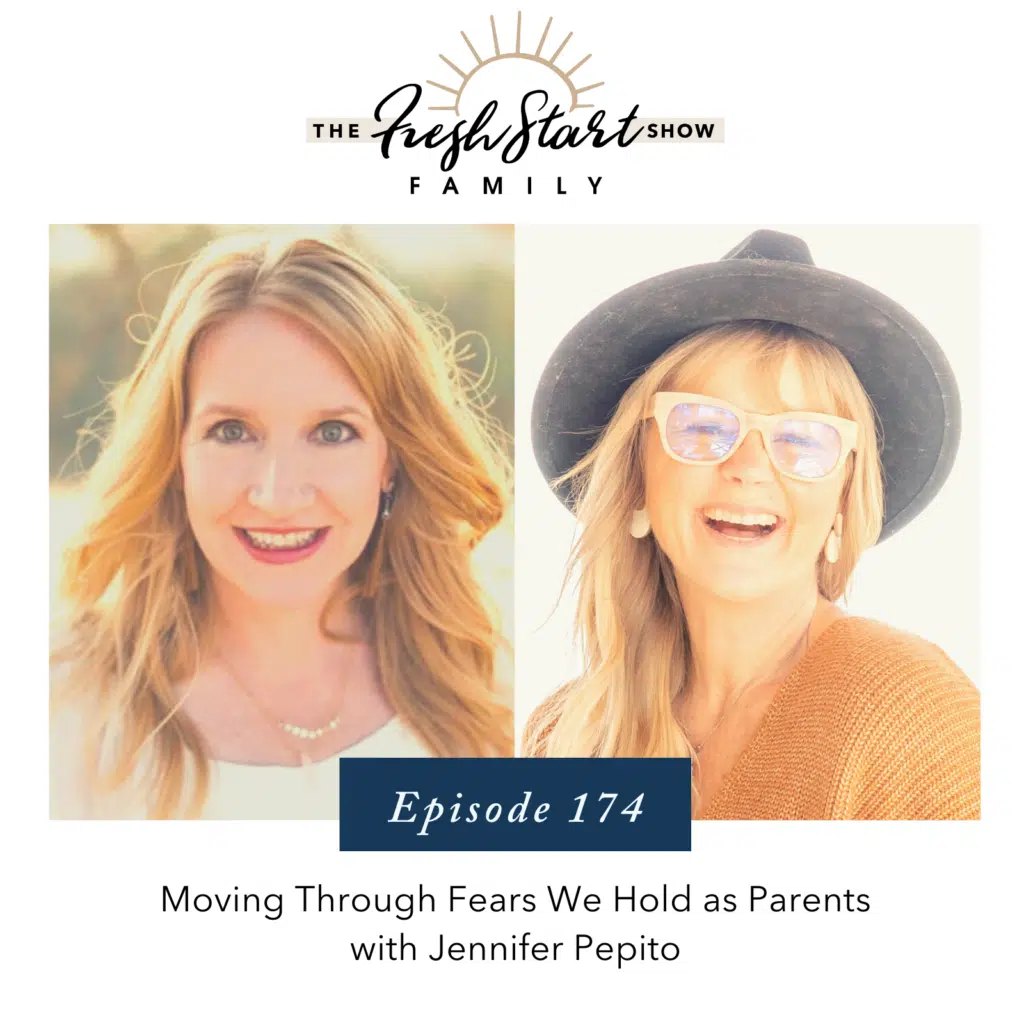
On this episode of The Fresh Start Family Show, Wendy sits down with homeschool pro Jennifer Pepito about the fears we face in parenting and how to move through them. Jennifer is mama to 7 kiddos, founder of The Peaceful Press, host of the Restoration Home podcast and co-host of the Wild + Free podcast.
There are so many things that can hold us back as parents, and our fears and worries really do affect more than just us. Working through them is not only healthy for us, it’s healthy for our whole family. Tune in as Wendy and Jennifer get into what’s behind our fears and what we can do about them to live in abundance.
Raising A Strong Willed, Intense or Sensitive Child? If yes, I have a FREE gift for you!
This free bundle comes with an extensive learning guide & FREE workshop with me, where I’ll teach you ways to build connection & methods to work WITH your strong willed kids instead of trying to MAKE THEM change.
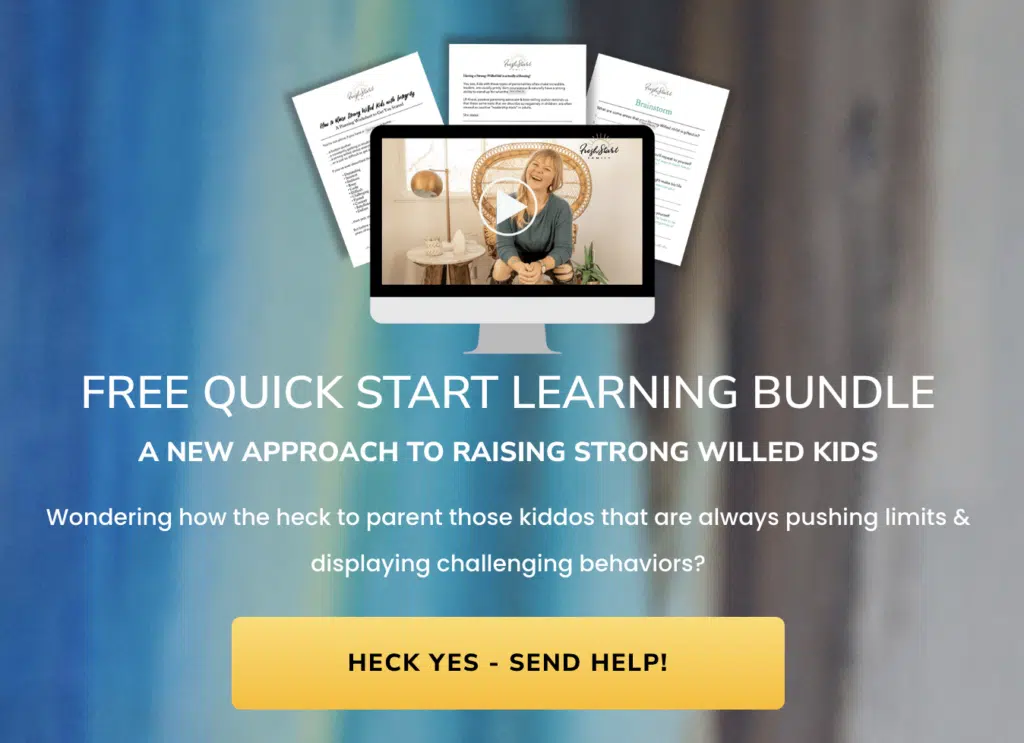
Inside this FREE learning bundle I’ll teach you:
*Firm & kind strategies to navigate challenging behavior with firm kindness & connection (vs. fear, force, yelling, threats & bribery)
*Ways to build connection instead of pushing your child away w/ heavy handed “hand me down parenting tactics”
*How to work WITH your kids instead of forcing them to comply or trying to MAKE them change
Click here to grab your free bundle now & start learning today!
Episode Highlights:
- Our fears and worries affect our kids, too, not just us
- Fears we imagine starts early and are not built on truth
- Journaling, prayer, gratitude and manifesting/visioning it differently can help
- So many of the things we have fear over are from things that happened in our childhood when we didn’t get the comfort we needed about them
- Getting to the root of the fear and forgiving ourselves for mistakes is so important to healing it
- One big fear we might feel is we’re not enough & we’re ruining our kids
- Being a steward of the healing we get means keeping up healthy habits that don’t undo the healing
- Fear of judgment is often in our heads, which is often based on trying to be perfect or have our kids be perfect, which is not a realistic expectation.
- God is the potter and we and our kids are the clay. People who judge our situations is on them, and no one can take our peace from Him.
Resources Mentioned:
@jenniferpepito on Instagram and on Facebook
@thepeacefulpress on Instagram and on Facebook
Jennifer’s book:
Mothering by the Book: The Power of Reading Aloud to Overcome Fear and Recapture Joy.
Get a full week’s sample curriculum of her best selling resources
Not able to listen or want to read along with us?
Here is the episode transcript!
Wendy:
Hello, listeners, welcome back. I’m your host, Wendy Snyder, positive parenting educator and family life coach. And today I have on the show, Jennifer Pepito, who is the author of Mothering by the Book and the founder of The Peaceful Press. Jennifer is on a mission to help moms overcome fear and love their life. And her homeschool curriculum empowers this through heroic stories, heartwarming poetry and engaging life skills development. Her resources help create joyful memories among families, which leads to deeper connections and lasting relationships. Jennifer’s writing has been featured in several online and print journals, including Wild and Free, commonplace, quarterly and Home Educating Family.
She’s a wild and free podcast host and has made guest appearances on popular podcasts such as A Thousand Hours Outside, At Home with Sally, and Charlotte Mason Poetry. She lives in the mountains, which is so cool with her beloved family where she enjoys reading aloud, working in the garden, and watching the sunset. And Jennifer and I just have the most beautiful conversation in this episode about how we can address and move through fears we hold as parents, especially in our motherhood journey. And so we talk about a lot in this episode, but we talk about the process of finding hope, and also we talk about comparison and how much that jacks us up as mothers.
We talk about habits. There’s just so much that we touch on, and I think you’re really gonna enjoy hearing from Jennifer. So even if you’re not a homeschool mama, like I’m not a homeschool mama. And I found this conversation, conversation to be just so rich. Jennifer is very well known in the homeschool community, but when I looked at her work and I listened to her voice, I think she just has a lot of goodness to offer the world and is very inspiring in the way she does motherhood. So if you are a family who homeschools, you’re gonna love this episode. And if you’re not a family who homeschools, you’re still gonna love this episode because this conversation around how much fear we do move through as parents.
And you can do that kind of in an unhealthy way where you avoid it and it gets suppressed and it often comes out in a lot of unhealthy ways. Or you can do it in a way where you’re processing it in a healthy way, where you’re aware of the fears that you hold as a parent throughout many different situations that you face on a day-to-day basis while you’re raising human souls. And when you learn to process fear in a healthy way, and even to possibly use it for good, I think your whole life can change. So without further ado, you guys enjoy this episode. And as always, thanks for being a loyal listener of the Fresh Start Family Show. We appreciate you, we see you and we admire you. All right, enjoy this episode.
Stella:
Well, hey there, I’m Stella. Welcome to my mom and dad’s podcast, the Fresh Start Family Show. We’re so happy you’re here. We’re inspired by the ocean, Jesus, and rock and roll, and believe deeply in the true power of love and kindness. Together we hope to inspire you to expand your heart, learn new tools, and strengthen your family. Enjoy the show.
Wendy:
Well, hey, there families. Welcome to a new episode of the Fresh Start Family Show. I am thrilled to be here with Jennifer Pepito this morning we’re gonna be talking about addressing and moving through fears we hold as parents. Welcome to the show, Jennifer.
Jennifer:
Thanks, Wendy. I’m excited to be here.
Wendy:
Yes, so as you guys heard in the intro to this episode, Jennifer is an amazing homeschool mama. And just, I always say like I w I don’t believe maybe that this is just a mistake and belief, but it doesn’t feel like I was cut out to be a homeschool mama. But if I was, I’d wanna channel your homeschool nest, Jennifer.
Jennifer:
Oh, thanks. I, I have a lot of fun with it. Like I know it’s not for everybody, but I really love making mud pies or doing science experiments with my kids or reading out loud. So the lifestyle of it suits me very well. And I know that’s not for everybody.
Wendy:
Oh, it’s, well, it’s, we have so many listeners who are homeschool parents. I just had a call with a student yesterday and she just loves it. She has four kids. She lives, where does she live again? Bababa. I’m not gonna remember right now, but she just was telling me how much she just loves it. She loves it. And so whether listeners, whether you are a homeschool parent or not, I think what we, I know that what we’re gonna talk about today is gonna serve everyone because we all have fears as parents that we really, it serves us well when we learn to move through them and not avoid them or suppress them. And I know Jennifer, you love to to speak about this topic, so it’s gonna be really fun today. But before we get started, will you just tell us a little bit about your story, Jennifer?
How did you co become so passionate about what you do and as far as creating the peaceful press and all the resources that you have for homeschool parents? Like I said, it’s just a beautiful world that you have created and we would love to hear more about how you got here, why you’re so passionate about it, all the things, and also how old your kiddos are.
Jennifer:
Well, I appreciate that. I’m the mom of seven children. The oldest is 29 and the youngest is 14. So sadly I’m getting to the end of my homeschool fun. But I, my second daughter has some learning disabilities and so we were doing occupational therapy and speech therapy and some of these activities and I realized there was really no curriculum for homeschoolers that incorporated those fine and large voter skill activities. And so a lot of homeschoolers were just letting their kids play in the early years and then getting frustrated in, in kindergarten, first grade when their child couldn’t hold a pen or track words on a page. And so what I set out to do originally with the peaceful press was just incorporate some of the things we had learned through some reading therapies or some occupational therapy that really helped prepare children for academic excellence.
And I’m also a big reading aloud mom. I love to read out loud to my children. I follow what’s called a Charlotte Mason Method of Education. And so I started writing some curriculum that were based on some of our history cycles of things that we were reading out loud and the art and poetry we were looking at. And because I’ve read aloud for so many years, 25 years of homeschooling, I ended up writing a book about overcoming fear that sort of ties some of the books I read aloud to common fears that most of us as moms face, I mean, I have struggled with a lot of fear as a mom. I don’t think I’m unusual, honestly. I think we just, as moms, we love our kids so much and it’s easy for that love to translate into fear, especially if we’ve had some kind of trauma in our childhood.
Wendy:
Yes, absolutely. You know, it was, it was wild. So I’ve been on like a personal growth journey, so to speak, for 12 years now. So I found positive parenting, what I teach now and life coaching about 12 years ago. And it’s been quite the journey, right? Like just, you just continue to learn about yourself and all the things. But I remember like a few years into it, I was in a weekend class and one of my favorite mentors of all time who had been teaching the class, we had worked through a bunch of things that weekend where I realized that I felt scared all the time, but I grew up in a home where it was like I was in the country, I was like had an older brother, he was rough, Tom, you know, he is just rough and tough. Like I wrote in the back of pickups, like if you fell down, I was like, get up, you’re fine.
Don’t be scared of the dark, don’t be silly. It was just like being taught how to feel scared never existed. It was, the message was don’t be scared. And so that weekend my mentor had said to me, we worked through all this beautiful stuff and at the end he looked in my eyes and he was like, Wendy, one of your biggest jobs is gonna be to teach Stella, my daughter, who’s now 15, how to feel scared. And it was like probably eight years ago now or something. But it has become one of my loves is to, to realize and and teach others too. And so I’m so excited to chat about this, but all, all over the place, like if you can just realize like, oh, I just feel scared right now, it’s okay. It’s like I don’t need to panic, but if I can move through it and on the other side is bravery and courage, then life becomes so like fulfilling and right, like all the things.
But it really has become one of the biggest learnings in my life is to realize I do feel scared a lot, don’t we all? And how to actually move through life amidst it instead of like blocking it or hiding from it. So I love that. Awesome. And you said your youngest is 14 and your oldest is 29. So you still have two. Do you have two at home right now that you’re still Yes,
Jennifer:
I’m still homeschooling. I’m still homeschooling two of my children. They’re grades eight and 10. Yeah. And you know, talking about fear, it’s interesting because my fears for my children, I would’ve thought of more as like concerns. You know, I just wanna be the best mom ever. I just want them to not experience the teenage rebellion and the pain from that that I experienced, or you know, so the, they were just normal cares in a way. But the problem with fear is that when we as moms sort of sink down into that, instead of learning to take our thoughts captive or learning to work through whatever the underlying thing is, what happens is our kids think they are the cause of our misery.
You know, if we’re afraid, our face looks really serious and we seem kind of unhappy, and my kids weren’t making me unhappy at all. I loved my kids, I was just constantly thinking about them. But because I had this face that was scared to them, it was like, oh, I’ve done something wrong and it stole a lot of joy from our family. This is why I’m very passionate about helping moms work through their fears because we have to rejoice, we have to live in joy for the sake of our children. And I know that takes work.
Wendy:
Yes. Yeah. And I love, I love, I feel like your account, like, I mean, Instagram is just one way that we present like our, our voice, right? But I love your account does just bring so much peace and you know, you can just feel your mission to live amidst joy and gratitude on a day-to-day basis, even though these flare-ups come all the time. Right. Like it is such a practice. It is such a practice. Well, awesome. I love that. And real quick, before, for those of us who aren’t in the homeschooling world, I just think it’s so fascinating to learn a little bit more so like the free or unschooling world versus Charlotte, Charlotte Mason versus Montessori versus Waldorf.
There’s like all these different things, right? I know one of my staff members, one of my coaches, she’s actually our podcast manager too, Amy, she did Wild and Free, which I know you’re like, don’t you, you are like a guest on their podcast often. Is that right? Or Yes,
Jennifer:
I’ve been, I w I’ve been a podcast host for them for several years, yes.
Wendy:
Oh, awesome. Well, their, their program seats amazing. But she did their program for two years during Covid and just like with a Waldorf curriculum and just loved it. And she felt like her boys thrived, they were actually in Alaska at the time. But maybe just give us a little brief, like what are the differences? Like maybe there’s some parents out there who are thinking about going towards homeschooling and they’re like, there’s all these choices. Like what is, what is this
Jennifer:
For sure. I’d love to do that. You know, it’s interesting because in Covid a lot of parents had to do Zoom school with their children and then they were like, oh, I can never homeschool. But Zoom school is definitely not homeschooling. So that’s the first thing I’d like to say that is not homeschool. Oh, that’s a good point. You know, so there are so many methods. There’s the traditional method where you buy a boxed curriculum for every child and there are several different publishers, you know, Calvert or Bob Jones, there’s several different publishers and every child has a textbook and every subject, or there are online curriculums like you talked about. And both of those are kind of what we would consider a traditional method of education. And then there is, like you say, the unschooling and that can range, like I know a woman who’s, who would say she was an unschooler but had a ton of structure in her home.
Other people are unschoolers and there’s no structure. So that’s, you know, a situation where you are giving your children more of the lead in what you learn. And that can range, like I said, from a lot of structure to child has complete free choice. And then there’s the Waldorf curriculum, which is based on the Rudolph Steiner’s methodology. And that incorporates a lot of art and nature and they delay teaching your child to read until they feel that they’re developmentally ready. There’s a lot of beautiful story and just honor for the imagination in that Waldorf method. Then there is the, the Charlotte Mason Method, which is what I most identify with.
And Charlie Mason was a, a woman who wrote in the 18 hundreds about education, late 18 hundreds. And she really emphasized the importance of reading beautiful stories, presenting a feast of beautiful stories to your children, letting them make the connections and a, as well as incorporating daily time in nature narration as opposed to fill in the blank tests. So narration is just a way of retelling what you heard or what you learned. So it, the big emphasis with Charlotte Mason is art literature and nature. That’s the one that I most identify with, but also the Montessori method. I love so much of the teaching by Maria Montessori about raising independent learners and helping children develop those motor skills early on.
So they’re, I mean, you know, I think that most homeschoolers start out one way, maybe even traditional, and then as they dive into it, they do a little more research and they start folding things in. The one thing that I have learned over 25 years is that children who are presented a feast of literature, and I have a daughter who’s working on a juris doctorate on decentralized finance, and we did, you know, this Charlotte Mason, lots of reading out loud, lots of time in nature, but not necessarily a traditional rigorous education. But it does create people who have good critical thinking skills because as you listen to all these stories and you talk about them, it helps your children develop a mind that can kind of wrap themselves, wrap itself around ideas.
Whereas when you just read a text fill in the blanks, you kind of forget it. So it’s, I, I believe it’s the discussions that are so powerful in a literature based education. I forgot to mention classical education, which I think is very similar actually to Charlotte Mason, lots of great literature teaching the classics a little bit more rigor in terms of memory work.
Wendy:
Oh, that’s so cool. And yeah, so what, so you mentioned your older, one of your older daughters, what are your kids up to? Right, because like sometimes, again, I am not in the homeschool world at all and I look at your life and I’m like, I imagine your kids graduate like once they’re 18 and they just become like these like amazing, peaceful, free, but like are you saying one went through like the traditional schooling once they got to college and Yeah, yeah. I
Jennifer:
Have a couple who’s grad. Yeah, a couple have graduated from university. One, like I said, is working on her juris doctorate, some are now working, one is doing a, like a Christian discipleship program. So they’re all doing a variety of activities of their lives and we, you know, we really encourage them as we are raising them to seek the Lord and see kind of what he had for their lives as opposed to sort of deciding for them or putting a lot of pressure on. My parents were very un non-traditional. My siblings, there are five of us and I think only one graduated from traditional school and, but all of them have started businesses and, and become successful in many ways through just kind of that same reading, a lot of literature discussing it as a family.
Jennifer:
Oh,
Wendy:
That is so cool. Yeah. One of my favorite, like Ted talks I ever saw was a kiddo who was actually from like up in a near, kind of near your area Tahoe, and he was 13 at the time when he did it. And it was this, he was like, wanted to become a professional skier at some point, I think, and he was homeschooled and he said, you know, everyone always asked me like, what do you wanna do when you grow up? What do you wanna do? What do you wanna be? And he and his whole talk was out about how he started answering, I wanna be happy and healthy. Right. And so I love that it sounds like, you know, the way you schooled your children and the way you designed their learning created a love of learning and a quest to be happy, healthy, connected to God, all these things like, and that led them to feel really empowered to do whatever they wanted to once they were, you know, past 18 years old or whatever.
And that some of them were able to just to go right into a university system and still thrive. Right? Yeah. Because I think that is one of the fears we might, we might touch on that for parents who homeschool, and I do hear this in my membership and the coach on it sometimes is like a fear that my kids won’t be socialized or they won’t understand how to like handle the constraints, right. Of a traditional school system. And it’s just seems like it’s not true.
Jennifer:
No, I mean it’s, it’s, you know, every, I have seven children, every single one has a completely different personality. So some of my kids love being around people. They, you know, like my son who’s in a discipleship school, he lived with 14 young men his first year at that school and got along just fine with all those people. Right. You know, some others of my kids might prefer more alone time than that. So I think every child is different. It’s not so much the child as it is or, or the, the method of raising them as it is your own personality, your own inter interpersonal dynamics in the family and then the child’s personality because children will often grow up somewhat like their parents.
So if you have social skills, your children will probably have social skills Yeah. As well. You know, in homeschooling there are so many opportunities for being around other people. My my children, the older five all did high school classes at the community college. So once they got to high school, I had them enroll in a couple classes a semester at the community college. So they ended up finishing high school with almost half of their, their undergraduate credits.
Wendy:
I did that too. I mean, I was in traditional school when I did that. My senior year was fantastic.
Jennifer:
It’s a brilliant way to get some of those credits, especially in California where it’s tuition free right now. And then they, several of them, a couple didn’t choose to apply to colleges, but the ones that applied to colleges, they got accepted to private Christian colleges with scholarship money, but still, you know, the, the, the tuition, they didn’t wanna go into debt and so they ended up doing the community college two state university route. So I’m all that to say worrying about like children who are homeschooled. They’ve been going to college for years now, do you know what I mean? Francis Collins. Yeah. The head of the human genome project was homeschooled. There’s a family, the Colfax, as they were a northern California family, you know, they went to like Harvard and Yale.
So it’s, it’s really kind of backwards thinking to think that a homeschool child can’t go to college.
Wendy:
Yeah. It reminds me of when I teach about empowerment, especially with strong-willed kids. So, you know, so many families get into trouble because the strong-willed kids, like you have this idea, it sure seems like from cultural conditioning and all the things that, like if you give them an inch, they’ll take a mile, right? Like if you give them more power, then they’re just gonna become like these dictators and think that the world revolves around them and then they’re gonna go out in the world and demand that they have a choice with everything. Right. And I always tell students like, it’s actually the opposite. The more empowerment you give them in the home, the less they will demand it out in the world because their buckets are filled. Like they have that bucket that to feel powerful, so filled up and so respected within the walls of their home and their family unit that then they can bob and weave and bend with parameters out in the world.
And so it kind of reminds me of this, it’s like this idea of really providing structure, but also freedom within curriculum and, and empowerment. And some might think like, oh, when they get to a university, they’re just gonna be like, where’s the freedom? I’m just gonna, I wanna relax, I wanna wake up at 10. They’re like, it’s silly. No, they’re gonna actually be able to, to weave right into that system so easily because they’ve been blessed with so much like time with not so much of a strict structure and being forced to do things a certain way. So, right. Makes me think of that a little bit.
Jennifer:
Yeah. One of my biggest ideas about that is so many kids, they, they push through because I feel like the traditional high schools basically replicate the information you would learn in undergraduate studies at university. And, and so they enter university so burned out. And I think that’s part of why we have a terrible mental health crisis. I mean, besides being pushed in their, in their, you know, shoved in a house for two years and not being able to co-regulate with other people, they also under this intense academic pressure in high school with very little freedom to choose what they want to learn or what they, they from the whole 12 years, there’s really no, hey child, what would you like to learn about? And so they, they end their school career with almost no personal passion.
Jennifer:
And I think that leads to a loss of hope as well.
Wendy:
That’s so true. There’s a documentary called Race to Nowhere. Have you seen that one, Jennifer?
Jennifer:
No. Sounds amazing.
Wendy:
Well, it’s like, it’s a little bit more catered to like those of us who have kids in public school, but it is life-changing and it changed everything for us. And we saw it right when Stella was in kindergarten. She’s now 15, my oldest one. And thank God because it ca it, it gave us a real blueprint to pull back on this rat race. Right? Right. Like it’s still, you know, our kids are still in public school, so everything you just said absolutely applies and this conversation is really meaningful cuz it’ll inspire me to make sure that I’m doing what I can while my kids are still in public school to like encourage that creativity and freedom and all the things. But it’s just as a beautiful flick to like, make sure everyone understands that the public school money is driven by funds, right?
Like, so like of course that’s how it works and it’s not like they’re out to get us or anything, but the, the testing and the, the standardization and all these things, like you don’t have to like comply with everything, right? Like you can be different and still move through the public school system. And that really empowered us to do things differently with Stella and not make her do homework, right? Like her whole elementary school career. Now, our local elementary school is, thank God here in southern California, they really like, we have a full-time social emotional literacy teacher. The kids really don’t get homework until sixth grade. And my, my boys in sixth grade, he doesn’t even really have homework. I’m like, yay, there big change. But back when Stella was in kindergarten, there was so much pressure on like getting her above the 66% mark on the reading test and you’re like, 60 what?
Like what? And also there was homework at kindergarten. I have so many students inside of our Fresh Start Experience membership that I coach to let go of this like forcing of homework because it creates so much stress. Like there’s
Jennifer:
No time, no time for connection. That’s one of the reasons that I I’m so passionate about overcoming fear is that fear rob’s connection because what is it we’re afraid if our kids don’t do their homework, they won’t go to college. So we push this and create all kinds of strife instead of have an evening where you play a game together and sure, review math facts in a dice game or there are other ways, you know, read a story and talk about it. There are other ways to reinforce that things they’re learning at school. But what we, what our kids need so desperately is more eye contact, more hugs, more empathy, especially in those early years so that they don’t feel like mother is someone who will not comfort them.
Because that, that teaches them a lot about how, where, where are they going to go to get comfort if it’s not from their mom or dad in the home in the early years.
Wendy:
Heck yes. It’s so true, Jennifer. Oh, I love it. Well, let’s hop right in. Let’s talk about fear. We’ve mentioned it a few times, but I know you talk so much about it in your book. But give us, give us just riff on this a little bit for us, like addressing and moving through fears we hold as parents. What does that mean, right? Like what do we do with this? What are some of the common fears that you have found in your work are, so whether it’s homeschool families, not homeschool families, like what are these common fears that so many of us hold and well, yeah, I mean, what do we do about it?
Jennifer:
They, they start right in the beginning, right? We’re afraid that we won’t be able to sleep through the night ever. We’re afraid that they will never potty train. We are afraid that this ear infection will kill them. Like from the very beginning. Our fears are there with our kids. And you know, I think that that if we don’t deal with them, they only increase. Like we get more intense the longer we don’t deal with them. And so in mothering by the book, what I do is I just pair common fears that moms are experiencing with a lesson I learned from literature and then I give moms a study guide and kind of action steps to work through it. So for instance, the fear of being alone. And I talk about how, you know, in pride and prejudice the mother was so strident and I feel like it’s a picture of a woman who has not dealt with their wounds.
You know, maybe she didn’t feel loved by her husband, maybe she didn’t feel loved by her parents at some point. She didn’t do the inner work of forgiving those people who offended her, asking God to comfort maybe some of those memories. And so she gets harder and harsher and more and more miserable. And, and all of it stems down to this fear that they will lose their home and she will be abandoned and she’ll, you know. And so I think that’s a problem with fears that are dealt with is they make us crazy. They make us act in ways that are very manipulative and controlling. So some of the things that I talk about in the book to overcome fear are, you know, journal, journal some when you are feeling scared or sad, just take some time to journal it out and what are you feeling?
Take some time instead of reacting and like, oh, your child didn’t clean their room and so you think they’re never gonna have a clean room and they’re gonna live on the street in a, in a cardboard box and trash everything. Instead of that, just sit down, take some time to journal what’s going on in my heart that’s making me assume the worst outcome. You know, take some time for me. I will often say like, you know, God, what is, what does the word of God say about this? Or what do you wanna speak to me right now about this? What is true about this situation? Another thing that I I do to work on fear is just learning to be thankful. Cuz sometimes it’s easy, you know, maybe there’s not enough money for something special you wanna do or maybe and, and then what we do, it’s not just that there’s not enough money, then we project, oh they, we don’t have enough money for this sports thing so my child won’t be able to get into college.
Instead, what is there to be thankful for right now? You know, learning to be in the present and be thankful for what we do have. Another thing I talk about in the book is just taking our thoughts captive because these, these ideas come in our head constantly. You know, my child’s on the trampoline, they’re probably gonna knock their head and get a concussion, my child’s driving and they’re probably gonna get in an accident. There are these little ideas that come in our head and I don’t, I don’t believe that they are our friend. I believe they are our enemy because we’re imagining things that are bad that have not yet happened. And so instead, you know, I really have gotten aggressive about taking those thoughts captives, saying, Jesus, this is a lie.
Take it away from me. Or I confess that I’m believing lies or, or I confess that I’m believing the worst outcome. Can you send these lies far away from me and give me your peace? I might speak scripture to myself to help give myself a renewed mind, a renewed perspective. And I also might just try to imagine a better outcome. You know, you, I I don’t know if you’ve done this, but you know, there’s, there can be a trouble in our lives and we can start imagining what could happen and losing sleep over what could happen. And instead I’m, I am actively working on using my imagination for good imagining things being as they should be imagining the peace of God coming into that situation.
Yes. So those are just a few, you know, a few of the things. And, and really I do feel like so many of our fears as women, maybe men too, come from places in our childhood where we just did not get the comfort we needed. And so we believed something that wasn’t true about, you know, for me, I was alone in, on our farm and I got pulled into a barn and molested. Yeah. And so there was a almost like a deep inner fear that if I was alone, something bad would happen. And I’ve really had to go after that fear and just, you know, continuously say, Jesus, I know this is not true. I know I’m not gonna be abandoned because you said you’ll never leave me or forsake me, but come and comfort me in this memory because we have to be able to start healing, healing those wounds to get that healthier adult perspective.
Cause it’s almost like there’s a broken inner child that is lying to us and messing up our adult lives.
Wendy:
Dang, Jennifer, there’s so much I wanna say here. I’m like, yes. It’s, it’s all so good. First off, yes. It’s crazy how early it starts. So I remember being in the hospital after Stella’s birth. So emergency C-section, seriously, it feels like a miracle. We both survived torn placenta, absent birth, like ripped from my body as I was unconscious. And I woke up and I’m just like, whoa, what happened? And then back then I didn’t know anything, so we just moved on, right? You’re like, okay, you’re, you’re alive, everything’s good. Like it’s just a c-section. But looking back, I’m like, wow, that was some straight up trauma. Husband got left in the hallway because they forgot about him.
And it was the moment he like, really found God though. So you, it’s crazy. God just uses everything for good, right? If we allow ’em to. But it was just crazy. But I remember the doctor coming in and after this like, there was no compassion. Like, they were not like, oh my gosh, you’ve been through a lot. Like, let’s talk about the feeding. They were just straight to like, well, you’re not making enough milk, so now you need to have this thing, you’re gonna need to like give her the bottle. And I just remember being like, I don’t wanna give her the bottle. Like the, my whole vision was that I was gonna breastfeed and all these things and, but there was just like, it was such a jolt and there was this fear immediately of like, you’re not doing enough. Your body’s not working, your body’s broken, your baby’s gonna suffer.
Like you’ve got it. Like something’s wrong with you. You know? And I’m, it’s just, that was like the earliest I’m, I probably have some fears that I can, I don’t know, I don’t feel like I had fears when I was pregnant. I was so optimistic and I had this great pregnancy, but that was the first like, holy smokes, this is, even as I tell that story again, it’s such a deep fear. And it started so early, right? Like it just started so early and just over the past few years I realized stepping into some healing work around that was necessary, which I did. Number two, I love this idea of like refuting the lies, right? And I know I, I recorded a podcast episode called Fear is Your Friend, because I love that you combine gratitude with it, Jennifer, because I think there’s a way to like, so for example, every time Stella drives away, she’ll e here in southern California, it’s like the e-bike capital of the world.
It’s like, it’s crazy. You go to high school or middle school here and it’s like, there’s like a hundred e-bikes, like all the kids have ’em, but it’s a lot, right? As a parent, as you drive your, you see your kid driving away every morning and I do sometimes have this vision, or not a vision, but a fear pop up of like, God, what does she gets hit by a car, right? And so I like the idea of combining the gratitude of like refuting that, that vision, that that lie or whatever, but also thanking God for the reminder to teach, right? So I’ve been such an advocate. I’m like the safety police in my area. There was a little girl hit on my street growing up who was like s by a actually getting off the school bus. But like she was severely emotionally and physically disabled the rest of her life.
And I just love educating kids on like the importance of helmets and they ride around town without their helmets buckled. So many of ’em. I’m like, where are your parents? Like, just unbuckled, no helmet. Two kids on the bike. I’m like, but you know what I mean? That reminder like, thank you God for this reminder. Tonight at dinner we’re just gonna review what traumatic brain injury is, how it affect, how it can like really change the trajectory, trajectory of someone’s life. But that education piece, right? I feel like sometimes God speaks to us, can speak to us through the fear if we refute the catastrophizing and instead thank him for, for just the reminder to teach, right?
Life is like one big long teaching thing when you’re a parent. And then last thing I was gonna say is I love that idea of identifying that root lie, right? Which so many of us have that creates this fear. Just recently over the last month, it was actually spawned by like a misbehavior my 15 year old had that caused me to like really go inward to to look at like she is developing a life skill. And I always tell my students like, check in. Are you developing that life skill too before you discipline, before you, you know, anything? Like, just make sure you’re modeling it and look at yourself.
Cuz oftentimes it’s a mirror. And what I realized was I I, I had a missing life skill and anyways, it caused me to go down this like crazy. It was like a lightning bolt of healing came upon me from God over this like four day period. And I realized that there was sexual abuse from an older cousin that I had suppressed for 30 freaking years. Like yeah, I think I’ve told two people in my whole life and I like hid it. I was so shameful of it, but the lie God sent me like straight to these podcasts that weekend that was all about like the discovering the lie in the agreement I had made with the enemy. And mine was like that something’s wrong with me and that I have to hide.
And it was, and, and I’m sure there was a lot that I made back then, but just finding that, identifying that and then breaking the agreement, I feel like a different person. I’m like,
Jennifer:
Right. And then, and this is exactly why I wrote my book because there are so many like things that we maybe think they’re small, like we, you know, I was molested, but there was, there was no penetration. It was a one-time event. It wasn’t my dad or someone really important, but still these big lies come into us especially, you know, and, and I think like for my kids, some of them the lies were, you know, like we were much more protective than I my parents were because I of my own experience, but still for my kids, like having one or the other of us parent being angry with them or, you know, my, one of my daughter’s biggest traumas as a child was that when she was, you know, probably four, I put her in charge of her two-year-old sister while I was pregnant and washing the blinds or something.
Yeah. And they wandered into the front yard and I, and I yelled at her. And so it’s like, yeah, they can be such small things like the traumas that absolutely distort our perspective on life. Like obviously it’s not a small thing that I let a four-year old watch a two-year old, but you know, the, they’re normal to me. Thank God, you know, thank god she wasn’t molested. Thank God they weren’t kidnapped. I mean, sometimes we think that trauma, we, we underestimate the power of small traumas, especially when we’re young because our understanding of the world is just being shaped. And so if a mother is disappointed in you because you didn’t do a good job at something, that’s a big trauma for a small child, you know?
And so I think, yeah, you know, and, and, and it’s only but the grace of God, like for one thing, anybody listening moms are probably listening and thinking, oh my gosh, I yelled my kids every day. Or Oh my gosh, you know, I, this, you know, my child was molested by an older cousin. And, and I just want mom to know, I mean, all things work together for good to those who love God. And so there is hope. There is always hope. And the human experience is messy. You know, you read the Psalms, the human experience is messy. You will not be able to be a perfect parent. You will not be able to be such a good mom that your children will never have a complaint about you, even though you have all kinds of complaints about your mom. Yeah. This is not, this is not facts, you know, facts are, there will be mistakes made, you will feel bad about the job you’ve done.
But, but God, he is with us. He will never leave us or forsake us. And he does not hold a record of our wrongs. And so I think, you know, honestly, one of the most powerful things I’ve done as a mother to overcome fear and just to get perspective, is to forgive. To forgive myself. You know, an active forgiveness. I, I blew it with my kids. I made so many mistakes. I, I wish I’d been more responsive to them when they were young. I wish I had handled this situation differently. And then, God, thank you for rear forgiveness. And and same with, you know, sometimes I think it’s easy for us to blame our husbands or our parents. Like those are the closest people.
They should have protected us. They should have made better decisions. But when we hold on to forgiveness or hold onto bitterness, it’s like drinking poison and waiting for your enemy to die. It only hurts ourselves. And so, you know, just, you know, for those moms listening who are feeling bad right now or feeling ashamed of what they’ve done, there’s so much grace. God is merciful and compassionate and tenderhearted and tomorrow’s a new day and a clean slate.
Wendy:
Mm. A fresh start, right?
Jennifer:
That’s right. That’s right.
Wendy:
I love that. So as a family life coach and a parenting educator, we, I teach weekend life coaching course called Freedom to Be, it’s actually at the time of this recording, it’s next weekend. So I have, I’ll have 20 people coming in to do that course with me. It’s gonna be so good. But it, I love that you what, like you outlined here as part of this healing process. Truth, forgiveness, and blame. That’s exactly what our entire weekend is about. Like we have so much of like forgiveness of others and forgiveness of self and holy smokes. It’s so transformative, right? When you, like, I think learning to forgive others and yourself is a really like big job. And sometimes people just wanna do it and it’s like, great pray about it.
Be in, be in relationship with God about it and get yourself into support where someone will like actually walk you through the process. Cuz it is just life changing, right? And then blame, right? Like blame is the opposite of forgiveness. Well it’s, it’s just associated. It’s like, but we do naturally just blame. Like, just the other day I was cracking up, I think my intern was here, or no, maybe I was, maybe I was on a meeting, I think I was on a meeting with one of my team members and I tripped over the dog bowl and the dog bowl was like full of water and it spilled everywhere. And it instantly, I was like, Yuki, my w my in my Alaskan husky. I like yelled at her and then I just cracked up. I’m like, even after 12 years of being in complete training and being an educator and life coach of this stuff, I still blame, I still blame the dog for where the water bowl was put next to where I was like sitting there with my computer.
I’m like, it makes no sense. But the kneejerk reaction was to blame, right? And so just that process, finding joy in the process of learning to take responsibility without shame and stop blaming right? Is a good one. It’s a good process. One thing I wanna just go a little more into, because I love everything you said about that fresh start, that clean slate because I know one of the biggest fears that I know is it’s, it seems to be buried pretty deep. It’s not one that we say a lot, right? Like, but it is that we’re not enough and that we’re ruining our kids and that like, there’s something wrong with us, right?
So for me, like finding what I believe is one of the root causes or what Carlos Whitaker describes as the spider this last month was so pivotal to understand like that probably was very formative me that that experience with that older cousin like to believe like something was wrong with me. But man, it is a thick one that is down there for so many of us, is just that we’re not enough. We should be doing more, we should be better. Like, and I know you did just speak to it, but if you could even riff just a little bit more on what comes to your mind about that. Cuz like you said, like you hear this like that how easily trauma forms because there’s small little traumas, big traumas, and it’s all trauma, right?
Like, it’s all just things that we can heal from, but it’s trauma and parents are like, man, I’m just, no matter how hard I try, I’m just not enough,
Jennifer:
Right? And I think there’s, you know, healing is so holistic, right? Like some people, I was reading some comments on a YouTube video about a inner healing model and people were saying, well, I tried that and I didn’t get better, you know, and people can be like that. Like, oh, I tried this and I didn’t get better, but here’s the deal, healing isn’t a one stop shop. It’s like peeling and onion. I mean, there are layers to it. And so I think first of all, we do have to identify what that, what that trauma was. I love the work of Dan Allen and Ellen Young on, you know, identifying, understanding your story of origin, getting some comfort, talking about it, co-regulating with, with people about what you’ve experienced, whether that’s a counselor or a prayer coach, a spiritual director, you know, getting some, taking time to grieve.
I feel like it’s so important to actually just let yourself feel whatever it is you felt, and then invite Jesus into that memory. I mean, the most profound healing that I have experienced has been when I’m feeling, you know, the effects. Like I I I and a memory comes up for me and I, you know, I can picture myself in the memory and it’s painful. You know, there’s a, there was a memory of myself trying to find my parents. We were at a family camp and I felt alone and lost. And I could feel it even as an adult remembering that memory. I could feel being alone and lost and scared. And then I, I just said, Jesus, can you comfort me in this memory?
And I saw a picture of Jesus come along and pick me up and say, I’ve got you. And you know, whether that’s my imagination or whether that’s the Lord speaking to me, I don’t know. But having, I mean, you know, I like tears instantly came, there’s so much comfort that the Lord brings. And and that is why he says, I am with you always, even to the end of the age. But if I was to, you know, I talked about this elsewhere, if I was to just take that experience with Jesus, that comfort that I got that really did soothe some of my fears and make me feel more relaxed in the moment, and then go back to drinking multiple cup of coffee a day and never feeding myself and going on Twitter and reading all the bad news and speaking evil and thinking evil and imagining the worst, that healing will be a erase in a day.
You know, it does take, we have to steward the, the breakthroughs that we get. We have to steward, you know, when God comes and comforts us, we have to then steward that we have to have some healthy structures in our lives where a, you know, I I’m working with a fitness coach right now and she has me high five myself in the morning. And just that little act of looking myself in the mirror and giving myself a high five is like, there’s some hope here. You know, I’ve been studying the Benedict teens for a book I’m reading, and they read all 150 psalms every week. And as I read the Psalms, I mean, there’s so much hope. God is our refuge. God will not fail. The Lord is in here in her. She will not fail, you know?
And so there’s so much comfort that comes from reading the scriptures and knowing that God has this, but there’s also personal discipline. Like, I need to go outside, walk bare feet, be in the sun for a few minutes. I need to drink my coffee with food so I’m not ruining my cortisol levels. I need to supplement, maybe, maybe go get some muscle testing and find out where the deficiencies are there. There’s a multitude of practices that we have to do. And I think that as we get older, like I think, you know, I was able to just push through as a younger mom, my fears could have been less damaging to my family if I had gotten more help earlier. But physically I didn’t fall apart. But I think that the longer espe maybe for women and men, the longer we don’t deal with that inner stuff and we don’t develop any healthy structures, the more of a negative impact it has on our body and our mind and the more potential for mental health issues.
Wendy:
Oh, that is, that is so true. Yeah. And I love the act of like, solidifying, right? So you, you’re starting, you know, as listeners, like you start to develop this practice of just the fears come up, the thoughts come up, the memories come up. You’re, you’re getting, you have this tone of curiosity, right? Like that weekend that I had such profound healing, it was like, God, could you just reveal to me like more about what’s happening here, reveal to me more like where could this be coming from? Right? But like the tone of curiosity and, and then it’s like once you’re, you’re finding it and you’re realizing like where these lies have formed or whatever it may be, finding the healing, but just then solidifying it into action, right?
Like that’s definitely the, the like, the point I’m at right now where I’m realizing that like, it’s, it sounds odd. I recorded a podcast episode on this healing through the mirror where I like relate all the dots here, but I have a tendency to overwork myself to like push through, right? And so, like right at the time of this healing that just happened to me over the last month that is so profound, like is it’s a time to take action right now to like really have the most courage to stop working at five and not push through to six, or to really, like, I have my team on me, just stop and meditate. Like at three, give your brain a break. Like, you know, but there is something to that, right?
Like the healing happens and it is so it can feel so easy just to go back to normal life when really it’s like, think and pray on that. Like, what are the action steps that I wanna take to solidify what’s what you’ve done in my life? God. So that is beautiful. Okay, well one more we’re gonna touch on and then then we’ll wrap Jennifer, but I wanna get you, I wanna hear you riff on this one, judgment by others.
Jennifer:
You know, one of the, I read, I read a couple books. I read Ruthless Trust by Brennan Manning, and I read How to Stop the Pain by James Richards. I read those both about over 10 years ago. So my, my daughter when she was 16, had a eating disorder. And at the time we were in a very judgey, a community where you were not saved if you did not display perfection. And so for me, I was like, oh my gosh, like I thought we were a perfect family, and now we have this terrible situation where my daughter’s believing lies about herself. And, and I, it just, it destroyed me. Like I was so in a way humiliated.
And so at that point I really had to get, get with God because I think we as moms, we do a lot of manipulating to get our kids to behave so we won’t be ashamed. And I don’t think that’s actually very productive. Like, you know, it’s, it’s natural. I want my kids to behave so that they won’t put a bad spin on us or God. But you know, they are God’s clay, not ours. We are not the potter. God is the potter. And, and you know, Adam was parented by God, the perfect parent, and he still made such a huge mistake that it ruined the whole world. The whole human race was ruined by Adam.
Yeah. So, you know, I think that, you know, we as moms when our, when we do come up on that, like, oh my gosh, my kid is failing in some way, we get so ashamed, and I don’t think, I mean, other people might judge us, but I think we are our own worst enemies often in this area. Heck yeah. But, but we really have to, I mean, we are the righteousness of Christ and, and the, the righteousness of Christ. Like there should be fruits worthy of repentance. It is true that, that if we really believe in, in the redemption of Jesus, that our love for him will start to change our behavior. But we have to recognize that we are covered in the blood of Jesus. That when God looks at us, he sees Jesus, he’s not holding our sins against us.
And so, you know, if people like, I mean, we’re going through it, we’re going through it with, with, we have a situation in our family right now that is just like crushing me, but I am the clay and my child is the clay. I am not the potter. And if the potter wants to do this situation in my family right now, I’m going to humble myself under the mighty hand of God. I will pray, I will fast. But if people wanna judge me, that’s on them. And I think so often people judge to make themselves feel okay. Do you know what I mean? Like, they, they, they don’t know that their salvation is secure.
And so to secure their salvation, they have to squash down other people. They have to put down other people to make sure that they stay up. But when we know that our salvation is secure in Jesus, nobody can take from me. Like, I can’t make a mistake that’s gonna make God not love me. It’s, it’s done. You know, it is finished. And so I can just keep my eyes on Jesus if I, and, and I think that gives us so much freedom to be fun and creative as people. Like my early years as a Christian and as a mother, I was so worried about what people thought of me. And it steals a lot of joy. Like you can’t just be creative or experiment or have fun if you’re constantly worried that you are going to encourage judgment either from God or others, you know, God poured out his wrath on Jesus.
If we could be perfect, Jesus wouldn’t have had to die. And so I think, you know, it’s, it’s unfortunate that some people don’t understand the gospel. And, and I, and it’s unfortunate that people abuse it, that people will fully yeah. Continue sinning, you know, but that’s, that’s not, that’s not what I’m talking about here. I’m talking about God has I, I’m his, I’m his adopted child. He sees Jesus when he looks at me. And so I can just do my best to honor him and not worry about what people are thinking about me.
Wendy:
Dang. So good, Jennifer. I love it. And like that idea that like when we’re in the fear, but we don’t realize, right? Like when we’re suppressing it, when we’re hiding it, when we’re operating out of it, instead of like being like, oh look, look, I journaled this morning, I’m freaking terrified. Like right now. Like you’re just like, I’m in this situation and I feel scared, right? Like we’re, we’re addressing it. We’re talking about, we’re bringing it into the light. Like when it’s in the darkness, it hides and the enemy just festers it, right? But it, when it’s in the light, it’s like now we can move through it. But you, when you’re in the fear, it’s that amygdala, like God designed our bodies perfectly, right? And when we’re in the fear and we’re like, fight, flight, freeze, danger, then our amygdala is lit up, right?
We’re catastrophizing. We’re like planning, like how are we gonna run from the bear? We’re doing like survival tactics. And that is the opposite of the creative brain, right? Like where he wants us, he wants us to be in that creative space. How are we gonna problem solve? How are we gonna mentor our child through this? How are we gonna look to Jesus? What guidance are we gonna get from him today? Whatever it may be. And then I love, love, love what you said about the, the judgment. Because really, like when I look at judgment, and if there’s two sides to it, right? There’s the fear of judgment, which isn’t always accurate, like that ac, we actually think people are judging us sometimes when they’re not. There’s that. But then when they really are, you know, it’s like I teach this in the Freedom to Be Weekend. It’s often a tone of disgust, right?
Like, ew, I can’t believe er, a family does that. I can’t believe your kid is doing that in the grocery store aisle, right? Like, ew. But it’s a tone of disgust, which is about judgment, which is about feeling like you’re better than, or wanting to be better than, which is a justification tone, right? It’s like it, it is something that it’s like we do to try to make ourselves feel better when we actually feel really low about ourselves. So everything just perfectly aligns with, with what I teach too. So, oh my gosh, Jennifer, you are just such a source of light and encouragement and wisdom and truth. Thank you for being here with us today. And listeners, make sure you go grab Jennifer’s book, and if you could just share with us, we’ll make sure we put everything in the show notes, but share with us where listeners can come find you and learn from you and learn more about Peaceful Press and all the things.
Yeah,
Jennifer:
For sure. My Instagram, Jennifer Pepito has everything linked there. I have a free connection challenge, free samples of my resources, and the link for buying Mothering by the Book is there as well. Also, the Peaceful Press Shop, if you’re looking for some learning resources for your children.
Wendy:
So good. Okay, listeners will go give Jennifer some love, check out her work. Thanks again for being here today, Jennifer. Thanks,
Jennifer:
Wendy. I loved chatting with you.
For links and more info about everything we talked about in today’s episode, head to freshstartfamilyonline.com/174.
Stella:
For more information, go to freshstartfamilyonline.com. Thanks for listening, families, have a great day.