

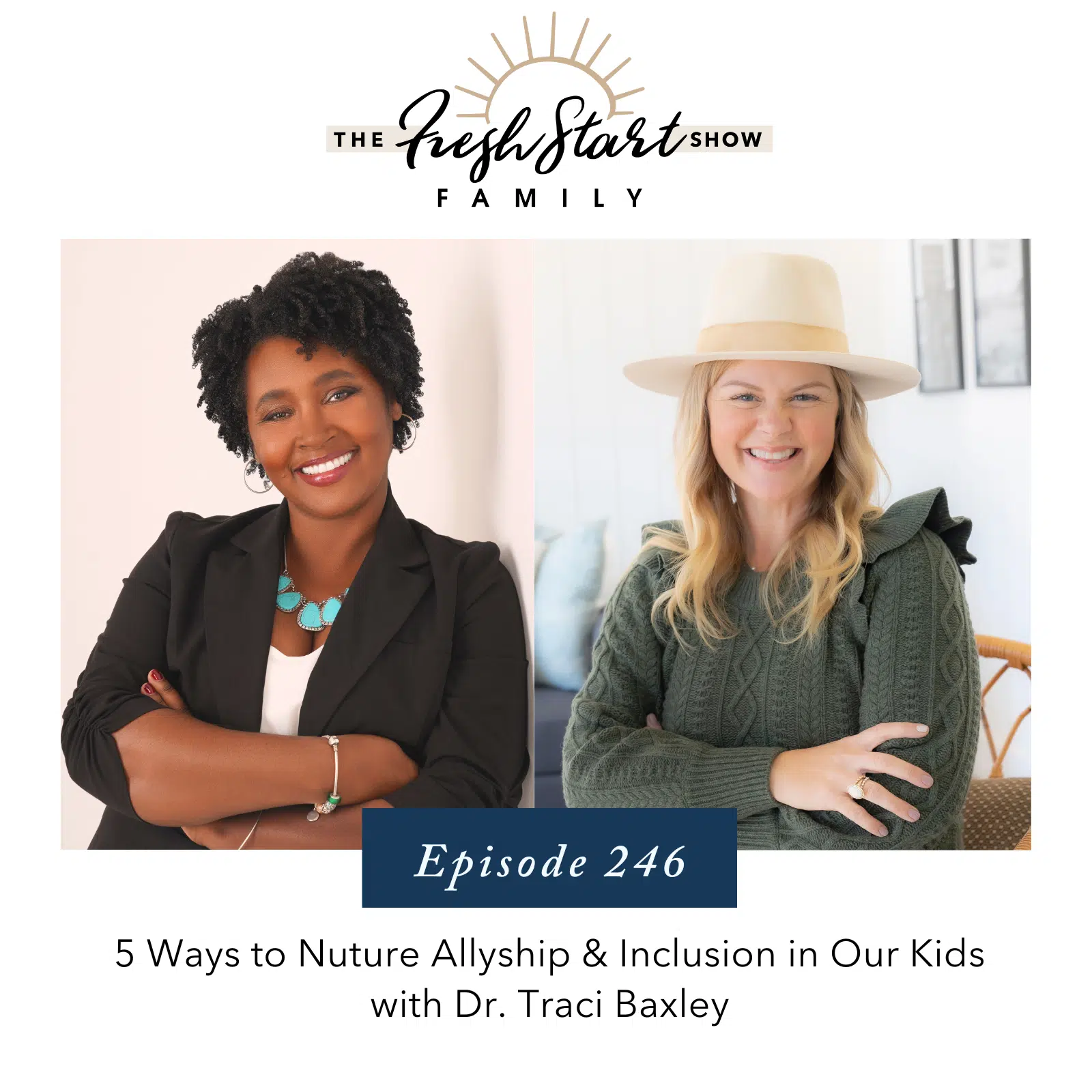
Get ready for an eye-opening episode of the Fresh Start Family Show! Today, Wendy sits down with Dr. Traci Baxley from Social Justice Parenting for a must-listen conversation on raising kids who stand up for what’s right. They dive deep into how parents can nurture allyship and inclusion in their children, sharing real-life stories, practical tips, and some hard-hitting truths about reflecting on our own biases.
Dr. Baxley opens up about her journey as a social justice advocate and offers down-to-earth advice on how to tackle tough conversations at home. Wendy and Dr. Baxley don’t shy away from the fears and challenges we all face as parents—they confront them head-on, with actionable steps that anyone can start implementing today. Whether it’s committing to brave conversations, building empathy, or taking meaningful action, this episode is all about empowering you to raise kids who care, act, and make a difference in our world. Tune in and walk away inspired to foster a home where justice and compassion thrive!
What if you could be an effective, firm & kind parent WITHOUT relying on fear, force, bribery & rewards?
Imagine learning a new way of firm (AND kind) parenting so you can end painful generational parenting cycles and create family legacies & memories YOU are proud of?
All while getting your kids to cooperate with your rules and boundaries with ease.

IMAGINE …
Parenting your kids with calm & confidence each day in a way that causes them to do what’s asked of them because they WANT to (not because they HAVE to) … because you’re helping to build essential life skills that have them behaving well & being respectful when you’re NOT looking!
The Firm & Kind Parenting Blueprint is your step by step plan & video training to help you build the family of your dreams. Click HERE to learn more now!
Episode Highlights:
- Confront Biases and Blind Spots: Understand and acknowledge personal biases to begin the journey towards effective allyship and inclusion.
- Commit to Courageous Dialogue: Engage in tough but necessary conversations with children and others, gradually building up the courage to confront uncomfortable truths.
- Cultivate Compassion: Approach discussions with a compassionate mindset while setting boundaries to maintain a positive impact without self-harm.
- Conquer Your Fears: Overcome the fear of making mistakes or ruining relationships by leaning into your core values and the desire to create change.
- Create Change: Actively participate in and encourage actions that promote inclusivity, ensuring your children witness and learn from your example.
Resources Mentioned:
Follow Dr. Traci on Instagram
Social Justice Parenting website
Grab Dr. Traci’s Book! Social Justice Parenting: How to Raise Compassionate, Anti-Racist, Justice-Minded Kids in an Unjust World
Watch Wendy & Dr. Traci’s IG Live
Catch the full episode on YouTube!
Not able to listen, or prefer to read along? Here’s the transcript!
0:00:03 – (Wendy): Well, hey there, listeners. Welcome to a new episode of the Fresh Start Family show. I am thrilled to be here today with doctor Traci Baxley from social justice parenting. What an honor it is to have you on the show. Welcome, Traci.
0:00:17 – (Dr. Traci): Thank you, Wendy. It’s an honor to be here. Thank you for inviting me.
0:00:21 – (Wendy): Yes. I forget how I found you, but when I found you, I was so excited to learn more about your work and all the things you are teaching and supporting families with. And, I mean, I just feel like I’m going to be majorly fanning out here in this episode because I really am just very in awe and inspired by your work. And so today, listeners, we are going to be talking about five ways that we can nurture allyship and inclusion in our kids, and we’re going to talk all about what that means, but it really is just an honor to have you here. Traci, love to start us off in these episodes with your story. Tell us a little bit about your story, how you became an author. I mean, gosh, as I read your intro before I recorded your intro, before we started chatting, I mean, wow, you have done a lot.
0:01:16 – (Wendy): You have so many beautiful accomplishments and accolades, and it’s just so inspiring. But I want to hear your story and how you became so passionate about doing what you do in the world and spreading light to families in particular in this way.
0:01:32 – (Dr. Traci): Thank you. Thank you so much. Wendy, I, you know, you look back and you can identify those moments in your life that let you hear, right when you’re in them. You don’t know that that’s the path, but I definitely can identify some kind of pivotal moments in my life that really kind of led me to what I’m doing right now. But I guess the main thing is becoming a mom, right? So I have five children, and they obviously inspire a lot of the work that I do and a lot of social justice. Parenting really started because of my experiences with my children and the way that I was showing up as a mom, you know, sometimes in that fear.
0:02:13 – (C): Right.
0:02:13 – (Dr. Traci): And my own experiences were guiding how I was showing up, and it wasn’t always the best way or a great way. So that, you know, I started doing a lot of reflecting on my own childhood, my own experiences, and I. How I showed up as a parent in that way. But even before becoming a parent, I was a classroom teacher, and I seemed to have always gravitated to those children who needed a little more love, who somehow were on the outside, and who I felt like needed a little support in belonging and feeling like, they belong and feeling good about themselves and feeling valued. And so I think the work that I did in the classroom also was part of what led me here.
0:02:58 – (Dr. Traci): And I think the culminating, really, societal change or shift was during COVID 2020, when George Floyd. The murder of George Floyd and all of the things that kind of happened, that spiraled because of that, really, people began to then find me and find my work and finding ways that they wanted to show up differently for their children so that these kinds of practices and the way we show up for each other is different and changes.
0:03:28 – (Dr. Traci): And I think that that was kind of the shift in my work being seen by other people on a larger scale. So that is when I started doing a lot more coaching on a bigger scale, and the book and all those things started to happen. But I think, like, quietly in my own corner, it’s the work that I’ve always done all my life, you know? So I think those life experiences growing up as a child who always felt the need to make people feel like they belong really kind of led me to here.
0:04:05 – (Wendy): Amazing. And so your book, social justice parenting, how to raise compassionate, anti racist, justice minded kids in an unjust world, that came out about two years ago now, is that right? Yes.
0:04:19 – (Dr. Traci): 2021. Yeah, yeah. A little over two years, yeah.
0:04:23 – (Wendy): So when George Floyd died, that. Is that when you said, I need to get this into a book, or were you already working on that? Was that, like, this inspiration that just funneled into you and caused you to, like, really move forward?
0:04:39 – (Dr. Traci): Yeah, that’s a great question. I had been working on the book, right. And I had some followers, and I was doing the work in terms of workshops and having some courses, you know, already. And I think it was the 2020 things that happened in 2020 that caused more people to search for the things that I was doing, including publishers, including agents. Right. I didn’t have my own agent. I was writing the book, which, you know, it’s that idea of preparation when preparation opportunity meets, really. That’s what really was a great example. I’ve been writing the book.
0:05:23 – (Dr. Traci): I didn’t know what I was gonna do with the work, you know, that I was writing, but I was led to writing the work. So when I got approached by a agent and the publisher, a lot of the book was already written. You know, it was written in the form of. I don’t know. You know, I didn’t know I was gonna self publish. I was gonna use it as part of my own platform. I wasn’t sure how it was going to be. Kind of put out into the world, other than just kind of, you know, entries on my social media.
0:05:52 – (Dr. Traci): And like I said, it was the timing of it. I had a lot of it already done, and when I was approached, it was kind of a good fit for what was needed in the world and what I was already kind of doing on my own.
0:06:05 – (Wendy): Oh, so, so beautiful. And so, as time went on. So you wrote your book, and. And tell me how you spend your days now. Traci, I know you, like, I just saw that you were speaking at a conference in the south, right. That the subject was so beautiful. I. What was it? I think I accidentally closed the tab out, but it was something around, like, addressing social justice from the fruits of the spirit. Is that right? Was that something along the lines?
0:06:36 – (Dr. Traci): I was like, yeah. Yes. That’s exactly what one of them was. Yeah. I was invited to Baylor University by the. The school of social work, and they look at Christian, the way we show up as christians through the lens of social justice. And so it was a great fit for me.
0:06:54 – (C): Yeah.
0:06:54 – (Dr. Traci): Yeah. And so one of the talks was working with, like, youth ministers or people in the. In the community that work with youth. And so I. My thought was to take it what they already know. Right. Which is the fruits of the spirit, and how do we take what they already know and where they already are and kind of push them to say that you’re already starting to do the work of social justice. If you’re living your life through the fruits of the spirit, it really is the beginning of social work. It’s just a matter of, you know, spreading your lens a little bit more. So that was.
0:07:27 – (Dr. Traci): That was that workshop with youth pastors and youth leaders in the community. So that was fun. Yeah.
0:07:34 – (Wendy): It’s such a great combination, and it’s a. It’s amazing. You’re so right. It is like, that is the beginning of the social justice work, or in my world of parenting, parenting with firm kindness and compassion. It really is the fruits of the spirit. And it is also crazy how much resistance in the world there is to everything. When I released a podcast episode called it was with my friend Christina Dronen, who runs gentle christian parenting, and the topic was parenting with connection with the fruits of the spirit.
0:08:07 – (Wendy): And I had a student who’s like. I mean, it was amazing, right? It was one of the most beautiful podcasts we’ve ever recorded. And also, I just know there’s so much resistance in the world that one of my students, her church, like, her Bible study fellow mamas, called a meeting with her because they were very concerned that she was, like, dipping into, like, they called it. You know, I think they took it to the edge of, like, satanic worship.
0:08:33 – (Wendy): How could you take.
0:08:36 – (Dr. Traci): I don’t. Yes. We’re so extreme right now that we can’t even just see where we can meet somewhere to just do good work. Oh, my God. I always tell my kids to just follow Jesus. Follow Jesus. He was turning over tables in the church, right? He was asking people to show up in a way that made a difference in the world around them and standing up for others. And so I just tell my kid, you know, we can’t be bothered by these extremes. We gotta just kind of see what the work is calling us to do.
0:09:13 – (Wendy): Yeah. I love it. Cause I was gonna ask you, how do you stay in this very, like, detached lane, right. Of, like, doing this beautiful work when there’s just so much absurdity of. Of resistance? And that is the perfect answer. There is no perfect answer. That is the most beautiful, inspiring answer. Just stay focused on Jesus. Like, yes, I can do that. I can do that, Traci. And there are days when it is just tiring. And I can imagine in your work, of just tiring. Right? So thank you for staying the course and doing this work every day, because there is an extra level of resistance and exhaustion that I think happens when you’re doing your work well.
0:10:00 – (Wendy): Amazing. Okay, well, today we are talking about, as parents, how we can nurture allyship and inclusion in our kids. So let’s talk about the definition of allyship and then inclusion. Let’s just lay that out first. Doctor Traci, please.
0:10:16 – (Dr. Traci): Okay, so inclusion is. And I try to do it in, like, kids terms, right. Inclusion is like being a part belonging. Right? How do we create a world where people can show up and they feel welcome, they feel valued, they feel seen and heard.
0:10:31 – (C): Right?
0:10:31 – (Dr. Traci): So that’s part of inclusion. Allyship is when you’re showing up in that kind of stance of inclusion for people whose identities may be different from yours, right? And so you’re using your. And this is another word that we are, like, attaching, like, as a very negative connotation, too, and we use it like a weapon. You’re using your privileges, right. In a way that you are supporting and acting in love for people whose identities are different from yours.
0:11:04 – (Dr. Traci): So can I just talk about that word privilege for a second, please?
0:11:09 – (Wendy): Yes.
0:11:09 – (Dr. Traci): So privilege, to me, is not something negative, not something bad, not something we should be ashamed of or fight about. Right. We all have identities in our lives where we have some more power than others, whether it’s our religion, right. Whether it’s our race, whether it’s our gender, our abilities, all of those things. We. Our language that we, you have in a certain society is privileged more than others.
0:11:39 – (Dr. Traci): And so I think if we can use the idea of privilege as a tool for change, right, a tool for making the world better versus using it as a weapon, I think we can really start to make positive ripples in the world by seeing it is, how do I use this space that I occupy in a way that I’m doing good. I’m doing good with people, standing with people, and for people in support of who may not have the same power, really, in the world that I may have based on this identity.
0:12:14 – (Dr. Traci): And so this idea of allyship is recognizing that, right? Recognizing there are some areas in which I have some privilege, like, for my kids. I tell my kids, you know, you may be marginalized in some ways, but we have socioeconomic privilege, we have religious privilege. Most of my kids have sexual orientation privilege.
0:12:33 – (C): Right.
0:12:34 – (Dr. Traci): And so how do we use those spaces in our world so that we are creating more good, doing more good, making changes in the world so that everybody feels included, everybody feels valued, everybody feels radically loved in so many ways. So that’s kind of the difference of how I see inclusion versus allyship when I’m working with children and working with families.
0:12:57 – (Wendy): That makes so much sense. Yeah. Allyship showing up in the stance of inclusion for people’s whose identity. Identity is different than yours and often is in a marginalized position. Right.
0:13:09 – (Dr. Traci): Absolutely.
0:13:10 – (Wendy): Like, that’s a part of that allyship.
0:13:12 – (Dr. Traci): Yes.
0:13:12 – (Wendy): Yeah, that. That’s okay. I love it how. It’s just because I think a lot of times, even when I say, like, I’m a positive parenting teacher, people are like, what is positive parenting? Right. Like. And so, with allyship, I feel like that’s. And even inclusion, like, that’s a word that we. We think we all know, but, like, it’s really nice to kind of define it. So I love that. And I’m. I’m just so excited to learn with you today because I’ve been, like, really going through my own journey of what it looks like to be an ally this past three years, especially since I’ve been diving deep into anti oppression and inclusion and diversity work that just had the honor of being in that work, which has been really challenging and intense, but also, I mean, one of the most beautiful things I’ve had the honor of doing, and it’s expanded my faith, and it has been intense. So we’ll get a little bit more into those stories a little later because I want to go cover our points now. And then I can kind of share what my personal journey has looked like over the last year or two.
0:14:17 – (Wendy): But let’s just start off with our first takeaway, which is in order to nurture allyship and inclusion in our kids, we must first, number one, confront biases and blind spots.
0:14:30 – (Dr. Traci): Yes. To me, this is the hardest one for people because it requires self work. It requires self reflection. It requires sometimes tapping into things that may be painful or triggering for us as adults. Right. But it’s necessary in order us, for us to be very intentional about the way that we are raising our children to maybe do things differently. Right. This is also could be about breaking generational traumas.
0:15:00 – (C): Right.
0:15:00 – (Dr. Traci): Or cycles. And so it really requires us to think about even when it’s painful.
0:15:08 – (C): Right.
0:15:08 – (Dr. Traci): Or uncomfortable, or that we don’t want to admit certain biases or triggers or blind spots that we may have. But being able to tap into those things really changes the way that we.
0:15:19 – (C): See the world and the way that.
0:15:20 – (Dr. Traci): We can show up for our children. And I think sometimes when I work with families or mostly moms I work with, the first thing is I don’t have biases.
0:15:31 – (C): Right.
0:15:32 – (Dr. Traci): I think we should all, we don’t see color. We all treat each other. Treat the same. Well, the reality is we’re not all the same. And if we don’t acknowledge that, we’re not the same and what we need is different from what other people need. People’s lived experiences are very differently. So I’m going to see something very differently, Wendy, than you may see something. And so that causes us to see the world differently, which are, which show up, could show up as biases.
0:16:01 – (C): Right.
0:16:01 – (Dr. Traci): And so I think really exploring what those experiences, those biases, those fears are in order for us to be able to unpack some of those things, for us to do the work a little bit differently. And we’re all on this journey in different places. Right, in these journeys. And, you know, for some people, it may, the next step may be just acknowledging that but not knowing what to do with it, not making any changes, but just kind of acknowledge those things when they come up. Right.
0:16:30 – (Dr. Traci): If I’m walking in a certain neighborhood, if I’m driving in a certain neighborhood, if somebody gets on the elevator with me, does my heart work rate increase just a little bit? Am I looking for ways to maybe make an exit? Am I locking my doors, holding my purse a little tighter? Am I looking, you know, those little things are part of our biases. Now, we may not like them, but just acknowledging that, okay, my body is feeling differently.
0:17:01 – (Dr. Traci): What is that? And why is that feeling that way? And maybe it’s legitimate. There’s a legitimate reason why you’re feeling that way. But I think being able to acknowledge those things and start to confront them is part of the journey of really showing up and teaching our kids to show up in allyship.
0:17:16 – (Wendy): That’s beautiful. Yeah. And not judging them. Right. Like, so the thoughts, when they come, not judging them, that’s been a huge part of my journey, is just, like, looking at it and saying, oh, isn’t that interesting? You know, and just being with your thoughts without the judgment side of it, that’s what I’ve learned, is part of, like, the responsibility and the learning is instead of, like, the deflection and the denying or justifying, but just really being like that, it’s not if it’s.
0:17:47 – (Wendy): Everybody has them, and especially if you are in a white body.
0:17:52 – (C): Right.
0:17:52 – (Wendy): Like, it’s just not. It’s just there. Like, we’re going to have them. And so that awareness step is so important and to just be with them because the suppression of them is what keeps the cycles going. Would that be an accurate way to think about it?
0:18:06 – (Dr. Traci): Yes, absolutely. 100%. And I think about it, too. I try to think about it through the lens of, like, meditation and prayer.
0:18:14 – (C): Right.
0:18:14 – (Dr. Traci): Sometimes you have these thoughts that float in your mind, and it’s that idea of non judgment.
0:18:19 – (C): Right.
0:18:19 – (Dr. Traci): You let them go. You let them sit there, you let them float, you know, but you don’t harp on it.
0:18:23 – (C): Right.
0:18:23 – (Dr. Traci): You give yourself the grace and the space that you need to deal with them. But it’s that. I love that idea that you brought up. Right. It’s non judgmental. It’s just acknowledging that they are there and sitting with them.
0:18:36 – (Wendy): Yeah. When a few years ago, when I started the anti oppression, diversity and inclusion work I was doing, reread the book my grandmother’s hands by Resma Menakim. Is that how you say his last name? And it was so. That book was so, like, intense, but so beautiful to help me learn about biases and, like, blind spots that I didn’t realize I even had. And do it in a way where you are compassionate with yourself and you’re not trying to defend or anything, but it was really fascinating. I forget if it was in Resma’s book or. Or just in our discussions, like in our weekly cause that someone brought this up, but just the idea of how trauma is passed down in, like, literally the cells of our bodies.
0:19:22 – (Wendy): And so a lot of it, what I learned and what I took from it, and they told. And again, I don’t remember if it’s in Resna’s book or if it was just in our discussions, but there was, like, a story of, I think it was mice or rats where they were in a cage and they were like, I think one of the parents got, like, shocked, and then. I’m not going to tell this story that well, now, maybe you know this story, but it’s like the mice get shocked, and then they.
0:19:56 – (Wendy): When the mice get shocked, when they put a hint, I think it’s vanilla or something in the cage. These mice get shocked when the scent of vanilla gets put in the cage, and then they remove everything. And the mama mice gets pregnant, and then she has babies, and they remove the parents, and it’s just the babies who have never been shocked before. And when the vanilla gets pumped into the cage again, they flinch.
0:20:24 – (Wendy): Is that accurate? Is that the story?
0:20:27 – (Dr. Traci): I don’t know that story.
0:20:28 – (Wendy): Okay.
0:20:29 – (Dr. Traci): I’m reading a lot about epigenetics because the. The book that I’m writing now, it’s on parenting through trauma. That’s exactly what I’m. So I’ve been doing a lot of reading on epigenetics on how that is in our bodies three generations back.
0:20:43 – (C): Right.
0:20:44 – (Dr. Traci): So my grandchildren will feel some of my trauma and in our DNA. Yeah. And so if we’re not intentionally working on changing those things, it will continue to cycle out generation after generation after generation. Yeah.
0:21:02 – (Wendy): Yes.
0:21:02 – (Dr. Traci): It is amazing.
0:21:04 – (Wendy): It’s amazing, right? And wild. But I’m looking at my family book right now that my mom so beautifully put together all the way. We come from Ireland and Scotland, and she just, like, has everything you can imagine, both sides of her family that ended up landing in Kansas. And part of it is such a gift, and it’s also intense because a lot of it includes slave owners. And I just think about, like, the trauma of all sides of things that were endured in that time.
0:21:38 – (Wendy): And, like. And we talked about this in our, like, our weekly meetings for all those years that we were doing the anti oppression and diversity inclusion work. But, like, both sides of, like, witnessing things and remaining quiet and then also the things being done to you. Right. If you were black and brown skinned, like, there’s trauma there. There’s trauma there from, like, being part of a system that you didn’t, like, didn’t maybe speak up about or feel safe, challenging because you were a woman. There’s just.
0:22:12 – (Wendy): It feels like there’s trauma and secondary trauma everywhere. That in theory, right. Is what we’re learning, and what you just spoke to is getting passed down, whether we like it or nothing. And so to heal from it and not continue to have those biases or the trauma reaction, right? Like, if I think about it in terms of, like, every time someone says something that makes me uncomfortable, like, when I’m quiet about it, I almost think of it. It could be a bit of a trauma response of, like, this was passed down in my generation, like, in my family, the cells of my family lineage, to, like, not speak up or nothing.
0:22:51 – (Wendy): And I’m just like, dang, I gotta break that, right? Like, I gotta heal from that. I have to do the healing in order to help my children not have that gene passed down to their kids or whatever. So that’s. I don’t know if that’s an accurate way of thinking of it, but that’s helped me.
0:23:04 – (Dr. Traci): There’s two things that you said that I want to kind of piggyback on and talk about just for a second. The one thing about your family book, it’s so beautiful in so many ways, right. That you’re. It’s a legacy that you’re leaving for your children. But also, I also think, in this idea of confronting biases and blindsides, one of the things that I like to recommend is this idea of discussing your ancestry, right?
0:23:28 – (Dr. Traci): Sharing the stories that your families, their backgrounds, the beautiful things about it, but also not. But. And you’re discussing strengths and any prejudice or any things that may be hurtful later.
0:23:41 – (C): Right.
0:23:41 – (Dr. Traci): So the fact that you said that that book contains all the beautiful, great, wonderful things that you want to pass down, but it also. And it also includes the hard things, right. Because now our children, they get a better idea of the whole story, right. Not a single story. Right. Not this idea of building family up without the humanness.
0:24:05 – (C): Right.
0:24:05 – (Dr. Traci): That happens, which are not always great things. But the fact that the book contains both of those things is a concrete way of confronting biases and blindness without making my family feel shame about it. Right. You know, these are the humanist parts of our family. So I think that is beautiful and is a great, concrete example of how families can start to do that. And then the second thing that you said was, my brain is trying to think, but it was so powerful to me because it made me think about.
0:24:37 – (Dr. Traci): Oh, man. What did you say?
0:24:38 – (Wendy): Take your time, because we can pause. I’m just going to grab it real quick. I think I.
0:24:41 – (Dr. Traci): Okay, what were you talking about. You were talking about.
0:24:53 – (Wendy): I was talking about the mice. I talked about the stories of the slave ownership, something in your own family.
0:25:02 – (Dr. Traci): That sparked something in me that I wanted to highlight.
0:25:05 – (Wendy): If someone says something and I stay quiet about it.
0:25:08 – (Dr. Traci): Yes. Yes.
0:25:09 – (Wendy): Okay.
0:25:09 – (Dr. Traci): Yes. That was it. So when you think about it, when we talk about this epigenetic and how it lives in our bodies, think about when somebody says something and you don’t say anything. Like, later on, your brain is always like, dang, when he said that or she said that. I wish I had said this. I wish I had thought about this. And your brain kind of plays that over and over and over. Right? So that’s that looping. That’s the stuff that’s living in your body now.
0:25:36 – (Dr. Traci): Just think about if somebody said something and you said something back right away, your brain is no longer looping on that because you felt like you did the right thing and you said it and you got it out of you. And that’s kind of what we’re doing with the generational trauma. When we confront it and we start to put something that kind of stops or mitigates that trauma from reoccurring, it no longer lives in our body, and we start to then disrupt that for our children.
0:26:05 – (Dr. Traci): But when we don’t do something and we loop in it, it’s now inside our body.
0:26:10 – (C): Right.
0:26:10 – (Dr. Traci): And that becomes part of our DNA that we’re now passing on. So these interruptions that we do, these little interruptions are really changing the lives of our. Of generations that we don’t even know that will exist and we will no longer be around for. So I think that confronting is a. Is a big deal in changing those loops for our children, our grandchildren, our great grandchildren.
0:26:33 – (Wendy): Absolutely. Okay. And that’s a perfect segue into our next point, which is commit to courageous dialogue. And so how do we do this? Right. So, like, it’s. I feel like it’s easy to have courage to talk to your kids inside your family. But, like, man, does it take an immense amount of courage to have dialogue, especially when people say things or do things that are just not okay. And so I know you’ve had some, like, beautiful post on, like, active listening and just what it looks like to engage. I mean, there’s this one post I’m looking at that is so simple and amazing to understand, but then in real life, it’s just so intense and.
0:27:25 – (Wendy): Yeah, talk to us about that. Commit to courageous dialogue.
0:27:27 – (Dr. Traci): Yes. And I think it’s, again, it’s a process.
0:27:32 – (C): Right.
0:27:33 – (Dr. Traci): It’s not like, okay, let’s check this box off and we can do it. It’s not. You have to see. You have to decide where you are in your own journey. And again, it may be just acknowledging this makes me uncomfortable. I really want to say something. I may not be able to do that today, and that’s okay, too. Giving yourself, again, grace and space to be there. And then I think it takes small things. Like, it may be somebody says something that you don’t like, you get up and you walk away.
0:28:00 – (C): Right.
0:28:01 – (Dr. Traci): So maybe you are not ready to confront them, but you’re saying. You’re showing a sign to say, this is not okay with me. I don’t want to be involved in this conversation. It doesn’t make me feel good. I’m walking away. So maybe that’s where you are in your journey. Maybe the next part of your journey is you saying, I don’t feel comfortable with this. I’m gonna. I’m gonna choose not to be a part of this.
0:28:22 – (C): Right.
0:28:22 – (Dr. Traci): So you’re not confronting them. You’re talking about the way it makes you feel. Right. Your own I statements, the own. It’s about me. I’m going to get up and I’m going to walk away.
0:28:30 – (C): Right.
0:28:31 – (Dr. Traci): So you’re now verbalizing the fact that it makes you not feel comfortable and you’re walking away. And then the next step may be saying, what you’re saying is not correct, or what you’re saying makes other people not feel good about it. And then I’m choosing to not be a part of that, walking away. So I think there’s levels in the ways that you’re committing to courageous, courageous dialogue and. But I think you should always be doing something feeling a little bit comfortable.
0:28:57 – (Dr. Traci): Right. So once you feel comfortable just walking away, you’re no longer pushing yourself to be a better ally. Once you feel comfortable with saying, this makes me uncomfortable, I’m not going to stay here. Once you feel comfortable doing that, then you need to be pushing yourself to be. To be a part of the next part of your journey. And so I say, feel where you are. What makes you a little bit comfortable. Do that. Do it uncomfortable. When you get comfortable with that, what can I do next that will push me a little bit more in my allyship?
0:29:28 – (Dr. Traci): That makes me feel a little comfortable and do that. So I think small steps make big actions over time. So don’t feel like I got to do it all or nothing. That’s not the way it usually works. It’s usually a process that we have to walk ourselves through, but we’re always pushing ourselves to be a little bit more uncomfortable, to do a little bit more. And I think that’s the way we show up for our kids too, right? We’re teaching them to do small actions around small things, and then over time, those things get bigger.
0:30:01 – (Wendy): Yeah. And it’s like, there’s twofold here, right? There’s teaching kids in all the moments when they bring home, like, a little story about school, right? Like, we’ve had so many stories about school. Or just in the car yesterday on the way home from the mountains, there was, like, a story of something happen at Stella’s volleyball club that is so gnarly that those are the teaching moments, right? Where you can teach in the family meetings and the dinners and stuff, but there’s also all these little moments that you can teach exactly what you just said, right? Like, there’s different levels, and the most important thing is that you are taking somewhat of action. And then as you get more comfortable, you learn to be. Because for kids especially, right? Like, and obviously, I’m speaking from, like, the white bodied perspective, but, like, for, for kids especially, it’s, um, it is just an advanced maneuver to have someone make a racial slur, someone on the black top. And for you to be like, excuse me, I’m. I’m not okay with that.
0:31:00 – (Wendy): And it’s not correct. It’s actually not accurate, anything that you’re saying. And it’s really harmful. Like, you gotta build a kid up to that. But, like, I love what you’re talking about, is walking away and going to the bathroom and not engaging in the laughter and the jokes and making. Like, that’s something I’ve implemented, too, on a different subject. But, like, for some reason, especially in the church, there’s, like, there’ll be times when my pastor at my old church would be giving a sermon and joking about whipping.
0:31:30 – (Wendy): And I’m like. And I would just look around, everyone’s laughing, and I’m like, I’m not going to freaking laugh at this. I’m going to go to the bathroom. I am uncomfortable. And I’m not going to join in on laughing about this because it’s not okay. But that’s, like, different than going to my head pastor, because we were at a very big mega church at the time, and I didn’t. I thought about it. I thought about sending him an email, and I love you so much. And this is what’s on my heart. And I just was, I didn’t do it right, but I was able to walk away. And so. And my kids watch me. So that’s the second part, right? It’s like making sure you are actually doing things and your kids are watching you, which is the best way to learn, right?
0:32:11 – (Wendy): So it’s like, I think of the last year, God’s been steering me into all the anti oppression and diversity inclusion work. I thought, okay, God’s gonna have. I’m gonna be equipped and gonna really need to step into the space of racial discussions, which is important, but fantastic. Like, put me in coach even though I’m scared, but really where he put me was like, LGBQT affirming advocate space. And holy smokes, did it kick my ass. Like, I published a podcast episode with my friend Meredith Miller about what it looks like to be an affirming family.
0:32:49 – (Wendy): And, man, did the daggers. Like, it was. It makes me want to cry just thinking about it. It was so intense. We got so many unsubscribes in ten minutes. People telling me I was the devil and I was the most harmful person on earth, and I’m tricking children into. It was just so heartbreaking. And then that happened, and it was just like, boom, right? Like, okay, you’re in it. You’re in this. And then that settled. My body settled. And then I was like, felt so much better on the other end because now I just felt clean, like Jesus and I could be clean together. And then after that, we found a new church, and I started advocating.
0:33:28 – (Wendy): I started volunteering, and word got out. But I was affirming because I have a big podcast, right? I had to have very intensive conversation about it and really advocate. Here was my opportunity to not submit or just walk away and be quiet and just be like, you know what? This is too much. There was many times where I was like, I’m just not going to hold a small group. This is too much. My nervous system can’t handle it.
0:33:56 – (Wendy): But God slowly was like, you can do this. You can have a conversation. Like, you’re capable. Your heart’s going to be coming out of your chest, but you can have this conversation and share what you’ve learned and shared the Bible studies you’ve been part of. And. And I was like, okay. And so had the conversations and are now standing as an advocate in the space that is. It’s not the norm, right? Like. But that has been such an intense journey.
0:34:20 – (Wendy): But the reason why I brought that up is because my children have watched me, and they’ve watched me sit on the edge of the ocean crying for a good, like, a solid hour one day because I thought I was getting. I thought there was one day where I thought I was getting notified that I would not be able to hold a small group because I was an affirming Christian, and I was sobbing and grieving, and my husband was beside me, and he was just like, it’s okay. We’re gonna find someplace that accepts us. And it was just like a glimpse of what marginalized groups must feel, right? Like this white, privileged woman.
0:34:59 – (Wendy): But the depth of aching and heartache inside of me. And Terry came beside me, and I just will never forget my children. Just like mom. We got you. We’re together. We are one. And they got to see me standing for something I love.
0:35:18 – (Dr. Traci): It’s like you’re making me cry. It’s beautiful. It’s beautiful because. Sorry, that’s.
0:35:26 – (Wendy): And the good news is, before you, Traci, the good news is I was wrong. They’re accepting me. I’m gonna hold the Bible study. I’m good. I’m good. Even though we’re on a bit of a different pages, but I’m gonna be okay. Like, it’s. It’s all okay there, but. So now go ahead. That’s. Tell me what I just.
0:35:42 – (Dr. Traci): Yeah, no, no, I’m happy about that because, I mean, I. I’ve experienced that, like, church hopping, you know, trying to find where I feel like I belong and where I want to raise my children. It’s very, very difficult sometimes. Yes. But I’m so touched by all of that. One. The way you stand scared, right. It’s okay to stand scared.
0:36:08 – (C): Right.
0:36:08 – (Dr. Traci): And the way that you showed your children how to do that, and you didn’t shelter them from the breakdown.
0:36:15 – (C): Right.
0:36:15 – (Dr. Traci): Because our kids think highly of us, but they need to see us when we’re low, too, to know when they’re low. Mom did that, too. And mom was in a low place, but mom got through that. And so it’s okay that I feel low. I don’t always have to feel high. I don’t always have to feel like I have it together. I don’t always feel like things have to be easy for me.
0:36:38 – (C): Right.
0:36:38 – (Dr. Traci): And so I think the beauty of your children seeing you kind of ride that wave, it’s going to have lasting impressions on them and how they live their life and how they’re able to show up for themselves, even in the lows. So I think that itself is so beautiful. And, you know, obviously, the next level of that is that you are part of that allyship for a group of people who are often marginalized, especially in the religious sector, who need more support and more love in that space, in their spiritual growth and their belonging.
0:37:18 – (Dr. Traci): To feel like they have a connection and a relationship with God, I think, is so beautiful. And I think more of us need to be very active in that space, in our allyship, especially when it comes to spiritual beliefs, in our spiritual practices. So yay. I know you’re not. You’re not saying that to get a yay, but I think it’s beautiful, and I think, don’t underestimate that space in the way that you can show up in your. In your privilege, in your power to share that space with people who need it.
0:37:53 – (Wendy): Yeah. And the next point, Traci, we have on our list is cultivate compassion. This has been something that has helped me because of the attack that’s come for that. And I can, like, only imagine, like, that’s why it’s like. Like, I have aired one episode on the fresh start family show. What was her name again? Doctor? It was basically, like, how to raise anti racist children. And she was incredible.
0:38:22 – (Wendy): And I pushed go. It was another one of these where I was just shocked at, like, the response. I pushed go, and I was like, oh, my gosh. This is so amazing. I need to look at her this episode. She was so good. It was like, early on, we’re at, like, episode 230 right now or something for the fresh start Family show. And this was back in, like, episode 30, but I immediately got people that were like, this is dumb.
0:38:49 – (Wendy): This unsubscribe. There is no such thing as systemic racism. Like, this is the stupidest thing on the planet. You are like, I will not take part in this evil woke agenda. And I was just like, what is happening? How could. Literally, how could this be a thing? And so her name is Doctor Dana Crawford. She’s amazing. It’s been years, but I guess it was episode 58, and she was just so brilliant. And it’s like, how could anyone take that away?
0:39:19 – (Wendy): And then, obviously, when this episode aired about what it means to be an affirming family, I at first was, like, crushed. And then there’s a lot of anger that comes out, especially, like, when I think about being home with, like, my neighbors who have been in the same house next to where I grew up. My parents live in the same house, and my neighbors have not done any growth. No. No growth ever. And the racism stuff they say. Racist stuff they say. And I’m just. And they have no idea that they’re racist. They have no idea.
0:39:48 – (Wendy): They really think that they’re like good human beings who have no blind spots, no biases, and they’re just state and facts, and there’s so much anger involved. Right. And there’s just, like, you just feel like you’re gonna like. And then there’s fear because you’re like, oh, my gosh, I want to say something, but, like, this is going to be awkward. So the point of compassion, I want to hear you speak to this, because it has helped me so much to think, okay, jesus, fill me with compassion. Like, these people probably been raised in fear.
0:40:21 – (Wendy): They have been indoctrinated to think this way. Like, I don’t know, but tell me about the compassionate piece from your angle, Traci.
0:40:30 – (Dr. Traci): Yeah. I think it’s so important. First of all, self compassion, first of all, is very important. Right. We sometimes get so hard on ourselves that we don’t recognize that we need to give ourselves a break.
0:40:46 – (C): Right.
0:40:46 – (Dr. Traci): So self compassion is first.
0:40:48 – (C): Right.
0:40:48 – (Dr. Traci): And that’s kind of self preservation a little bit. Right. But I think people are so kind of dogmatic on this idea of keeping people out. I think it’s all based on fear. It’s all based on fear. It’s all based on fear. And mostly people want to be heard.
0:41:13 – (C): Right.
0:41:14 – (Dr. Traci): And so even if what they’re saying goes against every fiber of your being, I think it’s important to give people space to be heard for up to a certain extent. Right. And I think being compassionate with hearing people speak their truth is really important, because when we don’t do that, we don’t walk into spaces with the. With a heart of compassion. Nothing changes.
0:41:42 – (C): Right.
0:41:43 – (Wendy): Yeah.
0:41:43 – (Dr. Traci): Nobody’s listening. Nobody is willing to at least hear somebody’s perspective, and then we get more of the same. And so I often try to show up in spaces, even when I know it’s something that may cross my boundaries. All right. I know that the compassion is the only way to open the door. So let me give you an example. So I had somebody comment on my Facebook group. Facebook page. It’s a while ago, maybe. Maybe six months after my book was published, and just spewing negative stuff about social justice, parenting, about my book and the agenda. Just the same thing you’re saying, pushing this agenda and how it’s, you know, just very negative things from a.
0:42:38 – (Dr. Traci): From a christian perspective.
0:42:40 – (Wendy): Right, right.
0:42:41 – (Dr. Traci): But very exclusive. Right, right. And so, of course, my friends and my family and people who follow me were just, like, going in back at him, and I. My response was, thank you for reading. Thank you for your comment. Let me ask you this. Have you read my book, which, of course, he had not yet his ideas of what social justice parents meant. And it was like you say, this woke agenda that did more dividing than anything else.
0:43:12 – (Dr. Traci): And so I say, let me tell you the building blocks of my book. And I named the rocks, you know, which are kind of the building blocks in my book, which is reflection, open dialogue, compassion, kindness, and social engagement. And I talked to him about what. How I saw social justice and how I defined social justice and why it was important for me to teach my kids about these things. And so then he started asking questions, and I was able to kind of answer his questions about my definition of those things and why I thought it was important not just for my kids, but that for other people’s kids.
0:43:46 – (Dr. Traci): And I could feel the walls opening. And so by the end of just he and I having dialogue away from everybody else’s kind of comments, at the end of that, he said, thank you for answering my questions. I learned a lot.
0:44:03 – (C): Right.
0:44:03 – (Dr. Traci): So, wow, my drop was right. Right, exactly. So that was the sense of, okay, I’m coming with compassion, with open. My heart open, even though I think this person has no idea what I’m talking about, and I have really don’t want to hear what he has to say. I think through the lens of compassion, I am going to listen. And it was through that that we began to have a conversation that, you know what? We’re not so far apart in our basic values.
0:44:33 – (Dr. Traci): Something we could walk away that we agree on, that we didn’t know we can agree on at the beginning.
0:44:37 – (C): And I.
0:44:37 – (Dr. Traci): So I think compassion definitely will open doors and open minds when our hearts are coming through from the space of compassion. I also want to say we want to teach our kids to be compassion, and we want to teach our kids to hold boundaries. Right. Because there are some times that compassion is not enough. And if it’s starting to do damage to our kids and our kids psyche and crossing the lines of them feeling safe, crossing the lines of them pushing against their core values, it’s okay to say, you know what?
0:45:15 – (Dr. Traci): We can agree to disagree on this. This is where I stand. I’m walking away. So the idea of teaching compassion is not, like being run over, right? Trying to love so deeply that we, our kids are in harm. So we want to teach compassion with the idea of, here are our boundaries. What does that look like? What do we say in that moment? How do we then walk away from situations that, well, could cause harm?
0:45:44 – (Wendy): Yes. And what I’ve learned, too, is, like, especially, you know, if we’re talking racial justice. And if you’re in a black and brown body, like, not feeling responsible for educating people, like, not feeling like you have to teach this person, like, that’s not the angle of compassion, right? It’s like the, like, I can feel it in the way you responded is like, I’m gonna respond from an angle of compassion and engagement just because I have the bandwidth in this moment, whatever. I could feel like you’re almost relaxed about it versus like, I have to put this person in their place.
0:46:18 – (Wendy): I have to teach this stupid. I get a little crazy with my language. I shouldn’t go there. Sorry, Jesus. But you can feel this defensive justification and it’s like, well, this person probably has been raised, but it’s not real compassion. It’s like, instead, but there’s not a responsibility there. It’s just from an angle of like, okay, this, I’m able to engage in this right now and I’m not going to let it wreck my nervous system. I think that’s the big thing. Because if you’re not, if you’re not full of care, it can, you can come in with compassion, but then all of a sudden you’re engaged in this conversation that will, can really take you down.
0:47:00 – (Wendy): But, so it’s just, it’s, it takes practice to, to develop the ability to engage with compassion or sometimes choose not to. And I get it all the time in the world, my world, with like, the people who want to fight about whether gentle parenting is biblical or not. And I finally have gotten to a place where I’m able to extend compassion back just in my heart, out of my heart towards them. But I’m very boundaried now. I’m like, I have no interest in having this conversation with you.
0:47:28 – (Wendy): I wish you well. Here’s our podcast episodes about it. And thank you so much for caring. And I have no interest in engaging with this conversation. And so for me, I’ve learned that that kind of stops the, like, my nervous system was not doing well with it because I would just get so caught up trying to air quotes, help these people change their mind or understand that I then was not serving the people who really are interested in learning and changing. And so, yeah, I like that you brought up that boundary part. That’s so important.
0:48:04 – (Wendy): Okay, so we have two that we’ve got to wrap on. I wish I didn’t have a hard stop today at the hour because I have, as I was telling Traci before we recorded today, I have two Dr. Traci’s. I’m interviewing today, back to back. I normally don’t have back to back, but just finish us off with these two things. And we’ve spoken, Dr. Traci, about this throughout this. But conquering your fears and then creating the change, those are points four and five. If we want to nurture allyship and inclusion in our kids by the way we parent, so speak to those before we wrap up.
0:48:35 – (Dr. Traci): Yeah, I think just real simply is make the mistakes, ask the hard questions, do the work, apologize, lean into our kids natural curiosities to ask questions, to want things to be right and let that drive us and not our fears drive us. Right. And so I think if we can lean into that a little bit more, even though it’s hard, and watching our kids be curious about things, letting that drive us and not our fears, and then get involved. Right. Do something.
0:49:08 – (Dr. Traci): If you want things to be differently, what is your role in that? What is your responsibility, you know, in the context of what we’re talking about, you know, where is the God? Where is the spirit leading you to be a part of some of that may be the teaching, right? Like, I feel like God has called me to do some teaching, and that is my role. Somebody else, especially in the space of being an activist, I know a lot of black activists that say, it’s not my job to teach you.
0:49:33 – (C): Right?
0:49:33 – (Dr. Traci): It’s your job to learn. It’s kind of my job.
0:49:36 – (C): Right.
0:49:36 – (Dr. Traci): That’s where I think God is using me in a way that I know how to teach. I know how to come from a space of healing and service. I know how to meet people where they are, to try to get them to see things differently, I think that’s a gift that God has given to me, and I think that’s the way he wants to use me. So I think thinking about how you use your gifts and how you can create change in the world around you and allowing your children to see what that change looks like is really important.
0:50:06 – (Dr. Traci): But this idea of modeling for your children what it is that you want them to be and the way that you want them to show up, using the core values of your homes to lead you and moving beyond your fears, I think is really important. And then finally, I think what I call back pocket talk is giving your children words that they can use when they are in situations that seem hard and difficult. So role playing, modeling, asking them, what perspective do you want to change?
0:50:40 – (Dr. Traci): What perspective do we want to take on this? Here are some words to say if that happens. Here are some things that you can say when you feel like you are in a place of feeling threatened or need to express your boundaries or standing up for somebody else. What does that look like? So that they don’t walk away saying, I should have said. I could have said, but I already have this language in my back pocket that I can just kind of pull out and not let the fear get in the way of creating the change that I want to. To see and be a part of in the world.
0:51:11 – (Wendy): Yeah. And I love that you talk about the practicing. Like, you know, like, that is such a big deal for kids. Right. Because if you can practice it even just a few times, like, whatever it is that you need courage to do to create change or hold your boundary or remain safe and heard, it’s like, it’s so much easier. I think, like, the neural pathway gets paved if you do it a few times when you’re not, like, in that heightened emotional triggered state, you’re just a little bit more likely to be able to do it or just even practicing walking away.
0:51:47 – (Wendy): I mean. Yeah. And, gosh, I wish we had with so much more time because I would riff with you so much on the conquering your fears because that one, I mean, I think we get so caught up in our head and, yeah, I look at my journey of, like, I remember when I first recorded with Doctor Dana. That feels like a long time ago. It was probably, like two years ago now. I remember being so nervous for the conversation. Like, am I going to say something wrong? Am I going to offend?
0:52:11 – (Wendy): I’m just this white girl. No learning at the time, but I knew I wanted to. And here we are, like, two years later, and I’m, like, so relaxed, and I’m just like, oh, my. I’ve stepped into education for two years, but it’s like, it’s true. You have to just be like, okay, I might totally say something wrong here, but here we go. Or, like, you know, fears about ruining relationships. Like, I mean, I could just hear you riff forever on that. Because it’s like, if they. If they really can’t handle a conversation, are you holding a boundary about having a different opinion on them around x, y, and z, then really, are we trying to maintain this relationship? But then it gets dicey when it’s family.
0:52:52 – (Dr. Traci): Yeah, I know. I know. But I think, you know, there’s seasons of. Of certain relationships, right? People are in our lives for certain seasons, and that season may be over.
0:53:04 – (C): Right.
0:53:04 – (Dr. Traci): Even if it’s family members, the way that we respond to or collaborate with or show up for those family members, it’s different. We have to evolve. We have to evolve in those friendships. We have to show our children how to involve in those. I mean, during. I know we got to wrap up, but during, like, the election times and during, I had a lot of families saying, how do I go to grandma’s house now?
0:53:27 – (C): Right?
0:53:28 – (Dr. Traci): What does that look like for my children? How do I help my children create boundaries around what we do in our own house as core values is now different from my extended family. What does that look like? And that’s when I say, you practice, practice, practice. You really help your kids to make the mistakes at home and say, okay, this is what we did last time we were around them, right? So what does that look like now when this happens? What’s a?
0:53:53 – (Dr. Traci): We can do a b? What does that look like? If we feel like, we all feel like it’s too much for us, step c, or option c, is that we leave as a family. Like, so really having the language, the experiences, the role playing, the plan in place when we’re going to certain places, what does that look like? What does that look like? What is our word or our phrase or our symbol that it means we need to get the heck out of there, right? So having those things to create safety for your immediate family may be where you are and what you need to do in order so that your kids know that you’re showing up in this way.
0:54:31 – (Dr. Traci): No matter where we are as a family, we are in this together, and we’re going to show up as allies no matter where we are.
0:54:39 – (Wendy): Heck yes. So, listeners, you can tell there, I mean, we have just scrape the tip of the iceberg here with Dr. Traci’s work. So. Oh, my goodness. Her book is a must own. So a, let’s make like Traci, tell us where everyone can find your book, but also where can they come learn with you more? I’m going to make sure, listeners that I put in the show notes, the top four. I had pulled four of Traci’s very easy to understand Instagram carousel posts that are so educational and wonderful. So I’ll include those in the show notes. But where can they come find you and start learning with you and start following your work?
0:55:17 – (Dr. Traci): Yeah, I think Instagram is where a lot of the action happens. And if you want to contact me directly, there’s a space on Instagram to be able to do that. I do a lot of workshops in different places with parenting groups, with schools and organizations. I’m in the process. And this is. You’re the first person mentioning this to. I’m in the process of creating a, I want to say it’s going to be a group of moms, right? And I’m calling it the Grace parenting collective, where we are unpacking our traumas, unpacking our parenting, and supporting each other on how we can show up differently.
0:55:53 – (Dr. Traci): And the grace stands for something. So we’ll talk about that a little bit. But I’m going to, I’m starting to drop posts in my Instagram around the grace collective, parenting collective. And I want to start off with like ten to twelve moms who really want to dive in through their traumas, through their fears and really do some work around that. And this first group of moms, it’s like going to be no charge, right? It’s going to be us, like learning together and growing.
0:56:19 – (Dr. Traci): And so if anybody.
0:56:20 – (Wendy): Lens of social justice parenting.
0:56:22 – (Dr. Traci): In the lens of social justice parenting, yep. We’re going to really focus on really the r and the rocks on that reflection part of how we can unpack our fears and unpack some of the things in our lives and how we start to create social justice parenting around some of those. There’s those things. And how we start to disrupt those cycles of, you know, the epigenetics that are going on. How do we start to disrupt some of those things so that we can show up differently, so our children will show up differently for their children.
0:56:51 – (Dr. Traci): So that’s something I’m really working on now that I’m excited. Yeah.
0:56:56 – (Wendy): Normally episodes sit in the bank for a few months before, but maybe I can push this one up and get it aired because I just love your work so much. And is that maybe going to start soon or in the next month or two?
0:57:08 – (Dr. Traci): I’m thinking like, yeah, late spring, maybe the summer. We’re still working out some of the.
0:57:13 – (Wendy): Details, so we have a little time.
0:57:14 – (Dr. Traci): So it may line up right nicely with, with you. But by the time you air this, we’ll at least have some more podcasts, I mean, more Instagram posts around what that’s going to look like and how we can start, start meeting around that. So. Yeah.
0:57:34 – (Wendy): Oh, my gosh. Well, Traci, thank you for being here. Your work is just amazing. The education you are doing in the world, the light you are spreading. Thank you. Thank you.
0:57:43 – (Dr. Traci): Thank you, Wendy. Thank you for all that you’re doing as well.
0:57:46 – (Wendy): No, thank you. Well, what a joy. All right, listeners, go get your book. Dr. Traci is everywhere where books are sold, I assume.
0:57:54 – (Dr. Traci): Yes. Anywhere. Yes.
0:57:56 – (Wendy): Okay. Well, thanks again for being here. We’re so grateful for your work.
0:58:00 – (Dr. Traci): Thank you wendy.