


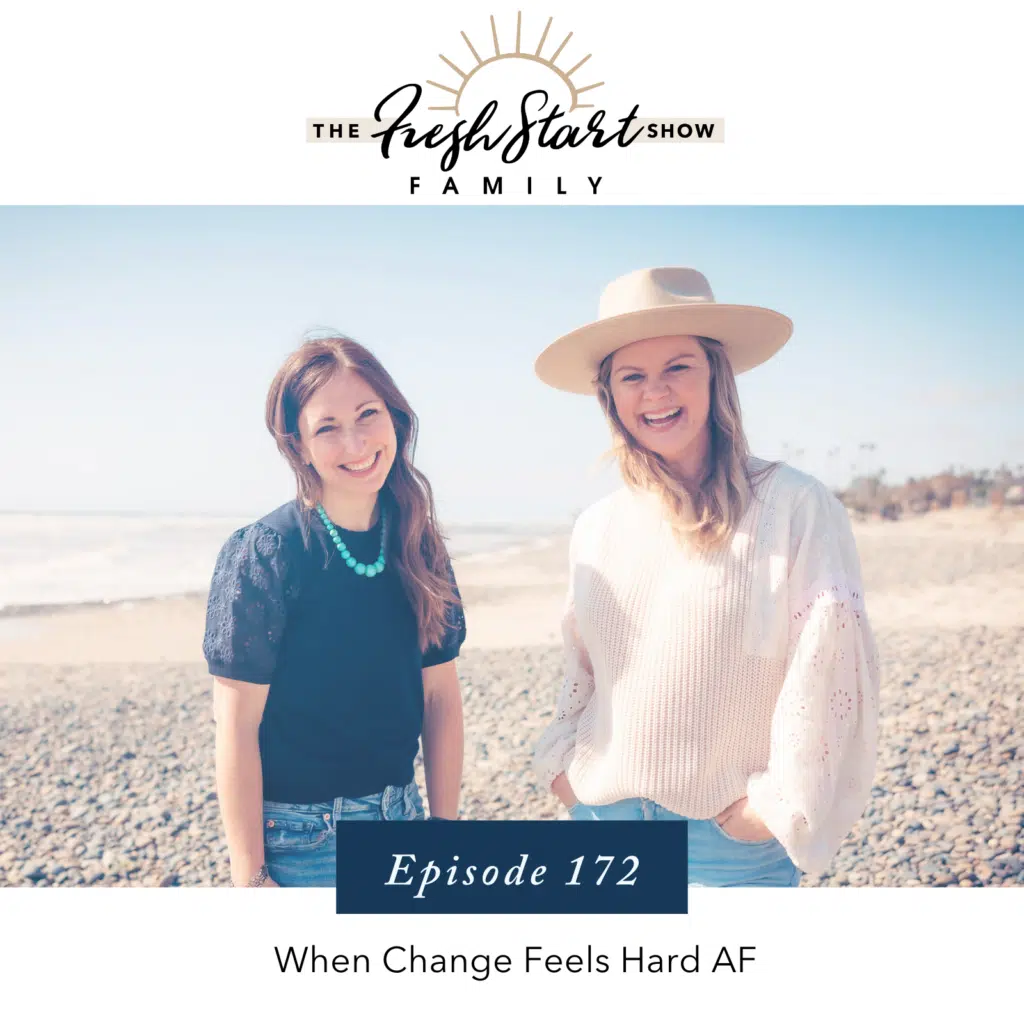
On this episode of The Fresh Start Family Show, Wendy and community coach and podcast manager Amy break down why we often resist change and how to move forward when we feel scared of it and why it sometimes just feels so hard.
Whether it’s change that we choose or change that’s thrown upon us, one thing for sure is that we often resist it because it brings discomfort. If we can acknowledge why we are inclined to fight it and work to re-wire our brains to adapt and roll with it, it is often much easier to do!
Even when changing up our parenting game feels scary and hard, we can apply a few strategies to help us move forward with intention.
Raising A Strong Willed, Intense or Sensitive Child? If yes, I have a FREE gift for you!
This free bundle comes with an extensive learning guide & FREE workshop with me, where I’ll teach you ways to build connection & methods to work WITH your strong willed kids instead of trying to MAKE THEM change.
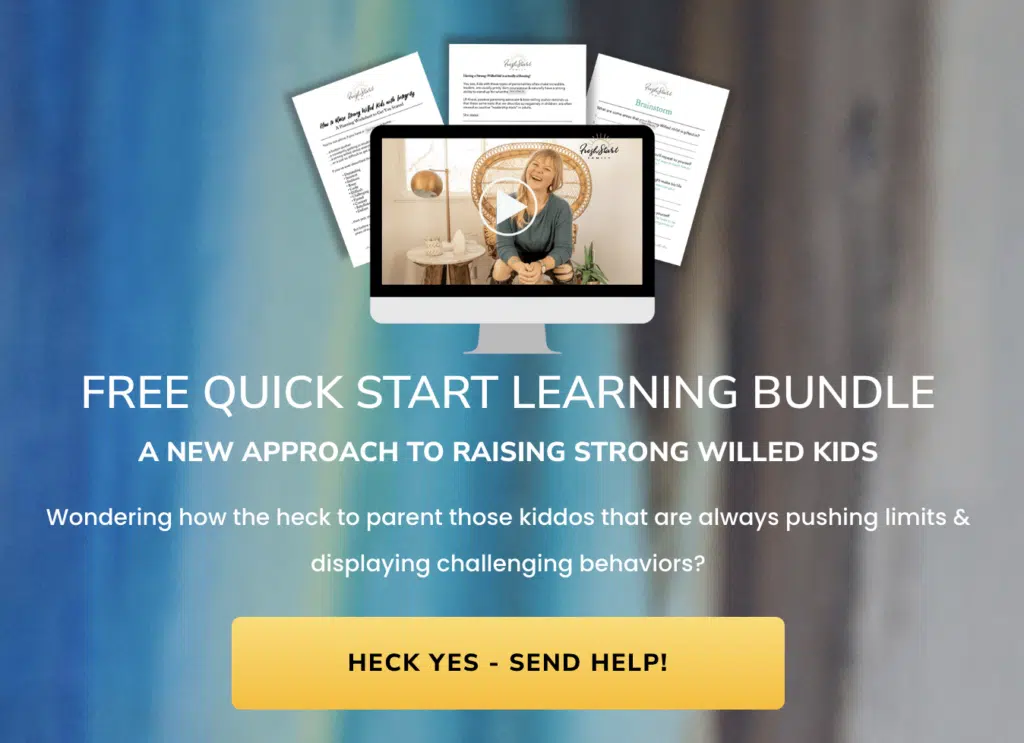
Inside this FREE learning bundle I’ll teach you:
*Firm & kind strategies to navigate challenging behavior with firm kindness & connection (vs. fear, force, yelling, threats & bribery)
*Ways to build connection instead of pushing your child away w/ heavy handed “hand me down parenting tactics”
*How to work WITH your kids instead of forcing them to comply or trying to MAKE them change
Click here to grab your free bundle now & start learning today!
Episode Highlights:
- Change feels scary because our brain is wired in the old way.
- Our brains want to keep us safe, and the unknown of the new can trigger our amygdala to feel scared and keep us paralyzed
- It’s important to look at what areas of change give us anxiety
- Do we want change or do we ‘want to want to’ change? (strong-willed people often resist change that they didn’t get to decide for themselves!)
- The feeling of scared is part of the process to getting to bravery and courage to move forward with change
- Sometimes we can reframe “hard” to “uncomfortable” or “new”, and others we can give ourselves compassion and grace for how hard it is
Resources Mentioned:
FSF Ep. 158 Calm Can be Cultivated
FSF Ep. 173 You Can Do Hard Things
Dr. Rick Hanson episode on change
Not able to listen or want to read along with us?
Here is the episode transcript!
This episode of the Fresh Start Family Show is brought to you by our Quick Start learning bundle to raise strong-willed kids with integrity. This two pack learning bundle comes with a downloadable learning guide and also a free online workshop with me all about what to do when your kids say, no, I won’t and you can’t make me in one way or another. Cuz we all know our beautiful, strong-willed kiddos resist in lots of different ways. Head to freshstartfamilyonline.com/free to grab your quick start bundle and get started learning with me today.
Stella:
Well, hey there, I’m Stella. Welcome to my mom and dad’s podcast, the Fresh Start Family Show. We’re so happy you’re here. We’re inspired by the ocean, Jesus, and rock and roll and believe deeply in the true power of love and kindness. Together we hope to inspire you to expand your heart, learn new tools, and strengthen your family. Enjoy the show.
Wendy:
Well hey there families and welcome to a new episode of the Fresh Start Family Show. I’m your host, Wendy Snyder, positive parenting educator and family life coach, and I am here with Coach Amy today and we are going to have a great conversation around when change feels hard af. Welcome, welcome to the show and so happy you’re here with us today Amy. Hey Wendy, thanks so much for having me. I’m still looking forward to this one. Yes. Okay, so guys, we gotta tee up this conversation because, so here, here I’m gonna tell you kind of the backstory of how Amy and I said, you know what, let’s record on this because we knew it was gonna support and encourage so many of of you guys listeners and we also have just been navigating this in our own life.
And so we thought we’d, we’d give a little context and then we’re gonna jump into some really great sources of encouragement for you all today. But recently, so our Fresh Start family team here is four women. So we have contractors and lots of different people that help us execute all the tasks in Fresh Start Family Land. We have pretty large membership now through the Fresh Start Experience and we also obviously have our podcast and just all of our incredible education programs that we just find it, you know, it’s just so fun to serve and support families all across the world. But obviously this takes a lot of work. So we have a great team of four women now and two of our girls on our team are pretty solid with their planning efforts and are comfortable planning and time blocking.
And then there’s me and Amy and we are just like, fly by the seat of our pants kind of girls. We both have, you know, a bit of a strong will deep down. So we kind of, you know, sometimes are a little resistant to change and we often might have a little squirrel brain tell us if you can relate Amy and are the ones who if you, if we screen share on a meeting, you’ll see that we may, might may or may not have like 27 tabs open. And so as we were doing some planning for our year this year, we decided that really creating some like operational efficiencies and like streamlining our team communication and execution process when it came to tasks and all the things was something that we really wanted to focus on.
And so we have been leaning into creating some change that is in regards to our calendar and the way we execute tasks and time blocking and all these types of things. And Amy and I are just kind of hanging on for dear life and we’re also really excited. But we have just been noticing about how hard it can feel when you’re used to doing things a certain way. And even though you start to realize like, oh goodness, this way isn’t quite giving me the results that I want, it still feels really hard to let go of. And of course we are gonna circle this back to give you guys an analogy, you know, of how this, how this shows up in our parenting life when we’re learning a different way when it comes to parenting.
But this is definitely something that we’ve just been observing about ourselves and kind of leaning into how can we embrace the change and really kind of almost welcome and accept the hardness and the uncomfortableness of what it feels like to change things up when you have a very strong neural pathway built. And just, just a few more things about this and then I wanna have you chime in Amy with you know, your thoughts about how this has been lately but it’s so in the kind of the productivity world or having like a clear thriving mind when it comes to task or business, whatever it may be. I mean the research has really proven that when you’re able to focus and do one thing at a time and keep track of like maybe your to-do list or your point most important priorities that staying on task and not having a squirrel brain mentality is really what gives people the best results and also provides the most peace in people’s lives, right?
Like the research is pretty outstanding when it comes to that. So as Amy and I have been looking at this the past few months now really we know what our vision is. We’re gonna talk to you guys about having that strong vision and how important it is and how it can really guide you and keep you grounded and why you’re doing things, why you’re changing things up. But we know that if we can get on the other side of this uncomfortable feeling of doing things differently, that the outcome is gonna be remarkable because Amy and I are the two on the team that struggle with overwhelm the most. So there’s no surprise that, you know, for us where it’s like time blocking and planning and sticking with the schedule or not multitasking or allowing ourselves to get sidetracked with other tasks, like it is directly correlated to the amount of peace and focus we’re able to have, right?
So we have that visibility now we’re just in the depths of actually creating the change in our day-to-day and I’m just so happy that we’re doing it together Amy. So we’re gonna get to the parenting part in just a minute, but I thought I’d tee that up for you guys and maybe Amy you can add kind of your 2 cents on how it’s been for you lately as just far as approaching change. Cuz I know we’ve had some really great conversations about this.
Amy:
Yeah, thanks Wendy. That’s just such a beautiful way to introduce this because I think everybody can relate on some level to areas in their life where they just feel that rush or they feel that scattered or overwhelmed and it’s, it’s really important to look at it and see like, what could I maybe be adjusting here? What am I maybe scared of and avoiding because it just feels uncomfortable. And that’s really what a lot of this is about. Seems like, I think it does tend to come more naturally to some of us than others. And you know, we talked about a couple episodes back in maybe what 168 for cultivating Calm. If you don’t see yourself as a calm person, you can still become a calm person.
Well we don’t necessarily see ourselves as organized or, or you know, monotasking people and we can still become that with some intentional change in behaviors. So we’re, we’re getting there.
Wendy:
Yeah. Yeah. And just really like, we’re already starting to see some of the fruits of our labor, right? Like when we, even though it’s uncomfortable to like group a bunch of tasks into like one day and then, but the peace that comes when you finish your day and you’re like, oh wow, I got a lot done in this one area. Instead of getting like a million little tasks done in all these different areas, it does bring peace of mind so, well I love it. And what we have to remember you guys is I so much in life, like I would say most good things in life require risk and will feel hard. So if you think about like getting a new job, a pregnancy, having kids like switching up your parenting style, which we’re gonna talk a lot about today, like going to couples counseling or a course like Freedom to Be that we teach here at Fresh Start Family or like all of it you have to learn and you wanna learn how to lean into the discomfort versus just avoid it or give up.
And so Terry’s all jazzed lately, we went to on a ski vacation last week and there was this book in our cabin that we were staying in that was, it was like a business leadership book, but he’s, He, he was so into it and he, he was like, yeah, it’s just like this cheese analogy cuz we were talking about this that we were recording today on this, on our walk this morning with the pups. And he’s like, yeah, it’s just like the cheese where, you know, so many people they’ll get into say this like, you know, you think of like this experiment where like rats or mice are put in this maze, right? And like there’s no cheese in the middle and so there’s lack, there’s discomfort there, there’s nothing like, but they get some mice get so comfortable not having anything that they’ll just keep relying on whatever external feeding whatever happens and they’ll just stay kind of in this land where they’re, it seems so scary to go out into the maze to try to find like the block of cheese.
They’ll just stay there no matter how much discomfort is because that’s what they know. And then there’s other type of mice who will actually venture out into the maze even though it’s scary as hell and like experience all the discomfort of getting lost and the anxiety of not knowing which way to turn or feeling like you’re gonna die, right? Like so many times as you’re switching up your parenting strategy, you’re like, this is not working right? Like I’m just gonna give up, I’m gonna go back. Or many of them do return home, right? Or return back to the center where there never will be cheese. But some of these mice, they actually make it to the end right?
Where there is the block of cheese and just the, the glory and the joy that comes from that. So he’s been cracking me up lately with this analogy about the cheese and the maze and, but it’s so true, right? Like we have this option, we can stay in what we know even though we’re highly aware that we’re missing out on so much. And often for many of us there is a lot of pain and suffering that happens when we just stay put. And then on the other side there is actually having the courage to venture into the maze, do something different even though there’s risk and then at the end there’s so much reward.
And that’s definitely, you know, one of the reasons why I love leading this organization now is I feel like I am experiencing that like top of the mountain feeling right now that I have the teenagers and we’ve been doing this for 12, 13 years now. It’s like, there are so many days where I feel like I’m sitting on the mountain top and I’m looking out and I’m like, oh my gosh, the journey was intense to get here and become fluent and totally do a 180 in our parenting walk and switch out of the punishment into the compassionate discipline, learn to cultivate my calm, learn to become responsive versus reactive, learn to like communicate with my strong-willed child with respect and empowerment instead of fear and force and pressure and all the things.
And now I sit in this place where I get to enjoy these beautiful relationships I have with the kids. I feel like I get to enjoy the fluency and my goodness was, you know, it’s been a, it’s been a journey. It’s been a long 13 years, but we all can do it. We can’t avoid it. And the more we fight it when it comes to change, often the worse it, it is. So, so I don’t know Amy, like, does, when we think of change, like I know we, you and I have been on this journey, but like for you, does it spark excitement or does it spark anxiety when you hear it? I think, I think I know what the answer is. Well you tell me
Amy:
Well if you know me then it’s both. And so I think when I’m initiating the change, it’s excitement but, and when change is sort of being put on me, it’s anxiety.
Wendy:
Oh that’s so good.
Amy:
So it’s definitely a both and it just depends. Yeah, I think, you know, one of the things that I’ve learned was just if there’s anxiety there, it’s worth a closer look and it’s when we start to tell ourselves the story of like, it’s too hard or I can’t do this, it, it can be very motivating, especially for us strong willow ones to say like, oh I can and I will. And it’s, if we get to be in charge of saying that we want the change is re really drives the change because as soon as it’s being put on us by somebody else, you know, we might dig our heels in and resist it differently than other other people.
Wendy:
Yes. I can just picture your, your face at the meeting like right in the beginning of the year where we’re like, we’re gonna change this up. And I just remember you being like, okay, I have some questions but I wanna backtrack for a minute cuz you know, we mentioned this, the strong will because I know you mentioned like you have this strong will and like do, do you, do you feel like that ha did that show up later in life for you? Or like was it, do you feel like you were like that as a kid? Because I know you’ve also mentioned like I I probably was that strong-willed kid who like, you know, the fear and force got put on so it kind of gets broken a little bit. But cuz I mean, it’s so cute because you come across as so like mellow because you’ve learned to cultivate your calm.
So I feel like I don’t see your strong will so much. Like it feels like it’s more behind the scenes. Yeah. But it definitely, I I can so relate to it showing up when you, if someone else is telling you like you have to be the one to get behind it or else it’s gonna be a, a painful journey for you.
Amy:
Yeah, absolutely.
Wendy:
But when did you, when did you realize like, oh, I do actually have a pretty strong will.
Amy:
Yeah, so I definitely grew up in a house where strong will was looked at it as a negative thing like many of us did, you know, they just, we don’t, we don’t have the same tools then as we do now. And you know, my amazing mama that I love so much, she did the best she could with what she knew how to do with somebody who was behaving those ways of just wanting to have a voice and an opinion and, and what, what to do when it was different and clashed with what she wanted. So I had a strong will, but it was not cultivated in a healthy way. It wasn’t probably guided in a healthy way. So then you end up with, you know, behaviors and actions that are getting your power and needs met in a, in an unhealthy way. But as I grew into my adulthood and I gained more autonomy over my life and I, and I grew my self-control skills and different things than, it was less about me needing to exert my strong will all the time.
And so I, I just, I think it, it comes out, hmm, it comes out less and less, but it is still very much at the, at the underbelly. It’s in there.
Listen up parents. I want to remind you that although this podcast is loaded with tons of encouragement, motivation, and inspiration when it comes to positive parenting and family life coaching, the real action is when you step into learning with me through our free quick start learning bundle, just pop in your email at freshstartfamilyonline.com/free and you’ll get instant access to a downloadable learning guide about how to raise strong-willed kids with integrity without losing your mind. And then also an invite to join me for my free Power Struggles online workshop where I will teach you five positive parenting strategies to handle pushback with firm kindness and connection versus yelling force and threats.
You can grab your free quick start learning bundle at freshstartfamilyonline.com/free. Okay, back to the show.
Wendy:
It’s so awesome and it is, but it is so true. Like I see it at Stella so much, what was it last week? I’m gonna forget right now. Well it doesn’t matter whether it’s church or something, I don’t know, something I’m trying to teach her. Like you can just see her flip when she gets behind the idea and it becomes about something that she wants to do, which is why it’s so important, right? That we describe to kids and help explain boundaries and rules and the reasons why those, those rules and boundaries or family values, whatever it may be, are actually great for the strong-willed kid. Because if they ever, and us like I’m the same way, I have the same exact strong will if I feel like someone is just trying to pressure me to do something because that’s what’s best for them and I’m not bought into it, I will resist with all my might.
So like, and, and I love what you said Amy, about when there’s anxiety then there’s like an opportunity to look deeper and just kind of figure out like, oh, what’s underneath of that? Because we do have the ability to change the way we see things, right? Like we do have an ability to talk back to our thoughts and not every thought that our brain serves up, even if it’s like, oh this person is forcing this on me or they’re pressuring me to do this. Like we have the ability to look at that and ask ourselves like, well is that actually really the case? So much like you, you know, you can’t apply this everywhere for sure. But I just, I do enjoy playing around with like, okay, this isn’t happening to me, it’s happening for me. Like how can I turn this into something that is like really meant to be like, it’s like what am I gonna do with this that’s gonna actually build in some type of benefit into my day?
And so that often will pull me out of that anxious cycle of like the sucks, that kind of stuff. Yeah,
Amy:
Yeah, for sure. I think it’s definitely a missed opportunity to look at all changes bad and when we, it it’s, you know, it reminds me of the Crood movie with the dad and he’s afraid of everything and it’s like new things are bad and he’s like slamming that hand print on everything. It’s like the visual I’m getting. Like he’s like, you know, anything that is bad cuz he’s just trying so hard to protect his family from anything new that feels unfamiliar and could potentially be dangerous and out there. And it’s not until the end of the movie when he really embraces change and sees that it’s a good thing, you know, that it kind of comes full circle. But yeah, it is an opportunity to add new richness to your life and just facing, facing the scar, the scariness of it is a skill you have to, you just keep growing.
Wendy:
Yeah. I love this quote that you had dropped into our notes for the day from Jack Canfield, author of the Chicken Soup for the Soul Books among many others. He wrote, “Change is inevitable in life. You can either resist it and potentially get run over by it, or you can choose to cooperate with it, adapt to it, and learn how to benefit from it. When you embrace change, you will begin to see it as an opportunity for growth. And I think it’s awesome. You did bring up the Croods movie. I love those movies by the way. I think they’re really sweet. But the dad, like the, the, the fact that the reason he is so resistant to the change is because he is trying to keep his family safe, right?
Like, so remembering that that kind of, that anxiety that flares up and, and really the way I see it in parenting is, you know, when parents find our work, so here at Fresh Start Family, so many of them kind of mimic my story. They mimic your story, right Amy, where it’s like the pain point and the realization that things are not going so well, not going as we had planned that we kind of find this work we’re in when we’re in like crisis mode, right? Versus like finding it when you’re pregnant. You’re like, wouldn’t that be great if we just use, you know, positive connected firm and kind parenting. Now I really do think more and more people are gonna have that experience as work like ours becomes just commonplace on the planet.
But for right now, most of our families find the work they realize they’re in kind of crisis mode. They’re like pulling their hair out with their toddler, or usually it’s the strong-willed kid that they’re arguing with all day or they’re trying all these traditional punishment tactics and wondering why there’s chaos and disconnection in their home and hitting, kicking, biting, screaming, spanking, doors slamming, I hate you being thrown around, right? And so they realize like, okay, I think I’m ready to do things a a different way. Like there’s got to be a better way and they start learning with us and they’re excited, they’re excited, they’re excited. And then there comes a point when if things which, you know, good change takes time.
Sometimes there’s like a panic that sets in of like, oh no, everything hasn’t changed overnight. Right? Or I’ve been doing this work for two months, even though we know in our rational brain that we’ve been parenting our kids often for 3, 4, 5, 6, 7 years, right? Often with like fear force, intimidation, overpowering, external controls, all the things. And but yet when we learn a new way, we just want it to like everything to change. We just want it, we just want all the old stuff to go away. We just wanna be like, look, I’ve raised my hand, I’ve learned the new way and now I’m doing things and everything is not that. Everything is not like perfectly better overnight, right?
And I think if we can just give ourselves some compassion, because remember like that’s how our brains work. Like they that feeling of scared of, oh, it’s not working, or this is too hard, or I’m incapable, or I should know this by now, or I’m still yelling at my kids, or they’re still hitting each other. Our brains are like designed to keep us safe. And so when we change the status quo, we are telling our brains that the unpredictable is coming and that can potentially equal danger, which auto automatically alerts our amygdala to be on alert, right? So it’s like it rationally it doesn’t make sense because we’re raising our hand saying, Hey, things are very chaotic in our home.
We don’t want so much fighting, aggression, hurting our children in order to make them feel behave better. And we freaking know it. So our brains are very safe with it. And when we go to change, the unexpected is just like this path, right? It’s like it represents the maze in the cheese path where it’s like, even though we know that there is a way out and the end is like this glorious chunk of cheese, hunk of cheese, whatever, it sure feels scary to like go this new route. So our brains neurons are also very strongly wired together. Making changes to the plan means our brains are no longer going to be running in familiar territory on autopilot.
It’s going to take intention to override what’s there and create new patterns and, and wiring those neuro pathways are thick and often come from decades and decades of believing something as truth. Like there’s, there’s so many ways that shows up. A lot of times it’s like from straight up like religious trauma of like being raised in homes where like it was like seen as truth that like in order for kids to behave better, they must be hurt.
They must be shamed, they must be put in their place. Like right. Or sometimes it just comes from just growing up, you know, 15, 20, 20 years witnessing someone who gets power in unhealthy ways, whether it’s through yelling or overpowering or intimidating or oftentimes permissiveness, right? Like just giving in and people pleasing. Mm. But being witness to that for so many years, especially in our developmentally a as we’re developing, as we’re growing as we’re children like it, the neural pathways are deep. Yeah. So, so listeners just remember we often resist change because of the story we tell ourselves, it’s going to be hard.
We can’t do it, it’s too much effort, it’s not going to really work or really make a difference. We set ourselves up for misery and failure that way. We often talk about this inside of our Fresh Start Experience is, you know, playing around with the what we tell ourselves as truth. And today’s conversation is actually a mixture between making sure we’re monitoring and like engaging with the thoughts that are actually gonna serve us well. So if we’re constantly telling ourselves like, this is gonna be so hard, oh my gosh, like why does this have to be so hard? Then a lot of times we will become that mouse that never moves forward because we’re we’re terrified of the hardness.
The other way to look at that is like, Hey, I’m gonna recognize that this is gonna be hard af and I’m capable. And the vision that I have and the belief that I know our family legacy can be different than it was for generations past in my family who had fighting and failed relationships and disconnection and all the things, right? I know that it can be different. I believe that it can be different. And so even though it feels really hard in those moments that I’m going to choose to walk away or choose compassionate discipline over punishment, I’m gonna do it and I’m gonna set myself up for success to be able to do it instead of just going to that like frozen place.
So there’s a saying that pain is inevitable, but suffering, suffering is optional. I’m sure you guys have heard that. And this is also true of change. So change is inevitable, you guys and suffering is optional, suffering through the change. The more we resist, the more we suffer often the more we say we want things this way, not that way, the more we suffer. So yeah.
Amy:
Yeah. I think clinging to that, clinging to what we know in resisting that change is where we see that suffering come into. We just don’t trust the process or we don’t trust ourselves to be able to do it. And it, it just, it just slows everything down.
Wendy:
So a lot of times you and I will see this often in, in the Experience, right? With when, when we coach families that if there is a lack of belief that you’re capable of changing or creating the family legacy of your dreams, the way you want to influence your children and the way you want connection to look in your home, peaceful problem solving all the things. And then there’s also not quite full belief in the process and what actually is possible for your family. That’s where we see so many parents struggle and it actually doesn’t show up too much, but we always can tell when it’s a parent because it really will stop you in your tracks because it’s hard to move forward and have the courage to keep going down the path that is often very counter-cultural and doing things that’s against your neural like pathways and pavings if you just don’t actually believe you’re capable or you don’t actually believe it could work for your family.
Amy:
Right?
Wendy:
Yeah. Which makes sense because it’s like so mu so many of us who were raised in the autocratic homes, it’s like we, we often end up in our adulthood with not a ton of self-confidence because like mistakes were always touted as like detrimental things, right? Like if you made a mistake, if you weren’t perfect, if you did something that was not good, air quotes good, then there was a price to be paid. Like there was danger, there was repercussions, there was suffering, there was humiliation, there was shame. So it makes sense why as adults we are terrified of doing something that could, I suppose, result in failure.
Would you agree that like for so many of us, that’s just like a, a thick neural pathway that’s paved that like causes us to have trouble believing in our capabilities as we get older?
Amy:
Yeah. For sure. We haven’t been shown a lot of compassion around mistakes and it, it becomes like, the reward almost seems less for the possibility of succeeding in it than the, than the fear and repercussion of the failure that could happen. It just, you know, we haven’t gotten there on, on going forward anyway, feeling, feeling that scared and, and moving on to bravery and a lot of us just haven’t learned, you know, this really important skill. Yeah. So we stay paralyzed in it.
Wendy:
Yes, totally. So John C. Maxwell, author of the book, the 21 Irrefutable Laws of Leadership said, “Change is inevitable, growth is optional. I might resist the idea of change, but I am all for growth. It helps to think of change as just a necessary means to growth.” I love that. And Amy, for us, just a minute, there’s a podcast episode with Dr. Rick Hansen where he talked about how we can want to change or we can want to want to, and I know that’s like a, can be a little confusing. So tell us a little bit about what that means because like, I just think God’s so cool because even this week as we’re talking about this, like we’re, we’re seeing it inside of our membership, right?
Like we, we have a sweet mama that we’re coaching where we’re just like, we are just really encouraging her and, and digging deep to understand like, do you really want this or do you feel like there’s pressure? Like you have to be the one to decide? Yeah. So talk to us a little bit about that.
Amy:
Yeah, I love that episode. I’ve listened to it several times, just trying to really internalize some of what I learned in there. I think Dr. Hansen’s like a fantastic resource. He’s a clinical psychologist, he’s an author, does a podcast with his son, the podcast called Being Well, I think. But in the episode he talks about how there’s a want to change and then there’s a, I I want to want to change. So for me, an example of want to want to is I’m not huge on exercise. I like to be active and move, but I don’t necessarily, you know, I’m not a gym rat. Like I don’t have to get, you know, every single day in kind of thing. I know a lot of people really just thrive that way, but I also know it’s healthy for me and as I’m aging and things, I want good things for my body.
So I try to make it work, but I, I want to want to do it more than I want to do it. So things that we, we feel like maybe we should want, this is a want to want to, you know, I should drink less or I should exercise more. Or like, those shoulds are kind of the want to want tos, you know, but you’re not all the way a hundred percent there yet on a want to, for an example of a want to, when we switched over to vegetarian 10 years ago, I fully on my own wanted that it was important to me. It was, it was a change that, that I wanted to make. And so it was an easy change.
Wendy:
Yeah,
Amy:
Just subbing out things at restaurants or not buying meat anymore for the, for the home or whatever was an easy swap. So it was a want to clear cut. It was very driven by the motivation of me versus, you know, oh, I, maybe cultural or whoever telling me I should do this for the planet or I should do this for the animals, or I should do this for my health is a want to want to, you know, people who are giving up on habits and they, he talks about it how in AA they make a list of, okay, let’s look at this thing that you’re doing as a choice. So you’re choosing to yell, you’re choosing to smoke, and when it feels like a choice, you can give it up a little bit easier because now you’ve put it in your court, something you’re responsible for.
And then they can also like weigh the list of what are all the benefits to doing this old way? What are you getting out of it? It is serving you to some capacity or you wouldn’t still do it. And then let’s look at all the, the benefits and of the new way and weigh those out. And then we can kind of get to this place of like, okay, this change is important and I do want it versus want to want it, which can lead to big change.
Wendy:
Ah, that’s so helpful. Okay. Yeah, I get it now. Yeah. I’m thinking of my own life if when want to want to versus like, yeah, it shows up in my faith journey where I really wanna be the person that like wakes up at 5:00 AM with the candle and the scripture and the quiet time and the meditation. And I mean, it has been years and years and years. And now that I just heard you speak, like I honestly, like, I actually want to just experience God all over the place. Like that’s why I’m behind that. I am like, oh my gosh, look at that sunset. Like, oh, I’m like, look at that rainbow. Look at that child, look at that butterfly.
Like, look at my husband the way he looks at me. Like I’m just, I wanna be in relationship all the time with God. But I feel like, like there’s been messaging that’s like, no really in order to really, you know, and I can think of some cer certain sermon sermons where it’s like, if you’re not doing this every morning right, then you’re literally giving God scraps. And I’m like, cool. I’m like, oh no, I should, I wanna,
Amy:
But yeah, so it’s a, it’s a want to want to because you think you should
Wendy:
Right? But I’m so much happier when I just implement it authentic, like authentically in different ways. Like that’s who, that’s part of who I am. Like that’s, that’s part of like, I think, well who makes me, me? And like my relationship is like always on. So yeah, that’s, that’s really helpful.
Amy:
I think with parenting, people have to get to a place where we say, do I want to, like, do I want to stop yelling or do I want to want to stop yelling? Do I, do I just keep going with these old ways because I think they’re gonna work? Or am I really fully committed to this? Is this, is this where I see the changes possible and I’m scary and hard and I’m gonna go for it anyway.
Wendy:
Yeah. And let’s, and we’ll talk about like the defining too visioning we’re gonna speak to here in a second because it is so important, right? When you’re like, when you ask yourself, do I really wanna stop yelling? Like, I love the idea of asking yourself like, well, do I really want peace and the ability to like walk away, but we’ll get there in a second. One more quote I wanted to throw out here from author Robin Sharma from The 5:00 AM Club said, change his heart at first. Messy in the middle, and gorgeous at the end.
Amy:
Oh, I love that.
Wendy:
That’s so good, right? Yeah. Cause you can see that, right? Like in so many of our amazing members inside of our Fresh Start Experience, like who are just so willing to stay in the journey. Like they’re in the maze and they’re just like, oh my gosh, that’s messy. And then they have days where they’re just like, oh my gosh, hashtag success. This is working. Yeah. Like
Amy:
You get those glimpses,
Wendy:
You get those glimpses, and then you have like you, me and Courtney who are been in this for a long time now. Yeah. Courtney’s our other like head coach and we’re just like, it’s gorgeous. Yeah, right. Like it’s just beautiful. Not to say that it’s perfection coming. There’s not just keep
Amy:
Coming, keep coming our way. It’s, I promise it’s coming.
Wendy:
Yes, it is. It’s so good. Okay, so you guys, so the question is, is what can we do, right? Like, so we’re acknowledging that change fields hard af sometimes. And we talked about how, you know, if, especially if you’re a student of ours in the Frustrated experience, like, you know, nine outta 10 times, if I’m coaching you at one of our Friday coaching sessions, and if you’ve put hard in your, you know, your question that week, you can usually count on me kind of reframing it for you and saying like, okay, remember like, this is new, this is uncomfortable, this is something I’m unsure of. Like, and I also in this conversation with Amy today, you know, really want to make sure I’m acknowledging, we’re acknowledging like, yes, it feels so freaking hard and just remembering that you can do hard things.
Terry and I actually have recorded a podcast called You Can Do Hard Things that you’ll be able to listen to next week, but it just feels so good once you get to the other side of it. And just remember that like a lot of times the the like fearing change when it comes to feeling scared of something, bravery and courage is what is on the other side of scared. So every single emotion has beauty to it. God-given emotions. There is not a bad emotion, but happy, mad, sad, hurt and scared and scared on the other side you like, you will not be able to feel bravery and courage until you have first felt scared. So it is a precursor to having that like, full sense of empowerment and that’s where capability comes from, right?
Like, you just had a project this week, Amy, right? Where you, I’m pretty sure were terrified like Amy had to do this like crazy downloading, uploading in our podcast like mega platform where there’s 160 episodes and that it’s so technologically like heavy. And I didn’t know how to do it and I was just like, Amy, do it. And, and you were like, oh my gosh. And then you did it and then we talked today at the team meeting and you were like, I feel really good. I did it. You know? And you said you had, you had felt that bravery and courage. Yep. But you know, just remember like, this isn’t like a, and or this is like, or this isn’t like choose one or the other.
It’s like you can, you can use these concepts in different times of your life, right? So if one day you’re like, I’m gonna reframe this, I, I see that I just, as I was speaking to my husband or my sister-in-law, whatever it may be, I said, I could hear myself, I said how hard it was today with the kids. I said it five times today, I’m gonna like play, like, I’m gonna play around with restating that actually it’s uncomfortable, it’s new for me to choose to get down on my kids level in the grocery store. When I fear people are judging me. It just feels so new and uncomfortable because if you’re talking to your sister, you know, mom and dad would just smack us like all those years, you know, like, it’s just so new for me. And then other days you’re gonna hear yourself say how hard everything is a million times in a day and you get to just have compassion on yourself and say, yeah, it, it is no wonder it’s so hard.
No wonder it feels so difficult. Like you’ve been culturally conditioned and physically conditioned within your mind from what you’ve witnessed and how you’ve been raised, thinking that this other way is the only way. So no wonder this feels hard to actually change the neural pathways in your brain, right? Right. Like that compassion piece. So you can kind of play around with what feels best. But let’s talk about some takeaways that listeners can have and like when something feels hard af and I’ll just, I’ll lay ’em out and then we’ll kind of go through each one. Number one is like, really have some strong visioning in place. Number two, expect the hard and know what to do with it.
Again, going back to the vision number three, make a plan. And then number four, find joy in the journey, which really does take community, which is what we specialize here at Fresh Start Family and within the Fresh Start Experience. And then number five, celebrate your progress and success along the way. The concept of a thousand miles starts with one single step. So let’s just kind of riff for a minute on the visioning part of it. Like, why do you think it’s important, Amy, to like define your goal. This is what we were just chatting about five minutes ago and it’s like, hey, I really am committed to stop yelling. Well that’s great, but what, what are you actually wanting?
What is the vision for you in your day-to-day life as a, as a mom, as a dad, as a human?
Amy:
Yeah.
Wendy:
Like how do you see visioning? Yeah,
Amy:
I think visioning is really taking ownership when we, in the inside The Experience we, we talk about why is this your problem? And yeah, if you don’t see the problem, that’s ha you know, if you don’t see the problem that’s happening and the why behind you should change it or why you would want to change it, you know, then you’re less likely to make the change. So when you have a really clear vision, you’re taking ownership of what you wanna see change so that it gives you fuel for the whole journey to make, you know, make it through. Cuz it’s, it’s not gonna be overnight. It’s, it is a process. And we have to give ourselves permission to experience the, you know, the hard beginning, the messy middle, and then the glorious ending. We have to be, we have to sign up for the whole thing.
And the vision is for the long run. It’s for the whole journey.
Wendy:
Yeah, I love that. And for me, it just helps me so much to like, understand how my body will feel and like when it comes to being in line with like my values, my morals, my faith. Like what, what do I, how do I want to operate every day as a parent? Like what is, what are the relationships that I wanna have with my kids 5, 10, 15 years from now? Like, I want children who come to me and feel safe and tell me the truth and see mistakes as opportunities to learn that, take responsibility for their, you know, wrongdoings instead of blaming and justifying and defending and denying.
Like, I want to feel like I’m emotionally literate. Like I understand what to do when I feel terrified. I understand what to do when someone has said something unkind or done something unkind and I feel hurt. Or when I feel like fire’s coming out of my head and I’m so pun- like tempted, I still slam doors. I won’t give that example. I’m so tempted to like say a shaming statement or like hurt back, right? Like, I want to be an emotionally literate person who is able to like process my feelings and my emotions in a healthy way and take 5, 10, 15 minutes a day if I need it to like walk away and just have the tools to process.
All right, family’s one more quick pause because I wanna make sure you know where to find more information. If you are interested in learning more about our Fresh Start experience, a full support program for parents looking for clear answers and easy to implement guidance on how to redirect their children’s misbehavior with integrity, connection, and long-term effectiveness. The Fresh Start Experience combines teaching and the power of community to fast-track cooperation and results. I’ve developed a really unique teaching style that has helped thousands of parents actually see success when learning and implementing new positive parenting strategies into their home.
So are you ready to create a family legacy and memories that bring you joy every single day? If yes, I want you to head on over to freshstartfamilyonline.com/jointoday where you will get to read all about what the program includes, the pricing, all that good stuff. Just head on over there and it will have everything you need to know. All right, well I hope to see you inside of the experience soon. Let’s get back to the episode.
I just get so fired up on like defining and visioning, like this is what manifesting is, right? Like whether I think for families of Christian faith or of any faith, like you can see it as prayers of supplication where you’re just like, God, thank you for blessing me with this.
Thank you. Like I know you want good things for me. Like this is, I thank you in advance, like you’re gonna give this to me, like my prayers will be answered. And then manifesting is like universe provide like, but you have to be seeking it. You have to know what you’re looking for. You have to be like looking for it to show up in the world like what you believe is your reality. We actually had just had a really good sermon at church the other day around the research that has come about around like how your mind from like a mirror neuron processing standpoint will match the story you believe in. And so these, these social scientists have proven it like whatever you believe, that’s what’s actually gonna be your reality.
Yeah. And I just think that’s so fascinating. So it’s just like research that proves that manifestation prayer is a supplication. Like if you are just spending your days worrying and like just going deep, dive into the fear of what if it doesn’t work? What if I’m not capable? What if someone judges me? Like I I, another phrase I’ve heard before that I loved was like, worrying is like praying for what you don’t want. So visioning is important, you guys so clearly define the end goal. We have a full lesson within The Fresh Start Experience. We actually started off the new year this year, right? With visioning where oh my gosh, was that not so incredible to watch all Oh cool.
Of the families. Do you remember the little girl? I think it was Mary’s daughter
Amy:
Yep.
Wendy:
Who did her visioning statements and I think
Amy:
She’s six, I think she’s six.
Wendy:
Yeah, she’s six years old. And she was like, I forget exactly what she said, but it was along the lines of like just speaking truth over herself of like who she is and the self-control she has and like the faith she lives with. And oh my gosh, we were just all kind of in tears. We were like, that’s a six-year-old who’s growing up with a mom who’s super committed to like creating the family legacy of her dreams. Right? So, so cool. Okay. Number two, expecting the hard and knowing what to do with it. And then going back to the vision. So acknowledging that it’s probably gonna feel like it’s gonna suck.
No need to sugarcoat it. Change does often lead to bigger and better things. The journey of change, however is not always easy or comfortable, but doesn’t make it any less necessary or valuable. Like childbirth is painful to go through with big rewards in the end for our perseverance, change is painful with major payoffs in the end. Mm.
Amy:
Yeah. I think expecting it to be hard and then sometimes we’re surprised that it wasn’t actually as hard as we thought. And it is about engaging with those thoughts, the story we’re telling ourself, you know, that project you were just talking about, I had blown it up in my head just to ginormous proportions and then actually getting into it and just staying, you know, calm and, and focused again, trying to work away from multitasking to be really focused. It was like, oh actually I can do this and I don’t, you know, I don’t need to tell myself a story that I’m incapable or that this is too hard, I just need to get in there and start doing it.
Wendy:
Yeah, yeah. There’s some peace with like, it’s so I know listeners are probably like, Wendy, I’m so confused. Or do you want me to think it’s hard. Do you not want me to think it’s hard? Trust me, this is an advanced conversation, right?
Amy:
Yeah.
Wendy:
Like that’s what a lot of this like life coaching side of like, whether it’s re mothering yourself or like understanding like your deep rooted triggers about like why you freak out so bad when like your kids spill their milk. Like a lot of it is deep and it’s like these really interesting conversations. But yeah, I, I have like, cuz it is just been about three weeks that I’ve been playing around now with like this idea of like, instead of always telling myself, Wendy, that’s not true. It’s not gonna be hard. It’s actually gonna feel so good to like, do it this way. You’re gonna be so stoked at the end of the day, you’re gonna feel accomplished, you’re gonna feel focused. Like I’ve just been starting to play around with like, no, it’s gonna effing suck and you can do it, you can do, and then so you overestimate the suck.
Yeah. And then like you said, Amy, you get in there whether it’s with the kid that you walk away from or the discipline that you follow through with instead of threatening the spanking and you’re like, oh, that wasn’t as bad as I made it out to be. And then that sets up a precedence that the next time you’re like your brain, you’re like, Hey look, remember last time we really thought it was gonna be like, ruin our day and it actu or make us feel so permissive. And it actually, it didn’t, we were okay. We were okay. Okay. Number three, make a plan and have accountability. Like that’s what we focus, like that’s what we specialize in.
I’d say here at the Fresh Start Experience, we specialize in a lot of things, but accountability, partnership, like being, doing this work besides other families, like besides other parents, no one said it has to suck alone. It often is easier and more fun to buddy up as we go through something. And I think a common like cultural thing you’ll hear is like, misery loves comfort, right? Or something like that.
Amy:
Misery loves company
Wendy:
Loves company and you know, I normally kind of strike that down, but at it for this conversation it is, it can serve us. Like you’re not, you’re not like, it’s okay if you feel like today was really, really hard, you’re not alone.
Amy:
Hmm. Well, and there’s a, there’s a bible verse I can’t remember from where, but it’s two or better than one if one stumbles and the other can bring each other up. You know, like it’s, it’s accountability and it’s also just the, the support and the compassion piece of having somebody cheer you on when it does suck and you need someone to just remind you what your vision is maybe, or to encourage you to keep going.
Wendy:
Yeah. And we, we even find that that like, when you’re in a group, like the Fresh Start Experience, like you can e you can even do it for yourself based on like the way we, we have our systems in place. So like we, we are very, very, very probably over encouraging, but we really encourage our members to share hashtag success stories. Because what happens is when you work through a problem that felt so hard last month or felt impossible or you’ve been reacting all the time, or threatening or whatever, or your kid just hasn’t been responding yet, and then the following month, like you follow through, you find success, like, and you share that within a group environment, it not only serves you because you get to solidify that.
Like what you’re doing is actually working. Like so many times we will, at the end of the day, we will forget all the things that went well. We will forget all the wonderful things we did. It’s like mother, so many mothers, right? Like you get to the end of the day when you’re in that busy season and you’re like, what did I even do today? I did nothing. So our brain is like tricky, right? So when you document like, no, we’re doing it like I’m slowing down, I’m taking deep breaths, I’m walking away, I’m teaching instead of punishing, I’m modeling self-control, I am teaching peaceful conflict resolution and it, and it, I’m seeing these little lights, right? Or these big moments of like, of that gorgeous, gorgeous end.
But it not only serves you for that purpose, but it also serves other people when you’re in community because it shows the person like maybe that just started or hasn’t quite found the success yet. Like what is ahead of them? Like what does mid mountain look like? Yeah. What does like the top of the mountain look like? And we just see that show up so much in our group and it’s our document, our success document now is like 800 pages long and it’s, it’s just beyond inspiring. Okay. So our last point, or actually we have two more finding joy in the journey, which really does take community. I think that is something that has helped me over the years, right?
Like those days when you’re just like, man, this is a thick journey like this. I want it to be just overnight and everything changes. And I realize like there’s a lot of layers to unpeel from the artichoke, so to speak, to like find root causes, but
Amy:
Yeah. And not, and not expecting happiness. That’s not the only feeling. So making room and, and leaving space for all the emotions that are gonna come on the journey because they’re all, they’re all a perfectly designed part of it
Wendy:
That is so yeah, that is such a good point, right? Like the, the remembering that the wholeness of life makes up all emotions. I think. I think we’re actually, let’s see, we’re, we’re, yeah. I think when this releases, we’ll be studying that in the bonfire together is our focus lesson. It is our five basic emotions lesson. Yeah. But my goodness isn’t, like, that was one of the most joyful things for me to learn about. Yeah. Because we all, most of us are raised with this idea that like, happy is the goal. Yeah. Like, be happy. That’s what you were taught. Like if you were hurt, like get up, you’re fine. You’re not even bleeding. Like don’t, you’re not going
Amy:
Get over it quickly. Yeah.
Wendy:
Get over it. If you were scared, it was like, come on, there’s nothing to be scared of. It’s like not even dark or I’ll keep you safe. Don’t be scared. Yeah. Or angry was like, don’t you dare like yeah. You will never allow to be angry with me. And sadness was like, no, no, no, don’t cry. Like I’ll give you a cookie. I’ll do anything to like have you not cry. Right. Like, especially boys, if you’re a boy, boys don’t cry. But really as you get older, and especially when you’re in communities like ours, it’s like, no dude, there’s so much beauty and sadness
Amy:
And it’s un, it’s uncomfortable to watch our kids go through those emotions. But as we are doing this re mothering and reparenting ourselves, it’s so beautiful to be able to support our kids, to feel all the feelings from those young ages that we weren’t necessarily encouraged to feel. I think that’s, yeah, I think that’s one of the changes that I’ve really been excited to jump on board with is just letting our kids do it differently is, is a necessary change, you know, for the next generation.
Wendy:
I agree. Because like you get to, when you allow your kids to move through it, like you get to see that other side, like the other side of hurt that’s so beautiful. The other side of sad that’s so beautiful. The other side of angry, which is all about justice and where firm kindness is born, right? Like there’s just so much beauty that we will be just focusing on this as you know, with our first start experience members this month. So that’s gonna be really fun. And the last thing is, we already mentioned it but we’ll mention it as our number five is celebrate your progress and success along the way. Oftentimes it’s not gonna hope happen overnight, so just buckle in and get cozy. Our future self will thank us for enduring the season of change so we can continue to grow and evolve into the people we’re meant to be.
I know we gotta wrap here, but I’ll, I’ll leave with one story that I love. I don’t know if you remember hearing this Amy, but there was a day where our member, Rachel was at the park and like all these moms, right? They were like talking about their grandmas and they’re like, oh my gosh, my grandma was cool or My grandma was awesome because of this. And then she’s like, oh, and she shared this in the group. She’s like, I had this realization that one day our kids are gonna be at the park and they’re gonna be talk, our grandkids are gonna be talking about us as like, remember grandma, her name’s Rachel. So remember Grandma Rachel? Like she was so incredible. She was always the one you could talk to that would never judge you.
She was the one who was the first person in our family to like step forward to like really learn about emotional literacy and like start teaching the family about peaceful conflict resolution and forgiveness and courage to like do things different and to not have like, you know, all the things. And she’s like, one day our grandkids are gonna be talking about us as the generational cycle breakers of our family. And it was just so beautiful. So I love the idea of like thinking about our future self. Yeah. And knowing that we are, we’re, we’re embracing change even when it feels hard af because we are creating family legacies that we’re proud of.
Amy:
That’s so cool. It reminds me of the Bob Marley quote. If it’s easy, it won’t be worth it. And if it’s worth it, it won’t be easy. Like these changes are worth it and they are not gonna be easy and that’s okay.
Wendy:
Oh dang. Way to break out the Bob Marley quote.
Amy:
Just, that’s
Wendy:
Awesome. Okay. We’re gonna have to link that song in the show notes. We will link everything in the show notes guys. Amy will link everything in the show notes. Thank you Amy, for all your hard work on the podcast. Of course. All your joyful work, right? We’ve actually been playing around with as a Fresh Start Family team changing hard work to joyful work.
Amy:
Joyful Work. I love it
Wendy:
We’re serious here. We’re always like navigating this word hard. We really are.
Amy:
Yeah. It makes a difference in your mindset. It really to change it from hard, which feels heavy physically on my shoulders. And when I change it to new or different, it’s like hopeful and it’s, it’s empowering. I love it.
Wendy:
Oh, so good. Amy, another great conversation. Thanks for being here today. We love you so much families. Thanks for listening and please share if you’ve enjoyed this conversation, you can take a screenshot, share over on Instagram, making sure you’re tagging me. I’m @FreshStartWendy. But thanks for listening as always, and we will see you in the next episode. Families, I hope that you have loved this episode as much as I have loved recording it for you. Don’t forget to go grab your free Quick Start Learning bundle so you can really step into learning with me. Head on over to freshstartfamilyonline.com/free, and you’ll get your downloadable learning guide about how to raise strong-willed kids with integrity so you don’t lose your mind.
Wendy:
And then also an invite to join me for my Free Power Struggles online workshop. All right, go grab that now. freshstartfamilyonline.com/free. As always, thanks for listening and I’ll see you in the next episode.
For links and more info about everything we talked about in today’s episode, head to freshstartfamilyonline.com/172.
Stella:
For more information, go to freshstartfamilyonline.com. Thanks for listening, families, have a great day.